What Is Bathing without Water?

It’s always made good sense.  If you feel down or need to clear your head, go out and take a walk. That is what happened recently at Minnewaska State Park Preserve, when 10 people and Abe, an energetic Golden Retriever, set out for a hike on a cool, somewhat damp autumn morning in October.

But it was a hike with a special purpose – to explore a Japanese-inspired concept called “Forest Bathing” (Shinrin-yoku ), which is a form of nature therapy that requires no actual bathing. The term was coined by the Japanese Ministry of Agriculture, Forestry, and Fisheries in 1982, and can be defined as contacting and taking in the atmosphere of the forest.

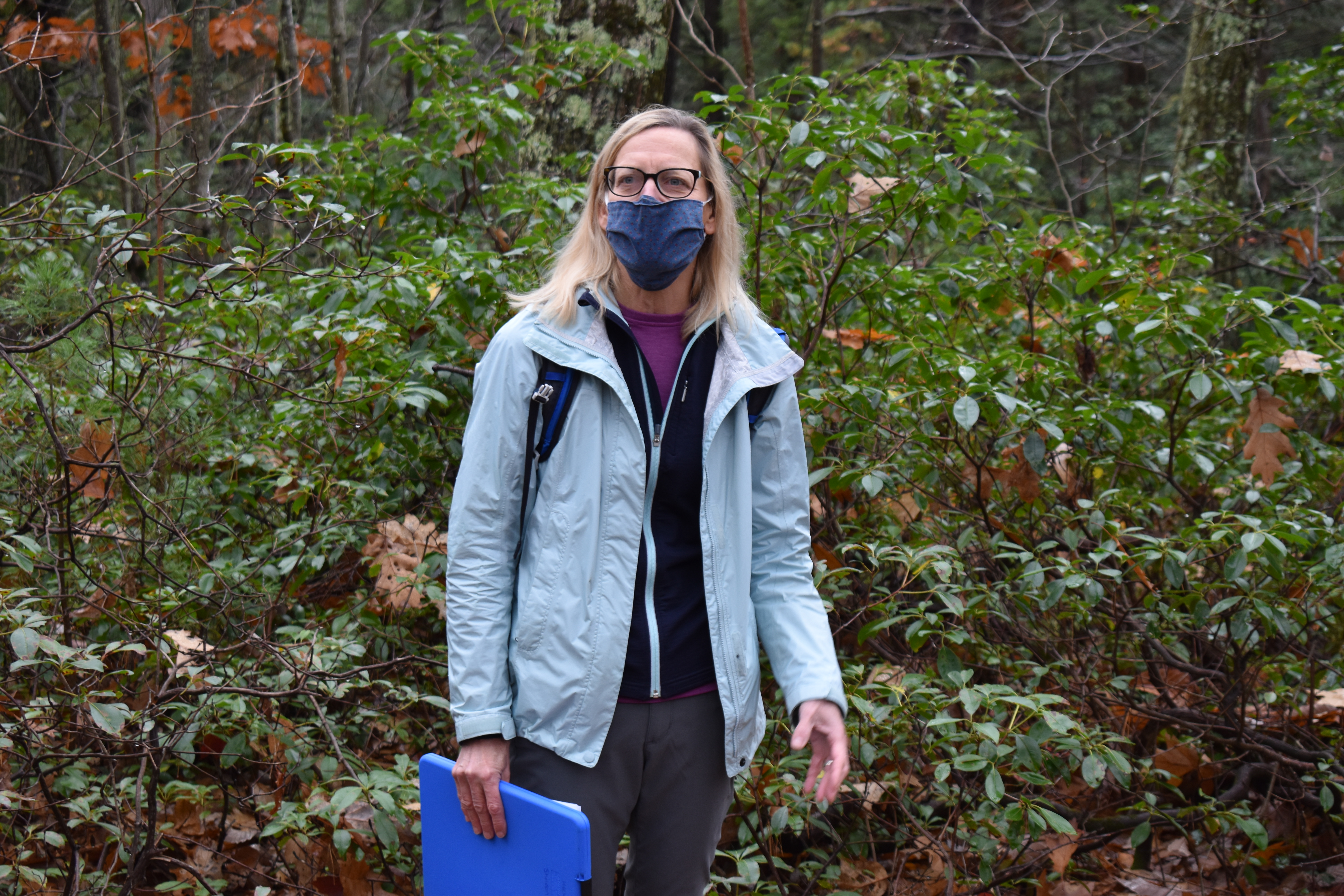
Forest Bathing guide Jane Dobson leads the recent group at Minnewaska State Park.

Japanese officials began exploring the concept in response to what government officials saw as rising levels of unhealthy stress among residents of an advanced industrialized nation that was undergoing rapid technological change.

The basic idea in Shinrin-yoku is to observe and experience natural surroundings with a slowed and deliberate focus, rather than treating a hike as a distance between two points to covered briskly in competition with whatever else pops into one’s head.

And while to some forest bathing may sound like a gauzy abstraction, there is a growing body of scientific evidence showing real and measurable physical and mental health benefits from spending time in nature.

For example, this 2010 study in the peer-reviewed journal Environmental Health and Preventative Medicine, based on field experiments with 280 people across 24 different forest and urban locations in Japan, found “forest environments promote lower concentrations of cortisol (the so-called “fight or flight” stress hormone), lower pulse rate, lower blood pressure, greater parasympathetic nerve activity, and lower sympathetic nerve activity than do city environments … The results of the field experiments also provide a platform for interested enterprises, universities, and local governments to promote the effective use of forest resources in stress management, health promotion, rehabilitation, and the prevention of disease.”

Since then, other studies have reconfirmed these results. Some of these studies can be found online at the International Society of Nature and Forest Medicine, which is linked at the bottom of this story.

That’s something to pay attention to when average Americans spend 93 percent of their time indoors or in automobiles, according to the Environmental Protection Agency (EPA). And it is especially important when many of us are stressed due to the COVID-19 pandemic, and have been turning to healthy and safe outdoor activities, like hiking and other activities in State Parks, where there are more than 300,000 acres of forest to “bathe” in throughout the year.

Visits to Parks during this season remained strong, with overall 2020 attendance through October down only 2 percent compared to 2019, even given the density reduction requirements, cancellation of the early camping season, and closure of indoor facilities during the pandemic.

At Minnewaska’s program on an introduction to the concept of forest bathing, Michael and Geralyn O’Reilly, of Troy, along with Abe, their Golden Retriever, went with the group along the park’s Mossy Glen Trail to a bridge over the Peterskill creek.

During the walk (where people used masks when not social distancing), participants were encouraged to move slowly, deliberately, while pausing to focus on breathing, putting thoughts of everyday issues out of their minds, and taking in the sights, sounds and smells of the woods filled with oak and laurel around them.

On starting a hike, participants first took time to quietly stretch and breathe, focusing on slow movement of various joints like the ankles, knees, shoulders and neck.
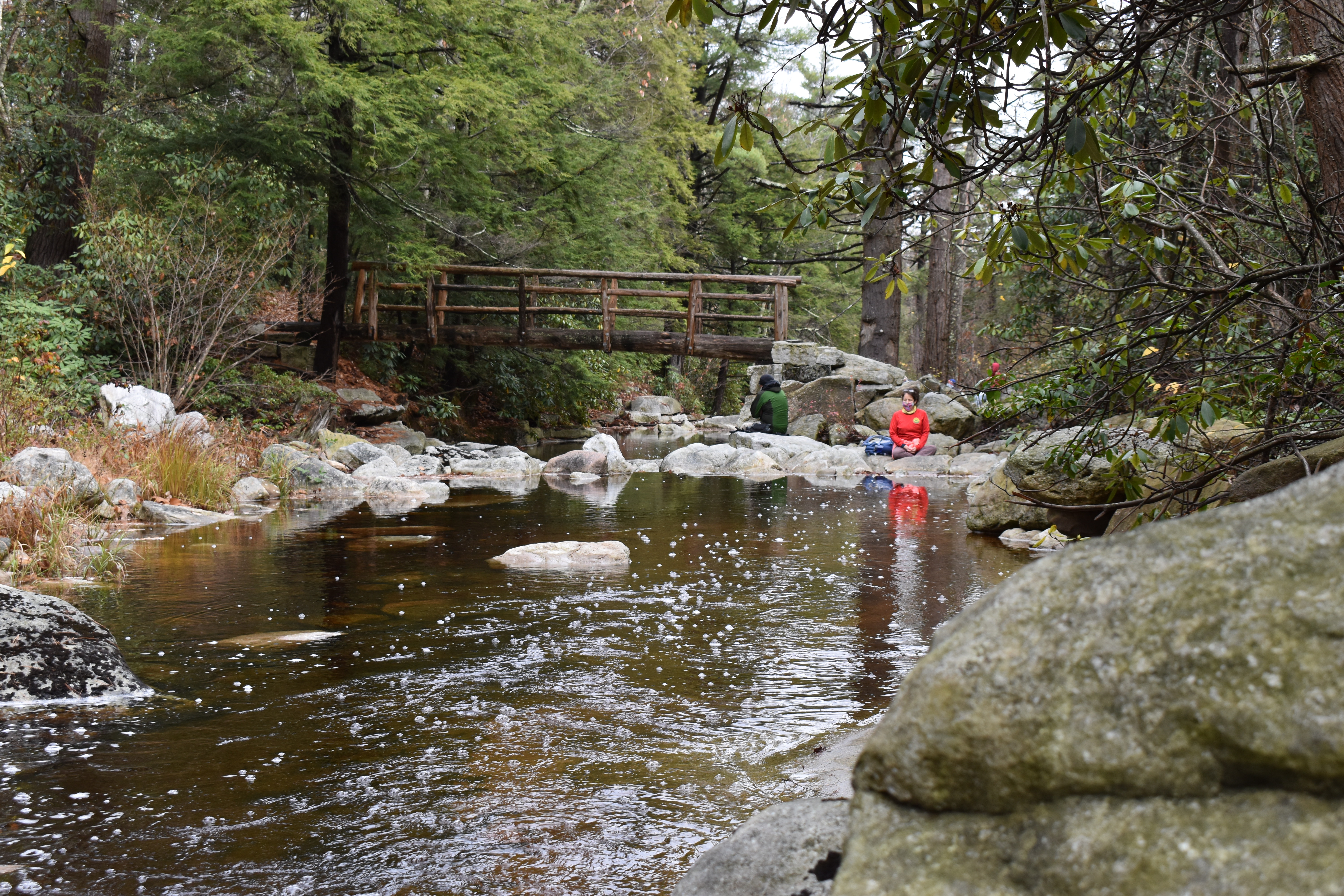
One of the “forest bathers” takes a few moments to sit quietly at the Peterskill to focus on their surroundings.

Key to that is the idea of “settling into” a present moment, rather than thinking about anything else that presents itself, which relates to the Buddhist concept of the “monkey mind,” referring to a parade of thoughts that are unsettled, restless and intrusive in the manner of a non-stop “to do” list.

“A program like this helps us to slow down and better experience this beautiful place,” said Geralyn O’Reilly. “And as someone who loves the outdoors, I enjoy being here with like-minded people.”

Growing up in the Bronx, Robert Dosch now lives in Orange County and visits Minnewaska often. Relaxing after the hike, he said, “I have always enjoyed being in the outdoors. A program like this gives you a new perspective … It helps to be reminded that there are times when you should put everything aside and just be where you are.”

Forest Bathing is a practice that reconnects us with nature and its healing properties.  This is not just about hiking, getting to a destination, or exercise.  This is downshifting and unplugging, which can be difficult when smart devices can bring distractions and demands for attention.  Urbanization and the saturation of technology in our lives has disconnected us from our direct sensory experience of sight, sound, smell, touch, taste.

Forest Bathing is the antidote this type of sensory anesthesia.  Like a bath, you are soaking; only you are soaking in all your senses.  A Forest Bathing walk offers different sensory invitations to allow you to connect more deeply with nature.  This connection allows nature to quiet our busy minds and reveal the beauty of the present moment. 

Although the term Forest Bathing is relatively new, by no means is this a new practice.  The healing properties of nature have been recognized throughout time by virtually all cultures.  The only change is that now we have scientific data to back up this intuitive knowledge.

Of course, it is important to remember that nature, including its health benefits, is not just a resource to be taken.  There is something more innate at play.  Forest Bathing helps reconnect humans with the outdoor world to which we are naturally adapted, where we have spent more than 99 percent of our time as a species.  The recent pandemic has made one thing clear as unprecedented numbers of people have flocked to parks and preserves across the United States – people need nature.  As we restore our relationship with the natural world, we are reminded of the vital reality that we, too, must take care of nature as it takes care of us. 

Post by Jane Dobson, Mindful Outdoor Nature Guide, MindtheForest LLC

Learn more about forest bathing from the International Society of Nature and Forest Medicine. The website includes links to reports on the concept from such outlets at the Wall Street Journal, the BBC, The Guardian and the China Times.

Try Forest Bathing Yourself

  1. Don’t worry about being in the forest if that is not possible. Any nearby park or natural open area will do, any time of the year.
  2. Before you begin your hike, do some basic stretches of your ankles, knees, neck, wrists and hips. This relates to a practice in yoga called “the eight churnings,” which will stimulate the fluid that lubricates joints.
  3. Allow yourself three full minutes before starting the hike to just breathe deliberately and relax. This quiets the mind and allows you to notice more.  It may be hard to sit still at first, but that will come easier with time.
  4. Once on the hike, move slowly and deliberately. Take time to pause from time to time to take in the surroundings. Pick a feature, like a tree, rock or portion of a stream, that appeals to you. Try to avoid letting your thoughts wander off from where you are and what you are experiencing.
  5. Take time to sit down. Experience quietness, which can allow you to notice small sounds and events that might otherwise have gone undetected. By just sitting, you will begin to connect more deeply with nature. 

Targeting a Watery Invader at Lake Taghkanic

Thanks to a “hands-on” kayak mission against invasive water chestnut this summer at Lake Taghkanic State Park, this popular lake ought to be clearer of these aquatic invaders for next paddling season.

And timing is critical in dealing with water chestnuts, floating plants which can rapidly spread to create dense patches that can clog a lake, damage the native ecosystem and make it hard for canoeists and kayakers to paddle.

Water chestnut (Trapa natans) is one of the several Aquatic Invasive Species (AIS) that are monitored in hopes of reducing abundances in state waterbodies. Widespread in the state, water chestnut is now found in 43 counties.

The aquatic invasive water chestnut can be found in 43 countries across the state. Counties shaded green are known to be infested. (Photo Credit – NYS Department of Environmental Conservation)

Invasive species, like water chestnuts, are organisms that are non-native to an area, typically causing harm to human health, the economy, and the environment. If left unchecked, AIS can spread quickly from one body of water to another, threatening biodiversity and potentially impeding recreational opportunities.

The key to battling the an infestation discovered this season at Lake Taghkanic in Columbia County was to remove hundreds of plants before going to seed. Water chestnuts are annuals, and thus must reseed themselves each year to propagate.

Anyone who has been out along a shoreline and came across a strong, spiny, star-shaped brown nut-like “fruit” or seed pods has found a water chestnut nut. Bearing four sharp spines or points, each nut contains a single seed that can produce 10 to 15 stems.

Anchored to the water bottom, the plants have submerged, feathery brownish leaves on stems that can grow up to 15 feet long. On the water’s surface, these stems come to an end with a floating rosette, or circular arrangement of leaves. The leaves are triangular shaped with toothed edges.

These clusters can float on the surface due to buoyancy bladders connected to the leaf stems, forming dense floating mats that can be nearly impenetrable. Each rosette produces about 20 of the hard nut-like fruits in the late summer and early fall which, after dropping from the plant to the water bottom, lay in sediment over the winter to sprout in the spring

You can imagine the concern when water chestnut showed up in Lake Taghkanic State Park, a park focused on boating, swimming, water sports and beach activities. Controlling water chestnut at the park was vital to support these recreational opportunities as well as the native fauna of the lake, including one rare species known there.

Due to the fast-growing nature of water chestnut, it is important to control newly introduced infestations as soon as possible, also known as “early detection, rapid response” (EDRR). If left unchecked, patches of water chestnuts can spread prolifically.

A map of Lake Taghkanic, showing the area of water chestnut infestation highlighted in green. (Photo Credit – NYS Parks)


Water chestnut is an invasive species of high concern for many waterbodies in New York State, having potential ecological, economic and health impacts. The plant can form dense mats on the water’s surface, greatly impacting the organisms below. These layered mats can block sun and oxygen from submerged plants, resulting in a die back of native species and fish populations. Recreation is also inhibited by dense patches of water chestnuts, making it difficult to swim, boat, kayak, or fish. The spiny nuts often drift to shore, creating an additional hazard for pets and people to step on.

Effective control of water chestnut depends largely on preventing seed formation. By manually removing the plants in mid-summer before mature seeds can drop, managers can halt such potential reproduction.

At Lake Taghkanic, staff from the Office of Parks, Recreation and Historical Preservation, state Department of Environmental Protection, and Capital Region Partnership for Regional Invasive Species Management (PRISM) worked to rapidly respond to the infestation. This team of ten individuals were well-versed in the control of invasive species, and several team members had prior experience manually removing water chestnut.

Held July 16, the pull was led by Matt Brincka (NYS Parks Invasive Biologist), with other participants including Falon Neske (NYS Parks), Lindsey DeLuna (NYS Parks), Lauren Gallagher (NYS Parks), Rebecca Ferry (NYS Parks), Kristopher Williams (Capital Region PRISM), Lauren Mercier (PRISM), Lauren Henderson (PRISM), Steven Pearson (DEC), and Catherine McGlynn (DEC).

The team navigated to the water chestnut infestation in kayaks, maintaining social distancing and wearing face coverings when necessary. When manually pulling water chestnut plants, it’s important to reach as far down the stem as possible to pull the root system from the bottom sediment.

At Lake Taghkanic, water chestnut was mixed in among lily pads, presenting a challenge to pulling by hand from kayaks. (Photo credit – NYS DEC)

Once pulled, the water chestnuts were collected in garbage bags, drained, and weighed. Within a day, more than 100 pounds, or from 300 to 400 plants were removed! The information was recorded for upload to iMapInvasives so that the infestation of water chestnuts can be tracked.

iMapInvasives and You Can Too!

You may have heard the name iMapInvasives before, but if you have not been exposed to this magnificent mapping tool, I recommend you check it out! iMapInvasives, New York State’s online invasive species database, could be compared to a modern-day hero. A robust and helpful resource- thanks to its devoted observers. Citizen Scientists, Educators, Students…

Afterward, the team also surveyed the 3.7 mile lakeshore to ensure there were no other visible water chestnuts. Parks staff developed a control plan that will include monitoring and hand-pulling at Lake Taghkanic annually in order to deplete the seed bank (seeds can remain viable for several years at the bottom) and keep the problem at bay.

Over the years, NY State Parks has organized and participated in several invasive species pulls, additionally having a seasonally staffed AIS Strike Team and Boat Steward program. Reader more about these programs in the posts below.

Selkirk Shores State Park has been one focus area for State Parks staff in efforts to control a water chestnut infestation. In 2015, about 240 bags of water chestnut were removed there, visibly reducing the biomass by 40 percent. During the 2016 season, another 12.5 tons were pulled out. This removal resulted in a decrease in abundance of water chestnut during from 2017 through this year, further maintaining the value of this State Park.

Prompt invasive species responses, such as water chestnut pulls, work towards ensuring recreational enjoyment and preserving natural ecosystems in our parks. Early detections of invasive species are often reported by patrons.

The next paddling season may be months away, but remember: If you believe you have found a new population of an invasive species at a State Park, tell a park staff member or reporting it in iMapInvasives will ensure that swift eradication action is taken.

Protecting Our Waterways

You may have seen them in a park near you, these super heroes and heroines in disguise. Since 2008, New York State Parks have deployed Invasive Species Strike Teams. These Strike Teams conduct invasive species surveys and manually remove non-native invasive plants in areas of significance. The goal is to protect native plant and animal…

Protect Our Waters: Don’t Pick Up Hitchhikers!

Now that summer is here, when you head to the boat launch for a day on the water, you will often run into a friendly face in a blue vest. These are Boat Stewards! Boat Stewards are educators who share their knowledge of invasive species and how to prevent boats from spreading such species into…

Cover shot: Members of the removal team spread out in kayaks on Lake Taghkanic.

Post by Lauren Gallagher, State Parks Water Quality Unit

Nature Education At Letchworth During COVID

On the second weekend in March with spring in the air at Letchworth State Park, maple sap was being boiled down into tasty syrup in the newly built sugar shack at the park’s Humphrey Nature Center. Maple weekends were coming soon, and many gallons of syrup were needed to treat hundreds of visitors expected for outdoor education programs in one of western New York’s most popular State Parks.

But the next day, the sugar shack at Letchworth went cold. Because of emerging COVID-19 pandemic, Parks workers were told to immediately start working remotely from home. So public events at State Parks like Maple Weekends were cancelled. And a completely booked public field trip season at Letchworth for May and June disappeared as well.

If people could no longer brought to nature by park naturalists, perhaps those naturalists could bring nature to people remotely?

Immediately, newly hired NYS Parks Corps member Conrad Baker tapped prior video production experience to make a weekly video series called ‘Nature Detectives,’ for Letchworth State Park’s Facebook page. The approximately five-minute videos invited viewers, especially kids, to use their senses, or ‘nature tools,’ to make observations, or ‘notice nature clues’ about a mysterious plant, animal, or fungus found outdoors. Then, the video solved the mystery and encouraged viewers to find the same species in their own neighborhoods.

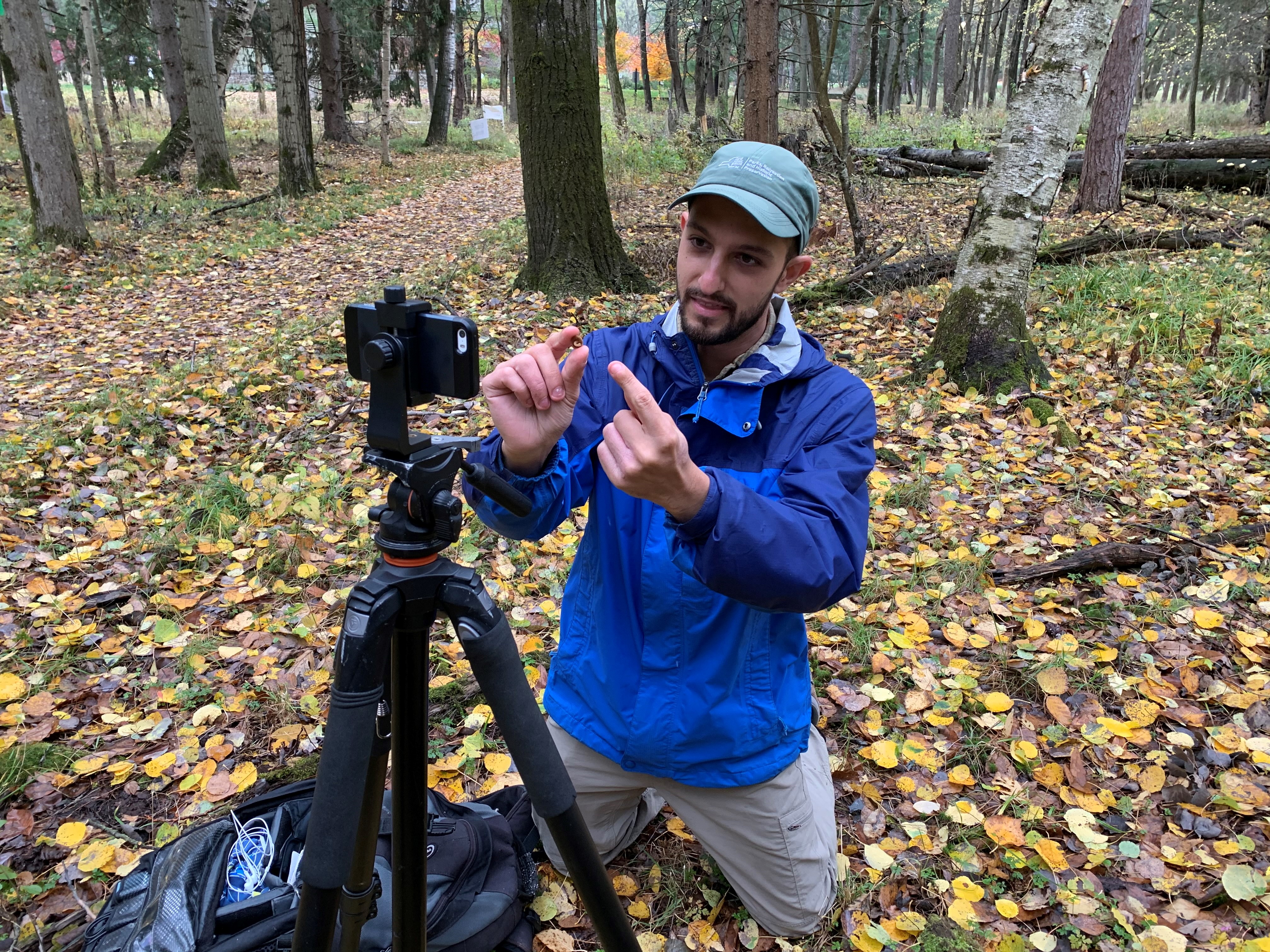
Conrad Baker tees up a video for the Nature Detective series on the NYS Parks Facebook page. (Photo credit – NYS Parks)


While using these  videos satisfied the Park’s short-term goal of providing some safe, educational public programs,  none of the Nature Center’s field trips were happening for the foreseeable future. But within this challenge lay an unexpected opportunity. Now unable to deliver in-person programs as usual, Environmental Educator Elijah Kruger could use the sudden schedule vacancies to adapt existing field trip lesson plans into safe, immersive, virtual programming. With   Baker at the camera, Kruger took to the field.

Letchworth State Park educators and interpretive staff Mike Landowski, Steph Spittal, Karen Russell, Sandy Wallace, Doug Bassett, and Brian Scriven reviewed draft videos and gave crucial program design advice.

There are currently five virtual field trip videos on the NYS Parks YouTube channel. The playlist is accessible here.

Since previous records showed that the topics of Geology, Mammals, and Invasive Species were the most in-demand field trips, those videos were made throughout April and May, and released June 1. Next came more scientifically complex field trips about the natural world and the human relationship with it. A field trip on Forest Ecology was released Sept. 18. Life of the Monarch butterfly is the most recent to go up.

Normally, an in-person Geology field trip group would hike about three quarters of a mile between several gorge overlooks, with the trip taking about 90 minutes.  But using video, viewers can move instantly between overlooks and cover the entire field trip in detail in 20 minutes. This work pushed the limits of cell phones, birding cameras, free editing software, and existing office supplies that had to take the place of top-end video gear.

A Mammalogy field trip group is often stationary, sometimes even inside the Nature Center. An educator invites the field trip group to see and feel up-close details of mammal furs and skulls to learn more about their adaptations and roles in the ecosystem. On video, such furs and skulls are presented next to real-world outdoor signs left by these animals. Close-up cutaway shots were key to highlight the animals’ homes, scat, and habitats. Deep detail in teeth, bones, and furs were only visible by building on the right cutaways.

Previously, in-person Invasive Species field trip groups never hiked through the territory now covered by the Invasive Species virtual field trip. This third field trip video was an opportunity to use cutaways and editing to visually capture complex, multi-stage forest succession changes, like deer overbrowsing, in which deer damage the ecosystem by eating away at all the young trees and shrubs.

And some improvisation was needed to get the right shots. By using rubber bands to attach lenses to cell phone cameras, close-ups showed fine details in macro shots, like crawling ticks and the hemlock wooly adelgid, a tiny insect that threatens the health of helmlock trees.

Previously, a Forest Ecology field trip group would walk about a half-mile of forest trail around the Nature Center, noticing content-relevant animals, plants, fungi, and environments along the way. Field trip video now assembles a kind of “best of” experience, with exceptional examples of lichens, woodpecker holes, short-lived fungi and quick glimpses of animals from miles apart and over several weeks into one cohesive experience.

The Life of the Monarch video is the culmination of skills and tools picked up from the four previous videos. The segments are carefully assembled from footage that was shot miles and weeks apart. Close-up cutaways show monarch butterfly handling and tagging. Footage of feeding caterpillars, time lapses of metamorphosis, and slow-motion videos of butterfly releases tie together the story of these creatures’ lives and how they benefit us in unseen ways.

The pandemic encouraged our environmental education staff to do what they do best – adapt and use the tools at their disposal to serve park visitors with safe, enjoyable, educational programs. In-person programming is now resuming with safety precautions. Still, teachers are already starting to request virtual guided field trips, where park educators join classes via video chat to answer questions and match virtual field trip video content to their class lessons.

So, what was born out of necessity and imagination has now become a regular part of Letchworth State Park’s mission to bring education nature programming to anyone, no matter where they might live.


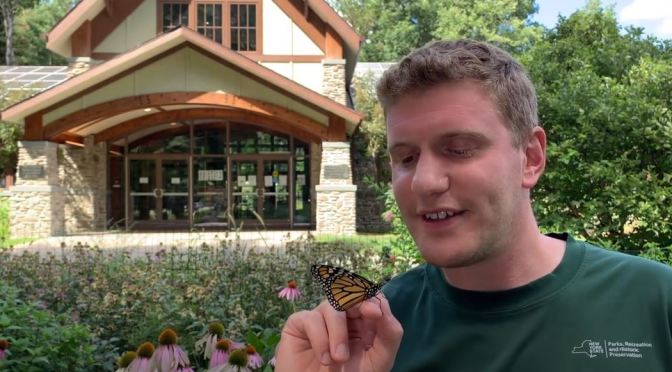
Cover shot – Letchworth State Park Environmental Educator Elijah Kruger with a Monarch butterfly. (Photo credit – NYS Parks)


Post by NYS Parks Corps member Conrad Baker