Throughout the fall season, you’ve maybe found yourself outside at some point — around a cozy campfire or on a trail enjoying the beautiful autumn foliage — and heard a sound you didn’t quite recognize. Perhaps the sun was down, and you were startled?
If you’re thinking back on your fall adventures and this feels a little familiar, you wouldn’t be alone. There are so many different noises when you’re out in nature, and sometimes it’s hard to keep track of them all. With this article, we hope to demystify some of these sounds and show you they’re more interesting than unnerving!
Slowly scroll below to discover the thrilling world of five New York native animals that are often associated with autumn. Can you guess who each sound belongs to?
Art and artifact conservators are the guardians of our cultural heritage. Their fascinating work blends art and science to protect the treasures of the past for future generations. But that work is often invisible to the public.
The American Institute for Conservation showcases this field through the annual Ask A Conservator Day. This year, NY State Parks and Historic Sites’ Department of Historic Preservation conservators Elizabeth Robson (Paintings) and Paige Schmidt (Wooden Objects) took a break from their labs to answer questions about their work.
What do conservators do? What is outside the scope of their field?
Conservators are highly skilled, highly trained professionals who care for art and artifacts. They assess the condition of a particular object and carry out a course of treatment for it. They also provide guidance on how to store and exhibit an object or work of art.
Conservators also specialize in one area of expertise, such as paintings, paper, objects, textiles, or architecture. There are further specialties within these categories, like murals, books, photographs, frames, wooden objects, archaeological objects, metals, and more. While a conservator’s treatment may improve the aesthetics of an object (e.g. replacing missing paint), they never do so at the expense of any original material. Nor do they give appraisals of artworks or artifacts.
This Veterans Day, New York’s Office of State Parks and Historic Sites honors and recognizes our military veterans around the country. We are fortunate to have a number of veterans as members of our Parks family, and we thank them, not only for their service, but for sharing how their military experience informs their civilian roles within our agency.
Andrew Bresset, Neil Briggs, and Francis Cleveland.
Andrew Bresett is an Army veteran and a maintenance worker at Lakeside State Park in Waterport. He says his service taught him perseverance. “No matter the situation, we can always get through it,” he said. “I can get through any challenge that’s thrown my way.”
Neil Briggs is an Army veteran and a seasonal maintenance worker at Selkirk Shores State Park in Pulaski. As an equipment operator in the Army, he brings a wealth of experience to his position. He says that a highlight of his service was loading a multi-million-dollar computer onto a C145 airplane guided by a ‘Full-Bird’ Colonel.
Francis Cleveland works at Robert Treman, Buttermilk Falls and Allan Treman State Parks in the Finger Lakes. Before that, he served in the Marines. “I was a ‘jar head’ for six years,” he said. “I appreciated the comradery we all had. Gung Ho!” He credits his service with his strong work ethic and attention to detail. “I take my work seriously. Things need to be done right.”
Hispanic Heritage Month, spanning mid-September to mid-October, is a time for Latinx people in the U.S. to celebrate their roots. Through the vantage of Hispanic / Latinx staff, we reflect on the namesake for Roberto Clemente State Park — the sole park in our system named in honor of a Hispanic icon.
Roberto Clemente State Park first opened in 1973 as the Harlem River Bronx State Park. In that same year, the New York State Commission met to rename the park after the famous Puerto Rican Hall of Fame Baseball player, Roberto Clemente, who tragically died in a plane crash off the coast of Puerto Rico taking aid to Nicaragua.
The decision to rename the park after Clemente was not because he was a famous baseball player, but because he believed in helping people and doing good. He was truly a humanitarian. “Anytime you have an opportunity to make a difference in this world and you don’t, then you are wasting your time on Earth,” he once said.
I am joyful to be a Latina “Boricua” and oversee the first State Park built in New York City, and especially proud that it holds the name of Roberto Clemente. When I was a young child, I remember my mother speaking about how, although we came from a town next to his, our cousins lived in the town Roberto Clemente came from. I often remember him and think of my baseball card collection.
With the chill in the air and pumpkins popping up everywhere, many folks are making plans for Halloween. Signs are out inviting ghosts and goblins, large and small, to join historic cemetery tours that highlight the resting places of the victims of murder and mayhem as well as the rich and famous, some even by candlelight. If you’re thinking of adding a cemetery visit to your agenda, these tours offer safe ways to weave through complicated landscapes and monuments for the dead. For many reasons, however, the last ten years have also seen a marked increase of people visiting historic cemeteries around Halloween on their own.
In the 19th and early 20th centuries, cemeteries in or near urban spaces were used as places to picnic and relax before public parks were readily available. These days, Halloween, which is fast approaching the social status of a major holiday, has increased people’s interest in them. Not just for visiting family or friends buried there, but also as locations for weddings and other celebrations. Mortuary art has evolved over the years, and the artistry of historic gravestones and mausoleums can often rival what is seen on public and private building, allowing people to get up close in a way they cannot in many locations.
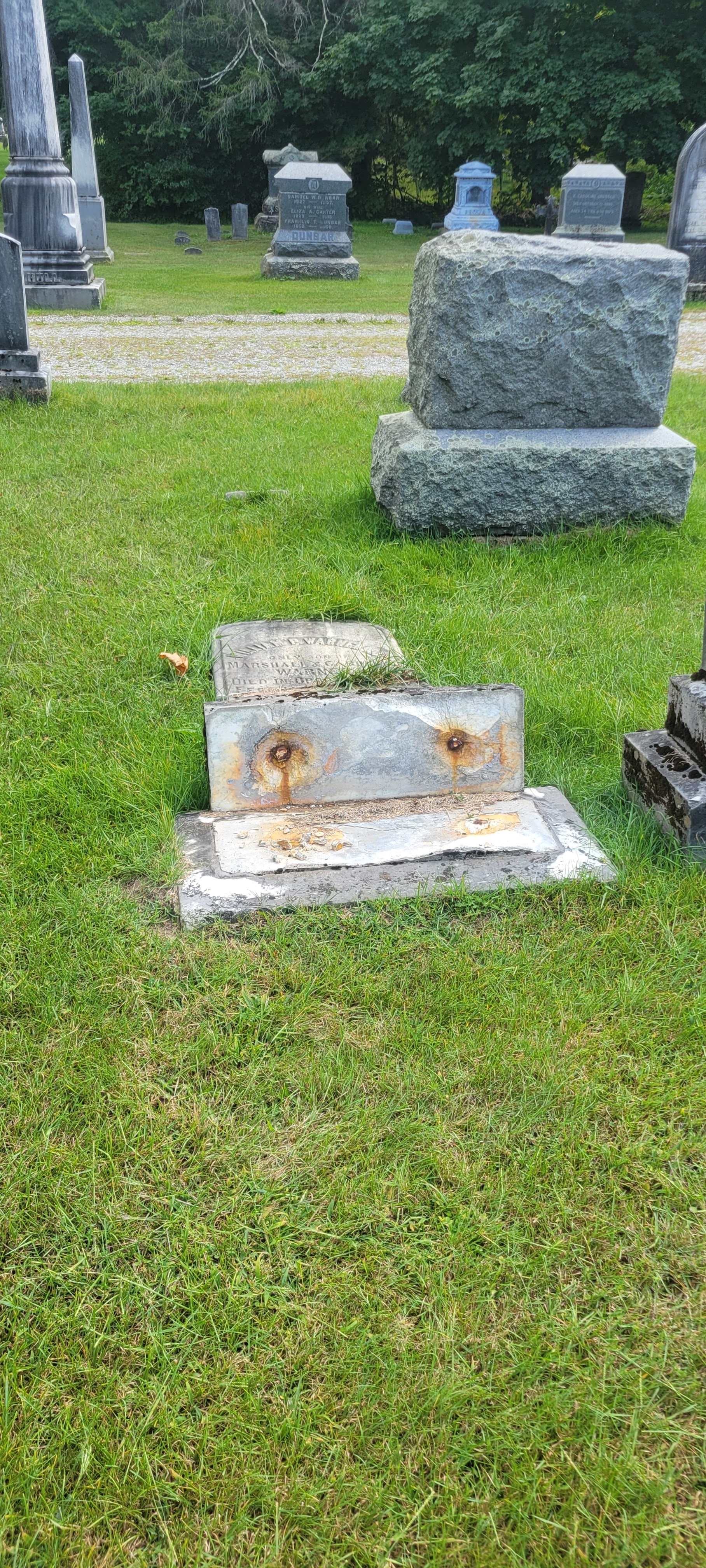
New York’s historic cemeteries range from the 17th through the early 20th century and cover every culture. Many offer visitors a rare opportunity to travel the state’s historic timeline for hundreds of years within their acreage. The variety of headstones is amazing to behold. This higher number of visitors is, unfortunately, often causing unrepairable damage to grave markers or headstones. Fragile historic artifacts that often appear more solid than they may be.
A toppled headstone. Photo credit: Ian Stewart, Preservation Inc.
Within these sacred spaces the sizes and types of stones or cement work used to mark graves can range from folk art to opulent cement work and newly created stones with laser cut designs. To preserve these artistic and historically significant pieces it is important that a few etiquette rules be observed. By doing so, we can ensure the history they represent remains for years to come.


 New York State Parks and Historic Sites Blog