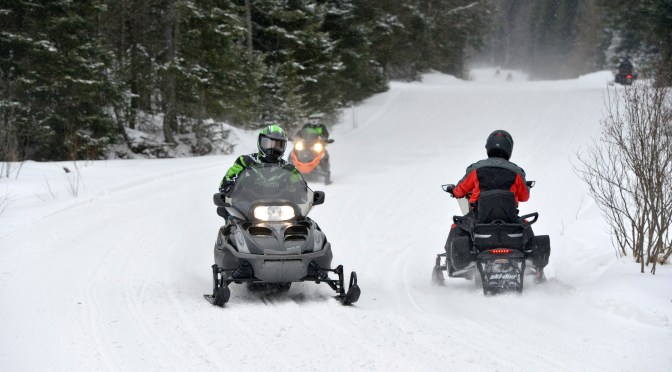
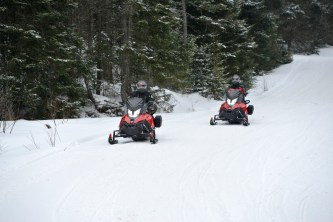
Snowmobilers enjoying some of New York’s 100,000 miles of snowmobile trails. Photo by OPRHP
You may not see any snow when you look out the window right now, but winter is here and now is the time to think about all of the outdoor activities it brings. One of the best ways to experience the natural beauty of New York in the winter is on a snowmobile, exploring The New York State snowmobile trail system which crisscrosses 45 counties through woods, fields, towns and our State Parks. Snowmobiling is a fun, family-friendly way to enjoy winter scenery and wildlife, especially for those people with disabilities who are unable to do strenuous activities like cross-country skiing and snowshoeing.
With over 10,000 miles of public trails, there’s something for everyone to enjoy from local loops to weekend getaways. A Google Earth map of the trail system is available on the snowmobile page of the State Parks website. Many of our parks have trails connecting to the statewide trail system. And some parks, like Allegany State Park, not only have over 60 miles of groomed trails, they also have winterized cabins which are open year-round for a warm winter weekend retreat.
If you’re new to the sport, or have never been on a snowmobile before, the New York State Snowmobile Association is teaming up with State Parks to offer Take a Friend Snowmobiling events where you can learn more and take a free snowmobile ride, conditions permitting. An event is scheduled at Selkirk Shores State Park on January 31, 2015. Necessary equipment will be provided; participants are urged to dress appropriately for outdoor weather conditions.
State Parks recommends all snowmobilers attend a certified New York State snowmobiling safety course, and never drink & ride!
“Ever since I was young, the story about bears was always the same. Bears hibernated all winter long, usually in a cave and would emerge in the spring. I have since learned a bit more about the environment and ecology and have found that there is much more to the story,” said State Parks staff member Patty Wakefield-Brown.
Hibernation occurs when an animal’s body temperature drops and its breathing and heart rate slows, thus lowering the metabolism of the animal, and conserving the animal’s energy. Bears are not “true” hibernators. They sleep for long periods of time but are easily awakened and, if the winter is mild, bears may wake to eat. This behavior is termed torpor, a state or inactivity achieved primarily by a greatly lowered (reduced) body temperature for hours, days or months. Only woodchucks, jumping mice, and cave bats are the “true” mammal hibernators in New York State.
Taking a long winter nap when food is scarce and weather is bad is a great adaptation for bears. While in a state of torpor, a bear will not urinate or defecate in the den. Their bodies absorb the urea and turn it into protein, which is needed during the long winter months.
During hibernation, female bears (sows) give birth and nurse their cubs. Females have delayed implantation, meaning that the egg is not implanted in the uterus unless the female bear has the energy, weight, or does not have the physical requirements to provide for the cubs during pregnancy and just after birth, the egg is released and there is no pregnancy. That is amazing. While in the den, sows wake up in January or February to give birth, generally 2-3 cubs. Black bear cubs are born altricial, which means helpless, hairless, and blind. Cubs remain with the mother for a year and a half or more before they disperse or she forces them out.
Bears generally emerge from their dens in late March and early April and are primarily interested in two things; eating and reproducing. Mating occurs in May or June. Males and females are sexually mature at around four years of age.
With the human population increasing and more and more land being transformed to accommodate this increase, the natural habitat of the American Black Bear is being minimized. Because of this, there is a greater likelihood that a person will have an encounter with a black bear. Wildlife biologists collar and collect data from bears to learn about their populations, home range, health and preferences for den sites. Like all wildlife that we share our environments with, keeping track of this data helps to create local and regional management plans.
Collecting Data on Sows and Cubs
“While a college student, I took a two- semester black bear management class. We worked with the New York State Department of Environmental Conservation (DEC) to assist in the creation of a database regarding den site criteria. We were able to accompany DEC staff on bear den visits in mid-March and collect data about the bears. The bears were outfitted with telemetry collars which enabled them to be found when they were in their dens during the winter months,” noted Patty Wakefield-Brown.
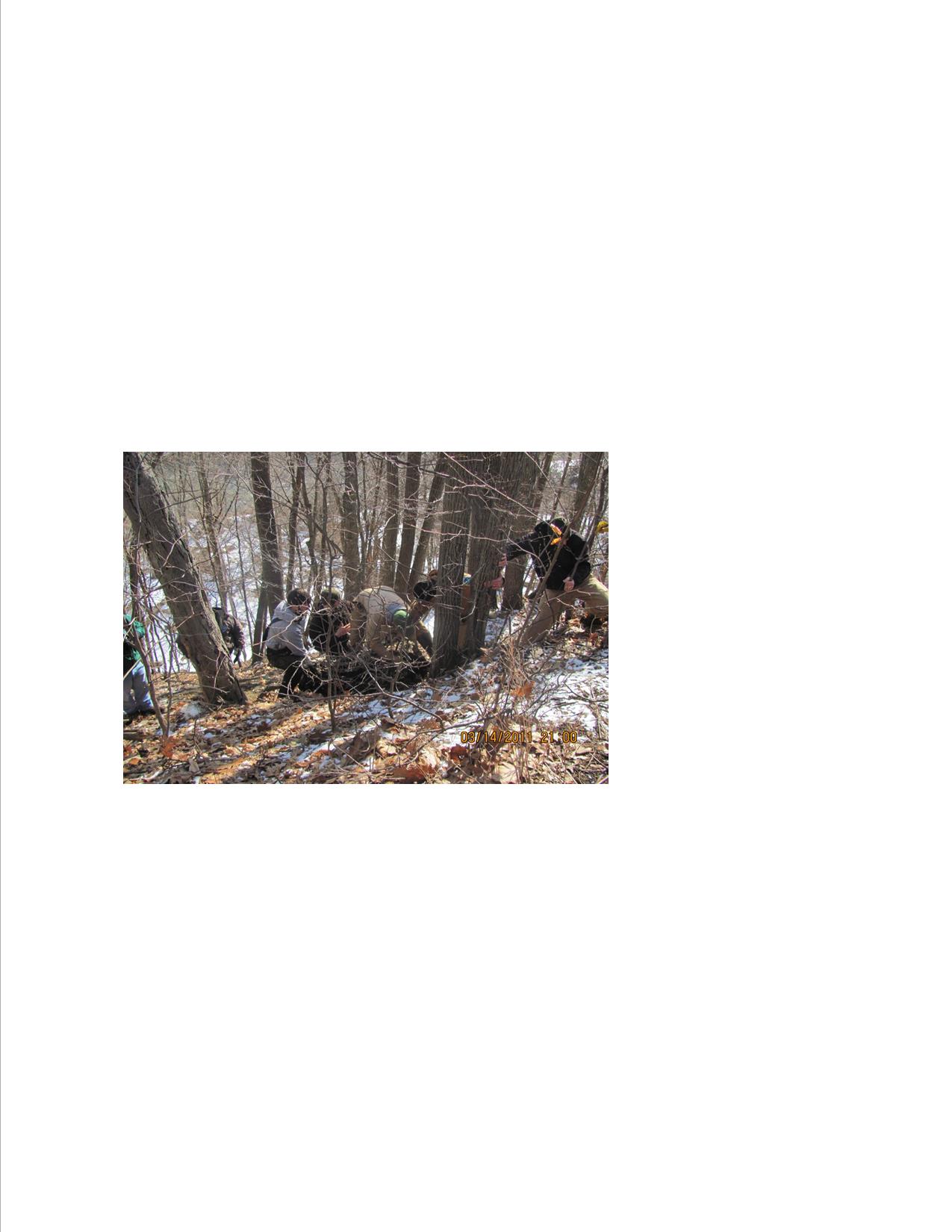
‘Photo 1’ below shows the DEC staff gently removing the tranquilized bear from the den; the entrance was on quite a steep slope.
Photo 1, by Patty Wakefield-Brown.
The bear was a female that had been previously collared. The purpose of the den visit was to change collars and to collect data including weight, visual appearance, take blood samples and note whether any cubs are present. DEC staff also inspected the den, described its location, (i.e. old log, brush/thicket, hillside, under porch, etc.), took measurements of the den’s interior, what materials den was comprised of, and the amount of cover, and noted the den’s proximity to humans, houses, and roads.
“On this day there were three cubs in the den with the sow. As the mom was being ‘processed’ we got to hold the cubs to determine their age. The way to age young cubs was to measure the hair on the tops of their heads (between their ears) or inside their ears, from the tragus to the tip of the ear (Photo 2) (Bridges et al. 2002). When all the data was collected, the mom was placed back into the den comfortably with her cubs (Photo 3)” recalled Patty Wakefield-Brown.
Photo 2, by Patty Wakefield-Brown.
Photo 3, by Patty Wakefield-Brown.
When bears disperse, they sometimes wander into populated areas creating human-bear conflicts. That was the case in October 2010, when a young male bear wander onto the Rochester Institute for Technology campus in Henrietta. The DEC natural resource managers ‘captured’ the bear and took him to a facility to collect data on him before he was relocated (Photo 4). The bear management class was invited to observe the event. After the bear was tranquilized, a patch was put over the bear’s eyes, so that they don’t dry out (the bears don’t blink when anesthetized). Blood samples were taken, ears were are tagged and a tooth was taken to age the bear, also the inside of the lip was ‘tattooed’ with a number and a radio collar was placed on the bear (Photo 5).The process was done very methodically and quickly. The bear was then released into the Hi-Tor Wilderness Area.
Photo 4, by Patty Wakefield-Brown.
Photo 5, by Patty Wakefield-Brown.
Winter slumbering bears are an essential part of the the ecosystems found in New York State parks. They are part of the splendor of the natural world that mesmerizes us and holds us captive in its magic. If you are lucky, you might get a chance to capture some of that magic if you see a bear in a New York State Park next summer.
Post and photos by Patty Wakefield-Brown, OPRHP.
Reference:
Bridges, A.S., Olfenbuttel, C Vaughan, M.R. (2002). A Mixed Regression Model to Estimate Neonatal Black Bear Cub Age . Wildlife Society Bulletin, Vol. 30, No. 4.
Civilian Conservation Corps By Unknown or not provided (U.S. National Archives and Records Administration) [Public domain], via Wikimedia Commons.
What started in 1931 as a simple idea to put unemployed New Yorkers to work on state-funded public works projects through the New York Temporary Emergency Relief Administration grew to become the largest peace time utilization of people and equipment in US history – the Civilian Conservation Corps, the CCC. Many New York State Parks including Thacher State Park, Fahnestock State Park, Lake Taghkanic State Park, Selkirk Shores State Park, Thacher State Park, Green Lakes State Park, Letchworth State Park, Hamlin Beach State Park, Chenango Valley State Park, Franklin D. Roosevelt State Park and more benefited from the work that was performed by over 200,000 CCC members from 1933-1942. During these nine years, 61 camps of 200 CCC members built roads, trails, cabins, and stonewalls, planted trees, worked on early invasive species detection and removal and more. The Allegany and lower Hudson Valley regions were considered the highest environmental priority and had CCC camps each year, while other encampments would last a season or two, moving on to another location when the job was done.
This slideshow requires JavaScript.
About 40 different CCC camps were spread across the state each year. The typical CCC member was between 18-25 years old, “unemployed, unmarried, healthy, not in school, from a needy family, and capable of doing work” (Thompson). Most CCC members were white males; however New York also had CCC camps for Native Americans, African Americans, WWI veterans (separate camps for white and African American veterans), and separate camps for women (known as She-She-She Camps).
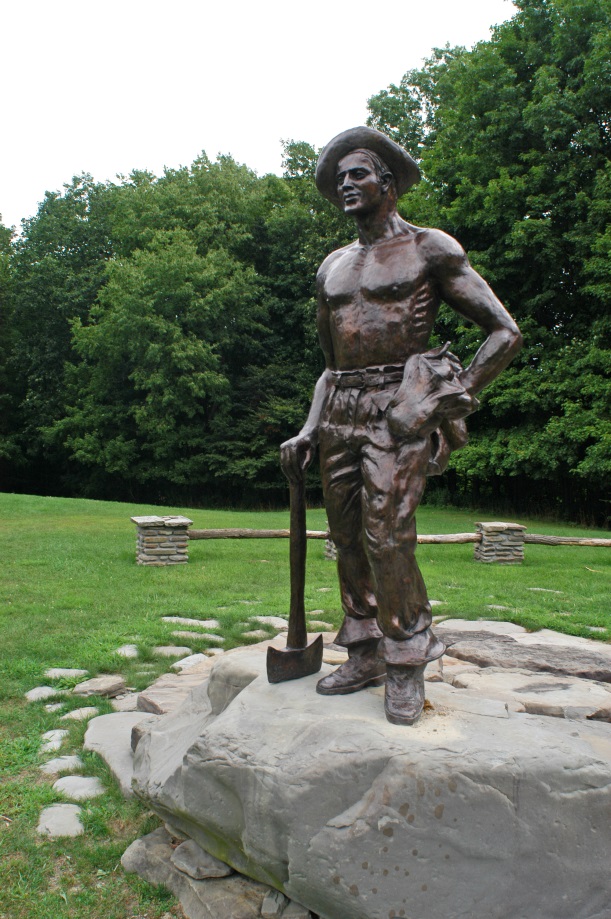
State Parks honors the memory of the CCC members with a CCC Statue at Letchworth State Park.
CCC Statue at Letchworth State Park. Photo by OPRHP.
This January, New York State is reviving the Temporary Emergency Relief Administration conservation corps with the inaugural New York State Excelsior Conservation Corps (ECC) and a 10-month residential program modeled after the CCC. The program is open toNew York State students and residents aged 18-25, with an emphasis on veterans and expanding diversity. The 50 ECC members will be based at SUNY Morrisville where they will receive eight weeks of specialized trainings and certifications lead by the Student Conservation Association – Hudson Valley Corps . Then, starting in March and running through early November, ECC members will work in State Parks, Department of Environmental Conservation and other state agency lands on projects across the state focused on:
Open Space Management, maintaining and improving hundreds of miles on New York’s hiking trails
Recreation and Access Mapping, monitoring and mapping over 10,000 acres of public land for safe recreational use
Natural Resource Stewardship, invasive species removal and protection of native species and ecosystems
Environmental Education and Outreach, educating New Yorkers on conservation and stewardship of public lands
Infrastructure and Sustainability, helping to cut New York’s energy consumption and energy costs through the construction of renewable energy projects.
During the 10-months, ECC members will get a chance to work on their education plans and develop career skills. At the end of their service they will be given a Segal AmeriCorps Education Award.
Building on their hands-on experiences and training, ECC members will be poised to become New York’s next generation of conservation leaders. Learn more about the ECC in future blogs.
Post by Susan Carver, OPRHP. Slideshow photos courtesy of OPRHP.
Thompson, Craig; 75 Years Later: The Legacy of the Civilian Conservation Corp; Conservationist, New York State Department of 85 Environmental Conservation, February 2008; http://www.dec.ny.gov/pubs/42768.html.
The dog days of summer are a very distant memory, but many intrepid New Yorkers thrive in winter and are eager for falling temperatures and continued snowfalls. To these hardy adventurers, a few extra layers of gear combined with the snowy terrain offer a winter wonderland of nature, fitness and fun.
In fact, a few of New York’s State Parks remain open and offer accommodations this time of year. From cold-weather sports to the quiet beauty of snow-covered landscapes… snowshoe treks to winter carnivals, skating rinks to seal walks, New York State Parks are popular destinations for winter recreation and the perfect remedy for cabin fever.
Allegany State Park is not only the largest state park in New York at 65,000 acres, but this flagship property offers four seasons of adventure and is considered to be a premier winter-time destination for cold-weather fun in the northeast. Allegany features 18 trails with 80 miles of hiking and snowshoeing, more than 25 miles of cross-country skiing and 90 miles of groomed snowmobile trails. While the mercury may be dropping, the park heats up as families and outdoor enthusiasts enjoy winter activities and snow-based recreation in this vast wilderness setting. Convenient and affordable winter lodging options at the park include year-round cabins and cottages available for rent.
Snowmobilers leaving Group Camp 5 at Allegany State Park. Photo by OPRHP.
With winterized cabins and the incredibly scenic Genesee Valley gorge as a backdrop, Letchworth State Park is another ideal destination for winter sports. Winter activities include snow tubing, cross-country skiing, and snowmobiling. Families can also rent the Maplewood Lodge, located in the middle of the park near the entrance to the Highbanks Camping Area. A popular choice for snowmobilers, it connects to the New York State snowmobile trail system. The three-bedroom lodge sleeps up to eight people and consists of a furnished kitchen, living room with cozy fireplace, dining room and a full size bath and powder room.
Cross-country skiing is a popular activity in many State Parks over the winter months. Photo by OPRHP.
Wellesley Island State Park along the St. Lawrence Seaway in the Thousand Islands is another prime location with winterized accommodations to host weekend getaways or an impromptu overnight when available. The park’s Minna Anthony Common Nature Center is open year-round and includes nine miles of hiking trails, and five miles of cross country ski and snow shoe trails. During the winter months visitors can warm up by the fireplace and meet other explorers. The trails have a diversity of habitat including field, forest, wetlands and views of the St. Lawrence River.
In Cooperstown, Glimmerglass State Park offers a variety of child-friendly activities such as tubing, ice skating and winter trail sports. Reserve one of the cottages that sleep eight at nearby Betty and Wilbur Davis State Park and bring the whole family to enjoy a day of snowmobiling too.
For patrons enjoying New York’s state parks year-round, there is no ‘off-season” and every reason to get outside and embrace all types of cold- weather recreation among the wintry landscapes.
Post by Wendy Gibson and MaryAnn Corbisiero, OPRHP.
Get outside to a State Park this New Year’s Day! New York State Office of Parks, Recreation and Historic Preservation (State Parks) is putting RECREATION at the top of this year’s New Year’s resolution list with First Day Hikes. Now in its 5th year, First Day Hikes are a great way to help you get your New Year’s resolutions started on the right foot.
On January 1st State Parks is hosting 41 First Day Hikes in parks and historic sites across the state from eastern Long Island and Staten Island, to the Hudson River, Lake Champlain, Lake Erie, and much more. Hikes range from accessible, level walks; a leisurely stroll across the world’s longest elevated pedestrian bridge, explorations of historic landscapes or quiet forest; dog-friendly rambles, mountain hikes, family-orientated activities and more. If there is snow, bring your skis or some parks have snowshoes you can borrow.
During your hike you’ll be able to meet new people, see new places, spend time with family and friends, get a bit of exercise, and enjoy time outdoors. Could there be a better way to spend the first day of 2016?
Remember to dress in warm layers, wear appropriate footwear, and bring water and a snack for your group. Most hikes range from one to three miles in length.
Remember your camera and please share your photos on State Parks’s Facebook Page!
Click here for a complete listing of “First Day Hike” events and registration guidelines.





![CCC By Unknown or not provided (U.S. National Archives and Records Administration) [Public domain], via Wikimedia Commons](https://nystateparks.blog/wp-content/uploads/2016/01/ccc-by-unknown-or-not-provided-u-s-national-archives-and-records-administration-public-domain-via-wikimedia-commons.jpg)


 New York State Parks and Historic Sites Blog