Tag Archives: Hudson River

From glass eels to silver eels and everything in between The life stages of the American Eel

Imagine yourself hiking next to a babbling creek.  You come to a small waterfall surrounded by rocks.  The rocks glisten from the spray of the falls.  You walk closer and see dozens of small snake like creatures slithering over the wet rocks.  You watch them move from the top of the rock pile to the bottom.  Then they slide back into the creek.

You saw the American eel utilizing one of its unique adaptations.  Their bodies are coated in a mucus layer, providing protection and a way to absorb oxygen through their skin.  This mucus, in combination with their muscular bodies, allows them to move out of water and across land to avoid barriers.  This, and other adaptations, makes the American eel able to live in more diverse habitats compared to most other fish species.

American eels are fish, despite their snake like appearance, and the only species of eel that live in North America.  They are catadromous, migrating from the saltwater of the Sargasso Sea to the freshwater of streams and lakes.  The Sargasso Sea spans a part of the Atlantic Ocean between Bermuda and Puerto Rico.  Once they reach maturity, they journey back there to spawn.

The vastness of the Sargasso Sea makes it tough for researchers to locate and observe eels spawning in the wild.  At this point, observations of spawning eels remain to be made, although one silver eel was tracked to the Sargasso Sea. Researchers believe the eels die right after spawning.  Some mystery surrounds the final life stages of the American eel.

What happens as they grow?

Let us review the known information about the life stages of the eel.  The eel’s life begins in the Sargasso Sea.  First, they resemble a willow leaf.   These small, oblong, transparent fish, called leptocephali, lack the snake like form of adult eels.  They are about one inch long and rely on the ocean currents to bring them to the east coast.  This journey takes about one year.
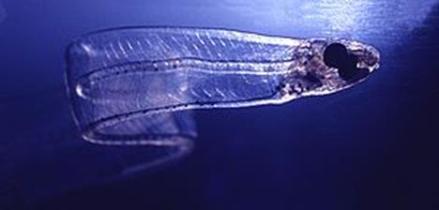
Lept
The beginning life stage of the American Eel is called a leptocephalus and these leptocephali use the current to travel to the East Coast. Kils at the English language Wikipedia [GFDL (http://www.gnu.org/copyleft/fdl.html) or CC-BY-SA-3.0 (http://creativecommons.org/licenses/by-sa/3.0/)%5D, via Wikimedia Commons
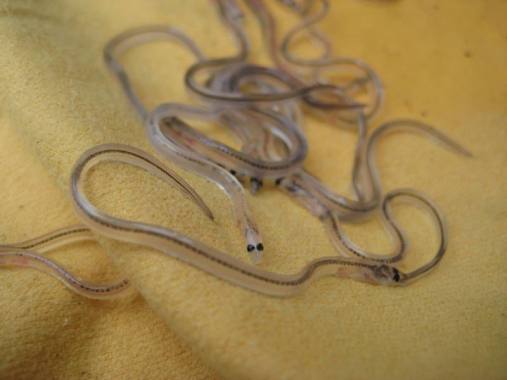
Now they resemble vermicelli or rice noodles.  At two inches long and still transparent, they are called glass eels.  They make their way into estuaries which connect saltwater to freshwater.  Many of them find themselves in water bodies of local New York State parks along the Hudson River.  Once in freshwater, they develop a brown coloration.  This signifies the shift to their next life stage as elvers.

Glass
The American eel in their glass eel life stage as they arrive to the coast. Chris Bowser

As the elvers grow longer over the next few years, they enter their yellow eel stage.  They live in this stage right before they reach full maturity.  Their size varies based on sex.  Males can grow to two feet long whereas females can reach sizes of four feet.  Their size in each life stage is based on their surrounding environment.  They become silver eels when they reach full maturity to start their migration.

This silver eel stage happens to be the most understudied of all the life stages.  There is no set age that eels are known to reach full maturity and age cannot be determined from external characteristics. Researchers look to study silver eels right before they begin their migration.

What kind of research?

Sarah’s motivation to study silver eels stemmed from her previous experiences working with them in their other life stages.  Her work with eels started with a summer project at Bard College, eight years ago.  After graduation she continued to work with glass eels, elvers, and yellow eels as a Student Conservation Association (SCA) intern at the Hudson River National Estuarine Research Reserve and Estuary Program.  Studying silver eels seemed like the next logical and exciting step for her. Sarah Mount at the SUNY College of Environmental Science and Forestry conducted research on yellow and silver eels.  Her research led to a model that sorts yellow and silver eels into different maturity classes.  The model relies on external characteristics such as the length, weight, eye diameter, pectoral fin length, head length, head width, and body depth of the eels to differentiate maturity classes. This means that future researchers can utilize this model to study the relative age of eels with a capture and release method that does not harm the fish.

With the guidance of Karin Limburg at SUNY College of Environmental Science and Forestry, she developed her research ideas into a master’s level study.  With the help of colleagues at the Hudson River Research Reserve, she spent two summers and two autumns collecting yellow and silver eels from the streams of the Hudson River estuary.

Interns
SCA interns at the Hudson River Research Reserve help Sarah set up a silver eel fyke net. Chris Bowser

Silver eels migrate at night during rain events in the autumn.  To catch them, Sarah set up a fyke net the day before a predicted rain storm.  This v-shaped net spanned the width of the stream and was removed the next morning.

The final life stages of the American eel still remain a mystery.  Sarah Mount’s research begins to solve it both for future research and for herself.  Her model will help future researchers understand when eels reach their full maturity to begin their migration.  When asked about her next steps she said, “Now the only missing piece left is the ocean, I’ve got to get out to the Sargasso Sea sometime.”

Post by Brianna Rosamilia,  Master of Science candidate in Environmental Interpretation at SUNY College of Environmental Science and Forestry
 

The 3 Season Paddler: Safety Tips for Extending Your Boating Season

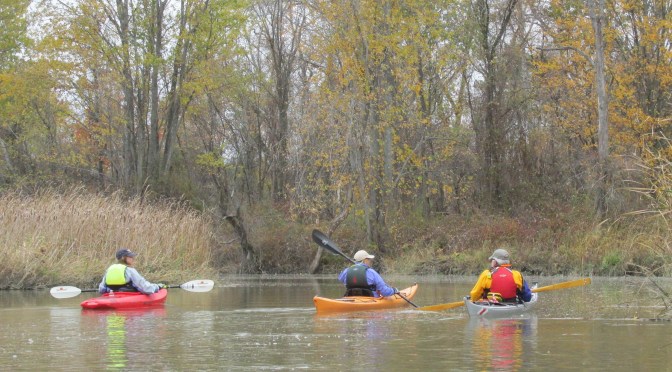
The tang of a slightly warm breeze rattled the yellow leaves of the cottonwoods under a dome of grey clouds welcoming an intrepid group of fall paddlers chasing the last vestiges of summer at Schodack Island State Park on the Hudson River near Albany.

“We weren’t planning to go out on to the Hudson River for this trip, but were headed to the kayak launch at Schodack Creek on the eastern side of the island,” Ro Woodard recalled. “It has tidal waters like the Hudson and snakes through the phragmites reeds and cattails swamp under the mighty bridges of the CSX Railroad and NYS Thruway.  It was exciting to think, as I drove over the Thruway bridge and looked down to the creek, that I would be soon seeing the secrets of the marsh from a water’s eye view rather than a bird’s eye view.”

Warm fall and winter days might tease paddlers into heading for their favorite open water, but the warm air temperatures can deceptively mask the dangers of the cold water surrounding our boats as we paddle. NYS OPRHP would like to remind paddlers and sportsmen who venture out on the water between November 1 and May 1 that everyone in boats less than 21 feet in length  (this includes motor boats, too) MUST WEAR a US Coast Guard approved life jacket while underway.  OPRHP also recommends that everyone wear a life jacket if the water temperature is less than 70o F.

All boaters (and, yes, paddlers are boaters) should be aware of the possibility of a sudden unexpected swamping, capsize, or a fall overboard into the cold water. At the onset of a sudden cold water immersion there is an initial uncontrollable gasp reflex leading to hyperventilation and increased heart rate and blood pressure which can result in immediate drowning. Go to Cold Water Boot Camp to see what this reaction looks like.  A life jacket may save your life by keeping your head above water and your body floating you while you get your breathing in control.  Next you should attempt self-rescue by getting back in or on your boat.  You have about 10 -20 minutes depending on the temperature of the water before your muscles and nerves cool down and stop functioning;   even good swimmers can’t control their movements and ultimately experience swimming failure.   Again, the life jacket can make all the difference because it will float you.   This is a sobering message for those going out for what they hope to be a fine day on the water.  Remember to wear your life jacket, because it can make all the difference.

Late season paddlers should dress for the water temperature, not the air temperature with either a wet suit or dry suit under your life jacket.  Bring along safety equipment to help with rescue in case of a capsize: pump, rescue bag, sling, paddle float, whistle, visual distress signals, and a VHF radio or cell phone is a waterproof bag.  Also take a course to learn how to use the equipment and how to rescue a paddler who is in the water, empty the water from their boat and get them back inside before you head out for your cold season paddling trip. It is important to have essential skills and equipment, which we hope we never have to use, with you when you kayak and canoe.  The American Canoe Association has a variety of courses for all level of paddlers.

Always paddle with a group if possible and be sure to let someone know where you are going and when you are expected to return.  Take a boating safety course and refrain from the use of alcohol when paddling.  Boating safety courses can be found at http://nysparks.com/recreation/boating/boating-safety-class.aspx  and a free online paddle sport safety course at www.paddlecourse.com.

Click on an image above to enlarge it and read the caption.

The properly dressed and equipped group enjoyed a pleasant afternoon sweeping upstream on the incoming tide, sharing summer paddling stories and watching the sky hoping for a glimpse of one of the many eagles which inhabit the shores of the Park.  They passed under the bridges to the sound of a honking horn.  The honking must have come from a sharp-eye paddler who was crossing the bridge in his or her car and spotted us paddling. After encountering a tree across the narrowing creek, they turned around to head south just as the tide was turning and the current carried them back to the launch ramp. No eagles on this trip, but a flock of crows soared over head as we finished our day.

The fabulous fall padding season has wound down. The air temperatures are dropping and so is the water temperature.  Though lots of us summer paddlers put away our kayaks and canoes until spring, many hearty paddlers continue to enjoy the late fall paddling until ice forces them off the water. If that paddler is you, remember to wear your life jacket, let someone know when and where you are paddling, dress to stay warm, bring your safety equipment, don’t drink alcohol while out on the water, and paddle with a group if possible.   The rest of you, we’ll see you in the spring!

Post and photos by Ro Woodard, Marine Services Bureau, OPRHP.