The Ghost Plant: A Closer Look At The Spookiest Plant In The Forest

What’s black and white and spooky all over? The ghost plant! More commonly known as Indian pipe (Monotropa uniflora) since it is said to resemble a Native American peace pipe, it is also known as corpse plant, death plant, and ghost flower. This unusual looking plant is often mistaken as a fungus because it is mostly white and doesn’t have any chlorophyll… but it is really a flowering plant and is actually part of the same Family (Ericaceae) that includes blueberries, cranberries, azaleas, and Rhododendrons. Weird, right?

indian_pipe (missouri department of conservation)
Photo by Missouri Department of Conservation

You’ll often find Indian pipes in dark and spooooky environments. Since it doesn’t have any chlorophyll it doesn’t need light to photosynthesize its own food. Instead, the food source for this plant is a lot more sinister, for it is actually a parasite! Specifically, Indian pipes are parasitic on mycorrhizal fungi in the soil. Mycorrhizal fungi have a symbiotic relationship with trees (epiparasitism), meaning both the fungi and trees both benefit from each other. The tree gathers sunlight and use it to turn water and carbon dioxide into sugars and other carbohydrates. The fungi harvest minerals in the soil. The tree and fungi then exchange these resources in a process that resembles a harmonious story of cooperation and mutual benefit. It is then exploited by the Indian pipe.

What happens is the tree obtains its energy (sugars and other carbohydrates) from photosynthesis and the fungus obtain some of those sugars directly from the tree roots. So how does the Indian pipe get its energy from the fungus? Some menacing tom-foolery, that’s how! The Indian pipe actually tricks the fungus into thinking it is forming a mycorrhizal relationship, but in fact the Indian pipe is parasitizing the fungus! The Indian pipe essentially gets a free ride and doesn’t have to produce its own energy or absorb its own minerals. Typically, when a parasite exploit a host the host fights back, but for some reason the fungus and tree goes along with the Indian pipe’s menacing ploy.

By Staben, accessed from Wikicommons
Indian pipe flowers, photo by Staben, accessed from Wikicommons

After months, and sometimes years, of gathering its nutrients from the fungus into its root system, the Indian pipe, almost rather suddenly, develops above ground. White stalks and then flowers are produced, which are then pollinated by insects. Once pollinated the Indian pipe releases tens of thousands of extremely tiny seeds, which hardly have the food storage capacity to start a new plant. Those seeds are dispersed long distances by wind and settles to the ground. Once there, the seeds actually don’t start growing right away. In fact, the seeds chemically mimic a tree’s root systems and wait for certain types of mycorrhizal fungus to come along. The fungus then attaches to the seed as it would to a tree, but then is forced into providing nutrients the tiny seeds needs to grow! So essentially, from seedling to growth to pollination to seed dispersal, the Indian pipe does almost absolutely nothing itself!
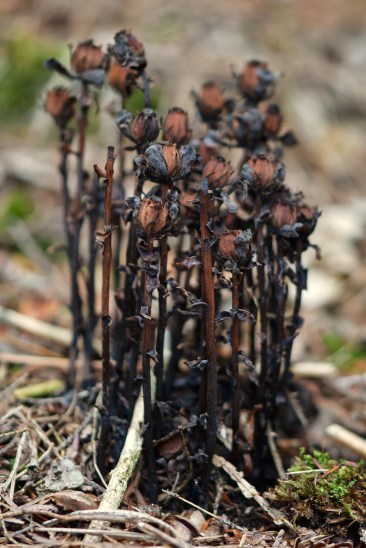
Ryan Hodnett, accessed from Wikicommons
Dried Indian pipe flowers, photo by Ryan Hodnett, accessed from Wikicommons

Due to its fascinating nature, the Indian pipe has been immortalized by many poets and storytellers in their works, including Emily Dickinson, whose favorite flower was the Indian pipe. She drafted the poem “‘Tis whiter than an Indian Pipe-” in 1879:

Tis whiter than an Indian Pipe –
‘Tis dimmer than a Lace –
No stature has it, like a Fog
When you approach the place –
Not any voice imply it here –
Or intimate it there –
A spirit – how doth it accost –
What function hath the Air?
This limitless Hyperbole
Each one of us shall be –
‘Tis Drama – if Hypothesis
It be not Tragedy –

Post by Matt Brincka, State Parks
A Spider Sampler

Few creatures are as iconic in the public imagination as the spider. From the ancient Greek myth of Arachne, the Akan folktale character Anansi, or the titular hero of Charlotte’s Web, these stealthy, silk-spinning predators have a long history of popping up in our shared myths and stories.

However, despite their cultural prominence, these awesome hunters are often unfairly feared and misunderstood. Spiders play an important role in balancing our ecosystems, such as by consuming pests that may destroy crops or carry disease. Fortunately, there’s no better way to learn about our fascinating eight-legged friends than by getting out to our state park system and seeing them first hand!

Spiders belong to the class Arachnida, which encompasses other joint-legged invertebrates such as scorpions, ticks, mites and harvestmen – some 100,000 species all in all!

In New York’s seasonal northern climate, spiders typically live about a year. They typically survive the winter as eggs and develop into adulthood during the summer. All spiders produce silk – thin, strong protein strands produced in the abdomen. Although best-known as the raw material for spider webs, not all spiders use their silk to catch prey – they may also use it to cover egg sacs, create waterproof retreats or to produce draglines to help them travel long distances on the breeze.

There are about 40,000 identified spider species worldwide. Here, we’re going to focus on just a handful of the more common species you might find in New York state – and imagine what they might say if they could speak for themselves.

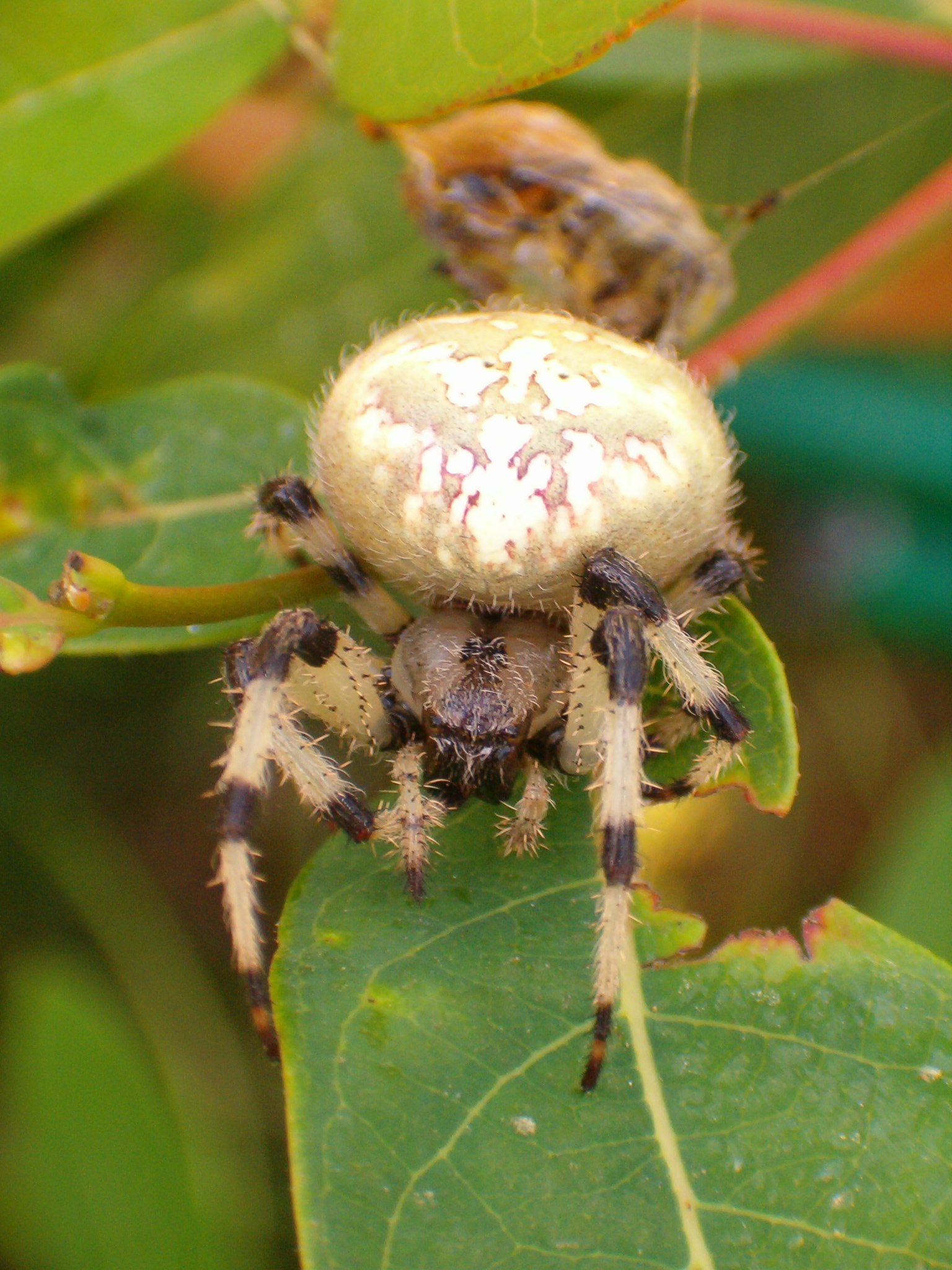
Marbled Orb Weaver (20)bst
Marbled Orb Weaver (Araneus marmoreus)

As a Marbled Orbweaver, I tend to get around. We’re found all over the continent grasses – basically anywhere in the woods or near streams or other running water. So when people ask me where I’m from, I tend to be at a loss – North America, I guess? When I look in the mirror I don’t see just another Araneus –  I see me.” – Jose, Marbled Orbweaver, Brooklyn.

Shamrock Spider
Shamrock spider, Araneus trifolium

“I wake up early every day to at what’s left of yesterday’s web and build a brand new one in its place. Some people call me a perfectionist – I think I just see the value of a job well-done, even if you don’t always get noticed for it. Personally, I think it’s more satisfying to find meaning in the work you do – which you can control – rather than on being recognized, which you can’t.” Mike, Shamrock Spider, Utica.

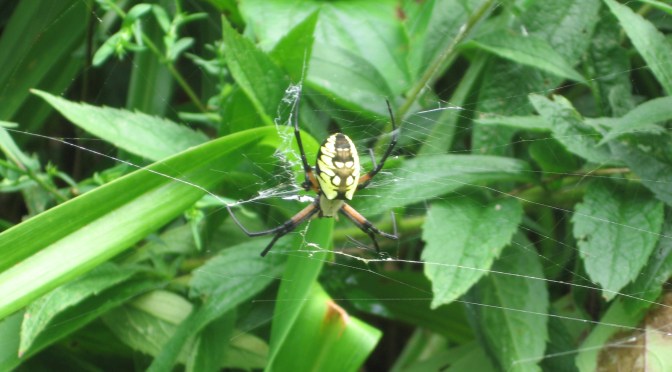
yellow garden spider DWSP
Yellow garden spider, Argiope aurantia

“It can be lonely being a Garden Spider sometimes. I’m diurnal, so I like to be out during the day, unlike my nocturnal orb weaving cousins. But I just try to keep my head down, refreshing that web glue every day and eating my lunch out in the sunshine.” – Shereen, Black and Yellow Garden Spider, Niagara Falls.

Learn more about New York Spiders:

Borror, Donald J. and Richard E. White, A Field Guide to Insects: America North of Mexico; Houghton Mifflin Harcourt, 1998

BASF Spider Identification Guide

NY State Dept. of Conservation  Common Spiders of NY Brochure

Post by Ben Mattison, State Parks

Be a Voyageur!

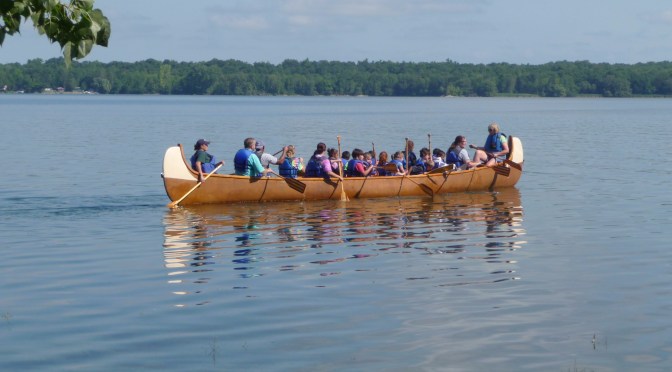
Since the 1980s, there has been a 36-foot long, 16 passenger (plus two staff), fiberglass Voyageur canoe at the Minna Anthony Common Nature Center in Wellesley Island State Park. No one really knows where the canoe came from or exactly what year it arrived, but there are a few stories told about its origins.  Some say there used to be five Voyageur canoes located in parks along the St. Lawrence River and Lake Ontario and some say the canoe was made by NYS Parks’ employees.  Ultimately, the mystery of its origin is part of its mystique.  What they will say is that every summer for about the last 30 years park visitors and Nature Center staff have headed out on daily trips in our canoe to learn about the history of the Voyageurs and to explore the ecology of Eel Bay, the Narrows, and Escanaba Bay.

Voyageur canoe trips leave the Nature Center docks at 9 am and return at 11 am, but there is plenty for staff to do before anyone ever steps foot into the boat.  If it has rained, staff must bail the canoe and dry the wooden seats for passengers.

Unknown photographer 2003
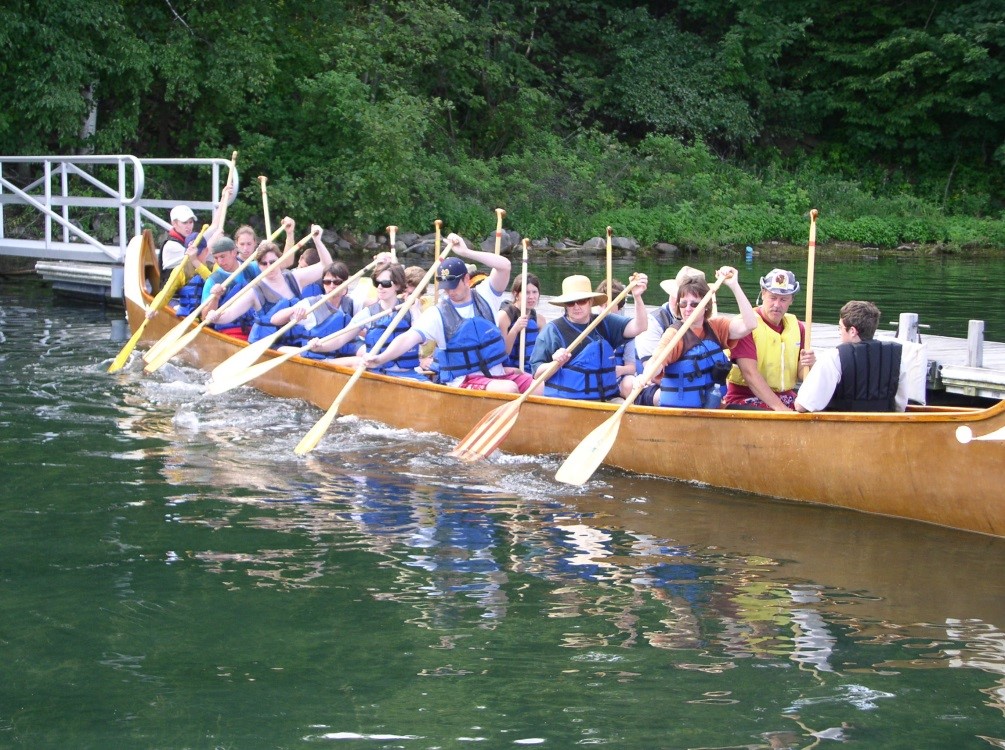
Novice voyageurs head out on their first journey, photo by State Parks.

They also move the boat into place on the docks so it is ready for the day.  When that day’s voyageurs come down to the dock house they are fitted with personal floatation devices (PFD’s) and paddles while being taught about the fundamentals of paddling before heading out to the canoe.  Loading the canoe with passengers can be quite tricky, as people who are likely to be stronger paddlers must be strategically positioned in the boat and the canoe must be balanced on the water to safely leave the docks.  Once the canoe is balanced and its passengers comfortable, staff jump in at the bow (front) and stern (back) and slowly steer the boat out into Eel Bay.

The staff member sitting at the bow of the boat begins the interpretation as the large boat gets underway.  They talk about how the canoe weighs 1,000 pounds empty and how it is made of fiberglass.  As the passengers paddle, they discuss the importance of Eel Bay as a large, shallow water bay on the St. Lawrence.  Then conversation shifts to the Voyageurs who were part of the French fur trading companies that existed in the 18th and 19th centuries.  The interpreter weaves a tale about the adventures Voyageurs had as they transported furs, predominately beaver, from Montreal to trading posts along the shores of Lake Superior.  As the boat rounds the sharp turn into the Narrows passengers learn what a day in the life of a Voyageur was like, from what they ate to how they were paid.  The staff member sitting in the stern who has been quietly working to steer the boat will ease it to a stop as the canoe coasts into Escanaba Bay.  Passengers will spend a little time admiring the plentiful water lilies that dot the bay before reversing course and heading back towards the Nature Center.  On the return trip to our docks, some time is dedicated to floating along in silence, taking in the sights and sounds of the majestic St. Lawrence River.

Molly Farrell
Pat and Aziel Snyder standing next to the newly restored Voyageur canoe. Doesn’t it look beautiful? Photo by State Parks.

The canoe had begun to show its age in recent years but last winter Pat Snyder of River Restorations, a local boat restoration company, beautifully restored it to top condition.  A few sections of the gunnels were replaced, the gunnels and seats sanded down and refinished, the seats reinforced to help prevent deflection when people are stepping into the boat, and the fiberglass shell was repainted.  The canoe once again looks majestic and is ready to go out on the water!

Each July and August, look for the return of our sleek Voyageur canoe to the Nature Center’s dock.  For just $4 (anyone over 13) or $2 (under 13) you can join staff from the Nature Center on a memorable journey on smooth waters, travelling the shorelines of Wellesley Island.

For information on upcoming trips, please visit our Facebook page (Minna Anthony Common Nature Center- Friends).  To have enough paddle power to steer the boat, we must have at least 8 people over the age of 18 on board.  To reserve a spot on a trip, please call the Nature Center at 315-482-2479.

Post by Molly Farrell, July 2018

Learn more about Voyaguers:

Durbin, William; The Broken Paddle; Delacorte Press, NY, 1997.

Ernst, Kathleen; The Trouble and Fort La Point; Pleasant Company Publications, Middleton, WI, 2000.

Weekend Forecast: Heavy Meteor Showers

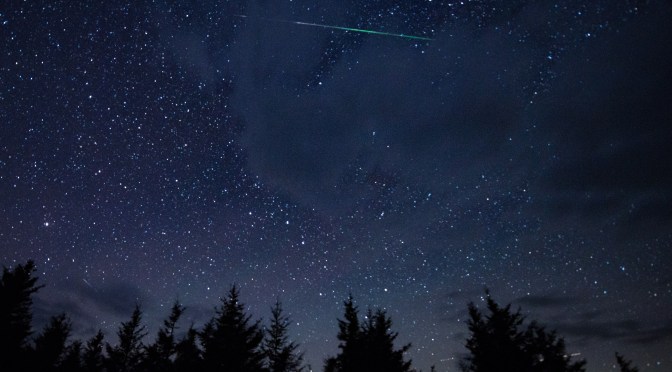
Each year when the second week of August rolls around, I know where my family will be. Loaded with blankets and camp chairs, we head to Lake Erie State Park to sit back, relax, and gaze at the stars. Why? Early August marks the peak of the Perseid meteor shower, one of the best displays of shooting stars every year.

This year, the predicted peak performance is on the night of August 12th (intensifying through the predawn hours, if you can stay up that long), though you may catch a glimpse of meteors any night between July 17th and August 24th. The Perseid meteor shower typically produces 50-100 meteors per hour, with outbursts up to a couple hundred meteors per hour in some years.

The meteors we see–particles ranging in size from a grain of sand to a small pebble—come from the debris of the comet Swift-Tuttle. Though this comet (think of a 16-mile-wide dusty snowball) orbits around the sun only once every 133 years, the Earth passes through its long-lasting trail of rocky and dusty debris around the same time every year, presenting us Earth-dwellers with the fiery flashes of the Perseid meteor shower.

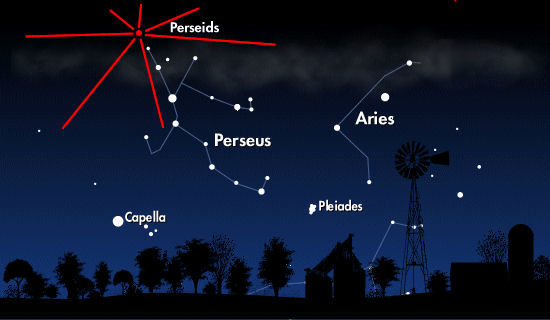
As the tiny particles collide into the Earth’s atmosphere at a measly speed of 133,000 miles per hour (37 miles per second), they ignite due to the friction of the atmosphere. If you trace the paths of these meteors, they will appear to originate from around the same area; this point is called the radiant, and the Perseid meteor shower radiates from, you guessed it, the star constellation Perseus. Don’t worry though, you don’t need to know exactly where this constellation is to find the show; just look towards the northeast!

Direction_of_the_Perseids
Perseid meteors will appear to originate near the Perseus constellation, so look to the northeastern sky for the best view. Image from NASA

The number of meteors you see depends on several other factors as well, including lights, weather, location, and moon phase. The Northern Hemisphere is the place to be for these showers, and lucky for us, on August 12th the moon will be nearly brand new, which means that the night sky should be nice and dark. We can’t control the weather, so be sure to go out on a night with less cloud cover.

How do you throw a get-together for a meteor shower? You have to planet! The best way to see the Perseids is to find a safe, dark and secluded spot away from city lights – a local park perhaps? Be sure to check that the park will be open at night, and some State Parks are even offering programs for the big event! Leave the binoculars and telescopes at home, you will be able to see these meteors with just the naked eye, and the more open sky in your field of view, the better. Dress for the weather, bring blankets to lay on or comfortable chairs to sit in (reclining camp chairs are great for this), and don’t forget the snacks. The longer you sit out, the more meteors you are likely to see! It takes about 30 minutes for your eyes to fully adjust to the dark, and the number of shooting stars increases throughout the evening. So go outside, get settled, and enjoy the beauty of fiery space debris!

Click here to check out some upcoming star-related State Park events!

Post by Kelsey Ruffino, State Parks

Resources:

NASA Meteor and Meteorites Perseids In Depth

In The Sky Perseid Meteor Shower

Space.com Perseid Meteor Shower 2018: When, Where & How to See It This Month

DateandTime.com Perseid Meteor Shower 2018

Sky and Telescope The Best Meteor Showers in 2018

Stardate Meteors

Learn more about meteors:

Aronson, Billy; Meteors : the truth behind shooting stars; Franklin Watts, NY, 1996.

Rose, Simon; Meteors; Weigl Publishers, NY, 2012.

Featured image: NASA/Bill Ingalls