
Poetry and literature have long been used to explore the natural world in ways that can circumvent the pitfalls of scientific and technological determinism. Similarly, in the history of architecture and landscape architecture, new modes of drawing and rendering can add contour and depth to insights from the environmental and biological sciences.
In Spring 2023, Jeanne Haffner, Special Assistant and Director/Chief Curator of the Jones Beach Energy & Nature Center and S.E. Eisterer, Assistant Professor for Architectural History and Theory at Princeton University, collaborated on a seminar for Masters and Ph.D. students called “Histories of Embodied Energy: From Turtles to the Grid.” The course followed the mission of the Jones Beach Energy & Nature Center, investigating “the relationships between human beings, energy systems, and environmental stewardship.” Students toured the Center and surrounding site, and then chose an artifact from Jones Beach to work with for the semester.
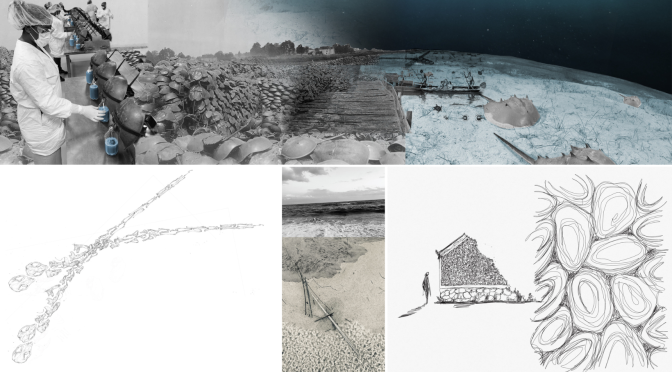
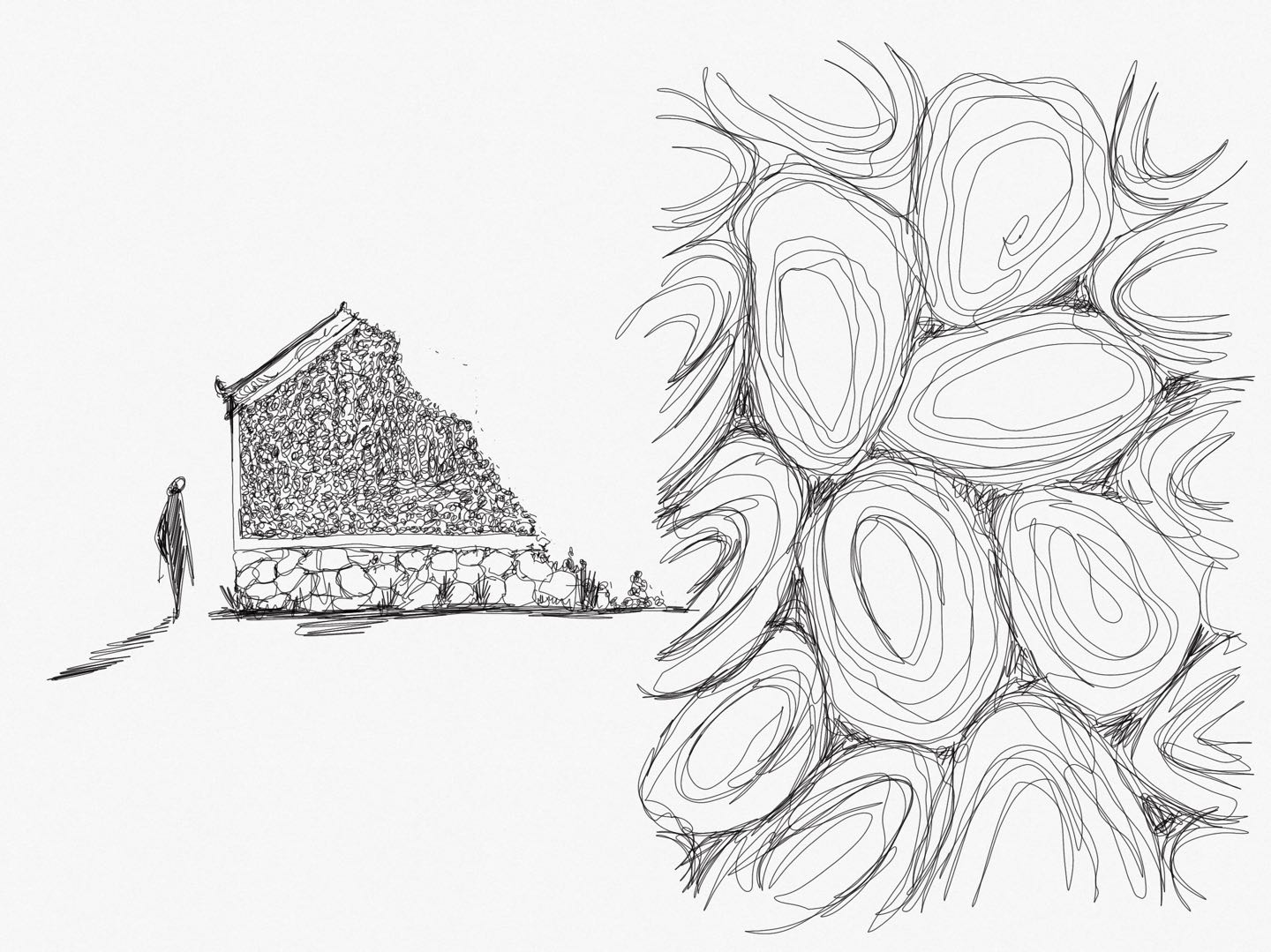
Having chosen an artifact, students wrote poems and created a drawing about it. But instead of producing abstract scientific diagrams or architectural renderings, they instead reflected upon alternative ways of representing the environment—ways that prioritize artistic, rather than strictly scientific, approaches. Maryam Popoola, for instance, sees an owl pellet not simply as an object for dissection but as a metaphor for the ever-changing nature of form. Valen Zhang’s poem and drawing considers oysters’ dynamic interactions with the ocean, beach, and built environment. For Marcos Garcia, beach grass on a sandy dune becomes a nexus between humans, lifestyles, and ecological impact. Masa Crilley depicts a horseshoe crab not in isolation, but in a long history that connects underwater worlds, Native American fishing practices, and industrialization.
This selection of poems and visuals reminds us of the continuing connection between art and environmental science, as well as the complex entanglements between environmental, social, and technical systems.
–Introduction written by Jeanne Haffner, Ph.D., Special Assistant and Director/Chief Curator, Jones Beach Energy & Nature Center (NYS Parks) and S.E. Eisterer, Assistant Professor of Architectural History and Theory, Princeton University
–Poems and visuals below created by Maryam Popoola, Valen Zhang, Marcos Garcia, and Masa Crilley
Maryam Popoola
Regurgitate
Backwash. Vomit
Ripples. Spittle
Crashing torrents, Convulsing throats
Nature spits into nature
Pieces left behind, pieces taken away
left to form new paths
acquire new definitions
how does a blade of grass become more than a dent in sand
how does a rat femur become more than a corpse entangled in matted hair
waiting to dissipate into air
swallowed hole, carved out
(what’s left behind?)
wholeness in absences, in the lack of
and then
water gushes in
names take shape
(who’s left unknown?)
these little pieces
little parts of the unknown
sink into the finer lines of history
pointing to the way forward.

Valen Zhang
Shell
Born of the tides painted blue,
Made of sands as water passes through,
Clothed in mystery, A treasure grows,
Leaving behind a tear, for extravagant shows.
As waves crash down upon the sandy shore,
The oyster shell is cast upon the floor,
Pearls taken, flesh eaten,
A hidden gem is discarded, left to rot,
But in the concrete mix, it may find its spot.
A new life breathed to create a shrine,
For castles built to the tribute of time,
The concrete stronger, sturdier than before,
A testament to the oyster on the shore.
And so the humble shell, once cast aside,
Has created a new home to reside,
So let us not forget, the oyster shell.
A legacy, that spans both land and sea,
Carved by nature, for all to see.
Marcos Garcia
YOU PLANTED ME, AND I PLANTED YOU
YOU PLANTED ME, AND I PLANTED YOU
I came from all around
Because you wanted a mound
Don’t look at me that way
I did give you a place to stay
My root and my leaves
Your towel and your kid
My dune and my beach
Your umbrella and your fridge
Don’t you dare to flatten me
I am now what I wanted to be
You think you did
But you never got it
You moved in and out
And I was not allowed
Enjoy the movement, my friend
There’s still time to comprehend
YOU PLANTED ME, AND I PLANTED YOU

Masa Crilley
Broken Cycle
The moon draws near, pulling the waves to the sandy shore.
The horseshoe crab detects its faint signal,
and crawls its way up.
Legs weak, its velocity decreasing, it musters its strength to continue climbing.
Its loss of blood confuses the horseshoe crab’s circatidal rhythm.
The journey to lay its eggs grows more difficult.
The legs slow to a stop,
resting on the sea floor.
The moon draws back, the waves retreat.
Last season’s molts slowly decompose,
until nothing is left on the sandy shore.
Based on “Sublethal Behavioral and Physiological Effects of the Biomedical Bleeding Process on the American Horseshoe Crab, Limulus polyphemus” by Anderson et. al (2013).

 New York State Parks and Historic Sites Blog