
Ashley Longo, an environmental educator working for New York State Parks’ Long Island Regional Environmental Education Office was awarded a scholarship opportunity to attend a Teacher and Educator’s Course at the Bimini Biological Field Station Foundation in South Bimini, Bahamas. Through her participation, NY State Parks was represented along with 13 other educators out of nearly 200 applicants. More commonly known as the Bimini Shark Lab, this world-renowned research facility was established in 1990 by Dr. Samuel Gruber and has contributed to advancing the world’s knowledge on elasmobranchs (sharks, rays, skates, and sawfish) through several research projects as well as providing educational opportunities for future scientists and the public.
When you hear the word, “Shark” what comes to mind? Does it evoke a sense of fear in you? Does it stimulate your curiosity? Is your immediate first thought about how they are so negatively portrayed in the media and how unjust it is?
Sharks are some of the most talked about animals on the planet, often portrayed in a very negative light. With increasing sightings of them off Long Island in the past couple of years, misinformation and public fear can spread, something first started by the movie Jaws. It should be made clear, however, that increased shark sightings are actually a sign of a healthier ecosystem!

Sharks (rays & chimaeras too), the elasmobranchs, are one of the most advanced groups of animals in the world, with specialized sensory adaptations, reproductive methods, and migration patterns not seen in other living creatures. More than half the species of sharks in the world don’t grow bigger than three feet (one meter) and most live in the waters of the deep sea, never seeing the ocean’s surface or a human being. There’s a lot more to sharks than many people realize, including myself, and I am excited to be bringing that knowledge back to the beaches of Long Island after being at the Bimini Shark Lab in the Bahamas.
Life at the Bimini Shark Lab
South Bimini, Bahamas is located alongside the Gulf Stream some 46 miles from Miami, Florida. The level of biodiversity is high surrounding Bimini and because of this many shark species can be found around Bimini and the rest of the Bahamas. Many shark species will migrate between Bimini and the United States. In 2011, the Bahamas declared their waters as a shark sanctuary, becoming the 4th country in the world to do so at the time. The value of a shark alive is worth far more than a dead shark in the Bahamas, with the diving industry there being among the highest earning in the world. As the Shark Lab has so cleverly coined, the Bimini is not infested with sharks, but INVESTED!
Growing up, I saw the movie Jaws and was absolutely terrified to set foot anywhere near the ocean. Jaws set a precedent for me that everything that came from the ocean was scary and because of that I barely went to the beach during my childhood. During high school, I became more educated on what the ocean was all about, and I fell in love. Watching Shark Week deserves some of the credit for that mentality change. Sharks went from being something I feared to something I couldn’t get enough of. They are the reason I chose to study marine biology at Eckerd College, and I specifically picked Eckerd because they offered a course on sharks and rays. There were opportunities to visit the Bimini Shark Lab through that course. Unfortunately, I was never able to visit the Shark Lab during my time in school. That’s what made being awarded the Teacher and Educator’s scholarship even more special. It’s been a dream of mine to visit and have that real life experience swimming with sharks in their natural habitat since I first saw the Shark Lab being featured on a Shark Week program.

During my weeklong course, not only did we get to experience snorkeling and swimming with sharks, but we also learned about the biology and conservation of sharks and rays through daily lectures given by Dr. Dean Grubbs, Associate Director of Research at the Florida State University Coastal and Marine Laboratory, and Matt Skumall, President and CEO of the Bimini Biological Field Station Foundation (BBFSF). We learned about each order of elasmobranch and what made each unique when it came to their reproduction, migration patterns, and the pressures they faced in their respective habitats. We were also introduced to all the research the lab has done in the past and what projects they are currently working on. For more information about the Shark Lab itself and their research please visit www.biminisharklab.com.
There are three experiences during the weeklong adventure at the Bimini Shark Lab that I hope will inspire you to see sharks in a different light. Please keep in mind that these activities were performed with professionals and like any activity involving the ocean there is risk involved. Big thank you to the staff of Bimini Shark Lab for the amazing opportunity!
Lemon Sharks of Bimini
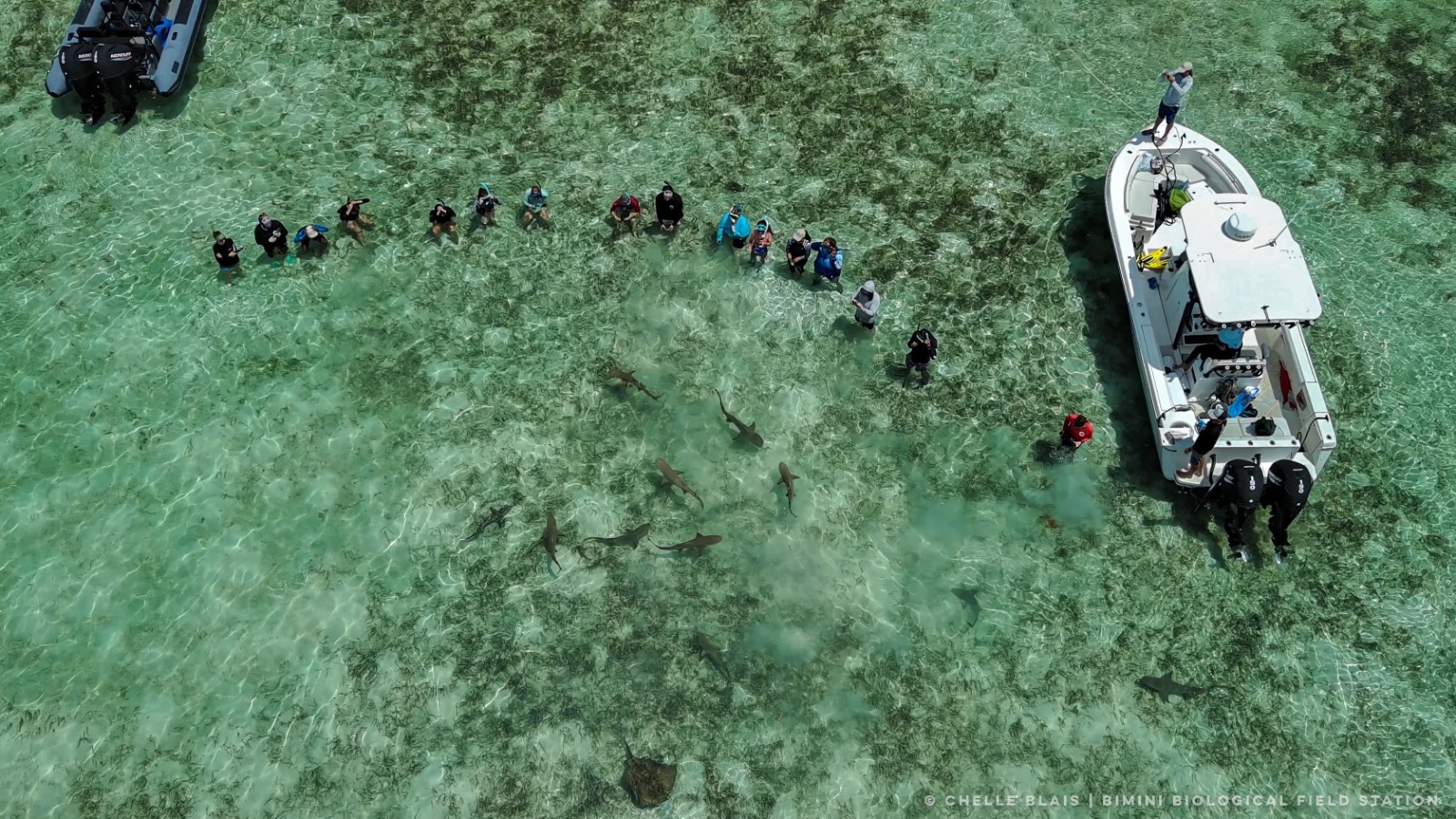
Many of our field activities during the trip centered around interacting with juvenile Lemon Sharks. Lemon Sharks are named for the yellowish-brown color of their skin. These sharks can grow up to 10 feet long and usually reach sexual maturity at around 11-13 years. Female Lemon Sharks can give birth to 4-17 pups, and she will return to the site she was born to give birth to her young, a phenomenon known as natal homing.
Mangrove habitats around Bimini provide critical habitat for juvenile Lemon Sharks. Mangroves act as a nursery ground for these species, where they will remain for several years sheltered away from larger predators. During my trip, we were able to snorkel through a path among the mangroves to a secluded spot full of juvenile Lemon Sharks cruising around. They all have distinct personalities and that was definitely evident in their behavior around us. For more information on the mangroves of Bimini, check out this link: www.biminisharklab.com/mangroves.

Honeymoon Harbor
Imagine swimming with dozens of wild southern stingrays around you in beautiful turquoise waters.
Honeymoon Harbor is a beautiful, remote strip of shore located south of Bimini only accessible by boat and it’s well known for being a hotspot to have face-to-face encounters with southern stingrays that have become accustomed to humans over the years. These rays sure didn’t know what personal space meant and that was fine with me! As long as you treated them with respect, they respected you.
Stingrays are often overlooked as being close relatives to sharks. These southern stingrays all still had their barbs or spines. Stingrays can replace their venomous spines if they break off. Being able to snorkel and make eye contact with them as they flapped along the sea floor was an incredible experience. Not only did the area attract southern stingrays as soon as the boat pulled up, but Nurse Sharks and even Blacknose Sharks came to visit.
Nurse Sharks, often thought of as harmless, can pack a powerful bite if harassed. Their jaws and teeth are equipped to suck in and grind hard shelled organisms they find on the seafloor. Many sharks must continue swimming to get oxygen across their gills to stay alive. Nurse Sharks have an amazing adaptation called buccal pumping, where they can stay motionless on the seafloor and still have the ability to breathe. These Nurse Sharks that came to visit the area swam around everyone’s legs and right up to some of us, and at no point did any of us feel threatened. The Blacknose Sharks zipped around the area checking all of us out but didn’t take a chance at coming closer like the Nurse Sharks did. Blacknose Sharks can be identified from the black smudge on their snouts, having olive-green colored skin, and white edges on their fins.

Snorkeling with Caribbean Reef Sharks at Turtle Rocks
Visiting Turtle Rocks as the last field excursion of our trip was saving the best for last. At this site we were able to snorkel with six Caribbean Reef Sharks. These sharks were definitely the largest ones we encountered on the trip and they were swimming right under our snorkel fins. Their behavior was peaceful, and they occasionally moved up to check us out in the water column. With warmer water temperatures during the summer, many of these sharks leave the area or stay at deeper depths where the water temperature is cooler. Caribbean Reef Sharks live in tropical waters ranging from the southeastern U.S. to Brazil. They are commonly found on coral reefs, but due to climate change and the loss of coral reefs, they are losing their primary habitat for foraging. As of 2019, they have been listed as Endangered by the IUCN (International Union for Conservation of Nature).

Being “Shark Smart” in New York State Parks
With the opportunity granted to me through the Bimini Shark Lab, I’m looking forward to using the knowledge and hands on experiences acquired from this trip to develop school curriculum and public programming that will better connect our park patrons to the sharks we see in our waters and the ocean environment as a whole. We’ve already started outreach at Robert Moses State Park this summer, a state park beach that often closes due to shark sightings. Educating the public will hopefully lessen any fear and increase understanding and awe for these marvelous animals.
REMEMBER:
- Sharks have always been in the ocean, but with more advanced technology, a healthier ecosystem off Long Island, and more media attention, people are seeing them more often these days. Keep in mind that while they may be predators, they are not seeking us out.
- When you step foot in the ocean it’s important to be aware of your surroundings. Some practical advice to reduce chances of encountering a shark: avoid swimming in murky waters, swimming near seals or large groups of fish, and swimming at dawn, dusk, or at night.
We can still enjoy the ocean, but it’s important for us to know how to minimize the chance of a negative interaction when we do encounter marine life. We can be “Shark Smart” in New York State Parks!
–Written by Ashley Longo, an environmental educator working for the Long Island Regional Environmental Education Office for New York State Parks.
 New York State Parks and Historic Sites Blog
One thought on ““Shark Smart” with NY State Parks: A Trip to the Bimini Shark Lab”