

A rare total solar eclipse is passing through western New York, the Finger Lakes, and the Adirondacks on April 8, 2024, and eclipse mania has begun! The eclipse will be fully visible in New York State across a narrow route, referred to as the path of totality, but all New York residents and visitors can still experience a partial eclipse throughout the rest of the state.
Whether you’re in the path or not, what makes an eclipse-viewing experience so special? And what should we expect to see, feel, and be exposed to?
We spoke to David Cheney, Program Executive in NASA’s Heliophysics Division, to shed light on all the need-to-know information. Whether you’re planning to attend one of the eclipse-viewing gatherings scheduled at our parks and historic sites (featuring eclipse-themed activities, discussions and trivia, snacks, and distribution of solar viewing glasses to prevent severe eye injuries); register for and follow NASA’s livestream monitoring the path from Mazatlan, Mexico to Milton, Maine; or just pop outside that day; we’ve got you covered.

This interview has been lightly edited to provide optimal context.
Q: What, exactly, is heliophysics? Can you describe your field?
Cheney: We want to understand how the sun works and then also how the sun interacts with us, with our planet, the solar system, and the universe.
For anyone who might be unclear on what’s going to happen on April 8, can you speak to the benefits of being in the path of totality (full total solar eclipse), but also describe what those around New York State will still experience if they’re outside of it (a partial eclipse)?
Cheney: There are there are two basic types of eclipses: one as a total eclipse and the other as a partial eclipse. You can [also] have a special partial eclipse, which we had as an annular [“ring of fire”] eclipse that happened in October [2023].
WATCH: Ring of Fire: 2023 Annular Solar Eclipse Broadcast (NASA Image and Video Library)
Cheney continued: If you were in that kind of the path of totality in October, you actually got to see the annual where the moon went directly in front of the sun, but the shadow was not big enough to cover the whole sun. You actually had a ring of the sun all the way around the outside of the moon. So, that’s a special type of partial eclipse.
On April 8, everyone outside of the path of totality is going to get a partial eclipse where the moon’s shadow is going to cover some portion of the sun. I think most of New York State is pretty close to within the 90 percent of totality. So you’re going to get most of the sun covered. And it’s actually it’s a great experience to watch that. You get lots of really cool shadows. I think you still get some of the interaction with animals where they start to think it’s going nighttime as well. But I think the further you are away from totality, the less impact that has on them. You also still feel that it’s getting colder during a partial eclipse.
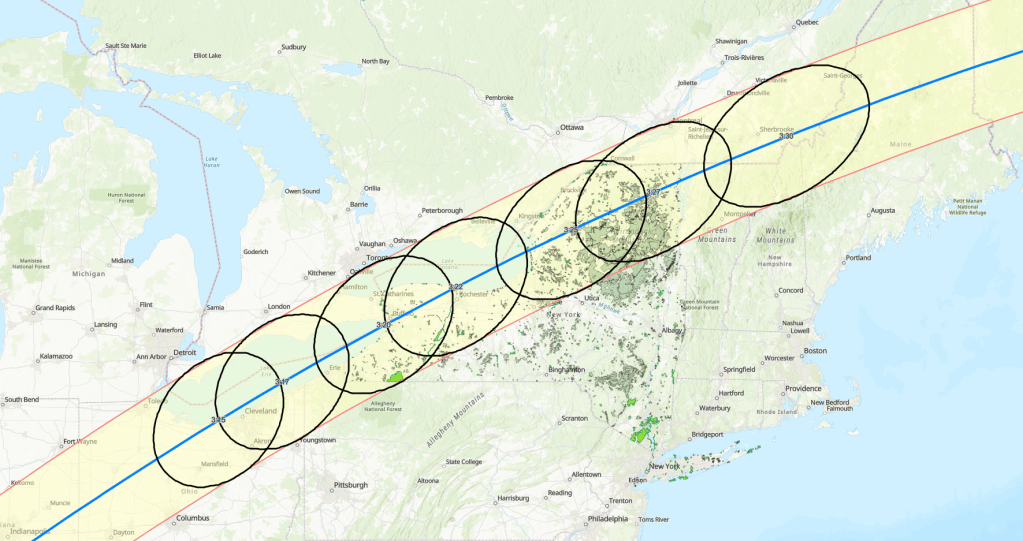
The thing you don’t get to have in the partial eclipse area is the shadow of the moon covering the entirety of the sun. And so you can’t actually ever take your eclipse viewing glasses off in a partial eclipse area. But in a total eclipse area, in the path of totality, you can actually take your glasses off and look at the corona, which is the atmosphere of the sun. [State Parks Safety Note: Only remove safety glasses when you can no longer see any part of the sun, and put them back on as soon as you start to see the sun again.] You can still see around the shadow of the moon. You can see some stuff that normally we don’t we don’t get to see very often, especially with just our eyes.
Q: You brought up animals being affected by the eclipse. Any other information to share that previews the environment shifts during an eclipse experience?
Cheney: From a heliophysics perspective, the sun is obviously the prime source of energy. During an eclipse, we actually can feel how much that changes when you’re in the shadow [of the moon]. There can be a very significant temperature change. And so it really helps us understand how dependent we are on the energy coming from the sun and that it’s consistently shining on us. I think that it helps us put our life in perspective, understanding about how the sun is so important to us.
On a normal day, as the sun is setting, it’s so gradual. Even though an eclipse is slowly building up and slowly progressing throughout the experience, the fact is that you feel that transition in a shorter time, I think it’s going to be fascinating to experience it. The animals actually think it’s nighttime, so they actually try to go to sleep. They’ll try it. It’s actually a pretty surreal experience to just be there during a total eclipse. And you can hear the difference in what’s going on around you. And feel it, too. It’s a very cool experience to be a part of.
Q: At eclipse-viewing gatherings within the path of totality, is there a moment when people say, “Okay, look now!” and that guidance is given to take your eclipse glasses off to view the sun’s corona?
Cheney: You could have someone there that knows and can give you guidance. But in general, if you’re watching [in person], you will be able to see when the shadow completely covers the sun. When you see that, you can take the glasses off. Depending on where you are in the path of totality determines how long that time is. If you’re kind of in the center of the path of totality, then it’s going to be close to four minutes. You’re actually going to get to observe quite a long time. But if you start to see a little bit of the sun coming back, it’s time to put the glasses back on.

Q: For folks just trying to understand what that moment looks like, having not experienced one before, that’s very helpful. Thank you.
Cheney: The lead up to totality is a fairly lengthy process. You can start to see the moon’s shadow starting to cover the sun. I haven’t looked at the timing for that, but it could be as long as an hour and a half ahead of time. If you get the glasses, you can put those on any time and go out and look at the sun. You can watch the shadow go across the sun and you can tell when you’re getting pretty close [to peak totality]. That makes it easier. And those glasses will protect you.
REGISTER TO WATCH LIVE: Join NASA experts on April 8, 2024, for a broadcast of the total solar eclipse.
Q: I’ve read that the last total solar eclipse in the contiguous U.S. was in 2017, and the next one is 2045. Both of those didn’t pass through New York though, so just how rare is this for the northeast?
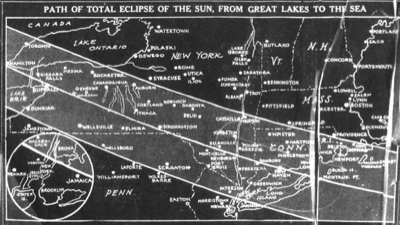
Cheney: It’s not a common experience to get to see a total solar eclipse. They happen, but not always in the same spot [within a lifetime]. There is actually an area {in the U.S.] that was in the 2017 eclipse path of totality, but it’s also in the path of totality this time. A lot of people traveled a long way to get in the path of totality. And then Niagara Falls had [an eclipse] in 1925 [and are in the path for the April 8 eclipse], so that’s 100 years ago. I think that for most of us, we’re probably not going to have more than a couple of opportunities in our lifetime to go to someplace where the path of totality is.
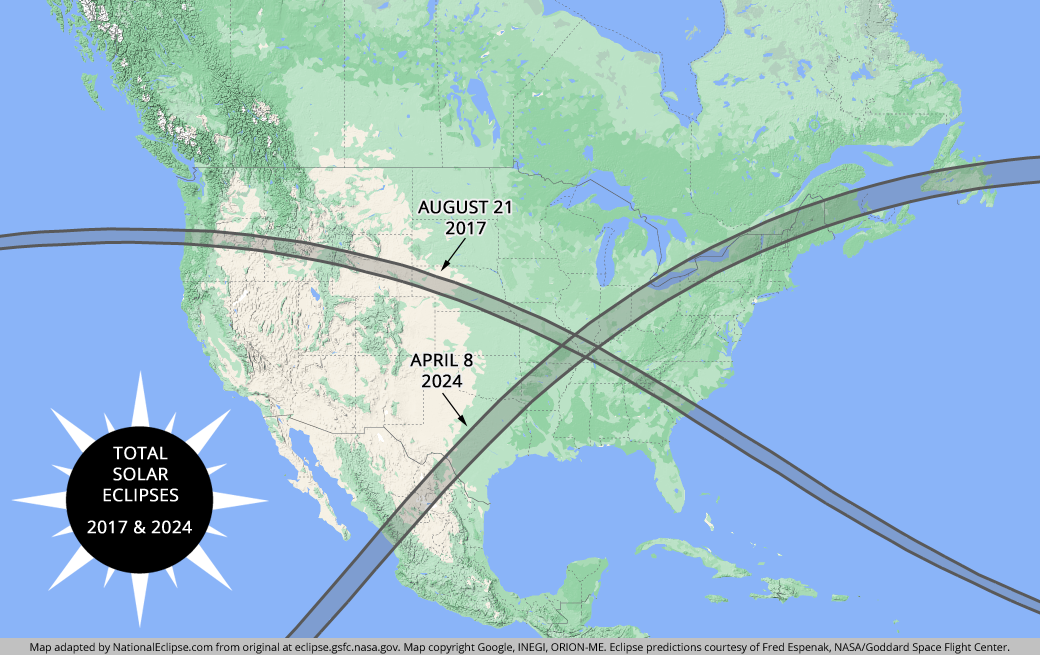
One of the things that people don’t probably realize is that there are actually eclipses of some kind, either partial or total, usually two every year. Sometimes there’s as many as three or four somewhere on the globe. But it could be like over the ocean and, you know, nobody sees it.
Q: Just the dolphins.
Cheney: Right. Where we are completely determines if we are actually going to be able to see one.
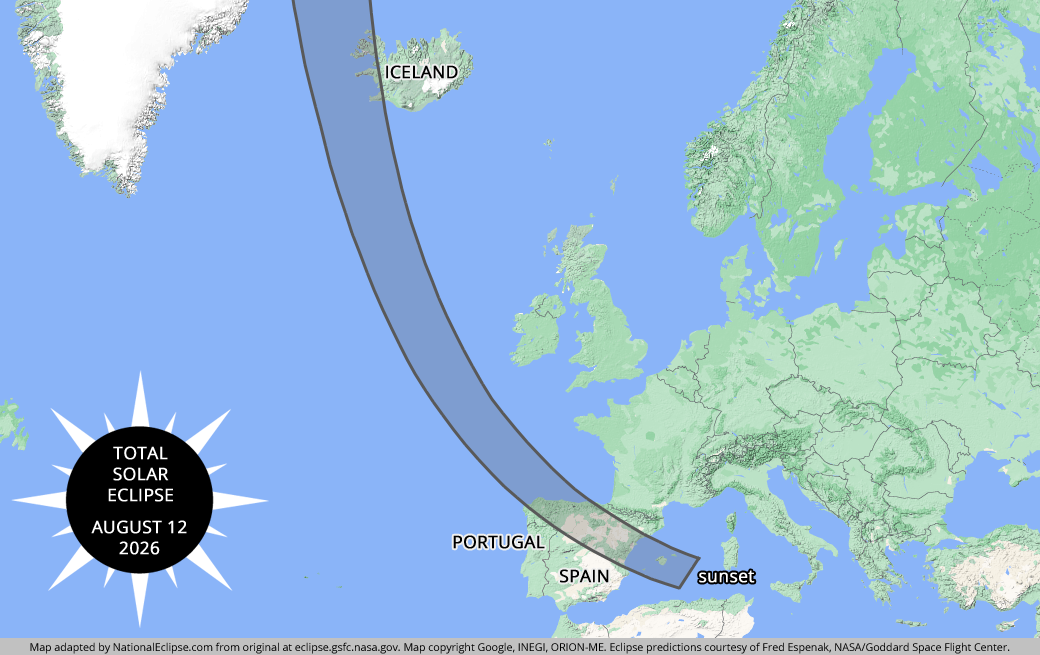
Q: In deeper scientific terms, what exactly are we going to be witnessing with the April 8 eclipse, in a few sentences?
Cheney: You have the sun and the moon and the Earth all basically in the same orbit. But the moon’s orbit around the Earth is slightly tilted. So it doesn’t actually happen in the same exact plane of rotation as does the sun and the Earth. Because of that, you [normally] don’t end up with a total solar eclipse.
What happens is the moon actually passing between the sun and the Earth. You can take a ball or anything like that and put it in front of a light and you see that there is a shadow that’s cast by that, right? So, the same thing is happening. And so because the sun’s light is so big, then the shadow that’s cast is little on the Earth. It’s not the same size. The moon is a fairly small thing. And that’s what we’re seeing. We’re seeing that as the moon passes in front of the sun. We’re seeing that shadow projected down onto the Earth. From our perspective, the moon’s actually completely covering the sun.
Q: In your opinion, is this eclipse something people should prioritize seeing and experiencing?
Cheney: Because there’s such a long time [leading] up to totality, there’s like little bits of time… You see the moon slowly progressing across the sun. So you can actually go out every 15 minutes and kind of take a look and see how far how it’s progressing, so you’re not just standing out there, whatever is going on. But I would definitely take the ten or 15 minutes around the time of totality and try to go out and observe that if you can, if there is a possibility to. I know there are some people are not going to be able to do that, but I would definitely go out and try to observe that if I’m in a total eclipse area or even the partial eclipses. I would take some time to go outside during that time and just take a look, you know. I think it’s very worth it.
How to experience the April 8 eclipse safely?
😎 Get your eclipse glasses from a trusted source.
🚗 Plan for increased traffic and follow parking signage.
👕 Dress for the weather, rain or shine.
📱 Download the NY State Parks Explorer App and “favorite” your intended park location for the latest eclipse updates.
Visit https://parks.ny.gov/eclipse for more information!
-Written by Lacey Seidman, Deputy Public Information Officer in Public Affairs with support from Conrad Baker, Kate Jenkins, Jennifer Robilotto and Angelina Weibel.
 New York State Parks and Historic Sites Blog
One thought on “What To Expect With the April 8 Eclipse, According to NASA ”