

With the weather warming up, people are itching to get out and enjoy all that New York’s state parks have to offer. Unfortunately, there’s another thing that might get them itching – the bite of a tick!
According to the Centers for Disease Control, as many as 476,000 people in the U.S. contract Lyme disease, one of several tick-borne diseases found in the Empire State, every year. Considering there are countless cases that go unreported, it’s important to be aware of ticks and how to avoid them as we go out and enjoy nature. Here’s some information about ticks, and some ways to avoid being bitten.

May Is Lyme Disease Awareness Month
Deer ticks are the vector species that carry and transmit Lyme disease. Adult deer ticks sometimes have higher rates of Lyme disease, but they can be found or removed due to their larger size before Lyme disease has a chance to be transmitted to a host, which usually takes about 38-48 hours.
Deer tick nymphs can also carry Lyme disease, and because they are so small (about the size of a poppy seed) they play a significant role in transmitting Lyme to humans. People who contract Lyme disease are often unaware they were bitten since the nymphs are so small. Because deer tick nymphs are usually active in May, this month is designated as Lyme disease awareness month. For more information about Lyme disease, check out the Centers for Disease Control and Prevention (CDC) website.
Tick Questing, Tricks, and Prevention
One of the best ways to avoid ticks is to avoid their habitats, which means sticking to trails when hiking. Ticks cannot jump or fly, and they do not climb trees to drop on unsuspecting hosts. Ticks usually live in shrubby vegetated areas, where there’s leaf litter or other humidity-retaining ground cover for them to hide in between host-seeking efforts, which is called “questing.” While questing, ticks usually crawl out to the edge of a leaf or blade of grass, holding out their arms in the hopes that an animal (or human) brushes by. They usually first come into contact with people between ground level and waist height, and climb their way up.
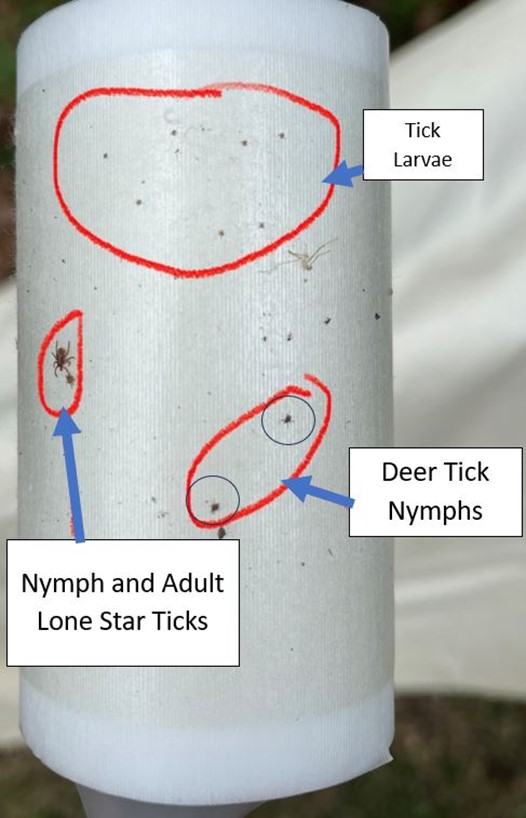
Using repellents and clothing treatments, as well as keeping your pants tucked into your socks and your shirt tucked into your pants, can keep them from getting to your skin. After a hike, it’s a great idea to give yourself a once-over with a lint roller to remove ticks that haven’t latched on yet. Even if you haven’t come into direct contact with tick-harboring vegetation, getting close can give ticks a chance to be pulled through the air using static electricity. They can also sometimes be found on the ground, so it’s important to check for ticks even if you stay on trail.
Safe Removal
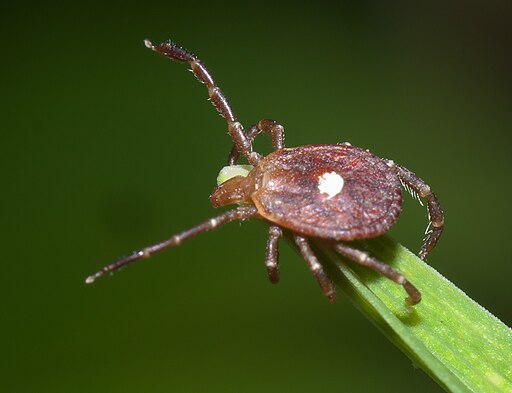
Tick bites sometimes happen even when we do our best to prevent them, so it’s important to know how to safely remove a tick. There are a few different tools out there that can be used to remove ticks, including the “tick twister,” “tick key,” or pointed tweezers. The main themes are to find them early, avoid squeezing the body, and pull them out by the mouthparts or head.

Never put petroleum jelly, heat or flame, or volatile substances like gasoline or alcohol on an attached tick. After removal, it is safe to sterilize the bite area with peroxide or alcohol.

Tick Management
Here at New York State Parks, we try to reduce staff and patron exposure to ticks by managing vegetation, educational outreach and signage, and in some cases, targeted pest management activities. One of those is the use of “four-poster” devices to treat white-tailed deer for ticks. Deer are a preferred host for adult ticks, and this device targets ticks that are attached to deer. That means we’re targeting ticks that are the most likely to successfully reproduce, specifically the adult female ticks that can produce hundreds of eggs each.
The devices are simple: deer are attracted to a feeding bin that dispenses corn, and while lowering their heads to access the corn, their ears and necks (which are tick hotspots) come into contact with paint rollers that are treated with permethrin. The permethrin kills the ticks on the neck and ears, and during grooming, the deer distribute the permethrin to other areas of their fur. By using this method, we target ticks during a crucial life stage, and avoid the effects of a spray pesticide that might harm beneficial insects.
It’s important to stay away from these devices if you see them. They’re meant to be worked on by pesticide professionals only, and the more often people are around them, the less often deer will be!

Tick Surveillance
I’ve been doing tick surveillance in the Long Island region of State Parks for about four years now, and I enjoy sharing the things I’ve learned with fellow staff and patrons. Surveillance is important for monitoring the efficacy of our management actions, and for keeping an eye out for range expansions of tick species, such as Asian longhorned ticks or Gulf Coast ticks. If you’re in a state park on Long Island, you might see me out and about in my survey gear, and you’ll never see me without a lint roller! I do my best to prevent myself from being bitten while collecting ticks for surveillance. I have to go off-trail and into remote areas where you wouldn’t expect to see someone, but don’t worry, I’m on official business!

If you’d like some more information about ticks, the University of Rhode Island has a great website. I hope you found this post interesting and informative, and that you stay safe and bite-free!
— Written by Orazio Marine, Deer Management Technician, Long Island
 New York State Parks and Historic Sites Blog
Man, I HATE ticks. You’re doing incredible work. Thanks!