All posts by New York State Parks

Happy Arbor Day

What is it about trees that can make you stop and look?

Is it the sunlight on the trunks of yellow birch that catches your eye – the bark silvery-gold and curling? Or the smooth gray bark of beech –  easy to look for scars from bear claws on this canvas. Or perhaps it is the rough platy bark of a shagbark hickory that intrigues you.  No matter what catches you about a particular tree, your gaze inevitably follows the trunk up it’s base, and continues upward into the canopy where the branches are silhouetted against the sky. The beautiful spectacle prompts many questions: How old is it? What has it been through? Are there any animals up there?

Of course, trees with showy flowers – like magnolia, cherry, or crabapple – always grab our attention. But all our broadleaf trees also have flowers, so look a little closer for those that are not so conspicuous. Among the first to flower in the spring are the maples, a hint of color in the treetops. Look for red tassels on red maple (Acer rubrum) or silver maple (Acer saccharinum) or green on sugar maple (Acer saccharum). Norway maple (Acer platanoides) has larger yellow-green flowers. Take a closer look at these little bouquets; you can usually find clusters that have fallen to the ground.

Red maple_Donald Cameron_One time use for this blog
Red maple (Acer rubrum) flowers. Photo by Donald Cameron 2017, GoBotany, used with permission.

A nice tree to look for in the spring is serviceberry, also known as shadbush (Amelanchier canadensis and A. arborea). Its delicate white flowers show up long before the other trees leaf out, so you can spot these trees more easily in spring than in the summer. There are also several shrub species of Amelanchier in NY State, all with similar flowers.

And later in the season, in May-June, look for the straight-as-a-pole tulip poplar (Liriodendron tulipifera) whose flowers look like yellow-green tulips!

Trees become a busy place in the spring too. Bees and other insects feed on the nectar and pollen of the flowers above. Woodpeckers search for insects under the bark and many animals hide out or make their home in tree cavities – bats, owls and other birds, raccoons, squirrels, and porcupines. Bears climb trees for safety and sometimes curl up in the base of big hollow trees. With all that activity, trees are a good place for wildlife watching, whether in your neighborhood or in a state park or historic site.

Birding at Minnewaska_Jubilee Feist
Binoculars are good for watching wildlife and also for getting a better look at the trees. This volunteer was making a list of birds at Minnewaska State Park Preserve on I Love My Park Day.

NY State Parks are home to countless beautiful trees.  Look for many mature and outstanding trees around the mansions and other historic sites, at campgrounds and picnic areas, and in the forests that cover nearly 80% of State Park lands. Get out and enjoy the trees on Arbor Day – and every day – in your neighborhood and favorite parks.

Post by Julie Lundgren, NY Natural Heritage Program. Photos by NYNHP or other as noted; for use by permission only.

Exploring New Netherland

In December 2016, members of the Dutch Consulate, including Consulate General Dolph Hogewoning; the Deputy Consulate General, Jan Kennis, and Cultural Officer Tessa Dikker, toured Schuyler Mansion State Historic Site and Crailo State Historic Site (Crailo).

Their visit to Albany was part of a larger effort to promote Dutch history, heritage, and culturally connections globally.  The group met with several directors of cultural institutions that connect the story of the Dutch locally; explored promotional efforts and plans to improve information sharing.  State Parks Division of Historic Preservation Director Michael Lynch shared information about State Parks’ resources at five Dutch related state historic sites.

During their visit, the consulate staff was invited to return to the Capital Region to experience the first Pinkster event at Crailo, tour the new exhibit at Senate House State Historic Site, and visit Philipse Manor Hall and Clermont State Historic Sites to explore even more Dutch connections.

State Parks hopes that the visits will be the start of a strong and lasting relationship with the Dutch consulate, including enhancing the connections with scholars in both the Netherlands and the United States.

Exhibits
Touring the exhibits at Crailo State Historic Site, (left to right) Deputy Consulate General, Jan Kennis, Cultural Officer Tessa Dikker, Crailo Site Manager Heidi Hill, and Consulate General Dolph Hogewoning, photo by State Parks

Featured image: Consulate General Dolph Hogewoning and Deputy Consulate General Jan Kennis discuss the Schuyler family with Heidi Hill at Schuyler Mansion State Historic Site, photo by State Parks

Unseen Buds

We salute National Poetry Month with a poem by Walt Whitman, the 19th century poet whose birthplace is a New York State Historic Site.

UNSEEN BUDS

Unseen buds, infinite, hidden well,

Under the snow and ice, under the darkness, in every square or

cubic inch,

Germinal, exquisite, in delicate lace, microscopic, unborn,

Like babes in wombs, latent, folded, compact, sleeping;

Billions of billions, and trillions of trillions of them waiting,

(On earth and in the sea – the universe – the stars there in the

heavens,)

Urging slowly, surely forward, forming endless,

And waiting ever more, forever more behind.

Walt Whitman, Leaves of grass, 1891-1892

Take some time this month to see the poetry in the unseen buds and early spring flowers in a state park or historic site near you.

Owl Pellets: An Answer to the Question, “What Was for Dinner?”

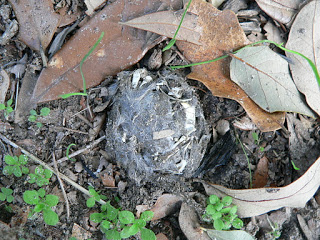
Walking through the forest, especially under big trees, you might come across something rather interesting on the ground beneath you.  It’s pretty small and dark colored.  Maybe it’s a pine cone?  Looking closer, you notice this peculiar item is covered in fur, but is obviously not alive.  You poke it with a stick and notice it’s a little squishy.  Maybe it’s animal scat?  You peer even closer and notice that it might even have some small bones sticking out.  What you may have found is an owl pellet.

Owl Pellet_JACE STANSBURY
Owl pellet on the forest floor, photo by Jace Stansbury

Owls are a bird of prey, which means they hunt other animals.  They rely on their excellent vision and even better sense of hearing to locate a meal.  Their feet are armed with sharp claws, or talons, that latch onto prey.  Instead of having sharp teeth like mammal predators such as coyotes and bobcats, owls have a sharp, down-curved beak that helps them eat meat.

When an owl eats another animal it usually swallows that animal whole.  However, not every part of the ingested animal can be digested by the owl.  The second of two stomachs in the owl’s digestive system is able to separate the digestible parts from the non-digestible parts of their meal, which includes fur, hair, bones, and teeth.  These non-digestible parts are then packed tightly into a neat package inside the owl’s stomach and later regurgitated, almost as if the owl is throwing up.  Because the pellet partially blocks their digestive system, an owl usually can’t swallow new prey until it expels the pellet made from the last one.

Pellet_Philip R Brown
Small owl pellet, photo by Phillp R. Brown

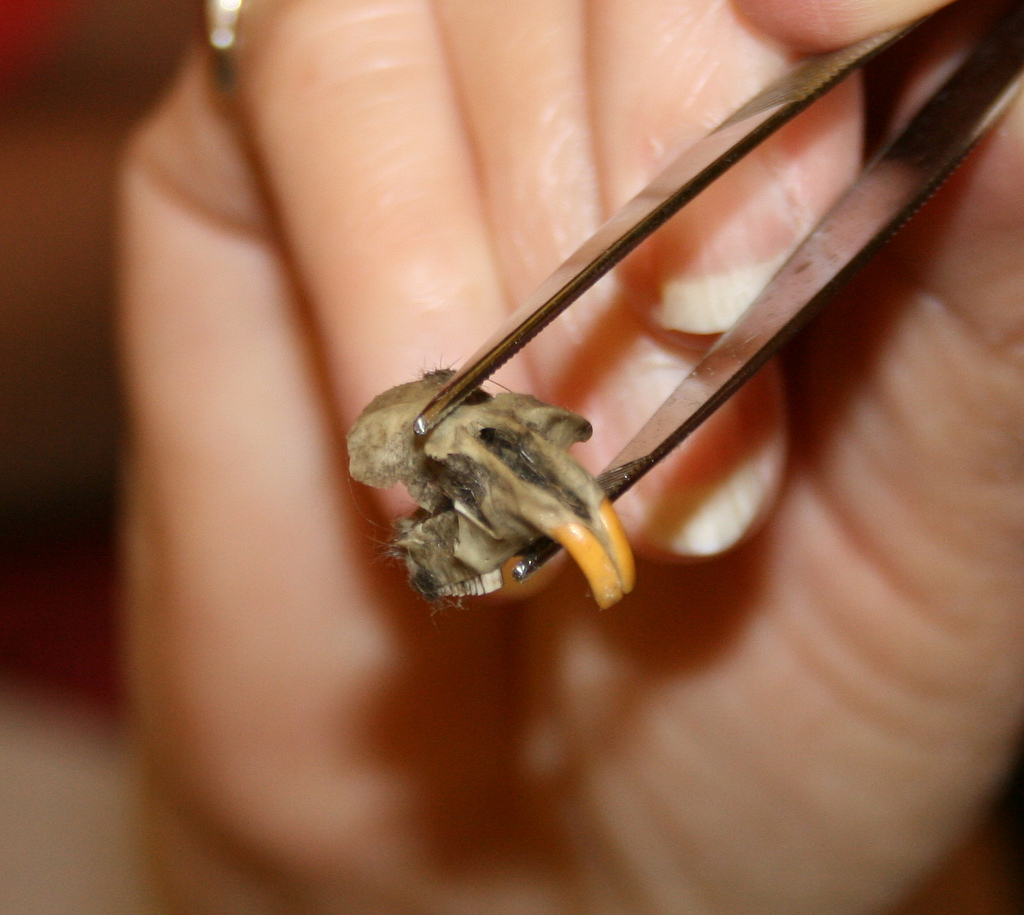
What is so fascinating about owl pellets is that the bones inside them can be identified.  This helps us learn what owls like to eat!  Some things to look for in a pellet to help you identify an owl’s prey are the jaws of rodents, which should have the long (usually orange) front teeth, and bird beaks or feet.  Unless you can see feathers in the pellet, bones are typically the best way to identify their prey.  Other bones that can usually be identified include the pelvis, femur (upper leg bone), humerus (upper arm bone), and scapula (shoulder blade).

Jason Bottom
Rodent skull found in an owl pellet, photo by Jason Bottom

In the winter and early spring, a good place to look for owl pellets is under evergreen trees.  Why?  Because owls tend spend most of their time in evergreen trees in winter because they provide the best cover to stay hidden from other birds that might harass them during the day.  So the next time you are in the forest, be on the lookout for owls in the trees, and their pellets at your feet!

Barred Owl, Eastern Screech Owl, Great Horned Owl, and Northern Saw-whet Owls are the most common species of owl in New York State.  Snowy Owls, Barn Owls and even Great Gray Owls may be seen irregularity in New York as well.  More information can be found here.

Post by Elijah Kruger, State Parks

Featured image: Barred owl by Lilly Schelling, State Parks

American Robin – Nature’s Harbinger of Spring

The last snow on the ground has finally melted away. It’s early spring. The first hints of warmth are beating down from the sun. Life, for as long as you can remember, has been cold and white… has it been 6 weeks? No, maybe 2 months… longer? Who knows how long it has been since you’ve seen green grass, but it is a glorious sight. The bright green of new growth surrounds you. You finally get a chance to sit out on your back deck with a nice cocktail after work when all of a sudden you hear a “whinney” from a tree in your side yard… you know this sound. It means spring is officially here. And as if it knew you were thinking of it, a flash of orange descends onto your yard on a mission for a tasty treat.

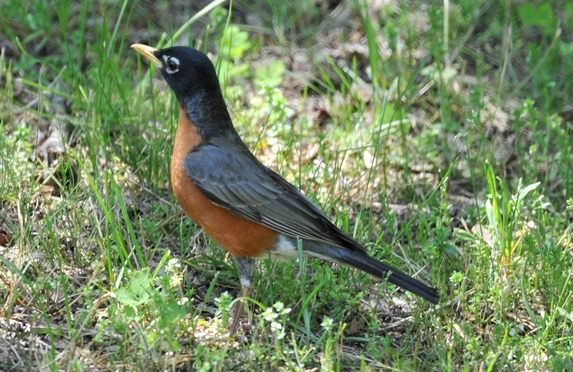
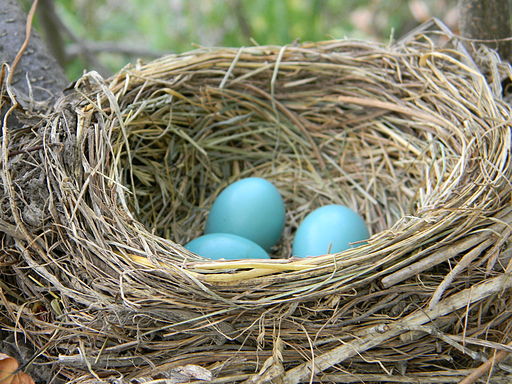
The American robin, Turdus migratorius (Latin for migratory thrush), is the first sign of spring for many in northern North America. Though its range stretches south into areas where it can be viewed year around, it is typically one of the earliest birds to lay its eggs during the spring breeding season. These resourceful thrushes make their nest out of anything from paper to twigs. They will smear mud to hold the nest all together and often will make a soft lining out of grass. A protected and safe nesting site can sometimes produce up to three broods with multiple chicks in one year.

American_Robin_Nest_with_Eggs
Robin eggs, photo by Laslovarga (Own work) [CC BY-SA 3.0 (http://creativecommons.org/licenses/by-sa/3.0)%5D, via Wikimedia Common
With a sleek gray to brown back and head and a rusty orange chest and belly, there isn’t any other bird in North America that can really be mistaken for an American robin. When in flight, a white patch under the tail and lower belly can be noticed. Sexual dimorphism, or the visual difference between male and female, within this species isn’t very noticeable, but the female does tend to have a more pale head.

This large member of the thrush family uses a wide range of habitats from wide open spaces like lawns and tundra, to neighborhoods with scattered trees and shrubs, as well as deciduous and evergreen woodlands. Robins are often found hopping along or standing erect on a lawn searching for invertebrates, such as earthworms or grubs, but can also be seen in bushes and trees feeding on caterpillars, fruits and berries. Typically, a robin’s diet changes throughout the day, with more yummy earthworms in the morning — thus the phrase “the early bird catches the worm” — and more delectable berries in the afternoon. During the late fall and winter months, they often gather in large flocks (sometimes numbering close to 250,000 individuals!) to eat berries and roots that are still available. Sometimes, when winter flocks feed exclusively on crabapples or honeysuckle berries, they can become intoxicated due to the fermentation of sugars in the berries! When birds become intoxicated from fermented berries, most are just a bit tipsy and you might not be able to notice any signs. However, when some birds overdo it, they may have trouble perching, hopping/walking, and controlling their flight, often crashing into branches and each other. Sadly, this also includes crashing into larger obstacles, like buildings, which can lead to the bird’s death.

Cousin to the musical hermit thrush and wood thrush, the robin is also an impressive songster. However, as one of the first birds to sing at dawn – or predawn – they make many a camper grumpy from the early wake-up call. The song is a loud, repeated musical whistle that ascends and descends through a series of notes. They have a variety of calls ranging from an alarm ‘yeep chuck’ to a loud ‘whinney’. To hear their songs and calls, or to learn some more cool facts about American Robins, visit The Cornell Lab of Ornithology website.  Get started by listening to robins call below.

Some interesting tidbits:

  • Only 40% of nests produce offspring
  • Only 25% of young robins survive the first year
  • The average lifespan is 2 years; longest known is 14 years
  • State bird of Connecticut, Michigan and Wisconsin
  • They occur across almost all of Canada and the United States
  • Known to winter as far south as Mexico, the Gulf Coast, and Cuba
  • Was featured on the Canadian $2 bill (no longer in use)

Post by Matt Brincka, State Parks