Category Archives: Flora & Fauna

Rare or noteworthy wildlife spotted in New York State Parks

Things That Go Squawk In The Night

Ooo Halloween is just around the corner. Soon you may be venturing outdoors at night for trick-or-treating or a cool evening stroll. While you are outdoors you just might hear an eerie squawk, squeak, or snort coming from the woods. What is making that sound? In the darkness it is impossible to see, but if you pause for a moment and listen, you might be able to figure out what animal made the sound.

Some familiar autumn night sounds include:

Field Cricket, By Cody Hough (Own work) [CC BY-SA 3.0 (http://creativecommons.org/licenses/by-sa/3.0) or GFDL (http://www.gnu.org/copyleft/fdl.html)], via Wikimedia Commons
Field Cricket, By Cody Hough (Own work) [CC BY-SA 3.0 (http://creativecommons.org/licenses/by-sa/3.0) or GFDL (http://www.gnu.org/copyleft/fdl.html)%5D, via Wikimedia Commons
The male Field Cricket song is a series of short chirps, 2-3 per second. Each chirp consists of 3-5 pulses, which are made when he closes his forewing (front wing). Male crickets call from burrows or cracks in the soil. If Halloween is a warm evening, crickets may be calling in fields and other grasslands. Listen to field crickets.


Spring Peeper, Lilly Schelling, NYS OPRHP

Male Spring Peeper frogs normally sing their sleigh bell like mating call in spring, but a few will also sing in the fall in woodlands near small ponds or wetlands. Listen to spring peepers.

More unfamiliar sounds include:

Eastern Screech Owl, By Greg Hume (Own work) [CC BY-SA 3.0 (http://creativecommons.org/licenses/by-sa/3.0)], via Wikimedia Commons
Eastern Screech Owl, By Greg Hume (Own work) [CC BY-SA 3.0 (http://creativecommons.org/licenses/by-sa/3.0)%5D, via Wikimedia Commons
Screech Owls are little owls (about 8” long) that pack a loud call! In 1845 Henry David Thoreau described the call of the screech owl as “A most solemn graveyard ditty, the mutual consolation of suicide lovers remembering the pangs and delights of the supernal love in the infernal groves, …… Oh-o-o-o, had I never been bor-r-r-n.”
Our only small owl with ear tufts, both males and females screech owls sing. A common sound is “an even-pitched trill, often called a “bounce song” or tremolo; and a shrill, descending whinny.” (All About Birds, Screech Owl). Occasionally mated pairs will sing to each other. Listen to a screech owl.

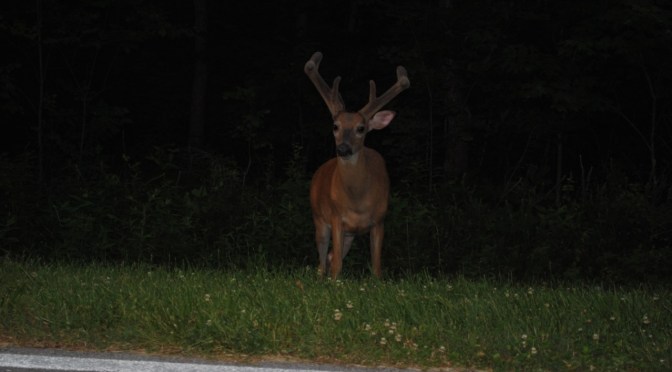
White-Tailed Deer, Lilly Schelling, NYS OPRHP

The otherwise mute White-Tailed Deer will snort when startled. Listen to a white-tailed deer snort. This is one of the few sounds that deer make. Bucks use a series of wheeze-grunt-snort to assert dominance during the breeding season and does and fawns communicate through bleats and grunts.

Raccoon, By D. Gordon E. Robertson (Own work) [CC BY-SA 3.0 (http://creativecommons.org/licenses/by-sa/3.0) or GFDL (http://www.gnu.org/copyleft/fdl.html)], via Wikimedia Commons
Raccoon, By D. Gordon E. Robertson (Own work) [CC BY-SA 3.0 (http://creativecommons.org/licenses/by-sa/3.0) or GFDL (http://www.gnu.org/copyleft/fdl.html)%5D, via Wikimedia Commons
Raccoons, those masked, ring-tailed animals, produce a Variety of vocalizations including screams, growls, and whistles. One sound is similar to a screech owl’s call. Listen to a raccoon.


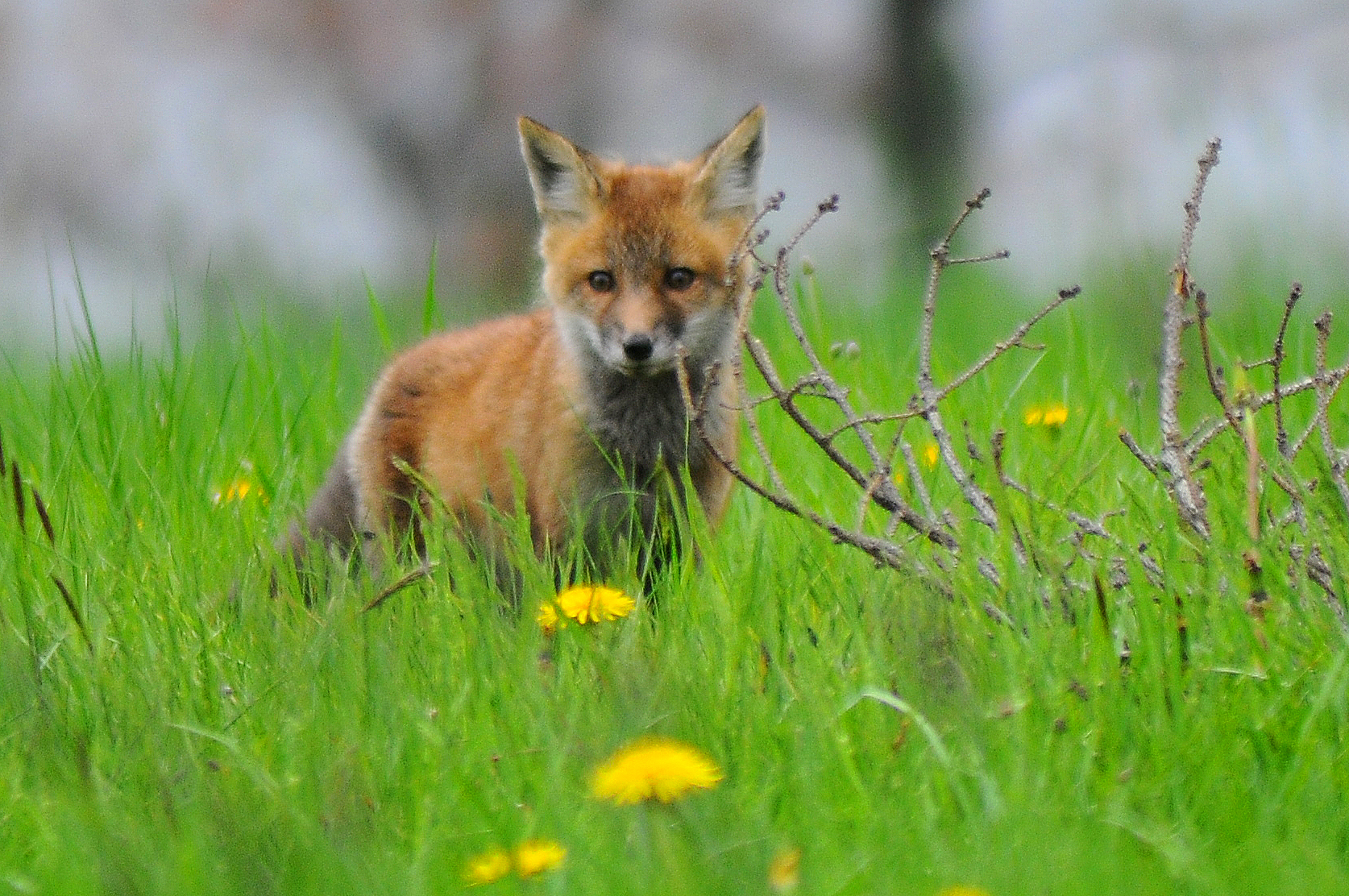
Red Fox Kit, NYS OPRHP

Adult Red Foxes make 12 different sounds; kits, baby foxes, make eight different sounds. These sounds span five octaves and are divided into contact calls and greeting calls. Contact calls, sounds made when foxes are at a distance from one another; start off as a “wow wow wow.” As the foxes get closer, the call changes to a three-syllable call that sounds similar to clucking chickens.
A submissive fox will produce a shriek or high-pitched whine when it greets a dominant fox. And during breeding season males and females may emit a rejection call – a rattling throaty sound termed “gekkering.” Listen to a red fox.

Sources:

Cornell Lab of Ornithology All About Birds http://www.allaboutbirds.org/
Cornell Lab of Ornithology Macaulay Library, http://macaulaylibrary.org/
New York State Department of Conservation, http://www.dec.ny.gov/animals/263.html
Wikipedia, https://en.wikipedia.org/wiki/Main_Page

Post by Susan A Carver, OPRHP.

Painted Turtles of Point Au Roche State Park in Clinton County, New York

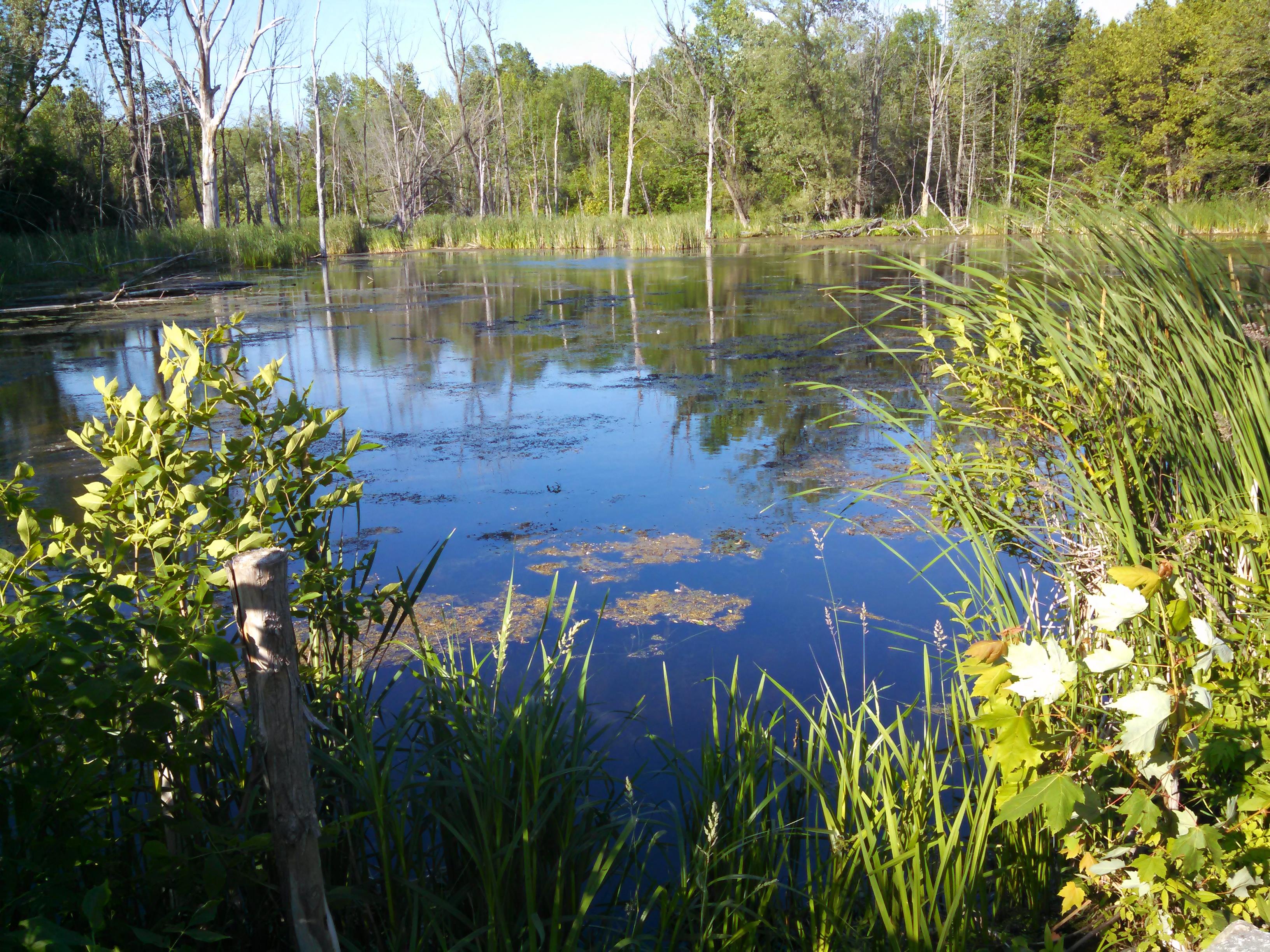
Lower pond site at Point au Roche Park where all 4 turtle hoop traps are set. (Danielle Garneau)

Point Au Roche State Park is a beautiful and diverse park with a lot to offer visitors. By visitors we’re talking both the reptile and human kinds.  Not only does the park offer spectacular views of Lake Champlain for park visitors, it also provides great habitat for painted turtles!

Beginning in September 2012, two SUNY Plattsburgh students and Professor Danielle Garneau began their first field experience handling painted turtles. The goal of the project was to compare sex ratio and age structure of turtle populations in both urban, as well as rural ponds in Clinton County, New York. This research is part of the Ecological Research as Education Network’s (EREN) on-going TurtlePop project that is a collaboration among numerous colleges across the country.

Participants perform the same experimental protocol to determine if a greater number of adult males exist within urban turtle populations, and if this is a nationwide trend. The decline in young females is thought to result from their high rate of road kill when laying eggs at roadsides. An additional cause of death for urban painted turtles is an increase in the abundance of mesopredators (e.g., skunks, raccoons, opossum, foxes) who raid nests for eggs. Since starting, the TurtlePop project has offered field research experiences to many SUNY Plattsburgh students.

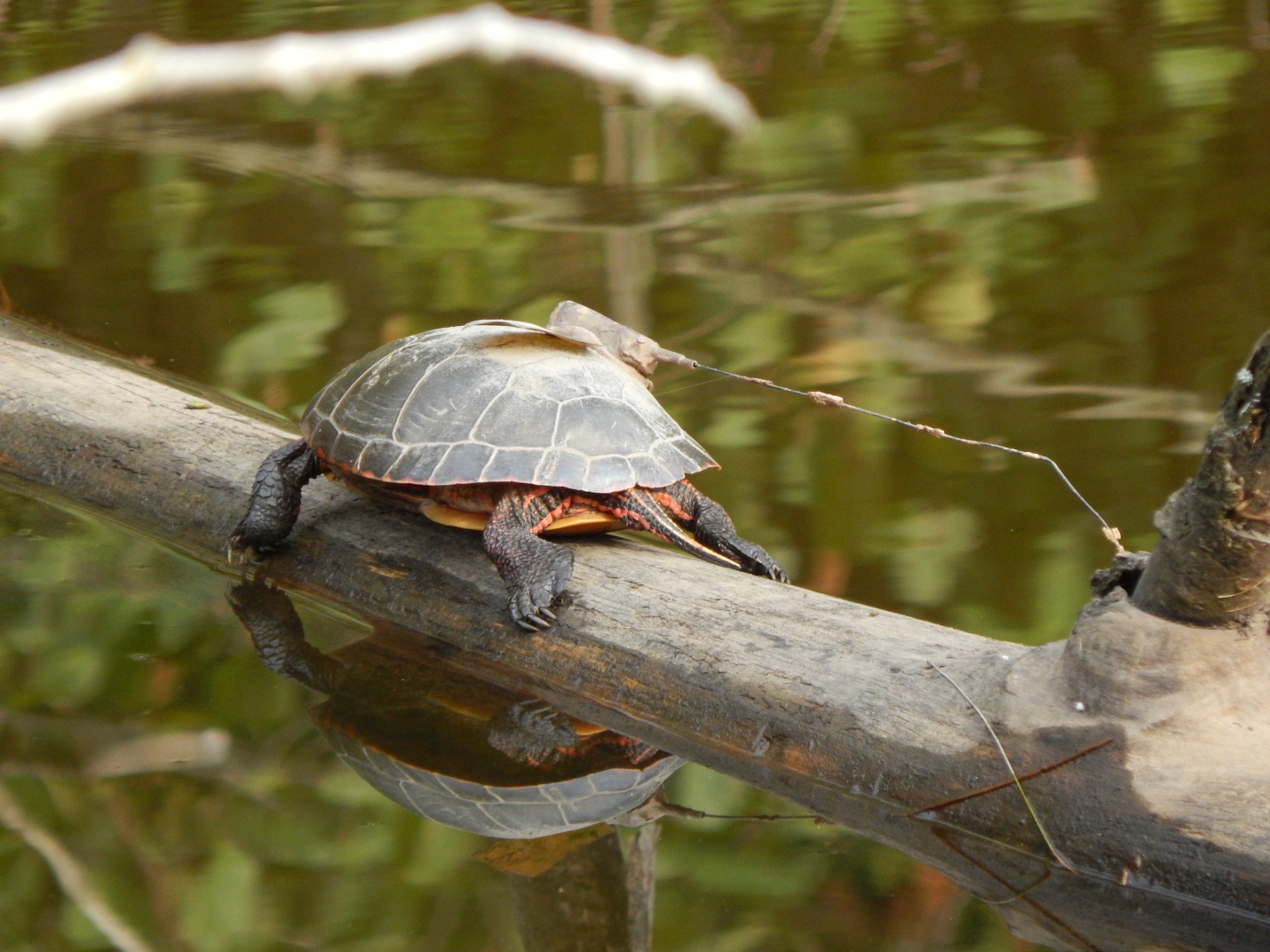
Painted turtle basking on a log with VHF transmitter glued to carapace (top of shell) at the golf course site (urban). Transmitters are used to track animal locations and note movement behavior, nest site selection, and overwintering spots. Note the shedding of scutes (keratin layers) on the top of the turtle shell, which occurs in the middle of summer as turtles grow. Days later this transmitter device fell off the turtle and was relocated along the pond shore. (Danielle Garneau)

About a year into the project, as participants grew ever more curious, a radio-telemetry dimension was added by placing a VHF transmitter on the top of turtle’s shells in order to monitor their movement around a gold course pond complex (urban site) in the city of Plattsburgh. Findings suggest that city turtles do not tend to wander far from the shores of their pond and commonly used basking sites (e.g., downed trees, rocks).

In the summer of 2015, with the help of Point Au Roche State Park Naturalist and SUNY Plattsburgh Ecology alumnus Gillian Dreier-Lawrence, park visitors and college students had the opportunity to participate in and contribute to this growing collaborative research effort at Point Au Roche State Park. We are learning that Point Au Roche State Park has high turtle abundance; approximately 33 individuals were caught over three months of trapping in the lower ponds. Plans to further investigate the turtle population at Point Au Roche are in the works, as the  large number of turtles found indicate that  the population size at the park is likely quite large, only 11 marked turtles have been recaptured so far!

Post by Danielle Garneau, Associate Professor at SUNY Plattsburgh

Useful websites:

http://www.nysparks.com/parks/30/details.aspx

https://www.facebook.com/Friends-of-Point-au-Roche-State-Park-116729181851239/timeline/

http://erenweb.org/new-page/turtle-pop-project/

https://www.facebook.com/#!/ErenTurtlePop?fref=ts

Note: All photos were taken by Danielle Garneau and permissions are granted to use in press.

The Mysteries of Fall Foliage Revealed

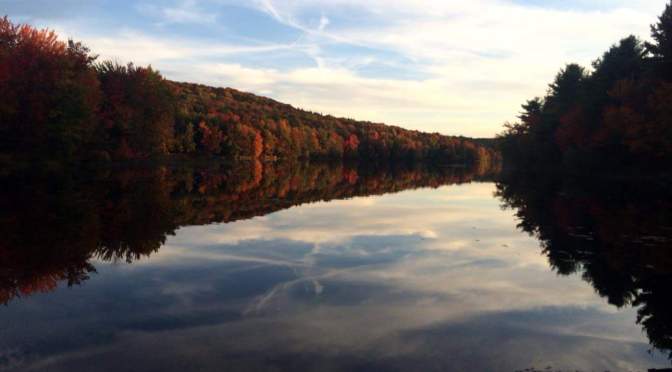
Have you ever wondered what makes the leaves change color in the fall? Or why some years are more vibrant than others? It is quite a fascinating phenomenon, and it all starts with the seasonal temperature and day light hour change. In the fall, the days become shorter and the evenings become cooler. This is what triggers deciduous trees (trees that lose their leaves in the winter) to begin their process of preparation for the winter months to come. This is also why the foliage changes color around the same time every year.

abcission layer
Photo of abscission layer and leaf detachment. Photo by Lilly Schelling.

It starts with the expansion of the abscission layer between the stem and leaf, which slowly blocks the movement of water and sugar back and forth between the leaf and stem. This causes the leaf to lose the ability or resources to replenish chlorophyll, which gives leaves their green coloration. The chlorophyll rapidly breaks down and we are left with xanthophylls and carotenoids, which are responsible for the yellow and orange pigments you see on trees like aspen and birch. These pigments are usually present in the leaf throughout the growing season but are masked by the green pigment of the chlorophyll.  Anthocyanins are responsible for red and purple coloration and are created by the buildup of sugars trapped in the leaf. As fall progresses into winter all of the other pigments break down, as the chlorophyll did, and the only pigment that remains are the tannins, which are responsible for the brown color of the fallen leaves – though some trees retain their brown leaves throughout the winter, such as oak and beech.

Factors that affect the color and duration of fall foliage are temperature, sunlight and moisture. Ideal conditions for colorful fall foliage are a good growing season followed by dry, warm, sunny days and cool nights. If there was stress in the growing season, such as a drought or flood, the abscission layer may form early and the leaves will fall off before changing color. Additionally, too low of temperatures (freezing) in the beginning of fall will rapidly break down the products responsible for bright colors and the only pigment left will be brown. Other factors that can affect colorful fall foliage are heavy rain and windy storms, as these conditions will cause the leaves to fall.

When you are out admiring the fall colors this year, try to identify which pigment products are responsible for the colors you are seeing on the trees. A great way to view the fall foliage is from a canoe or kayak, but remember to wear your personal floatation device as the water will be chilly! The New York Fall Foliage Report is a great tool for tracking the color changes across the state: http://www.iloveny.com/seasons/fall/foliage-report/#.VgQGwstVhBd.

References:

The United States National Arboretum

Post by Lilly Schelling, OPRHP.


The Folklore of the Woolly Bear

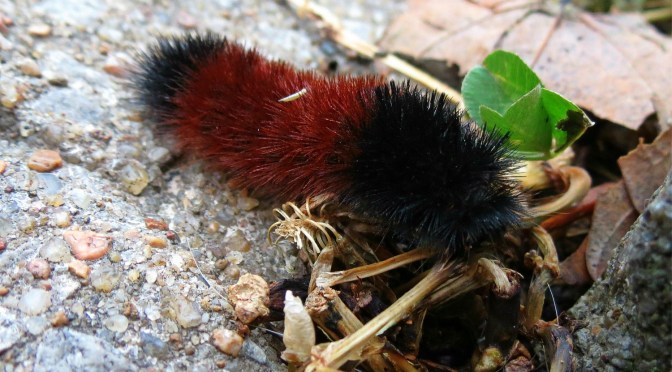
Finding a banded woolly bear caterpillar during a walk in the woods leaves no doubt that autumn is upon us.  These familiar black and reddish-brown caterpillars are larval Isabella moths.

The woolly bears that we see in the fall are the second generation of woolly bears for the year; the first generation hatched out in May.  This second generation of woolly bears emerged back in August.  Since then , they have eaten leaves from a variety of plants from grasses to clover to trees and sunflowers.  Once the cold weather hits, the woolly bear finds a sheltered spot like rotted log, or under a rock, or in a pile of leaves, to overwinter. When the temperatures drop below freezing, woolly bears also freeze.  Fortunately woolly bears have a cryoprotectant, a natural sugar-based antifreeze which protects the caterpillar’s tissues from being damaged when it freezes.  In spring, woolly bears emerge from their sheltered spot, eat a few more leaves then make their cocoons and undergo metamorphosis to become an Isabella moth.

Moth
By Andy Reago & Chrissy McClarren [CC BY 2.0 (http://creativecommons.org/licenses/by/2.0)%5D, via Wikimedia Commons.
Folklore has it that woolly bears predict the severity of the upcoming winter based on the proportion of black and reddish brown banding on the caterpillar’s body.  A thin reddish brown band means we are in for a tough winter.

But is this folklore true?  Dr. C. H. Curran, curator of insects at the American Museum of Natural History in New York City (1928-1960) traveled to Bear Mountain State Park in 1948 to find out.  On a single day, he gathered as many woolly bears as he could find, compared the reddish brown segment to the black segment, then reported his findings and a winter weather prediction to a reporter at the New York Herald Tribune.  Dr. Curran continued his study for eight more years and was never able to conclude whether the woolly bear was able to predict the winter.

More recently scientists have found that the size of the reddish-brown band increases as caterpillar matures and that wet weather increases the size of the black bands.

While woolly bears may not be an accurate forecaster of the upcoming winter, they are still a delight to see during a visit to a park.  Perhaps you’ll see one curled in a ball or looking for the next leaf to eat.

Post by Susan Carver, OPRHP.


Sammi’s Story

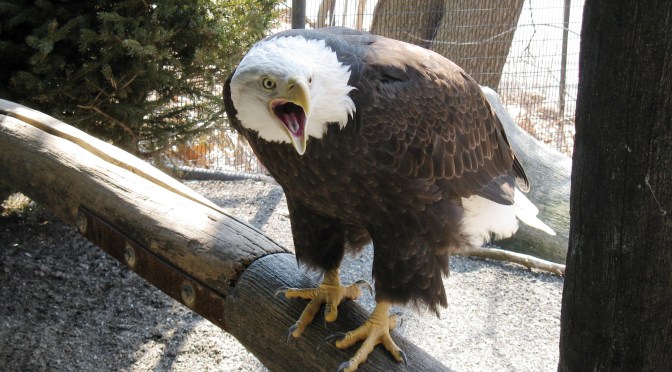
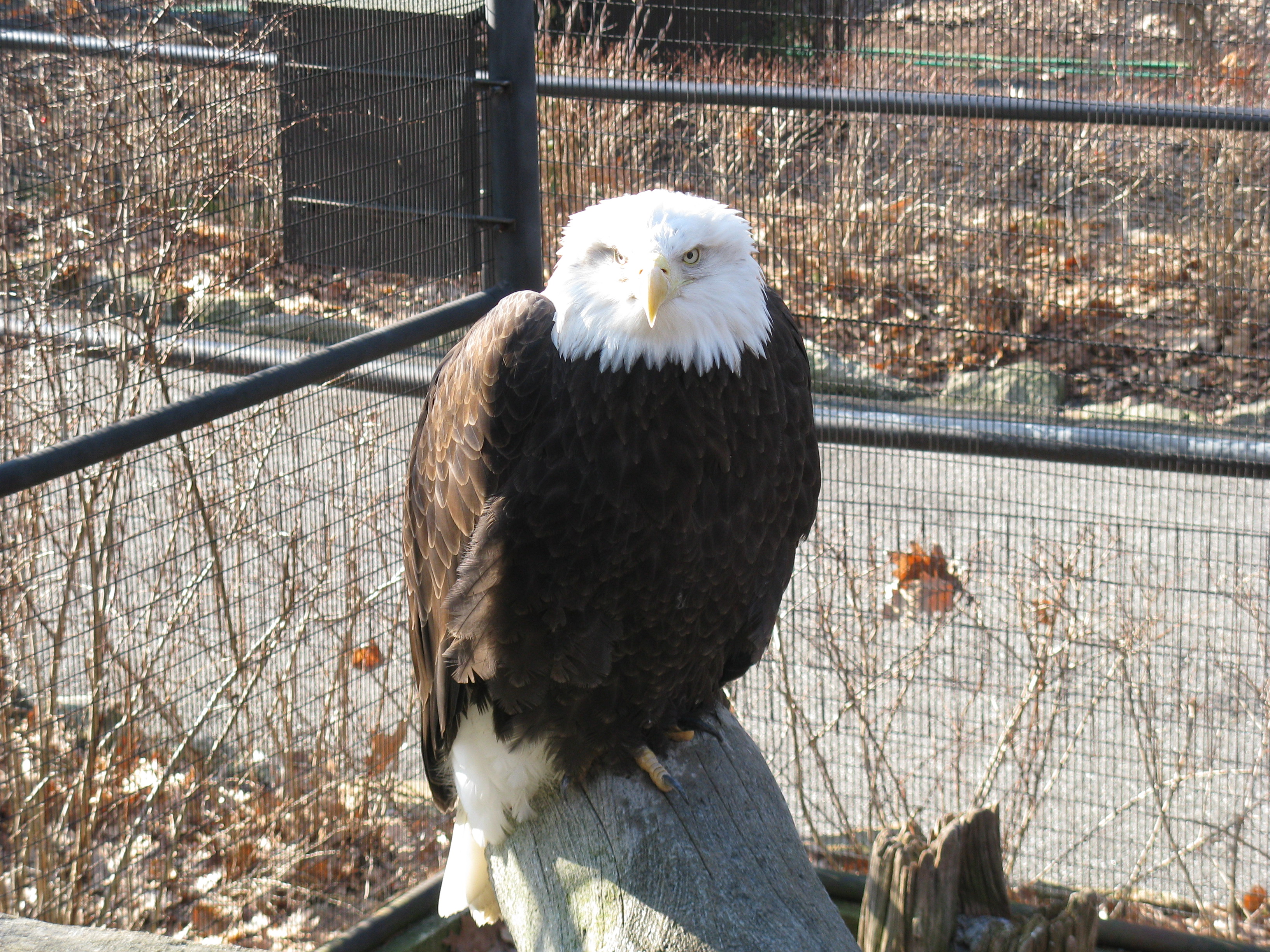
Up close observations of bald eagles are rare and usually reserved for biologists and dedicated naturalists, however if you have been to Trailside Museums and Zoo at Bear Mountain State Park over the last 30 years, then you have probably had an intimate encounter with Samantha, our impressive resident bald eagle. Affectionately known as Sammi, she has been greeting visitors since 1985.

Her story began in southeastern Alaska in the early spring of 1984. In the nest, her mother laid two eggs several days apart. Both parents took turns keeping the eggs warm and hunting for food. About thirty-five days later, Sammi and her sibling hatched from the eggs. Mom and Dad hunted continuously to feed their very hungry baby eaglets and themselves. The eaglets grew bigger and stronger and soon they would be getting ready to learn to fly, also known as fledging.

Meanwhile, Research Scientist and Endangered Species Unit Leader Peter Nye and a team of biologists from the New York State Department of Environmental Conservation’s (DEC) Endangered Species Unit had traveled to southeastern Alaska. As part of New York’s Bald Eagle Restoration Project, they collected nestling bald eagles from 1976 through 1989, restoring New York State’s declining eagle population, which had been decimated by hunting, habitat destruction and widespread use of the pesticide DDT. On July 17, 1984, Mr. Nye climbed up Sammi’s tree and collected her and her sibling. They were put into crates and transported, along with 30 other young eagles, back to New York State.

Sammi and about half of the eagles were transported to a site in the Adirondacks, while the others went to a site in Albany County. The young eagles were raised to independence through a process called hacking. Living in artificial nests, called hacking towers, they were fed by hidden human hands, until fully feathered, when they were released to learn to fly and hunt from the towers. Sammi was released on August 31, 1984. She fledged from the tower on September 2 and returned to it on September 7. She left the hacking area entirely on September 20. DEC personnel last had contact with her on November 2 on Sacandaga Reservoir, near Northville, NY. Winter was coming, so Sammi migrated south.

Unfortunately for Sammi, she would barely get to know the usual rewards for migrating south, warmer weather and open water for fishing. She was found injured on the ground on December 27 in Woodleaf, North Carolina by a private citizen. She was taken to Dr. Brown of the Carolina Raptor Rehabilitation Clinic, where it was discovered that she had been shot with a .22 caliber firearm, which broke one metacarpal in her right wing. Dr. Brown and his staff spent an extensive amount of time and effort trying to rehabilitate her, but to no avail. Even with surgically placed pins and replacement of dead bone, the damage was irreversible. She was returned to New York on April 17, 1985, where Dr. Edward Becker surgically removed the right wing at the wrist joint.

Samantha was transported to Trailside Museums and Zoo on May 10, 1985 on a permanent loan as an educational specimen. She is a very proud and feisty bird, keeping the zookeepers on their toes whenever they have to enter her enclosure. She keeps her feathers very well groomed and always seems to maintain an aura of majesty. It is difficult not to utter an ‘ooh’ or an ‘ah’ when coming upon her. She can be very vocal, delighting and sometimes startling passersby with her piercing call. While we know that Sammi would much rather have spent the last 30 years living her life in the wild, she remains an excellent ambassador of her magnificent species, providing daily lessons on power, grace and hope. The Bald Eagle Restoration Project was an astounding success. There are now more than 170 pairs of bald eagles nesting in New York State.

IMG_0260

Photos courtesy of Palisades Interstate Park Commission.

Sources:

Post by Chris O’Sullivan, Environmental Educator at Trailside Museum and Zoo at Bear Mountain State Park.