Category Archives: Park Personnel

Forest Health Specialists: Climbing in Pursuit of Invasive Insects

Forest Health Specialists are an important part of New York State Park’s Invasive Species Management Team. Their work helps protect native plants, wildlife  and forests that are currently being threatened by two non-native invasive species: Hemlock Woolly Adelgid (HWA) and Emerald Ash Borer (EAB). Although these insects are very different from each other in appearance and behavior, they both cause significant destruction and mortality to their host trees.

What do Forest Health Specialists Actually Do?

The Forest Health Specialists are seasonal employees that travel throughout New York State conducting invasive species surveys and monitoring infestations in various Parks. They have training in field biology, forestry, and tree climbing. The team of two camps at the park of interest while completing their work. Surveys involve lots of hiking and investigating trees that look to be in poor health, taking photos, and recording information on location and observations made at each site.

Although hiking in the woods isn’t a bad way to spend a work day, monitoring infestations of HWA is where the job really gets interesting. Specialists need to collect canopy samples from hemlock trees in order to see if insect numbers are declining or increasing. So, using a giant 8-foot slingshot, a line is shot high into the tree to a branch anywhere between 50 to 90 feet above the ground. Then a climbing rope is attached and pulled into the canopy and the fun begins! The Specialist, equipped with a harness and two ascenders (the name for special clips), climbs the rope upwards into the treetop. Climbing can be highly physical but is always rewarding.

3
A Forest Health Specialist working their way up to the canopy using a climbing harness that is attached to the rope. Climbs typically take about an hour.
4
A bird’s eye view looking down from the top of a hemlock. The tiny speck at in the bottom (in the green shirt and white cap) is the other team member!

So What’s the Goal?

The goal of this program is to get a better grasp of where these invasive species are spreading, assessing their impact on the forests, and ultimately taking action to slow their spread and keep their numbers under control. It also allows biologists and managers to anticipate other impacts to wildlife or rare species; to plan for potential avoidance or removal of hazard trees along trails; and to help others understand changes they see in the forest and landscape around us.

Of course a key component to the program’s success is you! By offering educational programs and volunteer opportunities, Forest Health Specialists also help people all over the state learn about invasive insects. The more people participating in and understanding invasive species in New York; the better chance we have of making a difference in our parks and our communities.

Remember, the best way to stop the spread of Emerald Ash Borer and Hemlock Woolly Adelgid is to avoid introducing them in the first place. Don’t move firewood, take caution in moving landscaping debris around, and clean equipment and vehicles if moving from a site with these pests to somewhere else!

For more information go to NYS DEC website:  www.dec.ny.gov/animals/265.html

Post by Kelly Blood (OPRHP). Photos by Kelly Blood and Alyssa Reid (OPRHP).


Saving the Sand: Great Lakes Dunes Stewards

It’s a summer day on the eastern shores of Lake Ontario.  As a visitor walks down the beach they observe the sparkling of the water, the crashing of the waves, and the laughter of people as they enjoy the beach.  Parallel to the water runs a series of fencing and signs that mark the perimeter of the remarkable dune ecosystem that lies just behind.  This seventeen mile stretch of Lake Ontario is home to the most expansive dune ecosystem in the state of New York.  The dunes are large sand hills that are held together by extensive plant root systems.  They not only serve as habitat for a variety of species, but as a vital buffer between the power of Lake Ontario and the intricate system of ponds, marshes, and waterways that reside on the other side of the dunes.

The Dune Steward Program was established in the mid 1990’s to help protect this fragile dune system by maintaining the fencing and signs, removing litter, working with wildlife biologists and technicians on a variety of projects, and most importantly interacting and educating the public on the importance of the dunes.  The stewards patrol the 17 mile stretch of coastline that includes El Dorado Nature Preserve, Black Pond Wildlife Management Area (WMA), Lakeview WMA, Sandy Pond Beach, Southwick Beach State Park, and Deer Creek WMA.  Every summer the Department of Environmental  Conservation (DEC) in conjunction with New York State Office of Parks, Recreation and Historic Preservation, The Nature Conservancy, and The Student Conservation Association (SCA), places three interns from across the country to work as dune stewards.  Dune stewards are current students or recent graduates who have a background in environmental conservation.

edited black pond
Beach and dunes at Black Pond WMA. Photo by Jennifer Brady.

Along with the duties described above, this program allows the stewards the opportunity to be involved in other conservation efforts.  Some of these projects include placing identification bands on birds, identifying and monitoring invasive and endangered species, bird surveys, educational events, and a variety of environmental training opportunities. This year the stewards were able to assist in the successful protection of the piping plover, a federally threatened shorebird species.  This small bird lays its eggs in shallow scrapes on grassless beaches or dredged soil areas.  This summer was the first time in over 30 years that the piping plover has nested on Lake Ontario.  Stewards talked to visitors about the plovers and what they can do to assist in the protection of the bird and its chicks. They advised that visitors maintain a respectful distance and keep dogs on a leash when walking through areas where the plovers were nesting.

Piping Plover
An adult piping plover and its day old chick. Photo by Elizabeth Truskowski, DEC.

One of the most important aspects of this program was public interaction and education.  Each day visitors see the work that the stewards are doing and often approach the stewards to ask questions, express concerns, or even just to thank them for the work they are doing.  “It is extremely rewarding to be able to share what we know about the dune environment and its inhabitants to hopefully be able to protect this area for the considerable future,” said Jennifer Brady, DEC dune steward.

Post by Jennifer Brady, DEC Dune Steward, Student Conservation Association (SCA).

2018 Update

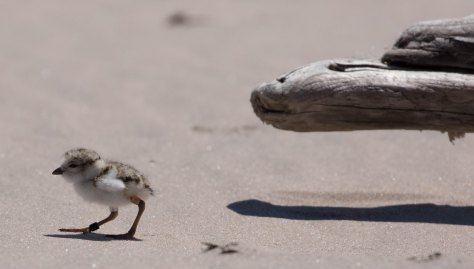
For the first time in decades, a pair of piping plover successfully nested at Sandy Island Beach State Park.

PipingPlover1a
2018 piping plover chick on the beach at Sandy Island Beach State Park.

Sources:

http://www.seagrant.sunysb.edu/glhabitat/dune/dune.html

http://www.fws.gov/midwest/endangered/pipingplover/

https://usfwsnortheast.wordpress.com/2018/08/07/the-real-plovers-of-new-york/

Invasive Mussels & Snails of Lake Champlain

In my two months as a New York State Parks Boat Steward on Lake Champlain I have already collected two aquatic invasive species: the banded mystery snail and the zebra mussel. I encountered the banded mystery snail at two different boat launch sites by the shore of Lake Champlain near Point Au Roche State Park. The zebra mussels are often found attached to rocks, driftwood, and recreational equipment that has been in the water for some duration.

The banded mystery snail is native to the southern United States and its introduction to this region can be traced back to 1867 when an amateur biologist released 200 of the snails into the Hudson River. This event was followed by subsequent introductions from aquariums owners. The snails can grow to be 1.75 inches long and 1.5 inches wide, with anywhere from one to four red bands on the shell. This species also lives in very high densities. Scientists are still studying the ecological effects of banded mystery snail invasion on natural communities. However, the presence of the species has been shown to decrease the survival rates of large mouth bass eggs in ponds and in the lab, which may eventually lead to a decline in fish populations in Lake Champlain.

The zebra mussel is an aggressive species that has spread very quickly since its first introduction to North America from Russia in 1989. By the mid-1990’s the species had become established in Lake Champlain. It is a D-shaped mollusk that is less than 2 inches long and has a distinctive brown zebra pattern on the shell. It poses great threats to native environments because it lives in dense populations of up to 750,000 specimens per square meter. Zebra mussels will attach themselves to any hard surface including native mussels, plants, man-made objects (such as piers and boat motors), and will even adapt to live on soft sediment. They are able to attach to objects by spinning a mass of tiny fibers called byssal threads that allow them to cling to any surface. Their larvae (veligers) are microscopic and float near the surface of the water which makes them easily transportable by boats or any recreational watercraft. Zebra mussels are strong competitors. One way that they outcompete native species is by grazing on large volumes of phytoplankton, thereby reducing the food resources available for native mussel species. They also take up large amounts of space on the lake substrate that is needed for fish spawning. Additionally, they cause drastic economic damage each year by  clogging pipes and pumps at wastewater treatment facilities and damaging municipal drinking water systems, hydroelectric power plants and irrigation systems.

ariana inspection
Ariana London completing a boater/angler survey about aquatic invasive species at the Great Chazy River Boat Launch (north of Plattsburgh on Lake Champlain). Photo by Megan Phillips, OPRHP.

While it is possible that Lake Champlain may never be free of the zebra mussels and the banded mystery snail, we can still ensure that these species do not spread to ponds, lakes and streams that are not yet infested. I feel incredibly honored to be part of the effort to stop the spread of the aquatic invasive species by educating people on what they can do to help.

Remember to clean, drain and dry your watercraft after use. To reduce the risk of spreading invasive mussels and snails in their veliger stage, boaters may opt to wash their watercraft and flush the engine with hot water. Research indicates that zebra mussels in the veliger stage cannot withstand water warmer than 110 degrees Fahrenheit, and adults will experience mortality at temperatures greater than 140 degrees Fahrenheit. For a list of hot water, high pressure boat washing station in the North Country/Adirondack Park area, click here.

Post by Ariana London, OPRHP Thousand Island Region Boat Steward.

Sources:

http://www.nps.gov/isro/planyourvisit/upload/ZMBoaters.pdf

http://www.watershedmanagement.vt.gov/lakes/docs/ans/lp_zeeb-factsheet.pdf

http://www.adkwatershed.org/invasive-species/invasive-species-information/zebra-quagga-mussel

https://adkwatershed.wordpress.com/2014/04/17/banded-mystery-snail-vs-chinese-mystery-snail/

http://www.lcbp.org/wp-content/uploads/2012/08/LCB_Invasive_Species_Guide.pdf

http://nas.er.usgs.gov/queries/FactSheet.aspx?SpeciesID=1047