Today, we celebrate 150 followers of the New York State Parks Nature Times Blog!
Fireworks at Niagara Falls State Park. Photo courtesy of OPRHP.
To date, the blog has featured more than 110 posts than span a myriad of topics including park history, endemic and endangered species, special studies, quizzes, scavenger hunts and more. More than 30,000 visitors from 40 different countries around the world have visited the blog.
To become a follower, visit the blog homepage and click on the button in the upper left hand corner, just under the logo. Tell your friends and family to “follow” the Nature Times Blog, and they’ll never miss a post!
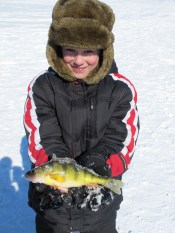
Young ice fisherman with a perch, photo by State Parks
Ice fishing opportunities abound in New York State. Winter anglers can catch a variety of fish; primarily perch, sunfish, pickerel, northern pike and walleye. In addition, many waters throughout the State are open to fishing for trout, lake trout and landlocked salmon.
Ice fishing requires doing a little homework. Learning about the equipment needed, proper clothing, safety precautions, the water you want to fish, and fishing regulations are all part of a successful, enjoyable winter fishing experience. Accompanying a friend on an ice fishing outing or visiting a tackle shop in a popular ice fishing area can be great ways to learn about the skills and equipment needed. The New York State Department of Environmental Conservation’s (DEC) ice fishing webpage also has some very good information to help you get started and lists some of the waters where you can ice fish. Pay particular attention to the ice safety section. There are also a number of free fishing clinics held in New York each year, including ice fishing clinics.
DEC and State Parks will co-host a free ice fishing clinic from 9 a.m. to 4 p.m. on Wednesday, February 17, at Glimmerglass State Park in the town of Springfield, Otsego County. The event will be moved to the public boat launch at Canadarago Lake just south of Richfield Springs on NYS Route 28 if there is not sufficient ice on Otsego Lake. Find out if the clinic is going to run by contacting Glimmerglass State Park at 607-547-8662.
In order to ice fish, you must first cut a hole in the ice. An ice auger is a good way to accomplish this. Ice augers come in a variety of sizes, so try to use an auger that is appropriate to the species of fish you are after. You will also need an ice scoop to clean slush and ice chunks out of the hole after it is cut.
Ice fishing methods include “jigging” with short, light fishing rods and using tip-ups. There are many different kinds of jigging poles and tip-ups available. Jigging involves the use of a jigging rod and either an ice jig or a small jigging spoon which is often tipped with a piece of bait. Spikes and mousies (maggots) are a good bait to use for smaller panfish, while minnows are often used for larger species. By jigging your bait (raising the rod tip up and down a few inches), you help attract fish to your bait. Generally, you will jig the bait a few times, then pause for a few seconds. Fish usually take the bait during the pause.
A tip-up is basically a spool on a stick that holds a baited line suspended through a hole in the ice. When the bait – usually a minnow – is taken by a fish, the pull on the line releases a signal, such as a red flag.
Placing the tip-up, photo by DEC Fisheries
Tip-up ready to catch a fish, photo by DEC Fisheries
Fish in similar areas you would during other seasons: weed lines, humps, depth changes, points, or other structure. Contour maps can help you find some of these places. Early morning or late afternoon tend to be the most productive times of day to fish.
Proper clothing helps make an ice fishing trip enjoyable, photo by DEC Fisheries
Proper clothing is critical for safe ice fishing outings. Dress warmly, paying extra attention to your head, feet and hands – dressing in layers is essential.
Water is a natural substance that all of us encounter on a daily basis. We rinse with it to clean ourselves and we drink it to stay healthy. In addition, more than 60% of the human body is comprised of water. But have you ever stopped to consider the uniqueness of this molecule that plays an intricate part of our lives and bodies?
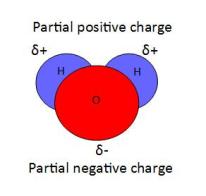
Diagram of a water molecule. Figure by Melyssa Smith
Perhaps the beauty of water begins with the simplicity of its molecule, H2O. It is made-up of only two elements: two hydrogen atoms (H2) and one oxygen atom (O). The H atoms create a slight positive electrical charge on one end of the molecule (a positive pole), while the O atom creates a slight negative charge (a negative pole). This polarity helps liquid water attract to, surround and break apart more substances than any other known liquid. Thus, scientists call water a “universal solvent” – something that many other substances (e.g. salt, sugar, powdered hot cocoa) can dissolve into. This attractive quality is how water is able to transport many vital minerals and nutrients throughout our soils, plants and environment.
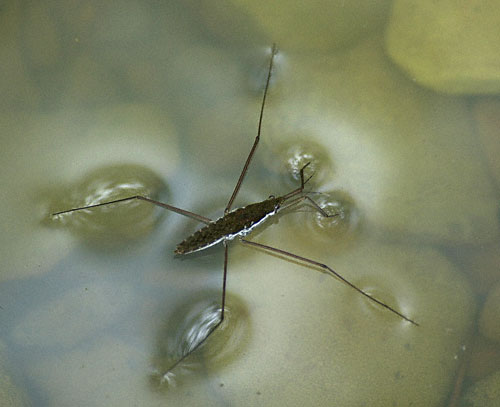
Not only does water bind easily to other substances (adhesion), but it also sticks well to itself (cohesion). The positive and negative ends of water molecules attract to each other and form water droplets. These dual properties help explain how water can ascent up the trunks of trees – water clings to the inner walls of the xylem in tree trunks and pulls other water molecules along, travelling up against the forces of gravity. You can observe water’s cohesive forces by filling up a glass of water slightly over the rim; water will hold onto itself and not spill over the sides. Similarly, surface tension enables spiders and insects, such as the water strider, to walk on the surface of the water. And so this seemingly simple molecule is capable of amazing feats.
Surface tension in a glass of water: Left glass is filled over the rim with water, right glass is empty for comparison. Photo by Lilly Schelling, OPRHP
Close-up of water being held together by surface tension. Photo by Lilly Schelling, OPRHP
Water has special physical qualities as well. Unlike any other material on Earth, water can exist in solid, liquid and gaseous forms naturally. The gas form floats freely in the air we breathe, with many molecules moving haphazardly far away from each other. This vapor can condense into clouds and return water to the earth as either rain or snow. When we hear the word “water” we usually think of the liquid form, and that’s probably because ~70% of our planet is covered in oceans. Snow and ice are examples of water’s solid phase, with molecules tightly packed and organized into crystalline structures. Unlike most other materials, the solid phase of water is less dense than its liquid form, which means ice can float atop liquid water. This property is useful in lakes during the wintertime, as surface ice acts as an insulating layer for the water below, shielding aquatic life from extremely cold temperatures. Clearly, water is a necessary ingredient for survival.
A frozen Letchworth Falls, Letchworth State Park, Castile, NY. All three physical states of water are present: solid (ice and snow), gas (air) and liquid (stream below). Photo by OPRHP
New York State has more than 70,000 miles of rivers and streams and around 7,600 lakes, ponds and reservoirs. Additionally, we are fortunate to share our borders with two Great Lakes, Lake Erie and Lake Ontario. Whether flowing, still, above or below ground, water is a ubiquitous feature in New York State Parks. It supports life and creates habitats for aquatic plants and animals. At the same time, water provides endless opportunities for recreation.
Many of our State Parks offer outdoor activities which involve water. Check out the 2016 Empire Passport to learn more about how you can access our state parks in any season. From swimming, boating and water skiing in the summer, to snowshoeing, sledding and cross-country skiing in the winter, to fishing (ice, fly or reel) year round — there is water-filled fun for every age all year long. The unusual chemical and physical properties that make water so valuable are also what make water so unique and enjoyable.
Post by Melyssa Smith and Erin Lennon (OPRHP Water Quality team)
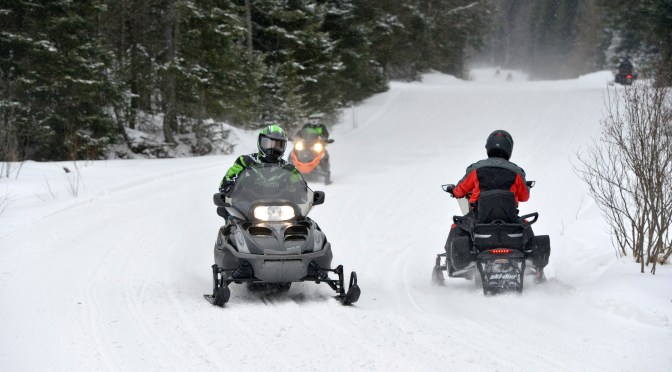
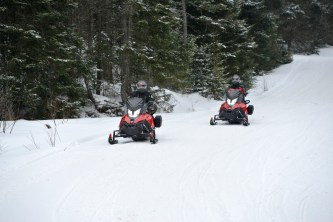
Snowmobilers enjoying some of New York’s 100,000 miles of snowmobile trails. Photo by OPRHP
You may not see any snow when you look out the window right now, but winter is here and now is the time to think about all of the outdoor activities it brings. One of the best ways to experience the natural beauty of New York in the winter is on a snowmobile, exploring The New York State snowmobile trail system which crisscrosses 45 counties through woods, fields, towns and our State Parks. Snowmobiling is a fun, family-friendly way to enjoy winter scenery and wildlife, especially for those people with disabilities who are unable to do strenuous activities like cross-country skiing and snowshoeing.
With over 10,000 miles of public trails, there’s something for everyone to enjoy from local loops to weekend getaways. A Google Earth map of the trail system is available on the snowmobile page of the State Parks website. Many of our parks have trails connecting to the statewide trail system. And some parks, like Allegany State Park, not only have over 60 miles of groomed trails, they also have winterized cabins which are open year-round for a warm winter weekend retreat.
If you’re new to the sport, or have never been on a snowmobile before, the New York State Snowmobile Association is teaming up with State Parks to offer Take a Friend Snowmobiling events where you can learn more and take a free snowmobile ride, conditions permitting. An event is scheduled at Selkirk Shores State Park on January 31, 2015. Necessary equipment will be provided; participants are urged to dress appropriately for outdoor weather conditions.
State Parks recommends all snowmobilers attend a certified New York State snowmobiling safety course, and never drink & ride!
“Ever since I was young, the story about bears was always the same. Bears hibernated all winter long, usually in a cave and would emerge in the spring. I have since learned a bit more about the environment and ecology and have found that there is much more to the story,” said State Parks staff member Patty Wakefield-Brown.
Hibernation occurs when an animal’s body temperature drops and its breathing and heart rate slows, thus lowering the metabolism of the animal, and conserving the animal’s energy. Bears are not “true” hibernators. They sleep for long periods of time but are easily awakened and, if the winter is mild, bears may wake to eat. This behavior is termed torpor, a state or inactivity achieved primarily by a greatly lowered (reduced) body temperature for hours, days or months. Only woodchucks, jumping mice, and cave bats are the “true” mammal hibernators in New York State.
Taking a long winter nap when food is scarce and weather is bad is a great adaptation for bears. While in a state of torpor, a bear will not urinate or defecate in the den. Their bodies absorb the urea and turn it into protein, which is needed during the long winter months.
During hibernation, female bears (sows) give birth and nurse their cubs. Females have delayed implantation, meaning that the egg is not implanted in the uterus unless the female bear has the energy, weight, or does not have the physical requirements to provide for the cubs during pregnancy and just after birth, the egg is released and there is no pregnancy. That is amazing. While in the den, sows wake up in January or February to give birth, generally 2-3 cubs. Black bear cubs are born altricial, which means helpless, hairless, and blind. Cubs remain with the mother for a year and a half or more before they disperse or she forces them out.
Bears generally emerge from their dens in late March and early April and are primarily interested in two things; eating and reproducing. Mating occurs in May or June. Males and females are sexually mature at around four years of age.
With the human population increasing and more and more land being transformed to accommodate this increase, the natural habitat of the American Black Bear is being minimized. Because of this, there is a greater likelihood that a person will have an encounter with a black bear. Wildlife biologists collar and collect data from bears to learn about their populations, home range, health and preferences for den sites. Like all wildlife that we share our environments with, keeping track of this data helps to create local and regional management plans.
Collecting Data on Sows and Cubs
“While a college student, I took a two- semester black bear management class. We worked with the New York State Department of Environmental Conservation (DEC) to assist in the creation of a database regarding den site criteria. We were able to accompany DEC staff on bear den visits in mid-March and collect data about the bears. The bears were outfitted with telemetry collars which enabled them to be found when they were in their dens during the winter months,” noted Patty Wakefield-Brown.
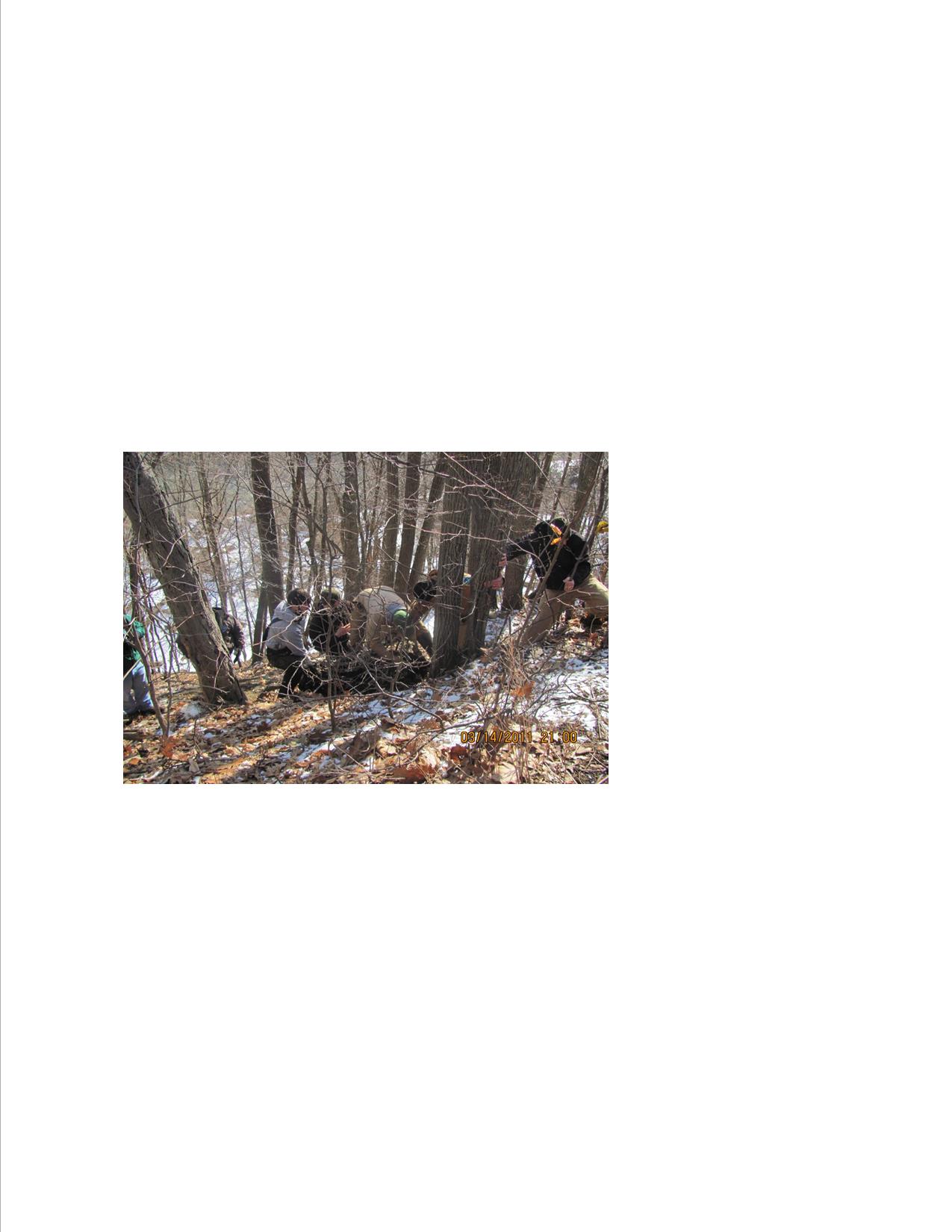
‘Photo 1’ below shows the DEC staff gently removing the tranquilized bear from the den; the entrance was on quite a steep slope.
Photo 1, by Patty Wakefield-Brown.
The bear was a female that had been previously collared. The purpose of the den visit was to change collars and to collect data including weight, visual appearance, take blood samples and note whether any cubs are present. DEC staff also inspected the den, described its location, (i.e. old log, brush/thicket, hillside, under porch, etc.), took measurements of the den’s interior, what materials den was comprised of, and the amount of cover, and noted the den’s proximity to humans, houses, and roads.
“On this day there were three cubs in the den with the sow. As the mom was being ‘processed’ we got to hold the cubs to determine their age. The way to age young cubs was to measure the hair on the tops of their heads (between their ears) or inside their ears, from the tragus to the tip of the ear (Photo 2) (Bridges et al. 2002). When all the data was collected, the mom was placed back into the den comfortably with her cubs (Photo 3)” recalled Patty Wakefield-Brown.
Photo 2, by Patty Wakefield-Brown.
Photo 3, by Patty Wakefield-Brown.
When bears disperse, they sometimes wander into populated areas creating human-bear conflicts. That was the case in October 2010, when a young male bear wander onto the Rochester Institute for Technology campus in Henrietta. The DEC natural resource managers ‘captured’ the bear and took him to a facility to collect data on him before he was relocated (Photo 4). The bear management class was invited to observe the event. After the bear was tranquilized, a patch was put over the bear’s eyes, so that they don’t dry out (the bears don’t blink when anesthetized). Blood samples were taken, ears were are tagged and a tooth was taken to age the bear, also the inside of the lip was ‘tattooed’ with a number and a radio collar was placed on the bear (Photo 5).The process was done very methodically and quickly. The bear was then released into the Hi-Tor Wilderness Area.
Photo 4, by Patty Wakefield-Brown.
Photo 5, by Patty Wakefield-Brown.
Winter slumbering bears are an essential part of the the ecosystems found in New York State parks. They are part of the splendor of the natural world that mesmerizes us and holds us captive in its magic. If you are lucky, you might get a chance to capture some of that magic if you see a bear in a New York State Park next summer.
Post and photos by Patty Wakefield-Brown, OPRHP.
Reference:
Bridges, A.S., Olfenbuttel, C Vaughan, M.R. (2002). A Mixed Regression Model to Estimate Neonatal Black Bear Cub Age . Wildlife Society Bulletin, Vol. 30, No. 4.











 New York State Parks and Historic Sites Blog