Excelsior Conservation Corps: A Modern Vision of an Old Idea

CCC By Unknown or not provided (U.S. National Archives and Records Administration) [Public domain], via Wikimedia Commons
Civilian Conservation Corps By Unknown or not provided (U.S. National Archives and Records Administration) [Public domain], via Wikimedia Commons.

What started in 1931 as a simple idea to put unemployed New Yorkers to work on state-funded public works projects through the New York Temporary Emergency Relief Administration grew to become the largest peace time utilization of people and equipment in US history – the Civilian Conservation Corps, the CCC. Many New York State Parks including Thacher State Park, Fahnestock State Park, Lake Taghkanic State Park, Selkirk Shores State Park, Thacher State Park, Green Lakes State Park, Letchworth State Park, Hamlin Beach State Park, Chenango Valley State Park, Franklin D. Roosevelt State Park and more benefited from the work that was performed by over 200,000 CCC members from 1933-1942.  During these nine years, 61 camps of 200 CCC members built roads, trails, cabins, and stonewalls, planted trees, worked on early invasive species detection and removal and more.  The Allegany and lower Hudson Valley regions were considered the highest environmental priority and had CCC camps each year, while other encampments would last a season or two, moving on to another location when the job was done.

This slideshow requires JavaScript.

About 40 different CCC camps were spread across the state each year. The typical CCC member was between 18-25 years old, “unemployed, unmarried, healthy, not in school, from a needy family, and capable of doing work” (Thompson).  Most CCC members were white males; however New York also had CCC camps for Native Americans, African Americans, WWI veterans (separate camps for white and African American veterans), and separate camps for women (known as She-She-She Camps).

State Parks honors the memory of the CCC members with a CCC Statue at Letchworth State Park.
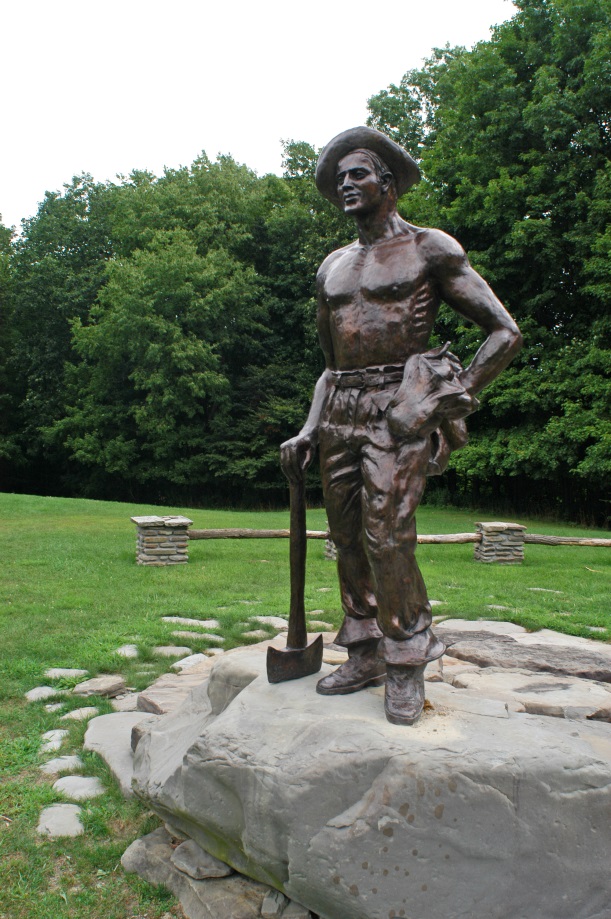
CCC Statue, Letchworth State Park, OPRHP photo
CCC Statue at Letchworth State Park. Photo by OPRHP.

This January, New York State is reviving the Temporary Emergency Relief Administration conservation corps with the inaugural New York State Excelsior Conservation Corps (ECC) and a 10-month residential program modeled after the CCC.  The program is open toNew York State students and residents aged 18-25, with an emphasis on veterans and expanding diversity. The 50 ECC members will be based at SUNY Morrisville where they will receive eight weeks of specialized trainings and certifications lead by the Student Conservation Association – Hudson Valley Corps .  Then, starting in March and running through early November, ECC members will work in State Parks, Department of Environmental Conservation and other state agency lands on projects across the state focused on:

  1. Open Space Management, maintaining and improving hundreds of miles on New York’s hiking trails
  2. Recreation and Access Mapping, monitoring and mapping over 10,000 acres of public land for safe recreational use
  3. Natural Resource Stewardship, invasive species removal and protection of native species and ecosystems
  4. Environmental Education and Outreach, educating New Yorkers on conservation and stewardship of public lands
  5. Infrastructure and Sustainability, helping to cut New York’s energy consumption and energy costs through the construction of renewable energy projects.

During the 10-months, ECC members will get a chance to work on their education plans and develop career skills.  At the end of their service they will be given a Segal AmeriCorps Education Award.

Building on their hands-on experiences and training, ECC members will be poised to become New York’s next generation of conservation leaders.  Learn more about the ECC in future blogs.

Post by Susan Carver, OPRHP. Slideshow photos courtesy of OPRHP.

References:

Hopkins, June; The New York State Temporary Emergency Relief Administration: October 1, 1931, The Social Welfare History Project, n.d.; http://www.socialwelfarehistory.com/eras/great-depression/temporary-emergency-relief-administration/

She-She-She Camps, George Washington University, n.d.; http://www.gwu.edu/~erpapers/teachinger/glossary/she-she-she-camps.cfm

Thompson, Craig; 75 Years Later: The Legacy of the Civilian Conservation Corp; Conservationist, New York State Department of 85 Environmental Conservation, February 2008; http://www.dec.ny.gov/pubs/42768.html.

Enjoy a Wintry Weekend at a New York State Park

The dog days of summer are a very distant memory, but many intrepid New Yorkers thrive in winter and are eager for falling temperatures and continued snowfalls.  To these hardy adventurers, a few extra layers of gear combined with the snowy terrain offer a winter wonderland of nature, fitness and fun.

In fact, a few of New York’s State Parks remain open and offer accommodations this time of year.  From cold-weather sports to the quiet beauty of snow-covered landscapes… snowshoe treks to winter carnivals, skating rinks to seal walks, New York State Parks are popular destinations for winter recreation and the perfect remedy for cabin fever.

Allegany State Park is not only the largest state park in New York at 65,000 acres, but this flagship property offers four seasons of adventure and is considered to be a premier winter-time destination for cold-weather fun in the northeast.  Allegany features 18 trails with 80 miles of hiking and snowshoeing, more than 25 miles of cross-country skiing and 90 miles of groomed snowmobile trails.  While the mercury may be dropping, the park heats up as families and outdoor enthusiasts enjoy winter activities and snow-based recreation in this vast wilderness setting.  Convenient and affordable winter lodging options at the park include year-round cabins and cottages available for rent.

Group camp5 Winter scene
Snowmobilers leaving Group Camp 5 at Allegany State Park. Photo by OPRHP.

With winterized cabins and the incredibly scenic Genesee Valley gorge as a backdrop, Letchworth State Park is another ideal destination for winter sports. Winter activities include snow tubing, cross-country skiing, and snowmobiling. Families can also rent the Maplewood Lodge, located in the middle of the park near the entrance to the Highbanks Camping Area.  A popular choice for snowmobilers, it connects to the New York State snowmobile trail system. The three-bedroom lodge sleeps up to eight people and consists of a furnished kitchen, living room with cozy fireplace, dining room and a full size bath and powder room.

Cross Country Skiing
Cross-country skiing is a popular activity in many State Parks over the winter months. Photo by OPRHP.

Wellesley Island State Park along the St. Lawrence Seaway in the Thousand Islands is another prime location with winterized accommodations to host weekend getaways or an impromptu overnight when available. The park’s Minna Anthony Common Nature Center is open year-round and includes nine miles of hiking trails, and five miles of cross country ski and snow shoe trails.  During the winter months visitors can warm up by the fireplace and meet other explorers. The trails have a diversity of habitat including field, forest, wetlands and views of the St. Lawrence River.

In Cooperstown, Glimmerglass State Park offers a variety of child-friendly activities such as tubing, ice skating and winter trail sports.  Reserve one of the cottages that sleep eight at nearby Betty and Wilbur Davis State Park and bring the whole family to enjoy a day of snowmobiling too.

For patrons enjoying New York’s state parks year-round, there is no ‘off-season” and every reason to get outside and embrace all types of cold- weather recreation among the wintry landscapes.

Post by Wendy Gibson and MaryAnn Corbisiero, OPRHP.

For more information, visit:

www.nysparks.com

www.newyorkstateparks.reserveamerica.com

First Day Fun in NYS Parks

Resolutions

Get outside to a State Park this New Year’s Day! New York State Office of Parks, Recreation and Historic Preservation (State Parks) is putting RECREATION at the top of this year’s New Year’s resolution list with First Day Hikes.  Now in its 5th year, First Day Hikes are a great way to help you get your New Year’s resolutions started on the right foot.

On January 1st State Parks is hosting 41 First Day Hikes in parks and historic sites across the state from eastern Long Island and Staten Island, to the Hudson River, Lake Champlain, Lake Erie, and much more.  Hikes range from accessible, level walks; a leisurely stroll across the world’s longest elevated pedestrian bridge, explorations of historic landscapes or quiet forest; dog-friendly rambles, mountain hikes, family-orientated activities and more.  If there is snow, bring your skis or some parks have snowshoes you can borrow.

During your hike you’ll be able to meet new people, see new places, spend time with family and friends, get a bit of exercise, and enjoy time outdoors.  Could there be a better way to spend the first day of 2016?

Remember to dress in warm layers, wear appropriate footwear, and bring water and a snack for your group. Most hikes range from one to three miles in length.

Remember your camera and please share your photos on State Parks’s Facebook Page!

Click here for a complete listing of “First Day Hike” events and registration guidelines.

Post by Susan Carver, OPRHP. Photos by OPRHP.


Making the Most of the Shortest Days of the Year

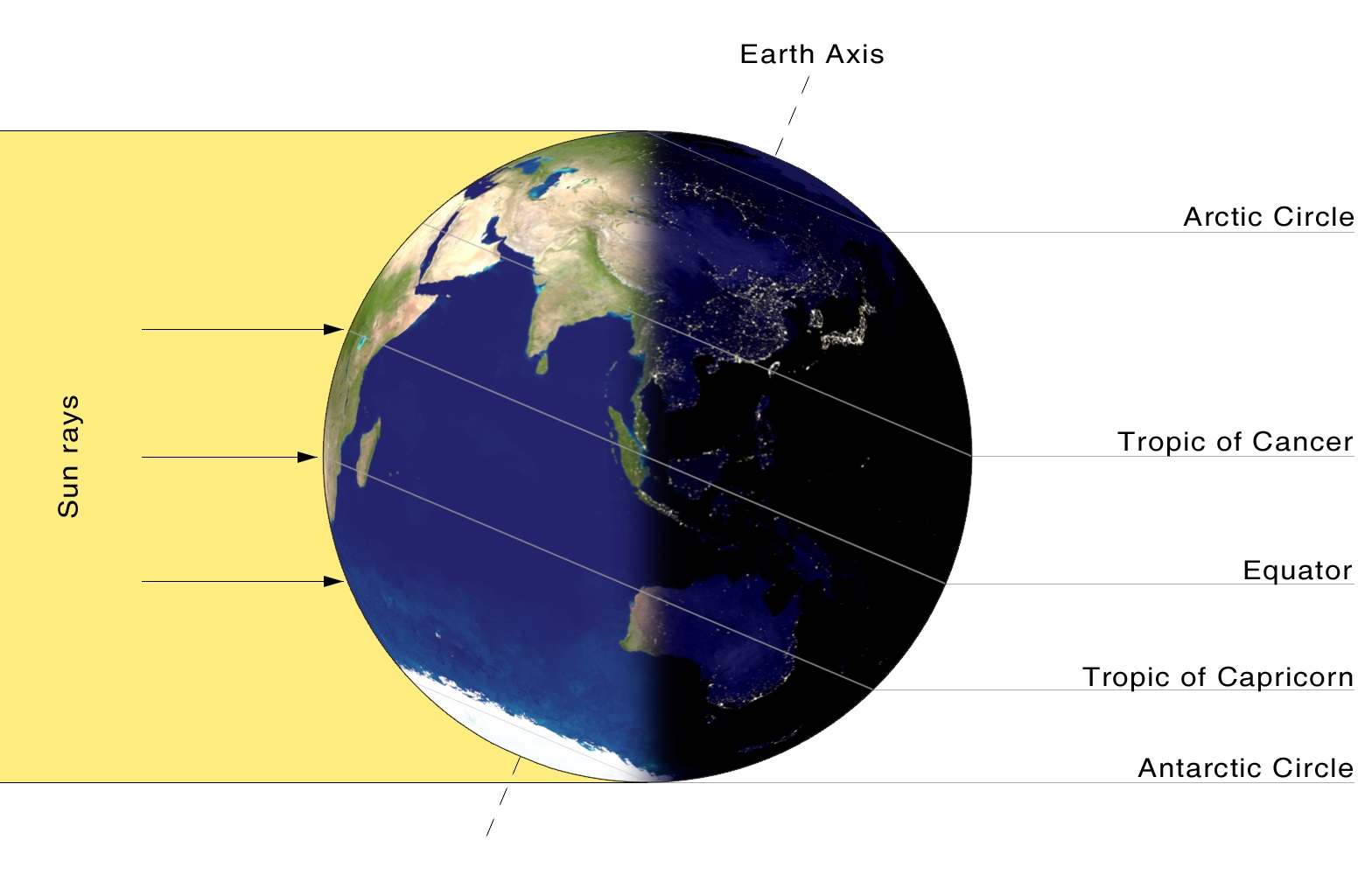
Ah, the winter solstice is here, that longest night and shortest day.  The solstice (sols=sun; tice=stand still) occurred at 11:48 EST on Monday, December 21, 2015.  This was the moment when the sun was directly over the Tropic of Capricorn in the southern hemisphere (see Figure 1).  Once it reached this point, the earth started to slowly tilt northward and the days began to get longer. Because the tilting of the earth’s axis is so slow, the day length is the same (stands still) for a day or two after the winter solstice.

Earth-lighting-winter-solstice_EN
Figure 1. Earth Lighting During The Winter Solstice https://commons.wikimedia.org/wiki/File:Earth-lighting-winter-solstice_EN.png.

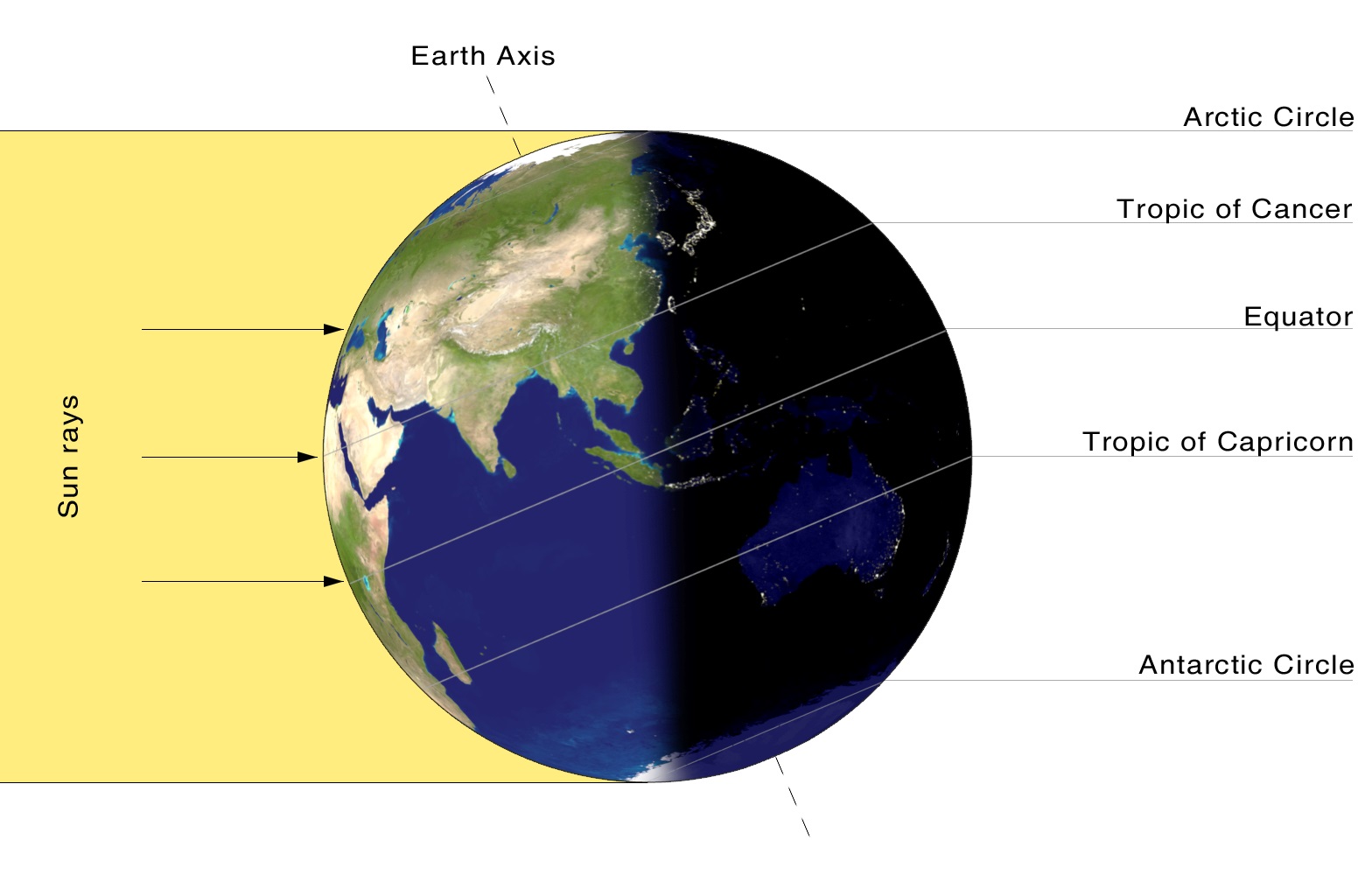
Then we slowly gain a minute or two of daylight each day until summer solstice (longest day) in June (Figure 2).

Earth-lighting-summer-solstice_EN
Figure 2. Earth Lighting During The Summer Solstice https://upload.wikimedia.org/wikipedia/commons/c/c8/Earth-lighting-summer-solstice_EN.png.

Winter is a great time to explore New York’s State Parks and Historic Sites.  Some Parks offer opportunities to try snowshoeing, cross-country skiing and, ice fishing.  Bring your own skis, ice fishing gear, snowshoes, snowmobiles, or skates to create your own winter fun in a Park or Historic Site.  Or take a hike go wildlife watching or attend a program.  Just remember to dress for the weather and you’ll have a grand time!

Post by Susan Carver, OPRHP.


Flitting Crystals

“Snow”

by William Cullen Bryant

Here delicate snow-stars, out of the cloud,
Come floating down in airy play,
Like spangles dropped from the glistening crowd
That whiten by night the Milky Way.

Snow is that magical precipitation that turns our stark winter landscape into a winter wonderland; gives school children joy at the possibility of a day off – SNOW DAY; and gives commuters white knuckles as they navigate home on slippery roads.  Snow is what we expect to see each winter here in New York State.  But what is snow?  How is it formed?  Is it true that no two flakes are the same?

Snow will form in clouds between the temperatures of -39˚F and 32˚F.  Clouds are mostly filled with tiny water droplets, tiny meaning that thousands can fit in a period.  Microscopic dust and salt particles from the land and sea are also found in clouds.

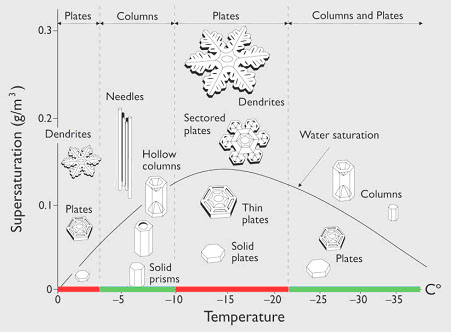
As the dust and salt cool in a cloud, they attract the tiny water droplets which stick and freeze to the particles – beginingthe formation of a snow flake (or the scientific term snow crystal).  These tiny snowflakes grow by collecting more water molecules.  When they get too heavy to be in the cloud they start to fall to the ground.  As they fall, they bump into other snowflakes causing pieces (tiny crystals) of the snowflake to break off which become new snow flakes.  The humidity and temperature inside the clouds will determine which type of snowflake is formed.  If the air is moist and warm (25o-32o F) large flakes will form.  If it is cold and the cloud has little moisture, the snow that forms resembles tiny columns.  Figure 1 illustrates how different types of snowflakes form in different cloud conditions.

Figure 1. Snowflake shapes at different temperatures and humidity (“Supersaturation”). From: http://mrsgallscience.wikispaces.com/Snowflakes
Figure 1. Snowflake shapes at different temperatures and humidity (“Supersaturation”).
From: http://mrsgallscience.wikispaces.com/Snowflakes.

Why do snowflakes have a six-sided symmetry? Snowflakes are six-sided because of the way that the individual water molecules connect together – they form hexagonal lattices which give the snowflakes six-sided symmetry.

Eight common types of snowflakes are:

Hexagonal Plate Crystal:

Hexagonal Bentley & Humphreys P. 45

Six-sided flat crystals with various amounts of surface patterns.  Largest of these can be just under ¼” across.  Hexagonal plate crystals are found in most snow falls.

Stellar Crystal or Dendrite:

Stellar Bentley 7 Humphreys P. 149

Stellar crystals are six-pointed star shaped snowflakes. These flakes can be up to 1/2″ across.  They can be found in low numbers in most snow falls.  Formed in the low atmosphere when the temperatures are not too cold and the humidity is high, sometimes the stellar crystal flakes join together to form large flakes that are 2” across.  The gentle drifting of the stellar crystal flakes gives a tranquil feeling to snowfalls.

Column Crystal:

Columns Bentley & Humphreys P. 210

Forming in cold clouds and low moisture, column crystal flakes are six sided and can be hollow inside.  During the winter, column crystals are commonly found in the high, wispy cirrus clouds.  They help to create a halo around the moon on winter nights. The halo is created by moonlight streaming through these ¼” crystals.  Rarely do these crystals fall to the ground.

Asymmetrical Crystal:

Asymmetrical Bentley & Humphreys P. 210

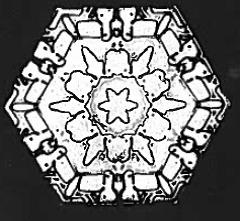
Asymmetrical Crystals are another common snowflake.  They appear to be many hexagonal plates stuck together and have been mistaken for stellar crystals.  They are about 3/8” across.

Bullet Crystal:

Bullet Bentley & Humphreys P. 210

Bullet crystals are column crystals that look like one end was sharpened with a pencil sharpener to form a hexagonal pyramid.  They can be seen either singly or in groups of three, attached by the points of the pyramid.

Tsuzumi Crystal:

Tsuzumi Bentley & Humphreys P. 210

Named for the Japanese drum of the same design, Tsuzumi crystals are column crystals with hexagonal plate crystals at each end.   They form when the column crystals bump into the hexagonal plate crystals as the snow falls.

Needles:

Needles Bentley & Humphreys P. 210

Needles are fine, six-sided columns with a point at each end; they range in length from ¼” to ¾” long.  This is one of the most common types of snow flake in a snow storm.  Sometimes the needle flakes freeze together during the descent forming conglomerate flakes.  These conglomerate flakes quickly break apart as soon as the flakes hit the ground.

Stellar Hexagonal Plate Crystals:

Stellar Hex Bentley & Humphreys P. 111

Stellar Hexagonal Plate Crystals are some of the most stunning snowflakes.  They form when either a stellar crystal goes through a hexagonal plate crystal cloud condition or a hexagonal plate crystal goes through a stellar crystal condition.  These are some of the most common snowflakes in a storm.

So is it true that no two snowflakes are alike?

During school vacation try one of these family activities – preserving snowflakes or making a snow catcher.

Post by Susan Carver, OPRHP.


Sources:

Bentley, W. A. and W. J. Humphreys, Snow crystals: 2453 illustrations, Dover Publications, New York, 1962.

Griffin, Julia, The science of snowflakes, and why no two are alike, PBS NewsHour, 22 December 2011, http://www.pbs.org/newshour/rundown/the-science-of-snowflakes/.

Martin, Jacqueline Briggs, Snowflake Bentley, Hougton Mifflin, Boston, 1998.

National Oceanic and Atmospheric Administration, How do snowflakes form?  The science behind snow.

Stokes, Donald, Stokes nature guides: a guide to nature in winter, Little Brown and Company, Boston, 1976.

National Snow and Ice Data Introduction to Snow.


The official blog for the New York State Office of Parks, Recreation & Historic Preservation