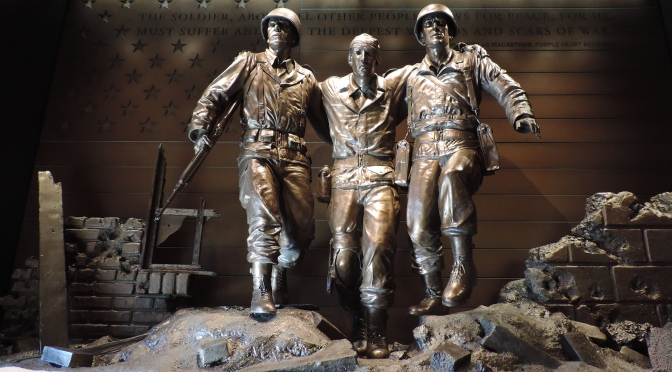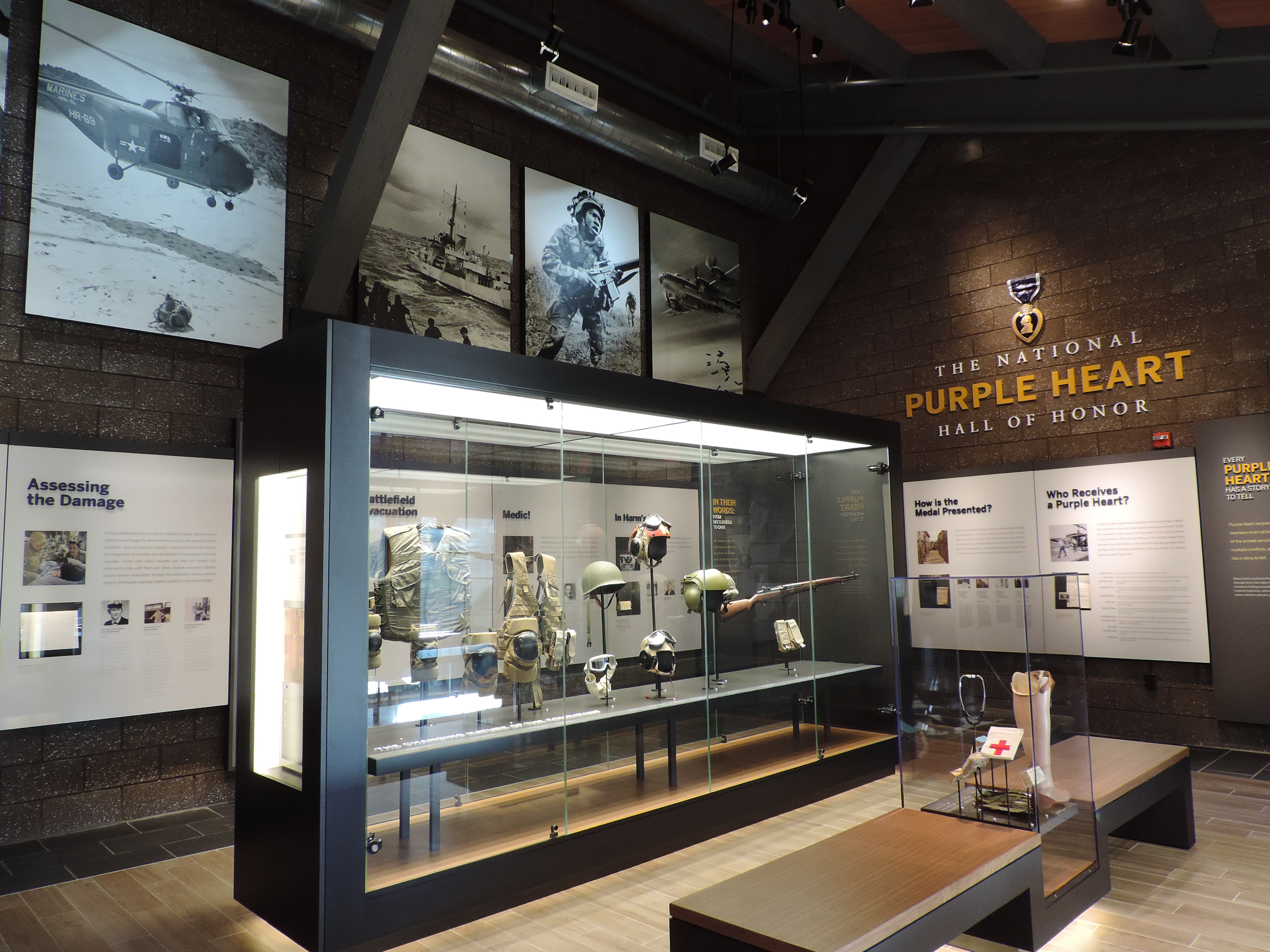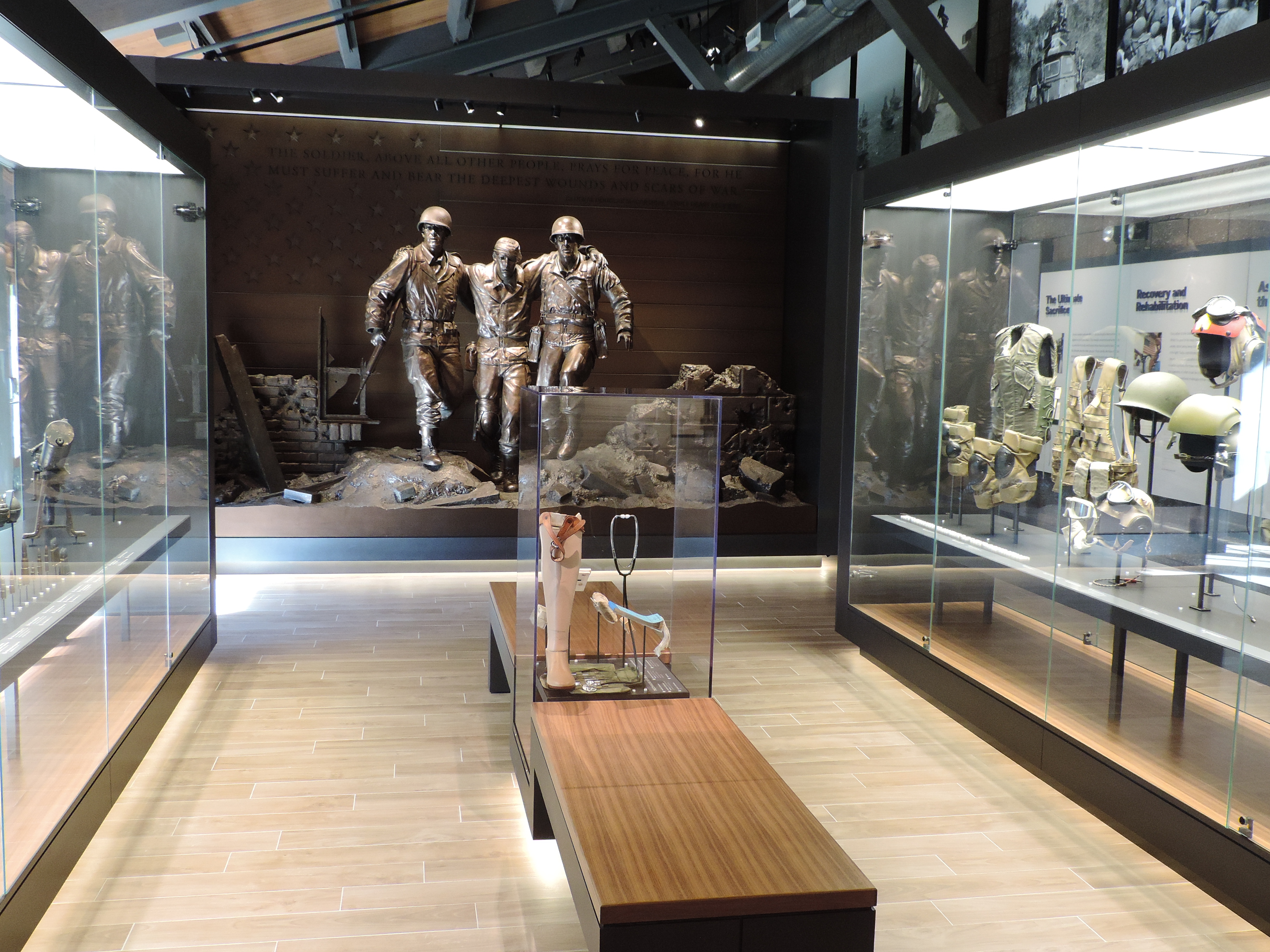
The National Purple Heart Hall of Honor recognizes the sacrifices of Purple Heart recipients. Our mission is to collect, preserve, and share the stories of Purple Heart recipients from all branches of service and across all conflicts for which the award has been available. We are located in the Hudson Valley, (New Windsor) 12 miles north of West Point, on the same grounds that the Continental Army occupied during the final months of the American Revolution. This location has an important connection to the history of the Purple Heart. We are located on these grounds to mark the May 28, 1932 Temple Hill Day ceremony which occurred here when 137 veterans of World War I were awarded their Purple Hearts. The ceremony was part of New York’s Bicentennial celebration of the birth of George Washington. The commemoration of the sacrifices of Purple Heart recipients continues today most visibly through our Roll of Honor.
National Purple Heart Hall of Honor
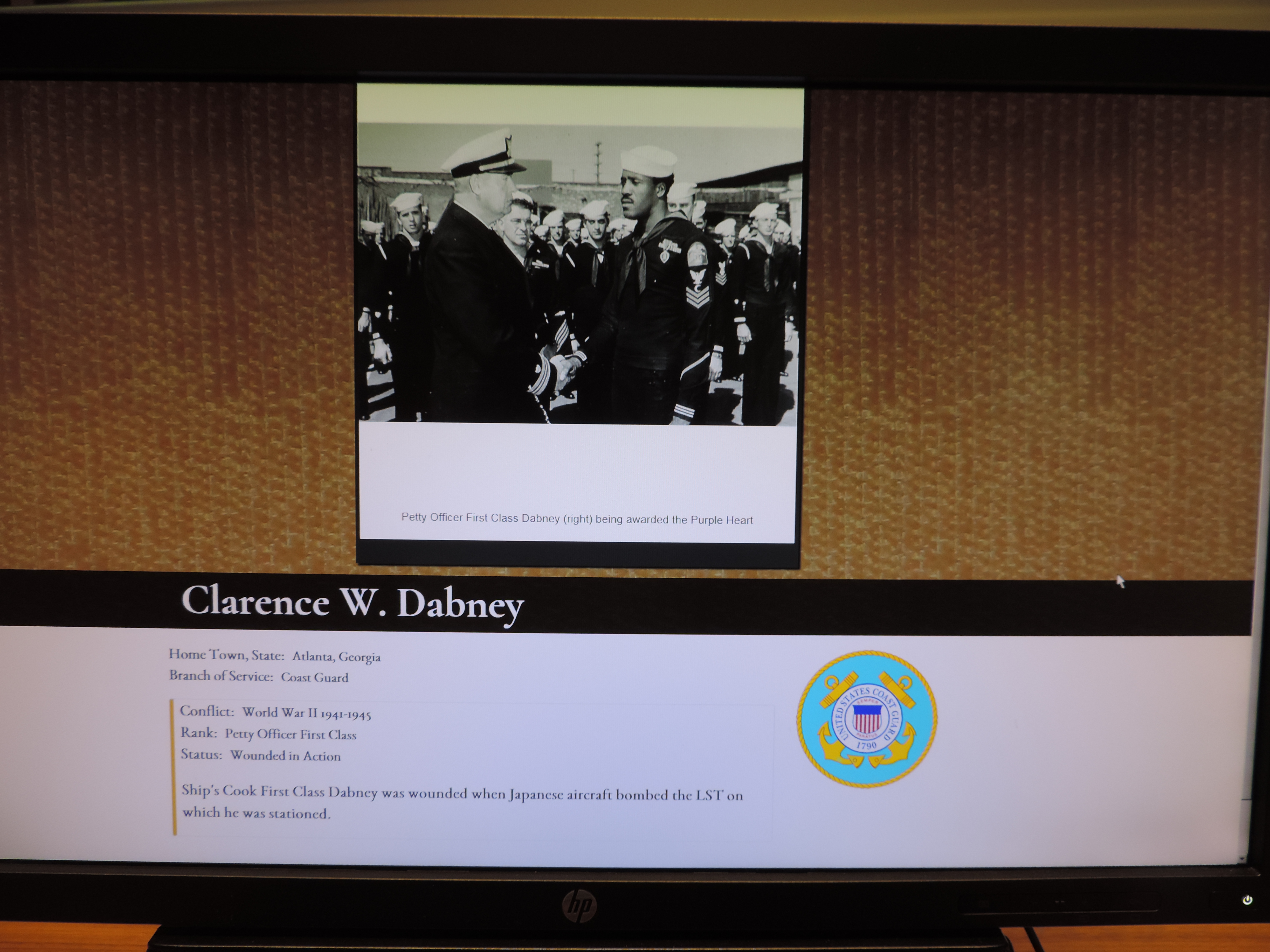
The Roll of Honor is a database of Purple Heart recipients representing all wars for which the award has been available. Our timeline of recipients, based upon the date they were wounded or killed, runs from April 6, 1862-October 1, 2017 and grows daily as we receive new enrollments. These enrollments represent all 50 states, Puerto Rico, Guam, the District of Columbia and the Philippines. However, all enrollments are done voluntarily and are made by the recipients, their families or friends. While it is estimated that 1.8 million awards have been made since the award was created in 1932, there is no comprehensive list of recipients maintained by the government. In fact, the only award for which there is an official list is the Medal of Honor. All information on awards and decorations is found in the military records relating to the individual. Our Roll of Honor is aimed at creating a comprehensive list of Purple Heart recipients, in order to preserve their history.
Enrollment profile for Purple Heart recipient Clarence Dabney.
The Roll of Honor is accessible both in the Hall of Honor and online allowing anyone to view the preserved stories of sacrifice. The online version can be viewed from any computer via our website: www.thepurpleheart.com. The recipient’s profiles can contain pictures as well as written narratives of the experience of that recipient.
WE NEED YOUR HELP!
If you are a recipient or know someone who is, we hope that you will consider completing an enrollment form for inclusion in the Roll of Honor. Information on enrolling can be found on our website: www.thepurpleheart.com or you can call the Hall of Honor at 845-561-1765 and we will send you a copy of the enrollment form.
COME VISIT:
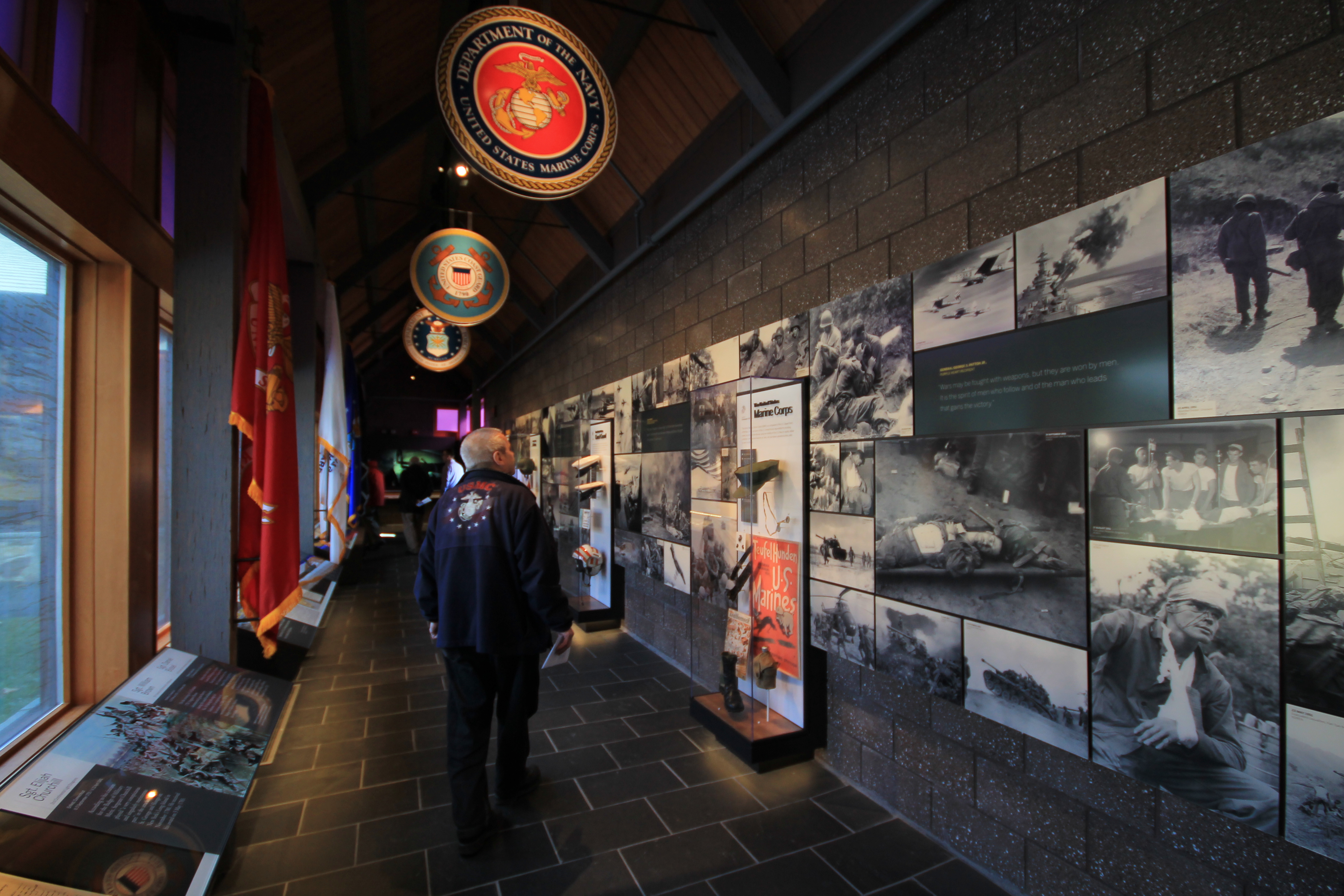
The 7,500-square-foot Hall of Honor is open six days a week, year-round, and we invite you to visit.. Our timeline gallery pays tribute to the branches of service while commemorating America’s major military conflicts of the 20th and 21st centuries.
Our Main Gallery transports visitors through the Purple Heart experience with personal stories and artifacts that help tell the story from being wounded to coming home. Our 10-minute video lets visitors hear the stories of how nine Purple Heart recipients received their awards and what it means to them. There are exhibits and stories for visitors of all ages. The facility also offers adult group tours and educational programs. To learn more about these offerings, please contact Peter Bedrossian, Program Director (peter.bedrossian@parks.ny.gov) or by phone 845-561-1765.
Long before refrigeration and supermarkets made it possible to get fresh fruits and vegetables from around the world, our predecessors relied upon drying, salting, fermenting, and pickling summer’s bounty for winter meals.
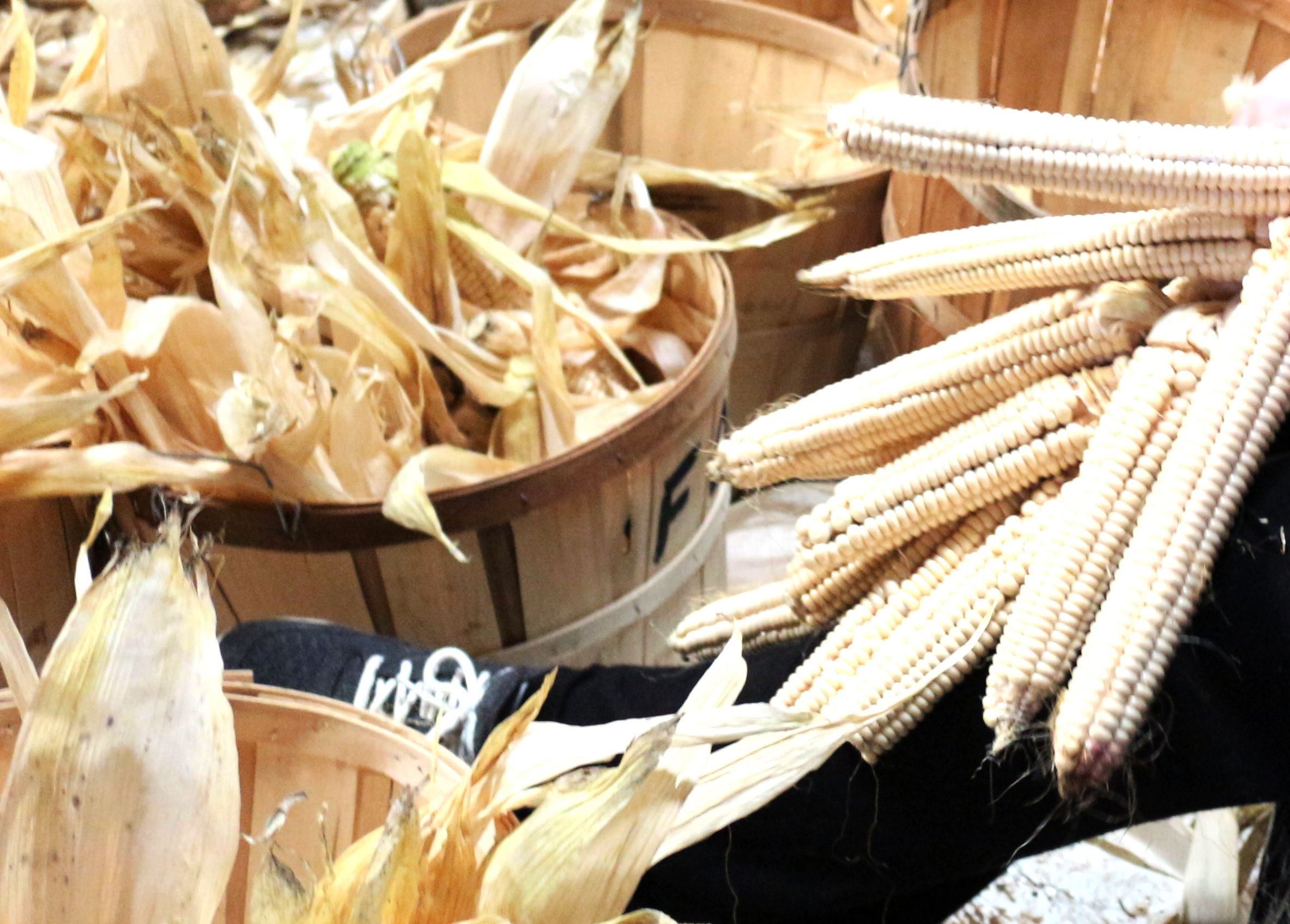
Allowing the wind and sun to dry food is the oldest method of food preservation. The Seneca and other New York Native American tribes dried millions of bushels of corn each year. The dried corn was turned into hulled dry corn and corn flour to sustain people during the colder months. Native Americans also dried meats, fish, and fruits such as blueberries for their winter meals.
Ganondagan State Historic Site Husking Bee, photo by Carol Llewellyn
Pickling vegetables and fruits goes back as far as 2030 BC. Pickling can be done in two ways, soaking the fruit or vegetable in either vinegar or saltwater (brine). The word pickle is a variation of the Dutch word for brine – pekel. Soaking vegetables in a brine bath is known as lacto-fermentation where lactic acid bacteria turn sugar in food to lactic acid.
Pickles of one sort or another have been produced and eaten in New York homes for many generations. Early European settlers sometimes used New World ingredients in their Old-World pickle recipes. One example of this is black walnut pickles, a variation of Old World English walnut pickles. Pickle recipes were passed down from one generation to another, with housewives recording the recipes in their special recipe book.
New York’s first European colonists were the Dutch, who maintained settlements along the Hudson River as far north as Fort Orange (now Albany). The van Rensselaers were a prominent Dutch family in the Hudson Valley. When sturgeon was abundant in the Hudson River, Maria van Rensselaer (a cousin to the Fort Crailo van Rensselaers) would use this hand-written recipe to pickle the sturgeon.
van Rensselaer family recipe to pickle Sturgeon, from Kellar, p. 12
And this recipe to pickle cucumbers:
Keep the Fruit n pickle till green, changing it often, then in cold water 2 days changing very frequently, then wipe and dry them & to every six lb fruit 8 lb Sugar, 6 lemons, ¾ raw ginger a bit of Mace- boiled to a clear Syrup. When cold pour it on the fruit, the day after pour it off & give it another boil – the next day as the same & as often as necessary, never pour it on hot, for it will spoil them.
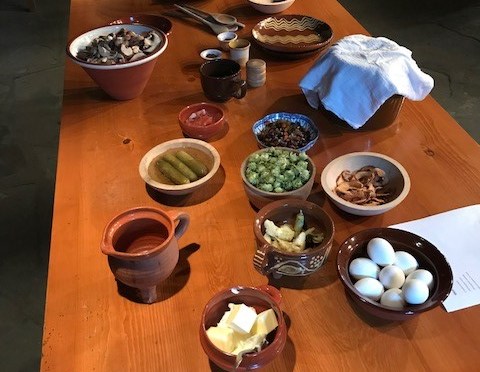
Eggs were one of many foods that were pickled because egg production is linked to day length; hens need about 13 hours of light a day to lay eggs. Staff at Loyalist home Philipse Manor Hall may have used a recipe similar to this recipe from The Lady’s Assistant (p. 277) to make pickled eggs.
To pickle Eggs.
BOIL the eggs very hard: peel them, and put them into cold water, shifting them till they are cold. Make a pickle of white-wine vinegar, a blade of mace, a bunch of sweet herbs, and a little whole pepper; take the eggs out of the water, and put them immediately into the pickle, which must be hot; stir them a good while, that they may look all alike; untie the herbs, and spread them over the top of the pot, but cover them with nothing else till they are turned brown; they will be fit to eat in nine or ten days.
Bruise some cochineal; tie it up in a rag; dip it in the vinegar, and squeeze it gently over the egg, and then let the rag lie in the Pickle. This is a great addition.
During his stay at the Hasbrouck House in the Hudson Valley it is possible that George Washington, who was a big pickle fan, dined on some of his wife’s pickles. Recipes from Martha Washington’s hand-written Booke of Cookery includes recipes (or receipts as they were once called) for pickling a variety of food from cowcumbers (cucumbers) to mackerel – George probably enjoyed them all!
From Martha Washington’s Booke of Cookery
Dianthus, formerly known as cloue (clove) gillyflower, photo by Noordzee 23, accessed from Wikicommons
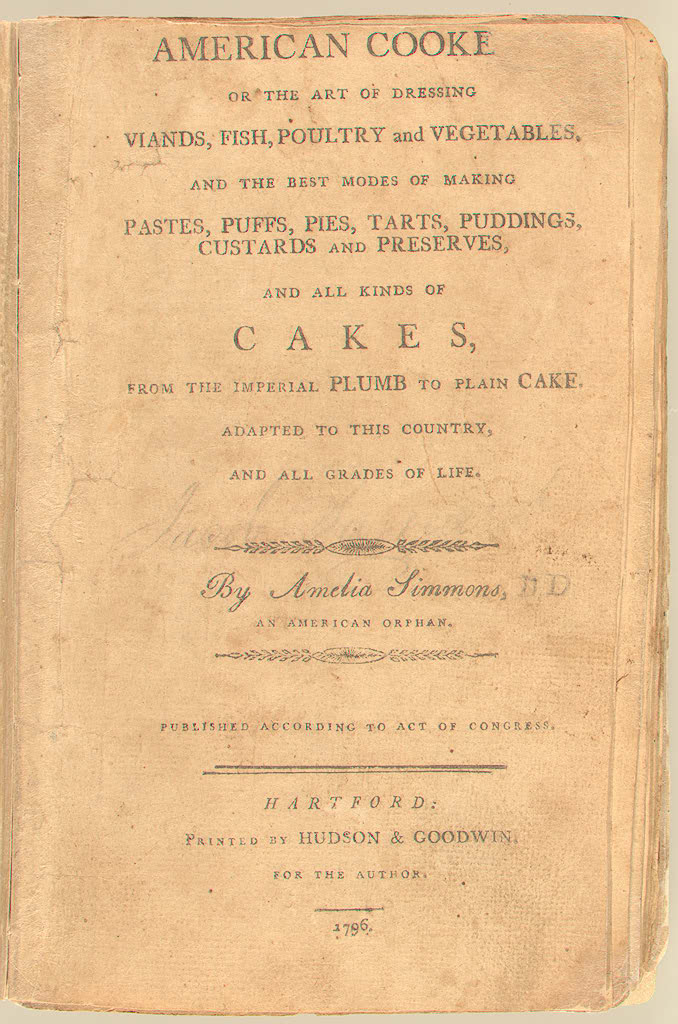
Cooks in the Jay, Livingston, and Schuyler families may have had access to Amelia Simmons American Cooke, the first American cookbook It was first published in Hartford, Connecticut 1796, with a second publication in Albany New York also in 1796.
Pickling recipes in Simmons cookbook included pickling the barberry fruit:
To pickle Barberries, from Simmons, page 43
Barberry fruit, photo from Wikicommons
The Lincklaen family recipe book from Lorenzo House included to pickle Chalottes (shallots) and to pickled cucumbers.
Recipes for pickled Chalottes (shallots) and cucumbers from the Lincklaen family cookbook.
Frederic Church’s family maintained a farm and gardens at Olana in the Hudson Valley. Some of the produce from the farm was used to make pickles, including this Sweet Variety pickle:
Church family recipe for Sweet Variety pickle
Pickles were not only important part of many New York family meals, they were also a menu staple on the military bases in New York as this menu from Fort Ontario illustrates.
Christmas dinner menu, 1939, Fort Ontario.
If you would like to learn more about preserving the summer harvest, maybe you can join in on the We Can Pickle That! program at Clermont State Historic Site on September 8.
Please note: recipes in this blog are for historic reference only and should not be made at home. The National Center for Home Food Preservation provides a wealth of information about food preservation as well as food preservation recipes for the modern family.
Kellar, Jane Carpenter. (1986) On the score of hospitality : selected recipes of a van Rensselaer family, Albany, New York, 1785 – 1835 : a Historic Cherry Hill recipe collection. Albany, NY, Historic Cherry Hill.
Mason, Charlotte. (1778) The Lady’s Assistant3rd Edition, London.
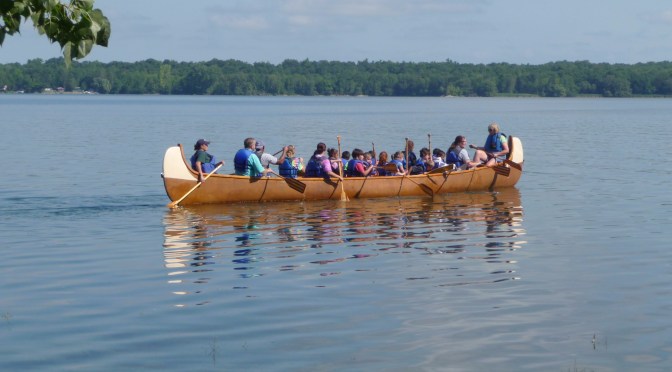
Since the 1980s, there has been a 36-foot long, 16 passenger (plus two staff), fiberglass Voyageur canoe at the Minna Anthony Common Nature Center in Wellesley Island State Park. No one really knows where the canoe came from or exactly what year it arrived, but there are a few stories told about its origins. Some say there used to be five Voyageur canoes located in parks along the St. Lawrence River and Lake Ontario and some say the canoe was made by NYS Parks’ employees. Ultimately, the mystery of its origin is part of its mystique. What they will say is that every summer for about the last 30 years park visitors and Nature Center staff have headed out on daily trips in our canoe to learn about the history of the Voyageurs and to explore the ecology of Eel Bay, the Narrows, and Escanaba Bay.
Voyageur canoe trips leave the Nature Center docks at 9 am and return at 11 am, but there is plenty for staff to do before anyone ever steps foot into the boat. If it has rained, staff must bail the canoe and dry the wooden seats for passengers.
Novice voyageurs head out on their first journey, photo by State Parks.
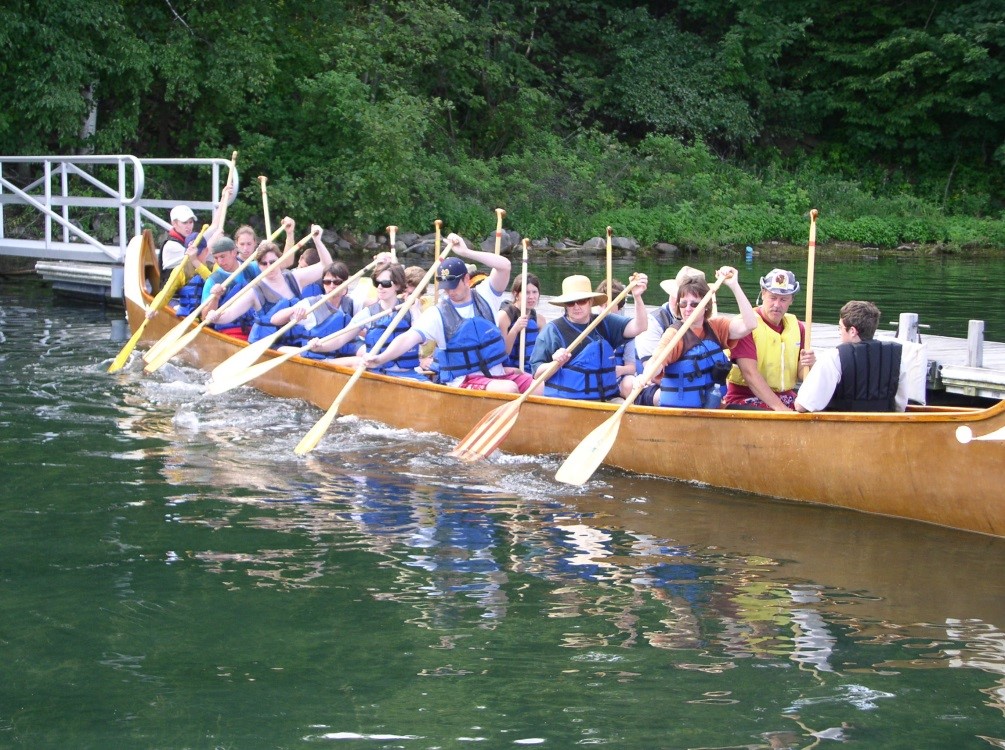
They also move the boat into place on the docks so it is ready for the day. When that day’s voyageurs come down to the dock house they are fitted with personal floatation devices (PFD’s) and paddles while being taught about the fundamentals of paddling before heading out to the canoe. Loading the canoe with passengers can be quite tricky, as people who are likely to be stronger paddlers must be strategically positioned in the boat and the canoe must be balanced on the water to safely leave the docks. Once the canoe is balanced and its passengers comfortable, staff jump in at the bow (front) and stern (back) and slowly steer the boat out into Eel Bay.
The staff member sitting at the bow of the boat begins the interpretation as the large boat gets underway. They talk about how the canoe weighs 1,000 pounds empty and how it is made of fiberglass. As the passengers paddle, they discuss the importance of Eel Bay as a large, shallow water bay on the St. Lawrence. Then conversation shifts to the Voyageurs who were part of the French fur trading companies that existed in the 18th and 19th centuries. The interpreter weaves a tale about the adventures Voyageurs had as they transported furs, predominately beaver, from Montreal to trading posts along the shores of Lake Superior. As the boat rounds the sharp turn into the Narrows passengers learn what a day in the life of a Voyageur was like, from what they ate to how they were paid. The staff member sitting in the stern who has been quietly working to steer the boat will ease it to a stop as the canoe coasts into Escanaba Bay. Passengers will spend a little time admiring the plentiful water lilies that dot the bay before reversing course and heading back towards the Nature Center. On the return trip to our docks, some time is dedicated to floating along in silence, taking in the sights and sounds of the majestic St. Lawrence River.
Pat and Aziel Snyder standing next to the newly restored Voyageur canoe. Doesn’t it look beautiful? Photo by State Parks.
The canoe had begun to show its age in recent years but last winter Pat Snyder of River Restorations, a local boat restoration company, beautifully restored it to top condition. A few sections of the gunnels were replaced, the gunnels and seats sanded down and refinished, the seats reinforced to help prevent deflection when people are stepping into the boat, and the fiberglass shell was repainted. The canoe once again looks majestic and is ready to go out on the water!
Each July and August, look for the return of our sleek Voyageur canoe to the Nature Center’s dock. For just $4 (anyone over 13) or $2 (under 13) you can join staff from the Nature Center on a memorable journey on smooth waters, travelling the shorelines of Wellesley Island.
For information on upcoming trips, please visit our Facebook page (Minna Anthony Common Nature Center- Friends). To have enough paddle power to steer the boat, we must have at least 8 people over the age of 18 on board. To reserve a spot on a trip, please call the Nature Center at 315-482-2479.
Post by Molly Farrell, July 2018
Learn more about Voyaguers:
Durbin, William; The Broken Paddle; Delacorte Press, NY, 1997.
Ernst, Kathleen; The Trouble and Fort La Point; Pleasant Company Publications, Middleton, WI, 2000.
Millions of people visit Allegany State Park every year, but how many have ever visited the zoo?
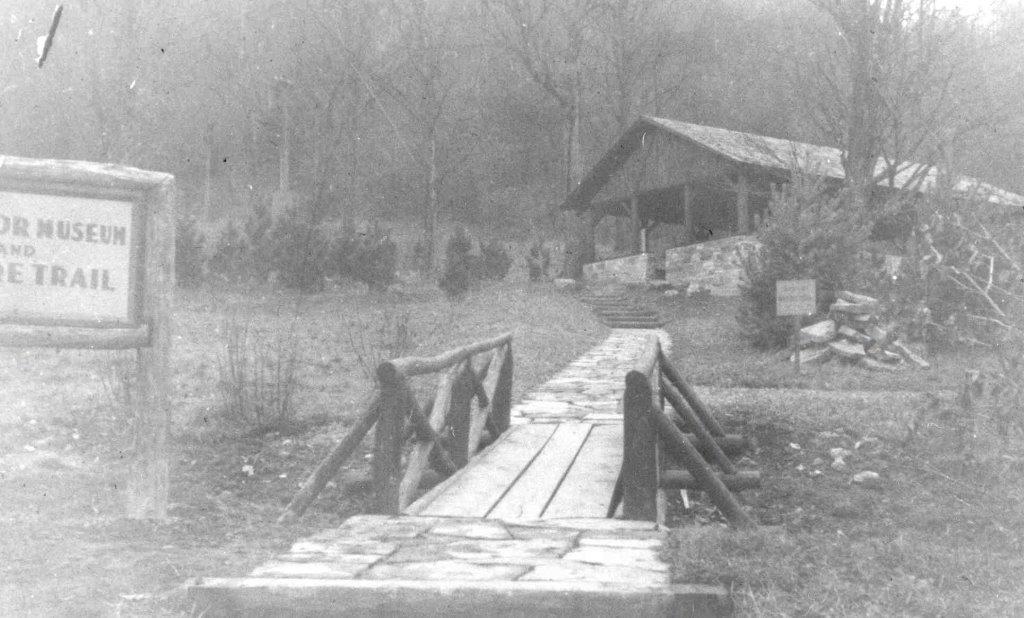
Tucked up on the hill, behind the Red House Administration Building among the maples, Scotch pine, and cherry trees, sits the stone foundation of what was once a highly-visited tourist attraction.
Path to the zoo, photo courtesy of Allegany State Park Historical Society.
Like so many other places on the East Coast, this area (in what is now Allegany State Park) was logged from the 1860s to the 1920s. Hemlocks, white pines, and hardwoods were harvested to supply large cities with building materials. While humans built houses, many local animals lost their homes and habitat.
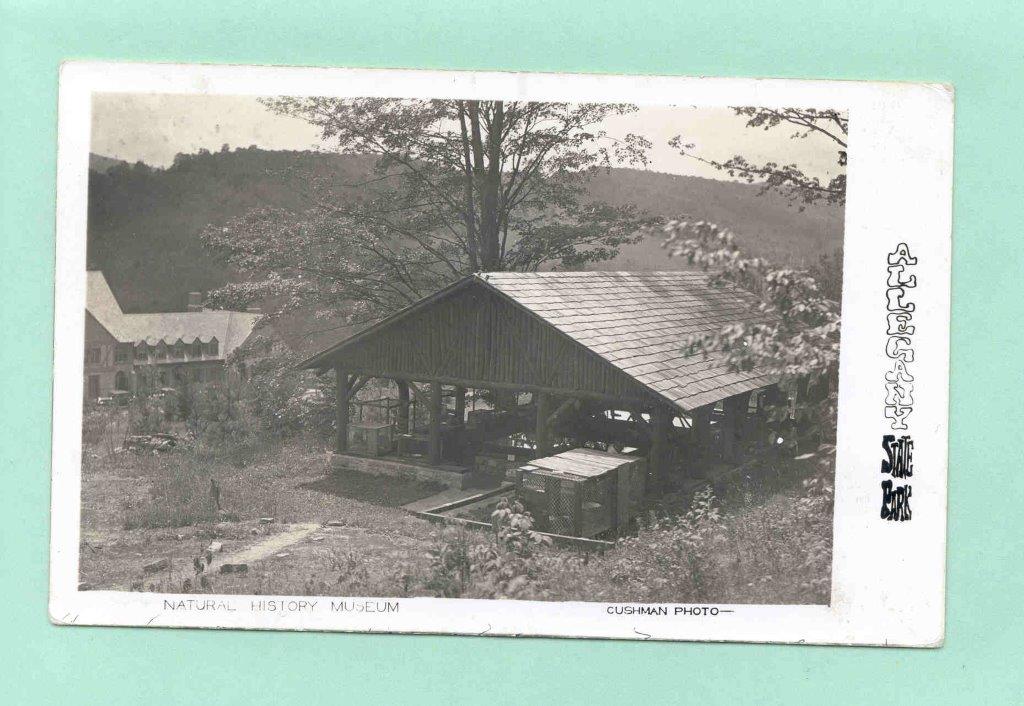
Postcard of the zoo, note the Red House Administration Building on the left, photo courtesy of Allegany State Park Historical Society.
The Outdoor Museum and Zoo was built in 1933 by the Civilian Conservation Corps (CCC) was intended to exhibit the local animals, birds, plants, fungi, and rocks of this area. The Zoo’s rectangular foundation (25×40 feet) and 3 ½ foot high walls were built from local sandstone quarried off the hill behind the museum. Chestnut and cherry posts supported a shake shingle roof. Shelves and brackets around the sides of the museum building supported animal cages, insect trays, unique plants, and rock and mineral exhibits. Cement pools with dry platforms housed aquatic creatures such as frogs, turtles, muskrat, and fish. Since this was a seasonal museum, the CCC oversaw collecting specimens for the Zoo. Upon its opening in 1933, the exhibit hosted a raccoon, skunk, woodchuck, rabbit, chipmunk, porcupine, five types of turtles, and several different species of frogs, toads, and salamanders. Five kinds of snakes had their own special snake pit separate from the rest of the museum. Irving Knobloch, a National Park Service naturalist oversaw the museum and its animals during the CCC days, after which the Allegany State Park (ASP) rangers and naturalists operated the zoo.
Display boards, image courtesy of Allegany State Park Historical Society.
Exhibit cases, image courtesy of Allegany State Park Historical Society.
Two of the first residents of the Zoo were “Smoke” and “Soot.” The bear cubs were rescued by forest rangers during a fire caused by sparks from the smoke stacks of the trains carrying lumber out of the area. The rangers decided to take the bears home, but as they grew, the small cubs became too much for the rangers to handle; so, they built them a small bear den surrounded by wire. They eventually escaped and roamed the area for handouts.
Soot and Smoke near their bear cave, photo courtesy of Allegany State Park Historical Society.
Bear cave entrance today.
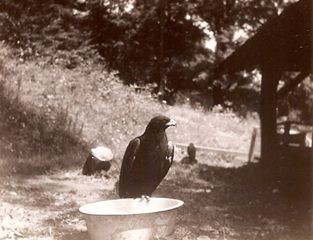
Another famous creature of the zoo was Cleopatra, a golden eagle, owned by Egbert Pfieffer, a world-renowned bird specialist and ASP naturalist. Cleo was a trained eagle who would sit on Mr. Pfieffer’s arm as he walked around the area. Pfieffer also supplied the museum with a red-tailed hawk, great blue heron, owls, and other birds of prey.
The Zoo was open from May until early October, when all the animals were released back into the wild. It was closed in 1944 due to World War II and was never reopened. The building was torn down in the 1960s, but the foundations remain.
Zoo foundation, photo by State Parks.
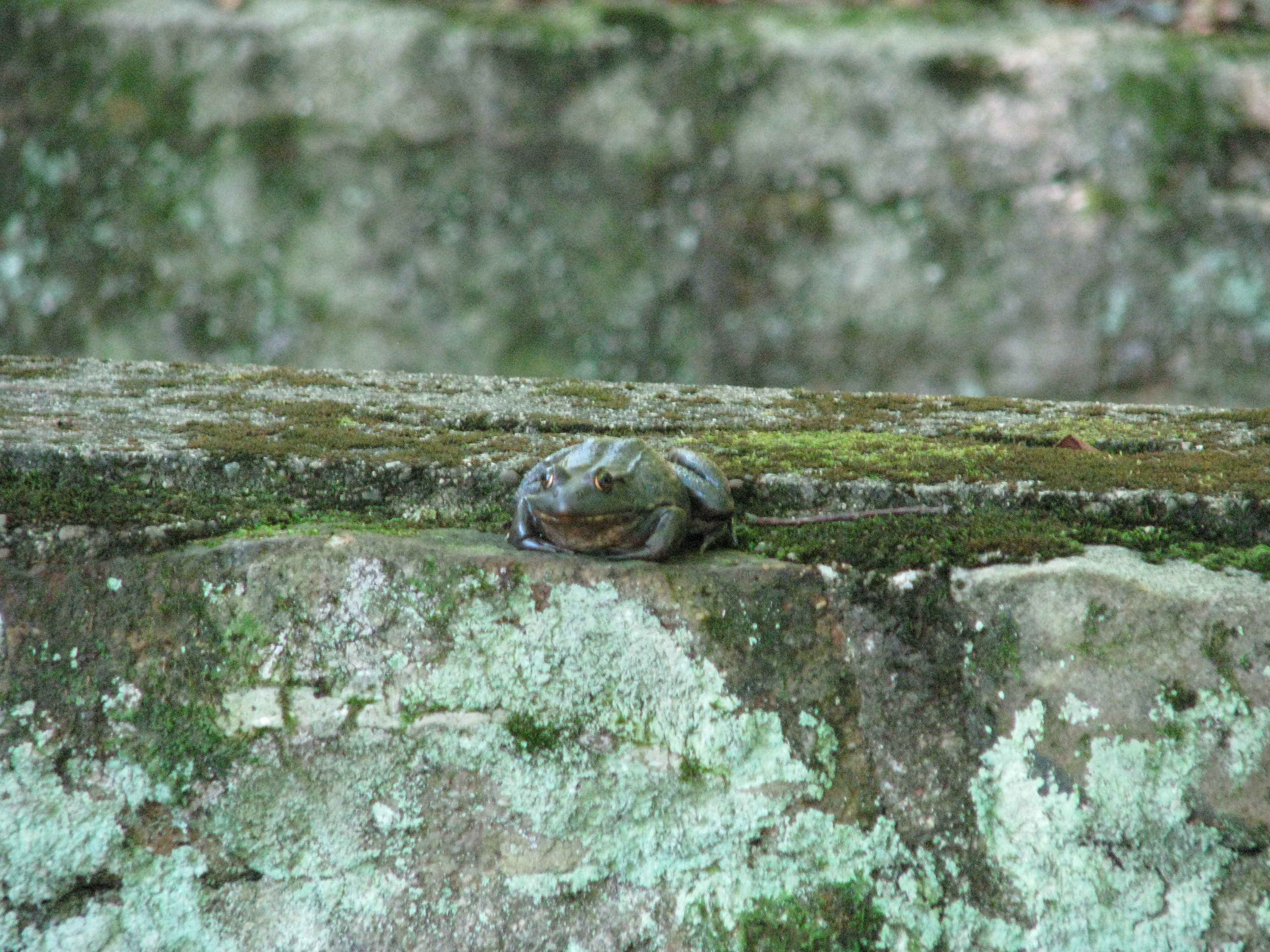
The cages and displays are long gone; but the Environmental Education Department still tells the story of the zoo. You can find amazing small wildlife like millipedes, salamanders, toads and frogs in or near the pools once inhabited by turtles and fish. One of the frogs, Louise, a green frog, was named by a kindergarten class who first discovered her two years ago.
Louise the Frog, photo by State Parks
Come visit the zoo, sit quietly on the moss covered stone walls, and imagine the sounds of excited children as they rush from one exhibit to another, looking at and learning about the wonderful wild things of long-ago Allegany.
In 1944, President Franklin D. Roosevelt invited a small group of Holocaust refugees to the United States. The War Refugee Board (WRB) was established to determine who should come to the US and where they should be housed. FDR sent Special Assistant to the Secretary of the Interior Ruth Gruber to Italy to bring back 982 men, women, and children. The refugees were from 18 different European countries and most were Jewish. Many had been fleeing persecution for years and had made their way to an Allied-controlled part of Italy. Almost 100 of the refugees had escaped concentration camps such as Dachau and Buchenwald.
The refugees were to be housed at Fort Ontario, which is outside of Oswego, New York, and is now a state historic site. The fort had recently been vacated of troops training to fight overseas. Barrack-like houses were quickly constructed to be the temporary homes for the refugees. The War Refugee Board chose to keep family groups together, and sought people with skills that would be helpful in the camp (for example, seamstresses and carpenters).
Two story barrack-homes and dining hall (Photos from ‘Token Shipment’ by Edward B. Marks)
The refugees took a ship from Italy to New York City, then a train to Oswego. After fleeing for months or years, the haggard group arrived at Fort Ontario on August 5, 1944. Many of the adults wore crude handmade sandals and most children were barefoot.
The refugees admired the beautiful grounds of Fort Ontario, but the tall fence around the compound reminded them of the concentration camps they had fled from. The barrier was a security measure and also served to quarantine them in case they brought communicable diseases. Oswego residents had been surprised to hear about Roosevelt’s invitation, and were curious about the newcomers. As soon as the refugees arrived, Oswegians came to the fence to greet them. Children on both sides played along the fence, and beer and cigarettes were passed over by the Americans.
Refugees receiving shoes, soap, and towels upon arrival (Photo from ‘Token Shipment’ by Edward B. Marks)
In the first days after their arrival at the shelter, the adults were interviewed by WRB staff. They had all passed a background check in Italy, and now officials wanted to determine if the refugees could provide information on Hitler’s Europe which could help the Allied armies.
When the refugees first arrived, many gorged themselves on the food provided during meal times. After years of food scarcity due to the war, they were scared that the plentiful food would not last. Most of the refugees were underweight, so the WRB increased the amount of nutritious food served, particularly milk. The WRB also listened to requests and provided a few traditional ethnic foods such as dark bread, and created a separate dining hall for the Jewish refugees who followed kosher dietary rules.
‘Lightkeeper’s House’ at Fort Ontario painted by refugee artist Olga Mikhailoff, c. 1945, State Parks; and English practice letter by refugee Stella Levi, October 25, 1944, State Parks.
After the initial quarantine period of several weeks, the refugees were permitted to leave the shelter. Children were enrolled in local schools and were bused in from Fort Ontario. Adults were given passes to go into Oswego and had to adhere to a curfew. In addition, the WRB hosted open house events where Oswegians could enter the camp; the main reason was to assuage local rumors that the refugees were living lavishly.
Refugees building wooden music stands and orking in the machine shop(Photo from ‘Token Shipment’ by Edward B. Marks)
Once the refugees became settled, they got to work. A library was created to provide books, English language classes were offered, and a day care was established. The dining halls and laundries were staffed, and private agencies outfitted workshops for creating products for sale, such as music stands. The refugees were paid a set wage, no matter the person’s previous work experience, funded by the WRB and private agencies. In the fall of 1944, a group of refugees left the fort for several weeks to help pick apples in the region.
Eleanor Roosevelt visiting Fort Ontario in September 1944 (Photo from ‘Token Shipment’ by Edward B. Marks)
Unlike the refugees coming to the US today, the World War II refugees were not initially granted the right to stay in the country permanently; FDR planned for them to return to Europe after the war was won. After FDR’s death and the war overseas came to an end, however, the WRB and federal government could not decide what to do with the refugees. The majority of the refugees wanted to stay in the US, and Oswegian leaders formed a Freedom Committee to advocate for the refugees to be permanently integrated into the community. Six congressmen of the subcommittee of the House Committee on Immigration and Naturalization visited Fort Ontario to hear testimony from the refugees, Oswego residents, and government officials. Leaders within the refugee committee were selected to give heart-wrenching accounts of what they had experienced during the war, and explain that many had no homes to return to.
Newspaper clipping showing Boy Scout Troop 28 testifying before Congressmen about their desire to remain in the US (Photo from ‘Token Shipment’ by Edward B. Marks) and page from LIFE Magazine, August 1944.
On December 22, 1945, President Harry Truman announced that the refugees who wanted to stay should be permitted to remain in the US. After many months of waiting for a decision, the refugees were overjoyed. Immigration processing began in January and the last of the refugees left Fort Ontario on February 4, 1946. A group of 66 Yugoslavs decided to return to Europe, but most chose to remain in the US. More than half of the refugees were resettled in New York State, and many went to New York City, which had larger immigrant populations. Others were reunited with family in 21 other states.
Senior conservator Heidi Miksch and Park Worker Brian Hibbert remove part of the historic fence at Fort Ontario. (Kevin Fitzpatrick, Palladium Times)
This chapter of American history is being brought back into the spotlight. Last summer, conservators from State Parks removed a section of the boundary fence for the refugee shelter and shipped it to the US Holocaust Memorial Museum in Washington, D.C. “It’s an iconic symbol,” says Paul Lear, historic site manager at Fort Ontario. “It was the meeting place between the townspeople and the refugees.” The fence represents the struggles and successes throughout American history to welcome newcomers to our country: the initial barrier, followed by acceptance.
The new exhibit at the US Holocaust Memorial Museum featuring the fence is scheduled to open in April 2018.
Post by Alison Baxter, Excelsior Service Fellow
Special thanks to State Parks staff members Paul Lear and Amy Facca for pictures and resources.
Featured image: Oswegians conversing with World War II refugees housed at Fort Ontario (Photo from ‘Token Shipment’ by Edward B. Marks)
Resources
Fitzpatrick, Kevin. “Section of Refugee Shelter boundary headed to National Holocaust Museum for new exhibit”. Palladium Times, June 30, 2017.
Marks, Edward B. “Token Shipment: The Story of America’s War Refugee Shelter, Fort Ontario, Oswego, N.Y.” United States Department of the Interior War Relocation Authority, 1946; revised 2017.