Ganondagan State Historic Site, in the Finger Lakes Region, was once the capital of the Seneca Nation and home to as many as 4,500 people. Ganondagan is translated to mean “a town on a hill surrounded by the substance of white” referring to white blossoms growing there which turned into an edible fruit. Located in Victor, New York, Ganondagan is the only New York state historic site dedicated to Native American history.
The original Ganondagan (ga·NON·da·gan) community was destroyed by a campaign of the French in 1687. At the time the French army and their allies spent days destroying corn, beans, squash and other foods that sustained the Seneca Nation and other Haudenosaunee (Iroquois people). Records show that that over 1,200,000 bushels of corn were cut down, burned and destroyed in mid-July of 1687. Seneca homes were also burned to the ground. In 1987 Ganondagan State Historic Site opened as a New York State historic site 300 years after its demise.
The Iroquois White Corn Project (IWCP) was first established in 1997 by Dr. John Mohawk, on a Seneca reservation known as Cattaraugus, upon his death in 2006 the project became dormant.
In 2012 the Friends of Ganondagan re-established IWCP in a farm house on site with the help of Historic Site Manager Pete Jemison who moved the equipment and Iroquois White Corn Project Ganondagan. Today the IWCP produces three products from heirloom Iroquois White Corn: whole hulled dried corn, roasted white corn flour, and white corn flour, which are marketed by the Friends group. Iroquois White Corn is a slow food, gluten free and highly nutritious, especially when combined with beans.
The process of removing the hulls from the kernels using cooking lime is known as nixtamalization. This culinary technique softens the corn hulls and kernels, creating whole hominy which can be ground in to masa flour. Nixtamalized corn has healthy amino acids and vitamin B and is more flavorful and aromatic. Nixtamal is the Spanish interpretation of the Aztec term for the process of soaking dry corn in fire ashes to improve flavor and nutrition nixtamalli.
About 75% of our corn is obtained from Haudenosaunee farmers and products are sold to the Seneca Nation, Oneida Nation, retail outlets (including Wegmans) and through the gift shop in the Seneca Art & Culture Center.
The Iroquois White Corn Project provides employment and training for both Native American and non- Native youth. Volunteers assist the IWCP at the annual husking bee (held in the fall) and by sorting corn kernels. Volunteers also assist in maintaining our onsite gardens. We grow the three sisters – corn, beans, and squash – known to the Seneca as Our Sustainers – Dioheko.
The Seneca Art & Culture Center at Ganondagan opened in October 2015 and houses a gallery, two classrooms, an orientation theater, auditorium, caterer’s kitchen, archival storage, and offices for the staff.
More information about Ganondagan and special events sponsored by the Friends can be found at Ganondagan.org
A growing husk pile, photo by Carol Llewellyn
Braiding the corn, photo by Carol Llewellyn.
More than 50 people helped during the husking bee, photo by Carol Llewellyn.
Young and old help to shuck the corn, photo by Carol Llewellyn
Looking over the playing fields at Fort Niagara State Park, it is hard to imagine that 100 years ago those fields were used for a different purpose: training young New Yorkers headed off to the ‘Great War.’
In April 1917, President Woodrow Wilson declared war on Germany, ending 2-1/2 years of neutrality. This was not an easy decision for President Wilson, but many factors influenced his decision. There was unrest in Russia and German U-boats were indiscriminately sinking US merchant ships. In addition, it was discovered that Germany had secretly offered to help Mexico recover land lost during the Mexican-American War (1846-1848) if Mexico would ally with Germany and declare war on the United States (Mexico did not take up this offer). With all this in mind, Wilson declared war on Germany.
When war was declared, the United States was not ready. The Army was small, with under 100,000 professionally trained soldiers, many of whom had never been on the battlefield. Sixteen nations had armies larger than the United States. With the declaration, the Army needed both enlisted men and officers to help defend United States’ interests and allies France, Belgium, and Great Britain.
As the United States inched towards war, Army officials were looking for places to train officers through the Reserve Officers’ Training Corps (ROTC). One of the places that was chosen to train officers was Fort Niagara, an army training post at the mouth of the Niagara River in Youngstown, New York. When Wilson declared war, Fort Niagara was training troops headed to Panama or to minor conflicts along the Mexican border.
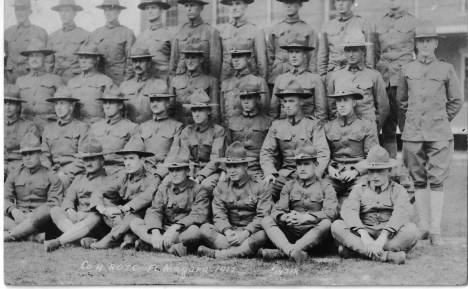
ROTC trainees, photo courtesy of Old Fort Niagara
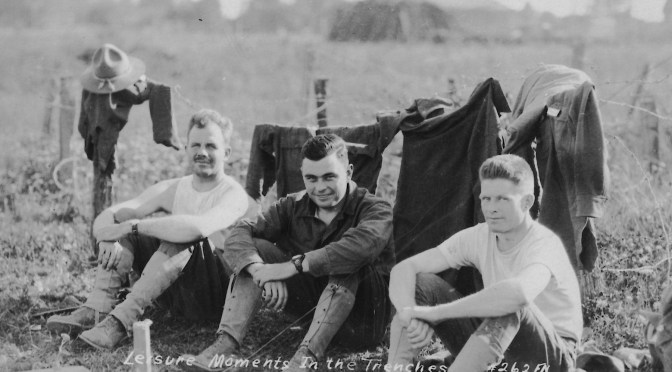
The Army planned two ROTC trainings at Fort Niagara in 1917, one from May through August, and the second from August through November. Each session would train men on field sanitation and hygiene, care of arms and equipment, drilling, military courtesies, and the realities of trench warfare. The chief training officer was Colonel John W. Heavey.
Chief training officer Heavey, photo courtesy of Old Fort Niagara
Aerial view of Fort Niagara 1917, photo courtesy of Old Fort Niagara
Inside the barracks, photo courtesy of Old Fort Niagara
Because housing for the trainees was in short supply, the camp quartermaster hired day laborers to build nine 20’ x 300’ barracks and four mess halls during the month of April. The buildings were completed before the first class of ROTC trainees arrived. Telephone and electrical systems were also installed throughout the training facilities in April.
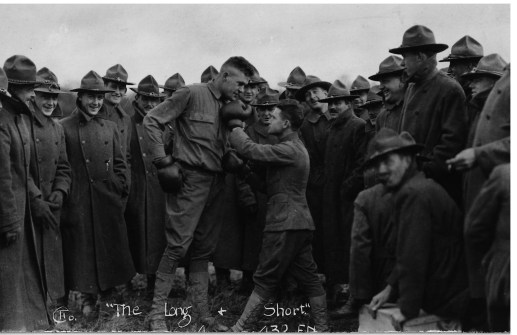
The ‘Long’ and ‘Short’ spar in autumn 1917, photo courtesy of Old Fort Niagara
The first officer class consisted of 2,500 young men from Pennsylvania, including some from wealthy Philadelphia families. Local newspapers noted that a few of the officer candidates “know more about the different brands of face powder than they do about gunpowder.”
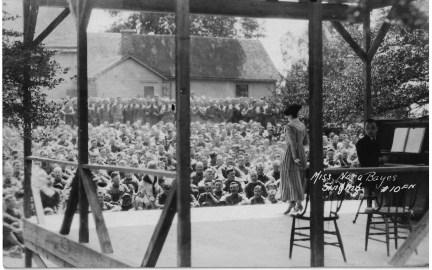
Nora Bayes singing to the ROTC trainees
The second class consisted primarily of New Yorkers, many of which were from Buffalo. These “typical Americans, clean-cut, upstanding fellows, the kind that make fighters” were lucky enough to have a concert by Nora Bayes (Eleanora Sara Goldberg) just after their training started. Ms. Bayes was a popular actress, singer, and comedian of the time who co-wrote Shine on, Harvest Moon with her husband Jack Norworth.
This slideshow requires JavaScript.
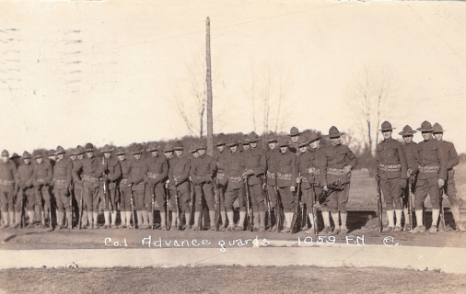
Bayes’ concert was a brief reprieve from the daily 16-hour training. Each day the trainees had inspections, signal practice, mapmaking, long marches, mock battles and marksmanship, and trench construction. The trenches were dug on the Fort Niagara Beach. Military ceremonies marked the end of the training, with the ‘graduates’ learning which regiment they were assigned in the American Expeditionary Forces. American Expeditionary Forces troops were also known as ‘doughboys.’
Advance Guard, photo courtesy of Old Fort Niagara
After the second ROTC training, the fort became training grounds for 1,772 Polish-American soldiers who were part of the Polish Blue Army. They trained at Fort Niagara from December 1917 through February 1918 before joining the Western Front.
After the war, Fort Niagara served as the home of the US Army 28th Infantry Regiment until the regiment was relocated to Fort Jackson, South Carolina in 1940.
Blog adapted from: Emerson, Robert, Clean Cut, Upstanding Fellows: Fort Niagara’s ROTC Training Camps, 1917 March 2017 Fortress Niagara, p 5 – 15.
Women have not always had the legal right to vote in America. On August 18, 1920, the 19th amendment was ratified granting women the right to vote. This milestone in women’s history was the result of decades of sustained action: protests, political organizing, direct confrontations and debates with people who felt women needed no further rights. Suffragists were ostracized, fired from jobs, beaten, arrested and imprisoned – all because they dared to strive for the right to vote.
For the supporters of women’s suffrage gaining the vote was a matter of life or death. Women were subject to the will and mistreatment of their husbands, both financially and physically within the home. Husbands had complete legal authority over their wives and could abuse them with no fear of consequences. Any woman attempting to leave a marriage faced the loss of custody of their children and destitution. The workplace was no better; women faced sexual harassment, abuse, terrible working conditions and lower wages than their male counterparts with little to no legal recourse. Women were also barred from many professions completely. The vote meant access to the political power needed to reshape laws and gain equal treatment and dignity as human beings.
When it came to the issue of women’s suffrage, New York was a state at war within itself. Major activists on both sides of the issue held meetings, published articles, and attempted to sway public opinion.
The anti-suffragists claimed that giving women the vote would move them too far away from their primary duty of running the home. They fully agreed with the notion that a “woman’s place” was in the home, although they did concede that women should contribute their time and talents to educational, charitable, religious and moral organizations. These endeavors did not require the vote, nor included politics.
Charles S. Fairchild, husband of Helen Lincklaen, was a politician and served under President Cleveland as the Secretary of the Treasury. Fairchild was the fourth owner of the estate which would later become Lorenzo State Historic Site in Cazenovia N.Y. and a staunch supporter of anti-suffrage. He was an active local leader in the effort to prevent women from gaining the vote. The collections of Lorenzo include many anti-suffrage items, such as, printed speeches, several issues of The Woman Patriot, a button which reads: “VOTE NO ON WOMAN SUFFRAGE”, anti-suffrage pennants, and books and handbills with titles like Anti-Suffrage: Ten Good Reasons and The Menace of Women’s Suffrage in New York State—some with hand written personal inscriptions by the authors.
Fairchild was not alone in his views within the town of Cazenovia. Many prominent individuals, both men and women, considered themselves avid supporters of the anti-suffrage cause. The Cazenovia Anti-Suffrage Society was very active and held regular meetings to support their cause and raise funds. Many anti-suffrage groups were organized by women; and the majority of these organizers were members of the upper class with husbands in prominent positions in business and politics.
From our modern day perspective it may be difficult to imagine why so many women supported the anti-suffrage cause. But the popular view of society in the early 1900s holds many of the answers. Life was cleanly divided into two halves, the domestic realm and the public world. Men were believed to be ideally suited by their nature to be masters of public life. Aggression and a competitive spirit were seen as traits best suited to politics, finance and war. Women were the converse, the peacemakers, the orchestrators of a happy family, the creators of cleanliness and order within the home. These views were not only popular but for many unquestionably true. Suffragists challenged this world view directly with the assertion that women were equal citizens and deserved the right to vote.
The first organized effort to seek the vote for women in New York began in 1846 when a small group of women in Clayton NY petitioned the state government asking for “equal, and civil and political rights with men.” It took nearly 75 years to shift public opinion away from these historic, engrained views towards a more equitable society.
The Copake Iron Works was established in 1845 along the Bash Bish Brook near the Massachusetts border by Lemuel Pomeroy (1788-1849). Pomeroy was a prosperous businessman from Pittsfield, MA. After operating an iron furnace in nearby Ancram, NY for the Livingston family, and being involved with the New York and Albany Railroad he started the Copake Iron Works. In 1853 he encouraged the New York and Harlem Railroad to expand the rail line to the ironworks and growing hamlet of Copake Falls Ironworks. Remarkably, the Ironmasters house and some worker housing from this early period are intact today.
Copake Iron Works, 1888, State Parks image
In 1861, John Beckley of Cannan, CT purchased the Iron Works. He sold it one year later to Frederick Miles (1815-1896) of Salisbury, CT. Miles elevated the operation to new heights and the Copake Iron Works developed a reputation for producing high quality iron products such as railroad wheels and axles. Miles also replaced the first furnace with the one that is still on site today and being stabilized by the Friends of Taconic State Park. Miles, who served in Congress with future Presidents James Garfield and William McKinley, entrusted the day-to-day operations to his son William A. Miles. Thanks to William, and with the good fortune of what is still standing at the property, the Copake Iron Works constitutes the largest group of iron-making remnants in the larger tri-state “Iron Heritage” area. In 2016, the Copake Iron Works was designated a Hudson River Valley National Heritage area by the National Parks Service.
This slideshow requires JavaScript.
The Copake Iron Works Museum showcases iron-making artifacts, and some 25 interpretative signs throughout the beautiful natural setting illustrate iron-making operations in great detail. Friends of Taconic State Park (Friends) supports the activities of the Taconic State Park – Copake Falls Area, with an emphasis on the preservation of the historic Copake Iron Works. The Friends group staff the museum every weekend in season and takes visitors into the blast furnace.
Museum artifcats, photo by Friends of Taconic State Park
Copake Iron Works Museum, photo by Friends of Taconic State Park
Parking is plentiful for cars and buses and there are also picnic facilities at the museum. Stop on over for a visit.
Rockland Lake, a 256-acre spring-fed lake at the foot of Hook Mountain, is today one of the most popular state parks in the Hudson Valley. Its two golf courses, pool, tennis courts, hiking trails, and ball fields attract legions of people in the summer months, who come to fish, picnic and play in this park along the Hudson River. And while few people know that the lake once (still might?) claimed to be the home of the world’s largest snapping turtle, there is a growing number of people who proudly point to Rockland Lake’s massive stone ruins along its eastern shore as laying claim to global fame on a distinctly different level, one that is very, very cool.
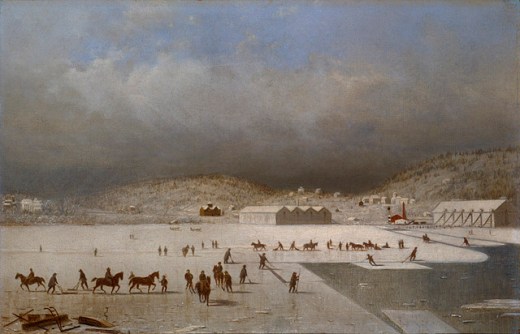
In 1806, up in Boston, a young and enterprising man named Frederick Tudor cut chunks of ice out of his family’s pond, loaded it onto a boat, and set sail for Martinique, convinced that the world would soon have an insatiable desire for ice in their drinks. He was a man ahead of his time, and after many false starts, bankruptcies, and even debtor’s prison, his idea finally caught on, and the demand for ice to cool drinks and preserve food spread around the globe. Rockland Lake, because of its clean spring fed water and proximity to the Hudson River, New York City, and international shipping lanes, soon became the undisputed leader in this new and sustainable industry, and the Knickerbocker Ice Company was formed in 1831 to meet that demand. What began as a single warehouse to store the ice blocks neatly cut into 20” x 40” rectangles soon became three massive structures capable of containing over 100,000 tons of ice.
Andrew Fisher Bunner (1841-1897), Cutting Ice, Rockland Lake, N.Y., New York Historical Society, accessed from flickr
A railway was built to convey the ice over Hook Mountain, and included a gravity-fed incline took the cars down the steep face of the mountain to a massive pier, where ice barges on the river were filled and shipped to the city. New York’s “Meat Packing District” was located on the Lower West Side to take advantage of the ice shipped down the Hudson on these barges to cool the meat. Soon, the ice from Rockland Lake became so famous around the world that imitators sprung up, and even a lake in Sweden was renamed Rockland Lake so that its owners could claim that they sold “Rockland Lake” ice. It’s hard to imagine that blocks of ice were shipped from a rural New York lake to exotic destinations like Australia and Asia, but for many people and businesses no other ice was as clear and clean as Rockland Lake Ice.
The ice at Rockland Lake was so famous that, in 1900 Thomas Edison Films documented the entire process of harvesting the ice at Rockland Lake, from the horses drawing the ice plows to the workers loading it onto the barges. Watching that film, it is hard to imagine that today the same site is far from the industrial zone depicted in the grainy black and white film.
By the early 20th Century, however, technology had caught up with demand, and artificial ice began to displace naturally harvested ice for most purposes, and while natural ice harvesting continued (and continues today) to be a sustainable source for cooling elsewhere, the harvests stopped at Rockland Lake in 1924. In 1926, while demolishing the facilities to make way for what eventually became summer cabins and hotels, a fire broke out in one of the buildings whose huge double-sided walls were packed with tons of sawdust to keep the ice cool. When the smoldering fires were finally extinguished (anecdotally, some said that they burned for over a year), all that was left of the houses were the massive stone walls at the base of Hook Mountain. Eventually, in the 1950s, the Palisades Interstate Park Commission began buying up private parcels, and in 1965 Rockland Lake State Park welcomed its first guests. The ruins of the ice house remained, lost but not forgotten.
In 1988, park manager Jack Driver and his wife Barbara led tours of the ruins to those curious about their history and Barbara led volunteers in the successful effort to have the ruins designated as an official Clarkstown Historic Site. While they managed some success, the Drivers moved to another park assignment away from Rockland Lake, and no proper dedication had ever taken place. Twenty years later, after jogging past the ruins countless times on the lake’s three-mile paved path, Rockland resident Timothy Englert inquired about the walls, which now contained a tangle of black locust and other trees. John Burley and Mike Krish, park managers, handed Mr. Englert a manila folder, inside of which was a trove of information regarding the history of the lake’s icy past, as well as official-looking documents attesting to its historic status. The forgotten folder also contained a faded black and white panoramic photograph of the ice harvesters standing atop the frozen lake, a photo that evoked the pride of place and industry that employed thousands of people during a period of great growth.
This slideshow requires JavaScript.
Mr. Englert realized that no dedication had ever taken place. He enlisted the help of Robert Patalano, a fellow Clarkstown resident and professional ice sculptor, who sculpted an 18’ ice replica of the original Knickerbocker Ice house, while Mr. Englert took one of the rot-resistant locust logs and created the Knickerbocker Bench to commemorate the site with something a bit more durable than ice. On a bitter cold weekend in January of 2007, the Driver family returned to Rockland Lake as the guests of honor at the Knickerbocker Ice Festival, which grew from a few hundred people that first year to over 25,000 people two short years later. The festival included massive ice sculptures and historic tours. That first sculpture lasted five weeks before it melted away.
Today, the legacy of ice at Rockland Lake lives on in historic markers placed throughout the ice house ruins at the park. Rockland Lake isn’t the only State Park where ice was once harvested. Both Bear Mountain and Schodack Island once also had ice houses of their own. And while the ice festival is no longer an annual event, the spirit of the ice lives on in the Knickerbocker benches found along the park’s trails, and in the pride of Rocklanders, who can walk into the ruins of Ice House #3 on a hot summer day and imagine themselves surrounded by 100,000 tons of ice.
The Knickerbocker Bench was created by artist Timothy Englert to pay tribute to the Knickerbocker Ice Houses at Rockland Lake, photo by Timothy Englert
Ice version The Knickerbocker Bench was created by artist Timothy Englert to pay tribute to the Knickerbocker Ice Houses at Rockland Lake, photo by Timothy Englert










 New York State Parks and Historic Sites Blog