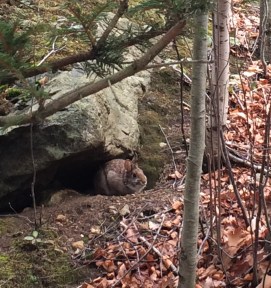
New York’s rarest native rabbit, the New England Cottontail, photo by Amanda Cheeseman
It is a typical morning at the Taconic Outdoor Education Center (TOEC) in Fahnestock State Park. The sunshine beams through the forest, a chorus of song birds are greeting the day, and 60 elementary school students are making their way to breakfast to fuel up for an active day of learning in the outdoors. Meanwhile, a familiar truck and crew rolls in to begin their workday visiting several small animal traps set in specific locations in hopes that at least one will contain a rabbit, particularly a New England Cottontail.
The State University of New York College of Environmental Science and Forestry (SUNY ESF) is collaborating with State Parks, and the Department of Environmental Conservation to conduct important research about the population decline of native New England Cottontail. Over the past decade, studies have indicated that their numbers have decreased about 50%. The two major factors contributing to the population decrease are loss of suitable habitat, and the expanding range of the Eastern Cottontail. The only native rabbit species east of the Hudson River is the New England Cottontail; however the range of the Eastern Cottontail has been expanding and now overlaps this territory which causes competition for resources. Predation is also playing a role in the decreasing population; part of this research project is keeping an eye on who’s eating New England Cottontails by using trail cameras. These cameras placed in baited locations and use a motion sensor to take pictures when an animal walks by. Different predators are “captured” in a photo as they come to investigate the bait, which shows the species that a present in the rabbit survey area.
Camera trapped red fox
Camera trapped bobcat
Camera trapped eastern coyote
Back at the TOEC, the students are gathering to meet with their instructors for their morning lesson, the phone suddenly rings. “We have a rabbit” says the voice on the other end. Flexibility is part of the job description of an outdoor educator, and no one passes up an opportunity to enjoy a teachable moment, especially when it involves a live animal. All plans are dropped for the moment and after a short walk the students quietly approach the researchers who are preparing to identify, collect data, and radio tag the small mammal.
Measuring a juvenile New England Cottontail, photo by Amanda Cheeseman
Many of students who visit the TOEC are from the New York City area and rarely get to experience being this close to a truly wild animal, and they have a lot of questions such as: “Why is it in a pillowcase?”, “How long are its feet?”, “Is that a baby?” and “What’s That!?”. Their sense of wonder is contagious and the SUNY ESF researchers return the enthusiasm by answering the barrage of questions being hurled at them, while also safely collecting data on their captive rabbit. Measurements are taken, and the data is recorded onto forms and will go into a large database to allow for comparison across the entire northeast. The final step is to attach a small antenna to the rabbit’s back so that the researchers will be able to locate the individual rabbit again through radio telemetry. Now comes the exciting part! The rabbit is released, and in a flash it darts away, immediately out-of-sight, camouflaged amongst the underbrush.
A well camouflaged New England Cottontail. Can you see the antennae? photo by Amanda Cheeseman
Upon reflection, many students will say seeing the rabbit was their favorite part of the week, and they walk away with the feeling of being included in something important. Nothing teaches better than experience; giving students the chance to interact with a living, breathing part of the ecosystem around them. It sure makes for a pretty great day.
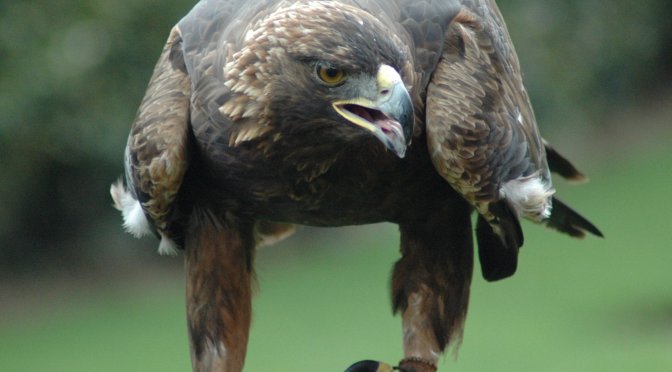
On February 24, 2009, two visitors to Betty and Wilbur Davis State Park were enjoying a sunny walk on Davis Road when two BIG birds flew overhead, going north. “Golden Eagles!” exclaimed these experienced bird watchers. Both were volunteers at the Delaware Otsego Audubon Society’s (DOAS) Franklin Mountain Hawk Watch which is known for its number of migrating Golden Eagles during the late fall. The Golden Eagle is one of the largest raptors (birds of prey) in North America, not that common in eastern New York, but well worth keeping an eye out for.
During spring and fall migration, raptors use prominent ridges to save energy by riding updrafts that lift and/or push birds toward their destination. On sunny days, warm air may spiral upward, creating thermals (columns of warm air) that lift birds to higher elevations. Raptors soar and glide as much as possible, saving their own energy resources during the long journey. In early spring, they are on their way to nesting territory. For Golden Eagles coming through New York, that Destination is in Labrador, Quebec and Ontario, Canada. Some Goldens stay the winter in our state, so in February it is hard to say if these were birds headed north or had been here all winter.
DOAS conducted Golden Eagle surveys at Davis Park in the spring of 2010, 2011, and 2012 with an average of 35 Goldens heading north each March. Since then, area hawk watchers have counted raptors there when conditions seemed favorable, averaging 16 Goldens each March. Data is collected by the Hawk Migration Association of North America and can be viewed at hawkcount.org. (Look for DOAS-Davis State Park.) It’s interesting to look at daily accounts to compare wind direction, wind speed, temperature and number of raptors identified, along with non-raptor sightings.
Wind break at sunset, Diane Graf, DOAS volunteer
Site supervisor Joe Ritton has been an enthusiastic supporter of the counting efforts at Davis Park. He built a wind break for the team near cabins 4 and 5 in early March. It provides shelter from the ever-present wind, and prevents spotting scopes from blowing over. The view to the south, west and north are wonderful with the park elevation being 1971 feet. Here’s a 360 panoramic view from a point above the wind break:
Hawk watching requires patience, watching the sky until the exciting moment when a bird appears as a tiny dot in the distance and approaches, bringing many possibilities: Is it large or small? What type is it: a Buteo, Accipiter, Falcon, Harrier, Eagle, Osprey? How many species are in a group of birds? Is the bird an adult or is it immature? The questions are many, and finding the answers is challenging. Wind can keep birds far away, lighting can make colors seem to change, and birds show different shapes when seen at certain angles. Practice is necessary to learn identification skills. Spending time with an experienced counter at an established hawk watch is a wonderful way to learn. Although Golden Eagles have been highlighted in this article, there will be many other species of raptors during migrations, too. Look for Bald Eagles, Northern Goshawks, Cooper’s Hawks, Sharp-shinned Hawks, Broad-winged Hawks, Red-tailed Hawks, Northern Harriers, Rough-legged Hawks, and Ospreys.
Bring a chair, good binoculars and a spotting scope if you have one. A beautiful, calm day is most appealing to the potential hawk watcher, but without wind there will be few raptors. Good visibility is important and raptors don’t migrate in the rain, so look for snow, fog or rain in the forecast when planning whether or not to come for raptors.
Those who are interested in spending more than one day looking for raptors at the Park may wish to rent a cabin. Barred Owls have been heard during the night as well a late in the day. Peace and quiet prevail.
Post by Becky Gretton, DOAS member and golden eagle watch volunteer
Maps are everywhere today, but did you know that cartography, or the art of map-making, has existed in various forms since the dawn of humanity? The earliest known map was discovered in Turkey in 1963. It is a wall painting showing the layout of a village and two erupting volcanoes dating from approximately 6200 BCE; the map closely matches the ruins found in the nearby valley.
Map of gold mines in the New Kingdom of Egypt, ca 1160 BCE. These maps, drawn on papyrus show the location of gold mines and rock quarries. Annotation in hieratic, the common language, indicate the meaning of colors and symbols such as mountains, roads and rivers. This map is also considered one of the oldest geologic maps as the coloration matches the types of rocks found in the area. Source: http://www.wikipedia.org
Many early traditions passed knowledge on through story or movement, similar to how we give directions today, “turn left at the store and you’ll see my house behind the pine tree.” India has a rich history of such ‘verbal cartography’. The epic, the Mahabharata, details the surrounding landscape using text rather than drawings. An excerpt from the Mahabharata describes King Bharata’s kingdom, “There are seven Main Mountains…but thousands more mountains are recognized in their general vicinity…Then, there are other hills less well-known…the population drinks from many rivers: the great Ganges, the Indus and the Sarasvati.”
A royal tapestry from the early 20th century, of King Njoya’s palace in Bamum Kingdom, Cameroon. A sketch was made on undyed cloth and then tightly stitched over. Next, the cloth was dyed with indigo and the stitching removed to show the undyed pattern. Source: http://www.portlandartmuseum.us/mwebcgi/mweb.exe?request=record;id=12637;type=101
Ephemeral, or temporary, maps, made by drawing on the ground, are found around the world. Imagine the person you are giving directions to is confused, so you draw the store, the road, your house and the pine tree. In 1817, the Russian explorer Otto von Kotzebue visited the Marshall Islands. There, a local navigator laid out the location of all known islands in the chain using pieces of coral. By recreating this map for navigators on other islands, von Kotzebue was able to create a nearly complete map of the Marshall Islands. Pacific Islanders were well known for their ability to create mental maps. Sailors would memorize island locations in relation to the stars and sail for days at a time without a physical map.
Examples of wooden map models of the Greenland coast carved by Ammassalik Inuit, Kunit fra Umivik, and collected in the late 19th century. The shorter map represents the coastline and the longer model represents a chain of islands. Source: http://books.google.com/books?id=iDspAAAAYAAJ.
Native Americans frequently made maps on birch bark. During the Revolutionary War, Benedict Arnold found one such map near the British garrison at Quebec. It was inserted into a split stick and pointing toward the western stream in a fork. When opened, the map included the streams, hunting camps, and a line showing a direction of travel.
During the age of European exploration, many traditional forms of mapping were replaced by the western method: using latitude and longitude to plot features on a grid. By the 1850s, mapping practices had become uniform across Europe and Asia. These methods eventually spread around the world. Today, most maps are created on computers, using Geographic Information Systems, or GIS. While maps may be easier to produce, they still require the careful eye of a cartographer to make sure they are easy to use and read.
Maps are everywhere now: on our phones, in our cars, on the trail. On-line versions can give us directions, link us to photos or restaurants, and even show us nearby parks to visit. There are over 90 State Park maps available for download to Android and iOS Apple mobile devices through Avenza.
Given the long history of cartography, it is exciting to think about what the future holds for mapping.
Post by Maddy Gold, former Student Conservation Association member
Source: Harley, J. B., and David Woodward, eds. The History of Cartography. Vol. 1-3. Chicago: U of Chicago, 1987-2007. Web. http://www.press.uchicago.edu/books/HOC/index.html.
Signs of spring are beginning to show in the great northeast. The days are getting longer, skunk cabbage is beginning to erupt from the cold ground and birds that have been afar for the winter months are beginning to return to New York State. One may think “What birds? The birds have been here all winter.” True, not all of our native bird species in New York migrate south for the winter months. Birds such as chickadees, northern cardinals, and red tailed hawks tough out the winter, anticipating the spring breeding season (see prior blog post on overwintering birds). But far more birds winter in South America, Central America, and the southern USA and make the long journey back to NY in the spring. It is an exhausting flight; the birds must make short stops to fuel up on available food and take a quick rest, then up to the sky to continue their journey. Upon arrival at their breeding/nesting grounds, whether in New York State or farther north, there is little time for rest or replenishment of their lost fat reserves from the long journey. The birds must stake out nesting territory, defend it, find a mate and start building the nest that they will care for, around the clock, in the weeks to come.
Keep your ears and eyes out for the early returning migrants, the birds that are first to arrive in the months of March and April. Before describing some of the species one may encounter while bird watching, lets discover the difference between bird calls and songs, primarily applying to passerines or “song birds”. A call is a brief simple sound like a chip note, peep, or chatter. A song is a longer sound segment, usually with distinctive melody such as a series of notes strung together. Calls can be heard all winter from our resident bird population, but in spring the songs begin. Songs are typically related to courtship and establishing territory. Bird sounds (song, hoot, chatter…etc.) are also very useful in assisting bird watchers with identification, as bird vocals are distinct to individual species.
Additional tips that help with bird identification are size, coloration or plumage, and habitat use. Pick a bird you are familiar with, say the American Crow, and think about the size of the bird you are trying to identify. Having an idea of what size the bird is can help you narrow down what the species is from one that may look similar but is larger or smaller than the bird you are trying to identify. Plumage (feather pattern) is very important when identifying birds and can also be very frustrating! However, the more you bird watch, the better you will get at noticing the differences between species. Habitat type can also help narrow down what species a bird is. For example, if you are observing a bird in a wetland and you think you know what the bird is, but you’re bird guide says that bird is primarily found in dry open fields – you will have to continue looking. All of these factors combined; sound, size, plumage, and habitat use are useful tools in assisting the observer with identifying a bird.
Early Returning Migrants: Meet the Birds!
Passerines or Song Birds
Red-winged Blackbird
These birds often travel in large flocks and can be found nesting in wet marshy or shrubby habitat. A medium sized bird; the male has a distinctive red patch on the upper wing. The female looks very different in color, being a light brownish hue with darker streaking.
The House Wren is smaller in size than the Red-winged Black Bird, weighing about 41 grams less. Both female and male House Wrens have similar plumage (meaning they look the same). Wrens in general are noted for the characteristic pose seen in the picture, with their tail feathers and head up in the air. The House Wren nests in dense brushy habitat, usually within woods. They will also take to bird boxes.
The Common Yellowthroat is a warbler and one of the first warblers to arrive in New York. The Common Yellowthroat is a small bird, similar in size to the House Wren. The male has a distinctive black mask, outlined in white – which the female lacks. Warblers in general are very colorful and eye catching. The Common Yellowthroat nests in wet marshy and brushy habitats.
The Killdeer is an interesting bird, in that it has the unique behavior of displaying a broken-wing act to draw predators away from their nest. So if you see the act, consider yourself lucky, but do not approach! Killdeer are in the plover family, which primarily are a shore bird. However, the Killdeer can be found nesting on open ground in many habitat types, such as agricultural fields, parking lots, and sandy/bare ground areas. Their vocals sound similar to “Killdeer” and they have two distinctive black rings on their chest. Killdeer are larger than the song birds previously discussed, but smaller then a crow.
Great Blue Herons have long legs for wading in water and can be over three feet tall! These birds have a diet composed of fish, frogs, and invertebrates (organisms lacking a spine, such as bugs and insects). Therefore they rely on open water to forage and find food and can be found anywhere from marshy wetlands, rivers, lakes and flooded areas to the shores of the ocean. Look for Herons as the waterbodies began to thaw in spring. These birds nest in rookeries with dozens of nests built of large sticks in a single tree or group of trees, usually within a wetland.
Ospreys are a large raptor – meaning they are carnivores. Primarily eating fish, they hover high in the air over water and then dive, talons first, at their prey. They can be found along the shores of river, lakes, and the sea and build huge nests compiled of sticks. The nests can be built on the crotch of a tree, utility poles, or platforms specifically installed for osprey nesting. Typically these birds mate for life, meaning once a pair bond is formed; it lasts until one of the birds dies. Ospreys will return to the same nesting site year after year, adding more to their nest as they see fit. Look for these birds as the water bodies begin to thaw, and their characteristic hovering behavior.
Now that you have learned about some of the early returning migrants, grab a good bird field guide, a pair of binoculars and a birding buddy and head to your local State or Town Park! Remember that these birds are under physical stress from their long migration, so avoid flushing or pushing them with your presence (don’t chase them). View with binoculars from a comfortable distance and maybe you will observe courtship behavior or the gathering of nesting material.
*Bird length, wingspan , weight and habitat preference obtained from The Sibley Field Guide to Birds of Eastern North America by David Sibley.
Post by Lilly Schelling, OPRHP, Wildlife Specialist
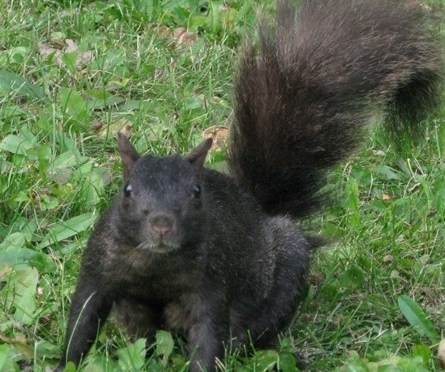
Most everyone has seen a gray, and glimpsed or at least heard of a red, but have you ever seen a black squirrel?!
An eye-catching squirrel at Whirlpool State Park with all black fur; Photo by M. Drahms OPRHP
Chances are if you have ever visited Niagara Falls State Park or any of the neighboring parks in the region you’ve seen what at first glance appears to be the shadow of a gray squirrel. That is, until it moves and starts chattering. Of the many types of squirrels in New York State, the black squirrel is not mentioned in most field guides but it most closely resembles the size and shape of the gray squirrel. It also eats the same diet of seeds and nuts with some fruits, fungi, and the occasional insect mixed in.
A bounty of nuts and acorns are found by squirrels at State Parks along the Niagara Gorge. Photo by M. Drahms OPRHP
There is a good reason for the similarities in appearance and habits as they are, in fact, the same species. The black squirrel is a color phase of the Eastern Gray Squirrel (Sciurus carolinensis), also known as a melanistic variant. Unlike species that change color seasonally, like the long-tailed weasel, these rodents retain the dark coloration their entire lives. The black fur is caused by a genetic mutation that is passed from generation to generation.
Both colors of Gray Squirrel can be seen throughout the year in parks along the Niagara Gorge. Photos by A. Weibel & M. Drahms OPRHP
During winters in Western New York the ground is normally covered in a layer of snow and ice that would make the darker black squirrel easier prey for predators such as coyote, owl and domestic cats. However, a darker coat means more absorption of heat energy from the sun and so less energy used by the animal itself. In the end, the two seem to cancel each other out and gray and black squirrels hold equal dominance around the Falls.
These adorable acorn gatherers garner much attention from the visitors who come to see the beauty of Niagara Falls, hike the Gorge Trail at Whirlpool and Devils Hole State Parks, or ice skate at DeVeaux Woods State Park.
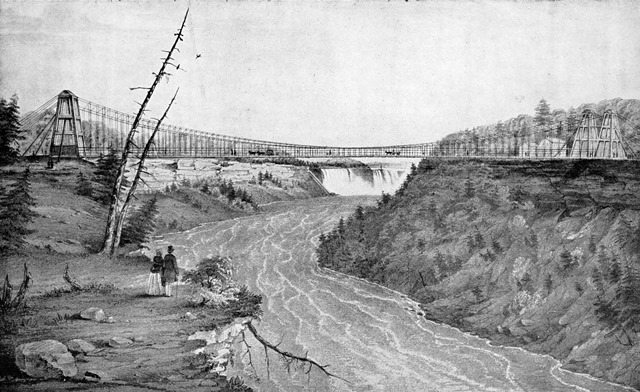
A lithograph created by Charles Parsons of Charles Ellet’s footbridge (completed 1848) commons.wikimedia.org/wiki/File:Charles_Parson_-_Niagara_Falls_Suspension_Bridge.jpg
As to when the variation first appeared in the area around the falls, it is largely unknown. Though there are historic records of black squirrels in the new world, there are none specifically referencing our area. And so, we are left with the urban legends. So the story goes, as the locals tell it, there were no black squirrels in Niagara Falls USA in the early 1800s, but there were across the river in Canada. When the first suspension bridge was built across the Niagara River, with the help of a young boy and his kite, the avenue was open and the black squirrels crossed the river to the USA. Whether the story is true, or whether it was simply over time that the genetic variation showed up in Niagara Falls too, we may never know. But when next you visit, make sure to keep an eye out for this not so common creature.
Post by Angelina Weibel, OPRHP, Environmental Educator, Niagara Region




 On February 24, 2009, two visitors to Betty and Wilbur Davis State Park were enjoying a sunny walk on Davis Road when two BIG birds flew overhead, going north. “Golden Eagles!” exclaimed these experienced bird watchers. Both were volunteers at the Delaware Otsego Audubon Society’s (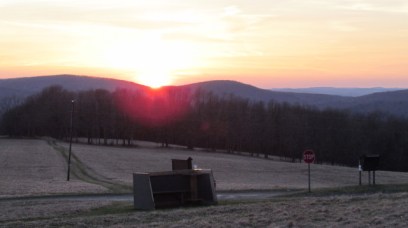




 New York State Parks and Historic Sites Blog
