
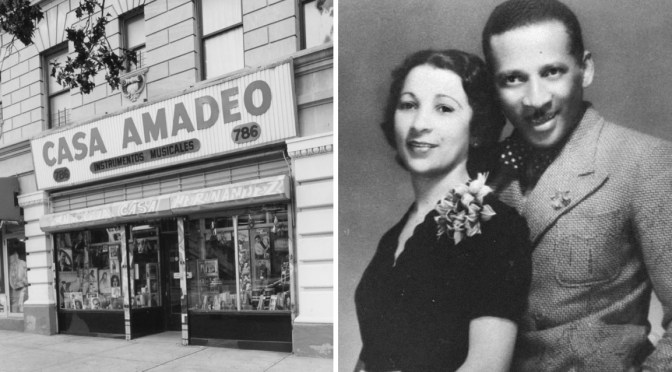
Added to the National Register of Historic Places in 2001, Casa Amadeo, antigua Casa Hernández is best known as the Bronx’s longest continually run music establishment and the oldest Latin music store in New York City. The store’s founder, Victoria Hernández, is one of the earliest female Puerto Rican entrepreneurs in the city. The National Register listing highlights her story and the lasting impact she had on the city’s Latin music scene.
This history is just part of the story! Read the complete nomination for Casa Amadeo.
Looming on a corner along Prospect Avenue in the Bronx, this 1905 Neo-Renaissance style apartment building is home to a cornerstone of New York City’s Latin music history.

Lasting Location
The triangular Manhanset Building was constructed during a building boom in the Bronx in the early 1900s, which happened after the IRT (Interborough Rapid Transit) subway was extended from Manhattan in 1904. Designed by architect James F. Meehan, the six-story stone and brick building is decorated with cornices, stone balconies, and repetitive window embellishments.
Tucked into a ground-floor storefront is Casa Amadeo, antigua (formerly) Casa Hernández. This small space has hosted big names and gained international acclaim in the world of Latin music. It is also one of the few physically intact spaces representing the heyday of the Bronx Latin music scene.
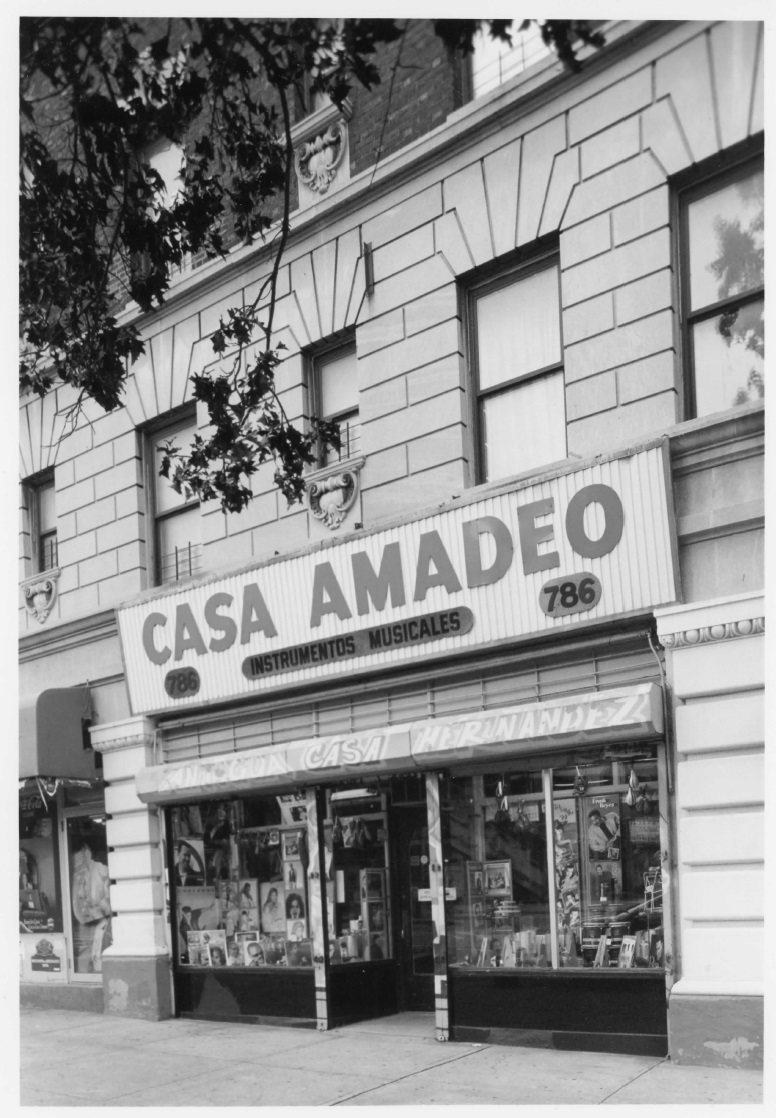
Current owner Mike Amadeo – a composer, musician, and the son of Puerto Rican composer Titi Amadeo – has owned and operated the store since 1969. During his decades of business, he has cultivated an international reputation for Casa Amadeo as a premier (and beloved) destination for Latin musicians and music aficionados.
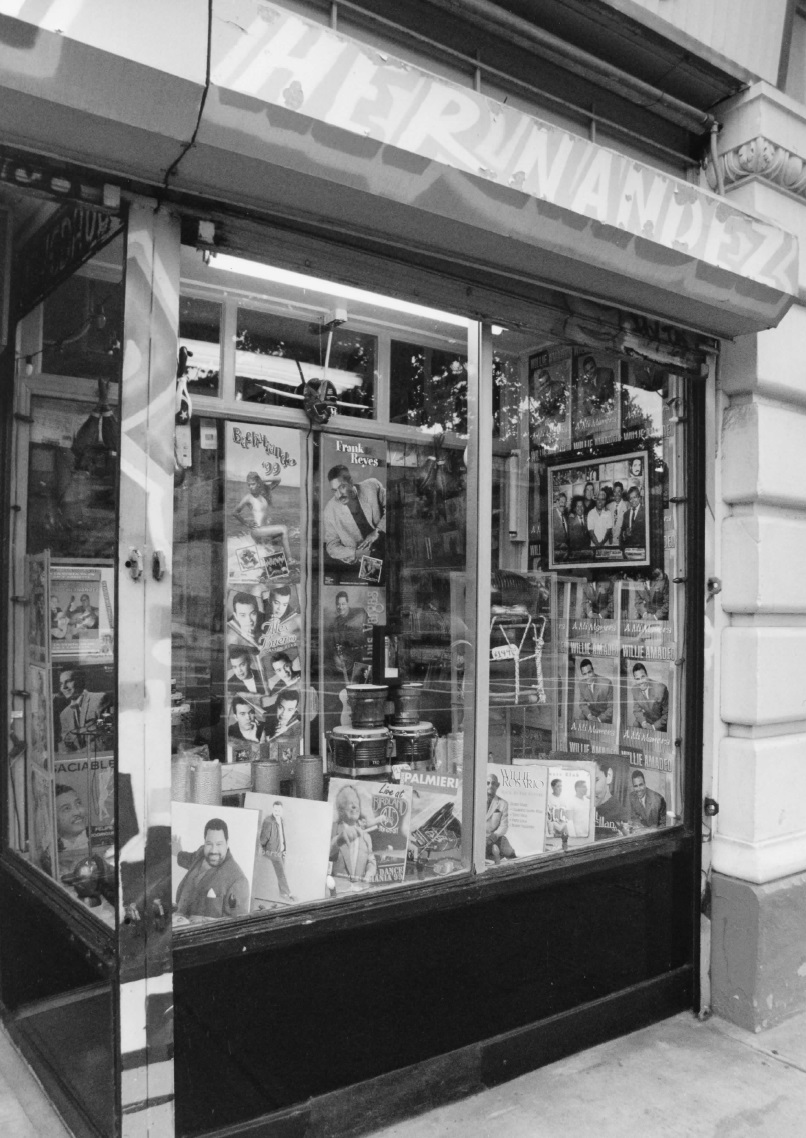
The store’s roots, though, date back to Casa Hernández and owner Victoria Hernández. Victoria Hernández was one of the earliest female Puerto Rican entrepreneurs in New York City. Her brother Rafael Hernández is considered one of Latin America’s greatest composers.
Victoria Hernández and Almacenes Hernández
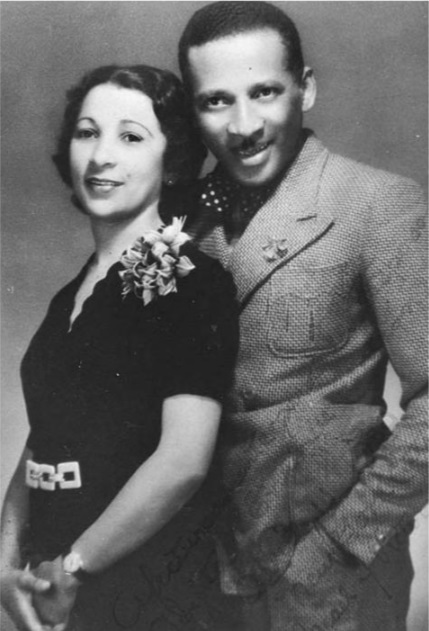
Victoria was born in Aguadilla, Puerto Rico in 1897. Her parents were Afro-Puerto Rican tobacco workers. She and her siblings were encouraged to study music by their grandmother and they became talented musicians. In the late 1910s, her brother Rafael toured Europe as part of the 369th Infantry “Harlem Hellfighters” military band. After he was discharged from the military, he, Victoria, and other family members moved to New York City. Like many Puerto Ricans who came to New York City in the 1920s, they settled in East Harlem. During this time, Victoria worked as a seamstress in a factory and taught piano lessons on the side.
In 1927, Victoria opened Almacenes Hernández (Hernández Music Store), which was likely the first Puerto Rican-owned music store in New York City. It was located on 1724 Madison Avenue between 113th and 114th Street. The store sold records, instruments, and other music accessories. The business supported the family and gave Rafael the space and time to write music. He later became one of the most prolific and well-known Latin American composers.
Victoria explored music’s business opportunities. Although she was an accomplished musician herself, it was considered more respectable for a woman to work as a business owner than as a musician. She operated Almacenes Hernández, served as manager for Rafael’s group (Cuarteto Victoria), and even started her own record label.

As the store’s owner, she worked closely with major record labels to help them understand what music was popular within the community. By the 1930s, East Harlem had become home to New York’s largest Puerto Rican community. Music stores were essential cultural spaces, where people could gather and where musicians and producers could connect on projects. Victoria became known as “La Madrina” (The Godmother) because she regularly served as an intermediary between recording labels looking for talent and musicians looking for paying gigs. Sometimes she advanced payments to the musicians in exchange for a cut of their fees, but that upset some musicians who complained about receiving less money.
As Cuarteto Victoria’s manager and booking agent, she organized tours and recording dates and made sure the group fulfilled their contracts. She also operated her own record label called Hispano for several years, until her bank failed in the Great Depression.
In 1932, Rafael moved to Mexico, where he married and started working with the Mexican film industry. In 1939, Victoria and Rafael sold Almacenes Hernández to Luis Cuevas, another entrepreneur and record producer from Puerto Rico. Victoria moved briefly from East Harlem to Mexico but later returned to New York City.
Casa Hernández and the Bronx Music Scene
When she returned to New York, Victoria settled in the Bronx. Her new community was home to hundreds of Latin musicians, including internationally-known Tito Puente, Tito Rodríguez, Marcelino Guerra, Charlie and Eddie Palmieri, Orlando Marín, Manny Oquendo, Ray Barretto, Barry Rogers, Johnny Pacheco, Joe Loco, and Joe Quijano. Music filled the neighborhoods as the musicians rehearsed, jammed, and performed in apartments, on rooftops, in social clubs, parks, and theaters.

In 1941, Victoria opened her second music store, Casa Hernández. The storefront was located in the Manhanset Building where Victoria lived and where Rafael stayed when he was in New York City.
Casa Hernández featured music and instruments, had booths to listen to the latest 78 records, and sold dresses. Selling a variety of “novedades” (novelties) — as was advertised in painted lettering over the front door — was not unusual for stores at the time. The decision to sell dresses reflects a common element of the Puerto Rican experience in New York City. Many women worked as seamstresses in factories, and at home doing piecework to supplement their family’s income – including Victoria.

Not much detail is known about Victoria’s career while she lived in the Bronx, but Casa Hernández played an important role in the developing Latin music scene in the Bronx throughout the 1950s and 1960s. In addition to managing the store, Victoria continued to give piano lessons to people in the neighborhood. The store was a popular gathering space for musicians, especially when Rafael visited. Emerging musicians remember buying their first records at Casa Hernández.
New Ownership Continues Musical Legacy
Rafael died in 1965. Victoria turned the store’s management over to her friend Johnny Cabán. In 1969, she sold Casa Hernández to Mike Amadeo, who has kept up the tradition of the community music store and preserved the space despite periods of arson and vandalism in the neighborhood. The store’s name, Casa Amadeo, antigua Casa Hernández, pays tribute to Victoria and Rafael and their lasting influence on New York City’s Latin music scene.

Victoria died in 1998 and is buried in her brother’s tomb in the Old San Juan Cemetery in Puerto Rico.
Casa Amadeo antigua Casa Hernández is recognized as a cultural treasure of the Bronx, and Mike Amadeo as a community historian and the keeper of the musical heritage of the community. He is frequently interviewed by historians and the media, such as in this 2024 NBC New York Hispanic Heritage Month feature.
— Written by Aine Leader-Nagy, Division for Historic Preservation
Sources:
Martinez, Elena and Ned Kaufman, National Register of Historic Places registration form: Casa Amadeo, antigua Casa Hernández, (2001) [PDF]
Latinas in the United States, Set: A Historical Encyclopedia. (2006). United States: Indiana University Press. | Link
Fernández, L. (2018). 50 Events That Shaped Latino History: An Encyclopedia of the American Mosaic [2 Volumes]. United States: Bloomsbury Publishing. | Link
Glasser, R. (1997). My Music Is My Flag: Puerto Rican Musicians and Their New York Communities, 1917-1940. United States: University of California Press. | Link
Casa Amadeo. Place Matters Census, City Lore | Link
Casa Amadeo, NY. US National Park Service | Link
 New York State Parks and Historic Sites Blog
One thought on “Recording Latin Music History in New York City ”