The history of European swordsmanship is often presumed to be the story of white, cisgender men. But people of all genders and races have played leading roles in this story.
On April 23rd, 2023, Schuyler Mansion State Historic Site partnered with the Musicians of Ma’alwyck (including Ann-Marie Barker Schwartz , Norman Thibodeau, and André Laurent O’Neil), actor Devin Funnye, and historical fencer Reily Mumpton, to present The Match!, a celebration of the stories of two 18th century individuals who exemplify these contributions: Chevalier de Saint-Georges and Chevalière d’Éon.
Learn more about The Match event from Schuyler Mansion staff and the actors who played Saint-Georges and d’Éon.
Saint-Georges and d’Éon were both considered celebrities in late-18th century London, and were part of the entourage of the Prince of Wales (through which they made the acquaintance of Schuyler Mansion’s very own Angelica Schuyler Church, of Hamilton fame!). On April 9, 1787, when the Prince of Wales hosted a fencing tournament at his personal residence, contemporary accounts hailed the match between Saint-Georges and d’Éon as the capstone of the event.
In addition to being immensely respected fencers, Saint-Georges was a celebrated musician and composer, while d’Éon had a thrilling past as a soldier and spy in secret service to King Louis XV of France. If this were not enough to capture the interest of their contemporaries and modern audiences alike, neither figure fit neatly into societal assumptions about the identities of aristocratic 18th century courtiers and fencers: Chevalière d’Éon was a trans-woman, while Chevalier de Saint-Georges was a biracial Afro-Caribbean man.
Left: Portrait of Angelica Schuyler Church. She and her two sisters were depicted in the musical Hamilton. Right: Flier for The Match at Schuyler Mansion in Albany, NY.
Possibly born intersex, d’Éon had been assigned male at birth and raised as a son of the French nobility. Her espionage career eventually led to exile, forcing d’Éon to protect herself by threatening to publish incriminating documents about the king of France. In 1777, at the age of forty-nine, d’Éon agreed to return to France and turn over the documents on several conditions: that she be legally recognized as a woman, be given a full feminine wardrobe suitable to her status, and be allowed to wear her military honors earned while presenting as a man. Desperate to avoid scandal, the king agreed. From that point forward, d’Éon was able to live publicly as a woman.
Saint-Georges, on the other hand, was born not into nobility, but into slavery on the plantations of Guadeloupe. His life story is featured in Searchlight Pictures film, CHEVALIER, which hit theaters on April 21, 2023. The son of a white French planter and an enslaved African mother, he was sent to France at the age of seven, where he was legally free. There he studied many topics, including music and fencing. The specter of racism still followed him, however, as the Code Noir (“Black Code”) limited his freedoms. He likewise faced personal prejudices from fellow fencers and musicians. He did not back down to his detractors, however, besting many of them with sword or violin, and eventually secured the patronage of Queen Marie Antoinette herself. He later became an important voice in the French abolition movement, and an officer in the French revolutionary forces.
Did you visit a New York State park or historic site last year? Maybe you plan to this year?
For nearly a century, New Yorkers and visitors around the world have enjoyed the great outdoors at New York State parks and historic sites. For everything these properties have given to us, we now invite you to give back and help ensure that future generations have the same access.
On Saturday, May 6, 2023, join us in celebrating the 12th annual ‘I Love My Park’ Day — an event in partnership with Parks & Trails New York; the New York State Office of Parks, Recreation and Historic Preservation; and the Department of Environmental Conservation. This is the largest statewide volunteer event to enhance parks, historic sites, and public lands across the State, and registration is now open.
“Our volunteers are crucial in making our state park system the very best in the nation and we look forward to welcoming thousands of volunteers for I Love My Park Day again this year,” said Erik Kulleseid, Commissioner of the Office of Parks, Recreation and Historic Preservation.
Last year, more than 5,000 volunteers gave back to our parks and public lands, planting more than 250 trees, creating and updating more than 1,000 gardens, and filling nearly 600 bags of garbage.
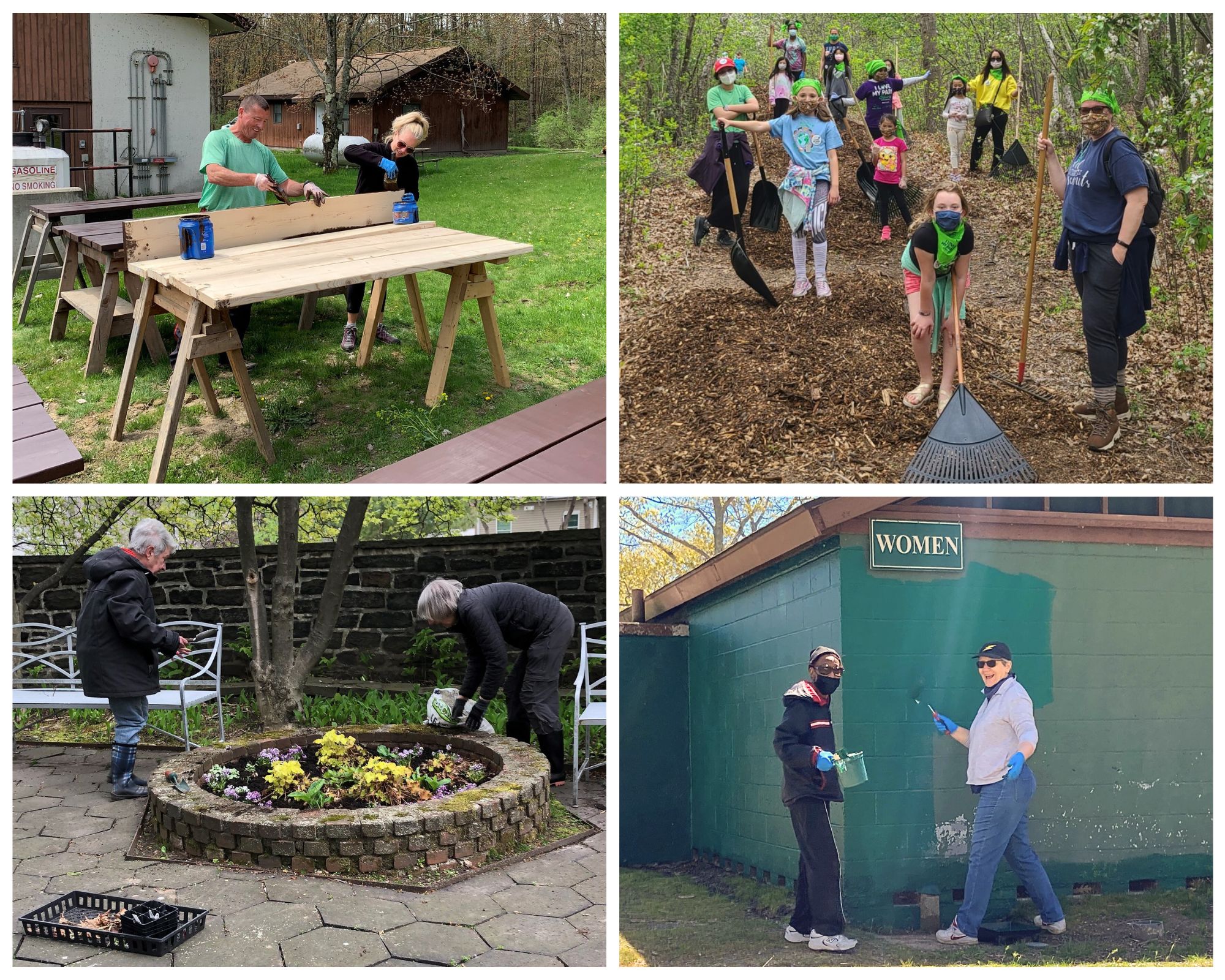
Volunteers from 2022 and 2021 making repairs, spreading mulch, planting flowers and painting restrooms.
You and your family and friends will have the opportunity to participate in rewarding cleanup events at over 120 state parks, historic sites, and public lands all across the state. Here’s a quick look at only some of the properties where you can volunteer across the regions:
Participate in various gardening projects at the public gardens in Bear Mountain State Park in the Taconic Region.
Mulch trails, help remove litter, and participate in general park cleanup at Bethpage State Park in the Long Island region.
Assemble Adirondack chairs, spread gravel, spread mulch, and help with tree maintenance at FDR Four Freedoms State Park in the New York City region.
Replant flower beds and planters and weed out gardens around the Culture Center at Ganondagan State Historic Site in the Finger Lakes region.
Participate in trimming and cleanup work on the disc golf course at Joseph Davis State Park in the Niagara Region.
Clean up the beach, camping sites, and horseshoe pits at Hamlin Beach State Park in the Genesee Region.
Help spruce up the land by planting trees and wildflowers, improve trails, and rake leaves at Max V. Shaul State Park in the Saratoga/Capital District region.
Take part in spring garden preparation, as well as weeding and trimming bushes at Robert Moses State Park in the Thousands Islands Region.
‘I Love My Park’ Day participants wearing t-shirts given out at previous events.
Registration is now open for sites across the State. But don’t wait! Volunteer spots will fill up quickly. We thank you for being responsible stewards so future generations can enjoy these special natural resources for centuries to come.
“I Love My Park Day is a great opportunity for New Yorkers to give back to our incredible parks and public lands,” said Governor Kathy Hochul. “I encourage New Yorkers to sign up and volunteer at a participating park, historic site or trail in their area to ensure future generations can continue to enjoy these amazing natural resources.”
This week we celebrate Earth Day! The first Earth Day was held in 1970 to draw attention to ongoing environmental issues in the United States, such as water and air pollution. Since then, Earth Day has become a global event held every April 22nd in honor of protecting the environment. With over 350,000 acres of park land and waters, NY State Parks play an important role in the protection and stewardship of New York’s natural ecosystems. If you would like to join in the celebration and participate in hands-on Earth Day activities, check out the list below for a sampling of Earth Day events held in State Parks across the state! If you can’t make any of this week’s Earth Day events, join us for Arbor Day programs next week and I Love My Park Day on Saturday, May 7th!
Long Island
Brookhaven National Lab Climate Van Jones Beach Energy & Nature Center Friday, April 22, 2022 09:00 AM – 04:30 PM This pioneering mobile laboratory consists instruments used in their climate research to measure atmospheric variables. Come explore and get a glimpse into the science of forecasting atmospheric conditions. The talks will be on Zoom as well as in person.
Protect the Pollinators Event Jones Beach Energy & Nature Center Saturday, April 23, 2022 12:00 PM Build your own bee or insect house; Guided tour of our Pollinator Garden; Springtime Storytime; and Pollinator Relay Races
Earth Day Celebration Project Connetquot River State Park Preserve Saturday, April 23, 2022 09:00 AM In celebration of Earth Day, please join Friends of Connetquot to plant native plants and ferns along the main road to the Clubhouse. Meet up by the Kiosk in the main parking lot starting at 9 am. Please dress appropriately and bring gloves. To register, please visit www.friendsofconnetquot.org.
Earth Day Hike Hallock State Park Preserve Saturday, April 23, 2022 09:00 AM – 11:00 AM Celebrate our earth home by taking a 3 mile hike through the trails of the Preserve observing all that nature can share with us! All programs meet in the upper parking lot unless noted. Programs led by MaryLaura Lamont. Call for details, reservations at (631)315-5475. Snow/rain cancels programs!!!
Earth Day Festival Hempstead Lake State Park Saturday, April 23, 2022 11:00 AM – 3:00 PM The event will include alternative energy activities, up-cycling t-shirt into aprons, make native pollinator seed bombs, and more!
Come to Hempstead Lake to up-cycle a t-shirt!
Niagara
Earth Day Walk Buckhorn Island State Park Friday, April 22, 2022 10:00 AM – 11:30 AM Happy Earth Day everyone! Joins us for a relaxing walk through the woods and along with Niagara River. For information and registration call (716) 282-5154
Arbor Day Walk DeVeaux Woods State Park Friday, April 29, 2022 01:00 PM – 02:30 PM Happy Arbor Day! Enjoy a walk through old growth trees. Registration required, please call (716) 282-5154.
Thousand Islands
Celebrate Earth Day! Point Au Roche State Park Saturday, April 30, 2022 10:00 AM – 12:00 PM Celebrate Earth Day with us! Go on a Scavenger Hunt! Play some Earth Day themed games! Plant a seed to take home! Help clean up the Park! Activities available 10am-12pm. All ages welcome!
Earth Day at Zoo New York Minna Anthony Common Nature Center Saturday, April 23, 2022 10:00 AM – 03:00 PM Come join the Earth Day celebration at the Thompson Park Zoo! Learn about the natural world around you and the importance of protecting our natural resources. Discover new places and ways to enjoy the outdoors. There will be numerous family friendly activities and many different organizations at the event, including the Nature Center! For additional information, please call the Thompson Park Zoo at (315) 782-6180. Preregistration recommended. Please call (315) 482-2479 to register. Face covering encouraged when indoors.
Arbor Day at TILT’s Sissy Danforth Rivergate Trail Wellesley Island State Park Saturday, April 30, 2022 10:00 AM – 02:00 PM Celebrate Arbor Day and the Thousand Islands Land Trust’ (TILT) 9th Annual “For the Trees” Celebration by planting trees at the S. Gerald Ingerson Preserve along the Sissy Danforth Rivergate Trail. Bring the whole family to get their hands dirty! There will be numerous family friendly activities, workshops, games, and exhibits from TILT and many different organizations, including the Nature Center! For more information, please visit tilandtrust.org or call (315) 686-5345. Preregistration recommended. Please call (315) 482-2479 to register. Face covering encouraged when indoors.
Trees and Climate Point Au Roche State Park Saturday, April 30, 2022 02:00 PM – 03:00 PM Join the park naturalist to explore trees, their important role in the ecosystem, and what they do for us. How can trees help with climate change? What can we learn by studying tree rings? What threats do trees face? Also, learn about Wangari Maathai, a very inspiring conservationist and activist, and how we can follow her example to help trees! Please note this will be an indoor program.
Finger Lakes
Beach Cleanup Event Sampson State Park Friday, April 22, 12:00 PM – 4:00 PM Looking for a good way to give back to your community this Earth Day? Come out to Samson State Park from 12:00pm to 4:00pm on Friday, April 22nd and help us clean up trash and debris along the beach front and cobble shoreline of Seneca Lake. Did you know that the beautiful and State Threatened grows right here at Sampson? Twinleaf is just one of the unique and important species that call Sampson State Park home. Come help us protect this important ecological community and learn about conservation efforts around the state! Feel free to bring work gloves, or borrow ours! Meet us near the beach and look for the FORCES table!
Saratoga/Capital Region
Earth Day Clean Up Saratoga Spa State Park Friday, April 22nd, 10:30 AM Celebrate Earth Day at Saratoga Spa State Park with our most recent park partner, the Children’s Museum at Saratoga! We will work together to make the park a little more beautiful. At 10:30AM on April 22nd, we will meet at the Lincoln Bathhouse where the Museum’s new Nature Backpack program will be demonstrated. At 11:00AM everyone will head out to help clean up one of the park’s many pathways. Come share in the reward of making a greener, cleaner world! Gloves and bags will be provided. No registration necessary.
Trout Discovery Day Grafton Lakes State Park Thursday April 21, 2022 11:00 AM to 1:30 PM Grafton Lakes State Park is hosting its annual Trout Discovery Day. As the weather gets warmer it is the perfect time to stock long pond with trout. The DEC will be providing trout and Grafton will be providing activities. Come on your own or bring out the whole family, Trout Discovery Day is the perfect event for all ages. Enjoy trout shaped treats, crafts, and educational booths highlighting the wonders of trout! Learn about their habitats, school programs and micro and macro invertebrates. Come help to stock our ponds. The event will be held on April 21 from 11am-1:30 pm, $2 cash per child, ages 6-15. Ages 5 and under and adults are free to enter. DEC will bring trout at 11:30 am. Park at Rabbit Run.
Earth Day Festival Grafton Lakes State Park Friday, April 22, 2022 5:00 PM-8:00 PM Join Grafton Lakes for a family friendly Earth Day festival. Learn about the migration of monarch butterflies, the importance of pollinators, the impacts of invasive species, and much more. Partake in activities, demos, and crafts. This year’s Earth Day theme is to Invest in Our Planet’s Future. Each one of us can make a positive impact from the small to the tall. No registration required. The Festival will be held Friday, April 22nd from 5-8pm. The charge for the festival is $3/person cash, ages 5 and under free.
Earth Day was first celebrated in 1970 as an act of support for environmental protection. Now, more than 50 years later, Earth Day events are attended by over a billion people worldwide. What better way to celebrate this year than to visit your local Preserve!
Immerse yourself in nature and stop by “education stations” along Brother’s Path from 10 am – 1 pm to learn about topics such as clean water initiatives, sustainability, native plants and pollinators, wildlife conservation, and more!
Start your own native plant garden with our seed planting activity, which will take place every half hour from 10:30 am to 12:30 pm beside Swan Lake. (While supplies last.)
Learn about birds of prey and get up-close and personal with a few of them in a LIVE demonstration from 1 – 2 pm on the Overlook trail. (Please note: no dogs or horses will be allowed on Overlook during this time.)
Participate in a “BioBlitz” to learn more about biodiversity within the Preserve and contribute as a citizen scientist by logging your observations using the iNaturalist app. We’ll meet at the Swan Lake kiosk at 2 pm and venture from there.
Cost: FREE! No registration required. You may want to bring cash for raffles and merchandise. Proceeds support the maintenance of our beautiful carriage roads and landscape. Appropriate for all ages. Rain date: April 24
The Peregrine Falcon is the swiftest of all birds of prey, slightly larger than a crow, with and nondescript coloration of brown, grey, and white. Peregrine falcons are one of the most widely distributed species of birds, nesting on every continent except Antarctica. The world’s largest urban population of nesting Peregrine Falcons can be found in New York City.
A peregrine falcon can spot its prey from six miles away. Tucking in its wings, diving like a missile, changing direction with precision, ruffling its feathers to control speed, and slamming its talons into its quarry mid-air. Its beak has a type of tooth that acts like a wire cutter, severing the spine of its prey in an instant. Peregrines are avian predators and feed almost exclusively on other birds. Most of their prey is caught on the wing. Peregrine falcons diving at prey has been clocked at speeds of more than 200 mph, making them among the fastest animal on earth.
Peregrine falcons have never been very abundant. Studies in the 1930s and 1940s estimated that there were at least 200 breeding pairs of peregrine falcons in the eastern United States. Then, beginning in the late 1940s, peregrine falcons suffered a devastating and rapid decline. By the mid-1960s, the species had been eliminated from nearly all the eastern U.S.
In the mid-20th century, peregrine falcon populations took a nosedive due to the DDT pesticide poisoning. DDT moved through the food chain from insects, fish, and birds and moved up to larger carnivores, like the peregrine falcon. DDT caused harsh chemicals to build up in the falcons’ fat tissues, reducing the amount of calcium in their eggshells. With thinner shells, the eggs would be easily crushed when incubated by the parent falcons.
DDT was finally banned in 1972, and a partnership between scientists and falconers worked together to breed the birds in captivity and release them to places where they had traditionally nested, including New York City. Peregrines naturally prefer cliffs as a habitat, so the city’s canyons and skyscrapers provide desirable nesting spots for them, along with an abundance of food like pigeons, starlings, and sparrows.
Due to restrictions on the use of DDT, and intensive captive breeding and reintroduction programs across the United States and Canada, the peregrine falcon has made a remarkable comeback. Peregrines have been returned to much of their natural range and have reclaimed many historic breeding sites.
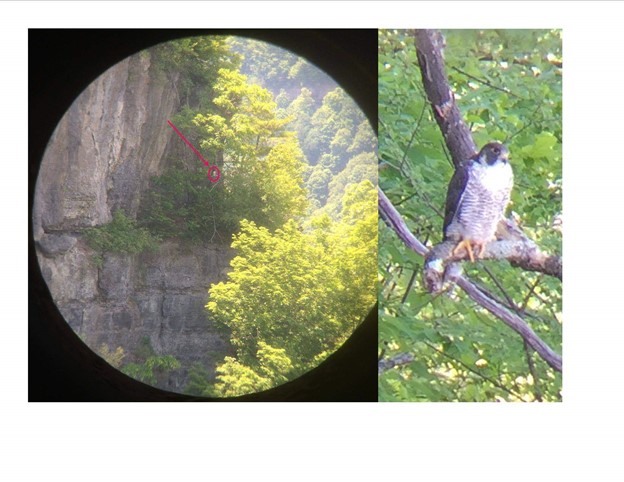
Thacher State Park is home to a 6-mile section of the Helderberg Escarpment, an exposed limestone cliff reaching several hundred feet high. An ideal nesting location for peregrines. Peregrines don’t build nests; they dig an indentation in the ground or in rock cliffs, called a “scrape”. The Helderbergs were a historic nesting ground in the 1950s and earlier. Since the ban on DDT, peregrines were not spotted around the Helderbergs until 2016 when a mated pair was discovered flying around the southern section of the park.
Since 2016, the Helderberg falcons have been monitored for nesting attempts. In 2021, the mated pair was found nesting with a clutch of eggs, but the nest was abandoned after a few weeks for unknown reasons. In 2022, the falcons have been spotted very early in the year, around February. With increased sightings and activity in the southern section of the park. Park staff and visitors are hopeful that this year will be a successful nesting season and may bring 3 to 5 new peregrine chicks into the world.
*SLAP* *SLAP* *SLAP* What’s that!? Oh, is it the tail slapping that beavers use to tell each other to watch out for something nearby? That must mean it’s almost International Beaver Day! Every April 7th, we get a chance to reflect on what these hard-working mammals mean to us!
The American Beaver (Castor canadensis) is a key player in NY State Parks— so key, in fact, that it is considered a keystone species of its wetland ecosystems, playing a major role in keeping ecosystems healthy. This is because beavers are one of the few animals that truly modify their habitats to better suit their needs, which has given them the title of “ecosystem engineers!”
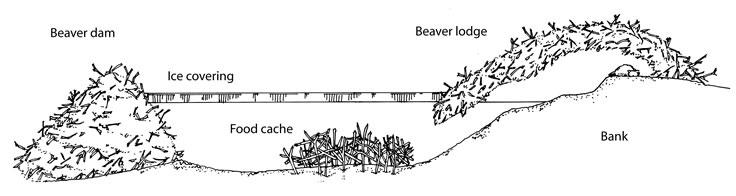
Most people associate beavers with their dams, which are certainly their most influential construction projects, but they build other structures too. Beavers don’t hibernate, instead opting to spend the winter in a cozy, dome-like lodge in the middle of their pond with a passageway that provides easy access to water below the ice. A lodge houses a family (colony) of beavers, including a pair of parent beavers and their young (kits). Beavers mate for life and have 3-6 kits a year. Those lodges must get quite snug!
Beavers also store food caches near the entrance to their lodges, which helps get them through long, cold New York winters. In these caches, the herbivorous beaver stores things like branches, leaves, and green stems that are crucial food sources in winter months.
Diagram of beaver structures. Photo credit: Jennifer Rees, Washington Department of Fish and Wildlife
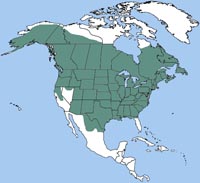
Their big, watertight dams—made of logs, sticks, mud, and sometimes stone— block running water, creating their own beaver ponds with rich, surrounding wetlands. Beavers constantly work to maintain their dams and build new ones where they hear running water. Beaver colonies can maintain several dams at once, sourcing wood from the forest around their pond. They use their sharp, orange teeth to cut down trees, leaving chewed stumps that can be seen up to 165 feet from bodies of water. Have you ever seen one of these stumps in a State Park? Beavers live in and modify almost any forested body of freshwater from Canada to Northern Mexico, so that’s quite a few waterbodies they may impact.
Beavers chew on trees across North America! Some of their favorites are aspens, willows, and maples. Photo Credits: NYS Parks; Range Map, New Hampshire PBS
Living with Beavers
State Parks can be centers of beaver activity, which comes with its own set of challenges between beaver habitation and park infrastructure. Damage to property caused by flooding, plugging culverts, and damage to trees are of particular concern. For instance, Seneca Lake State Park recently wrapped the bases of important trees with chicken wire to prevent beavers from gnawing on them, which worked well.
Other efforts in parks across the state include using devices such as beaver deceivers, culvert protection fencing, and pond levelling devices. Beaver deceivers are a very handy way to keep beavers in our parks while also reducing the risk of flooding for trails, roads, and other amenities we enjoy.
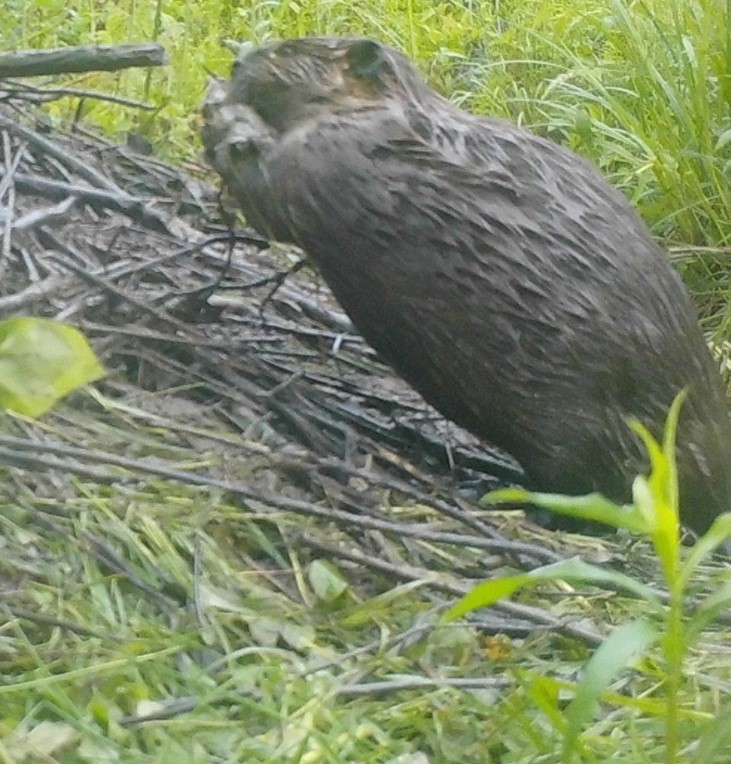
Interpretive programs also play an important role in promoting education and public knowledge of beavers and good beaver stewardship. Trail cameras can allow State Park Biologists to monitor beaver populations and observe their behaviors – and the photos can be used in educational programs too. The Beaver Walk and Talk at Moreau Lake State Park is a very popular educational program that shows off the major beaver lodge at the park. The Bear Mountain Trailside Museum and Zoo is also a wonderful place to brush up on beaver knowledge. Environmental stewardship in NY State Parks is vital to balancing the work of two major ecosystem engineers: beavers and humans. Good stewardship allows for the many environmental benefits of beaver-created wetlands, while also minimizing impacts to park infrastructure.
A beaver deceiver at Glimmerglass State Park (left) and a deceived beaver, caught on a wildlife trail camera at Allegany State Park (right). Photo Credits: NYS Parks
Beaver Wetlands
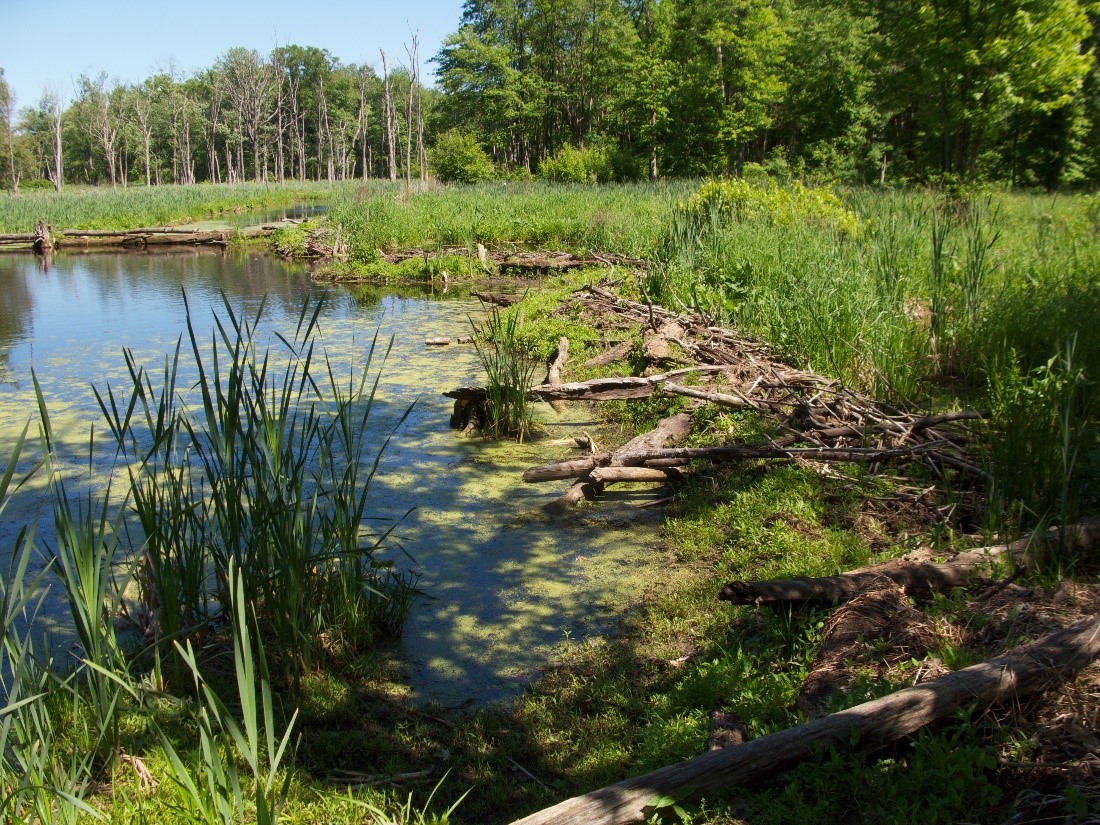
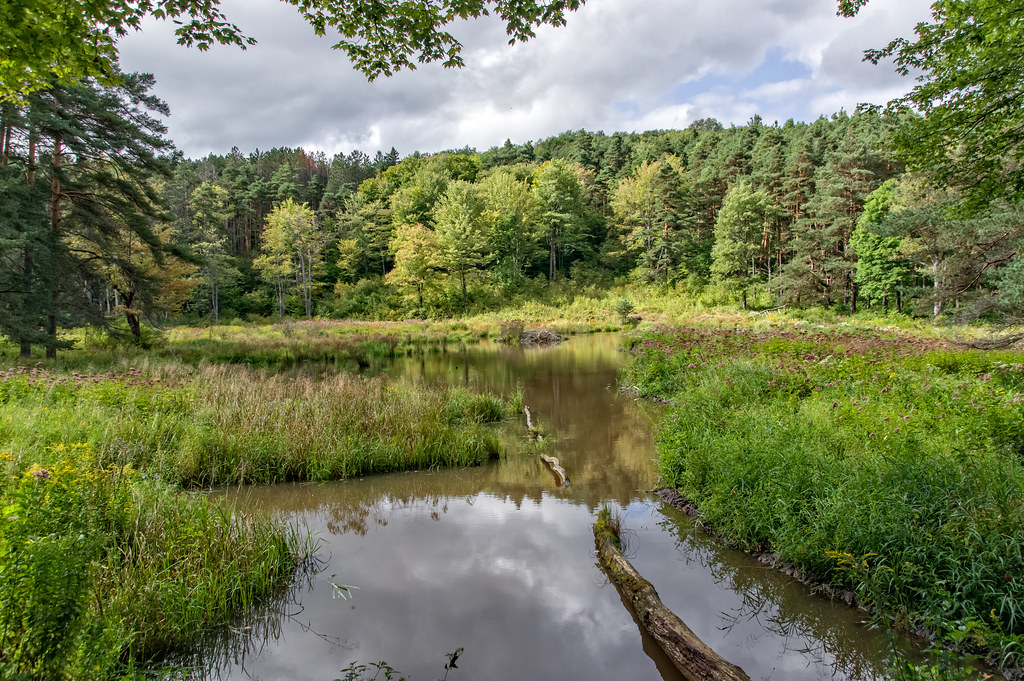
Prime wetland habitat is incredibly beneficial to all sorts of organisms and even the land itself. In terms of why beavers make dams, the resulting pond and wetlands foster growth of aquatic plants like water lilies—some of the beaver’s favorite summertime snacks. Wetlands also protect beaver colonies from predators such as coyotes and fishers. For other animals, beaver-created wetlands are highly productive environments. Amphibians, fish, invertebrates, large herbivores, and waterfowl flourish in these wetlands, supporting predator populations higher up the food chain like raptors, bears, other semi-aquatic mammals like otters, and more.
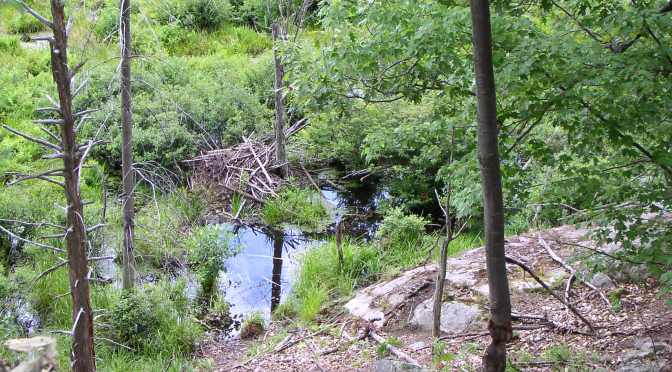
Beaver-created wetlands in Verona Beach (left), Wellesley Island (middle), and Allegany (right) State Parks. Photo Credit: Left and Middle, NYS Parks; Right, Michael Head (CC BY-NC-SA 2.0)
As for the landscape, wetlands act like a sponge. Wetlands store water in wet periods and release water as the landscape dries, helping to regulate the water table. They also work to filter sediment and more harmful chemicals, which benefits any animal or person using the water downstream. From the wealth of biodiversity to the maintenance of healthy landscapes, beavers can help make the environment strong and resilient, which is necessary to adapt to climate change now more than ever.
Beaver History
Beavers and their wetlands were once much more abundant than they are today, seeing a massive decline in numbers due to the colonial and post-colonial fur trade. Over the course of the fur trade in New York, beavers were sadly on the brink of extirpation (regional extinction) across the Northeast United States and beyond. Beaver populations dropped so low due to unregulated, commercialized trapping for their fur, which was often made into fancy hats. New York was a center of the fur trade as trapping flourished with widespread and abundant beaver populations upstate, coupled with the easy access to navigable waterways, including the Hudson River, Lake Champlain, and the Great Lakes. At the height of the North American fur trade between 1860 and 1870, trading companies reported buying 150,000 beaver pelts per year.
An old, whimsical illustration of beavers hard at work near Niagara Falls from the early 1700s. Photo Credit: Nicolas De Fer, from L’Amerique Divisee Selon Letendue de ses Principales Parties, 1713
From the 1600s to late 1800s, the fur trade grew together with cities like Albany and New York City at the expense of beaver populations. Beavers are displayed on the seals of both of those cities as symbols honoring their fur trading past and allude to values such as diligence and hard work. Likewise, the history of the beaver is tightly linked with the entire state of New York, as shown by the beaver’s status as state mammal. We’re lucky today that beaver populations persist and are not just symbols of fur trade history, unregulated trapping, and all that caused their decline.
Rebounding beaver populations are, fortunately, a great conservation success story. Trapping regulations in the United States and Canada around the turn of the 20th century started the end of the decline. Reintroduction programs (moving animals back to habitats where they once lived) along with perseverant beavers hidden away in high mountains, like the Adirondacks, provided seeds for the growth of new beaver populations across New York and elsewhere. In the 1920s, the Palisades Interstate Park Commission even reintroduced three breeding pairs of beavers back to Harriman State Park!
Beavers Today
Across their range, beavers number between 10 and 15 million, which is an incredible recovery! But that is only a conservatively estimated 10% of their pre-colonial population. There is much to celebrate about the beaver, but there is still much work to be done. There have been and will continue to be growing pains between beaver populations and people, but if we keep supporting the beaver, then they will help safeguard the natural places we cherish.
This International Beaver Day, let’s reframe our understanding of the beaver. Beavers may be seen as ignoble rodents, pelts for hats, mere symbols on city seals, or unredeemable nuisances, but let’s try seeing them as wetland restorationists— stewards working toward resilient wetland networks and precolonial environments. There is a lot of work to be done to foster harmony between people and beavers, which will require continual human stewardship, but their own current recovery is a testament to how much good conservation work can be achieved over time. So be eager to get out there and explore your local State Park for dams, lodges, and the beavers that built them!
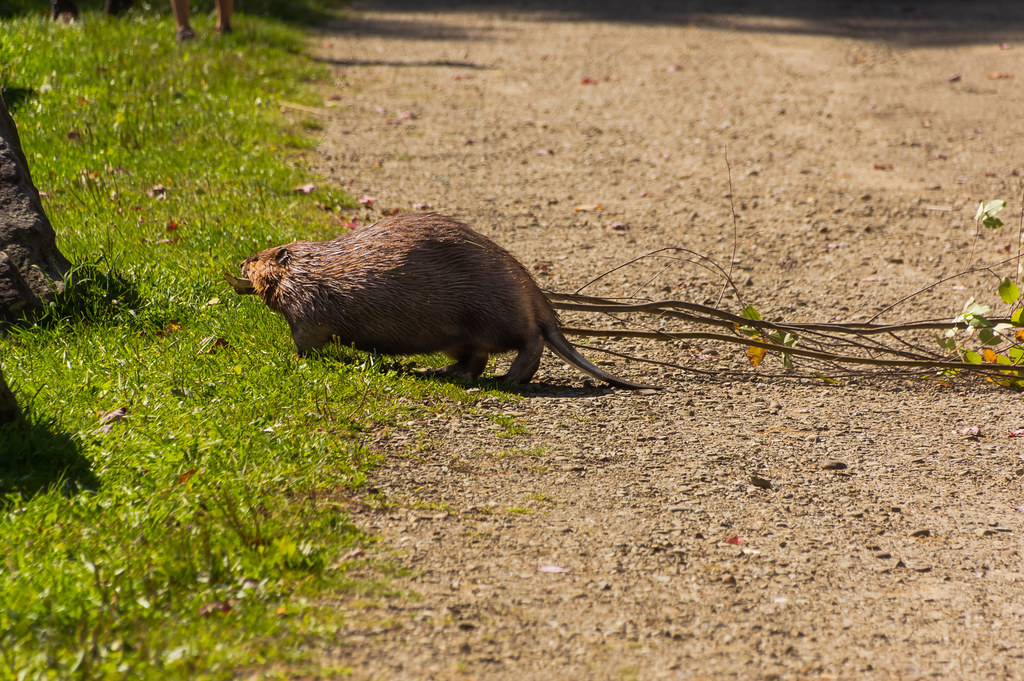
A beaver dragging twigs at Allegany State Park. Photo Credit: Michael Head (CC BY-NC-SA 2.0)
More Beaver Facts!
Beavers are very large rodents. They can grow anywhere from 26 to 65 pounds and be almost 3 feet long with almost another foot of length from their broad tail.
Beavers communicate with each other in a variety of ways. Adults will grunt and young beavers will use high pitched whines. Beavers will even use their big, flat tails to make a loud, slapping noise to warn other beavers in the colony of nearby danger.
Beavers have orange teeth. Their teeth are very hard and contain high amounts of iron, which looks orange to us. It’s not just because they forgot to brush!
Like other rodents, a beaver’s front teeth (incisors) never stop growing. The length of their teeth is kept in check by being worn down when gnawing wood and are adapted to always stay sharp.
Beavers have very special, flat tails. They use their scaly tails to help them swim, communicate, and pat down their dams. A beaver’s tail also helps to store fat and steady their body temperature (thermoregulation).
Beavers have webbed back paws that help them swim better, and the second back toes have split nails they use to comb waterproofing oils into their fur.
So water doesn’t get into awkward places, a beaver’s nose and ears can close completely underwater.
Beavers also have a special membrane for their eyes that they can close to keep the water out called a nictitating membrane, almost like a clear second eyelid.
A beaver’s lips close behind their front teeth so they can chew sticks and other plant material underwater.
Beavers are also known for what’s called a castor sac (hence their genus name Castor), which holds oil that has a strong smell and is used to make a substance called castoreum. Castoreum has been used as a perfume ingredient, food flavoring with a taste like vanilla, and a traditional medicine. Beavers also groom themselves with the castor oil to keep their fur waterproof. The strong scent of the castor oil makes it great for marking beaver territories, too.
Beavers don’t hibernate in the winter and their lodges stay quite a bit warmer than the cold temperatures outside.
Beavers are most active at dawn and dusk (crepuscular) and at night (nocturnal), so keep an ear out for tail slaps after the sun goes down.
Beaver lodges are so well-built and cozy that other semi-aquatic mammals, like otters or muskrat, might adopt them if the beavers ever move out.
Beavers are pregnant with kits from the middle of winter to late spring, so be on the lookout around then for furry, little beaver babies on your adventures in State Parks.
Post by Daniel Fleischman, NYS Parks and Student Conservation Association









 New York State Parks and Historic Sites Blog