Category Archives: Art

Honoring State Parks’ 100th Anniversary with Poetry

If you’re visiting a New York State park or historic site in the Hudson Valley this year, you might have a poetic encounter!

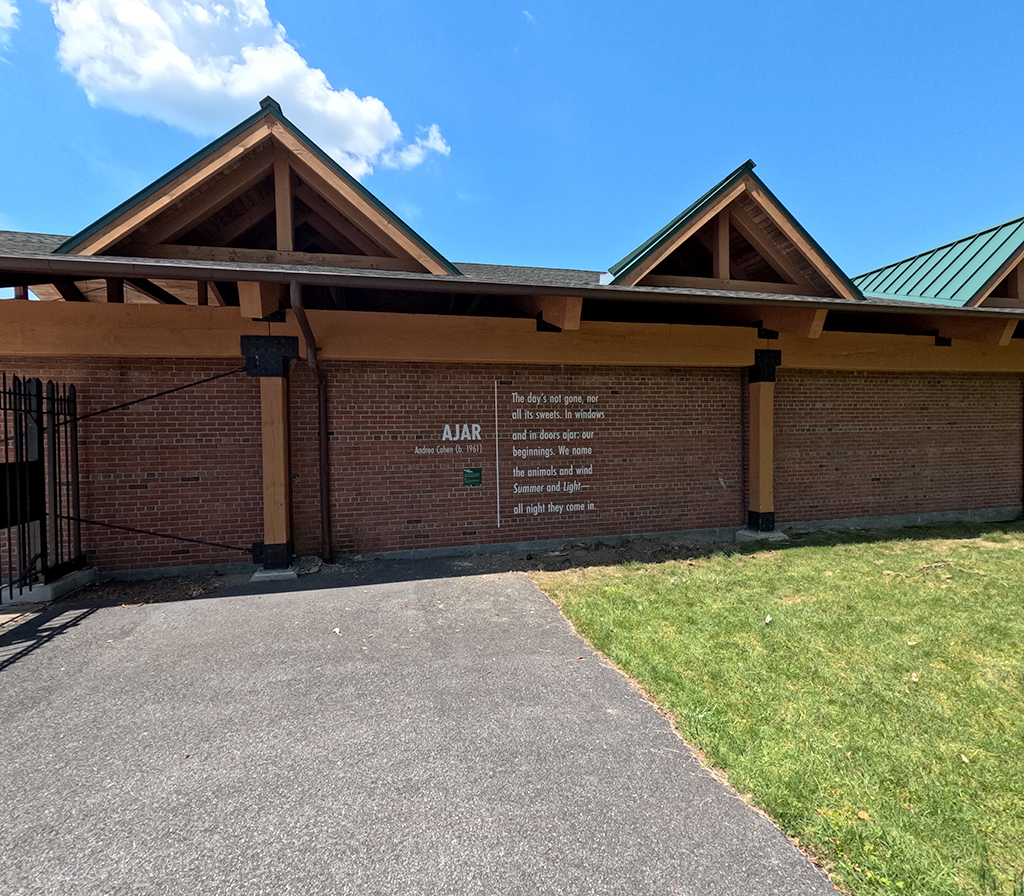
New York State Parks, Recreation and Historic Preservation (OPRHP) is presenting a new temporary public art project, Poetry in the Parks, to celebrate the Parks Centennial. Poems selected by the Poetry Society of America (PSA) and OPRHP are installed in three New York State parks and one historic site stretching from Westchester to Columbia County.

This inaugural installation of Poetry in the Parks includes works by Andrea Cohen at FDR State Park in Yorktown Heights; U.S. Poet Laureate Ada Limón and New York Poet Laureate Patricia Spears Jones  at Walkway Over the Hudson State Park in Highland and Poughkeepsie; Robert Hass at Lake Taghkanic State Park in Ancram; and Ishion Hutchinson at Clermont State Historic Site in Germantown. Integrated with the architecture found in the parks, the selected poems are meant to be discovered by visitors to help them reflect on the beauty of their natural surroundings.

Continue reading Honoring State Parks’ 100th Anniversary with Poetry

Where Art and Science Meet: A Q&A with Art Conservators

Art and artifact conservators are the guardians of our cultural heritage. Their fascinating work blends art and science to protect the treasures of the past for future generations. But that work is often invisible to the public. 

The American Institute for Conservation showcases this field through the annual Ask A Conservator Day. This year, NY State Parks and Historic Sites’ Department of Historic Preservation conservators Elizabeth Robson (Paintings) and Paige Schmidt (Wooden Objects) took a break from their labs to answer questions about their work. 

What do conservators do? What is outside the scope of their field?  

Conservators are highly skilled, highly trained professionals who care for art and artifacts. They assess the condition of a particular object and carry out a course of treatment for it. They also provide guidance on how to store and exhibit an object or work of art.

Conservators also specialize in one area of expertise, such as paintings, paper, objects, textiles, or architecture. There are further specialties within these categories, like murals, books, photographs, frames, wooden objects, archaeological objects, metals, and more. While a conservator’s treatment may improve the aesthetics of an object (e.g. replacing missing paint), they never do so at the expense of any original material. Nor do they give appraisals of artworks or artifacts.

Continue reading Where Art and Science Meet: A Q&A with Art Conservators

Princeton Students Interpret Jones Beach Through Environmental Poetry and Art 

Poetry and literature have long been used to explore the natural world in ways that can circumvent the pitfalls of scientific and technological determinism. Similarly, in the history of architecture and landscape architecture, new modes of drawing and rendering can add contour and depth to insights from the environmental and biological sciences.

In Spring 2023, Jeanne Haffner, Special Assistant and Director/Chief Curator of the Jones Beach Energy & Nature Center and S.E. Eisterer, Assistant Professor for Architectural History and Theory at Princeton University, collaborated on a seminar for Masters and Ph.D. students called “Histories of Embodied Energy: From Turtles to the Grid.” The course followed the mission of the Jones Beach Energy & Nature Center, investigating “the relationships between human beings, energy systems, and environmental stewardship.” Students toured the Center and surrounding site, and then chose an artifact from Jones Beach to work with for the semester. 

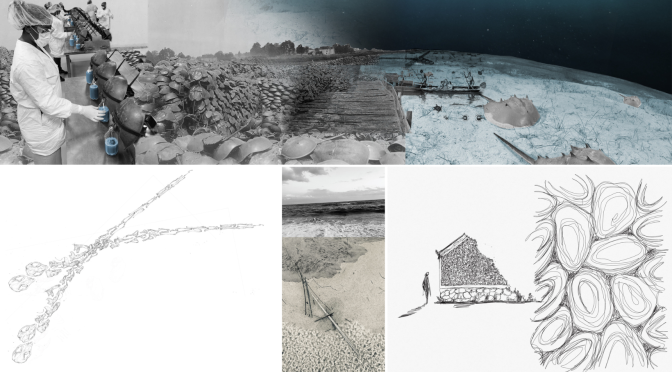
Having chosen an artifact, students wrote poems and created a drawing about it. But instead of producing abstract scientific diagrams or architectural renderings, they instead reflected upon alternative ways of representing the environment—ways that prioritize artistic, rather than strictly scientific, approaches. Maryam Popoola, for instance, sees an owl pellet not simply as an object for dissection but as a metaphor for the ever-changing nature of form. Valen Zhang’s poem and drawing considers oysters’ dynamic interactions with the ocean, beach, and built environment. For Marcos Garcia, beach grass on a sandy dune becomes a nexus between humans, lifestyles, and ecological impact. Masa Crilley depicts a horseshoe crab not in isolation, but in a long history that connects underwater worlds, Native American fishing practices, and industrialization.

This selection of poems and visuals reminds us of the continuing connection between art and environmental science, as well as the complex entanglements between environmental, social, and technical systems.

Introduction written by Jeanne Haffner, Ph.D., Special Assistant and Director/Chief Curator, Jones Beach Energy & Nature Center (NYS Parks) and S.E. Eisterer, Assistant Professor of Architectural History and Theory, Princeton University

Poems and visuals below created by Maryam Popoola, Valen Zhang, Marcos Garcia, and Masa Crilley

Continue reading Princeton Students Interpret Jones Beach Through Environmental Poetry and Art