Category Archives: Nature Centers

Wondrous Woodcocks

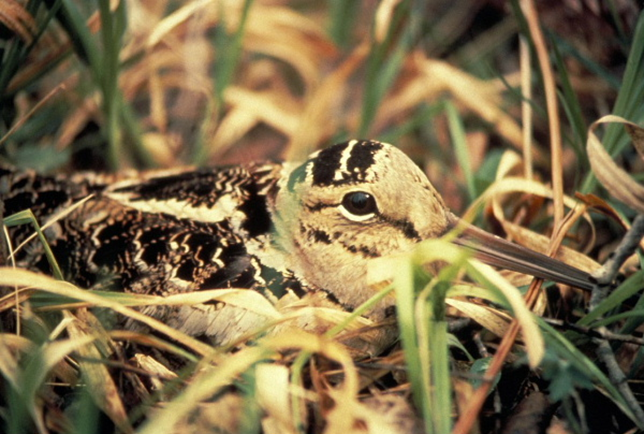
Roosting Woodcock
American Woodcock. NYSparks.com.


They are inconspicuous and well camouflaged for living on the forest floor, old fields, or wet spring meadows. Their eyes are nearly on the back of their heads, giving them the ability to see not only what is in front of them but what is behind them. Their bills look too long for their body; but this elongated bill helps them eat their weight in earthworms and other small invertebrates like spiders, beetles, and ants each day. And, in spring, males do an incredible “sky dance” at dusk and dawn, a mating display that is a highlight to any evening walk in springtime.

Who are they? They are American woodcock (woodcock), also known as the timberdoodle and Labrador twister. Woodcocks are mourning dove sized birds.  They have short necks and tails and large heads and beaks. They are one of the few shore birds that have adapted to living in the forest.

For many people, the mating “dance” of the male woodcock is a sure sign that spring has arrived. The courtship ritual starts at dusk with the male sitting on the ground in an opening in the forest or in a small field. He repeatedly utters a distinctive peent call. Next he takes off from the ground flying in a slow upward spiral. As the wind moves through the wings, a whistling sound can be heard as the bird rises. When he reaches 200-350 feet above the ground, the wing sounds become irregular and then cease as he starts a zig-zag descent. He also chirps as he goes down. He then lands silently next to a female woodcock, if she is present, and resumes peenting. The display starts again and will continue well into dark. He resumes the “dance” near dawn and will continue it until sunrise. Listen for them in the evening in wet meadows or fields in March or April, even before the snow has melted.  (Click here to listen to a woodcock.)

Woodcock dance
Diagram by Nate Kishbaugh.


After mating, a female woodcocks lays her eggs in shallow depressions on the ground. She usually lays four eggs that take about 21 days to incubate. Once they are hatched out, the young chicks follow their mother, learning what to eat. They grow quickly on their earthworm and insect diet. By the time they are a month old, they are nearly the same size as their mothers.

In mid-fall woodcocks migrate from New York to the southeastern coast. They return to New York once the ground has thawed.
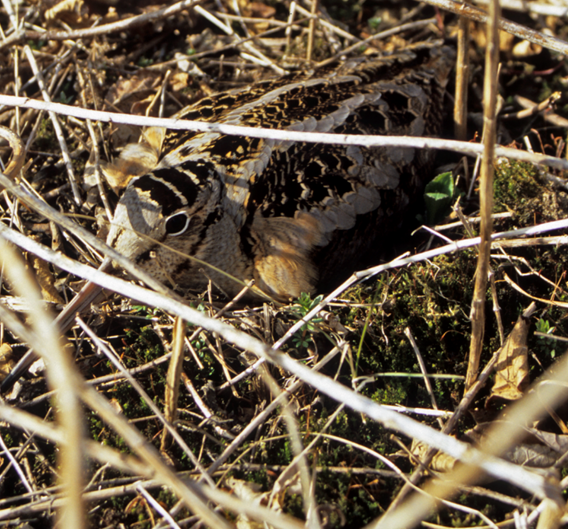
Woodcock nesting
Female Woodcock on a nest. NYSparks.com.


Post by Susan Carver, OPRHP.

Join us for a “Woodcock Walk” at:

Theodore Roosevelt Nature Center, Jones Beach State Park, Wantagh, Adult Ed-ventures, Friday, April 10, 7-8:30 pm, $4/person

Sources:

American woodcock, Cornell Lab of Ornithology, http://www.allaboutbirds.org/guide/american_woodcock/id

American woodcock, New York State Department of Conservation, http://www.dec.ny.gov/animals/45448.html


Native Spring Wildflowers

Spring is in the air and with warmer temperatures come the spring flowers everyone hopes to glimpse.  Most of the flowers people have come to associate with spring are not native to North America though.  Crocus, daffodils, hyacinths, and tulips, for example, are all European flowers.  There are, however, many native plants that “spring” up at this time of year.

Native plants are valuable for a variety of reasons.  They contribute to the biodiversity and health of ecosystems and provide habitat for birds, insects, and other wildlife.  Also, as they are acclimated to the local environment, native plants are often hardier and require less care than imported plants.

As you walk through the woods this spring, look for native plants growing beneath the trees.  In 1936, Minna Anthony Common made a list of plants that were native to the Thousand Islands Region in the journal she kept detailing her work on the Rock Ridges Nature Trail in Thousand Island Park.  These three were among the native plants that were already growing along the trail when she began to work on it.

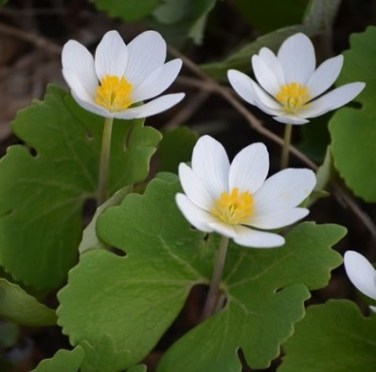
bloodroot

Bloodroot (Sanguinaria canadensis) has white flowers with 8 to 12 petals that are approximately 1¼ inch wide.  The flowers sprout on 3 to 6 inch stems through folded leaves.  The deeply lobed leaves open as the plant grows.  When the root of the plant is cut, it “bleeds” a reddish- orange liquid.  This is what gives the plant its name.  Bloodroot prefers moist soil and partial shade and is often found along the woodland edge.  At the Minna Anthony Common Nature Center, bloodroot can be found in the flower bed along the front of the museum building.

spring beauty

Spring Beauty (Claytonia virginica) has small (½ to ¾ inch) pink or white flowers with darker pink veins.  Each plant has a single pair of long narrow leaves.  These flowers also prefer moist woodland habitats.

roundlobe hepatica

Hepatica (Hepatica nobilis) is a member of the buttercup family.  It has ½ to 1 inch wide blue, pink, or white flowers and three lobed leaves.  Hepatica begins blooming in early spring and will continue to bloom into the summer season.  Hepatica prefers partial shade and is often found in woodland habitats.

If you are interested in learning more about native plants, visit us at the Nature Center.  We have a many books about native plants in our library and gift shop.  We also have a copy of Minna Anthony Common’s journal available for our visitors to read.  Best of all, we have miles of trails where visitors can see these plants in their native habitat.  The best way to learn about nature is to experience it.

Post by Molly Farrell, Nature Center Director at Minna Anthony Common Nature Center (Wellesley Island State Park).

Sources:

Common, Minna.  Rock Ridges Nature Trail: Record of the Trail, journal kept by Common while developing the trail system

Newcomb, Lawrence. Newcomb’s Wildflower Guide. Little, Brown and Company, New York. 1977.

USDA Plants http://plants.usda.gov (accessed 3/10/2015)

Minnesota Wildflowershttp://www.minnesotawildflowers.info/flower/virginia-spring-beauty (accessed 3/10/2015)

Prairie Moon Nursery www.prairiemoon.com  (accessed 3/10/2015)


Long Island’s Winter “Wing – Footed” Visitors

A highlight to any winter beach walk on a Long Island State Park beach is the sighting of a seal, either hauled out on sand bars during low tide or swimming off the beach at high tide.

Harbor and grey seals, and more rarely hooded, ringed, and harp seals can be seen off of Long Island from late fall through early spring.  These seals belong to the family Pinniped, meaning “feather-footed” or “wing-footed.”    They are considered true seals – meaning they have no ear flaps, their front flippers are short, and their necks are short.   Seals are excellent divers; they can hold their breath for 40 minutes, swim up to eight miles an hour, and dive up to 600 feet.  They eat a variety of fish and invertebrates including crabs and squid.  Thanks to a thick layer of fat and a dense coat seals keep warm in winter.

The best time to see large groups of seals is at low tide when they haul out of the water to rest and sleep on sand bars and rocks. When seals are hauled out at low tide they hold their head and tail up in a “banana-shaped” position.  Be sure to watch the seals from a distance since seals can be easily scared.

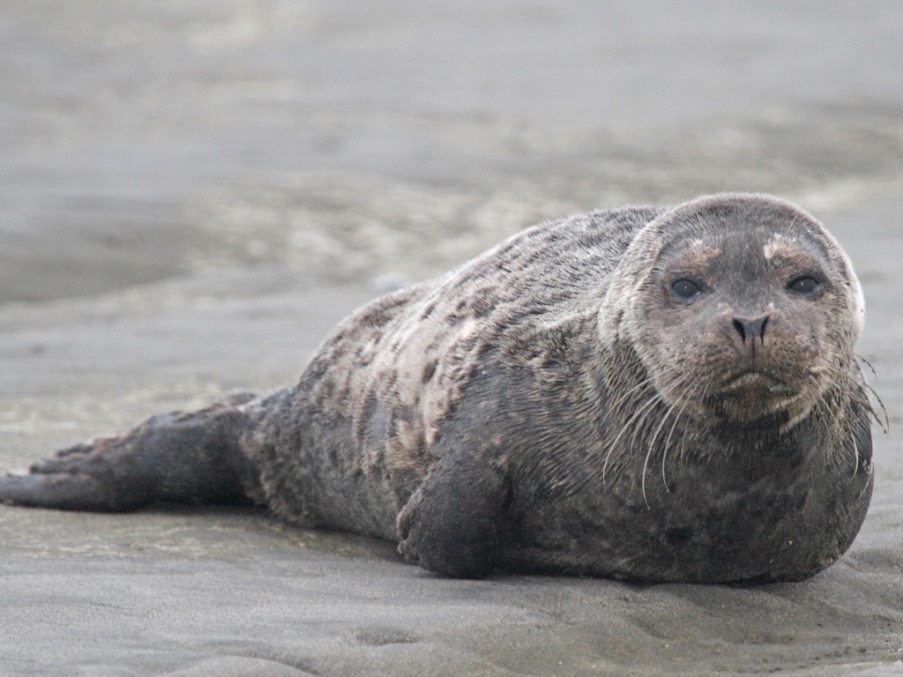
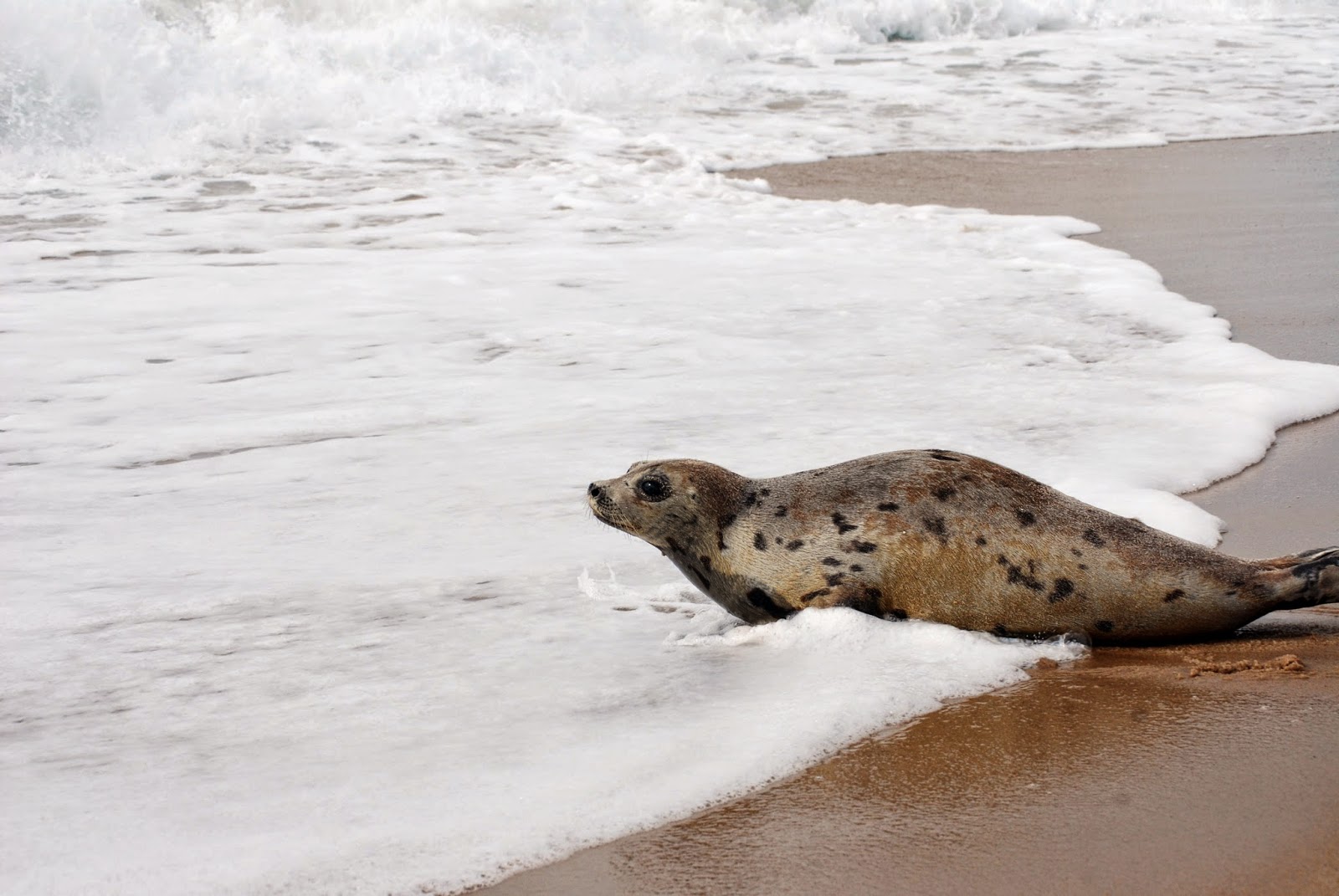
Harbor Seals are the most common seal that you will see.  These 4-1/2’ – 6’ seals range in color from tan to brown to light gray with irregular black spots.  They have a smallish head that looks like a Cocker Spaniel in profile.  This profile gave them the nickname “sea dog.”  Their nostrils are “V” shape when seen from the front.  Harbor seals weigh 250 lb.

Harbor Seal
U.S Fish and Wildlife Service accessed from http://www.fws.gov/refuge/willapa/wildlife_and_habitat/harbor_seal.html.


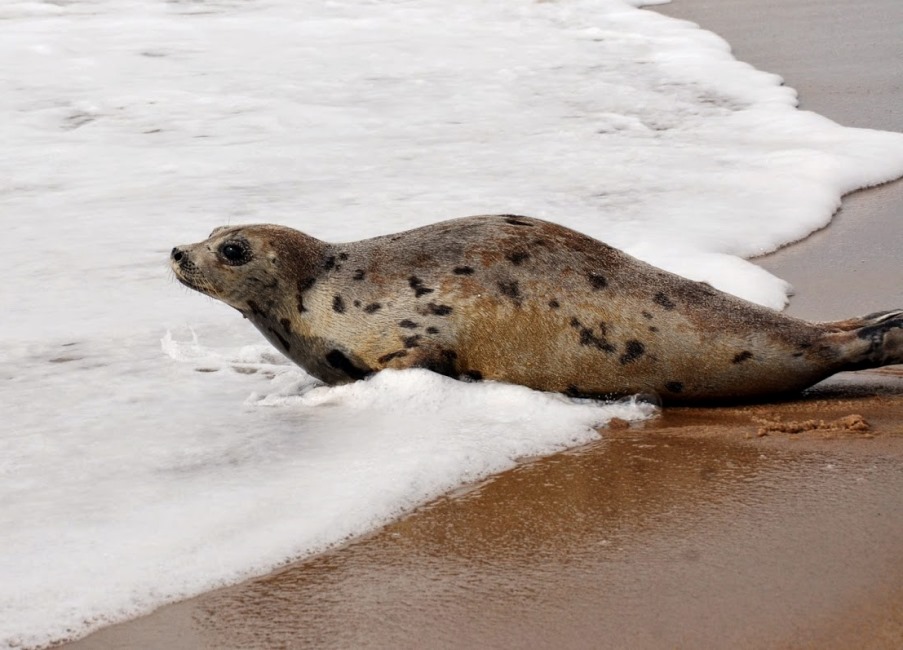
Gray Seals are a large seal with gray coloration. Interestingly, adult males are dark gray with small black markings and adult females are light gray or brown with dark patches.  Males can be 8’ long and weigh 800 lb., females 7’ and weigh 400 lb.  They have a distinctive “horsehead” profile and their nostrils form a “W” when seen from the front.  Females have a slightly smaller head than males.

Grey Seal
Andreas Trepte accessed from Wikicommons http://commons.wikimedia.org/wiki/File:Grey_Seal_Halichoerus_grypus_pup.jpg.


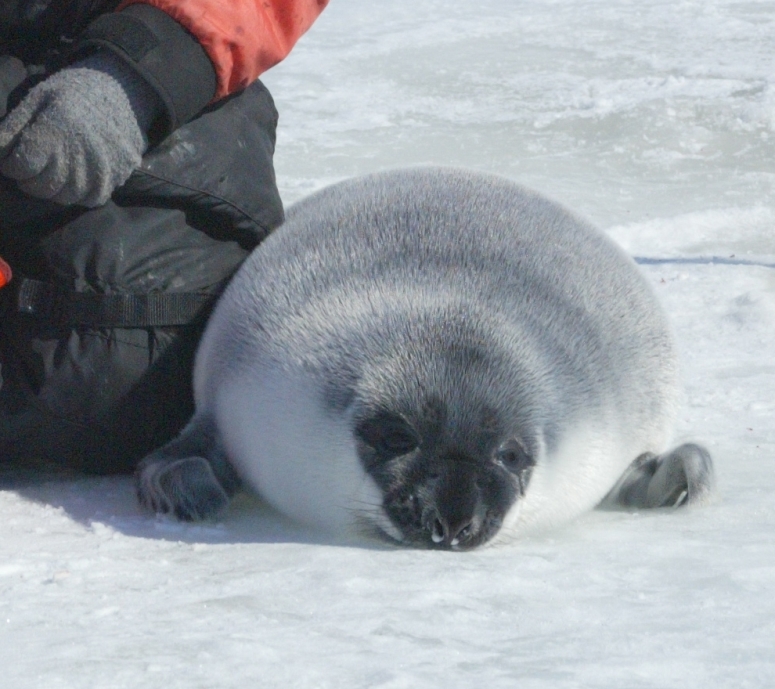
Hooded Seals are the largest seal that winters off of Long Island; males are 9’ long and females are 7’ long.  Males weigh 900 lb., females 670 lb.  The coat coloration of silver-grey with irregular black spots is the same in both adult males and females.  First year pups have a slate colored coat.  All female and juvenile male hooded seals have a larger head and broader muzzle than the harbor seal.  Adult males have an unusual nasal apparatus that they will inflate when they are angered or threatened.   Juvenile males do not have this nasal sac.

Hooded seal
From NOAA Fisheries accessed from Wikicommons http://upload.wikimedia.org/wikipedia/commons/8/8f/Hooded_seal.JPG.


It is always a thrill to see harp seals and ringed seals because they are rare visitors to Long Island.

Harp Seal adults are white with a dark harp- or saddle-shaped pattern on its back and flanks.  The more common juveniles have a light coat with dark blotches.  Harp seals look similar to harbor seals in profile but they are slightly larger (both males and females are 6’ long and weigh 400 lb.) and they have a stockier body than the harbor seal.

Harp Seal
Progressive Charlestown accessed from http://1.bp.blogspot.com/-hd_U5dR-kbk/U5sgdGx-4GI/AAAAAAAACmY/qzeNoJxoiUA/s1600/Puck+Back+Home.jpg.


Ringed Seals are the rarest and smallest seals found off of the New York coast in the winter; they measure between 4’-5-1/2’ long and weigh between 150-250 lb.  Generally, the coats are a gray-black color with numerous dark spots surrounded by light areas that look like rings. Juvenile ring seals have a fine silvery coat. From a distance, ringed seals have a slightly smaller head than a harbor seal and their nose is more pointed than a harbor seal.

Ringed Seal
From Osaka Aquarium accessed from Wikicommons http://commons.wikimedia.org/wiki/File:Pusa_hispida_(Osaka_Aquarium_KAIYUKAN).JPG#.

Join us for a seal walk at either Jones Beach State Park or Montauk Point State Park. Be sure to bring your binoculars!

And please keep your dog at home.  You wouldn’t want your dog scaring the seals.

References:

Katona, Steven, Rough, Valerie, and Richardson, David (1983). A field guide to the whales, porpoises, and seas on the Gulf of Maine and Eastern Canada : Cape Cod to Newfoundland.  New York: Charles Scribner and Sons.

New York State Department of Conservation (n.d.) Harbor seals http://www.dec.ny.gov/animals/60840.html accessed 01/22/2014

Dig Deeper in to Seals:

Bonner, Nigel (1994). Seals and sea lions of the world.  New York : Facts on File.

Kalman, Bobbie (2006) Seals and sea lions.  New York : Sierra Club Books.

Marine Mammal Stranding Center: http://mmsc.org/education/marine-species

The North Atlantic Seal Research Consortium: http://coastalstudies.org/programs/seal-research/cape-cod-seals/

Post by Susan Carver.


95 Years of Environmental Education

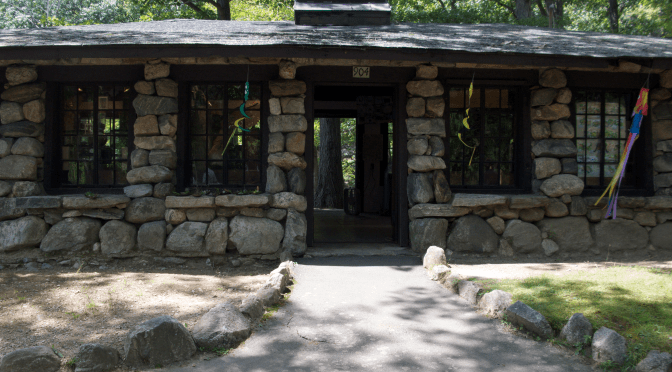
This August, the Regional Nature Museums at Harriman State Park, Orange County, will be celebrating 95 years of environmental education. Instituted in 1919 by Benjamin “Uncle Bennie” Babbit Talbot Hyde, the nature program at Harriman is one of the longest-running in the country. Currently, the Regional Nature Museums consists of four facilities at Tiorati, Twin Lakes, Kanawake, and Stahahe, supported by the Trailside Museum and Wildlife Center at Bear Mountain State Park.

Celebrate 95 of nature education at Kanawake Museum at 10am on August 8th. This free event will feature programs and games run by the museum staff, including storytelling, animal demonstrations, museum tours, local history, and much more!

For more information, see the NYS Parks events calendar

Bird Banding at TOEC

The Taconic Outdoor Education Center (TOEC), at Fahnestock State Park, invited the community to celebrate National Get Outdoors Day and National Kids to Parks Day on May 18th this year at the TOEC Outdoor RecFest. The day started with a bird banding demonstration led by Eric Lind of the Audubon Constitution March Sanctuary.

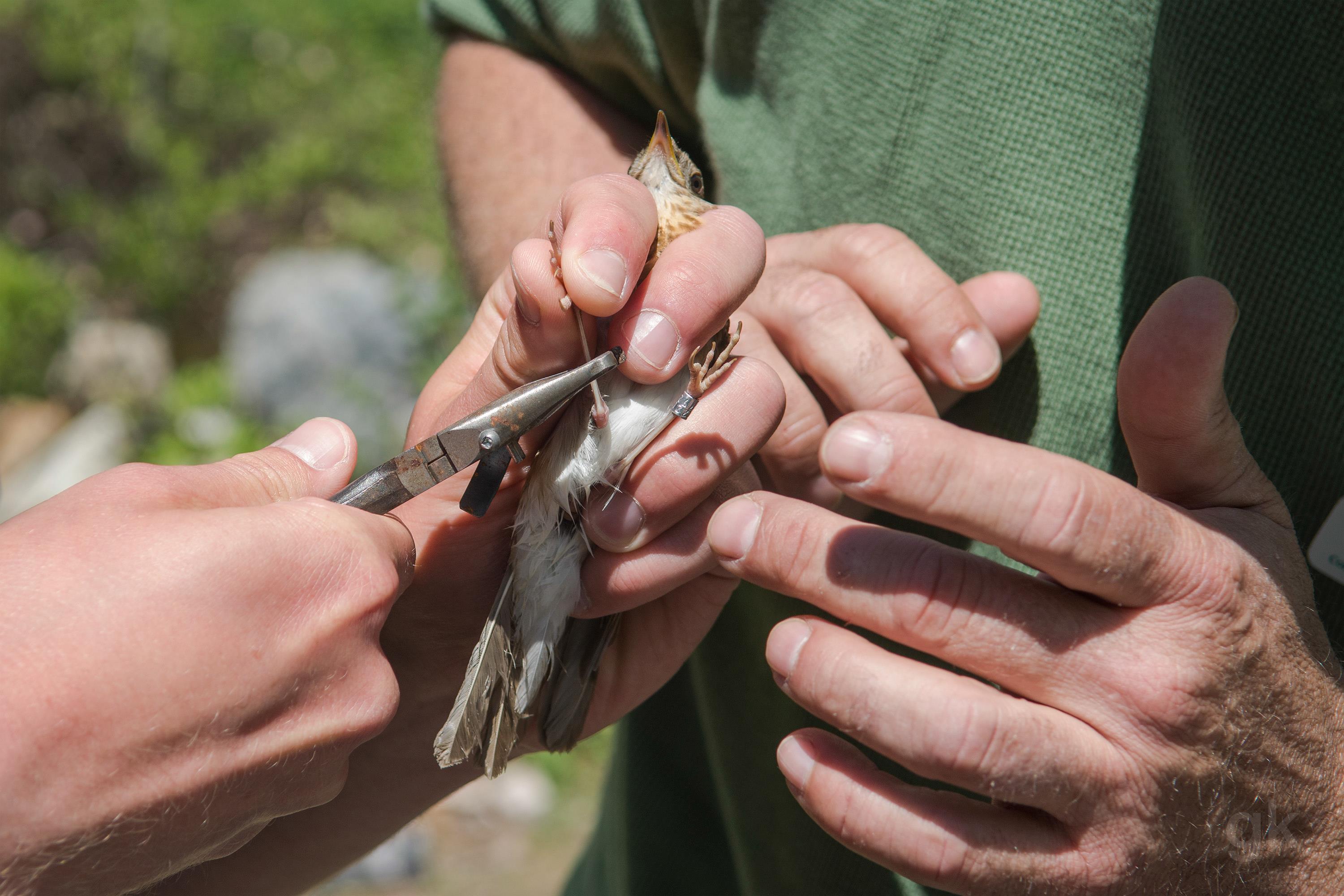
Bird banding is a way to gain valuable knowledge about migratory birds, including data used in studies of dispersal and migration, behavior and social structure, life-span and survival rate, reproductive success and population growth. The data can be used in both research and management projects.

At the RecFest, bird banding was also a great tool for education and getting kids introduced to and interested in outdoor science and the variety of songbirds that make Fahnstock State Park their home. It was also a special opportunity for kids to get up close and personal with a migratory bird. Participants learned about mist nets, band sizes, bird measurements, and data recording.

Other events of the day included a bird walk led by naturalist Peter Salmansohn of Putnam Highland’s Audubon and workshops in orienteering and canoeing. The Event was supported by the Putnam Highland Audubon chapter, and Audubon New York’s Constitution Marsh Sanctuary, with the help of TOEC outdoor Educators.

The presenters delicately attach a band to the leg of a small veery before releasing it. Photo by Gerry Katzban.

For more information on bird banding: http://www.pwrc.usgs.gov/bbl/homepage/whyband.cfm

Featured image of a veery in a mist net by Gerry Katzban. Post by Paris Harper.