Ecological Change in Lake Minnewaska

Small changes to lake ecosystems can mean big changes for plants and wildlife that make their homes there. Even though Lake Minnewaska (Minnewaska State Park Preserve, Ulster/Sullivan counties) looks the same from above the surface, life in the water has undergone major change in the past several decades. Lake Minnewaska is a unique “sky lake” ecosystem. Historically, Lake Minnewaska has been acidic acidic. No, it wouldn’t burn you to touch it, but it was too harsh for fish to live in. Studies show that Lake Minnewaska was oligotrophic as recently as the 1990s, meaning that nutrient levels were low and the phytoplankton that form algae were absent. The lake was home to other types of creatures, though, including a mat of sphagnum moss which grew up to 20 meters underwater and carpeted 60% of the lake, possible because of the high clarity of the water. The sphagnum moss sheltered two species of salamander which, because of the lack of predators, made use of the habitat and behaved in ways that no one had ever seen elsewhere (Bahret 1996).

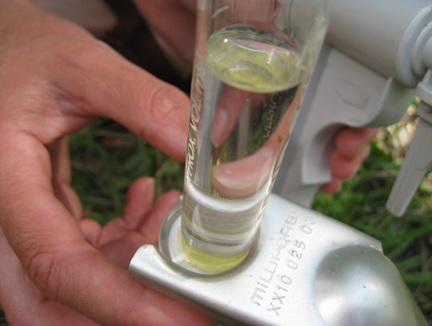
Since the ‘90s, however, the lake has gradually become less acidic and phytoplankton more prolific, moving the lake towards mesotrophic status. The primary factor in the trophic shift is the introduction of the non-native bait fish species, the Golden Shiner, which was first observed in Lake Minnewaska in 2008. The Golden Shiner eats zooplankton, which are the primary consumers of phytoplankton, leading an increase in microscopic plant life in the lake. Because of these changes, sphagnum moss no longer grows in Lake Minnewaska, and as these trends continue, we can expect further reductions in water clarity, and more plant and fish species to take up residence in the lake. NYS Parks’ Environmental Management Bureau – Water Quality Unit continues to monitor Lake Minnewaska as an ongoing part of a statewide lake monitoring program.

Image

References

Bahret, R. 19996. Ecology of lake dwelling Eurycea bislineata in the Shawangunk Mountains, New York. Journal of Herpetology 30:399-401.

Townley, Lauren. Investigation of trophic changes in Lake Minnewaska, a pristine sky lake in Ulster County, New York. Poster, Northeast Association of Environmental Biologists Conference. Online, accessed 8/25/2014.

Ice Volcanoes

Ice volcanoes erupt at Evangola State Park, by Dave McQuay
Trekking towards Lake Erie at Evangola State Park, by Dave McQuay


The turn to chillier temperatures reminds us all that there’s so much to look forward to in the wintertime at New York State Parks. One of our favorite winter phenomena are the ice volcanoes that form along the eastern end of Lake Erie shoreline. During cold weather, waves splash against the shore where the spray and slush form cone-shaped ice sculptures. In the middle of the cone is an open vent. As long as Lake Erie has open water, the waves roll under the ice volcanoes and are channeled through the vents. Water explodes into the sky as much as 30 feet high, increasing the height of the ice cone. When Lake Erie freezes over the ice volcano vents freeze shut and they become “inactive ice volcanoes.” At Evangola State Park, naturalists lead school and public groups to see the amazing ice volcanoes and ice sculptures that are a rare phenomenon found only on a few of the Great Lakes.

featured image is of park patrons in an ice cave, another unusual ice formation along the Lake Erie shoreline at Evangola State Park, photos and post by Dave McQuay.

Happy Thanksgiving!

Be sure to thank a turkey today!

photo by NYS Parks
photo by NYS Parks

Hemlock Woolly Adelgid

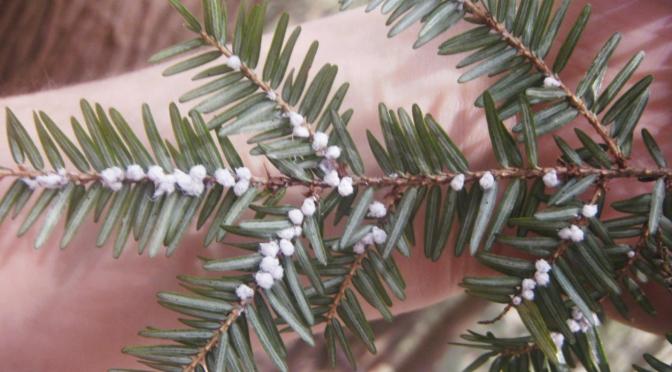
The Hemlock Woolly Adelgid (HWA) is one of few insects active during the winter months, and so now is the perfect time to be on the lookout for this tiny invader. Hemlock Woolly Adelgid (HWA) is an invasive insect native to Japan. We think it was introduced in the mid-1900s when Japanese ornamental plants became very popular in American gardens. This tiny insect is specific to evergreen hemlock trees (Tsuga spp.), attaching to new branchlets and feeding on the hemlocks starchy liquids. This continuous feeding weakens the trees and can kill it over the course of about six years. HWA has caused the death of millions of hemlocks along the Appalachians, and gray, ghostly forests are moving ever northward into New York.

HWA egg sacs are the most visible form of the insect, seen from October-May, a time when most insect predators are not active. Egg sacs are found on the underside of hemlock branches and look like small, white, fuzzy blobs, like the tip of a cotton swab.

HWA reproduces twice a year, allowing for exponential population growth in a short period of time. NYS Parks is taking an active role in managing new infestations of HWA. Chemical insecticides, applied very specifically to individual hemlocks, are the best method of control. In addition, NYS Parks has released predatory insects as biological controls in several state parks, with the hope they will one day keep HWA populations in check. Parks just hosted two HWA volunteer training events in Western NY to help us determine presence/absence areas.

Now is the perfect time to be on the lookout for HWA. For more information, or to report sightings in NYS Parks, contact  invasives@parks.ny.gov

Wildlife Spotlight: Least Terns

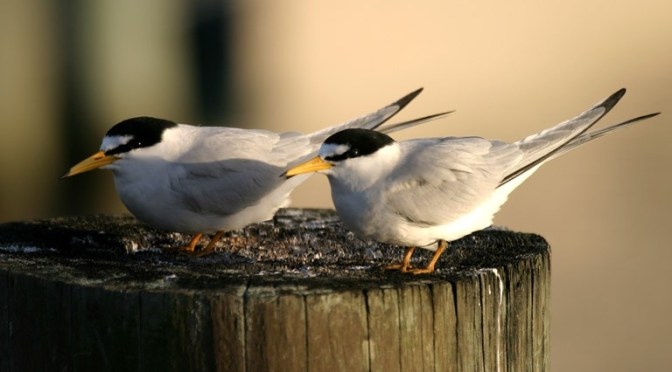
A rare denizen of NYS Parks in Long Island is the least tern. This state-threatened species is challenged by both loss of nesting habitat, as well as predation by rats, dogs, cats, and other birds.

The least tern is so named because it is the smallest member of the gull and tern family, growing to a maximum of only nine inches in body length. These beautiful birds make their homes on the Atlantic coast. In the winter, least terns migrate to the southern United States and the Mexican coast, but once it becomes warmer, they return to the beaches of Long Island to nest. Even though they are small, least terns are mighty. If an intruder crosses a nest, the tern will dive at the possible predator screeching to frighten the danger away. Least terns also make a habit to roosting with larger terns for protection.

The importance of Long Island shoreline habitat to least terns, as well as a plethora of other migratory bird species, is the main reason why some Long Island beaches are off limits to dogs. Even where pets are allowed, be conscious of how your dog might be affecting wildlife and protect the habitat of this small, but magnificent bird.

featured image is a pair of least terns, by Larry Master. Post by Paris Harper

The official blog for the New York State Office of Parks, Recreation & Historic Preservation