The Life and Times of Gonzo the Black Vulture

On July 22, 1997, Gonzo the Black Vulture stepped timidly onto northern soil for the first time at the Trailside Museums and Zoo at Bear Mountain State Park in the Hudson Valley. Born five years earlier at the Memphis Zoo, and later transferred to the Nashville Zoo, where he served as and education ambassador, Gonzo had made a northbound journey many members of his species would later take.

Early on in his career, Gonzo had developed a significant droop in his left wing, prompting surgery for a partial amputation to aid in his mobility. During his surgery, veterinarians discovered that Gonzo also suffered an irregular heartbeat.  While it would be an early retirement from commercial zoo life, Gonzo would not be arriving alone in New York’s strange and unfamiliar landscape.

Gonzo in his enclosure at the Trailside Museums and Zoo at Bear Mountain State Park.

Like Gonzo himself, black vultures are historically southerners. They are a neotropical species ranging from South America to Virginia, which remained the case up to the mid-20th century. However, beginning in the 1980’s and increasingly ever since, black vultures have been engaging in a northward expansion.

Sixteen years prior to Gonzo’s arrival at Trailside, the first ever black vulture was recorded in New York state at Minnewaska State Park Preserve on November 1, 1981 by Dan Smiley, a resident naturalist at the nearby Mohonk Preserve.  In 1997, the same year as Gonzo’s arrival, the first black vulture “nest” was recorded nearby on the eastern side of Bonticou Crag in Ulster County by Joe Bridges, a research associate with the Mohonk Preserve. The term “nest” is to be taken lightly, as black vultures aren’t much for creature comforts.  Like all new world vulture species, black vultures forego building nests instead opting for hard-to-reach rocky crags and recesses in caves, hollow logs, brush piles, thickets, and abandoned buildings to lay their clutch of eggs.

For Gonzo’s first years at Trailside, his neighbors outside his enclosure would consist primarily of his slightly larger and keen-smelling counterpart, the turkey vulture, which was the dominant vulture species in the Hudson Highlands at the time. Black vultures such as Gonzo lack the turkey vulture’s sense of smell, instead relying their sharp eyesight while coasting thermals to forage for meals.  Unable to smell carrion, black vultures have adapted a new strategy, relying instead on turkey vultures to do the work for them.  To find food, all black vultures need to do is keep an eye on the lower-soaring turkey vultures. Once the turkey vulture descends, the black vulture follows close behind.

How to tell a black vulture from a turkey vulture


Since his early days at Trailside, Gonzo bore witness to a population boom in New York of his species, a black vulture golden age. The latest large-scale survey of New York birds was performed during 2000 to 2005, splitting the state into 5,000 geographic blocks.  It confirmed black vulture nests in five blocks and reported suspected nests in 100; a significant increase since the last survey, performed during 1980 to 1985, which reported no found or suspected nests. Since then, its safe to say that the population has continued to increase as evidenced on local Christmas Bird Counts and the community science site eBird.org.

As to why the black vultures have taken up this avian manifest destiny to spread into New York, we are left only to speculate. Climate change may be a driving factor, turning New York’s colder climate into something milder and more habitable for black vultures.  However, the black vulture’s range has shifted northward only along the eastern seaboard from Virginia, and along the Hudson River north to the St. Lawrence, with little change in the Midwest.

 Other possible causes include an increase in deer and other mammal populations, and vehicle traffic, leading to increased food availability from roadkill, and greater tolerance of the species and increased protection under the federal Migratory Bird Treaty Act.
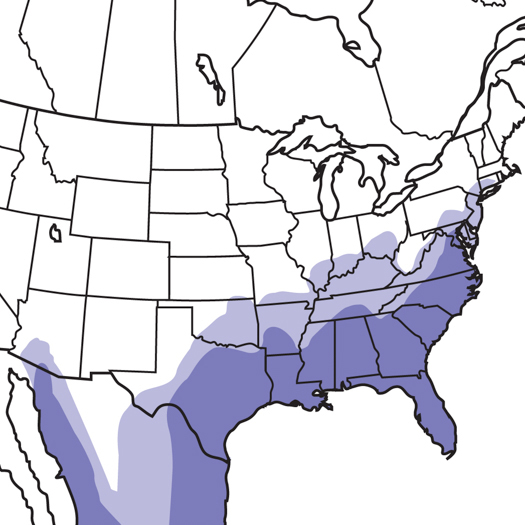
The range of the black vulture in North America is extending northward. The darker purple regions is where the birds are common, while the lighter regions are where the vultures are spreading, but less commonly found. (Photo credit – Audubon Society)

Despite being called “vultures”, black vultures and other new world species bear little similarity to old world species. Their common characteristics are a result of convergent evolution, or traits selected for a similar lifestyle.  Both share bald featherless heads, perfect for rooting around in carcasses without ruffling any feathers. Both share similar circular flight patterns, utilizing the energy saving tactic of coasting on thermals. And both share the same highly corrosive digestive system; the PH of a black vulture’s stomach acid rests just above 0, akin to car battery acid and nearly 100 times as concentrated as human stomach acid.

Black vultures are instead more closely related to storks with whom they share an interesting, yet effective means of thermoregulation[1]. If a warming climate is the culprit behind the black vulture’s expansion, they will, without a doubt, continue to thrive in warmer climates thanks to urohidrosis; or the habit in some birds of defecating onto the scaly portion of the legs as a cooling method, using evaporative cooling of the fluids.

[1] Thermoregulation is the ability of an organism to keep its body temperature within certain boundaries, even when the surrounding temperatures is very different

Additionally, keeping in mind that a black vulture’s stomach acid is highly acidic, they produce a sterile excrement which cleanses their feet of bacteria and parasites, which may accumulate due to their scavenger lifestyle. Two birds with one stone, if you will

 Black vultures will also simultaneously thermoregulate and sanitize through the process of sunbathing.  Often observed with wings out and backs to the sun, these birds are warming their bodies while utilizing the UV radiation from sunlight to kill bacteria and parasites on their feathers.

As adults, black vultures experience few predators. Their main threat comes in the form of nest predation either by raccoons or foxes.  Despite their relative safety, vultures still maintain a gruesome defense mechanism against predation; defensive vomiting. Utilizing their stomach acid once more, black vultures are able to produce a foul smelling and corrosive vomit that acts as a deterrent and mace for predators.

In addition to clever adaptations, black vultures themselves are undoubtedly intelligent birds, this trait being readily observable in Gonzo and other captive black vultures. Gonzo observed and interacted with the world around him with great curiosity.  Behind his soulful brown eyes, there was a spectacular presence, a timid and gentle personality with an almost irrefutable perception and understanding.

The social intelligence hypothesis posits that human “intelligence” has evolved in order to adapt to complex interpersonal relations and is generally accepted in the current theory of evolution. It is believed that as the size of the group increases, it becomes necessary to adapt to more complex social relationships within the group, driving the selective pressures for increased neocortex size.  Black vultures are not exempt from this theory, belonging to flocks largely composed of family units and roosting in large masses in the evening.

At Trailside, where the black vultures seemed to have designated the bear exhibit as their daytime roost, their community engagements can be observed through mutual preening, playful chasing, food sharing, and the occasional scuffle. But perhaps the best example of their sociality was seen with Gonzo.

 Confined to his exhibit, Gonzo began receiving vulture visitors, and over the years they grew in number to the point which on any given day a sizeable flock of wild black vultures could be seen mingling with Gonzo. Perhaps they were assessing the mystery as to why this member of their species was captive, putting their bald little heads together in a sort of vulture think-tank, or perhaps, lacking his own flock, the wild vultures assimilated him into their own.

Keepers at Trailside have observed on numerous occasions, the passing of food between cage bars to the flock; perhaps, an altruistic sharing of of a captive bird’s bounty. Food sharing in wild vultures is typically only observed within members of the same family.  Perhaps Gonzo viewed this flock as a sort of family. Between shared mice and fish, did the vultures swap tales of harsh winters, open skies, and a northbound journey? Voiceless secrets told hushed through throats lacking a syrinx[2]

[2] The syrinx is the lower larynx or voice organ in birds, situated at or near the junction of the trachea and bronchi and well developed in songbirds

Because Black vultures lack the organ responsible for birdsong in many species, their vocal repertoire consists mainly of huffs, grunts, and hisses. Click here to hear a recording of a black vulture from the The Cornell Lab of Ornithology Macaulay Library.

On the black vulture’s sociability, Charles Darwin wrote:

 “These vultures certainly may be called gregarious, for they seem to have pleasure in society, and are not solely brought together by the attraction of a common prey. On a fine day a flock may often be observed at a great height, each bird wheeling round and round without closing its wings, in the most graceful evolutions. This is clearly performed for the mere pleasure of the exercise, or perhaps is connected with their matrimonial alliances.”

It certainly does appear that black vultures perform many activities through the sheer pleasure the action brings.  Play is widely regarded as a hallmark of intelligence in birds, observable in both crows and ravens.  It is an activity which helps an individual gain information regarding its environment; and play in many forms can be observed in the vultures of Bear Mountain.  In the bear den and along the zoo trail, black vultures can be seen taking turns chasing each other, tossing about hay, playing with sticks and feathers, ripping apart paper bags, tugging on the mesh of exhibits.

Trailside’s resident black bear, Sadie, shares her exhibit with a wild black vulture.

Play is also one of the reasons many Hudson Valley residents are at odds with vultures. In their exploration of this world, it turns out black vultures can be quite destructive. Their favorite pastimes including tearing rubber from windshield wipers, and shingles from roofs.

Several years ago the Bear Mountain Inn experienced nearly $10,000 in roofing damage by black vultures and, as of 2017, black vultures are estimated to have cause nearly $75,000 in damages statewide. Much like teenagers, if you have enough black vultures in one place without enough to do, they’re bound to get up to trouble. As a consequence, many Hudson Valley businesses and residents are now flying in face of the Migratory Bird Treaty Act and federal law, taking up arms against the vultures. Several methods of deterrence include lasers, sprinklers, pyrotechnics, trapping and effigies; but with a population on the rise, conflict with humans is only more likely to increase.

On the other side of the coin, black vultures are a necessary asset to our ecosystem, serving as “nature’s cleanup crew” feeding on the dead and diseased other carnivores wouldn’t dare venture near, their stomach acid allowing them to safely digest putrid carcasses infected with rabies, botulinum toxin, hog cholera bacteria, and anthrax bacteria that would be lethal to other scavengers. Their work halts the further transmission of these diseases between humans and other wildlife, a role which, in the age of a zoonotic pandemic like COVID-19, is paramount.

For all those still at odds with the black vulture, Gonzo served as a shining exemplar of his species positive qualities, and magnificent beauty, connecting the black vulture in the minds of many to a handsome bird, with a quiet, yet inquisitive personality.

Gonzo passed away at Trailside on Tuesday, June 22, 2021 at 29 ½ years old. While longevity records for black vultures are scarce, Gonzo may have well been one of the oldest specimens in captivity.  He leaves behind the legacy of being one of New York’s pioneer black vultures, who instilled a passion and understanding for his species in many visitors.

Gonzo is survived by his flock, a family he made all his own, the wild vultures of Trailside. Months later, the occasional solemn vulture could still be seen idling outside what was once his aviary, wearing all black feathers, dressed as if for mourning.

Gonzo gives himself a health sunbath.

Post and photographs by Malerie Muratori, Student Conservation Association intern at Trailside Zoo.

Life Imitates Art: Parks and Rec Star At Thacher State Park

When John Boyd Thacher State Park Manager Bill Hein got a call saying that Ron Swanson was going to visit his park, he thought it was a prank. It’s not every day that you get a visit from a celebrity, but that’s just what happened when Parks and Recreation star Nick Offerman visited this  State Park in rural Albany County last month to promote his newest book on the network news program CBS Mornings.

The 51-year actor played the deadpan, gruff, libertarian head of small city parks department on the critically acclaimed series, which ran from 2009 to 2015. As fans know, Offerman in real life is a passionate woodworker, making furniture, canoes, and boats, and is the husband of actress Megan Mullally, who is best known for starring on the sitcom Will & Grace.  She was filming locally, so CBS producers looking for a picturesque natural Capital Region location for their interview with Offerman chose Thacher Park for its sweeping views from the Helderberg Escarpment.

The Helderberg Escarpment at Thacher State Park at sunrise.

Joining CBS anchor Anthony Mason, Offerman started his morning with sunrise fishing at Thacher’s Thompson’s Lake. While there, the two discussed Offerman’s background. Born and raised in Illinois, Offerman has penned a new book (Where the Deer and the Antelope Play) that reads like a love letter to the outdoors and a reflection on our shared responsibility to act as stewards of our environment. It isn’t his first book but may be his most poignant – set against the backdrop of some of the nation’s most incredible natural sites, including Glacier National Park. His best advice? Get outside!

“In my book, with a sense of humor, I’m trying to remind everybody … to get out. If you don’t know what the poison ivy or poison oak situation is, then you’re not getting deep enough in the woods,” he said.

Read this interview that Offerman gave to the Los Angeles Times about the book and some of his outdoor adventuring that inspired it.

Getting outside is just what he did at Thacher, a flagship park in the eight-county Saratoga-Capital Region. After a morning fishing at the lake (with no catch to show for it), Offerman and Mason enjoyed a hike along Thacher’s famous limestone escarpment. Sitting atop the Indian Ladder Trail, the overlook has a panoramic view that stretches to Albany, down the Hudson Valley, and east into neighboring Vermont.

Punctuating the visual splendor was a roaring waterfall, flowing with gusto from a string of summer rain showers. Offerman couldn’t contain his glee. “We don’t have this in Illinois,” he said.

Nick Offerman chats with Parks staffer Ray Muniz.
Fishing is only one of the activities available at Thompson’s Lake. Featuring 140 campsites, the park also has volleyball court, horseshoe pits, a playing field, swingsets, carry-in boat access, canoes, kayaks, and stand-up paddleboards, fishing areas, and nature trails. The lake is open for ice fishing in the winter.

Settling down on a picnic table to continue the interview, Offerman stopped, pulled out his handy Leatherman multi-tool and tightened up a few screws he thought might be coming loose, much like his Parks and Recreation character, who was really into tools, maintenance, and repair. Offerman reflected on his penchant for woodworking with Mason throughout the interview. It’s a hobby so central to his story – and so unique for an actor – that it was written into his character, who in one episode received a fictional award for woodcraft.

As the crew wrapped up from its morning shoot, Offerman met with some of our real-life Parks and Rec staff, including Regional Director Alane Chinian, Park Manager Bill Hein, and Environmental Educator Savannah Wilson. Hein, an avid fan, even brought copies of Offerman’s previous books. In true Ron Swanson fashion, Offerman was generous with his time, cracking jokes, answering questions, and offering autographs.

Offerman chats with Parks Student Conservation Association members Anna Pirkey and Grace Brennan (l-r).
Saratoga-Capital Regional Director Alane Ball-Chinian, Anna Pirkey, Nick Offerman, Grace Brennan, Thacher Park Manager Bill Hein, and Parks Environmental Educator Analyst Assistant Savannah Wilson.

“I had heard Nick mention Aldo Leopold during part of the taping and that kind of struck a chord with me,” Hein said. “I had read “A Sand County Almanac” in my earlier years and Leopold’s writing on killing wolves in the Southwest helped show me the importance of conservation and the delicate balance that nature lies in. It helped me solidify the career choice I was making out of college.”

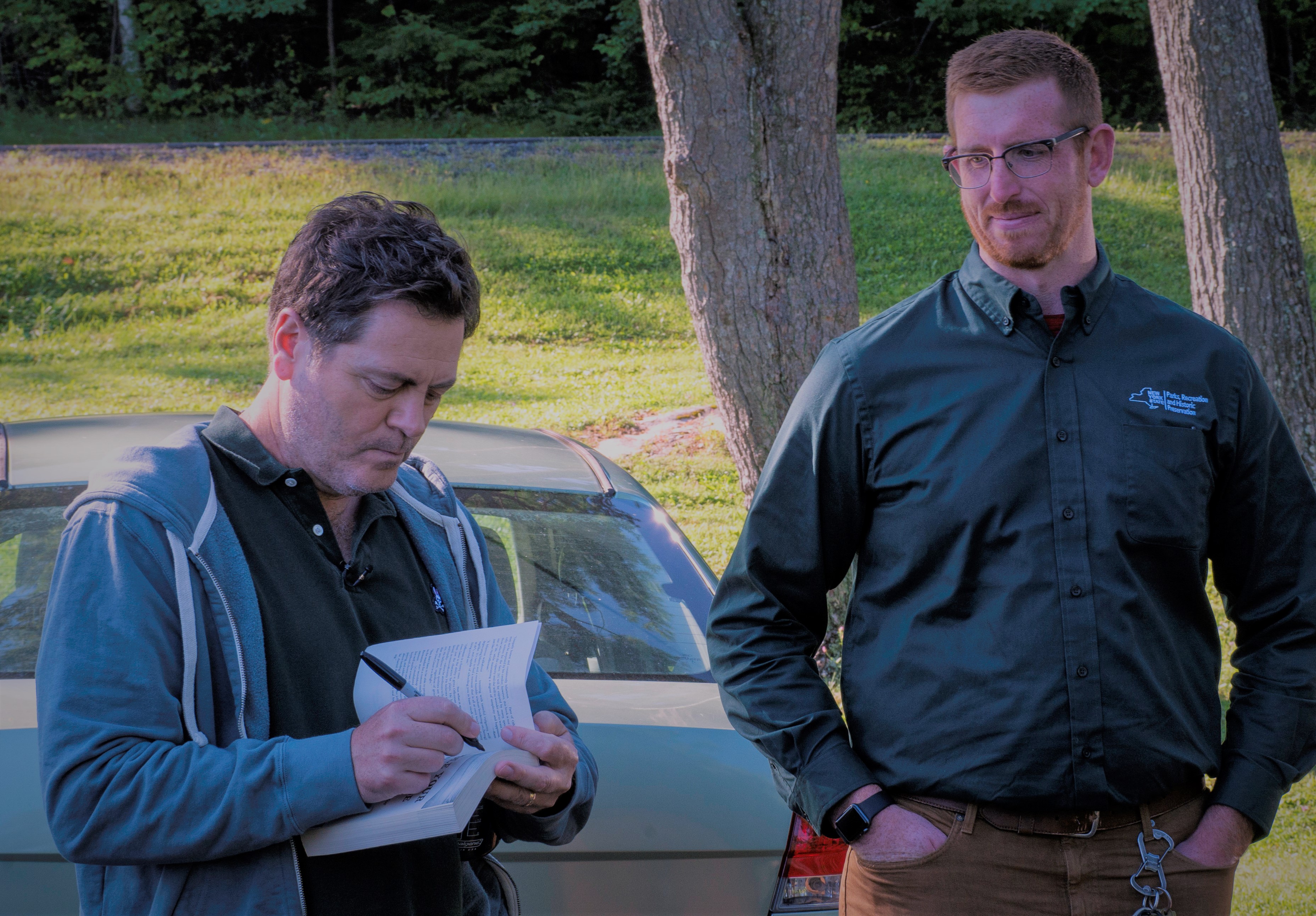
Hein had brought with him a copy of Offerman’s earlier book “Paddle Your Own Canoe” for him to autograph. Beneath his signature, he wrote two words: “To Mirth.”

Offerman signs a book for Thacher Park Manager Bill Hein.

Before leaving Thacher, Offerman had one last compliment to offer Parks staff. “I love your office,” he said, gesturing to the escarpment. “Thank you for the work that you do.”

And thank you, Nick Offerman and CBS Mornings, for helping bring a bit of the beauty of Thacher State Park to a national audience. With its spectacular views and 25 miles of trails spread across some 2,500 acres for hiking, mountain biking, cross-country skiing, snowshoeing, and snowmobiling, it is truly a year-round destination!


Cover Shot- Nick Offerman. All photos by NYS Parks

Post by Rey Muniz, Public Affairs Manager, Saratoga-Capital Region, NYS Parks


Mysteries At Crown Point

Crown Point State Historic Site lies at the tip of a peninsula, jutting northward into Lake Champlain, a place at one time quite remote with a unique history at the crossroads of war, laced with more than a few tales of folklore, mystery, and imagination befitting the Halloween season.

A calico patchwork in fall of orange, red and gold, the Adirondack Mountains flank the western shore of the lake while the Green Mountains of Vermont rise along the eastern side, just beyond the farmland of the valley floor.  It is a majestic, glorious landscape with a sky so expansive, it is a daily reminder of our small place in this universe, a place where young 18th century soldiers who once manned this stone fortress must have felt far removed from the rest of the world they knew

As twilight approaches, the breath and expanse of this geography folds into itself as the darkness envelops the mountains and lake.   The mere depth of the night is unnerving enough but without the benefit of sight, sounds are amplified in the deep black of the understory of the trees. Owls calling above and rustling in the brush below are reminders of how vulnerable we seem in the vast darkness of this wilderness even today.

Located in Essex County, Crown Point has been on both the historic State and National Registers of Historic Places since 1976, significant as the location of ruins of the French-built Fort St. Frederic (1734) and the British fort, H.M. Fort at Crown Point (1759), the largest fortification erected on the North American continent at the time.  The French and British fought bitterly for decades over control of this place – precisely because of the sightlines the majestic landscape could afford those who wanted command of the waters of Lake Champlain, pointed like a silver dagger from Canada into the heart of Colonial New England.

NYS Office of Parks, Recreation and Historic Preservation endeavors to preserve the Crown Point ruins in their current state as part of the 1910 stewardship agreement when New York State was gifted the property.  One of the defining features of the site are the officers and soldiers’ barracks in the British parade grounds, stones silently stacked and hidden behind the fort walls.  The structures are missing stairways, second story flooring and roofs; there is an ethereal quality upon viewing them, when conscious of the intended permanence of these structures and the ravages of time since people lived, worked, suffered and died within.

Take the darkness of night, mix with centuries old ruins, top off with harrowing local lore and this proves to be the perfect elixir of sinister, spooky, and spine-chilling. Visitors to the Haunted Histories at the Forts scheduled for October 29 will be welcomed with cider and donuts donated by local orchards and greeted with the first of many true, but unexplained tales at the site. 

Visitors to a previous Haunted Histories at the Forts events hear tales of some of the mysteries at and around the Lake Champlain historic fortress.

Present day meets the past in the most unfortunate of coincidences – this is not the first epidemic witnessed at Crown Point. The winter of 1775-76 found Boston in the throes of a smallpox epidemic.  Many know of the story of the artillery recovered from Crown Point and how General George Washington used the guns to drive out British troops during the Siege of Boston; however less well known, is at the time of liberation, the city was also ravaged by a pandemic of smallpox.

Most British troops had been inoculated or had the smallpox previously and were immune. In Europe, where smallpox was pervasive, most would have been exposed to the disease and likely had antibodies to protect them. 1 This protection was not the case for Indigenous peoples nor the colonists, and the disease persisted in Boston throughout the beginnings of the war, peaking in July 1775 and gradually subsiding by September of that year.  At that time, little was known about virology, and isolation was used as the primary control of transmission.

But then as now, that was only the first wave of the epidemic in the Colonies.  During the summer of 1775, the Continental Army launched the ill-fated Northern Campaign in an attempt to dislodge British forces in Canada.  Crown Point became the launching pad for these Patriot attacks directed at British-controlled Montreal and Quebec on the St. Lawrence River.

The second wave of the epidemic came in the midst of this campaign in 1776.  Patriot Major General John Thomas, Commander of the Army in Quebec, died of the disease in the summer of 1776 as the disease-weakened Continental Army was repelled from Quebec.  By that point, an estimated 3,000 men of the Northern Army were sick, most with smallpox.2 After a five-month siege on Quebec, defeated, diseased colonial troops withdrew to Crown Point where a hospital was set up. 

William Scudder, an officer serving in the New York 4th Regiment during the campaign, wrote in his journal:

“In June, I had the command of some batteaux…that were loaded with provisions to go to Crown Point, where our army then lay, under the command of General Sullivan, having retreated from Canada, – an such a scene of mortality was exhibited at that place, I never had beheld.  The hospital I judged to be about one hundred and fifty feet in length; on the lower floor in two ranges on each side, the poor sick and distressed soldiers.  Their disorder was chiefly the small-pox – Some groaning and begging for water, some dying and other dead and sewed up in their blankets; let it suffice to say, that by the middle of the afternoon they would begin to carry the dead from the hospital; I counted twenty-one carried out at one time, and it was common to bury fifteen or twenty in a day.” 3

Archeologists have been working at Crown Point from the mid-1950’s to the present.  In addition to first-hand accounts of those laying their final rest here, there are the Fort St. Frederic parish birth and death records of the French that inhabited the site prior to both the British and Colonial occupations.  Despite all the historical records, and the extensive archeological work throughout the 21st century, no evidence of human remains have ever been found. The French were Catholic, which prohibited them from burning the bodies, and even if the diseased soldiers had been disposed of by incarceration, there would be carbon remains.  No reasons can be found to explain this mysterious absence.

It’s not only the history that cannot be explained, but the mountains and lakes that surround Crown Point that are just as elusive and mystifying, as evidenced proven by both news reports and stories local inhabitants have passed down through generations.

Long before any European settlers arrived in the area, both the Abenaki and the Haudenosaunee native people had stories about a large creature inhabiting the lake. It was called Ta-to-skok by the Abenaki, a word meaning creature with two tusks. Early in the 18th century, Abenakis warned French explorers about disturbing the waters of the lake, so as not to disturb the serpent.

Samuel de Champlain’s diary reveals the following entry:

“. . . [T]here is also a great abundance of many species of fish. Amongst others there is one called by the natives Chaousarou, which is of various lengths; but the largest of them, as these tribes have told me, are from eight to ten feet long. I have seen some five feet long, which were as big as my thigh, and had a head as large as my two fists, with a snout two feet and a half long, and a double row of very sharp, dangerous teeth. Its body has a good deal the shape of the pike; but it is protected by scales of a silvery gray colour and so strong that a dagger could not pierce them.”

Never one to miss a trick, showman P. T. Barnum offered a reward of $50,000 in 1873 for “hide of the great Champlain serpent to add to my mammoth World’s Fair Show.” 4 No one ever claimed it.

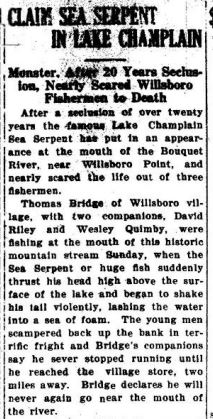
The Regional Office of Sustainable Tourism lists many 19th century sightings, with 1873 being a particularly robust year.  A New York Times story reported that a railroad crew had seen the head of an “enormous serpent” in Lake Champlain, with bright silvery scales that glistened in the sun. In July that same year, Clinton County’s Sheriff, Nathan H. Mooney, reported an “enormous snake or water serpent” he thought was 25 to 35 feet long. Then in August, the steamship W.B. Eddy encountered Champ by running into it. The ship nearly turned over, according to many of the tourists on board. Never one to miss a trick, showman P. T. Barnum offered a reward of $50,000 for “hide of the great Champlain serpent to add to my mammoth World’s Fair Show.” 4

The stories continue through the decades, marked by a roadside sign upon entrance to the neighboring town, Port Henry, where they celebrate Champ Day each summer, hoping to catch sight of him again. 

Fun folklore or relative of Nessie, world famous occupant of the Scottish Loch Ness?  Fast-forward to contemporary times, and a quick Google search on Champ turns up what may be the only existing photo of his presence, taken by Sandra Mansi in 1977 while vacationing in northern Vermont.  5

A 1977 photograph allegedly showing the mysterious Lake Champlain beast, taken by Sandra Mansi. Below, the Champ sign outside Port Henry.


Ronald Kermani, a former investigative reporter for the Times Union, whose family has a camp on Lake Champlain. He has spent summers here for the past five decades and told of his experience, at 7:10 a.m. on July 2, 1983, when he was fishing in a rowboat with a girlfriend.

He said he saw a creature about 30 feet away with “three dark humps — maybe 12 inches thick — protruding about two feet above the surface … two or three feet apart.”

Kermani wrote: “We watched in disbelief for about ten seconds. The humps slowly sank into the water. There was no wake, no telltale sign of movement. Unexplained. Eerie. Unsettling.”

He did not get a picture because he did not have a camera. Ever since, Kermani, who is retired and lives in Guilderland, has carried a camera in the boat with him when he is out on the lake — just in case. 6

It’s not just below the surface that menaces. In the mountains to the west of the peninsula are indigenous burial grounds.   Coot Hill near Port Henry has long been a reported locus of visions, vengeful murders, and accumulation of gruesome accidents.  Maybe they should have looked for property elsewhere to settle.

There’s not enough space to even address the French werewolves, apparitions appearing in the parade grounds, drowned Scottish soldiers or sounds that emerge and then follow a person as they try to retreat.  History books can explain some, but not all.   Coupled with deep darkness and imagination, that makes for a chilling trapse across the grounds at Crown Point, particularly in the dark of night.  For the Haunted History event, 18th century costumed interpreters will portray the restless soul of French settlers, who would have arrived at Fort St. Frederic with stories of their own to tell.

Keep your friends close and your flashlight on!


Post by Lisa Polay, Site Manager, Crown Point State Historic Site.

SOURCES

1 Gil Jr.l, Harold B. Colonial Germ Warfare.  Colonial Williamsburg Journal. Spring 2004.

2 Fenn, Elizabeth A. The Great Smallpox Epidemic.  History Today. Vol 53: Issue 8. August 2003.

3  The Journal of William Scudder, an officer in the late New York Line, who was taken captive by the Indians at Fort Stanwix, on the 23rd of July, 1779, and was holden a prisoner in Canada until October, 1782, and then sent to New York and admitted on parole. Evans Early American Imprint Collection

4  Lake Champlain Region (ROOST), https://www.lakechamplainregion.com/heritage/champ

Grondahl, Paul Champ:  Hook, Line and Sinker,. Albany Times Union. Dec 28, 2012.

6 Grondahl, Paul Champ:  Hook, Line and Sinker, Albany Times Union. Dec 28, 2012

Lights Out For The Birds

Twice a year, billions of birds migrate throughout the United States between their wintering and breeding grounds. These birds typically migrate south in the fall and will migrate north again in the spring. That means right now in New York State, birds are passing through as they travel down south to warmer climates. All types of birds will be seen migrating during the seasons, including warblers, shorebirds, raptors, and more.

Birds will usually spend their days saving their energy, resting, and finding food sources and during the night will use most of their energy flying. Migratory birds are typically nocturnal travelers, which means they gain the most mileage during the night hours. While we are asleep after an event filled day, there can be an estimated 150 million to upwards of 300 million birds travelling overhead in one given night. Even though the day is over for us and is our time to relax and unwind, the night hours are highly active for migrating birds!

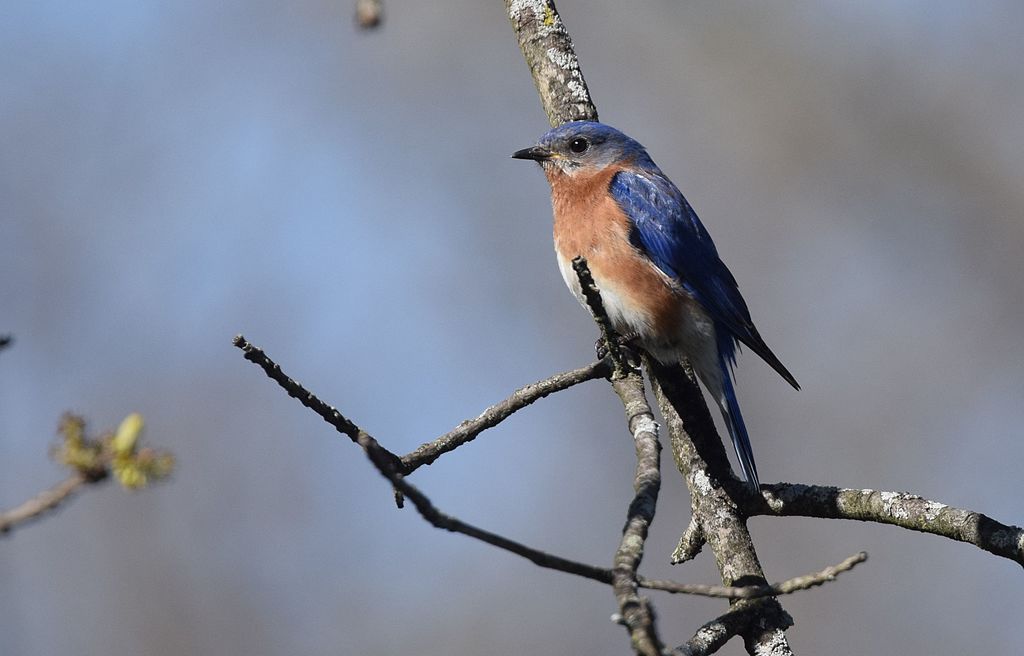
The official New York State bird, the Eastern Bluebird, migrates south in the fall to spend its winters in the southeaster U.S. or Mexico. (Photo credit – Wikipedia Commons)
Dark-eyed junco (female) migrate south into New York from Canada and sometimes hang around all winter. (Photo credit – Wikipedia Commons)

Nighttime migration poses different threats to these birds, particularly in big cities. Large buildings are typically lit up with hundreds of bright lights throughout all hours of the night. This light pollution can significantly change birds’ behaviors, including migration patterns, foraging for food, and communication with other birds in the area. Light pollution can distract the birds as they might start to think it is daytime, because they cannot process light sources like we can. All of these behaviors are a waste of energy for birds, making their long journey much more dangerous.

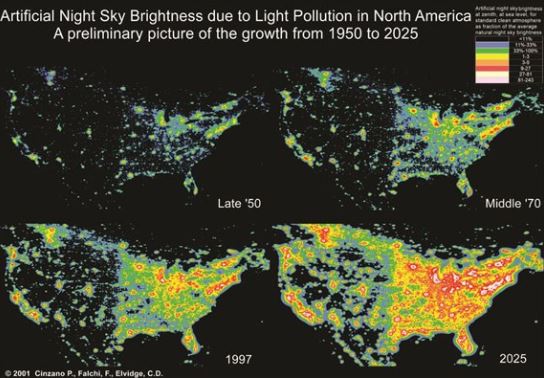
According to the National Park Service, nighttime light pollution in the U.S. has gotten much worse in decades after World War II, so much that now eight in ten Americans can no longer see the Milky Way. And this is an increasing issue for migrating birds.

This National Park Service map shows the growth of light pollution in the U.S. since the 1950s

Birds and State Parks

New York State Parks are a great place to visit to catch a view of migrating birds. The forests, meadows, wetlands, and other natural areas in State Parks provide some of the most crucial habitats for these birds along their journey, and have helped them survive over the years by offering shelter and food. In some parks there are specific areas designated as Bird Conservation Areas (BCAs). Of the 62 BCAs throughout the state, 27 are within State Parks.

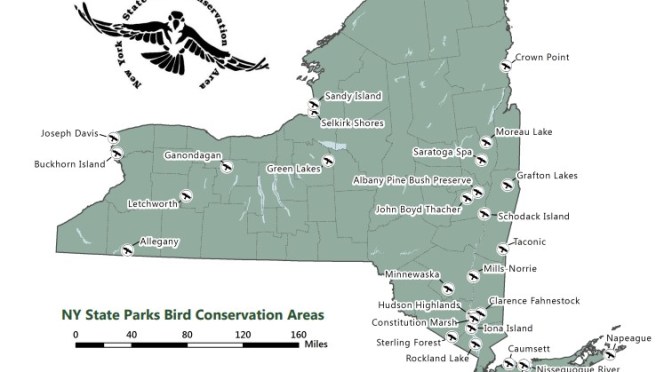
An area can be designated as a BCA if it is judged as important habitat for one or more species based on certain criteria. There are many BCA locations throughout the state, such as Saratoga Spa State Park that is home to more than 100 different bird species. You can find the location of Saratoga Spa State Park and other BCAs on the map provided below and the State Parks website. You can also check the State Parks events list for birding events near you!

A map of the Bird Conservation Area in Saratoga Spa State Park.

In addition to BCAs, there are also areas recognized nationwide by the National Audubon Society to help protect birds and their habitats; Important Bird Areas (IBAs). One example in New York State is Rockefeller State Park Preserve in Westchester county, and is home to 180 different bird species! Check out the National Audubon Website to see Rockefeller State Park Preserve and all the other IBAs in New York State.

What Is The “Lights Out” Movement?

The “Lights Out” movement is a nationwide event that was created in in Chicago in 1999 by the National Audubon Society to help reduce the number of bird fatalities. Since then, the effort has spread to cities including Atlanta, Baltimore, Boston, Cleveland, Dallas, Denver, Detroit, Kansas City, Milwaukee, Philadelphia, Pittsburgh, Portland, Salt Lake City, San Francisco, St. Louis and Washington, D.C.

Bird fatalities are more directly caused by the amount of energy birds are wasting during the night because of the heavy light pollution across the United States. This energy is being wasted on flying around, using more vocalization and the exhaustion is leaving them more vulnerable to other threats around them.

If you’re interested in watching migrations, a tool that can be used is the BirdCast migration tool. This website has many resources for nationwide and local monitoring. The nationwide mapping tools include a live forecast of the density of the birds migrating as well as a 3-day prediction forecast of what it could look like. In addition to the nationwide prediction forecast, you can also check out a live animated video of the current migration patterns each day!

Use the slider bar to see how the BirdCast migration changes between Oct. 6 and October 14.

Another neat tool that this website includes is a live local alerting map that is specific for a county, city, or town. The local maps tell you how many birds to expect flying over your area that night and what the next couple nights look like as well. This tool provides important information so you can participate in helping the birds during their migration.

There are two large windows for bird migrations;: one in the fall and one in the spring. Bird migration can take place from August through November with peak migration in October in the fall and from March through June with peak migration in May in the spring. Check out the links provided above to get more information on BirdCast and when peak migration is happening in your area!

How Can You Help?

Some suggestions to help get you started with the Lights Out Movement for nighttime hours:

  • Turn off exterior decorative lighting
  • Turn off interior lighting, or use curtains and blinds
  • Install automatic motion sensors and controls wherever possible
  • Click on the link to check out the full list of suggestions: Lights Out Movement. One of the local efforts is based in New York City.

After visiting State Parks and seeing the many different species of birds that are in New York State, it is important for all of us to do our part to help keep them safe. The National Audubon Society provides suggestions on how to decrease light pollution on a local level, which will help birds during their migration. It is estimated that 253 million annual bird deaths from collisions are from residential areas compared to 340 million from tall buildings and skyscrapers. Your part at home is just as important as businesses!

Participating in the Lights Out movement helps more birds safely reach their migration grounds, giving you and your family more opportunities to see them in New York State Parks! To make an official pledge with the movement, sign up here.


Cover Shot – A map of Bird Conservation Areas in New York State Parks.

Post by Allyson Paradis, Wildlife Unit Assistant, NYS Parks

More Resources from the NYS Parks Blog

Raptor Migration and Hawk Watching

When we think about spring and fall in the northeast, we often dwell on the extraordinary changes that occur to our trees and other plants. In the spring, we yearn for green to replace the barren gray and white of winter; in fall we marvel at the warm oranges, reds, and yellows that are on…

Golden Opportunities at Betty and Wilbur Davis State Park

On February 24, 2009, two visitors to Betty and Wilbur Davis State Park were enjoying a sunny walk on Davis Road when two BIG birds flew overhead, going north.  “Golden Eagles!” exclaimed these experienced bird watchers.  Both were volunteers at the Delaware Otsego Audubon Society’s (DOAS) Franklin Mountain Hawk Watch which is known for its…

To Boldly Go…

About four times each year, State Parks adds a variety of properties to the State Register of Historic Places, a step towards later being listed on the National Register of Historic Places as important pieces of America’s broad cultural heritage.

But while the vast majority of these listings are buildings, like factories, churches, homes, libraries or schools, that’s not always the case. Sometimes, Parks’ historic researchers like me working on the register listings get to take on the story of something truly out of this world.

Science fiction fans worldwide recognize the name “Enterprise” as the name of the starship in iconic 1960s television series Star Trek. A decade after the show went off the air, those fans helped see to it that America’s first prototype of a reusable orbiting spacecraft would also carry that name. In 2013 I was honored to document that historical connection as part of support for the listing the NASA Space Shuttle Enterprise on the state and national historic registers as culturally and technologically significant.

It was 45 years ago this September when the Space Shuttle Enterprise rolled out of its assembly building at Rockwell International Space Division’s facility in Palmdale, California. Waiting outside were a crowd of VIPs that included six cast members of the Star Trek crew, and series creator Gene Roddenberry.

On Sept. 17, 1976, the crew of Star Trek’s fictional Enterprise attended the roll-out of the Space Shuttle Enterprise at the Rockwell International Space Division’s facility in Palmdale, California. Show (left to right) are Dr. James D. Fletcher, NASA Administrator; DeForest Kelley (Doctor Leonard “Bones” McCoy); George Takei (Ensign Hikaru Zulu); James Doohan (Chief Engineer Montgomery Scott); Nichelle Nichols (Communications Officer Hyota Uhura), Leonard Nimoy (Science Officer Spock); Star Trek creator and producer Gene Roddenberry; unidentified NASA representative; and Walter Koenig (Ensign Pavel Chekov).
The model of the Starship Enterprise used during shooting of the Star Trek television series is now on display at the National Air and Space Museum in Washington, D.C. (Photo Credit – National Air and Space Museum’s Steven F. Udvar-Hazy Center by Dane A. Penland)

NASA had initially suggested naming the prototype Constitution and even wanted to unveil the spacecraft on September 17 – Constitution Day. But as NASA’s plans became publicly known, thousands of fans of Star Trek – which had gone off the air several years earlier in 1969 – began a write-in campaign to the White House urging President Gerald Ford to name the orbiter Enterprise in honor of the fictional starship.

“I’m a little partial to the name Enterprise,” said Gerald Ford, noting that he had served in the Pacific during World War II aboard a U.S. Navy ship that serviced an aircraft carrier of that name. The Star Trek write-in campaign apparently influenced President Ford and the show’s fans are generally credited as being the driving force behind the shuttle’s name change.

While called Enterprise, the prototype NASA orbiter was formally known as Orbiter Vehicle-101 or OV-101, and represented the culmination of years of research, design, and experimentation. Planning for the Space Shuttle Program had begun in 1968, ten months before Neil Armstrong and Buzz Aldrin set foot on the moon during the Apollo 11 mission. The intent was to develop a reusable and affordable vehicle that could travel to and from space routinely, easily, and affordably. 

Unlike typical aviation advancement, the space shuttle was a major technological leap forward. While airplanes tend to slowly evolve over time through constant adjustments based on testing and performance, the systems and design of the shuttle was unprecedented. Space flight capabilities went from disposable rockets and capsules to a reusable cargo space plane in only twenty years; there was no transitional design. As a prototype, Enterprise was largely responsible for making sure these new technologies and concepts worked properly to ensure the safety of the astronauts who would fly aboard the other vehicles.

Two events likely led to the decision to use a rocket/space plane system for the shuttle: the advent of thermal insulation tiles by Lockheed, which made it affordable and convenient to insulate an airplane-like design, and the order by Congress that the next space vehicle meet not only the requirements of NASA but also the U.S. Air Force. One of the biggest requirements of the Air Force was the ability to land at Vandenberg Air Force Base in California so that classified missions could be completed quickly and efficiently. After testing it was determined that the sweeping, triangular-shaped delta wing design would be more stable and would allow for the necessary maneuverability at high speeds that a conventional wing design wouldn’t allow.

Enterprise, the first and only full-scale prototype orbiter vehicle of the space shuttle fleet,was first used during the Approach and Landing Tests, one of the earliest missions of the Space Shuttle Program. The Approach and Landing Tests program saw Enterprise fly in Earth’s atmosphere, doing so thirteen times, five of which saw it separate from the Shuttle Carrier Aircraft to fly and land unaided. The Shuttle Carrier Aircraft is a modified Boeing 747 that is used to transport space shuttle orbiter vehicles in a piggyback-like configuration.

In February 1977, the Space Shuttle Enterprise rides atop a modified Boeing 747 carrier aircraft as part of approach and landing tests at the Dryden Flight Research Center in Edwards, California.
The NASA mission patch for the Approach and Landing Test.
Space Shuttle Enterprise just after releasing from the Boeing 747 carrier aircraft to start a five minute, 28 second unpowered test flight above the Dryden Flight Research Center.

Enterprise was also of paramount importance in planning and preparation at shuttle facilities in Florida and California. In the early days of the Space Shuttle Program, Enterprise was the only completed orbiter vehicle and was therefore the only vehicle capable of ensuring that the facilities were prepared and ready for the first launch. The fit checks, vibration tests, atmospheric flights and landings, and various other development tasks performed on Enterprise enabled Columbia to launch successfully into space during STS-1 on April 12, 1981.

Enterprise was used later in the investigations and procedural revisions following the Challenger and Columbia shuttle accidents. Following the Challenger accident in 1986, Enterprise aided in crew escape tests. Following the Columbia accident in 2003, one of Enterprise’s wing edges and a landing gear door were borrowed for tests related to foam chunks striking an orbiter during launch. Although the loss of two space shuttle orbiters was a devastating loss, Enterprise helped the program return to flight and continue its mission.

In February 1985, the Space Shuttle Enterprise is in launch position d during verification tests at the Vandenburg Air Force Base Space Launch Complex in California.

In 1983, Enterprise began its role as an ambassador and educational tool. Enterprise was first ferried to Paris, France for the Paris Air Show. The international tour continued on with stops in England, Germany, Italy, and Canada. This tour represents the only time an orbiter has travelled internationally. Upon returning home Enterprise was showcased at the World’s Fair in New Orleans, Louisiana. On November 18, 1985 Enterprise became the property of the Smithsonian National Air and Space Museum.

In June 1987 Enterprise was used for testing landing barriers. The landing barrier is essentially a large net stretched across the runway that helps the orbiter reduce speed when landing. The tests were successful, and the landing barriers were installed at three Transoceanic Abort Landing sites (Moron and Zaragota, both in Spain, and Banjul, Gambia). Although retired, Enterprise continued to aid NASA throughout the 1990s and 2000s to test new systems and technology.

Enterprise was put on public display by the Smithsonian in Washington, D.C. from 2004 to 2012 before being transferred to the Intrepid Sea, Air and Space Museum in Manhattan, where it remains on display.

The Space Shuttle Enterprise makes it final flight on April 27, 2012, atop a NASA 747 carrier aircraft on its way to John F. Kennedy Airport for shipment by barge to the Intrepid Sea, Air and Space Museum, located at the bottom center of the photo.

Accomplishments of Enterprise and the Space Shuttle Program

The Space Shuttle Program is responsible for releasing some of the most significant orbiting telescopes, such as the Hubble Space Telescope, the Compton Gamma Ray Observatory, and the Chandra X-ray Observatory. The shuttles also released many groundbreaking probes and space craft including:  the Galileo probe, which explored Jupiter; the Magellan probe, which helped map Venus; and the Ulysses probe, which conducted the first systematic survey of the environment of the Sun.

The biggest achievement of the program was the construction of the International Space Station (ISS). The main purpose of the ISS is to serve as an orbiting laboratory. The station has advanced science and technology in areas ranging from biology and medicine to astronomy and physics. Hundreds of experiments have been conducted in orbit aboard the shuttle and the ISS. Some of them are long term and more publicized, such as the effects of microgravity on the human body. Astronaut John Glenn, who first traveled to space during the Mercury Program in 1962, returned to space in 1998 at the age of 77 as part of an experiment to better understand the effects of microgravity on the elderly. Other experiments are much smaller in scope, such as determining if fish can swim upright and observing seed growth in microgravity.

Leroy Chiao, NASA astronaut on STS-65 (1994), STS-72 (1996), and STS-92 (2000), as well as commander and science officer on International Space Station Expedition 10 (2004-2005), stated that “[The] shuttle, to me, represents a triumph and remains to this day a technological marvel. We learned so much from the program, not only in the advancement of science and international relations, but also from what works and what doesn’t on a reusable vehicle. The lessons learned from shuttle will make future US spacecraft more reliable, safer, and cost effective.”

The space shuttle program was also the first American space program to reflect NASA’s adoption of diverse hiring practices. In the late 1970s NASA became more progressive regarding its astronaut selection process. Test pilots and military personnel were no longer the only recruitment avenue for astronauts. The agency began focusing on scientists and engineers as well as women and minority groups. The space shuttle program provided a platform for NASA’s shift in culture and allowing space to become accessible for everyone in a way that hadn’t previously existed. The first American woman (Sally Ride, 1983), first African American (Guion Bluford, 1983), and first African American woman (Mae Jemison, 1992) flew in space aboard the space shuttle. In addition, many non-US citizens have flow aboard the shuttle, representing a diverse group of people and a high level of cooperation. NASA brought diversity, equity, and inclusion to space exploration via the space shuttle.

“[The space shuttle] will be remembered for being the vehicle that enabled us to get the International Space Station successfully assembled on orbit, but it depends on what your favorite thing is. If you’re a scientist or an astronomer, it will always be remembered as the vehicle that delivered the Hubble Space Telescope, then flew four successful servicing missions capped off by one of the most spectacular flights in the history of the shuttle program, STS-125, when we did five back-to-back-to-back-to-back-to-back space walks and carried out every objective of that flight when no one thought we would be able to finish everything.

You look at other satellites that it deployed: Magellan, Ulysses. You look at the space laboratory that was flown on it, or the space habitation module. The people that it took to space. We now see, when you look at an astronaut crew, it’s usually a rainbow of people—all races, all genders, all nationalities…There are countless things that the space shuttle will mean, just depending on who you are and where you sit.”

– Charles Bolden, NASA Administrator, 2011

Like its fictional namesake, the shuttle Enterprise was the first step of a bold journey further into outer space. It performed a 36-year mission (seven times longer than that of the Star Trek Enterprise) that set the stage for the shuttles Atlantis, Challenger, Columbia, Discovery, and Endeavor and their crews to undertake unprecedented scientific and technological missions in orbit. The pioneering vessel truly has a place in the nation’s history, and State Parks was proud to have gotten it listed to the State and National Registers of Historic Places.

Live Long and Prosper!

One of the many letters received by State Parks to support the historic register listing of the Space Shuttle Enterprise was submitted by NASA astronaut Fred Haise, who had been in command of the shuttle on three of its approach and landing test flights. Haise was also a crew member aboard the ill-fated Apollo 13 lunar mission in 1970.
The Starship Enterprise as seen in the opening credits of the original Star Trek television series. (Photo credit – Paramount/CBS)

All photos credited to NASA unless otherwise noted.

Post by Daniel A. Bagrow, Historic Preservation Program Analyst, State Parks Historic Preservation Office

The official blog for the New York State Office of Parks, Recreation & Historic Preservation