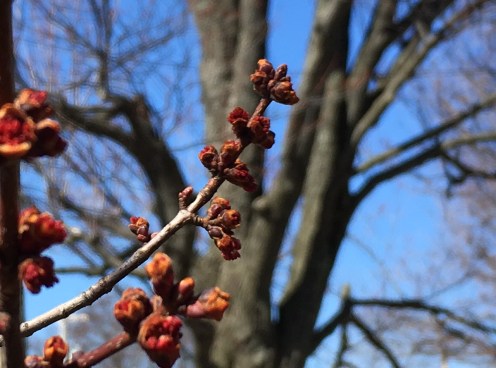
Spring is here and the tree buds are starting to pop. Red maple (Acer rubrum) is among the first to flower, revealing little tassles of red and orange. The leaves will emerge a bit later.
Silver maple (Acer saccharinum) is another early bloomer. Perhaps this tree was named after its silvery flowers.
Beech trees are late comers — the long skinny buds and last year’s leaves are still holding tight. They are easy to spot in the woods before everything greens up.
American beech (Fagus grandifolia) bud and leaves.
Remember all that snow and how heavy it was? If you find trees arching over a trail or at odd angles in the woods, that may be a sign that it survived a heavy load of snow like these hemlocks. Trees are amazingly resilient and strong.
Hemlock (Tsuga canadensis) branches bent down by the weight of the snow.
Before long the trees will be greening up and a new season of growth, with the sounds of birds, insects, and wildlife, will return. Take a walk through the woods. Look how small we are compared to the trees!
Immersed in the woods on a trail at Bennington Battlefield State Historic Site.
Do you feel inspired, in awe, empowered or claustrophobic under a canopy of trees? More than 80% of NY State Parks and Historic Sites are covered in forest, so you can find spots like this in a park near you.
Tree canopy at Clay Pit Ponds State Park Preserve, Staten Island.
Perhaps you prefer viewing the trees from a distance or sitting under a favorite tree. NYS Historic Sites are great places for this: Crown Point on Lake Champlain (below), Olana on the Hudson, Sackets Harbor on Lake Ontario, Lorenzo in Cazenovia, or Hyde Hall at Glimmerglass are a few spots to enjoy big trees.
Crown Point State Historic Site offers scenic vistas and some beautiful trees.
Take a little time this Arbor Day to appreciate our tall tree friends and spring into action with some walks in the woods or a stroll along a tree-lined path.
Post and photos by Julie Lundgren, State Parks Ecologist, NY Natural Heritage Program, NYNHP. NYNHP works in partnership with State Parks to survey and map rare species and natural communities in the parks to aid in stewardship of their natural resources.
In 1944, President Franklin D. Roosevelt invited a small group of Holocaust refugees to the United States. The War Refugee Board (WRB) was established to determine who should come to the US and where they should be housed. FDR sent Special Assistant to the Secretary of the Interior Ruth Gruber to Italy to bring back 982 men, women, and children. The refugees were from 18 different European countries and most were Jewish. Many had been fleeing persecution for years and had made their way to an Allied-controlled part of Italy. Almost 100 of the refugees had escaped concentration camps such as Dachau and Buchenwald.
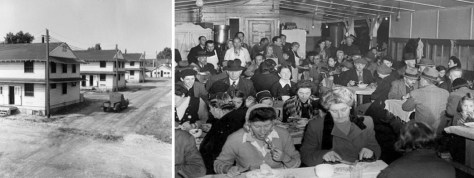
The refugees were to be housed at Fort Ontario, which is outside of Oswego, New York, and is now a state historic site. The fort had recently been vacated of troops training to fight overseas. Barrack-like houses were quickly constructed to be the temporary homes for the refugees. The War Refugee Board chose to keep family groups together, and sought people with skills that would be helpful in the camp (for example, seamstresses and carpenters).
Two story barrack-homes and dining hall (Photos from ‘Token Shipment’ by Edward B. Marks)
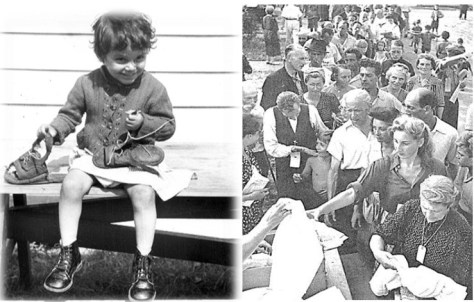
The refugees took a ship from Italy to New York City, then a train to Oswego. After fleeing for months or years, the haggard group arrived at Fort Ontario on August 5, 1944. Many of the adults wore crude handmade sandals and most children were barefoot.
The refugees admired the beautiful grounds of Fort Ontario, but the tall fence around the compound reminded them of the concentration camps they had fled from. The barrier was a security measure and also served to quarantine them in case they brought communicable diseases. Oswego residents had been surprised to hear about Roosevelt’s invitation, and were curious about the newcomers. As soon as the refugees arrived, Oswegians came to the fence to greet them. Children on both sides played along the fence, and beer and cigarettes were passed over by the Americans.
Refugees receiving shoes, soap, and towels upon arrival (Photo from ‘Token Shipment’ by Edward B. Marks)
In the first days after their arrival at the shelter, the adults were interviewed by WRB staff. They had all passed a background check in Italy, and now officials wanted to determine if the refugees could provide information on Hitler’s Europe which could help the Allied armies.
When the refugees first arrived, many gorged themselves on the food provided during meal times. After years of food scarcity due to the war, they were scared that the plentiful food would not last. Most of the refugees were underweight, so the WRB increased the amount of nutritious food served, particularly milk. The WRB also listened to requests and provided a few traditional ethnic foods such as dark bread, and created a separate dining hall for the Jewish refugees who followed kosher dietary rules.
‘Lightkeeper’s House’ at Fort Ontario painted by refugee artist Olga Mikhailoff, c. 1945, State Parks; and English practice letter by refugee Stella Levi, October 25, 1944, State Parks.
After the initial quarantine period of several weeks, the refugees were permitted to leave the shelter. Children were enrolled in local schools and were bused in from Fort Ontario. Adults were given passes to go into Oswego and had to adhere to a curfew. In addition, the WRB hosted open house events where Oswegians could enter the camp; the main reason was to assuage local rumors that the refugees were living lavishly.
Refugees building wooden music stands and orking in the machine shop(Photo from ‘Token Shipment’ by Edward B. Marks)
Once the refugees became settled, they got to work. A library was created to provide books, English language classes were offered, and a day care was established. The dining halls and laundries were staffed, and private agencies outfitted workshops for creating products for sale, such as music stands. The refugees were paid a set wage, no matter the person’s previous work experience, funded by the WRB and private agencies. In the fall of 1944, a group of refugees left the fort for several weeks to help pick apples in the region.
Eleanor Roosevelt visiting Fort Ontario in September 1944 (Photo from ‘Token Shipment’ by Edward B. Marks)
Unlike the refugees coming to the US today, the World War II refugees were not initially granted the right to stay in the country permanently; FDR planned for them to return to Europe after the war was won. After FDR’s death and the war overseas came to an end, however, the WRB and federal government could not decide what to do with the refugees. The majority of the refugees wanted to stay in the US, and Oswegian leaders formed a Freedom Committee to advocate for the refugees to be permanently integrated into the community. Six congressmen of the subcommittee of the House Committee on Immigration and Naturalization visited Fort Ontario to hear testimony from the refugees, Oswego residents, and government officials. Leaders within the refugee committee were selected to give heart-wrenching accounts of what they had experienced during the war, and explain that many had no homes to return to.
Newspaper clipping showing Boy Scout Troop 28 testifying before Congressmen about their desire to remain in the US (Photo from ‘Token Shipment’ by Edward B. Marks) and page from LIFE Magazine, August 1944.
On December 22, 1945, President Harry Truman announced that the refugees who wanted to stay should be permitted to remain in the US. After many months of waiting for a decision, the refugees were overjoyed. Immigration processing began in January and the last of the refugees left Fort Ontario on February 4, 1946. A group of 66 Yugoslavs decided to return to Europe, but most chose to remain in the US. More than half of the refugees were resettled in New York State, and many went to New York City, which had larger immigrant populations. Others were reunited with family in 21 other states.
Senior conservator Heidi Miksch and Park Worker Brian Hibbert remove part of the historic fence at Fort Ontario. (Kevin Fitzpatrick, Palladium Times)
This chapter of American history is being brought back into the spotlight. Last summer, conservators from State Parks removed a section of the boundary fence for the refugee shelter and shipped it to the US Holocaust Memorial Museum in Washington, D.C. “It’s an iconic symbol,” says Paul Lear, historic site manager at Fort Ontario. “It was the meeting place between the townspeople and the refugees.” The fence represents the struggles and successes throughout American history to welcome newcomers to our country: the initial barrier, followed by acceptance.
The new exhibit at the US Holocaust Memorial Museum featuring the fence is scheduled to open in April 2018.
Post by Alison Baxter, Excelsior Service Fellow
Special thanks to State Parks staff members Paul Lear and Amy Facca for pictures and resources.
Featured image: Oswegians conversing with World War II refugees housed at Fort Ontario (Photo from ‘Token Shipment’ by Edward B. Marks)
Resources
Fitzpatrick, Kevin. “Section of Refugee Shelter boundary headed to National Holocaust Museum for new exhibit”. Palladium Times, June 30, 2017.
Marks, Edward B. “Token Shipment: The Story of America’s War Refugee Shelter, Fort Ontario, Oswego, N.Y.” United States Department of the Interior War Relocation Authority, 1946; revised 2017.
Imitation is the sincerest form of flattery. And back in early 2016, Schodack Island State Park Manager John Lowe was musing with Capital Region Audubon Society President John Loz about potential partnership projects. Moreau Lake State Park’s nifty bird blind initiative came immediately to mind.
Designated both a state Bird Conservation Area (BCA) and an Audubon Important Bird Area (IBA), Schodack Island is a bird-watchers mecca waiting to happen. Many birds of conservation concern – bald eagles, great blue herons, cerulean warblers, to name only a few – nest on site. The waterfowl assemblages are impressive. But, aside from two interpretive signs near the parking lot, the Park offered limited amenities or functional improvements to engage the public with its remarkable wildlife resource. As the poet Gertrude Stein might have said, there was “no there there.”
But it takes a village, and in fall 2016, Park Manager Lowe cobbled together a motley assortment of local Audubon operatives, Schodack “friends”, along with community members and rank volunteers to work alongside his very capable Park Operations professionals in constructing three bird watching blinds at strategic spots along the trails at Schodack Island State Park.
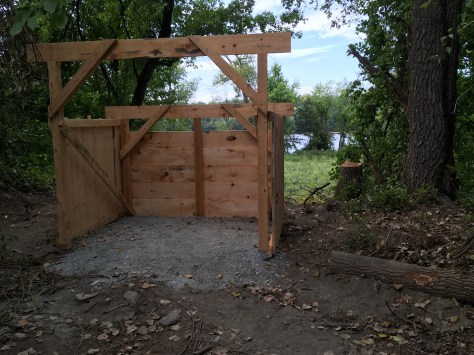
Bird blind in progress, note the nice view of the river beyond the blind. Photo by Audubon Society of the Capital District.
To be honest, the 6’ x 8’ wooden blinds were something that Park Manager Lowe’s handy Park Operations staff could have hammered together themselves in one day, and “done it good”. Lowe wisely summoned the butcher, the baker and the candlestick maker to make sure to give the community real ownership in his initiative. It worked!
Schodack Island State Park’s bird blinds serve several critical customer service needs: the rich viewsheds framed by intelligent placement of the blinds within the Park’s varied landscape draw serious photographers and bird-watchers, casual visitors can enjoy “close encounters of the bird kind” without disturbing wildlife, and also benefit from helpful interpretive signage in each blind.
Visitors are encouraged to enter their own bird sightings in the shelter register to help build the park’s developing scientific record. And the many joggers, dog-walkers and hikers who frequent the trails daily will welcome these arresting destinations within the park’s long and rather placeless linear trail system, 13 miles total with few rewards. So now, there’s a “there” there!
Realizing the park’s tremendous potential for developing bird tourism, Park Manager Lowe has been working closely with the Friends of Schodack Island State Park and the Audubon Society of the Capital Region to articulate a long-range vision which maximizes both the public accessibility to and the protection of the Park’s extraordinary avifauna, including planning to embark on a fourth bird-watching blind this spring.
The Audubon Society of the Capital Region mustered three more volunteer crews in spring 2017 to help stain the bird blind exteriors. And in summer 2017, the Audubon Society won a grant to oversee the design, fabrication, and installation of informative interpretive panels for each of the blinds. You might call it a model collaborative project. Or just a diligent Park Manager making sure that all the players get in game.
Under the leadership of former State Parks Deputy Commissioner Al Caccese, Audubon New York, the state-wide affiliate of the National Audubon Society, began an outreach initiative in 2009 which Al lovingly dubbed “Audubon in the Parks” to advance bird conservation in New York’s State Parks. At the time, Al was the Executive Director of Audubon New York, so the partnership made perfect sense. Through its 27 local chapters, Audubon New York has provided a wide variety of programs and services at over 50 state park facilities throughout New York, particularly targeting those designated as BCAs or IBAs.
For example, the Audubon Society of the Capital Region, Audubon New York’s Albany affiliate, has waged war with invasives, sponsored lectures, set up bluebird boxes, conducted bird walks and/or participated at festivals at every state park or historic site within its purview: Schoharie Crossing, Thacher and Thompsons Lake, Schodack Island, Peebles Island, Saratoga Spa and Grafton Lakes. The Audubon in the Parks partnership has done much to advance the mission and goals of State Parks, while forwarding the Audubon agenda.
We thank the butcher, the baker and the candlestick maker.
An example of the excellent craftsmanship that went into the building of the bird blinds, photo by Audubon Society of the Capital District.
As spring returns to New York, so does the eastern phoebe. This charming bird begins its courtship and nest-building in March and April. Since April is also National Poetry Month, it seems fitting to pay tribute to this little bird. The following ode to the phoebe was written by John Burroughs (1837-1921), the beloved New York naturalist who was born on April 3.
When buckets shine ‘gainst maple trees
And dropp by dropp the sap doth flow,
When days are warm, but still nights freeze,
And deep in woods lie drifts of snow,
When cattle low and fret in stall,
Then morning brings the phoebe’s call,
‘phoebe,
phoebe, phoebe,’ a cheery note,
While cackling hens make such a rout.
When snowbanks run, and hills are bare,
And early bees hum round the hive,
When woodchucks creep from out their lair
Right glad to find themselves alive,
When sheep go nibbling through the fields,
Then phoebe oft her name reveals,
‘phoebe,
phoebe, phoebe,’ a plaintive cry,
While jack-snipes call in morning sky.
When wild ducks quack in creek and pond
And bluebirds perch on mullein-stalks,
When spring has burst her icy bond
And in brown fields the sleek crow walks,
When chipmunks court in roadside walls,
Then phoebe from the ridgeboard calls,
‘phoebe,
phoebe, phoebe,’ and lifts her cap,
While smoking Dick doth boil the sap.
Listen to the phoebe sing:
Call recorded by Ian Davies
From John Burroughs Boy and Man by Clara BarrusSources:
Barrus, Clara, John Borroughs Boy and Man, Doubleday, Page & Company, 1920.
When we think about spring and fall in the northeast, we often dwell on the extraordinary changes that occur to our trees and other plants. In the spring, we yearn for green to replace the barren gray and white of winter; in fall we marvel at the warm oranges, reds, and yellows that are on display as our trees prepare for winter. But there is an equally amazing change that is occurring at the same time, one we often fail to realize because we simply don’t look up: the mass migration of raptors. Whether it is the sheer majesty of a bald eagle, the raw power of a northern goshawk, the pure speed of the peregrine falcon, or the extinct-ness of the Velociraptor, raptors have captured the minds and imaginations of people and cultures for generations. Raptors, also called “birds of prey,” include eagles, falcons, hawks, vultures, ospreys, harriers, and owls.
Raptor-watching, normally referred to as “hawk watching,” is a great way to spend a spring or autumn afternoon and can be enjoyed in many of our State Parks. Hawk watching is a draw for both veteran and novice bird watchers alike. Raptors are highly visible during their migration as they soar through the skies, unlike songbirds who hide in dense shrubs and tree tops. If you go to popular hawk watching sites during migrations (www.hawkcount.org), you will often find other observers and official hawk counters. These fellow birding enthusiasts are always eager to help you identify the shapes and flight patterns of certain groups and species. With a bit of practice, you’ll be a veteran in no time!
Migration
Migration is no joke and (as you can imagine) can be exhausting. Some species, such as broad-winged hawks, travel over 4,500 miles in about 9 weeks. Why do these birds go through all this trouble, anyways? Your first guess might be that the birds are escaping the cold. However, if so, then why don’t they stay closer to the equator, where it is always warm? The suggestion that temperature triggers migration is a very common misconception and is often connected to human behavior. Many northerners head south for warmer climates to escape the winter chill. Those who spend their entire winters in the south are even given the name “snowbirds.” With bird migrations, they aren’t escaping the cold; they are often migrating due to the lack of food availability in the winter.
Picture this (shouldn’t be hard for us Northeasterners)… the sun starts setting lower in the sky, the days grow shorter, and the frigid air from the north starts blowing. Plants go through an amazing transition. Annual plants who have dropped their seeds have reached the end of their life, while perennial plants drop their leaves, transferring their energy into their roots and stems to outlast the winter. The world feels a bit barren with the browns and whites of winter. Those plants provide food for insects and many small mammals. When the plants retreat, these small animals follow suit with either long slumbers or feeding off their stockpile of nuts and seeds in their winter dens. Even our ponds and streams can’t provide a bounty, for water denizens are sealed under a thick layer of ice. If you were a raptor, would you stay around and risk not finding food, or would you soar south where food is still plentiful? That said… not all raptors leave. Driving along major highways, you’ll often see red-tailed hawks perched high above, waiting for a mouse or rabbit to make the mistake of exposing themselves. Food is still around, it is just harder to come by. Raptors who do fly south must compete with southern resident birds for food and roosting sites. This added competition is OK though, for the adult raptors only need to worry about feeding themselves. However, when the desire for mating and offspring arises, these southern retreats don’t provide enough food to feed hungry young bellies. So, adults return to their summer breeding grounds… right when their unsuspecting prey emerges from their long winter retreat.
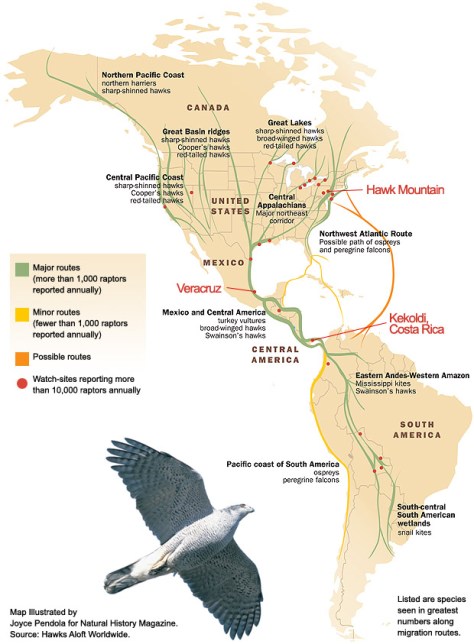
Like humans, raptors concentrate along specific routes while traveling long distances. So, just like you would find more people driving cars on highways than backroads, you’ll find more raptors along flyways. Here in the Northeast, we are part of the Atlantic flyway. Raptor flyways are normally found over level terrain. Mountains, large lakes, and oceans create obstacles that raptors cannot easily cross. Mountains do have a very important role to play, besides being simple barriers. In North America our mountain ranges run north-south. When cross winds hit these ridge an updraft is created, which raptors then use to help them soar and stay aloft. These updrafts mean raptors need to flap their wings less, conserving an enormous amount of energy for their long trip.
Image courtesy of Hawk Mountain
Updrafts are extremely helpful… when the wind actually blows. So, what do raptors do in early fall, when the sun is still high in the sky and the winds relatively calm? Physics, my friend. Even if you aren’t an avid hawk watcher, you have probably noticed vultures or hawks flying in large circles with their wings wide and high in the sky. This trick is called soaring flight and it is raptors mastering flight on thermal air currents. Thermal air currents, or thermals, are created when air heated by the sun rises from the ground into the sky. Thermals are often formed along the slopes of hills, but can also form over flat ground. As this warm air rises it cools and condenses, forming puffy, beautiful clouds. If you have a sunny, warm day with puffy clouds, it is also probably a good day for thermals and a good day for raptors to soar overhead.
Image courtesy of Hawk Mountain
Thermals typically do not form over open water; water releases heat evenly and slowly. Without any type of thermal or updraft most raptors must resort to flapping their wings, which uses an extraordinary amount of energy. If raptors decide to migrate over large bodies of water and need to flap the entire way, they are taking a huge risk: if they run out of energy, they will most likely drown. So, when raptors come across a large body of water while migrating, they typically hug the shoreline until they find a short way to cross. These short crossings often form bottlenecks where thousands of raptors pass through every year. One of the largest bottlenecks in the world happens to be in Veracruz, Mexico, where tens to hundreds of thousands of raptors migrating from central and eastern North America pass through, trying to skirt between the Gulf of Mexico and the Sierra Madre Oriental mountain range.
Identification
The identification of raptors hundreds of feet in the air, where you can often only see a silhouette against a cloud, can seem… daunting. Luckily, with a bit a practice it might be easier than you feared. Hawk watchers often utilize an identification protocol called the SPASMATIC method:
Shape
Relative sizes and proportions of wings, tail, and head
Pattern/plumage
Contrasting patterns of dark and light
Actions
How does the bird fly or what is it doing?
Size
How big is the bird in comparison to other birds?
Multiple Attributes
Use as many of the above characteristics as possible
Trust In the Concept
Believe in your ability to judge these characteristics
Shape and size are often the key characteristics you need to focus on and can be used to identify or narrow down most raptors in flight in the Northeast. Raptors (excluding owls) are broken down into 7 main shape groups: accipiters, falcons, eagles, buteos, vultures, osprey, and harriers. Each group has distinctive characteristics to help you with your identification venture.
Shape and size are often the key characteristics you need to focus on and can be used to identify or narrow down most raptors in flight in the Northeast. Raptors (excluding owls) are broken down into 7 main shape groups: accipiters, falcons, eagles, buteos, vultures, osprey, and harriers. Each group has distinctive characteristics to help you with your identification venture.
Hawk silhouettes, image from Learn.org
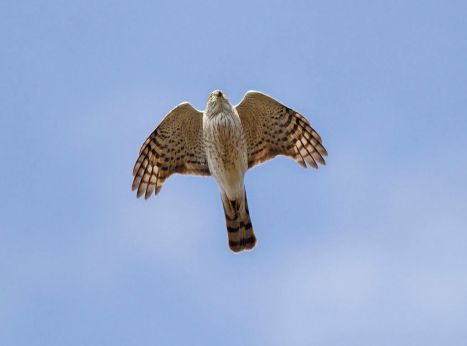
Accipiters (sharp-shinned hawk, cooper’s hawk, northern goshawk) typically chase and feed on songbirds in woodlands with closely spaced trees, so when in flight they have short, rounded wings and long narrow tails.
Sharp-shinned hawk, note the long tail and rounded wings. By Steve Berardi, accessed from Flicker
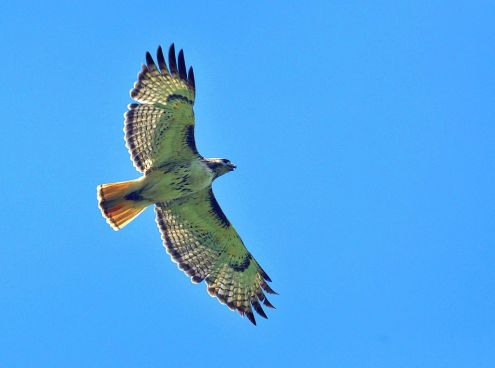
Buteos (red-tailed, broad-winged, red-shouldered, and rough-legged hawks) have broad-shaped wings for soaring and perching on high branches.
Red-tailed hawk, note the dark band of feathers across the belly. This can be seen in all birds, photo by USFWS Mountain-Prairie
Falcons (American kestrel, merlin, peregrine falcon) often catch prey in mid-flight in open spaces and depend on speed to capture swift prey, so when in flight you can see that they have pointed wings.
American kestrel
Harriers have broad, strong wings held in the distinctive v-shape (or dihedral shape), which allows them to fly low and slow at ground level, typically around grasslands and marshes. Northern harriers are the only harriers found in our region.
Northern harrier, photo by U.S. Fish and Wildlife Service Headquarters
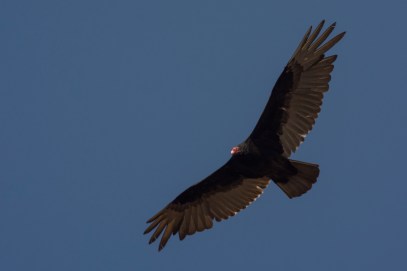
Vultures (turkey and black vultures) have long and broad wings, which aids in soaring over fields and woods while searching for carrion. Turkey vultures hold their wings in the v-shape, but black vultures lack the v-shape almost entirely.
Turkey vulture, note the difference in feather color between the top and the bottom of the wings,
Osprey distinctively look like large gulls in both body and wing shape. Their wings help them hover over water where they dive feet first into the water to capture fish.
Osprey in flight, note the distinctive coloration of the feather, photo by U. S. Fish and Wildlife Service – Northeast Region
Eagles (bald eagle and golden eagle) have large wingspans to soar high in the air; this also aids them in capturing food in large open spaces on the ground or over water.
Golden eagle in flight, note the large, long wings, photo by Juan Lacruz
Get out and Hawk watch!
New York has multiple premier Hawk watch locations, with many of them having designated hawk counters. HawkCount gives you the ability to find hawk watch locations across North America, contacts of designated hawk counters or coordinators, and new and historical data that has been collected at these locations.
We hope you enjoy your next hawk watching adventure. Why not make your next hawk watching experience at a designated hawk watching site in a New York State Park? Here are a few to check out!
Out on the south shore of Long Island is a barrier beach called Fire Island, where the First Island Hawkwatch can be found at the east end of Robert Moses State Park. This all-volunteer watch provides coverage from September to November and has access to a hawk watch platform.
To get to the hawk watch platform, proceed south on Robert Moses Parkway and cross the bridge to Robert Moses State Park. From the water tower circle, proceed East to parking lot #5. Park here and walk east toward the lighthouse.
John Boyd Thacher State Park outside Albany
The Helderberg Escarpment Hawk Watch is found just outside Albany, NY at John Boyd Thacher State Park. At the overlook parking lot, hawk watchers can view thousands of broad-winged hawks and other migrating raptors during the park’s annual mid-September Hawkwatch Festival.
To get to overlook parking lot take I-90 to Exit 4 onto Rt 85 west. Follow Rt. 85 for about 11 miles and make a right onto Thacher Road (Rt. 157). “The Overlook” parking area is about 2 miles up the escarpment.
Braddock Bay Park outside Rochester
The great Braddock Bay area outside of Rochester, NY, is one of the top hawk watching sites in New York and is considered a migration “hot spot.” Millions of birds migrate through the area every spring as they head to breeding grounds farther north. In 1996 over 140,000 raptors were counted migrating through the area, and on April 27, 2011 they tallied 42,235 hawks: the biggest spring flight day recorded in the U.S. and Canada. The official hawk count is conducted only in the spring season between March and May. Viewers can use the hawk watch platform found in Braddock Bay Park, which is owned by State Parks and operated by the Town of Greece. The Braddock Bay Raptor Research (BBRR) has conducted the hawk watch since 1986.
To get to Braddock Bay take the Lake Ontario State Parkway until the East Manitou Road/Braddock Bay Park exit. Turn north onto East Manitou Road and turn left into Braddock Bay Park. When you come to a T in the road turn right and continue until you see the hawk watch platform on your left.
Betty and Wilbur Davis State Park
The site is adjacent to parking lot at the crest of the road through Betty & Wilbur Davis State Park. It has excellent views to the west over and across the Cherry Valley Creek Valley, and south and southeast. The view to the north is good. The hill obstructs the views northeast and due east.








![John Burroughs Boy and Man By Internet Archive Book Images [No restrictions], via Wikimedia Commons](https://nystateparks.blog/wp-content/uploads/2018/03/john-burroughs-boy-and-man-by-internet-archive-book-images-no-restrictions-via-wikimedia-commons.jpg?w=474)







 New York State Parks and Historic Sites Blog