Tag Archives: student conservation association

From glass eels to silver eels and everything in between The life stages of the American Eel

Imagine yourself hiking next to a babbling creek.  You come to a small waterfall surrounded by rocks.  The rocks glisten from the spray of the falls.  You walk closer and see dozens of small snake like creatures slithering over the wet rocks.  You watch them move from the top of the rock pile to the bottom.  Then they slide back into the creek.

You saw the American eel utilizing one of its unique adaptations.  Their bodies are coated in a mucus layer, providing protection and a way to absorb oxygen through their skin.  This mucus, in combination with their muscular bodies, allows them to move out of water and across land to avoid barriers.  This, and other adaptations, makes the American eel able to live in more diverse habitats compared to most other fish species.

American eels are fish, despite their snake like appearance, and the only species of eel that live in North America.  They are catadromous, migrating from the saltwater of the Sargasso Sea to the freshwater of streams and lakes.  The Sargasso Sea spans a part of the Atlantic Ocean between Bermuda and Puerto Rico.  Once they reach maturity, they journey back there to spawn.

The vastness of the Sargasso Sea makes it tough for researchers to locate and observe eels spawning in the wild.  At this point, observations of spawning eels remain to be made, although one silver eel was tracked to the Sargasso Sea. Researchers believe the eels die right after spawning.  Some mystery surrounds the final life stages of the American eel.

What happens as they grow?

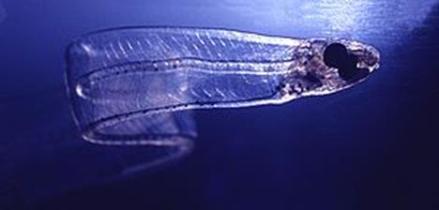
Let us review the known information about the life stages of the eel.  The eel’s life begins in the Sargasso Sea.  First, they resemble a willow leaf.   These small, oblong, transparent fish, called leptocephali, lack the snake like form of adult eels.  They are about one inch long and rely on the ocean currents to bring them to the east coast.  This journey takes about one year.
Lept
The beginning life stage of the American Eel is called a leptocephalus and these leptocephali use the current to travel to the East Coast. Kils at the English language Wikipedia [GFDL (http://www.gnu.org/copyleft/fdl.html) or CC-BY-SA-3.0 (http://creativecommons.org/licenses/by-sa/3.0/)%5D, via Wikimedia Commons
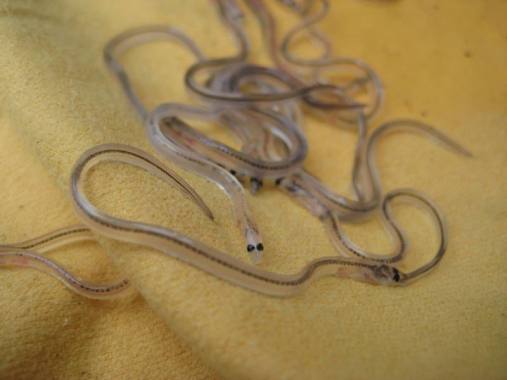
Now they resemble vermicelli or rice noodles.  At two inches long and still transparent, they are called glass eels.  They make their way into estuaries which connect saltwater to freshwater.  Many of them find themselves in water bodies of local New York State parks along the Hudson River.  Once in freshwater, they develop a brown coloration.  This signifies the shift to their next life stage as elvers.

Glass
The American eel in their glass eel life stage as they arrive to the coast. Chris Bowser

As the elvers grow longer over the next few years, they enter their yellow eel stage.  They live in this stage right before they reach full maturity.  Their size varies based on sex.  Males can grow to two feet long whereas females can reach sizes of four feet.  Their size in each life stage is based on their surrounding environment.  They become silver eels when they reach full maturity to start their migration.

This silver eel stage happens to be the most understudied of all the life stages.  There is no set age that eels are known to reach full maturity and age cannot be determined from external characteristics. Researchers look to study silver eels right before they begin their migration.

What kind of research?

Sarah’s motivation to study silver eels stemmed from her previous experiences working with them in their other life stages.  Her work with eels started with a summer project at Bard College, eight years ago.  After graduation she continued to work with glass eels, elvers, and yellow eels as a Student Conservation Association (SCA) intern at the Hudson River National Estuarine Research Reserve and Estuary Program.  Studying silver eels seemed like the next logical and exciting step for her. Sarah Mount at the SUNY College of Environmental Science and Forestry conducted research on yellow and silver eels.  Her research led to a model that sorts yellow and silver eels into different maturity classes.  The model relies on external characteristics such as the length, weight, eye diameter, pectoral fin length, head length, head width, and body depth of the eels to differentiate maturity classes. This means that future researchers can utilize this model to study the relative age of eels with a capture and release method that does not harm the fish.

With the guidance of Karin Limburg at SUNY College of Environmental Science and Forestry, she developed her research ideas into a master’s level study.  With the help of colleagues at the Hudson River Research Reserve, she spent two summers and two autumns collecting yellow and silver eels from the streams of the Hudson River estuary.

Interns
SCA interns at the Hudson River Research Reserve help Sarah set up a silver eel fyke net. Chris Bowser

Silver eels migrate at night during rain events in the autumn.  To catch them, Sarah set up a fyke net the day before a predicted rain storm.  This v-shaped net spanned the width of the stream and was removed the next morning.

The final life stages of the American eel still remain a mystery.  Sarah Mount’s research begins to solve it both for future research and for herself.  Her model will help future researchers understand when eels reach their full maturity to begin their migration.  When asked about her next steps she said, “Now the only missing piece left is the ocean, I’ve got to get out to the Sargasso Sea sometime.”

Post by Brianna Rosamilia,  Master of Science candidate in Environmental Interpretation at SUNY College of Environmental Science and Forestry
 

Sweet Days Are Coming

In the northeast, winter days can seem to drag on after the holiday season. Snowstorms seen to occur every three days and a constantly blowing wind chills the air to -10oF. It’s the type of weather that makes you wonder why humans don’t hibernate. While we can’t control the seasons; winter will always bring shorter days, the moon will revolve around the earth and the earth will revolve around the sun, we can change our mindset and that is what maple sugaring is about.

The maple sugaring season is almost a spiritual experience that lifts you through the last doldrums of winter. It ignites every sense. Imagine hearing the taps of sap into a metal bucket hung on a tree, the sweet steam lifting off the evaporator immersing your nose in warmth, the crackling fire fueling the evaporator, and of course the sweet taste of liquid gold. The whole experience does not occur unless the right weather conditions are present.

The release of sap in the spring is a sign that the trees are finally waking up from their winter rest. The ideal sap running conditions are warm days and cold nights. This temperature fluctuation causes the sap to run up and down the tree each day. The maple season may only last for as little as ten days, but they are an intense ten days.   Intense because of the time needed to collect and boil down the sap, and it is the boiling down of the sap that takes the most time.

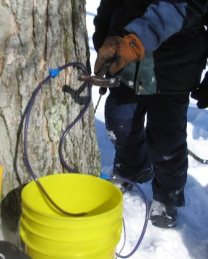
Inserting_the_tap
Tapping a maple tree, https://commons.wikimedia.org/wiki/Category:Maple_syrup_production#/media/File:Inserting_the_tap.jpg

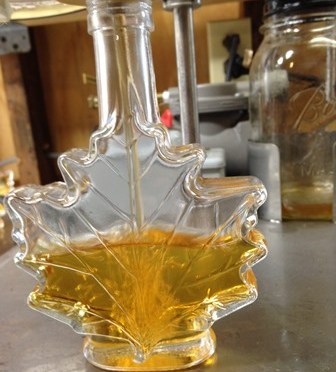
Do you ever wonder why pure maple syrup tends to cost five times more than pancake syrup? It because it takes 40 gallons of sap to make one gallon of pure maple syrup! There is a lot of energy involved to boil down the sap that contains 2% sugar to the sticky syrup containing 66% sugar content. Everyone around helps collect sap, tend to the evaporator, and bottle syrup. Tremendous effort goes into each gallon of syrup and it is all worth it in the end. There is no better feeling than creating something from start to finish and enjoying your success with the ones you cherish.

There are signs in nature that tell you when the maple season is over. The temperature stays above freezing during the night ceasing the sap to run up and down the tree. The buds on the trees start to burst open and the sap turns cloudy and is less sweet. A natural siren goes off-spring peepers serenade the woods as they emerge from their winter hibernation. It’s a bittersweet ending for the sugaring season. The transformation of sap to syrup is over for the year, but now the forest has come back to life and it is time for spring.

Learn more about maple sugaring by attending a program at a state park near you!

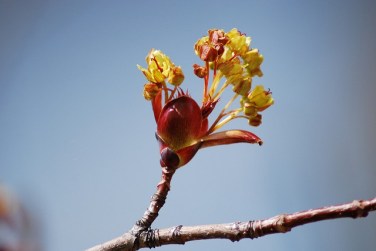
Flower
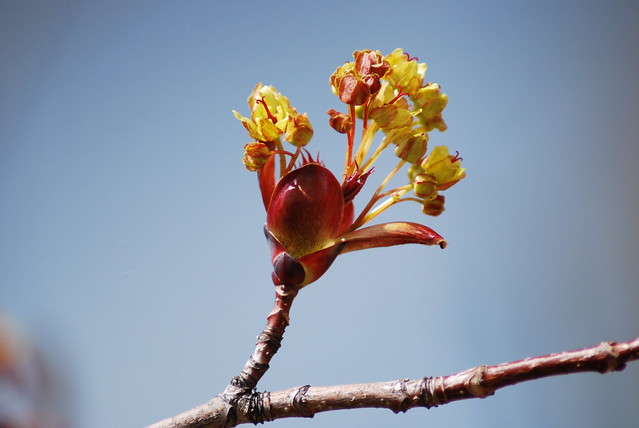
Sugar maple flower, http://farm4.staticflickr.com/3380/3497922622_2de9730b02_z.jpg

Post by Marlena Vera-Schockner, SCA Member served at Taconic Outdoor Education Center at Fahnestock State Park, 2015

Excelsior Conservation Corps: A Modern Vision of an Old Idea

CCC By Unknown or not provided (U.S. National Archives and Records Administration) [Public domain], via Wikimedia Commons
Civilian Conservation Corps By Unknown or not provided (U.S. National Archives and Records Administration) [Public domain], via Wikimedia Commons.

What started in 1931 as a simple idea to put unemployed New Yorkers to work on state-funded public works projects through the New York Temporary Emergency Relief Administration grew to become the largest peace time utilization of people and equipment in US history – the Civilian Conservation Corps, the CCC. Many New York State Parks including Thacher State Park, Fahnestock State Park, Lake Taghkanic State Park, Selkirk Shores State Park, Thacher State Park, Green Lakes State Park, Letchworth State Park, Hamlin Beach State Park, Chenango Valley State Park, Franklin D. Roosevelt State Park and more benefited from the work that was performed by over 200,000 CCC members from 1933-1942.  During these nine years, 61 camps of 200 CCC members built roads, trails, cabins, and stonewalls, planted trees, worked on early invasive species detection and removal and more.  The Allegany and lower Hudson Valley regions were considered the highest environmental priority and had CCC camps each year, while other encampments would last a season or two, moving on to another location when the job was done.

This slideshow requires JavaScript.

About 40 different CCC camps were spread across the state each year. The typical CCC member was between 18-25 years old, “unemployed, unmarried, healthy, not in school, from a needy family, and capable of doing work” (Thompson).  Most CCC members were white males; however New York also had CCC camps for Native Americans, African Americans, WWI veterans (separate camps for white and African American veterans), and separate camps for women (known as She-She-She Camps).

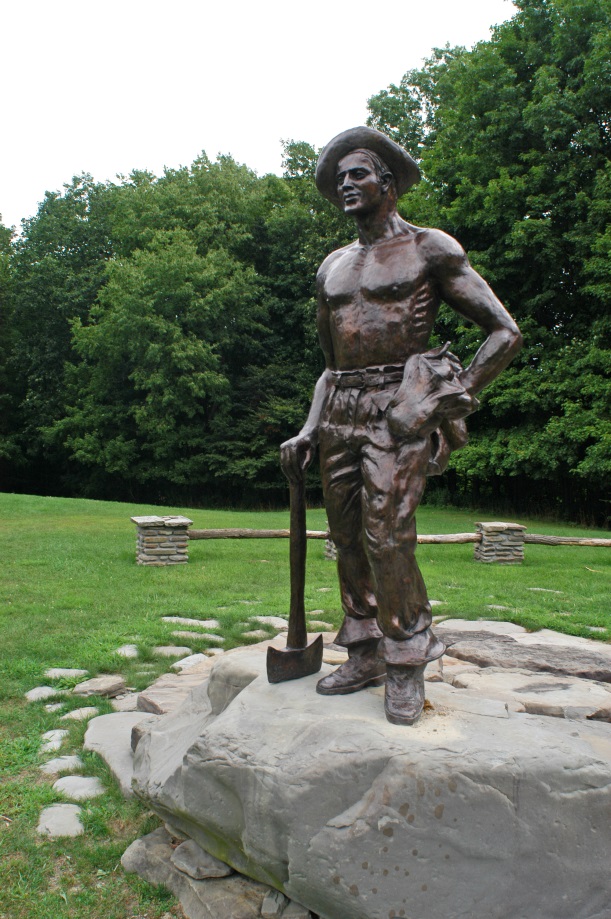
State Parks honors the memory of the CCC members with a CCC Statue at Letchworth State Park.

CCC Statue, Letchworth State Park, OPRHP photo
CCC Statue at Letchworth State Park. Photo by OPRHP.

This January, New York State is reviving the Temporary Emergency Relief Administration conservation corps with the inaugural New York State Excelsior Conservation Corps (ECC) and a 10-month residential program modeled after the CCC.  The program is open toNew York State students and residents aged 18-25, with an emphasis on veterans and expanding diversity. The 50 ECC members will be based at SUNY Morrisville where they will receive eight weeks of specialized trainings and certifications lead by the Student Conservation Association – Hudson Valley Corps .  Then, starting in March and running through early November, ECC members will work in State Parks, Department of Environmental Conservation and other state agency lands on projects across the state focused on:

  1. Open Space Management, maintaining and improving hundreds of miles on New York’s hiking trails
  2. Recreation and Access Mapping, monitoring and mapping over 10,000 acres of public land for safe recreational use
  3. Natural Resource Stewardship, invasive species removal and protection of native species and ecosystems
  4. Environmental Education and Outreach, educating New Yorkers on conservation and stewardship of public lands
  5. Infrastructure and Sustainability, helping to cut New York’s energy consumption and energy costs through the construction of renewable energy projects.

During the 10-months, ECC members will get a chance to work on their education plans and develop career skills.  At the end of their service they will be given a Segal AmeriCorps Education Award.

Building on their hands-on experiences and training, ECC members will be poised to become New York’s next generation of conservation leaders.  Learn more about the ECC in future blogs.

Post by Susan Carver, OPRHP. Slideshow photos courtesy of OPRHP.

References:

Hopkins, June; The New York State Temporary Emergency Relief Administration: October 1, 1931, The Social Welfare History Project, n.d.; http://www.socialwelfarehistory.com/eras/great-depression/temporary-emergency-relief-administration/

She-She-She Camps, George Washington University, n.d.; http://www.gwu.edu/~erpapers/teachinger/glossary/she-she-she-camps.cfm

Thompson, Craig; 75 Years Later: The Legacy of the Civilian Conservation Corp; Conservationist, New York State Department of 85 Environmental Conservation, February 2008; http://www.dec.ny.gov/pubs/42768.html.

The History of Hiking in New York State

Have you ever gone hiking and wondered where the trail came from, who built it, and when? Many of the oldest trails in New York began as Native American hunting paths, eventually becoming established trade and migratory routes. Until the Industrial Revolution, trails mostly served a functional purpose, but trail building boomed as a new ‘leisure class’ emerged and became interested in outdoor recreation. Today, 16,000 miles of trail run through New York, accommodating hiking, mountain biking, cross-country skiing, horseback riding, snowmobiling, and more.

In 1891, the New York State Legislature assigned funding to build a trail network across the state, which turned into the greenway system we know today. To promote and advocate for these trails, groups like the Appalachian Mountain Club, New York-New Jersey Trail Conference (NY-NJTC), and the Adirondack Mountain Club were founded. They provided the volunteers and training necessary to build enough trails to satisfy the demand. Many of these groups exist today and continue to train volunteers in trail construction and maintenance.

The first long distance hiking trail, the Appalachian Trail, was built by The NY-NJTC in Bear Mountain and Harriman State Parks in 1923. Conceived in 1921 by Benton MacKaye, the original idea combined recreation, conservation and economic socialism, with wilderness camping. It was seen as an opportunity for people to get away from the city and renew themselves. While MacKaye’s vision of interconnected mountain resorts was never fully realized, the trail was completed in 1937. Today, the Appalachian Trail stretches 2,175 miles from Maine to Georgia.

Promotional poster for the CCC. Source: http://www.rootsweb.ancestry.com/~wvcccfhr/history/3ccc.htm.

Adirondack Mountain Club hikers atop Mt. VanHoevenberg. Source: WikiCommons.

The Great Depression was a time of enormous parks and trails growth. As part of the New Deal, President Franklin Delano Roosevelt founded the Civilian Conservation Corps (CCC), based on a similar program he started while serving as governor of New York. This program, in operation between 1933 and 1942, provided unskilled laborers with jobs in the conservation and natural resources fields. During the nine years it ran, three million men participated (220,000 of which were in New York). They planted over three billion trees, and they built more than 800 parks nationwide.

As bicycles increased in popularity, cyclists began advocating for paved surfaces. Paved roads allowed cars to go more places and drive faster than they had been able to previously, thereby making road biking more dangerous for cyclists. In the 1960s, the government began converting unused rail corridors into rail trails to provide a safe space for biking. In the 1970s, rail trails also allowed inline skaters to venture outside of roller rinks and provided ideal corridors for the first recreational snowmobilers.

Following a funding slump in the 1970s, the 1980s and 1990s saw renewed interest in trail building. In 1987, New York City began planning a greenway system; the project was amended in 1993 with a proposal to develop 350 miles of bike and pedestrian trails throughout the city. As of 2010, 140 miles of trail were open to the public.

Black Diamond Trail Volunteer Work Day
Black Diamond Trail volunteer work day. The Black Diamond Trail connects Taughannock State Park, Allan H. Treman Marine Park, Buttermilk Falls State Park and Robert Treman State Park. Photo by OPRHP.

These days, most trails are built by volunteers through programs like the NY-NJTC, the Student Conservation Association, Park Friends groups and other organizations. Anyone can get involved to help build or maintain a pathway and contribute to the legacy of trails in New York.

Enjoy this short video about safety and preparedness tips for hiking in New York!

Post by Maddy Gold, SCA Intern.


Saving the Sand: Great Lakes Dunes Stewards

It’s a summer day on the eastern shores of Lake Ontario.  As a visitor walks down the beach they observe the sparkling of the water, the crashing of the waves, and the laughter of people as they enjoy the beach.  Parallel to the water runs a series of fencing and signs that mark the perimeter of the remarkable dune ecosystem that lies just behind.  This seventeen mile stretch of Lake Ontario is home to the most expansive dune ecosystem in the state of New York.  The dunes are large sand hills that are held together by extensive plant root systems.  They not only serve as habitat for a variety of species, but as a vital buffer between the power of Lake Ontario and the intricate system of ponds, marshes, and waterways that reside on the other side of the dunes.

The Dune Steward Program was established in the mid 1990’s to help protect this fragile dune system by maintaining the fencing and signs, removing litter, working with wildlife biologists and technicians on a variety of projects, and most importantly interacting and educating the public on the importance of the dunes.  The stewards patrol the 17 mile stretch of coastline that includes El Dorado Nature Preserve, Black Pond Wildlife Management Area (WMA), Lakeview WMA, Sandy Pond Beach, Southwick Beach State Park, and Deer Creek WMA.  Every summer the Department of Environmental  Conservation (DEC) in conjunction with New York State Office of Parks, Recreation and Historic Preservation, The Nature Conservancy, and The Student Conservation Association (SCA), places three interns from across the country to work as dune stewards.  Dune stewards are current students or recent graduates who have a background in environmental conservation.

edited black pond
Beach and dunes at Black Pond WMA. Photo by Jennifer Brady.

Along with the duties described above, this program allows the stewards the opportunity to be involved in other conservation efforts.  Some of these projects include placing identification bands on birds, identifying and monitoring invasive and endangered species, bird surveys, educational events, and a variety of environmental training opportunities. This year the stewards were able to assist in the successful protection of the piping plover, a federally threatened shorebird species.  This small bird lays its eggs in shallow scrapes on grassless beaches or dredged soil areas.  This summer was the first time in over 30 years that the piping plover has nested on Lake Ontario.  Stewards talked to visitors about the plovers and what they can do to assist in the protection of the bird and its chicks. They advised that visitors maintain a respectful distance and keep dogs on a leash when walking through areas where the plovers were nesting.

Piping Plover
An adult piping plover and its day old chick. Photo by Elizabeth Truskowski, DEC.

One of the most important aspects of this program was public interaction and education.  Each day visitors see the work that the stewards are doing and often approach the stewards to ask questions, express concerns, or even just to thank them for the work they are doing.  “It is extremely rewarding to be able to share what we know about the dune environment and its inhabitants to hopefully be able to protect this area for the considerable future,” said Jennifer Brady, DEC dune steward.

Post by Jennifer Brady, DEC Dune Steward, Student Conservation Association (SCA).

2018 Update

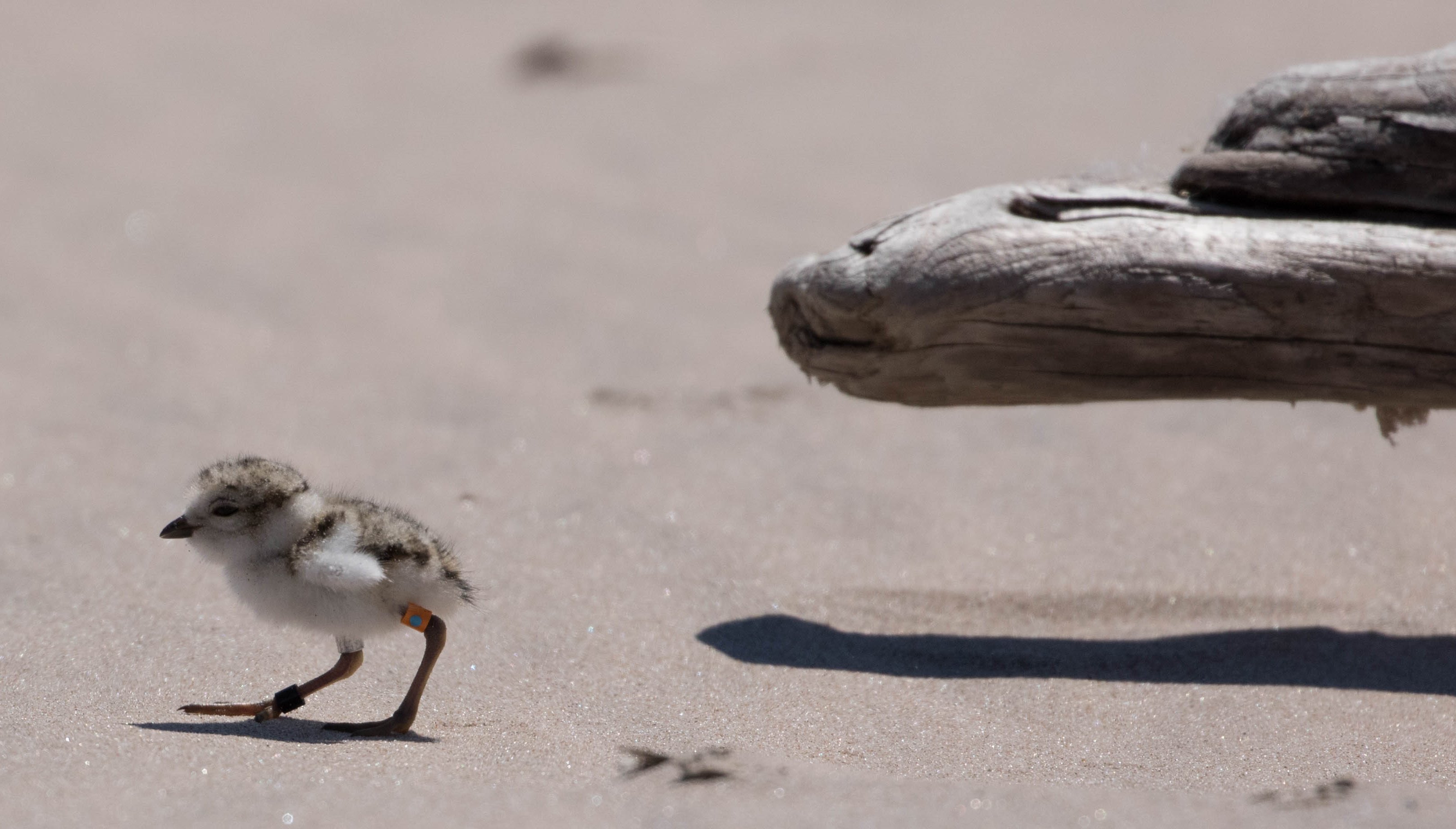
For the first time in decades, a pair of piping plover successfully nested at Sandy Island Beach State Park.

PipingPlover1a
2018 piping plover chick on the beach at Sandy Island Beach State Park.

Sources:

http://www.seagrant.sunysb.edu/glhabitat/dune/dune.html

http://www.fws.gov/midwest/endangered/pipingplover/

https://usfwsnortheast.wordpress.com/2018/08/07/the-real-plovers-of-new-york/