As New York splashes the summer away, a dedicated team works behind the scenes to make sure our beaches are swim-ready.
Meet the Water Quality Unit: Lauren Gallagher, Sarah Moss, and Veronica Mileski at a statewide convention. Since this photo was taken, Lauren Badinger has joined the unit as a seasonal assistant.
Consisting of three permanent staff and a summer intern, the Water Quality Unit at New York State Parks is charged with coordinating water sampling at the 75 monitoring stations at 49 beaches throughout New York State. Based in Albany they work closely with other agencies to report and track their results.
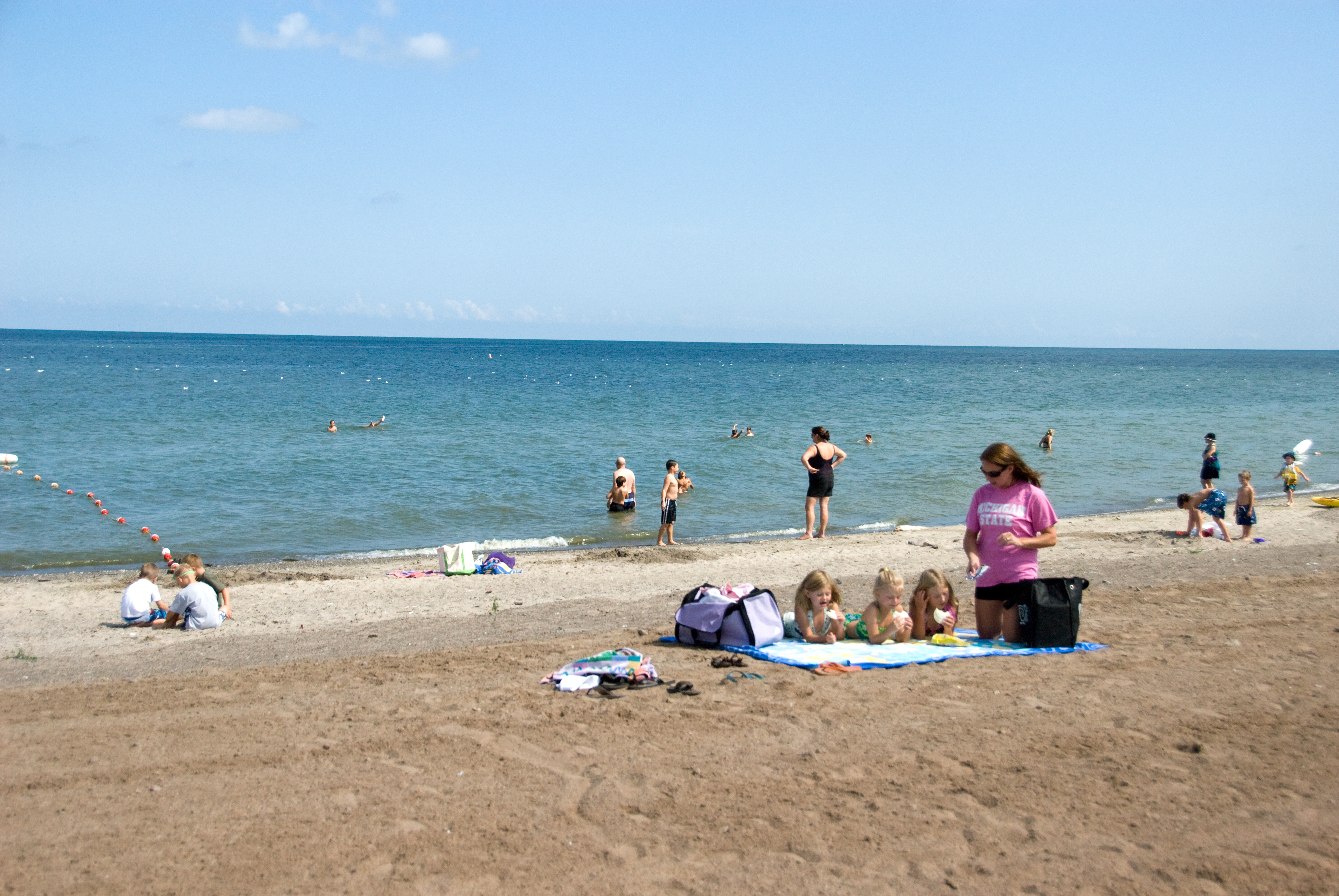
Guests enjoy Hamlin Beach on Lake Ontario, one of the 49 beaches monitored by our Water Quality Unit.
Water Quality Unit team members all agree that this is a job hiding in plain sight. While it’s essential to public health and appreciated by millions every summer, it’s generally under the radar of most of the people it benefits.
Water is a natural substance that all of us encounter on a daily basis. We rinse with it to clean ourselves and we drink it to stay healthy. In addition, more than 60% of the human body is comprised of water. But have you ever stopped to consider the uniqueness of this molecule that plays an intricate part of our lives and bodies?
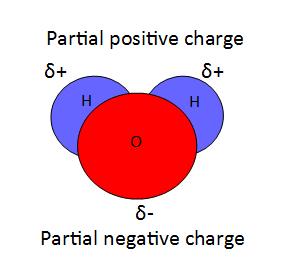
Diagram of a water molecule. Figure by Melyssa Smith
Perhaps the beauty of water begins with the simplicity of its molecule, H2O. It is made-up of only two elements: two hydrogen atoms (H2) and one oxygen atom (O). The H atoms create a slight positive electrical charge on one end of the molecule (a positive pole), while the O atom creates a slight negative charge (a negative pole). This polarity helps liquid water attract to, surround and break apart more substances than any other known liquid. Thus, scientists call water a “universal solvent” – something that many other substances (e.g. salt, sugar, powdered hot cocoa) can dissolve into. This attractive quality is how water is able to transport many vital minerals and nutrients throughout our soils, plants and environment.
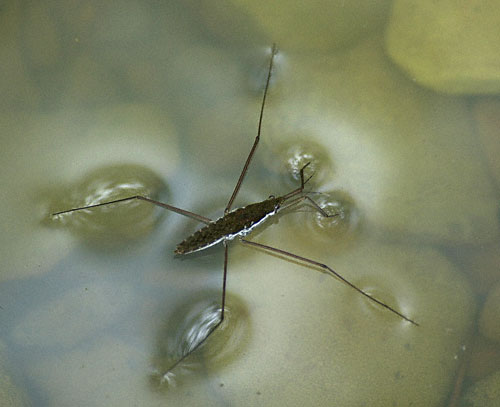
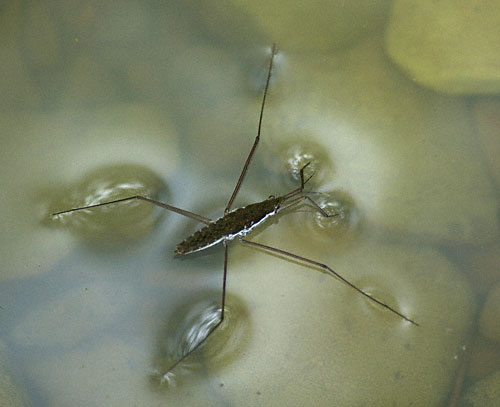
Not only does water bind easily to other substances (adhesion), but it also sticks well to itself (cohesion). The positive and negative ends of water molecules attract to each other and form water droplets. These dual properties help explain how water can ascent up the trunks of trees – water clings to the inner walls of the xylem in tree trunks and pulls other water molecules along, travelling up against the forces of gravity. You can observe water’s cohesive forces by filling up a glass of water slightly over the rim; water will hold onto itself and not spill over the sides. Similarly, surface tension enables spiders and insects, such as the water strider, to walk on the surface of the water. And so this seemingly simple molecule is capable of amazing feats.
Surface tension in a glass of water: Left glass is filled over the rim with water, right glass is empty for comparison. Photo by Lilly Schelling, OPRHP
Close-up of water being held together by surface tension. Photo by Lilly Schelling, OPRHP
Water has special physical qualities as well. Unlike any other material on Earth, water can exist in solid, liquid and gaseous forms naturally. The gas form floats freely in the air we breathe, with many molecules moving haphazardly far away from each other. This vapor can condense into clouds and return water to the earth as either rain or snow. When we hear the word “water” we usually think of the liquid form, and that’s probably because ~70% of our planet is covered in oceans. Snow and ice are examples of water’s solid phase, with molecules tightly packed and organized into crystalline structures. Unlike most other materials, the solid phase of water is less dense than its liquid form, which means ice can float atop liquid water. This property is useful in lakes during the wintertime, as surface ice acts as an insulating layer for the water below, shielding aquatic life from extremely cold temperatures. Clearly, water is a necessary ingredient for survival.
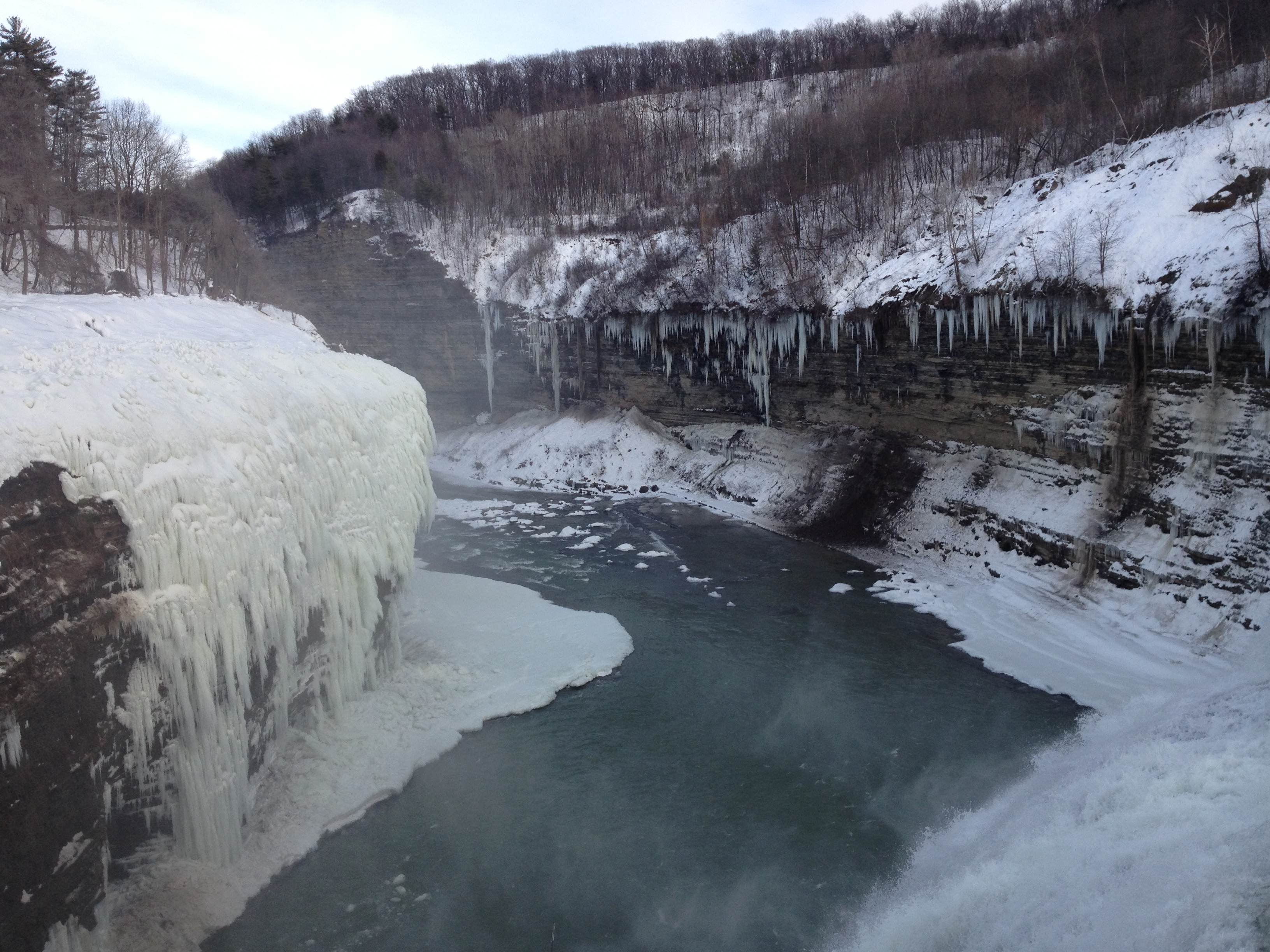
A frozen Letchworth Falls, Letchworth State Park, Castile, NY. All three physical states of water are present: solid (ice and snow), gas (air) and liquid (stream below). Photo by OPRHP
New York State has more than 70,000 miles of rivers and streams and around 7,600 lakes, ponds and reservoirs. Additionally, we are fortunate to share our borders with two Great Lakes, Lake Erie and Lake Ontario. Whether flowing, still, above or below ground, water is a ubiquitous feature in New York State Parks. It supports life and creates habitats for aquatic plants and animals. At the same time, water provides endless opportunities for recreation.
Many of our State Parks offer outdoor activities which involve water. Check out the 2016 Empire Passport to learn more about how you can access our state parks in any season. From swimming, boating and water skiing in the summer, to snowshoeing, sledding and cross-country skiing in the winter, to fishing (ice, fly or reel) year round — there is water-filled fun for every age all year long. The unusual chemical and physical properties that make water so valuable are also what make water so unique and enjoyable.
Post by Melyssa Smith and Erin Lennon (OPRHP Water Quality team)
Each year staff from NYS Parks’ Environmental Management Bureau (EMB) Water Quality Unit coordinates water quality monitoring programs for State Park beaches and lakes. The overall goal of EMB’s Water Quality Unit is to balance safe and enjoyable recreational opportunities with the environmental protection of our water resources. Since a substantial portion of attendance within the State Park system is associated with water use and enjoyment, it is important to assure that these facilities are operated in a manner that is both safe for patrons and protects the resource for future visitors. Water resources also need protection since they provide critical habitat for wildlife and ensure the proper functioning of ecosystem-level processes.
Keeping Park Beaches Healthy
NYS State Parks operates 77 beaches with lifeguards at 60 state parks. These beaches are located on lakes (including small lakes found within the borders of state parks, the Finger Lakes, Lake Chautauqua, Lake Champlain, and the Great Lakes), streams (including Enfield Creek and Dry Creek), rivers (including the Niagara and St. Lawrence), and the ocean (including the open ocean, bays, and Long Island Sound).
To keep the beaches healthy, NYS Parks staff must properly maintain beaches, monitor water quality, close when necessary, train staff, and educate patrons about safe swimming practices. Some of the tasks that Water Quality Unit staff do to help sites safely operate beaches include:
provide water quality training and assist park staff with site-specific questions and needs
distribute water quality educational materials
conduct research studies to learn more about the water quality of select beaches
maintain databases of beach monitoring results, contacts, and closures
work with outside Agencies (e.g. DOH, EPA, USGS) to develop models of beach water quality and expand knowledge on beaches
Moreau Beach in the Saratoga-Capital Region.
Sandy Island Beach in the Central Region.
Cherry Plain Beach in the Saratoga-Capital Region.
Maintaining Healthy Lakes in NYS Parks
There are approximately 180 lakes and ponds in the State Park system. These lakes provide important habitat for fish and wildlife and are enjoyed by many park visitors each year.
EMB staff have monitored over 125 lakes, ponds, and reservoirs since 1999. The goals of EMB’s lake monitoring program are to:
conduct targeted monitoring studies of lakes of significance or concern
maintain databases on lake water quality
compile lake reports regarding lake characteristics for priority sites
determine the degree of impairment, if any, for each lake
assist regional and park staff in lake restoration projects and with site-specific questions and needs
Karen Terbush assists with a mycelium installation project at Lake Erie State Park. The aim of the project is to reduce bacteria levels in a stream that feeds into the former beach area.
Melyssa Smith and Dan Munsell monitor water quality on Lake Minnewaska.
Lauren Townley records water quality data in the Finger Lakes region.
2012 Water Quality Team Distinguished Service Award
Commissioner Rose Harvey presented EMB’s Water Quality Team with a Distinguished Service Award for their extraordinary team accomplishment and dedicated professional service in working to protect NYS Parks streams, lakes and bathing beaches.
For more information about the Water Quality Team’s work in NYS Parks please contact the Environmental Management Bureau.
Post by Susan Carver, OPRHP. Photos by John Rozell and Water Quality Unit.
Small changes to lake ecosystems can mean big changes for plants and wildlife that make their homes there. Even though Lake Minnewaska (Minnewaska State Park Preserve, Ulster/Sullivan counties) looks the same from above the surface, life in the water has undergone major change in the past several decades. Lake Minnewaska is a unique “sky lake” ecosystem. Historically, Lake Minnewaska has been acidic acidic. No, it wouldn’t burn you to touch it, but it was too harsh for fish to live in. Studies show that Lake Minnewaska was oligotrophic as recently as the 1990s, meaning that nutrient levels were low and the phytoplankton that form algae were absent. The lake was home to other types of creatures, though, including a mat of sphagnum moss which grew up to 20 meters underwater and carpeted 60% of the lake, possible because of the high clarity of the water. The sphagnum moss sheltered two species of salamander which, because of the lack of predators, made use of the habitat and behaved in ways that no one had ever seen elsewhere (Bahret 1996).
Since the ‘90s, however, the lake has gradually become less acidic and phytoplankton more prolific, moving the lake towards mesotrophic status. The primary factor in the trophic shift is the introduction of the non-native bait fish species, the Golden Shiner, which was first observed in Lake Minnewaska in 2008. The Golden Shiner eats zooplankton, which are the primary consumers of phytoplankton, leading an increase in microscopic plant life in the lake. Because of these changes, sphagnum moss no longer grows in Lake Minnewaska, and as these trends continue, we can expect further reductions in water clarity, and more plant and fish species to take up residence in the lake. NYS Parks’ Environmental Management Bureau – Water Quality Unit continues to monitor Lake Minnewaska as an ongoing part of a statewide lake monitoring program.
References
Bahret, R. 19996. Ecology of lake dwelling Eurycea bislineata in the Shawangunk Mountains, New York. Journal of Herpetology 30:399-401.
Townley, Lauren. Investigation of trophic changes in Lake Minnewaska, a pristine sky lake in Ulster County, New York. Poster, Northeast Association of Environmental Biologists Conference. Online, accessed 8/25/2014.
Algae is usually just a fact of life when visiting natural bodies of water, whether it be the ocean, a lake, or a swimming beach at one of our New York State Parks. Unhealthy ponds can sometimes be choked with thick layers of goopy green algae but, for the most part, algae are a harmless and valuable part of a healthy ecosystem.
Some algae, however, produce toxins that are dangerous for people and animals. Blue-green algae (BGA) is one of these. BGA isn’t really an algae at all. It is a little organism called a cyanobacteria which which is naturally present in low numbers in our freshwater ecosystems.
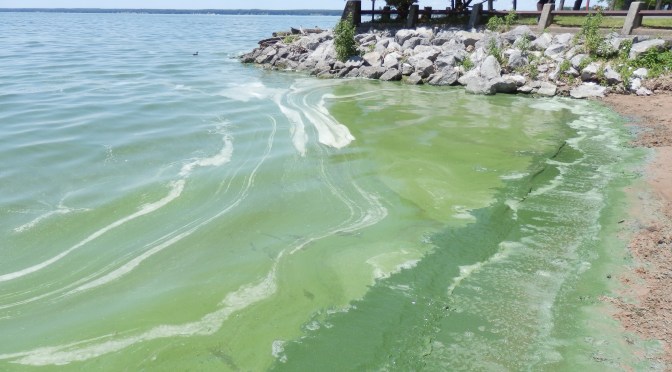
Blue Green Algae leaves a scummy layer on the shoreline
Like algae and other plants, these bacteria create energy using photosynthesis, but unlike plants, some species of cyanobacteria produce harmful toxins. In bodies of water with unnaturally high levels of nutrients, usually caused by fertilizers, stormwater runoff, or faulty septic systems, BGA can discolor the water and form a visible scum across the water’s surface. This is called an algal bloom.
Blue-green algae can be blue-green or green-brown in color, often resembling pea-soup. Unlike non-toxic algae, which is stringy or hairy in texture, blue-green algae is slick and slimy, appearing as spilled paint on the water’s surface. BGA is often accompanied by a musky odor. However, BGA can vary in appearance, and so all suspected BGA blooms should be avoided.
BGA leaves swimming areas unsafe for humans and animals
Unfortunately, many BGA incidents have directly affected dogs. Swimming in BGA-affected waters is risky for humans and pets, but dogs are more likely to jump into slimy and foul-smelling water, and then lick the algae off their fur. Contact with BGA can cause rashes and swelling, and ingestion can lead to difficulty breathing, stomach pain, nausea, and in severe cases, convulsions. Ingesting BGA can be fatal for dogs, and so if you suspect your pet has come into contact with BGA, wash her off with clean water immediately.
The best way to prevent BGA blooms is to prevent nutrient runoff into water bodies. Monitoring is being conducted around the state by state park staff and by private citizens.
If you see a suspected BGA bloom, be sure to keep children, pets and livestock away from the water. If you’re in a State Park, notify a lifeguard or any park staff immediately, or contact the Environmental Management Bureau’s Water Quality Unit (Water.Quality@parks.ny.gov; (518) 474-0409). Otherwise, contact your regional DEC office (http://www.dec.ny.gov/about/50230.html) or the Division of Water (518-402-8179)











 New York State Parks and Historic Sites Blog