Tag Archives: Wildlife

Sampling Wildlife Populations in State Parks: White-tailed Deer

It is important to monitor wildlife populations to ascertain how a species is surviving and how that may impact other wildlife populations and forest biodiversity. In many of our state parks, especially in the Hudson Valley, we monitor the deer population and the effect that deer are having on the forest vegetation. One method we use to monitor the deer population is a “distance survey” conducted at night, using spotlights, a range finder (to determine the distance between the deer and the vehicle) and a protractor, for measuring the angle at which the deer were observed. Four people and a vehicle are needed in this survey. Two “spotlighters” sit in the back seat and search for deer, the driver keeps the vehicle at five mph and stops when a deer is seen to get the information on the deer, and a scribe sits in the passenger seat to record the data. Data recorded includes deer group size, sex, age, habitat type, distance in yards and angle from the vehicle. To determine a deer’s sex, the surveyor notes if the deer has antlers or not – age and sex are defined as fawn, doe or buck.
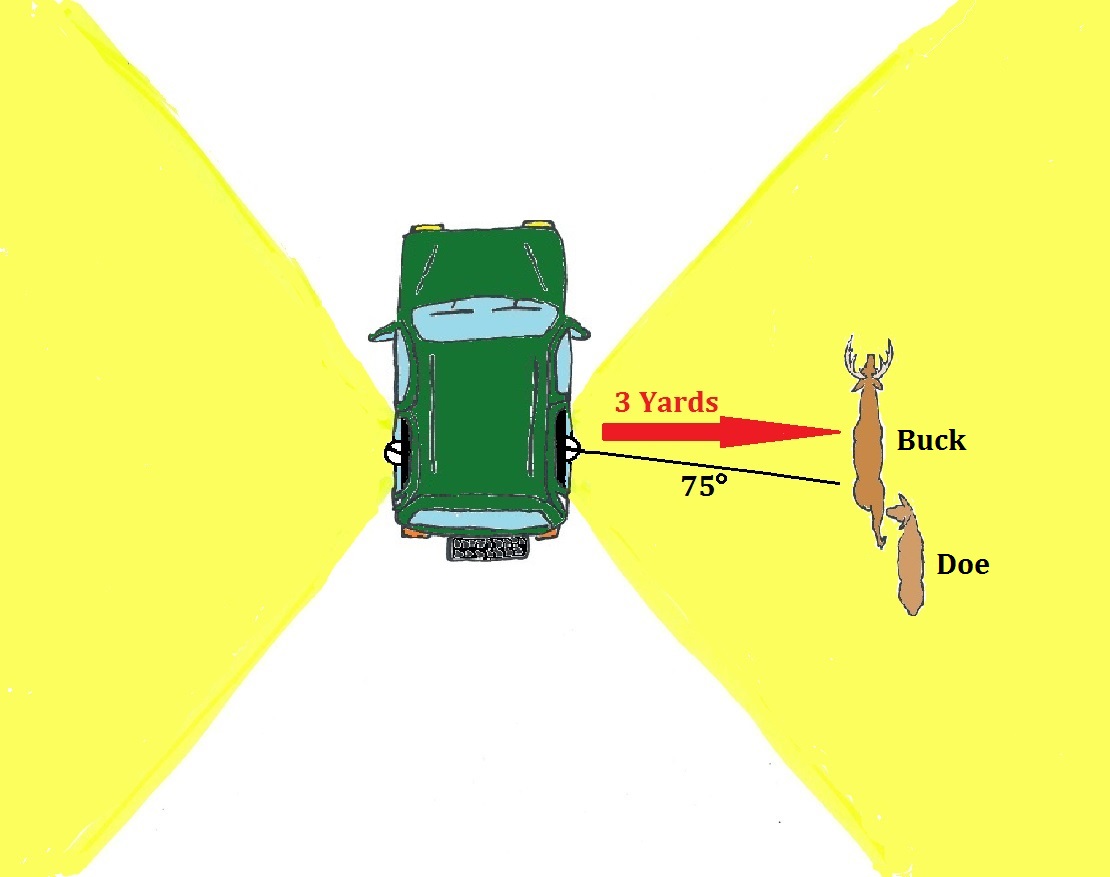
Deer Diagram

As an example, the above diagram shows a group of two deer at a distance of 3 yards and an angle of 75˚ from the side of the vehicle. The yellow color represents where the surveyors are shining their lights. The surveyor defines this as a  group of a buck, due to the antlers, and a doe. These observed deer are in a mowed hayfield, so this habitat type would be recorded as agriculture.

Click on an image above to read the caption.

After driving the predetermined distance sampling routes, we headed home for the evening. Back in the office, the data obtained will be entered into a statistical program that will calculate the number of deer per square mile in this particular park. This data will be compared to previous year’s data to track the deer population and will help determine future wildlife management decisions.

Post, diagram and photos by Lilly Schelling.


Things That Go Squawk In The Night

Ooo Halloween is just around the corner. Soon you may be venturing outdoors at night for trick-or-treating or a cool evening stroll. While you are outdoors you just might hear an eerie squawk, squeak, or snort coming from the woods. What is making that sound? In the darkness it is impossible to see, but if you pause for a moment and listen, you might be able to figure out what animal made the sound.

Some familiar autumn night sounds include:

Field Cricket, By Cody Hough (Own work) [CC BY-SA 3.0 (http://creativecommons.org/licenses/by-sa/3.0) or GFDL (http://www.gnu.org/copyleft/fdl.html)], via Wikimedia Commons
Field Cricket, By Cody Hough (Own work) [CC BY-SA 3.0 (http://creativecommons.org/licenses/by-sa/3.0) or GFDL (http://www.gnu.org/copyleft/fdl.html)%5D, via Wikimedia Commons
The male Field Cricket song is a series of short chirps, 2-3 per second. Each chirp consists of 3-5 pulses, which are made when he closes his forewing (front wing). Male crickets call from burrows or cracks in the soil. If Halloween is a warm evening, crickets may be calling in fields and other grasslands. Listen to field crickets.


Spring Peeper, Lilly Schelling, NYS OPRHP

Male Spring Peeper frogs normally sing their sleigh bell like mating call in spring, but a few will also sing in the fall in woodlands near small ponds or wetlands. Listen to spring peepers.

More unfamiliar sounds include:

Eastern Screech Owl, By Greg Hume (Own work) [CC BY-SA 3.0 (http://creativecommons.org/licenses/by-sa/3.0)], via Wikimedia Commons
Eastern Screech Owl, By Greg Hume (Own work) [CC BY-SA 3.0 (http://creativecommons.org/licenses/by-sa/3.0)%5D, via Wikimedia Commons
Screech Owls are little owls (about 8” long) that pack a loud call! In 1845 Henry David Thoreau described the call of the screech owl as “A most solemn graveyard ditty, the mutual consolation of suicide lovers remembering the pangs and delights of the supernal love in the infernal groves, …… Oh-o-o-o, had I never been bor-r-r-n.”
Our only small owl with ear tufts, both males and females screech owls sing. A common sound is “an even-pitched trill, often called a “bounce song” or tremolo; and a shrill, descending whinny.” (All About Birds, Screech Owl). Occasionally mated pairs will sing to each other. Listen to a screech owl.

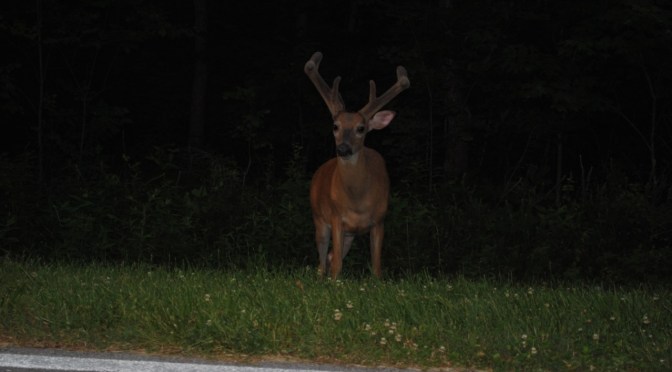
White-Tailed Deer, Lilly Schelling, NYS OPRHP

The otherwise mute White-Tailed Deer will snort when startled. Listen to a white-tailed deer snort. This is one of the few sounds that deer make. Bucks use a series of wheeze-grunt-snort to assert dominance during the breeding season and does and fawns communicate through bleats and grunts.

Raccoon, By D. Gordon E. Robertson (Own work) [CC BY-SA 3.0 (http://creativecommons.org/licenses/by-sa/3.0) or GFDL (http://www.gnu.org/copyleft/fdl.html)], via Wikimedia Commons
Raccoon, By D. Gordon E. Robertson (Own work) [CC BY-SA 3.0 (http://creativecommons.org/licenses/by-sa/3.0) or GFDL (http://www.gnu.org/copyleft/fdl.html)%5D, via Wikimedia Commons
Raccoons, those masked, ring-tailed animals, produce a Variety of vocalizations including screams, growls, and whistles. One sound is similar to a screech owl’s call. Listen to a raccoon.


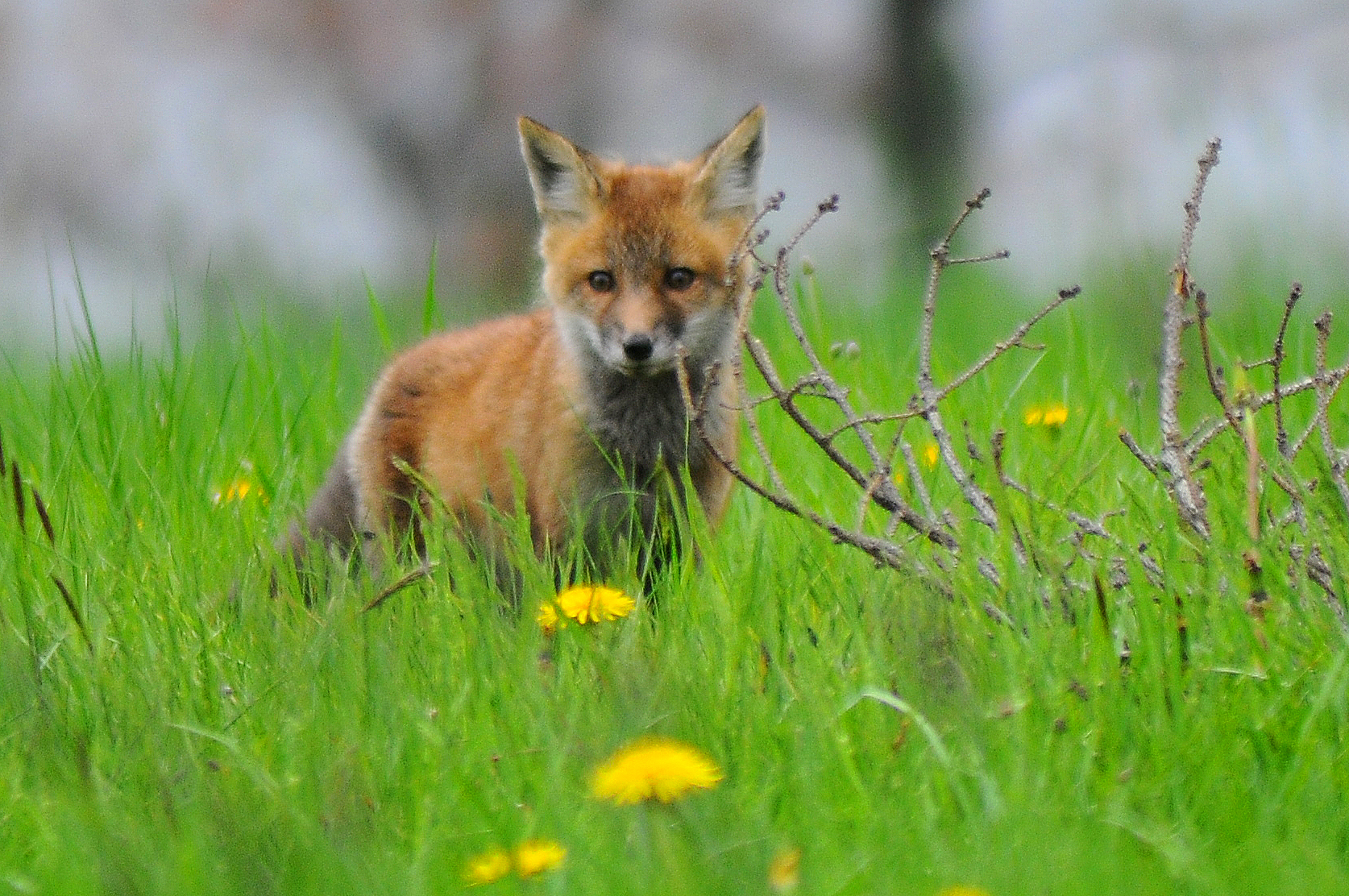
Red Fox Kit, NYS OPRHP

Adult Red Foxes make 12 different sounds; kits, baby foxes, make eight different sounds. These sounds span five octaves and are divided into contact calls and greeting calls. Contact calls, sounds made when foxes are at a distance from one another; start off as a “wow wow wow.” As the foxes get closer, the call changes to a three-syllable call that sounds similar to clucking chickens.
A submissive fox will produce a shriek or high-pitched whine when it greets a dominant fox. And during breeding season males and females may emit a rejection call – a rattling throaty sound termed “gekkering.” Listen to a red fox.

Sources:

Cornell Lab of Ornithology All About Birds http://www.allaboutbirds.org/
Cornell Lab of Ornithology Macaulay Library, http://macaulaylibrary.org/
New York State Department of Conservation, http://www.dec.ny.gov/animals/263.html
Wikipedia, https://en.wikipedia.org/wiki/Main_Page

Post by Susan A Carver, OPRHP.

Painted Turtles of Point Au Roche State Park in Clinton County, New York

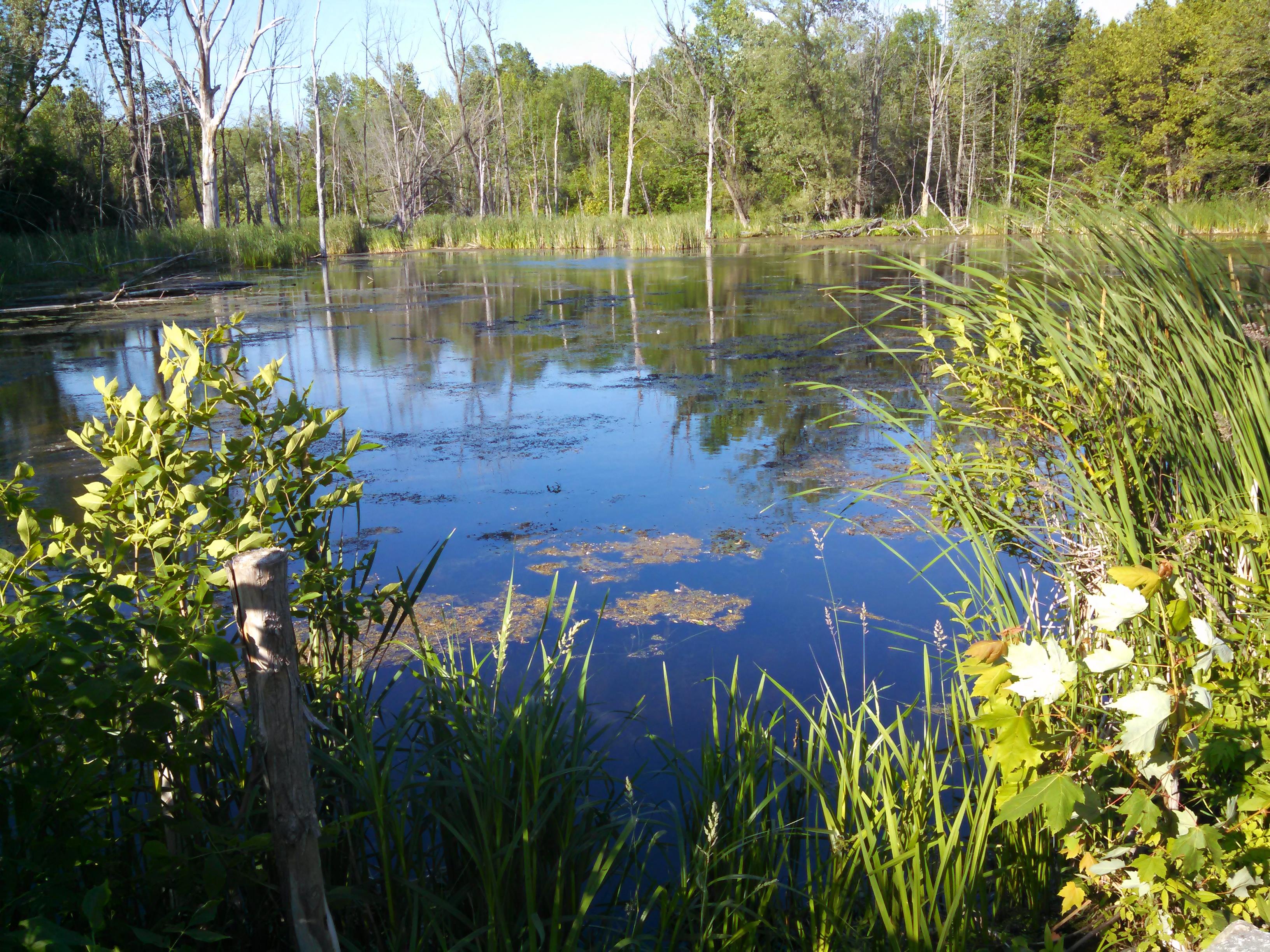
Lower pond site at Point au Roche Park where all 4 turtle hoop traps are set. (Danielle Garneau)

Point Au Roche State Park is a beautiful and diverse park with a lot to offer visitors. By visitors we’re talking both the reptile and human kinds.  Not only does the park offer spectacular views of Lake Champlain for park visitors, it also provides great habitat for painted turtles!

Beginning in September 2012, two SUNY Plattsburgh students and Professor Danielle Garneau began their first field experience handling painted turtles. The goal of the project was to compare sex ratio and age structure of turtle populations in both urban, as well as rural ponds in Clinton County, New York. This research is part of the Ecological Research as Education Network’s (EREN) on-going TurtlePop project that is a collaboration among numerous colleges across the country.

Participants perform the same experimental protocol to determine if a greater number of adult males exist within urban turtle populations, and if this is a nationwide trend. The decline in young females is thought to result from their high rate of road kill when laying eggs at roadsides. An additional cause of death for urban painted turtles is an increase in the abundance of mesopredators (e.g., skunks, raccoons, opossum, foxes) who raid nests for eggs. Since starting, the TurtlePop project has offered field research experiences to many SUNY Plattsburgh students.

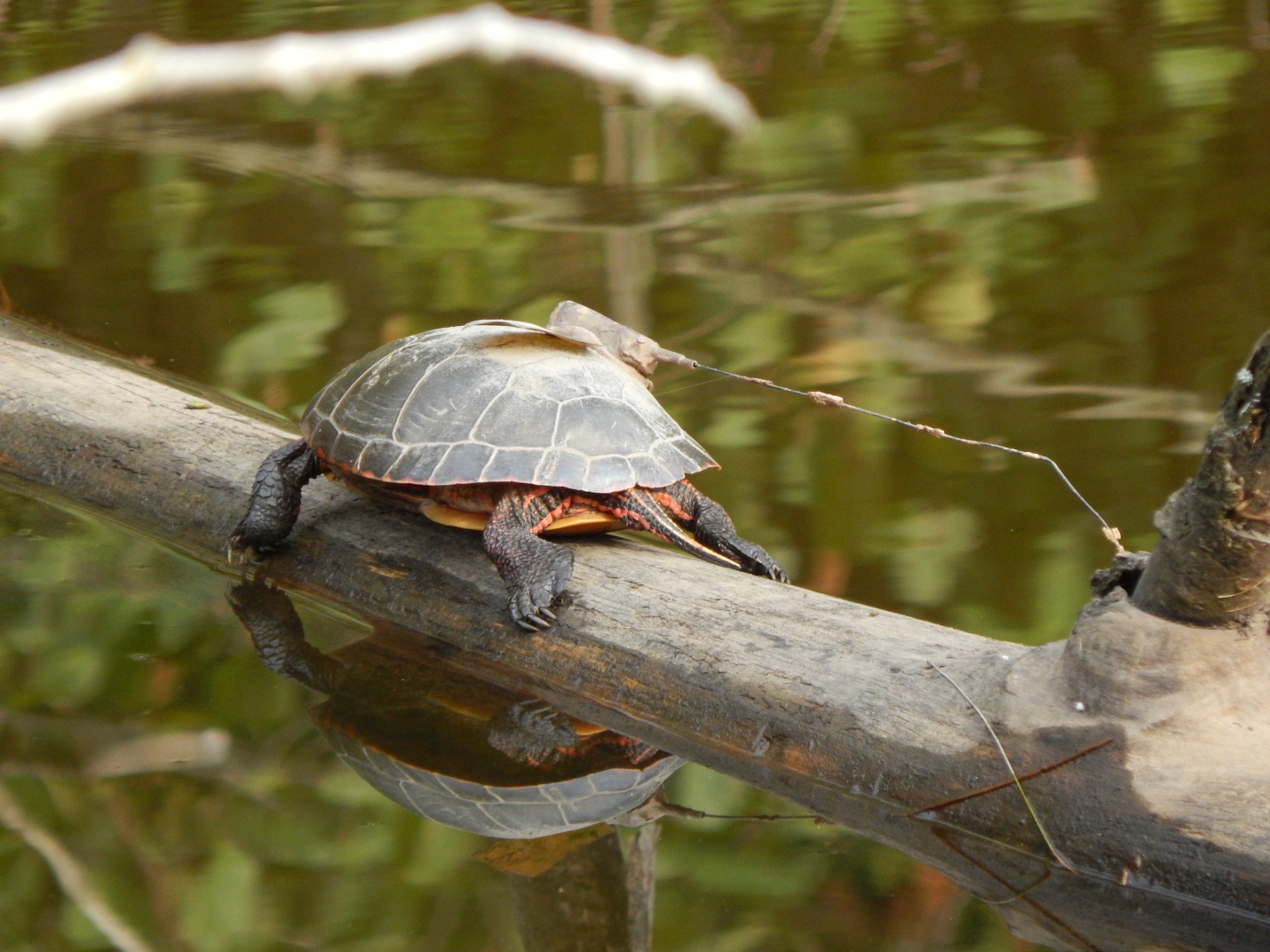
Painted turtle basking on a log with VHF transmitter glued to carapace (top of shell) at the golf course site (urban). Transmitters are used to track animal locations and note movement behavior, nest site selection, and overwintering spots. Note the shedding of scutes (keratin layers) on the top of the turtle shell, which occurs in the middle of summer as turtles grow. Days later this transmitter device fell off the turtle and was relocated along the pond shore. (Danielle Garneau)

About a year into the project, as participants grew ever more curious, a radio-telemetry dimension was added by placing a VHF transmitter on the top of turtle’s shells in order to monitor their movement around a gold course pond complex (urban site) in the city of Plattsburgh. Findings suggest that city turtles do not tend to wander far from the shores of their pond and commonly used basking sites (e.g., downed trees, rocks).

In the summer of 2015, with the help of Point Au Roche State Park Naturalist and SUNY Plattsburgh Ecology alumnus Gillian Dreier-Lawrence, park visitors and college students had the opportunity to participate in and contribute to this growing collaborative research effort at Point Au Roche State Park. We are learning that Point Au Roche State Park has high turtle abundance; approximately 33 individuals were caught over three months of trapping in the lower ponds. Plans to further investigate the turtle population at Point Au Roche are in the works, as the  large number of turtles found indicate that  the population size at the park is likely quite large, only 11 marked turtles have been recaptured so far!

Post by Danielle Garneau, Associate Professor at SUNY Plattsburgh

Useful websites:

http://www.nysparks.com/parks/30/details.aspx

https://www.facebook.com/Friends-of-Point-au-Roche-State-Park-116729181851239/timeline/

http://erenweb.org/new-page/turtle-pop-project/

https://www.facebook.com/#!/ErenTurtlePop?fref=ts

Note: All photos were taken by Danielle Garneau and permissions are granted to use in press.

Wondrous Woodcocks

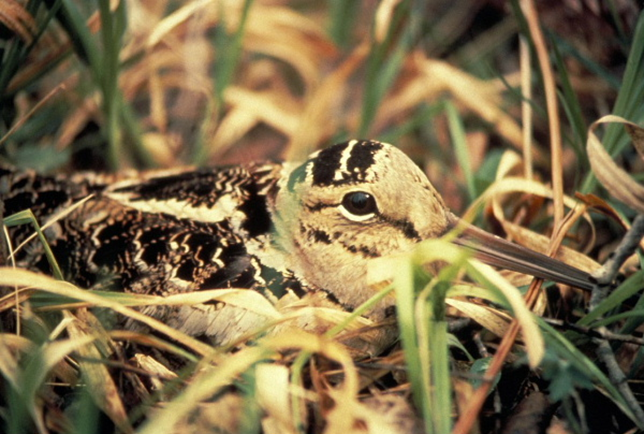
Roosting Woodcock
American Woodcock. NYSparks.com.


They are inconspicuous and well camouflaged for living on the forest floor, old fields, or wet spring meadows. Their eyes are nearly on the back of their heads, giving them the ability to see not only what is in front of them but what is behind them. Their bills look too long for their body; but this elongated bill helps them eat their weight in earthworms and other small invertebrates like spiders, beetles, and ants each day. And, in spring, males do an incredible “sky dance” at dusk and dawn, a mating display that is a highlight to any evening walk in springtime.

Who are they? They are American woodcock (woodcock), also known as the timberdoodle and Labrador twister. Woodcocks are mourning dove sized birds.  They have short necks and tails and large heads and beaks. They are one of the few shore birds that have adapted to living in the forest.

For many people, the mating “dance” of the male woodcock is a sure sign that spring has arrived. The courtship ritual starts at dusk with the male sitting on the ground in an opening in the forest or in a small field. He repeatedly utters a distinctive peent call. Next he takes off from the ground flying in a slow upward spiral. As the wind moves through the wings, a whistling sound can be heard as the bird rises. When he reaches 200-350 feet above the ground, the wing sounds become irregular and then cease as he starts a zig-zag descent. He also chirps as he goes down. He then lands silently next to a female woodcock, if she is present, and resumes peenting. The display starts again and will continue well into dark. He resumes the “dance” near dawn and will continue it until sunrise. Listen for them in the evening in wet meadows or fields in March or April, even before the snow has melted.  (Click here to listen to a woodcock.)

Woodcock dance
Diagram by Nate Kishbaugh.


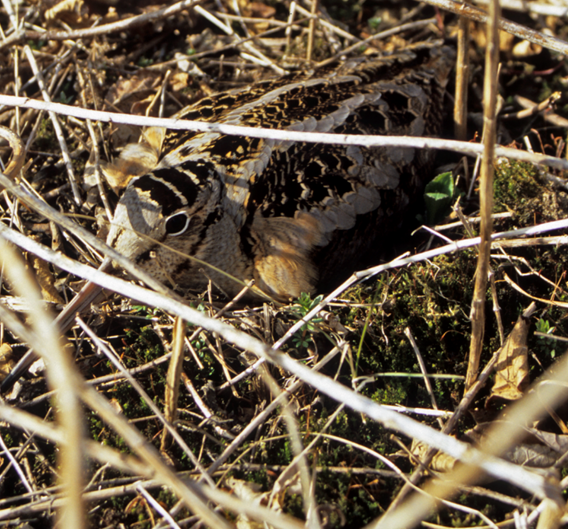
After mating, a female woodcocks lays her eggs in shallow depressions on the ground. She usually lays four eggs that take about 21 days to incubate. Once they are hatched out, the young chicks follow their mother, learning what to eat. They grow quickly on their earthworm and insect diet. By the time they are a month old, they are nearly the same size as their mothers.

In mid-fall woodcocks migrate from New York to the southeastern coast. They return to New York once the ground has thawed.

Woodcock nesting
Female Woodcock on a nest. NYSparks.com.


Post by Susan Carver, OPRHP.

Join us for a “Woodcock Walk” at:

Theodore Roosevelt Nature Center, Jones Beach State Park, Wantagh, Adult Ed-ventures, Friday, April 10, 7-8:30 pm, $4/person

Sources:

American woodcock, Cornell Lab of Ornithology, http://www.allaboutbirds.org/guide/american_woodcock/id

American woodcock, New York State Department of Conservation, http://www.dec.ny.gov/animals/45448.html


Winter Scat Identification

The winter snow provides a great backdrop for finding wildlife scat; you can learn how to identify some of the common critters that reside in our State Parks by looking at their scat. We will be focused on scat that you are most likely to run into while out exploring the beautiful New York State Parks.

When first looking at scat you want to see if there are any remnants or sign of what the animal has been eating. For example, are there berries, fur, bones, or plant fibers? Identifying what the scat is made up of will narrow down the type of species that the scat can belong to. If the scat contains fur or bone then you can assume that the animal is a carnivore, like a fisher or bobcat. Where things can get tricky is if the scat has berries or fur and berries, this comes from an omnivore like a fox, coyote, raccoon or black bear that eat both meat and vegetation. If the scat only contains plant fibers then you can assume that the animal is an herbivore. Some New York species that fit this category are deer, rabbit, porcupine and woodchuck.

The next thing to look at is the placement of the scat and its shape. Canines will generally place their scat higher off the ground such as on a rock in a trail; this is a way they mark their territory so it can be found by other canines. Scraping marks in the dirt from their paws can also be found in front of canine scat. Felines don’t specify where their scat lands and the scat are tubular and sectioned. Deer and rabbit scat is shaped like a ball or marble and can be found primarily in feeding areas. The scat from black bear and raccoon is usually dark in color and will be tubular in shape.

White-tailed deer scat is probably the most common that you will find in New York. It will generally be found in a pile and each piece will be around the size of a small marble. Softer scat will still resemble the ball shape, but more in a patty form.

White-tailed Deer vs. Cottontail Rabbit

white tailed deer
White-tailed deer scat. Photo by Nate Kishbaugh.
Cottontail rabbit
Cottontail rabbit scat. Photo by Susan Carver.


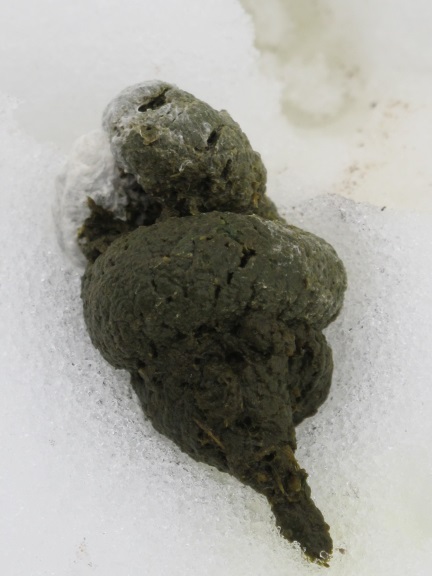
Below is a picture of coyote scat. Notice how the end of the scat looks like it has been twisted. Fox and coyote scat look similar, but fox scat is generally smaller. The second photo is scat from a domestic dog, notice the end are not twisted.

coyote
Coyote scat. Photo by Jackie Citriniti.
domestic dog
Domestic dog scat. Photo by Susan Carver.

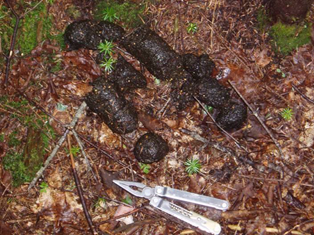
Black bear scat is usually in a large tubular pile and usually will contain different food items depending on the time of year. In the spring, bear scat will most likely contain vegetation. In the summer and fall, it will contain things such as seeds, berries, corn, acorns and apples if available.

blk bear
Black bear scat. Photo courtesy of NYSDEC.

Scat from a raccoon can be found anywhere from the water’s edge to around your trash can. It is moderately sized and can contain anything from berries to shiny garbage fragments (raccoons are attracted to shiny objects, especially in water).

raccoon
Raccoon scat. Photo by Amanda Dillon.


Bonus scat: Wild turkey have made a serious comeback in New York State, and are a common sight around agricultural field and forested land. Turkey scat is greenish to brown in color and it is believed that male turkeys’ (toms) scat is in a J shape whereas females’ (hens) scat is in more of a pile. The difference in shape is due to the different body structures between males and females.

wild turkey
Wild turkey scat (female). Photo by Tom Hughes at Sampson Lake State Park.