Native Spring Wildflowers

Spring is in the air and with warmer temperatures come the spring flowers everyone hopes to glimpse.  Most of the flowers people have come to associate with spring are not native to North America though.  Crocus, daffodils, hyacinths, and tulips, for example, are all European flowers.  There are, however, many native plants that “spring” up at this time of year.

Native plants are valuable for a variety of reasons.  They contribute to the biodiversity and health of ecosystems and provide habitat for birds, insects, and other wildlife.  Also, as they are acclimated to the local environment, native plants are often hardier and require less care than imported plants.

As you walk through the woods this spring, look for native plants growing beneath the trees.  In 1936, Minna Anthony Common made a list of plants that were native to the Thousand Islands Region in the journal she kept detailing her work on the Rock Ridges Nature Trail in Thousand Island Park.  These three were among the native plants that were already growing along the trail when she began to work on it.

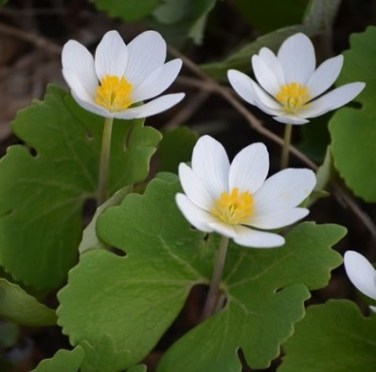
bloodroot

Bloodroot (Sanguinaria canadensis) has white flowers with 8 to 12 petals that are approximately 1¼ inch wide.  The flowers sprout on 3 to 6 inch stems through folded leaves.  The deeply lobed leaves open as the plant grows.  When the root of the plant is cut, it “bleeds” a reddish- orange liquid.  This is what gives the plant its name.  Bloodroot prefers moist soil and partial shade and is often found along the woodland edge.  At the Minna Anthony Common Nature Center, bloodroot can be found in the flower bed along the front of the museum building.

spring beauty

Spring Beauty (Claytonia virginica) has small (½ to ¾ inch) pink or white flowers with darker pink veins.  Each plant has a single pair of long narrow leaves.  These flowers also prefer moist woodland habitats.

roundlobe hepatica

Hepatica (Hepatica nobilis) is a member of the buttercup family.  It has ½ to 1 inch wide blue, pink, or white flowers and three lobed leaves.  Hepatica begins blooming in early spring and will continue to bloom into the summer season.  Hepatica prefers partial shade and is often found in woodland habitats.

If you are interested in learning more about native plants, visit us at the Nature Center.  We have a many books about native plants in our library and gift shop.  We also have a copy of Minna Anthony Common’s journal available for our visitors to read.  Best of all, we have miles of trails where visitors can see these plants in their native habitat.  The best way to learn about nature is to experience it.

Post by Molly Farrell, Nature Center Director at Minna Anthony Common Nature Center (Wellesley Island State Park).

Sources:

Common, Minna.  Rock Ridges Nature Trail: Record of the Trail, journal kept by Common while developing the trail system

Newcomb, Lawrence. Newcomb’s Wildflower Guide. Little, Brown and Company, New York. 1977.

USDA Plants http://plants.usda.gov (accessed 3/10/2015)

Minnesota Wildflowershttp://www.minnesotawildflowers.info/flower/virginia-spring-beauty (accessed 3/10/2015)

Prairie Moon Nursery www.prairiemoon.com  (accessed 3/10/2015)


Winter Scat Identification

The winter snow provides a great backdrop for finding wildlife scat; you can learn how to identify some of the common critters that reside in our State Parks by looking at their scat. We will be focused on scat that you are most likely to run into while out exploring the beautiful New York State Parks.

When first looking at scat you want to see if there are any remnants or sign of what the animal has been eating. For example, are there berries, fur, bones, or plant fibers? Identifying what the scat is made up of will narrow down the type of species that the scat can belong to. If the scat contains fur or bone then you can assume that the animal is a carnivore, like a fisher or bobcat. Where things can get tricky is if the scat has berries or fur and berries, this comes from an omnivore like a fox, coyote, raccoon or black bear that eat both meat and vegetation. If the scat only contains plant fibers then you can assume that the animal is an herbivore. Some New York species that fit this category are deer, rabbit, porcupine and woodchuck.

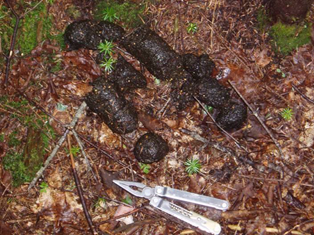
The next thing to look at is the placement of the scat and its shape. Canines will generally place their scat higher off the ground such as on a rock in a trail; this is a way they mark their territory so it can be found by other canines. Scraping marks in the dirt from their paws can also be found in front of canine scat. Felines don’t specify where their scat lands and the scat are tubular and sectioned. Deer and rabbit scat is shaped like a ball or marble and can be found primarily in feeding areas. The scat from black bear and raccoon is usually dark in color and will be tubular in shape.

White-tailed deer scat is probably the most common that you will find in New York. It will generally be found in a pile and each piece will be around the size of a small marble. Softer scat will still resemble the ball shape, but more in a patty form.

White-tailed Deer vs. Cottontail Rabbit

white tailed deer
White-tailed deer scat. Photo by Nate Kishbaugh.
Cottontail rabbit
Cottontail rabbit scat. Photo by Susan Carver.


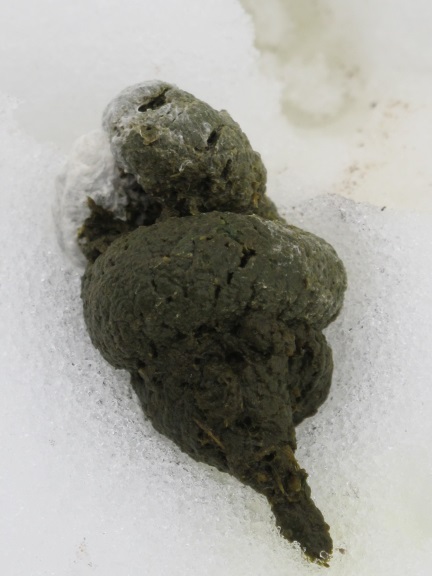
Below is a picture of coyote scat. Notice how the end of the scat looks like it has been twisted. Fox and coyote scat look similar, but fox scat is generally smaller. The second photo is scat from a domestic dog, notice the end are not twisted.

coyote
Coyote scat. Photo by Jackie Citriniti.
domestic dog
Domestic dog scat. Photo by Susan Carver.

Black bear scat is usually in a large tubular pile and usually will contain different food items depending on the time of year. In the spring, bear scat will most likely contain vegetation. In the summer and fall, it will contain things such as seeds, berries, corn, acorns and apples if available.

blk bear
Black bear scat. Photo courtesy of NYSDEC.

Scat from a raccoon can be found anywhere from the water’s edge to around your trash can. It is moderately sized and can contain anything from berries to shiny garbage fragments (raccoons are attracted to shiny objects, especially in water).

raccoon
Raccoon scat. Photo by Amanda Dillon.


Bonus scat: Wild turkey have made a serious comeback in New York State, and are a common sight around agricultural field and forested land. Turkey scat is greenish to brown in color and it is believed that male turkeys’ (toms) scat is in a J shape whereas females’ (hens) scat is in more of a pile. The difference in shape is due to the different body structures between males and females.

wild turkey
Wild turkey scat (female). Photo by Tom Hughes at Sampson Lake State Park.


Invasive Species Spotlight: Monitoring for Hemlock Woolly Adelgid

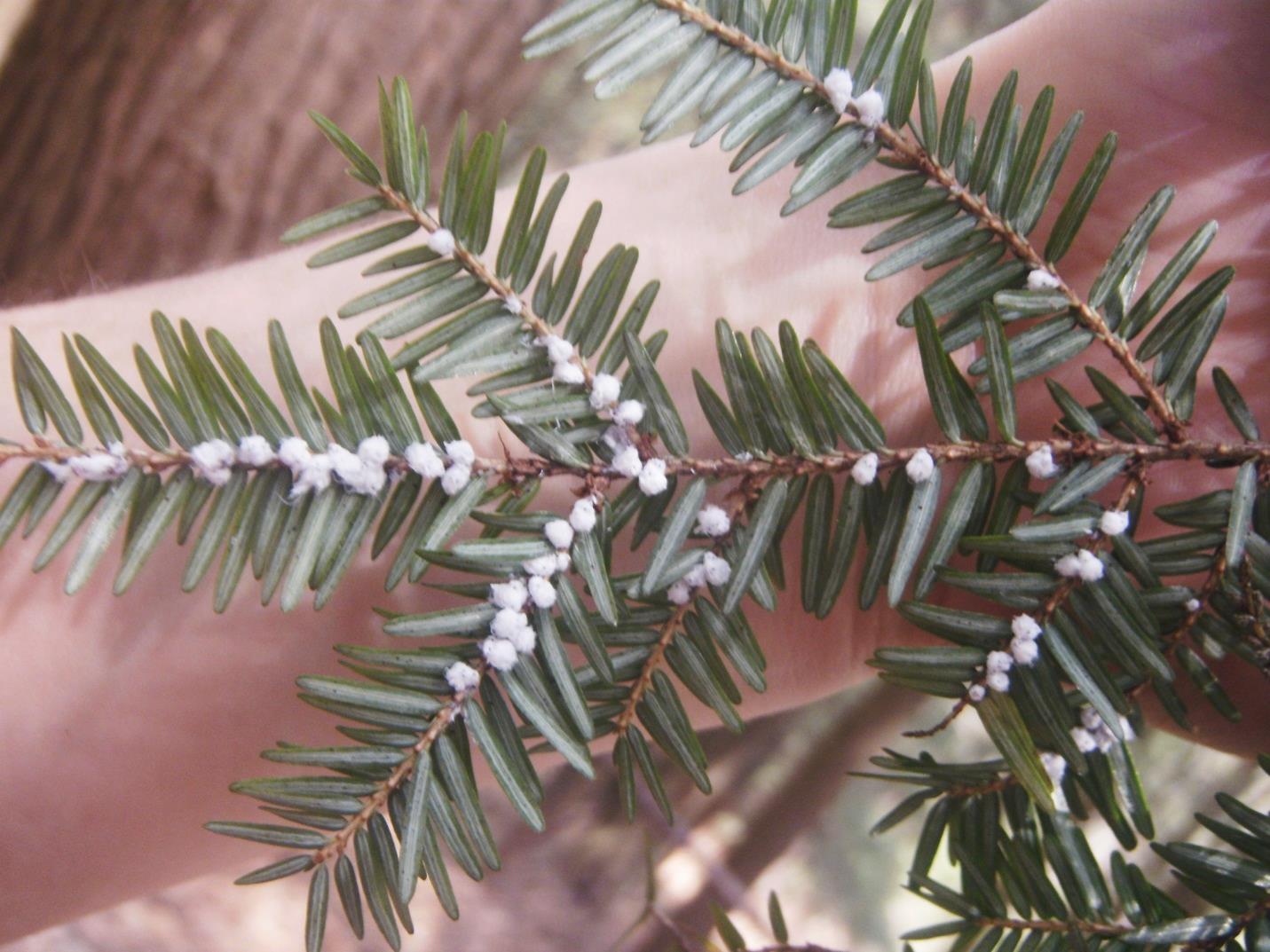
Hemlock Woolly Adelgid appears as white fluffy balls on the underside of hemlock branches during the cooler months.

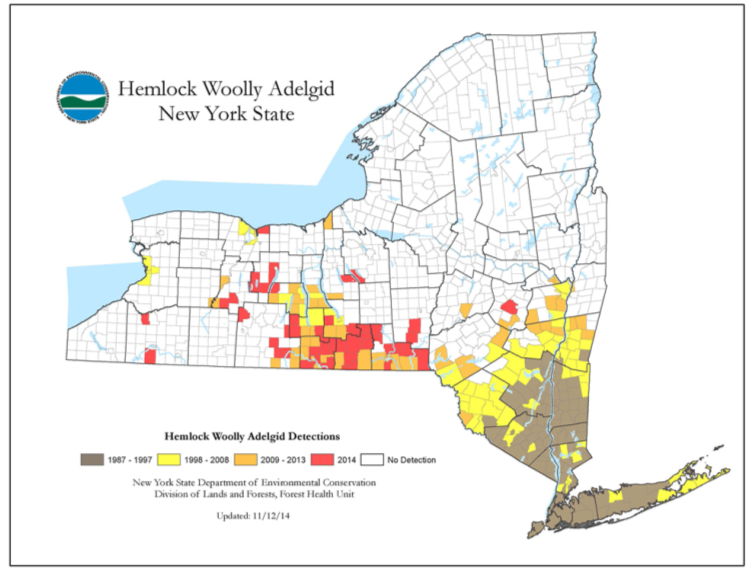
Hemlock Woolly Adelgid (HWA) is a tiny, invasive insect which kills hemlock trees in a matter of 6 years. Please see the previous post on HWA for more information. The insect was introduced in Virginia in the early 1900’s, and has steadily spread since then. New York state contains all stages of HWA infestation. There are heavily infested areas like the lower Hudson Valley, which have harbored HWA for 20+ years and contain increasing numbers of declining and dead hemlocks. Moderately infested areas include the Finger Lakes, where some areas have HWA and some do not. Several HWA early detections were made in Western NY’s Allegany State Park by dedicated volunteers, trained by Park staff to survey for the insect. Allegany just has a few isolated patches of HWA, and State Parks is working to keep those patches small. So far, the Adirondacks have escaped infestation, but they are not immune.

map
This map shows the spread of HWA by township since 1987. Map from http://www.dec.ny.gov/animals/7250.html.

How do we know all this information? The first step in determining if HWA is present is simply to look for it. Surveying for HWA takes diligence; the insects’ most visible life stage is the egg sac, which is present in the fall and winter. A hand lens is necessary to identify the tiny adults in the summer. Primarily through grant funding and volunteers, Parks has surveyed for HWA in 20 State Parks, and that number increases every year.

Survey technique demonstration for volunteers in Allegany State Park.

After surveying, maps are created and examined and hemlock stands are prioritized for treatment. Prioritization is a rigorous process which includes collaboration with state and local experts. These experts ask questions like: Do dead/dying hemlocks pose a health and safety risk here? Is there an area of ecological significance, for example, an old growth stand or is there an insect or animal present which is dependent on hemlocks? Will the loss of hemlocks create a significant, negative change to aesthetics? Is this an area of early detection, where treatments could make a big difference?

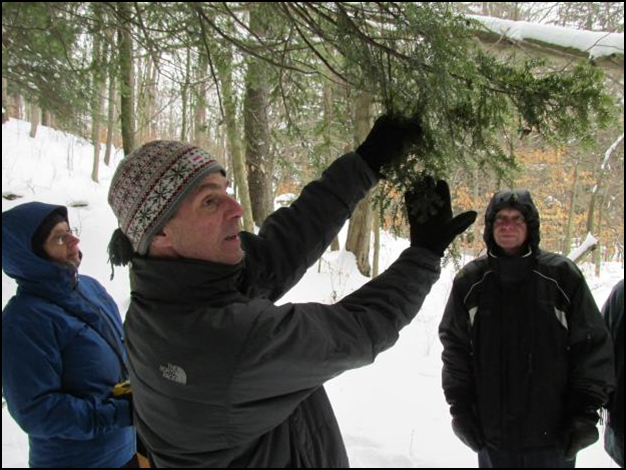
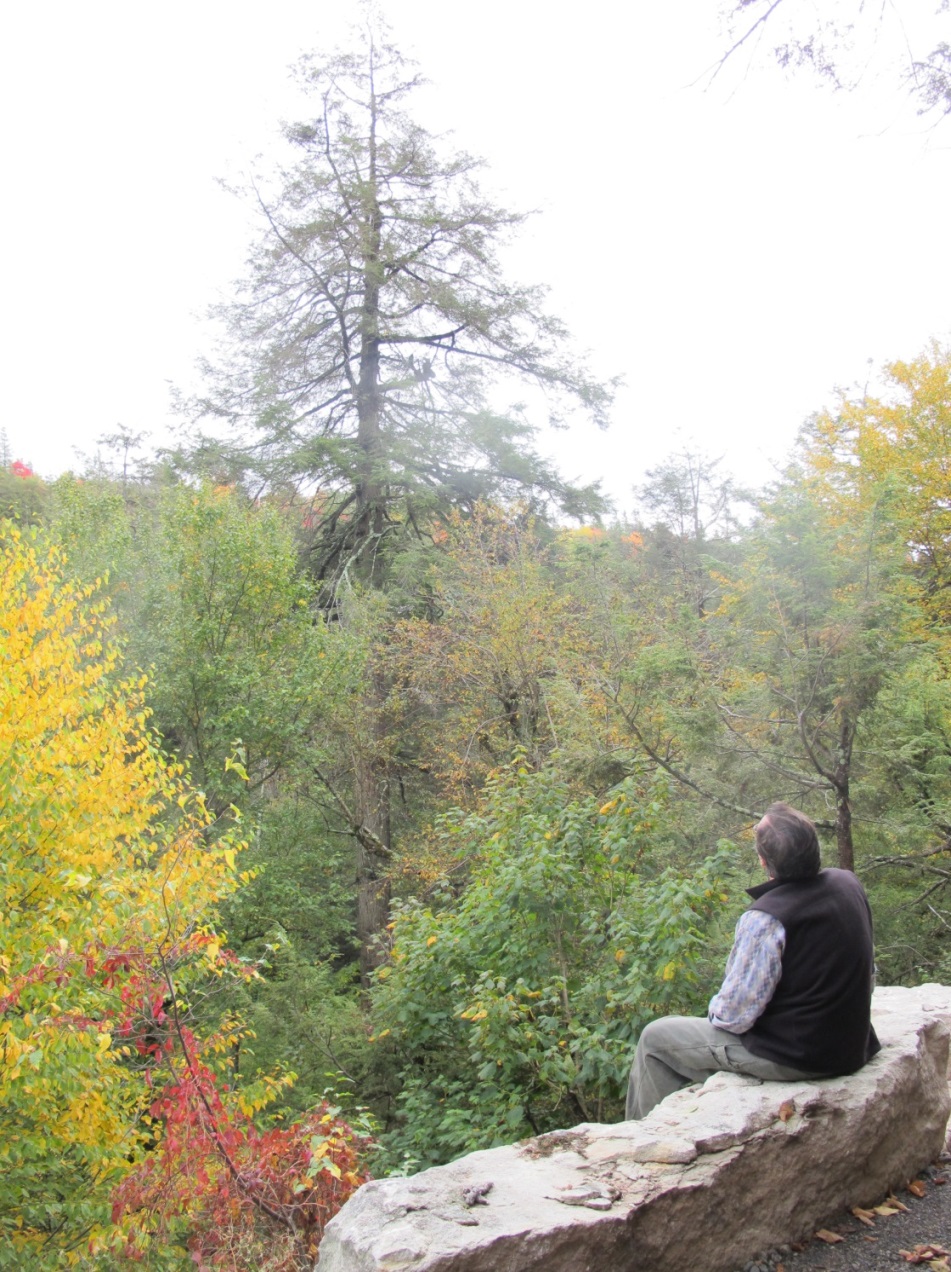
Mark Whitmore, of Cornell University, gazing at a hemlock in serious decline at Minnewaska State Park Preserve.

Treatment for HWA does exist. Parks has chosen our methods through regular consultation with experts, based not only on what works, but what has the least impact on the environment. Pesticides are carefully sprayed onto the bark of hemlock trees, in the spring or early fall. The pesticides are taken up rapidly through the bark and into the tree, where hemlock’s circulation system takes it throughout the tree, to all the little branches. The HWA will not survive on treated hemlocks for the next 7 years. While this is certainly not a permanent solution, it does buy us much needed time.

In conjunction with these treatments, Parks is also releasing biological control beetles. Biological control insects have an extensive approval process which can take a decade or more through the USDA. Many states have biological control review processes as well, including NY. These processes are designed to assess and evaluate the insect and its host specificity, the reproductive and cross breeding potential, and other factors. If, and only if, the insect is passes the host specificity and other tests, is it approved for release. Many biological control insects have been explored for control of HWA, one showing some promise is Laricobius nigrinus. These biological control beetles feed exclusively on HWA, and while they will not eliminate their food source, they can keep HWA populations in check so they are no longer killing hemlocks. While this is the ideal end result, it can take a decade or more before this is attained. Releasing a few hundred L. nirginus against millions of HWA means we need to buy time, through the use of pesticides, as these beetles work to increase their populations to levels where they can match HWA and keep it in balance.

Invasive insects are notoriously difficult to contain. While we may never stop the onward march of HWA, we can reduce the negative impacts of hemlock loss in specific areas through human intervention.

Sign up for an upcoming iMap Invasives training to learn how to report HWA when you spot it in State Parks’ forests.

Post and photos by Alyssa Reid.


Spring Tales About Springtails: Friends, Not Fleas!

photo1
Garden Springtail found in New York State. They’re not all this cute, but we want you to like them. From http://bugguide.net/node/view/652904.

Have you even been walking in the woods in late winter and seen a cluster of what look like fleas on the top of the snow?  You’ve probably thought “eww!” and hurried on your way to escape an itchy outcome. The truth is that these so-called “snow fleas” pose no danger to you or your furry pets.  You’re actually meeting one of the many species of Springtails, an order of arthropods that can be found on every continent, including Antarctica.  These incredibly abundant creatures may leap, but they are not biting fleas. They actually consume leaf litter, fungi, and even other smaller creatures.  Despite their tiny size, their existence may provide remarkable benefits that extend to you and me.

Springtails have six legs and antennas, but they are not classified as insects. Unlike insects, they have internal mouthparts and are wingless.   The spring in their step comes from a furcula, which is the springy two-pronged “tail” for which these fascinating creatures are named. It normally lies tucked under their abdomen. When escaping predators, the furcula is released almost instantly, and it vaults them up to 10 centimeters, which is no joke when your size maxes out at half a centimeter in length.

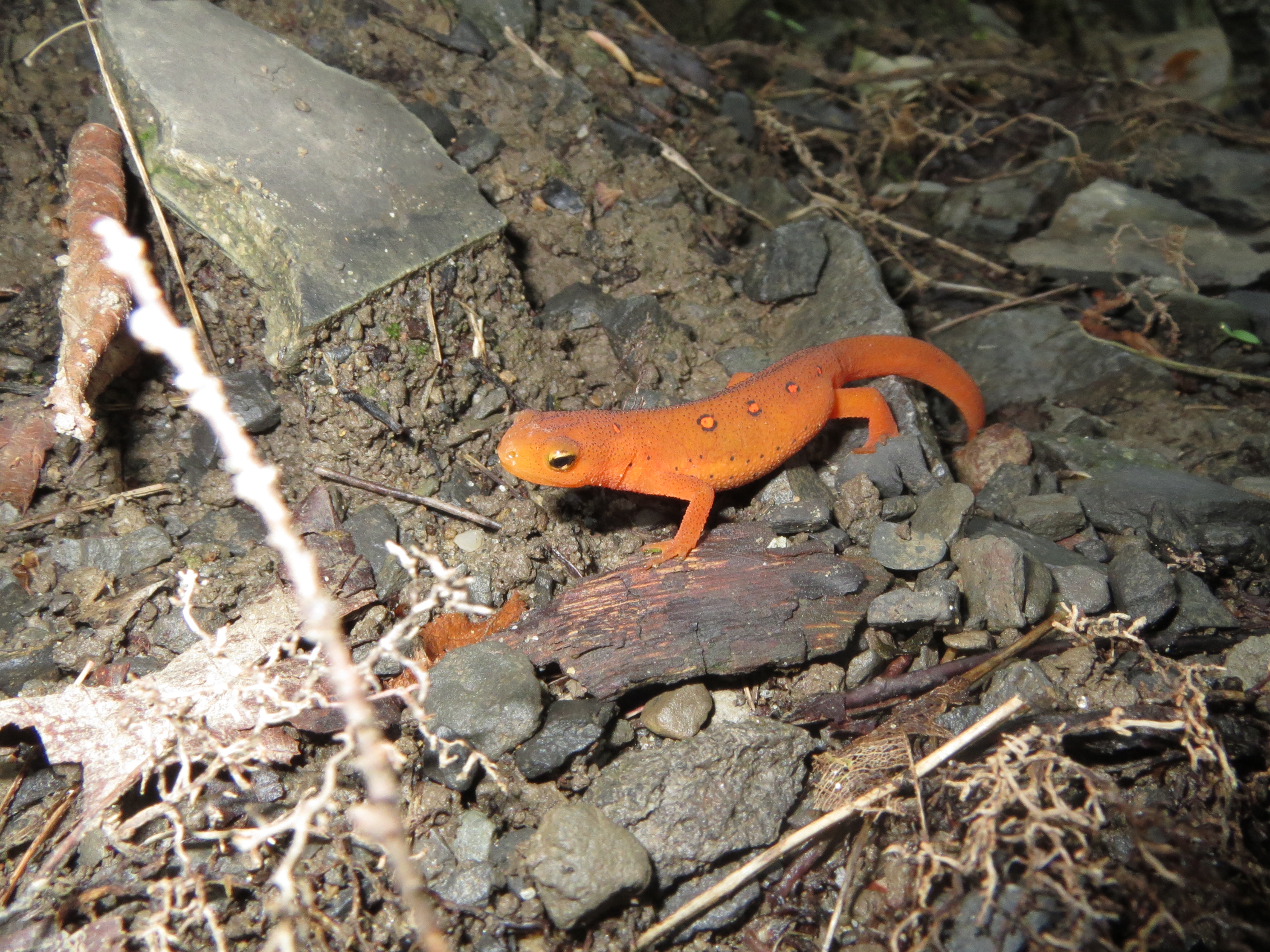
With 100,000 found in one square meter of forest, it is clear that these critters form a substantial base of the food web on the forest floor.  The red eft, the teenage stage of the red spotted newt, considers the springtails an ideal meal for their little mouths.  Even the harvestman, more commonly called “daddy long-legs,” preys upon the springtail.

Red Eft at Thacher -Photo by Lilly Schelling
The brilliant red efts you see on rainy days are prowling about for the Springtails, a little meal just right for their little mouths. Photo by Lily Schelling (OPRHP), taken at Thacher State Park.

Why should you care about these creatures?  They eat pathogenic fungi that can damage many agricultural crops. They also help spread the spores of mycorrhiza (fungi), whose symbiotic relationship with plants allow for an incredible array of plants to thrive, from wheat to beech trees.   The variety of Springtail that is sometimes called a “snow flea” is also a focus of biomedical research.  Scientists are trying to replicate the anti-freeze protein found in those ever-active Springtails in winter, and use it to aid the transition of body organs for transplant from donor to recipient.

We know nature’s ability to relax and soothe us in the midst of our busy lives, with scenic views and outstretched tree limbs. However the next time you take a walk in the woods, take a moment to appreciate the unseen world under your feet as well. It turns out that even the largely invisible, creepy-crawly world of wildlife in the woods may have myriad benefits for humanity.

A mass of live springtails in early spring. Photo by Greg Edinger, NYNHP.


Post by Liz Wagner, Grafton Lakes State Park.


Subnivean Life: A World Beneath the Snow

                                 Definition of “subnivean”:                                 the zone in or underneath the snowpack. 

Entrance hole in the snow.
Entrance hole in the snow. Photo by Patty Wakefield, OPRHP.

During the winter months when the temperatures fall into the single digits or below zero, and snow covers the landscape, survival in such harsh conditions is often challenging. Have you ever thought about the small mammals that reside in the fields along some of our country roads? One of those critters is the meadow vole (Microtus pennsylvanicus); which means small ears of Pennsylvania. The meadow vole is an integral part of the food chain for many prey species such as the red-tailed hawk (Buteo jamaicensis) and the red fox (Vulpes vulpes).

Meadow vole Photo courtesy of www.fcps.edu.
Meadow vole Photo courtesy of http://www.fcps.edu.

How do they survive? Meadow voles form runways or paths in dense grass in fields and/or wooded areas in the spring and summer months. You can see evidence of these tunnels by entrance holes.

Grass entrance
Entrance holes. Photo courtesy of http://www.pbase.com.


Grass Tunnels
Tunnels. Photo courtesy of http://www.pennlive.com.

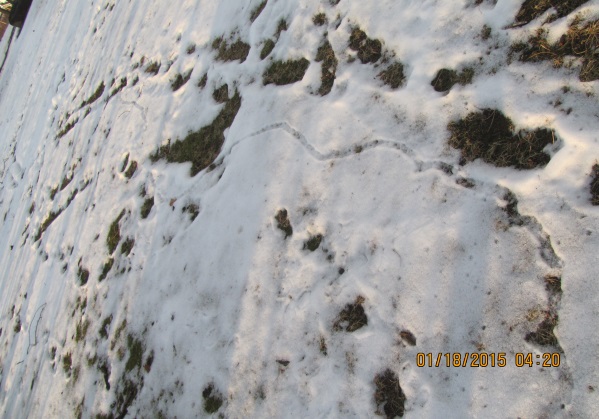
These runways allow the meadow voles to forage, reproduce and survive while protecting them from predation. Meadow voles also dig shallow burrows where nests are constructed. During the winter months, the tunnels are under the snow.

Tunnels1


The snow actually works as an insulator to help protect them from the cold.

Tunnels2
Evidence of snow tunnels (2 images). Photos by Patty Wakefield, OPRHP.

Meadow voles often eat the green basal (bottom) parts of grass, berries and the cambium (under bark) of small saplings and bushes.

Tree damage
Sapling chewed by voles. Photo courtesy of http://www.tlehcs.com.
Cute voles eating
Voles eating berries. Photo courtesy of http://www.mnginteractive.com.


Next time you take a walk in a State Park see if you can find traces of these remarkable little winter warriors. The beauty and wonders of nature is all around us. We need just take the time to observe and see what we can see.

Post by Patty Wakefield.