I Love My Park

On Saturday, May 6, thousands of New Yorkers will again join their family, friends and neighbors at over 120 state parks and historic sites to participate in volunteer projects as part of the sixth annual I Love My Park Day, a partnership between New York State Parks and Parks & Trails New York.  On behalf New York State Parks, I look forward to welcoming you all to what is a remarkable day for the New York State Park system.

Sponsored jointly by the New York State Office of Parks, Recreation and Historic Preservation (State Parks) and Parks & Trails New York, I Love My Park Day is a statewide event to improve and enhance New York’s parks and historic sites and bring visibility to the entire park system and its needs. Public parks in every corner of the State, from Jones Beach State Park to Niagara Falls State Park, will participate this year. Volunteers will have the opportunity to participate in clean up events at five national parks in New York State: Gateway National Recreation Area (Great Kills, Staten Island and Plumb Beach, Jamaica Bay, Queens); Fort Stanwix National Monument (Rome); Roosevelt-Vanderbilt National Historic Sites (Hyde Park); Fire Island National Seashore (Ocean Beach) and Saratoga Battlefield Historical Park (Stillwater), as well as fourteen properties managed by the Department of Environmental Conservation (DEC) in the Adirondack and Catskill Regions and at three environmental centers, Catskill Interpretive Center (Mount Tremper); Five Rivers Environmental Education Center (Delmar) and Reinstein Woods (Buffalo).  And, again this year, we will be joined across the state by members of the New York State Excelsior Conservation Corps (ECC), a New York State AmeriCorps program run by the Student Conservation Association, who will help State parks organize and implement I Love My Park Day projects.

Each year, a record number of volunteers turn out and complete an impressive array of projects to beautify our facilities and prepare them for the summer season. Volunteers will celebrate New York’s public lands by cleaning up debris, planting trees and gardens, restoring trails and wildlife habitat, removing invasive species, and working on various site improvement projects.    Your efforts demonstrate just how important your parks and historic sites are to your families, communities, and to our entire state as places to be active, explore the outdoors and relax with family and friends.  It is our honor to work every day to ensure that all state parks are open and accessible for all to visit, but we could not do it without you—the volunteers and friends who work not just on I Love My Park Day but year-round to make our parks and sites the very best they can be.

If you haven’t already registered, do so soon by visiting http://www.ptny.org/ilovemypark/index.shtml.

Post by Commissioner Rose Harvey
This slideshow requires JavaScript.

Parks Goes Solar

As we celebrate Earth Day we’d like to tell you a little bit about some of the projects our Energy & Sustainability Office is working on that benefit the environment. Particularly we’d like to tell you how they are developing renewable energy projects all across the state. State Parks has developed several solar arrays over the last few years. Solar arrays use panels to catch sunlight. You’ve probably seen them on the roofs of houses in your neighborhood or maybe even your own house. The panels catch the light from the sun and turn that into electricity for use in the house or building.

NYS Parks has completed 13 solar installation projects to date. Our goals is use the sun to power part or all of our Parks. As a result of their work State Parks is recognized as the leading renewable energy agency in the state. Most installations were completed by trained in-house State Parks employees after they went through a solar power training course at HVCC. By training employees to install solar arrays, Parks is able to save money and give employees the opportunity to learn valuable skills that give them a better understanding of the project. State Parks currently has about 50 staff members with this training and continues to train more each year.

Beginning in 2012 with the construction of the rooftop array on the Niagara Falls Discovery Center State Parks renewable energy projects have grown in number and size. State Parks Staff have installed arrays in several parks across the state including, Niagara Falls, Letchworth, Robert Moses, and Grafton Lakes.

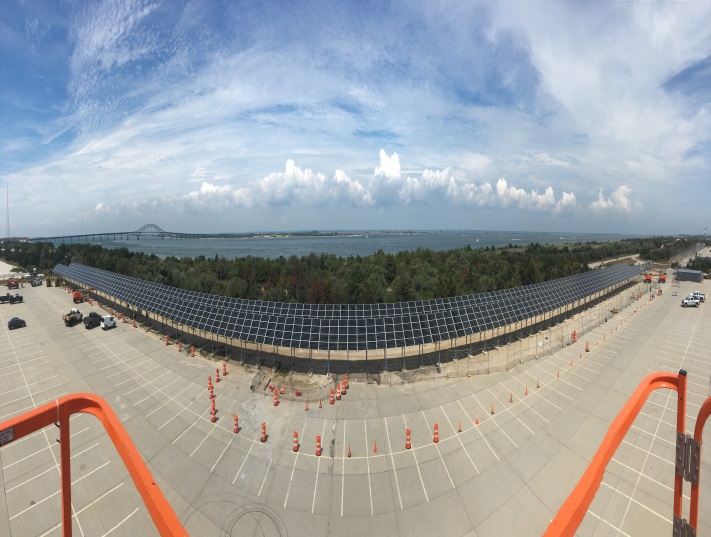
The 13th solar installation was at Robert Moses State Park in Long Island, and will become the first energy neutral State Park in the United States. The nearly 700 kilowatt solar array will save more than $100,000 each year. Built with 2,432 panels, this pole-mounted array is located in the back of parking field 4 of Robert Moses State Park. The solar panels are made in the United States by SolarWorld and supplied by National Solar Technology in Buffalo. This is the largest solar installation by State employees in the State’s history.

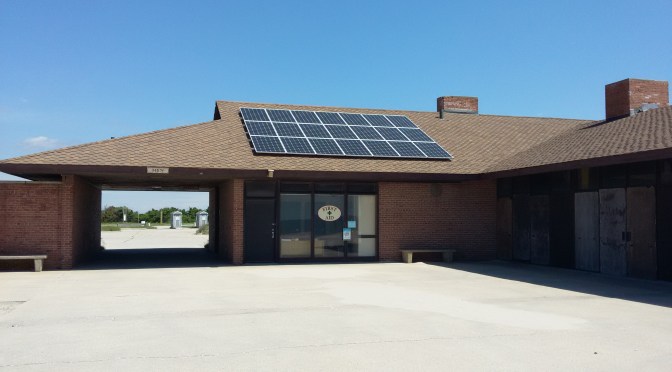
Currently Parks is installing a new solar system with a 144 kW capacity at the headquarters of the Historic Preservation Office, Peebles Island State Park in Cohoes. The array will account for more than 20% of the electricity used by the complex. Parks is also constructing a solar array on the roof of the Bathhouse at Lake Taghkanic State Park.  This 40kW solar array will provide more than 25% of the buildings electric need.

Happy Earth Day!

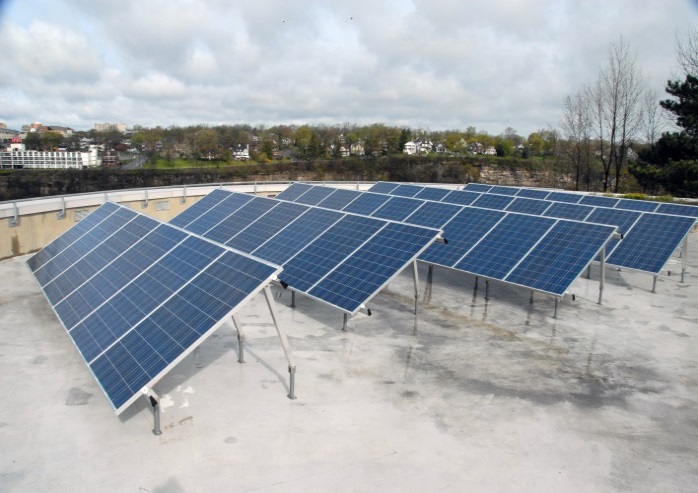
Niagara
Niagara Falls Discovery Center System Output: 8.74 kW Annual Output: 10,940 kWh, photo by State Parks
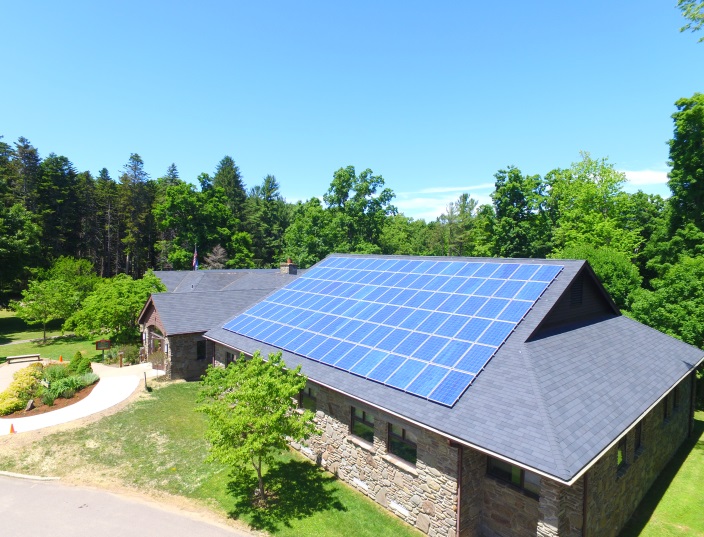
Letchworth
Letchworth Visitors Center System Output: 25 kW Annual Output: 29,200 kWh, photo by State Parks
Robert Moses
Robert Moses State Park, Field 4 System Output: 693.12 kW Annual Output: 920,000 kWh, photo by State Parks

Happy Arbor Day

What is it about trees that can make you stop and look?

Is it the sunlight on the trunks of yellow birch that catches your eye – the bark silvery-gold and curling? Or the smooth gray bark of beech –  easy to look for scars from bear claws on this canvas. Or perhaps it is the rough platy bark of a shagbark hickory that intrigues you.  No matter what catches you about a particular tree, your gaze inevitably follows the trunk up it’s base, and continues upward into the canopy where the branches are silhouetted against the sky. The beautiful spectacle prompts many questions: How old is it? What has it been through? Are there any animals up there?

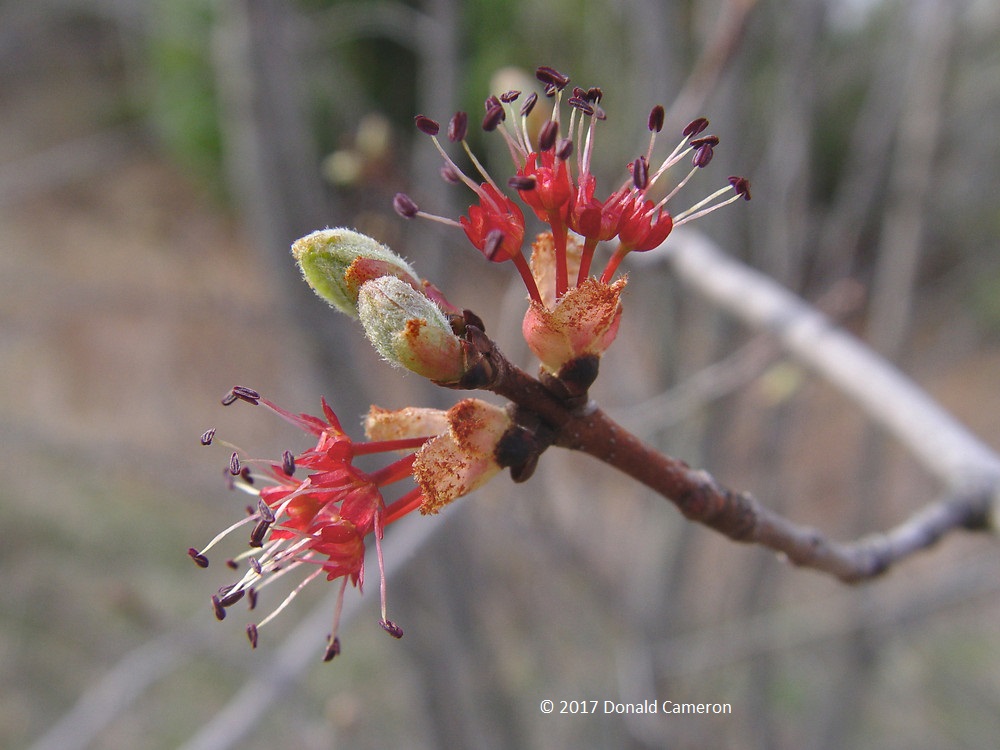
Of course, trees with showy flowers – like magnolia, cherry, or crabapple – always grab our attention. But all our broadleaf trees also have flowers, so look a little closer for those that are not so conspicuous. Among the first to flower in the spring are the maples, a hint of color in the treetops. Look for red tassels on red maple (Acer rubrum) or silver maple (Acer saccharinum) or green on sugar maple (Acer saccharum). Norway maple (Acer platanoides) has larger yellow-green flowers. Take a closer look at these little bouquets; you can usually find clusters that have fallen to the ground.

Red maple_Donald Cameron_One time use for this blog
Red maple (Acer rubrum) flowers. Photo by Donald Cameron 2017, GoBotany, used with permission.

A nice tree to look for in the spring is serviceberry, also known as shadbush (Amelanchier canadensis and A. arborea). Its delicate white flowers show up long before the other trees leaf out, so you can spot these trees more easily in spring than in the summer. There are also several shrub species of Amelanchier in NY State, all with similar flowers.

And later in the season, in May-June, look for the straight-as-a-pole tulip poplar (Liriodendron tulipifera) whose flowers look like yellow-green tulips!

Trees become a busy place in the spring too. Bees and other insects feed on the nectar and pollen of the flowers above. Woodpeckers search for insects under the bark and many animals hide out or make their home in tree cavities – bats, owls and other birds, raccoons, squirrels, and porcupines. Bears climb trees for safety and sometimes curl up in the base of big hollow trees. With all that activity, trees are a good place for wildlife watching, whether in your neighborhood or in a state park or historic site.

Birding at Minnewaska_Jubilee Feist
Binoculars are good for watching wildlife and also for getting a better look at the trees. This volunteer was making a list of birds at Minnewaska State Park Preserve on I Love My Park Day.

NY State Parks are home to countless beautiful trees.  Look for many mature and outstanding trees around the mansions and other historic sites, at campgrounds and picnic areas, and in the forests that cover nearly 80% of State Park lands. Get out and enjoy the trees on Arbor Day – and every day – in your neighborhood and favorite parks.

Post by Julie Lundgren, NY Natural Heritage Program. Photos by NYNHP or other as noted; for use by permission only.

Exploring New Netherland

In December 2016, members of the Dutch Consulate, including Consulate General Dolph Hogewoning; the Deputy Consulate General, Jan Kennis, and Cultural Officer Tessa Dikker, toured Schuyler Mansion State Historic Site and Crailo State Historic Site (Crailo).

Their visit to Albany was part of a larger effort to promote Dutch history, heritage, and culturally connections globally.  The group met with several directors of cultural institutions that connect the story of the Dutch locally; explored promotional efforts and plans to improve information sharing.  State Parks Division of Historic Preservation Director Michael Lynch shared information about State Parks’ resources at five Dutch related state historic sites.

During their visit, the consulate staff was invited to return to the Capital Region to experience the first Pinkster event at Crailo, tour the new exhibit at Senate House State Historic Site, and visit Philipse Manor Hall and Clermont State Historic Sites to explore even more Dutch connections.

State Parks hopes that the visits will be the start of a strong and lasting relationship with the Dutch consulate, including enhancing the connections with scholars in both the Netherlands and the United States.

Exhibits
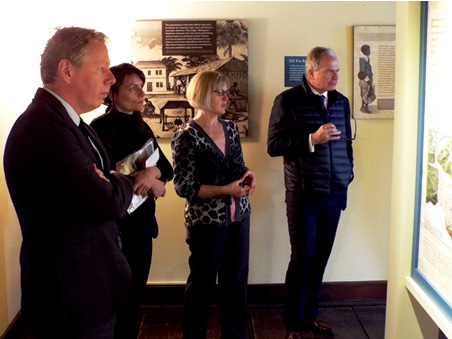
Touring the exhibits at Crailo State Historic Site, (left to right) Deputy Consulate General, Jan Kennis, Cultural Officer Tessa Dikker, Crailo Site Manager Heidi Hill, and Consulate General Dolph Hogewoning, photo by State Parks

Featured image: Consulate General Dolph Hogewoning and Deputy Consulate General Jan Kennis discuss the Schuyler family with Heidi Hill at Schuyler Mansion State Historic Site, photo by State Parks

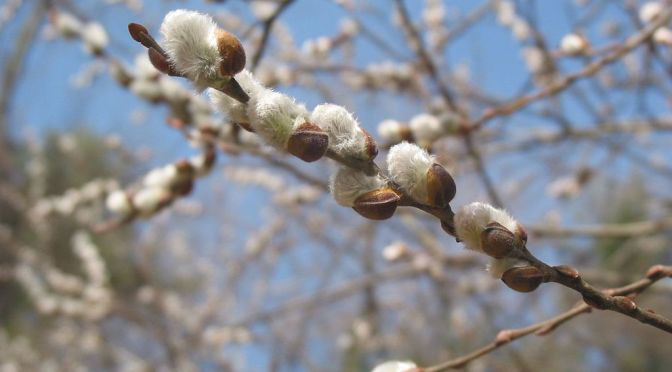
Unseen Buds

We salute National Poetry Month with a poem by Walt Whitman, the 19th century poet whose birthplace is a New York State Historic Site.

UNSEEN BUDS

Unseen buds, infinite, hidden well,

Under the snow and ice, under the darkness, in every square or

cubic inch,

Germinal, exquisite, in delicate lace, microscopic, unborn,

Like babes in wombs, latent, folded, compact, sleeping;

Billions of billions, and trillions of trillions of them waiting,

(On earth and in the sea – the universe – the stars there in the

heavens,)

Urging slowly, surely forward, forming endless,

And waiting ever more, forever more behind.

Walt Whitman, Leaves of grass, 1891-1892

Take some time this month to see the poetry in the unseen buds and early spring flowers in a state park or historic site near you.