

From New York City through the Hudson River and Champlain Valley up to Canada, and from Albany to Buffalo along the Erie Canal, New York State’s 750-mile Empire State Trail is the longest single-state multi-use trail in the United States. Weaving in and out of village main streets, urban centers, and rural communities across the state, the Empire State Trail provides a safe and scenic pathway for residents and tourists to experience New York’s varied iconic landscapes, rich history and diverse recreational offerings one mile at a time.
The Empire State Trail (EST) is open year-round, including winter, welcoming bicyclists, walkers, cross-county skiers and snowshoers of all ages and abilities. This jewel of the New York State Parks system connects 20 regional trails to create a continuous statewide signed route –75 percent of which is off-road on a mix of gravel and paved paths.
In this second installment of our Empire State Trail itineraries series, we invite you to explore the Finger Lakes, Northern New York, and New York City. We’ll see you out there!
Finger Lakes
Route: “Canalside Adventures” – Rochester to Fairport
Distance: 14 miles one-way, 28 round-trip (EST segment)
Erie Canalway Trail Information
The 365-mile Erie Canal was crucial to the development of New York and the United States during the 1800s. Granting access to the west, the canal gave rise to cities, towns and villages across its length as ships passed through the Empire State bound for the Great Lakes. Although no longer the vital shipping route it once was, the historic towns and villages along the canal still stand, along with the canal’s impressive infrastructure. Today, the Erie Canal remains important to New Yorkers for recreation, with opportunities for camping, biking, fishing, and boating.
From Watervliet to Buffalo, the Empire State Trail follows the footprint of the canal, making up the longest of the trail network’s three spurs. While there are hundreds of communities with access to the canalside trail, one of the largest communities along the EST is Rochester. A historic canal city with ties to the Underground Railroad, Rochester is full of natural beauty, esteemed universities, and innovative industry. The Rochester to Fairport section of the Empire State Trail exemplifies the best of Rochester.
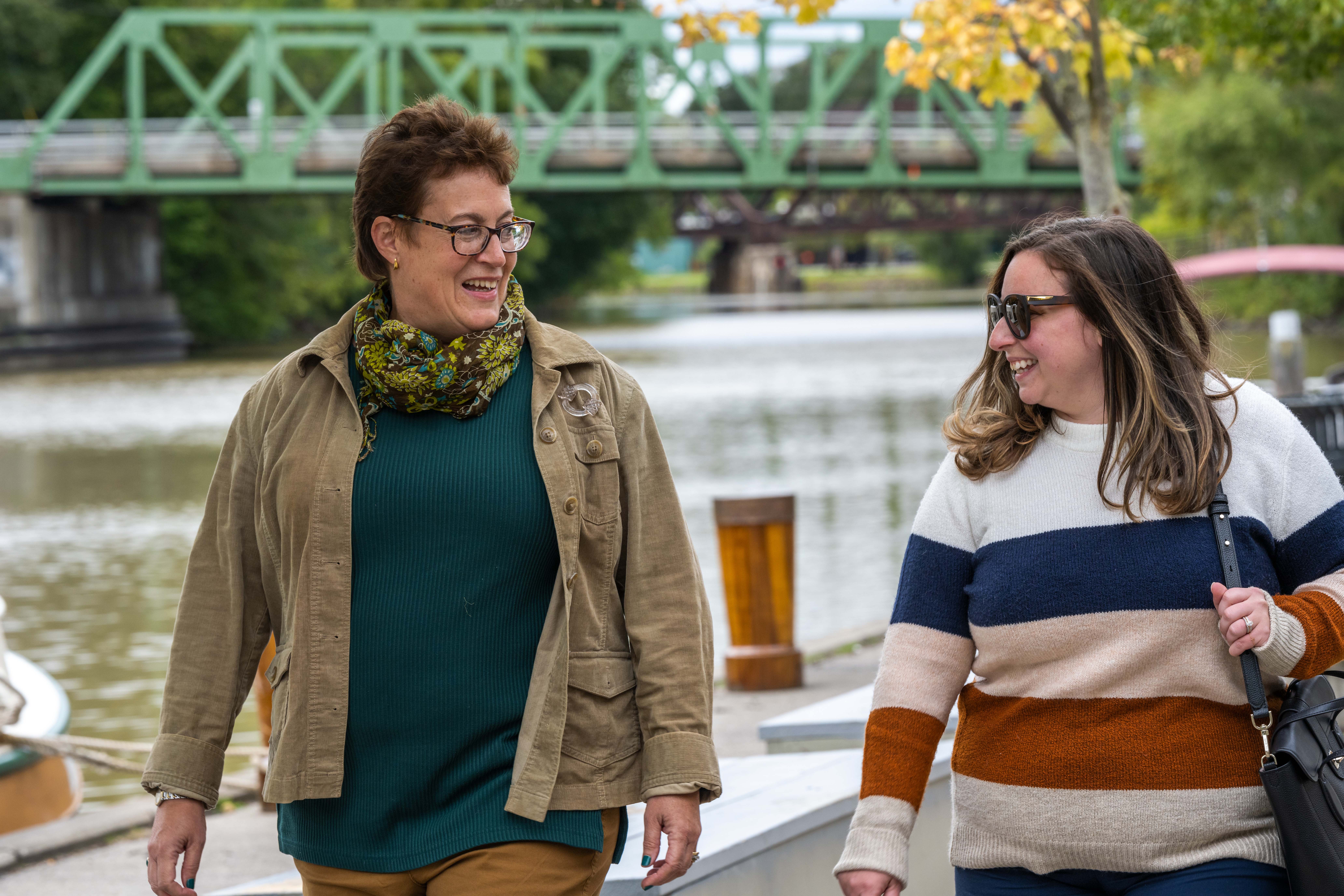
The trailhead for this section is located in the southside of the city, nestled between the University of Rochester and Rochester Institutive of Technology in the municipal Genesee Valley Park, itself a community jewel, with sporting fields, an 18-hole golf course, hiking trails, and Genesse Valley Greenway State Park’s northern gateway.
Head east along the canal, and you’ll soon pass Monroe Community College before encountering lock 33 of the Erie Canal. Along the Empire State Trail, you’ll pass many canal locks and may even get to see them in action as they help vessels navigate the historic waters. While many of these locks appear similar, lock 33 is special as it is the westernmost canal lock to offer campsites to those traveling along the Empire State Trail. Along the Erie Canal, there are 18 locks which provide limited amenity, or primitive, campsites for public use. Open May through October, these campsites are available for up to 48 hours on a first come, first serve basis. To coordinate your stay, contact the Section Office for the lock you wish to camp at. You can find more information about canalside camping on the New York State Canal Corporation’s website.
Roughly a mile down the trail, you’ll pass Nazareth University and lock 32 in Pittsford. Another lock which hosts campsites, these two locations are the only publicly-managed campgrounds along the Erie Canal in Western New York. Should you decide to take a detour and explore Pittsford, the small village welcomes you with authentic canal boat tours for another perspective on the canal’s cultural heritage.
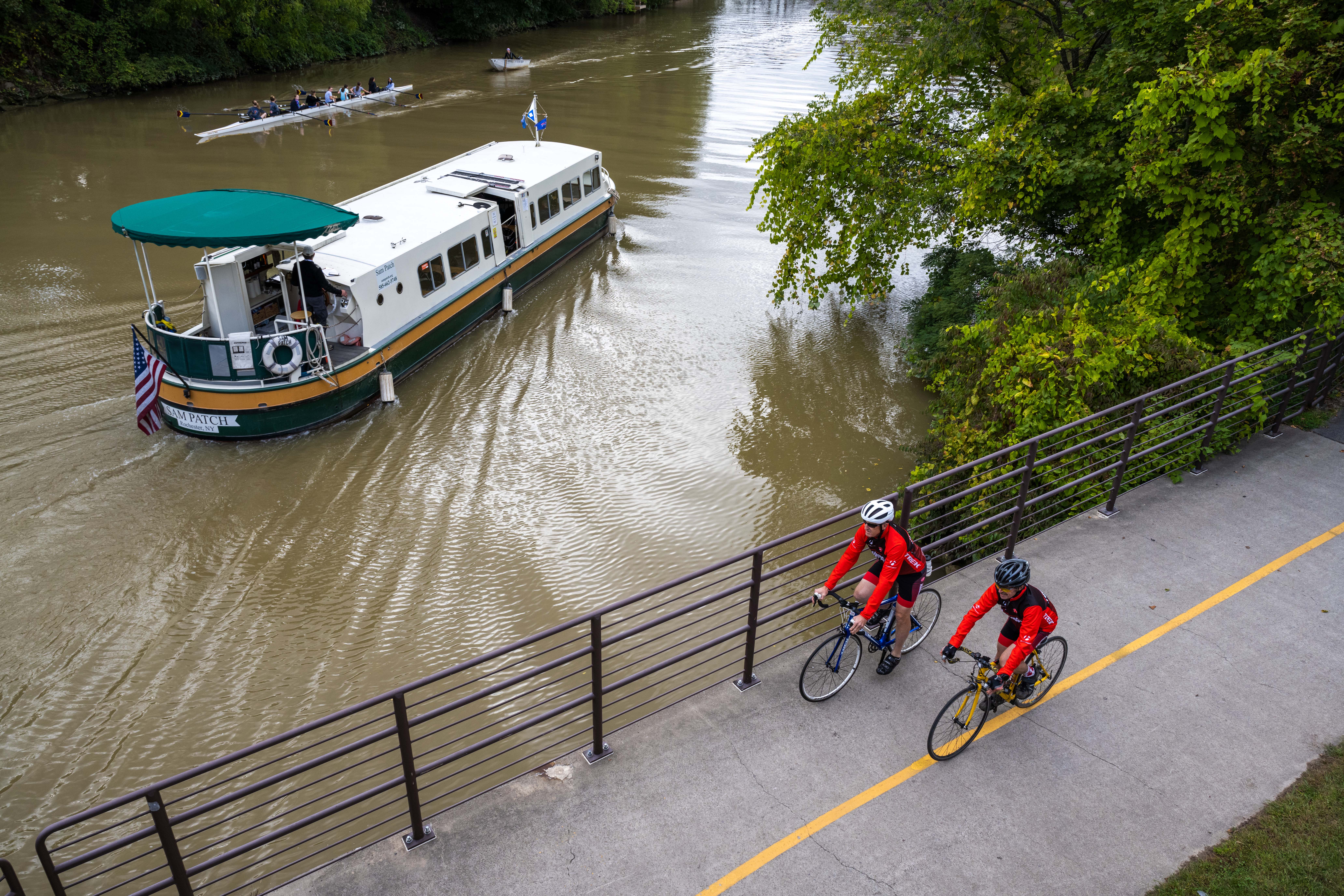
As you continue, you’ll leave pavement behind as the EST transitions to compacted stonedust for the next 5 miles as it winds its way through the Rochester suburbs. As you pass Great Embankment and Perinton Community Park, you’ll soon find yourself in the Village of Fairport. A vibrant canal town, Fairport is home to several restaurants, shops, historic buildings and a farmers market that’s held each Saturday.
Although a long route, this canalside adventure is mostly flat, making it a great choice for hikers and bikers of all abilities. It’s estimated to take a little more than one hour as a bike ride in each direction. It can take upwards of seven hours to hike the whole thing. Like every segment of trail on the EST, however, there are numerous access points allowing you to be in control of your journey and decide just how long your adventure is going to be.
For more information about this route and the different access points along it, visit the Empire State Trail website for additional guidance.
–Written by Jennifer Robilotto, Public Affairs Assistant
Capital District/North Country
Route: “Two Forts Route” – Fort Edward to Fort Ann
Distance: 24 miles round-trip, 12-mile turnaround option (EST segment)
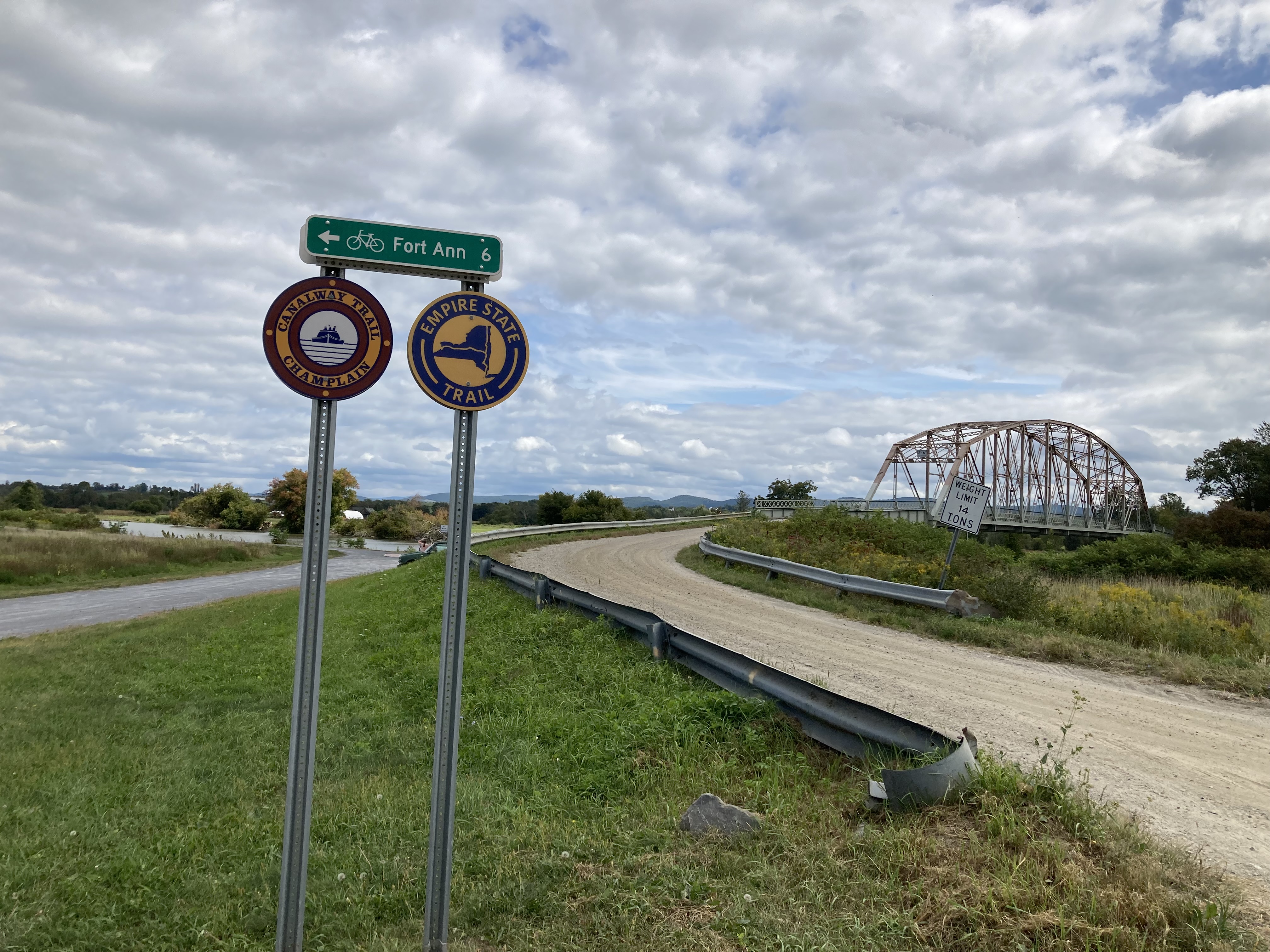
This 12-mile route connects two historic communities that were once frontier outposts – Fort Edward and Fort Ann. While most of the Champlain Valley Trail is best suited to experienced cyclists, this flat, mostly rural section is comfortable for hikers and casual cyclists of all abilities. It can be traversed in either direction, but this description begins at the Fort Edward Village Recreation Park (at the intersection of McIntyre and Factory Streets).
From the park, follow Towpath Lane, a low-traffic local road, northeast for 1 mile, to the start of the Champlain Canalway Trail, an off-road stonedust trail dedicated to walkers and bicyclists that runs adjacent to the abandoned historic Champlain Canal, which opened in 1823 – connecting Lake Champlain to the Hudson River. The stonedust trail gives way to a dirt road that the breed of cyclists known as ‘gravel grinders’ should enjoy.
After about six miles, the trail meets up with the modern Barge Canal at New Swamp Road. From here, the stonedust and paved trail meanders along the wider active canal constructed in the early 20th century. Canal Lock C-9/Smith’s Basin offers a nice rest stop, with picnic tables, a portable toilet in season, and a parking area. Primitive camping is also available for cyclists making a long-distance trek. The section ends at the Fort Ann Village Park on Clay Hill Road, which has picnic tables, a pavilion and bike fix-it station. The ride back to Ford Edward completes a 24-mile roundtrip. For a 12-mile roundtrip, make a U-turn at the New Swamp Road trailhead from either direction.
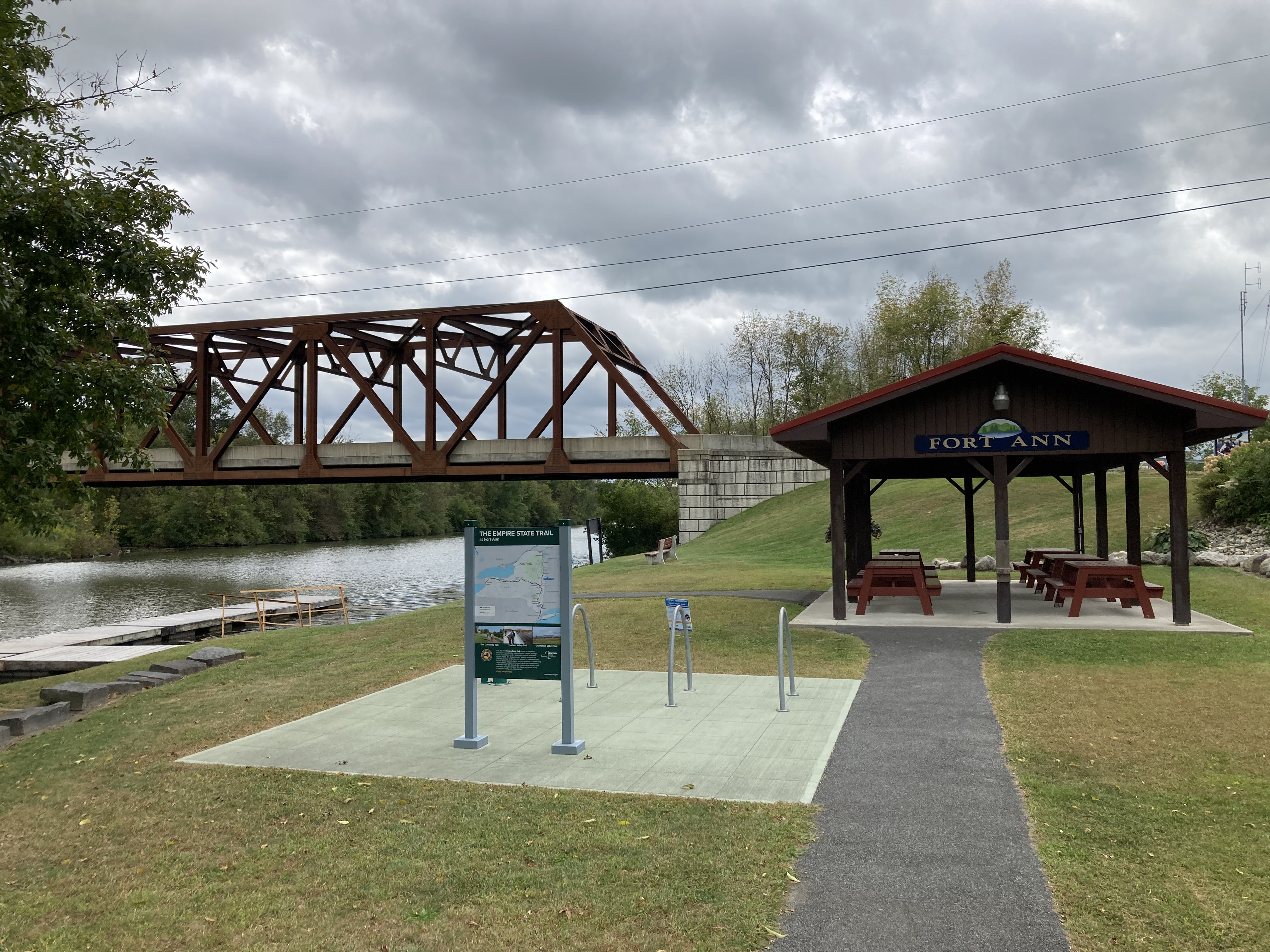
Restaurants, convenience stores and lodging are available in Fort Edward and Fort Ann, but there are very limited services in between. Both communities have notable connections to military history, with landmarks that are short side trips from the route. In Fort Edward, the Rogers Island Visitor Center preserves the story of the region, including that of Major Robert Rogers, a British Officer in the French and Indian War. Rogers wrote his “Rules of Ranging” while encamped on the island in 1757, which are still used in training of U. S. Army Rangers to this day. Fort Ann was the site of a July 8, 1777 American Revolution skirmish in the lead-up to the Battles of Saratoga, considered the turning point of the war. The American Battlefield Trust has recently preserved 160 acres of the battlefield.
–Written by Dan Keefe, Public Information Officer
New York City
Route: “Uptown, Baby” – Harlem to Washington Heights, with a pit stop adventure at Riverbank State Park
Distance: 2.5 miles, 5 miles roundtrip (EST segment)
The Manhattan Greenway trail is the southern-most tip of the Empire State Trail, allowing walkers, rollerbladers and cyclists to travel along the west side of the island with a remarkable view of the Hudson River and New Jersey.
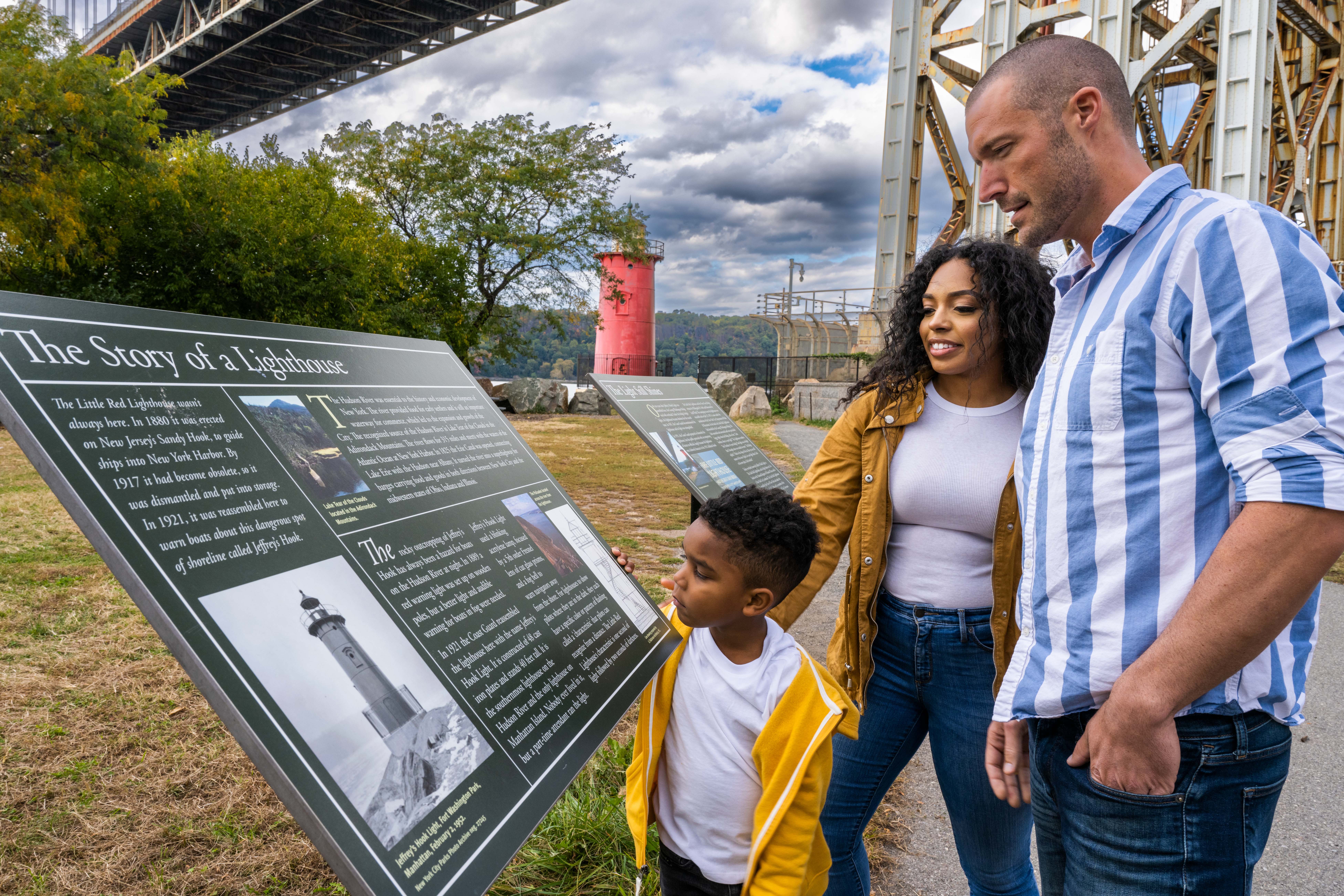
Due to current trail closures between (1) 100th Street and 130th Street and (2) 180th Street and Dyckman Street, biking the full length of that 12.5-mile trail segment between Battery and Inwood Hill north of the Upper West Side involves a good amount of on-road detours that are more challenging for navigation than the rest of the trail. Traveling on foot, however, offers a number of great opportunities to explore Manhattan’s coastline, including one of our favorite state parks in New York City, Denny Farrell Riverbank.
Whether you’re coming from the outer boroughs south of Harlem or from the north, take the 1 train to 125th street to begin your uptown journey. Once you’re off the train, walk three blocks west on 125th to the Greenway where you’ll officially enter the Empire State Trail! Take in the view and walk north on the paved trail about 15 city blocks to 145th Street — you can either go left over the Henry Hudson to enter Riverbank State Park or continue walking another mile or so up toward Washington Heights, passing first through Riverside Park and then Fort Washington Park (overseen by our friends at New York City Parks).
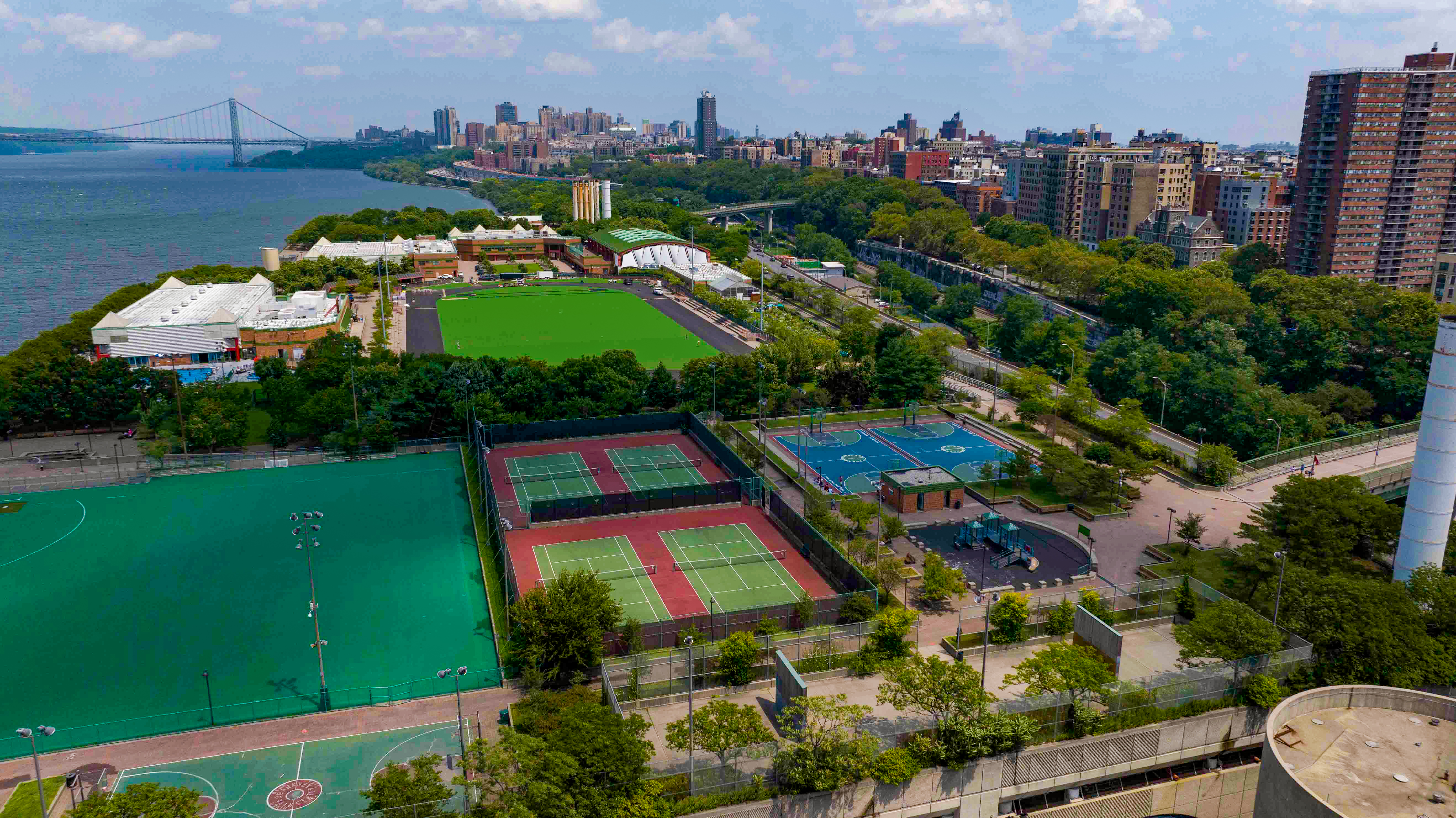
If you decide to explore Riverbank, there’s plenty to see and do. Inspired by urban rooftop designs in Japan, this 28-acre multi-level landscaped recreational rises 69 feet above the Hudson River. The park features a covered skating rink for roller skating in the summer and ice skating in the winter, an 800-seat cultural theater, a 25-yard lap pool, four tennis courts, four basketball courts, a 400-meter eight-lane running track with a football/soccer field, an educational greenhouse, two playgrounds, a delightful kid-inspired carousel, and dozens of weekly activities for visitors of all ages!
Riverbank State Park also boasts spectacular promenade views of the Hudson River, the Palisades and the George Washington Bridge. Stroll along the river and enjoy.
Whatever route you choose, this stretch of the Empire State Trail is active with runners, cyclists, folks walking their dogs, and children in strollers, so please be mindful as you navigate your way through this underrated stretch of Manhattan.
Trail Etiquette Tips
Before heading out on your Empire State Trail journey, some quick, common-sense tips to navigate busy trails safely, while being aware of the wide variety of trail users and occasional intersections.
State Parks’ new trail etiquette initiative consists of four main principles:
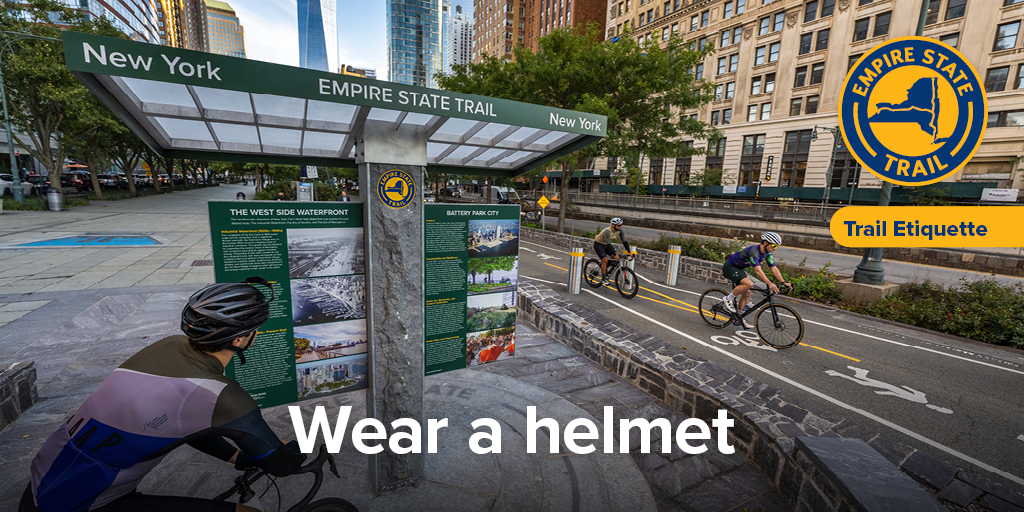
Wear a helmet: All cyclists should wear a properly sized bike helmet, with the strap buckled. Under New York State law, those under age 14 are required to wear an appropriate helmet.

Be courteous and aware: Because the trail is enjoyed by a variety of users, ages and abilities, visitors should be aware of the activity around them.
- All users, especially groups and those with children, should stay to the right and maintain a clear path for passing.
- Use and listen for bike bells. Cyclists must slow down for other trail users, use a bell or call out to alert others, and pass safely on the left. Under New York State law, all bicycles must be equipped with a bell that can be heard from 100 feet away.
- When stopping or taking a break, move to the side and avoid blocking the trail.
- Leashed dogs can make sudden movements and startle other trail users. Dog walkers must keep their pet under control at all times.

See and be seen: Cyclists are encouraged to ride defensively. Stopping at all intersections to check for oncoming traffic before safely crossing is advised.

Follow electric bike rules: Electric-assist bicycles, or e-bikes, are legal to use across the state. However, government entities and trail owners can place restrictions on the types and places they may be used. In most locations, e-scooters, one-wheels, and higher-speed e-bikes are prohibited. On road, Class I and Class II e-bikes are permitted where the posted speed is 30 mph or less. It is the responsibility of the rider to know where and what types of e-bikes are allowed and to operate them in a safe manner.
“Regardless of whether you walk, run, ride a bike, operate a wheelchair, walk a leashed pet, push a stroller, or cross-country ski, New York State Parks wants to ensure all trailgoers are aware of their surroundings and share our beloved trails with courtesy and safety in mind,” said New York State Parks Commissioner Pro Tempore Randy Simons. “We all want to get outside and enjoy all that New York has to offer, and small actions can mean the difference between a memorable fall day on the trail or a trip to urgent care.”
–Written by Lacey Seidman, Deputy Public Information Officer
 New York State Parks and Historic Sites Blog