You may have heard the name iMapInvasives before, but if you have not been exposed to this magnificent mapping tool, I recommend you check it out! iMapInvasives, New York State’s online invasive species database, could be compared to a modern-day hero. A robust and helpful resource- thanks to its devoted observers.
Citizen Scientists, Educators, Students and Dedicated Natural Resource Professionals…. You can be an observer too and you can help protect our natural areas.
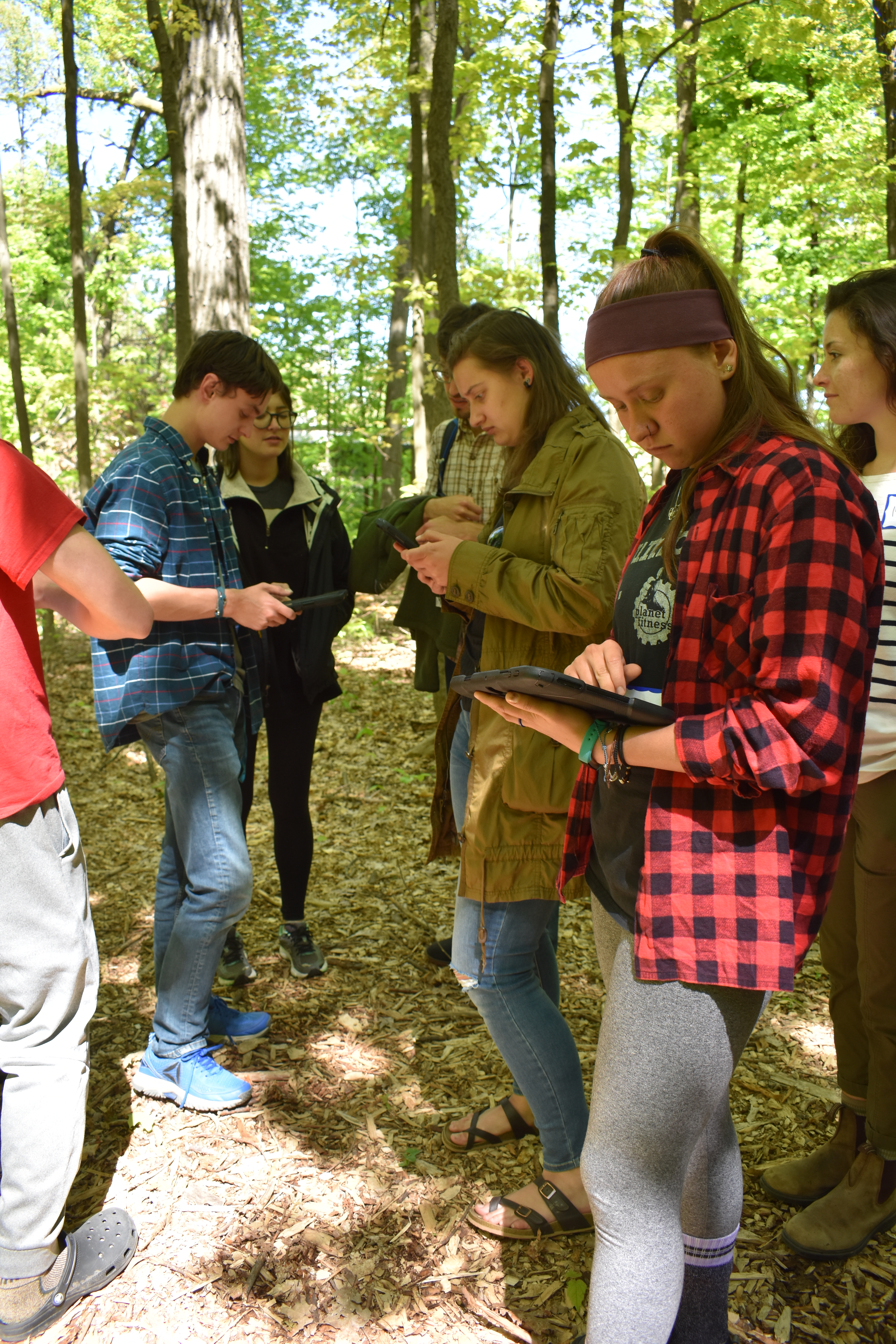
As we all know, every hero needs an extraordinary sidekick. In this case, it’s the Certified Trainers Network (CTN). The iMapInvasives CTN does its part by hosting trainings for people, located far and wide, about invasive species and how to report them. Established in October 2017, the network has already hosted over 75 in-person trainings across New York State and taught over 900 attendees about iMapInvasives’ capabilities.
If you have a desire to teach your community about iMapInvasives, you can become a certified trainer. All you have to do is:
Participate in the initial online training or watch the recorded webinar.
100 years ago this summer, a little girl received a lovely present from her grandmother.
A leather-bound notebook, perfectly sized for small hands. The paper was heavy, to thwart ink from pooling and bleeding through. The pages were lined, to keep unsteady handwriting neat. The gilded edges indicate the importance and timeless elegance of its owner, a daughter of one of New York’s first families. Her name was emblazoned on the cover— Honoria Alice Livingston.
Honoria was the eldest daughter of John Henry Livingston and Alice Delafield Clarkson Livingston. Her great-great grandfather was Chancellor Robert R Livingston, one of the 5 drafters of the Declaration of Independence, the Minster to France under Jefferson, and the co-inventor of the first practical steamboat, just to name a few accomplishments. The Livingston mansion, Clermont, was decorated in 7 generations of familiar excellence. Honoria grew up at Clermont surrounded by her family’s achievements and with the love her parents, her younger sister Janet, their beloved nurse Ollie, a dozen or so servants, and a menagerie of pets.
Honoria and her family
Her maternal grandparents, Howard and Alice Clarkson, lived just up the road and visited often. Grannie Alice and Mom Alice were both prolific poets and journal writers in their own right, so it’s no surprise that young Honoria was showing an interest and a talent for creative writing herself. Grannie christened the notebook with a special poem for her young granddaughter.
To Honoria.
When Grannie was a little girl
She made a little book,
And many times with joy and pride,
Did in its pages look.
And here she wrote her little tales,
And sometimes verses too;
For airy fondness came to her
Just as they come to you.
And now you write such pretty tales,
And little verses too;
So Grannie thought perhaps this book
To hold them all, would do.
The very day she received the book, Honoria took to work. On the next page, in her very best 10-year-old handwriting, she titled the contents “The Poetry I Made My-Self.” She wrote three poems that day and several more throughout the week.
Comb and brush
I hear a thrush.
Comb and brush
I want to wash.
Brush and comb
Gobi is home
Brush and comb
Away I rome.
Honoria A. Livingston. Aug 3rd 1919
Early poems reference her family, her beloved dog Gobi, and strict rhyming schemes, even if she had to bend the rules a bit to make it work. The following year, the little notebook traveled with the Livingston family as they moved abroad to continue their daughters’ education. Honoria’s repertoire of subject matter grew beyond family life at Clermont and started to include the French countryside, German soldiers, English fairies, and Italian friends.
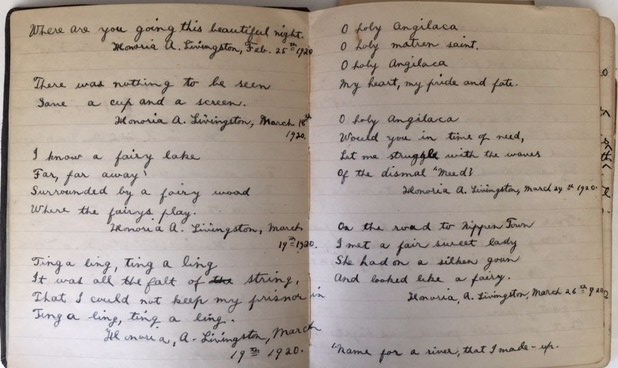
A sample of Honoria’s poetry including O Holy Angelica.
The Livingstons lived in Europe for the next 6 years. Honoria became a teenager and her subjects became more mature and dramatic:
There’s a road that leads to nowhere good,
There’s a road that leads to Hell;
But there’s also a road to Paradise,
and on that road I dwell.
-Honoria A. Livingston Oct. 5th 1924
Guicciardini, Florence.
Her structures became more experimental and modern:
Of the Universe!
Tell us, I pray thee
Where do the sunsets go when dead?
-Honoria A. Livingston December 2nd 1924
Guicciardini, Florence.
But even so, more than half of her poems are about her beloved pets and many about the comings and goings of her family and friends. Some of her poems are even in French and Italian! She loved to write about the moon and sunsets over Florence, where the family called home for her teenage years.
A week before her 17th birthday in 1926, she wrote a poem to herself, remarking on the occasion and how much she had grown since starting the notebook:
Almost Seventeen!
From a very little child
Into a stately maiden dark,
she has grown.
Guicciardini, Florence. January 25th 1926
The rest of her poems in 1926 play out as her previous years in Italy had— pets, family, and beautiful evenings at the family’s Villa. But in November, something happens. The family suddenly rushes back to the States, leaving precious friends and belongings behind. Honoria’s handwriting becomes rushed, the ink is half washed away in big drips, and pages are torn out. The end of 1926 and the beginning of 1927 do not exist.
Ripped pages from Honoria’s book.
This is when Honoria’s father, John Henry, passed away.
After JH’s passing, the family settled back in at Clermont. Honoria writes in the notebook for another year and then sets it aside— a memento of her childhood and teenage years. She grew up, had her debut in New York City, and married a charming Irishman named Rex McVitty.
Honoria and Rex
They spent their lives at Clermont in Sylvan cottage, even after the mansion and grounds were deeded to The People of the State of New York. They enjoyed meeting park visitors and actively took part in site events. Honoria lived in the cottage until her passing in 2000— her tin mailbox and Poughkeepsie Journal newspaper box were only recently removed from the driveway.
Honoria on Sylvan Cottage’s porch
But even as Honoria grew up, from a 10-year-old girl with her first important grown-up possession, to a beautiful debutant, to an accomplished writer, golfer, gardener, and the Lady of the Estate, she never forgot about her notebook. She came back to it “many times with joy and pride,” just as her Grandmother had before her. As an adult, she even edited and typed some of her early work.
The typed version of Fairies
From a historian’s perspective, Honoria’s poetry journal is a fascinating artifact. Not just a chronical of a young girl growing up, but a chronical of life for an American family and a window into post WWI Europe. Not just flights of fancy, but a collection of popular culture influences of the time. Not just cute pets, but little family moments that tell us so much about the last generation of Livingstons of Clermont. It’s a lovely little book, a scrapbook of experiences, and we are lucky to have it.
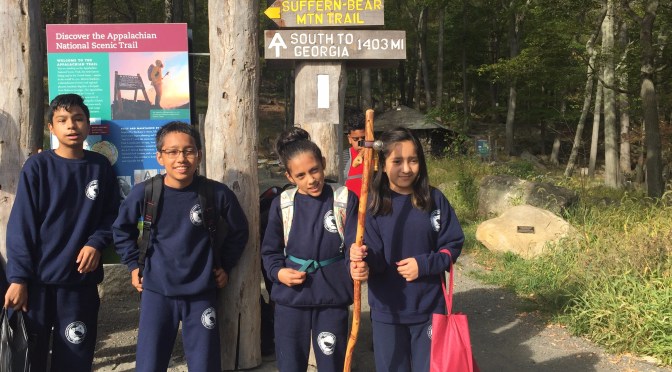
Since the fall of 2016, approximately 300 seventh graders from the P.S./I.S. 218 Rafael Hernandez Dual Language Magnet School in the Bronx have enjoyed an annual field trip to Bear Mountain State Park, thanks to the Connect Kids Field Trip Grant program run by State Parks. The hour-long journey from the school affords views of spectacular autumnal foliage and the Hudson River Valley to our urban students.
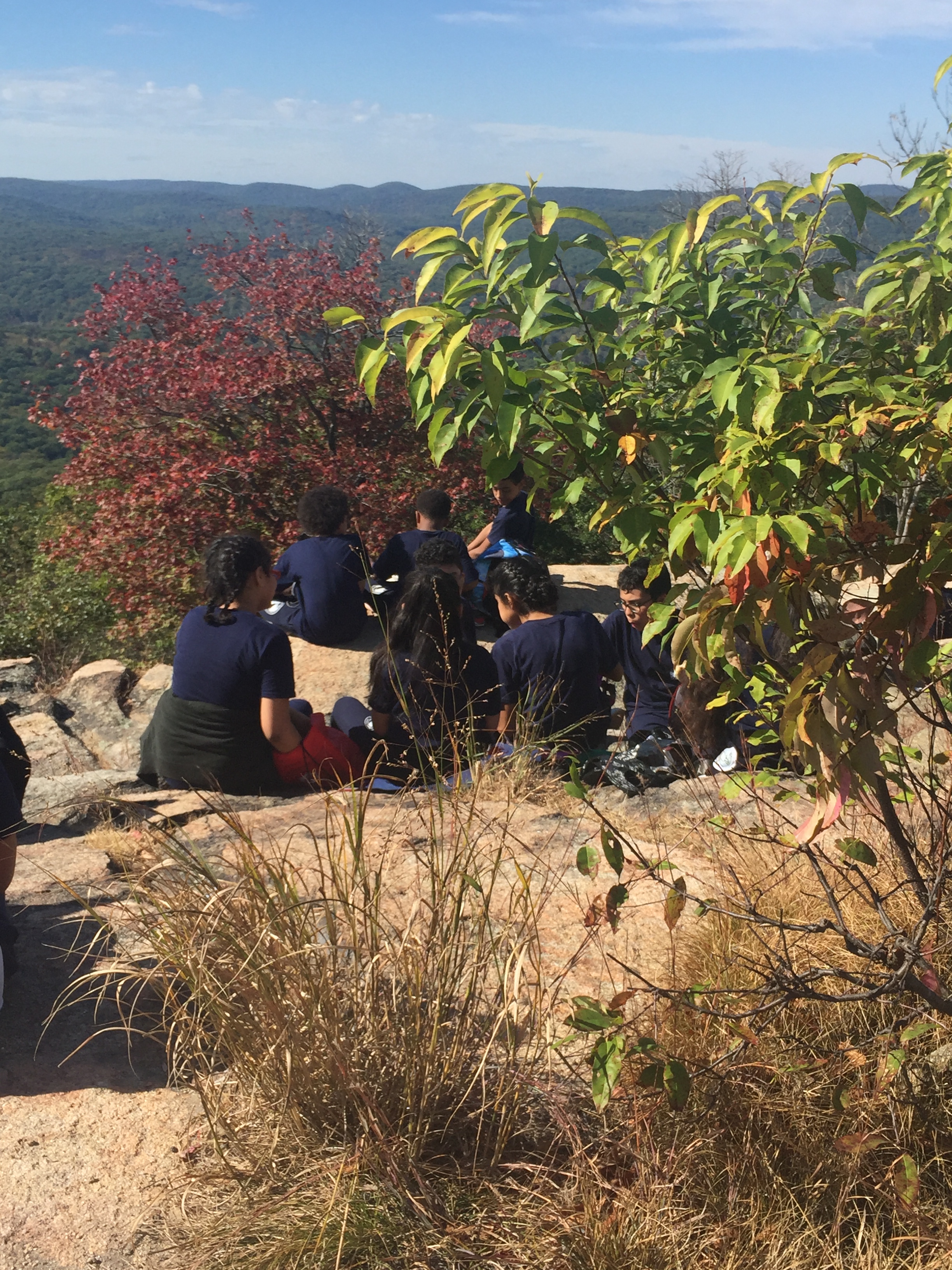
Students pause at the top of Bear Mountain, enjoying the views of the Hudson River
Arriving at the site the students divide into two groups: one group hikes a portion of the Appalachian Trail, while the other visits the animal exhibitions at the Trailside Museum and engages in organized outdoor play outside the Bear Mountain Inn. (Some of our students suffer from asthma and don’t choose the mountain hike.) They return to school thoroughly exercised, full of excitement from their experiences hiking or observing firsthand the animals at the Zoo. The trip coincides with an English Language Arts unit of study focused on memoir, or personal narrative. For many, the hike up the mountain has afforded the first opportunity to hike a woodland trail that our students have ever experienced, and they write about their experience and recall it throughout the year proudly.
Because we teachers applied late in the fall, we traveled to Bear Mountain in early December of 2016. The smell of the pines was intoxicating, but a light snow had just fallen, making the trail slippery and a bit treacherous on the way up. We conceded that the mountain top was beyond our reach that day, and did our best to lead the students back down the trail as carefully as we could. We wished we had foreseen the footwear that the students needed to better negotiate the trail under slippery conditions – some were wearing sneakers with little tread.
PS 218 students on the trail in early December
In our second year, we scheduled our trip in early October, and our mountain hikers encountered a blazing hot Indian summer day. Though we reached the top of Bear Mountain, a few children had inexplicably brought loaded backpacks, which created all kinds of challenges for our teacher crew. Yellow jackets were abundant near the picnic areas below; one student was stung! We realized later how much we needed to bring an abundant supply of water for the return trip home on the buses. Vomiting incidents drove home that there were risks related to the heat, but junk food and dehydration played a part as well.
This year, the buses were very late departing the school, which cut short our time and made it impossible to reach the top of the mountain. NYC morning rush hour traffic can be unpredictable; next year we will be sure to request our buses earlier. At the end of the day, a shortcut on a loosely pebbled trail led to multiple scraped knees.
Each year, we realize how we can plan better for the next! So, for your Kids Connect Trip, be sure you …
Require comfortable and appropriate footwear, depending on time of year; jackets if appropriate
Limit backpack weights. Test as kids leave bus (allow only lunches and a drink)
Outlaw sweet drinks, and chips or sweets for the ride! Students should eat a good breakfast!
Bring first aid kits for bee stings, cuts, bug bites
Stock an abundant supply of water on your buses
Secure contacts of individual bus driver
Remember your bus permit and paperwork to verify your site visit with a signature from Parks administrative staff
Post and photos by Heather Baker Sullivan, PS 218 Rafael Hernandez Dual Language Magnet School teacher
New York’s State Parks are home to many unique natural features. Green Lakes State Park, near Syracuse, is the home of a National Natural Landmark. The Landmark found here is Round Lake, which is one of 28 such sites found in the state. A National Natural Landmark (NNL) is a natural area that has been designated by the Secretary of the Interior in recognition that the site contains significant examples of the nation’s biological and/or geological features. Round Lake is a rare meromictic lake surrounded by a forest that includes about 20 acres of diverse, old-growth forest. These two components led to Round Lake’s designation as a National Natural Landmark in 1973. The maple-basswood rich mesic forest and the meromictic lakes at Green Lakes State Park have also been recognized as being of statewide significance by the NY Natural Heritage Program (2018) in addition to Round Lake’s designation as a NNL.
The plaque at Round Lake dedicating it as a National Natural Landmark.
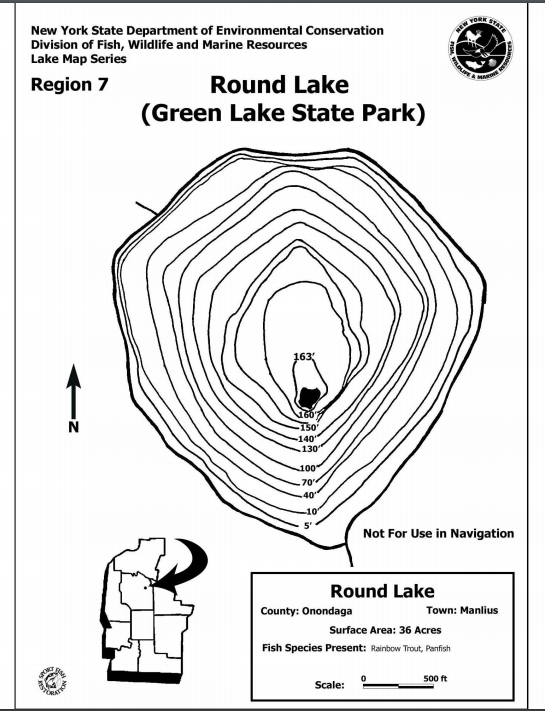
You may be asking yourself, what is a meromictic lake? A meromictic lake is a lake that does not have complete mixing of the surface and bottom waters. This is due to the lake being very deep without a large surface area: Round Lake is over 163 feet deep with a diameter of about 700 feet or 36 acres (see below). The most common type of lake mixing is a dimictic lake which mixes twice a year, once in the summer and once in the fall. To learn more about lakes and their seasons (they have them too!), please see this blog.
Meromictic lakes remain chemically stratified throughout the year which makes it very hard for organisms to live there especially in the deepest layers of the lake. Chemical stratification refers to the layering of the water within the lake based on chemicals such as dissolved salts and oxygen. Because of this, there is no oxygen and there tends to be lots of dissolved salts in the lower layers as the salts increase the density, or weight, of the water which makes it sink to the bottom of the lake. These conditions make species diversity in a meromictic lake very low. The few fish that occur here are confined to live in the epilimnion, the top layer of water, because that is where there is enough oxygen for them. Snails, zooplankton and phytoplankton (microscopic aquatic critters and plants) are the more abundant species in these lakes.
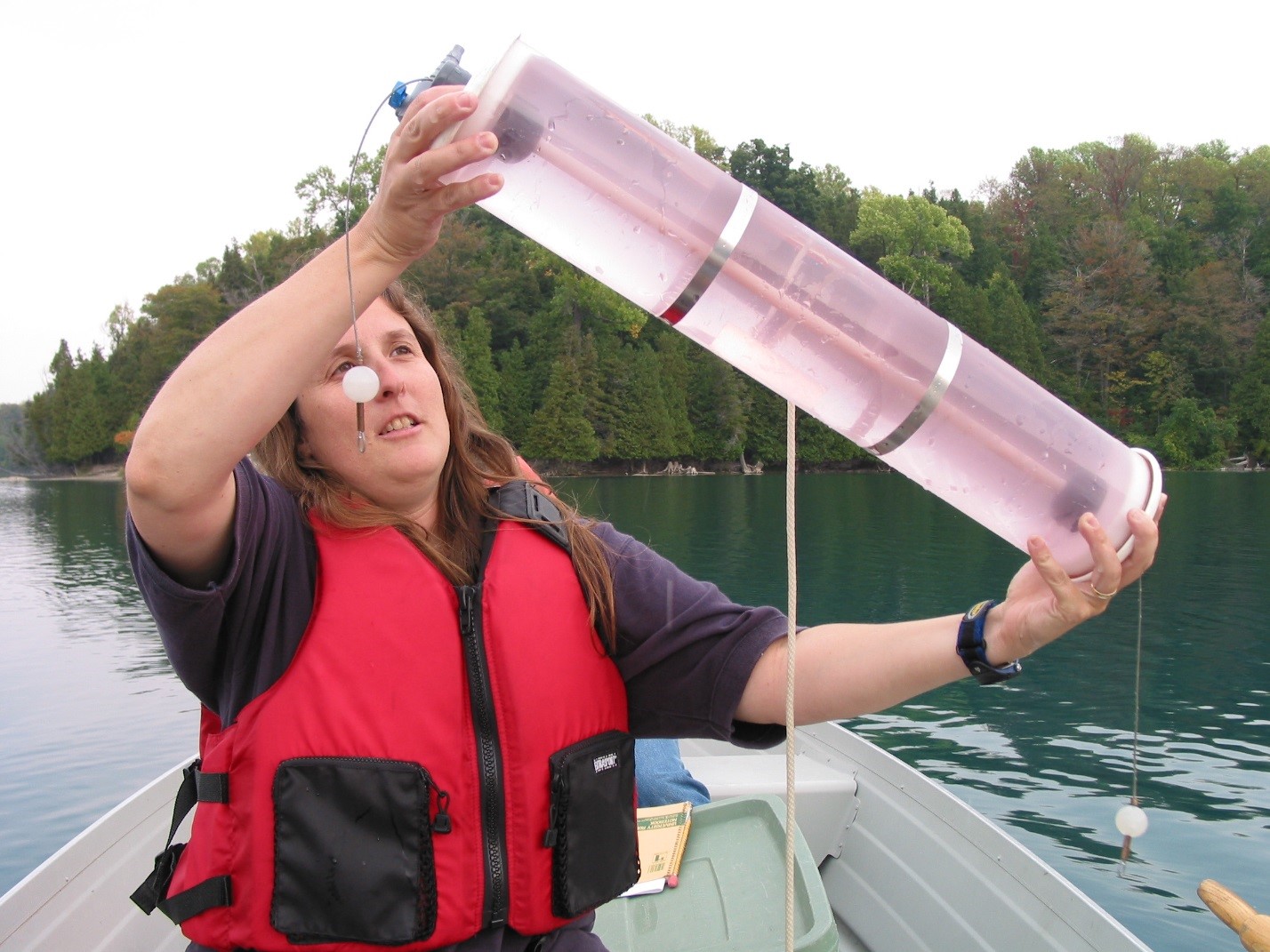
One exception to the lack of life in the depths of a meromictic lake is the presence of several interesting types of bacteria, for example those in the other lake on the park’s property, Green Lake. Green Lake has a characteristic purple sulfur bacterium that resides in the deep waters. If you pull a water sample from that layer of water, the sample that comes up is this purple-pink color and it smells like rotten eggs. This color and smell comes from the purple sulfur bacteria that resides in the water, which has been studied by many researchers such as those at SUNY College of Environmental Science and Forestry (see picture below). Although Green Lake is also a meromictic lake, it is not included in the Natural Landmark due to the higher use and less natural surroundings than Round Lake.
A water sample showing the purple sulfur bacteria at Green Lake. Photo by Kim Schulz, a professor at SUNY-ESF.
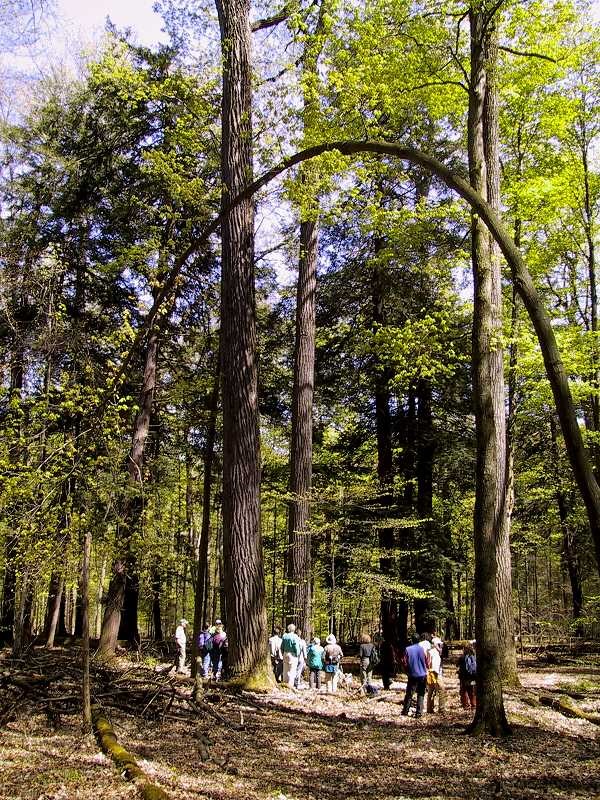
The other major component that makes Round Lake a National Natural Landmark is the old-growth forest that surrounds the lake. The Landmark is described as containing 20 acres of “virgin mesophytic forest”. The term “virgin forest” typically describes sites that have never been cut, which is not quite the case here, but the site is exceptional in having minimal cutting over the past few centuries and now supports trees that range from 100 to nearly 400 years old. Mesophytic is an ecological term that describes the vegetation characteristic of rich, moist, well-drained soils. NY Natural Heritage Program describes this forest as a maple-basswood rich mesic forest (2014) and maps roughly 130 acres in the park as old-growth forest – a good place to see some very old trees! There are some particularly old (and very tall) specimens of tuliptrees, bitternut hickory, sugar maple, hemlock and basswood within the Tuliptree Cathedral southwest of Round Lake. The largest tree measured there was 147 ft in 2011, one of the many tuliptrees to be found in this forest.
Above is a picture of the Tuliptree Cathedral renamed as such following extensive surveys of the old-growth forests in 2001-2002. Photo by Diane Wheelock.
NY State Parks contain many more exceptional sites to see beyond Round Lake! To learn more about other National Natural Landmarks located within State Parks, please see these blogs on the Ellenville Fault Ice Caves and the Iona Marsh.
Post by April Brun, State Parks
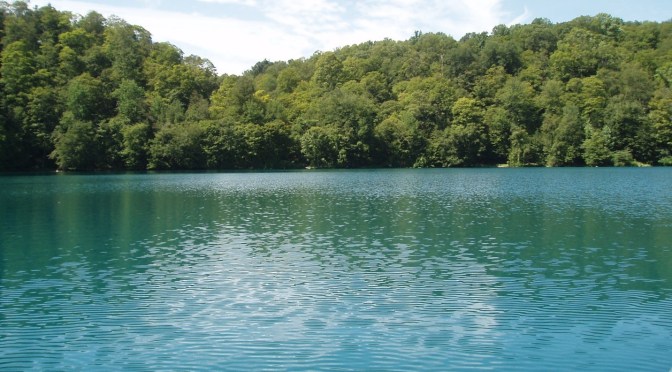
Featured Photo taken by Parks Water Quality Unit looking at the western shoreline of the lake.
This spring, as you spend time hiking or recreating in one of your favorite state parks, keep an eye out for an insect with a name almost as evocative as its striking appearance – the mourning cloak!
Nymphalis antiopa, also known as the Camberwell beauty in Great Britain, is easily recognizable due to its wings, which feature an irregularly-shaped bright yellow border with a row of iridescent blue spots on the inner edge. Some other historical names for the species also reflect its appearance, including “grand surprise” and “white petticoat.”
The mourning cloak is unusual in that it overwinters as an adult, hiding in tree cavities and under loose bark. It starts flying again as soon as the days warm up, even where there’s still snow on the ground.
Not just native to the northeast, the mourning cloak is broadly distributed around the hemisphere – in fact, it’s the state insect of Montana! Their wingspan ranges from 2 ¼ to 4 inches and they have one of the longest lifespans for any butterfly at 10 to 12 months. Their favorite snacks include rotting fruit or tree sap, and they can often be found gathering on oak trees.
Nymphalis antiopa (mourning cloak) caterpillar, photo by Hectonichus, accessed from Wikimedia Commons
They’re also highly distinguishable in their immature form as the spiny elm caterpillars, with black spiny bodies run through with a streak of reddish to orange colored dots. After feeding on young leaves, the caterpillars will pupate and emerge in their adult form mid-summer. Some adults migrate in the fall, and have been spotted as far south as Guatemala.










 New York State Parks and Historic Sites Blog