National Trails Day speakers at the site’s National Recreation Trail dedication included: NYS Parks Statewide Trails Program Planner Chris Morris, District Manager for NYS Assemblymember Addie Russell Kate Wehrle, Village of Sackets Harbor Mayor Vincent Battista, site manager Connie Barone, NYS Parks 1000 Islands Region Director Peyton Taylor, and Deputy District Director for NYS Senator Patti Ritchie Mike Schenk. Also attending were the Town of Hounsfield Supervisor Tim Scee and representatives from the Adirondack Mountain Club Black River Chapter, Ontario Bays Initiative, and Indian River Lakes Conservancy. Guests followed the trail in perfect weather and enjoyed refreshments donated by Walmart and Price-Chopper.
In June 2015, the United States Department of the Interior designated Sackets Harbor Battlefield History Trail at Sackets Harbor Battlefield State Historic Site (Sackets Harbor) as one of ten new National Recreation Trails. The trail tells the story of Sackets Harbor and the pivotal role it played during the War of 1812 through ten interpretive panels along the three-quarter mile loop trail. Additional panels highlight other historical aspects of the site including the 1860s Sackets Harbor Navy Yard and the importance of historic preservation.
Sackets Harbor Battelfield History Trail interpretive panel, photo by Constance Barone
The trail unifies the core of this 70-acre property. The trail is accessible and offers views of the 1860s Navy Yard structures, the 1913 War of 1812 Centennial 100-maple tree grove, the 1930s Civilian Conservation Corps decorative stonewall, abundant birdlife, and unsurpassed views of Black River Bay on the eastern end of Lake Ontario.
From mid-May through Labor Day, amenities near the trail include public restrooms, a picnic pavilion, interpretive programs, and living history demonstrations. On the trail visitors walk, jog, or bicycle. Just off the trail guests practice yoga, rest on benches, picnic, fly a kite, or bird watch. The non-motorized trail is open year-round, free of charge. Sackets Harbor staff maintains the trail’s stone dust surface and reproduction mid-19th century wooden boardwalks.
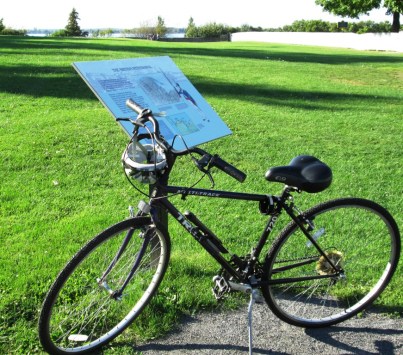
Bicycles are one of the many ways to explore the Sackets Harbor Battlefield Recreation Trail, photo by Constance Barone
Sackets Harbor Battlefield History Trail connects to the Village of Sackets Harbor’s War of 1812 Bicentennial Recreation Trail. That trail consists of stone dust paths, converted rail line, village roadways, and sidewalks. The six-mile loop through the historic village includes the former Army post Madison Barracks, two historic cemeteries, and farm fields where the 1813 Battle of Sackets Harbor took place. In July 2014, during the War of 1812 Bicentennial celebration, two granite monuments erected in the fields along the trail to honor the American forces who died defending Sackets Harbor and British-Canadian forces who were killed during the 1813 battle.
The National Park Service recognized the grounds at Sackets Harbor as one of the top War of 1812 sites in the nation. Sackets Harbor is the only deep-water United States port along eastern Lake Ontario. In June 1812 and again in May 1813 Americans successfully defended the Navy shipyard at Sackets Harbor from invading British and Canadian forces. WCNY featured Sackets Harbor battlegrounds in the 2014 documentary Losing Ground: The Race to Preserve War of 1812 Battlefields in New York State, funded by the National Park Service Battlefield Protection Program.
Come check out this newly recognized National Recreation Trail at Sackets Harbor Battlefield State Historic Site!
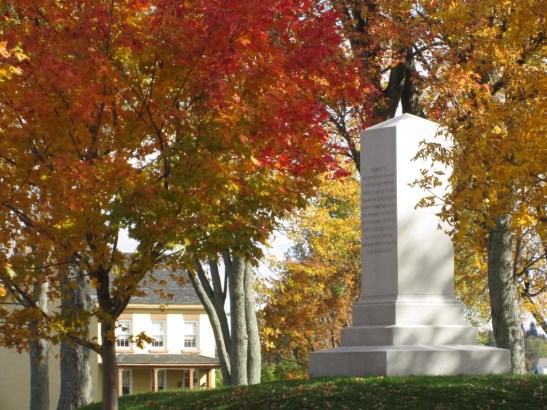
The Commodore’s House at Sackets Harbor Battlefield State Historic Site, photo by Constance Barone
Exploring Letchworth State Park geology at the Humphrey Nature Center, photo by Doug Kelly, State Parks
Interpreting might seem like a strange way to describe what the naturalists and historians at Letchworth State Park do. Instead of interpreting one human language to another, they tell the stories of the people who came before and of the beings with no languages; the rocks, trees and animals that make the park such a special place.
This need to educate the public about the park started even before there was a park. William Letchworth (1823 – 1910) assembled the Council Grounds and a museum to engage the strangers who came to his property on railroad excursion trains. He had trails and carriage paths which visitors could walk and enjoy the clean air and shady trees. He brought orphans from Buffalo to enjoy the country and learn vocational skills from his farmhands and household servants.
Following Letchworth, the American Scenic and Historic Preservation Society created the Letchworth Arboretum and built the William Pryor Letchworth Museum. The society intended there to be a research and educational aspect to the work they did. Most of their efforts were directed to building roads and facilities for visitors and transforming the park into a public space.
New York State took over management of the park in 1930. In the 1970s there was a statewide effort to mesh parks with schools and use the parks as educational tools for students. Interpreters were hired and nature and history programs started. By 1974, the National Audubon Society joined in a partnership with the Genesee State Park Region Commission to investigate building nature centers at Letchworth and Hamlin Beach State Parks. Although nothing came of this venture, the idea for a nature center at Letchworth never went away.
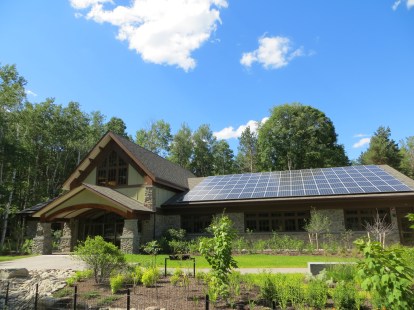
Humphrey Nature Center, photo by Elijah Kruger, State Parks
In 2016, the Humphrey Nature Center at Letchworth State Park opened on June 20 and was made possible by a joint fundraising effort of the Letchworth Nature Center Campaign Committee, which includes representatives of the Genesee Regional Parks Commission, the Open Space Institute’s Alliance for New York State Parks, and the Natural Heritage Trust. The campaign raised private funds that were matched 2 to 1 by New York State thanks to Governor Cuomo’s economic development initiatives. The Letchworth Nature Center Campaign Committee was chaired by Peter Humphrey who also, along with his wife, provided an extremely generous donation to kick start the fundraising campaign. The Humphrey Nature Center at Letchworth State Park was named in his honor, recognizing the great role Peter Humphrey played in making the project a reality.
State Park educators lead a tour of the Humphrey Nature Center, photo by Doug Kelly
The goal of the Humphrey Nature Center is to deepen the visitor experience of Letchworth State Park, which was voted the #1 state park in the nation in 2015. The 5,000 square foot, year-round, sustainable facility will help to enhance the exceptional educational and interpretive programming already offered to visitors. Meeting and classroom space, state-of-the-art, hands-on exhibits, a butterfly garden, bird observation area and trails that leave right from the building enrich the visitor’s understanding of the unique history, geology, and environment found in Letchworth State Park.
The next time you are in Letchworth, be sure to visit the Humphrey Nature Center for a program, to explore the exhibits, or just to talk with one of the knowledgeable naturalists. Remember, the Humphrey Nature Center is just your launching point into the fascinating natural history of Letchworth State Park!
Post by Elijah Kruger and Steph Spittal, Letchworth State Park educators
Water explorations, Letchworth State Park, photo by OPHRP
Relaxing after a program at Letchworth State Park, OPRHP photo
Text and photos by Lindsey Feinberg, Student Conservation Association Intern at Sam’s Point Please ask permission to use photos.
Located within Minnewaska State Park Preserve is Sam’s Point, an area of unique ecological significance encompassing roughly 5,000 acres in the Shawangunk Mountains of southern New York. Toward the end of April, during a particularly dry and windy week, a fire broke out along the Verkeerderkill Falls Trail and engulfed over 2,000 acres of pitch pine and oak woodlands. While this may seem like a devastating event, one of the factors that make the globally rare dwarf pine ridge ecological community of Sam’s Point so unique is that it is a fire dependent ecosystem.
Since progressing into the deep summer months, Sam’s Point has experienced an explosion of new growth. Toward the end of the fire there was an extended period of cold rainy weather that continued for a week after the fire was out. Soon afterward , bracken fern (Pteridium aquilinum) fiddleheads began springing forth through the burned earth and painted trilliums (Trillium undulatum) flowered near the Ice Caves trail in an area of low intensity burn. A number of pink lady slippers (Cypripedium acaule) also popped up along the Loop Road and the Verkeerderkill Falls Trail.
The fiddleheads of bracken ferns (Pteridium aquilinum), one of the first plants to return after the fire. Photo by Lindsey Feinberg
A perfect pink lady slipper (Cypripedium acaule) brightens up the landscape. Photo by Lindsey Feinberg
These painted trilliums (Trillium undulatum) emerged from the moist soils below the charred surface. Photo by Lindsey Feinberg
Sam’s Point was fully closed until Memorial Day Weekend, when it was reopened to limited capacity with only the Loop Road and Ice Caves Trail available to the public. Park staff members were positioned at the Verkeerderkill Falls Trail with a table of educational materials in order to encourage park patrons to obey the closures and help them understand the importance of staying out of affected areas. The main concern is the potential for rapid spread of non-native invasive plant species by seeds hitchhiking in the boots and backpacks of visitors. Without competition from established plants and with the increased availability of nutrients that follows fire, invasive species have the potential to quickly establish.
Fortunately, the closures seem to be working and few invasive plants and many native species have been seen in those areas. Blueberries (Vaccinium spp.) and huckleberries (Gaylussacia baccata) have been quick to return, along with chokeberries (Photinia melanocarpa), serviceberry (Amelanchier sp.), wild raisin (Viburnum nudum) and sheep laurel (Kalmia angustifolia), which have repopulated the understory in a carpet of vibrant green. Rhodora (Rhododendron canadense), a small, showy rhododendron that is threatened in New York State, has been proliferating in high numbers in some of the wetter areas of Sam’s Point. Even bunchberry (Cornus canadensis), a wildflower more typical of cool, moist woodlands and uncommon in southern New York, is coming back near the Indian Rock Trail.
The plants with the bluer leaves are the state-threatened Rhodora (Rhodora canadense), amidst the burned pitch pines. Photo by Lindsey Feinberg
Bunchberry (Cornus canadensis) displays similar morphology of its close relative the flowering dogwood. Photo by Lindsey Feinberg
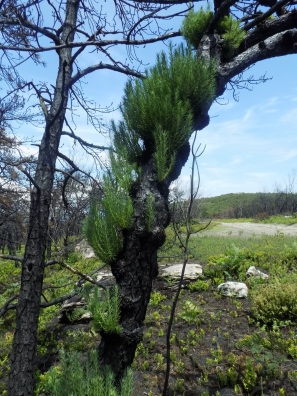
Many of the pitch pine trees that were blackened and scorched, all of which looked ostensibly dead, have exhibited new growth occurring at the base, epicormically (along the trunk), and from the top of the tree. Walking along the loop road, hints of long bristly shoots resembling bright green porcupines are apparent on a number of blackened trees. The majority of pitch pine stumps that were cut for fire control purposes have also begun re-sprouting.
Pitch pine is not the only tree sending out new shoots—scrub oaks, birches, red maples, and aspens are also exhibiting basal sprouting on burned trees. Quaking aspen seedlings have shot up in areas along the loop road, exhibiting strange early growth patterns of large, red tinted leaves. Photo by Lindsey Feinberg
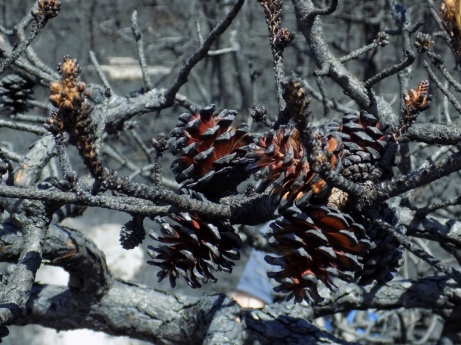
Equally important for the ecology and continuance of the globally rare dwarf pine ridge community is the successful germination of pine seeds. As pitch pines get older, they lose their ability to re-sprout. Many older pitch pines will experience a wave of mortality even after new shoots appear. Possible reasons for this subsequent mortality of pitch pines is that a burned tree tends to be more stressed, and may not as resilient to any new factors that can further increase stress, such as insect predation and extreme weather events. Additionally, new shoots probably won’t distribute evenly on each tree, and this added weight on a weakened tree can cause branches to break or the entire tree to topple over. But there is still hope. The closed, charred pine cones opened soon after the fire ended, their russet innards contrasting brightly against the blackened landscape. The seeds were dispersed and fell to the ground. In order to germinate, pitch pine seeds need to be exposed to mineral soil. This is usually achieved when a fire burns through the upper duff (dead leaves and other plant material) and organic soil layers, which are more likely to burn when the fire is allowed to continue for long enough and reach a hot enough temperature. Until recently, the park staff at Sam’s Point had been unable to find any seedlings despite nearly half of the acreage on Sam’s Point being burned.
Newly opened pitch pine cones along the Indian Rock Trail. Photo by Lindsey Feinberg
But how do you monitor 2000 acres for seedlings? You don’t. Instead, you look at a sample. One of the first post-fire initiatives by Parks’ Sam’s Point research staff was to establish 20 randomly placed research plots in order to document forest regeneration and the recovery of this natural area over time. Returning to the plots and recording information on the plants and soil helps us to understand and learn more about this ecosystem. In addition, we established photopoints in four of the research plots. Since May 7th, we have been photographing four plots from the same location on a biweekly basis. Photopoints are a great supplement to research documenting change over time, as it provides a way to visually understand what changes are taking place.
This slideshow requires JavaScript.
Sampling is scheduled to begin sometime in August, but one of the most exciting aspects of establishing randomly placed plots is discovering unique areas that might otherwise go unnoticed. During our fieldwork we found several areas of pitch pines averaging only 4 feet tall. Upon further examination, we discovered that the soil was extremely shallow in those spots, as little as 2 inches over solid bedrock. In July, none of Sam’s Point staff had seen any new seedlings during their regular duties around the park, but after checking in on the sections with low soil depth we were able to find a good number of seedlings. And soon after, seedlings were found in some of the wetland pockets as well. All good news for the recovery.
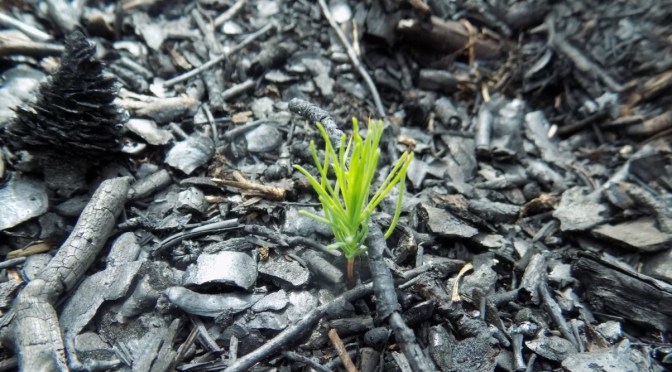
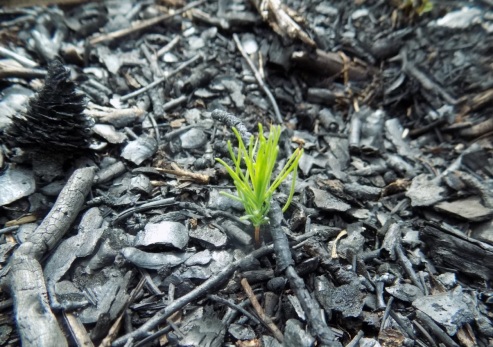
A pitch pine (PInus rigida) seedling finally appears, several months after the fire. Photo by Lindsey Feinberg
Sam’s Point has a number of unique, highly acidic wetlands too. While the larger pockets were relatively untouched by the fire, the smaller outflows were more vulnerable, especially in areas of extremely shallow soil. However, the wet areas that were burned along High Point Carriage Road and some other narrow strips of wetland have begun exhibiting their wetland qualities once again. Sphagnum moss, a characteristic moss genus found in bogs, has returned in some of these areas, while tiny sundews (Drosera spp.) can be seen on both the newly grown moss and the saturated but still blackened soil.
The spatulate-leaved sundew (Drosera intermedia) and other plants begin to appear again in the burned wetlands. Photo by Lindsey Feinberg
Pitch pine seedling growing next to sundews on recovering wetland. Photo by Lindsey Feinberg
Insect on a yellow-eyed grass (Xyris sp.) located in recovering wetland. Photo by Lindsey Feinberg
Animal activity was apparent almost immediately. The prairie warblers’ ascending trill could be heard throughout the spring in all areas of the preserve. Insect and pollinator activity has been high, especially with the return and subsequent blooms of milkweeds and meadowsweet. Park staff also noticed a number of ruffed grouse, which like forest openings. The remains of chewed up pine cones littering the forest floor are evidence of red squirrels. Eastern towhee activity was also high in the period immediately after the fire. Towhees are a species of bird that feed on pitch pine seeds as they are released from their cones. Amphibians could be spotted burrowing into the moist ground in order to keep cool.
Fowler’s toad (Anaxyrus fowleri) burrowing to keep cool in the burned area. Photo by Lindsey Feinberg
Ladybug (Coccinellidae family) and tiny insects (unidentified) on new shoots of pitch pine (Pinus rigida). Photo by Lindsey Feinberg
During a fire and the initial period afterward, it is easy to focus on the destruction and negative impacts. However, it’s important to remember that fire is a vital ecological process in many environments, especially for the health and longevity of pine barren communities. The Sam’s Point Fire offers great opportunities for discovery. Researchers from the Shawangunk Ridge Biodiversity Partnership, Mohonk Preserve, The Nature Conservancy and nearby colleges like SUNY New Paltz met to discuss research needs and interests to inform management and increase our knowledge about this exceptional place and ecosystem. It’s exciting to see what the future holds for Sam’s Point.
The fuzzy, stout body is typical of moths. This black-waved flannel moth (Lagoa crispata) is uncommon in New York. Photo: M. Schlesinger, NYNHP
It’s National Moth Week! So let’s learn a little more about them.
Moth or butterfly?
Moths and butterflies are members of the order Lepidoptera (Greek for scale and wing). Most butterflies have club-shaped antennae – a thin stem with a ball at the end – whereas moths usually (but not always) have feathery antennae like the luna moth above. Moths often have fuzzy, short bodies compared to the more slender, smoother body of butterflies.
The Luna moth (Actias luna) is one of our largest moths. Photo: K. Smith, NYNHP
Are all moths small and brown?
Many moths are small and brown, tan or white. But many are much fancier; in fact you may have mistaken some colorful ones for butterflies. Sometimes the colors are hidden while the moth is at rest, but revealed when in flight, like the tiger moth. The silk moths are spectacular in size and color – such as the Luna moth above.
A bird dropping moth (Eudryas sp.) Photo by T. Weldy, NYNHP
Virginia Ctenucha (Ctenucha virginana). photo by J. Lundgren, NYNHP
How many different kinds of moths are in NY State?
There are over 1,000 moth species in the state. A single State Park can harbor dozens to hundreds of different species of moths. Larger parks and those with rare habitats are great examples of places that support a diversity of different species of moths. To date, scientists have identified about 90 species in Watkins Glen and Taughannock State Parks, over 300 species in Minnewaska State Park Preserve, and nearly 500 species of moths each at Hither Hills and Napeague State Parks!
The sphinx moth – or hawk moth – can be mistaken for a hummingbird. Look for them hovering over flowers. There are many species in this group of moths. Photo by T. Weldy, NYNHP
Where and how do you find moths?
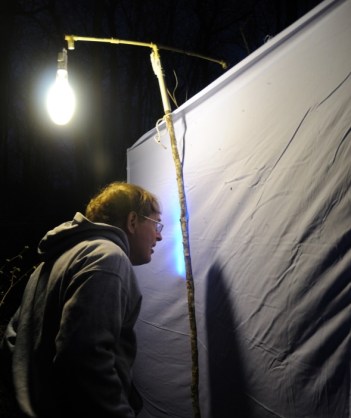
Most moths fly at night. The easiest place to see moths is at a porch light or around the lights of campground buildings. For better viewing hang a sheet or light colored cloth up with a light next to it. The moths will land on the sheet (see below) so you can get a close up look without even touching them. Other moths prefer daytime or can be seen resting during the day.
Moth expert Tim McCabe from the NY State Museum examines moths that were attracted to the light during a survey in Taconic State Park. Photo by George Heitzman
Why are those moths in boxes?
A lot of moths are difficult to identify. So scientists collect and preserve specimens in order to look at them closely to identify them. Collections are also important as a permanent record of what species were found at a site. Each specimen is labeled with location, date, and species name. Then the specimens are placed in ‘safe storage’ in a museum such as the New York State Museum or a university collection where they can be used for other research or study.
These are some of the moths found in hemlock forests in the Finger Lakes State Parks. The top row shows some of the ornately patterned tiger moths. Photo by J. Lundgren, NYNHP
NY Natural Heritage Program zoologists prepare and preserve moth specimens from surveys in State Parks (OPRHP). Experts identify these specimens and each specimen is labeled with the name, date, and location. Photos by J. Lundgren, NYNHP
Experts identify these specimens and each specimen is labeled with the name, date, and location. Photos by J. Lundgren, NYNHP
Are there rare moths in State Parks?
Yes! For example, four rare moth species have been found in Minnewaska State Park Preserve and over 30 rare moth species have been documented in Napeague and Hither Hills State Parks on Long Island. Some have fun names like fawn brown dart (Euxoa pleuritica), pink star moth (Derrima stellate), chocolate renia (Renia nemorali) and black-bordered lemon moth (Marimatha nigrofimbria). Most areas of the state have not even been surveyed for moths, so there is much more to learn. Currently, over 100 species of moths have been identified as rare in the state. See the NYNHP Rare animal list for the listing of New York’s rare moths.
A rare noctuid moth (Apamea burgessi) Photo by H. McGuiness
The pink star moth (Derrima stellata) is rare in the state. Photo: Tom Murray, 2011, accessed from BugGuide, http://bugguide.net/node/view/549324
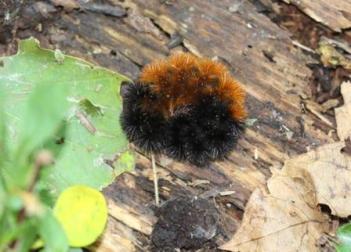
Quiz: What moth does this caterpillar become?
The woolly bear caterpillar is the young phase of what moth? Answer at bottom of page. Photo by M. Schlesinger, NYNHP
Quiz answer: The woolly bear caterpillar (Pyrrharctia isabella) becomes the Isabella tiger moth (Pyrrharctia isabella). Moths are one of the few groups that have different names for different life stages of the same animal. This is one reason why scientific names are important; from the common names we might think this caterpillar and moth were not related.














 New York State Parks and Historic Sites Blog