Are invasive species interrupting your boating and fishing experience? Did you know that if you conduct a quick inspection of your watercraft before and after each use and remove invasive species, you are helping protect and maintain our beautiful waterways? Did you know that many of the invasive species found on boats during inspections out-compete native species, displace waterfowl, decrease the size of sportfish, hinder recreational boating experiences, and damage our environment?
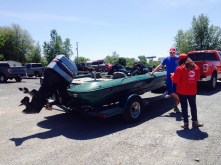
State Parks Boat Stewards work to help reduce aquatic invasive species in New York State waters, photo by Ro Woodard OPRHP
Over the summer, State Parks will have 15 Boat Stewards (Stewards) at many of our boat launches along Lake Erie, Niagara River, Lake Ontario, St. Lawrence River, Lake Champlain, Finger Lakes, and Saratoga Lake. The Stewards will conduct educational boat inspections to provide step-by-step instructions on ways you can effectively inspect your boat and dispose of invasive species. These demonstrations are both free and voluntary.
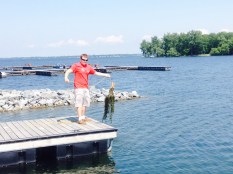
AIS disposal boxes are great places to put any plant or animal species you find on your boat, photo by Meg Phillips, DEC
The New York State Park’s Boat Steward Program is one of many boat steward programs throughout New York State. These programs provide targeted educational programming to increase awareness about aquatic invasive species and other environmentally significant issues. When you come across a red-shirted Boat Steward please stop and ask us any questions you may have.
Removing autotroph aquatic invasive plants, photo by Meg Phillips, DEC
Stewards participate in periodic educational events, festivals, and invasive species removal projects, such as water chestnut pulls. Also, feel free to follow us on the Boat Steward Blog. Stewards will be writing about their experiences and findings as the summer goes on.
Happy boating!
Download an Aquatic Plant ID sheet here. To learn more about other invasive species throughout the state, check out the New York Invasive Species Clearinghouse.
For more information on the boat steward program, please contact Matt Brincka, Ocean & Great Lakes Educator, New York State Parks, at 518-402-5587
“Forest Fire Scorches 3,000 Acres in Ulster Park” was the headline of a story in the New York Times on April 21, 2008. The park was Minnewaska State Park Preserve in the Hudson Valley. From when it was first reported on April 17 to when it was finally out on April 29, the Outlook Fire burned roughly 2,800 acres in the park. People from 134 state and local agencies came together to control the largest fire to hit the region in 60 years. Recently, another large fire in Minnewaska, the fire at Sam’s Point that burned over 1500 acres in April and May 2016.
Fire damaged pitch pine, May 2008, OPRHP photo
Mopping up fire remnants, Minnewaska State Park , April 2008, OPRHP photo
These fires were both wildfires, defined as uncontrolled fire in the forest or fields which spreads quickly and is difficult to control. Historically, wildfires were ignited by lightning strikes. Wildfires are a natural component of many different ecosystems; they have helped to maintain healthy native flora, fauna and systems around the world for thousands of years.
Fires help ecosystems in many ways. They help plants by opening up the tree canopy to allow sunlight to penetrate to the forest floor to enable new seedlings to grow; adding nutrients to the soil and raises the soil pH, giving plants an extra boost of natural fertilizer; reducing the competition for water and soil nutrients by thinning out the underbrush; and decreasing some invasive species and forest pests and diseases. But other invasive species can proliferate after fire, so preventing their spread is an important management strategy.
Some of natural communities in the state — places like Minnewaska, the Shawangunk Ridge, Albany Pine Bush, Long Island Central Pine Barrens and many areas within State Parks are fire-adapted, meaning they can survive wild fires. If fact, the need occasional fires. The plants have special features to survive fires. Pitch pine are one of the best known fire-adapted trees, and they are common in Minnewaska. If a pitch pine tree is damaged in a wild fire, the roots are not always killed and new growth will sprout from the base or the trunk of what appears to be a dead tree. Chestnut oak is another tree that is able to withstand fires due to the thick bark. Other plants have seeds that lie safe below the surface, called a “seed bank”, waiting to grow when conditions are right like when there is space and more light following a fire. And perennials like the ferns and trillium and starflower lie dormant underground (like tulip bulbs in your garden), ready to burst upward every spring and summer.
And some plants are fire dependent, meaning that they need fire to thrive or greatly benefit from fire. Pitch pine is a good example of this. Although some pitch pine cones will open on a hot summer day which drops the seeds to the ground, a fire also exposes the bare soil that helps their seeds to sprout.
Fires can help animals too, including insects, by creating new openings in the forest for the animals to thrive and by leaving snags (dead trees) which provide places for raccoons, squirrels, and woodpeckers and other cavity nesting birds to nest in. Many animals avoid fire by burrowing deeper in to the ground, flying off, or skirting the edge of the fire. Very rarely will an animal be trapped by a fire. Some species of beetles and birds hunt along the edge of the fire, looking for their prey as it escapes the fire.
This slideshow requires JavaScript.
Life was blooming in Minnewaska just after the Outlook Fire. In coordination with the New York Natural Heritage Program and State Parks. a team of scientists worked together to study effects of the fire on breeding birds, tree regeneration, and vegetation response. Within a couple of weeks, there were hints of green. Approximately a month after the fire had ended, there was abundant new life in the Pine Barrens, with ferns and Canada mayflower sprouting up, trillium and lady’s slipper flowering, and a wood thrush nest with eggs hidden amongst the charred leaf litter. Pitch pines, chestnut oaks, scrub oak, huckleberry, and other trees and shrubs showed new leaves, bright green against the blackened landscape. Not lost after all, but alive and well.
Susan Carver, State Parks and Julie Lundgren, NYNHP
Each week during the summer, volunteers at 34 State Parks campgrounds across the state assist novice and experienced campers with their camping experience through the Camper Assistance Program, CAP. This help varies from teaching new campers the ways of the woods, assisting with camper check-in, and helping campers learn about activities they can do while camping.
Below describes what could be a typical day for a fictional CAP volunteer:
7:00 am: Quiet hours are over. Some campers are up early, fires are getting started and the air smells good with all of the coffee brewing. I get my breakfast going as it will be a full day ahead.
10:00 am: Patrons that are ending their stay are typically packing to go home at this time. I take a morning walk to offer any assistance, and this morning I help a man and his dog get ready to leave. His dog likes to help him fold his tent, which is not very helpful, so I hold his leash until the tent is packed up.
11:00 am: The park manager asks if I can assist with visitor check-in later in the day. Typically, the busiest time is between 3 and 5 p.m. So for now, she would like me to clear out a flower bed at the entrance of the campground.
The maintenance staff arrives with rakes and shovels and we work together clearing away leaves and weeds. We have new flowers to plant in a wonderful design which creates a very welcoming display to campers at the entrance.
12:30 pm: Time for lunch! I head back to my trailer to clean up, grab a bite to eat, and relax at my camp site, enjoying the lovely day.
1:30 pm: Time for another walk around the campground loops.
Most campers have done this all before. However, today I helped a family who has arrived with a new camping trailer. Dad tries to back it in, but it’s clear that this is not a simple procedure, so I offer my assistance. After 20 minutes, we have successfully backed the trailer to the most level spot on his site. He thanks me for the help and they begin their week-long vacation at the campground.
3:00 pm: I head to the camping office and help with check-in. While the campers wait their turn, it’s my job to make sure they have their paperwork ready. This will help with a quick check-in, to get campers on their way to enjoying their stay.
I answer many questions; Yes, we sell ice. I can verify you have a reservation. Here is your site number. Patrons with dogs… Do you have the rabies certificate? Swimming begins at 10am each day. No, we can’t guarantee the weather but we do post the forecast each day.
5:00 pm. The rush is over and I walk back to my site and start my cooking fire for the evening.
5:30 pm. But wait. A patron walks over to my site and asks if I can help. They’ve broken one of their tent poles. I can help! I grab my tool bin and find duct tape…anything can be fixed with duct tape! Another camping disaster avoided.
6:15 pm settle in to my site for the evening.
This slideshow requires JavaScript.
The Camper Assistance Program (CAP) offers seasoned campers an opportunity to share their expertise and love of the outdoors with other people at campgrounds in parks throughout New York operated by State Parks. In return, CAP volunteers receive a free camping site.
You too can participate in the CAP program if you are a seasoned camper, at least 18 years of age, enjoy helping others, and are able to spend a minimum of two weeks at one of the participating state park campgrounds. CAP volunteers serve for a minimum of two, maximum of four weeks, usually between Memorial Day and Labor Day at the park manager’s discretion. They are on duty five days per week, including weekends and holidays. CAPs will be asked to work only two to five hours per day, but they may be on call at all times. In return for their services, they receive a free camping site during their duty. Additional campers may accompany the volunteer, within normal park rules.
CAP volunteers receive an orientation where they learn more about the State Parks and the CAP program and receive suggestions as to how they best can serve campers.
Visible downstream at the lowest level of the gorge, is the oldest visible rock layer within the gorge wall. This layer was deposited along a coastal area of a warm shallow sea in the late Ordovician Period, alternating between below and above sea level. The periodic exposure of the iron rich sediments resulted in the coloration visible in the sedimentary rock of the Queenston Shale. As you travel upstream the tilt of this layer causes it to disappear below visible levels.
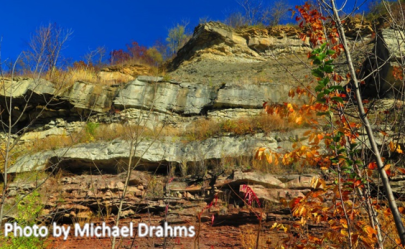
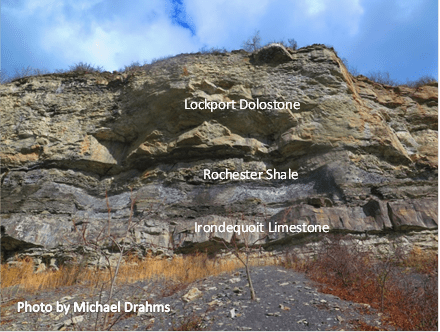
The rocks seen in the walls of the Niagara Gorge are sedimentary; they are made from sediments deposited in a shallow sea that covered much of the eastern U.S. and adjacent Canada around 440 to 410 million years ago (middle part of the Silurian Period). Rocks, such as limestone, shale, sandstone and dolostone, are seen as distinct layers. Some of these layers, for instance the soft, easily eroded Rochester Shale below the caprock of Niagara Falls, contain a great diversity of marine fossils, such as brachiopods, trilobites, corals and crinoids.
These rocks are layered, from oldest at the bottom to youngest at the top along a long ridge known as the Niagara Escarpment. The Niagara Escarpment is a prominent cliff-forming cuesta that extends from western New York into southern Ontario, northward to the upper peninsula of Michigan, and then bends downward into eastern Wisconsin and Illinois. The escarpment is capped by relatively hard, resistant rocks of the Silurian-age Lockport Group (chiefly dolostones and limestones), which are underlain by less resistant rocks (shales and sandstones, such as the Rochester Shale).
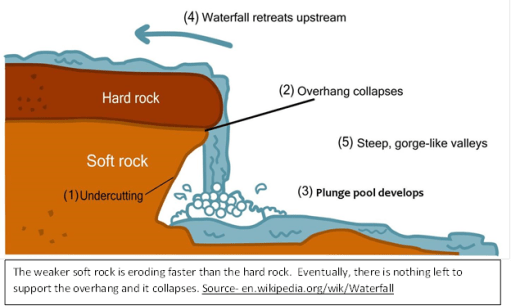
Near the end of the last ice age, around 12,300 years ago, the Niagara River began to flow over the Niagara Escarpment, located at what is now Lewiston, New York. Through the process of erosion the falls have receded to their present location. In the past, the falls receded on average 3-6 feet per year. However, the rate has been greatly reduced due to flow control and diversion for hydropower generation, to a mere 3-6 inches per year. 50,000 years from now, at the present rate of erosion, the remaining 20 miles south to Lake Erie will have been undermined. There won’t be a falls anymore, but rather a series of steep rapids!
While visiting Niagara Falls, or hiking in the Niagara Gorge, take some time to marvel in the events and processes that took place over time. From continental collisions to ice-age glaciers and the present day Great Lakes drainage basin, we are fortunate enough to witness the interactions of nature.
The small girl skipped ahead of her family on the grassy path toward the bird banding station, a couple of picnic tables covered with a canopy, with two tents pitched nearby. Five rows of mist netting were strung along alleys in the dense brush, with hopes that birds would fly into them and get caught so that they could be studied, banded, and released. Master bird bander Gordon Howard sat at one of the tables with a tiny bird in his hand, a book open in front of him. He gently stretched the wing feathers to look for different color patterns and signs of wear to help him determine the age of the bird.
The girl and her family walked up to Gordon, and he smiled and explained what he was doing. When he was finished, he asked if she would like to hold and release the brightly colored male yellow-rumped warbler. She nodded her head, and Gordon showed her how to gently wrap her small fingers around the bird’s neck and body so that it would not be injured. A broad smile spread across her face as she felt the soft, warm feathers and the rapidly beating heart of the bird. Her parents took pictures, and then Gordon told her to gently toss the bird into the sky and let go. The warbler flew from her hand right back into the hawthorn shrubs and began feeding, preparing for its migration further north. Although the bird had left her hand, the memory never left the child.
Male Magnolia Warbler with a band, photo by Ellie George, c 2010
Male Ruby-Throated Hummingbird, photo by Ellie George, C 2010
Eastern White-Crowned Sparrow in a net, photo by Ellie George, c 2010
Banding an Eastern White-Crowned Sparrow, photo by Ellie George, c 2010
Bird banding began at the Crown Point State Historic Site 41 years ago by J.M.C. “Mike” Peterson. Spring migrant birds have been monitored here every year since for two weeks in early to mid-May. Over 17,000 individual birds of 106 different species have been banded here, with each bird receiving a small metal band with a unique identifying number that is placed around its leg like a bracelet. Information on each bird that is banded, such as species, sex, age, and condition, is forwarded to the U.S. Fish and Wildlife Service, which oversees all bird banding in the United States. If the bird is ever found again, the band number can be reported to the USFWS and much can be learned about the bird’s movements. The current main banders are Gordon Howard, Gary Lee, and Tom Barber, with help from several other banders and a number of volunteers. Visitors are welcome from 7 AM to 5 PM every day of the season, which runs this year from the afternoon of May 6 to the morning of May 22. Educational programs about birds and bird banding are offered to school groups, birding clubs, and civic organizations. Reservations for these are arranged by contacting Gordon by email at ghoward@clemson.edu.
Third Grade Student ready to release a Mourning Dove, photo by Tom Barber, c 2015
First Grand Student and Great-Crested Flycatcher, photo by Tom Barber, c 2015
First Grade Class Presentation, photo by Tom Barber, c 2015
Bird banding has several values, including education, determining bird longevity, and figuring out migration routes. The Crown Point peninsula that juts north into Lake Champlain is an excellent place to capture and study migrating birds, because birds concentrate here to feed and rest on their journey northward each spring. Many of these songbirds wintered in South or Central America, and are migrating to their summer breeding ranges in New York, New England, and Canada.
If you go to visit, the best time of day is early to mid-morning. Calm, dry days are usually better than windy, wet days. Park in the lot by the museum, and walk up the blacktop road toward the barns. Then follow the signs that direct you onto the grassy path to the banding center which is tucked in by the brushy edge. Wear casual clothes and boots or shoes that can handle mud. Bring your family, a camera, binoculars, and your sense of wonder.
Post by Ellie George, volunteer with the Crown Point Bird Banding Association
Photos were supplied with one time use permission from the photographers Ellie (Eleanor) George and Thomas Barber.
.









 New York State Parks and Historic Sites Blog