On April 8, New York State Parks and Historic Sites welcomed people from around the world to share a once-in-a-generation total solar eclipse. Thousands of people enjoyed a rich, memorable experience thanks to the hard work of our staff over a two-year period.
Public Information Officer Angela Berti of the Niagara Region led this effort on behalf of State Parks and represented our agency on the statewide Eclipse Task Force.
Our Park Police used their expertise in peacefully managing large crowds to keep our visitors safe. Countless staff worked behind the scenes and on the front lines to open selected campgrounds for the occasion, plan educational programming, get the word out to the public, make sure our parks were in top condition, and ensure the safety of our visitors.
As Chief of Staff and Commissioner Pro Tempore, I am filled with pride and gratitude for all the hard work of our staff in preparing for this remarkable event. Enjoy reliving the day with photos from around our parks and sites!
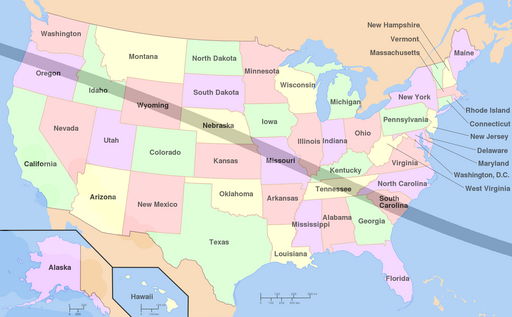
Many of us remember the last total solar eclipse in the United States, known as the Great American Eclipse in August 2017. The news coverage talked of the path of totality which travelled from coast to coast, starting in Oregon and arcing south across the country through South Carolina. Those who remained here in New York were treated to a view of between 59-75 percent obscuration (covering) of the sun as the moon passed between the sun and Earth. While it was definitely a national event, New York didn’t get the front-row seats that being in an eclipse’s path of totality provides.
Path of 2017 eclipse, courtesy of Wikicommons.
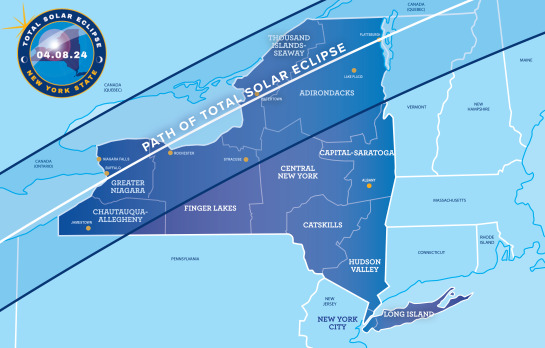
Thankfully, many New Yorkers will soon have the opportunity to see this celestial wonder for themselves from their own backyards or local parks. On April 8, 2024, another total solar eclipse will pass from Mexico through parts of 14 different states and into Canada. This time, New York is in the eclipse’s path.
The 2024 eclipse path in New York State, courtesy of I Love NY. To drill down on the path of totality for April 8, visit our interactive map.
Some people have been looking forward to the 2024 total solar eclipse for years, some for decades! But all of this anticipation has some of us looking backwards to the last total solar eclipse that passed through the skies of New York State in 1925.
Path of 1925 total solar Eclipse, Butler Papers, Archives of American Art, Smithsonian Institute.
New York State Parks is dedicated to making sure that visitors of all abilities can enjoy our parks and historic sites. In 2023, a record 84.1 million visitors came to our properties, so it is more vital than ever to ensure that all who visit have a safe and fun experience!
“Every individual has a different set of abilities, a different set of strengths, and a wealth of experience and wisdom that comes with them.
As in ecological communities, our social communities and lives are enriched by having a diverse array of problem solvers, friends, and loved ones.
We at Rockefeller [State Park] are excited to welcome people who have traditionally been excluded from outdoor spaces, knowing that the more perspectives and voices are on our public land, the closer we are to cultivating sustainable relationships to our natural world and to one another.”
-Devyani Mishra, Conservation Steward at Rockefeller State Park Preserve
A wheelchair user plays the metallophone on The Autism Nature Trail at Letchworth State Park.
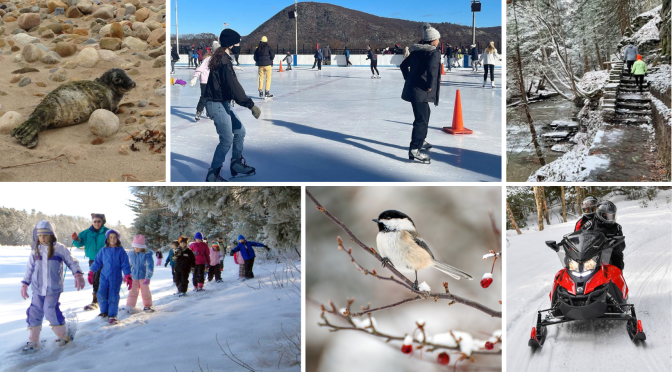
Winter doesn’t have to mean being stuck indoors. There’s year-round fun at our parks to help you beat cabin fever, chase away the winter blues, and experience a familiar spot in an entirely new way. Check out these iconic wintertime activities at our parks and sites, but hurry – spring will be here before you know it.
Ice, Ice, Baby
Ice skating is the classic wintertime activity, and our parks offer a safe way to enjoy the ice. From the urban setting of Riverbank State Park to the serenity of Grafton Lakes to the bustling atmosphere and panoramic views at Bear Mountain State Park, ice skating brings joy wherever you do it. This exhilarating experience gets your heart pumping, and is a fantastic winter bonding experience. Twelve of our parks offer skating, and most of them offer skate rentals as well.
With the chill in the air and pumpkins popping up everywhere, many folks are making plans for Halloween. Signs are out inviting ghosts and goblins, large and small, to join historic cemetery tours that highlight the resting places of the victims of murder and mayhem as well as the rich and famous, some even by candlelight. If you’re thinking of adding a cemetery visit to your agenda, these tours offer safe ways to weave through complicated landscapes and monuments for the dead. For many reasons, however, the last ten years have also seen a marked increase of people visiting historic cemeteries around Halloween on their own.
In the 19th and early 20th centuries, cemeteries in or near urban spaces were used as places to picnic and relax before public parks were readily available. These days, Halloween, which is fast approaching the social status of a major holiday, has increased people’s interest in them. Not just for visiting family or friends buried there, but also as locations for weddings and other celebrations. Mortuary art has evolved over the years, and the artistry of historic gravestones and mausoleums can often rival what is seen on public and private building, allowing people to get up close in a way they cannot in many locations.
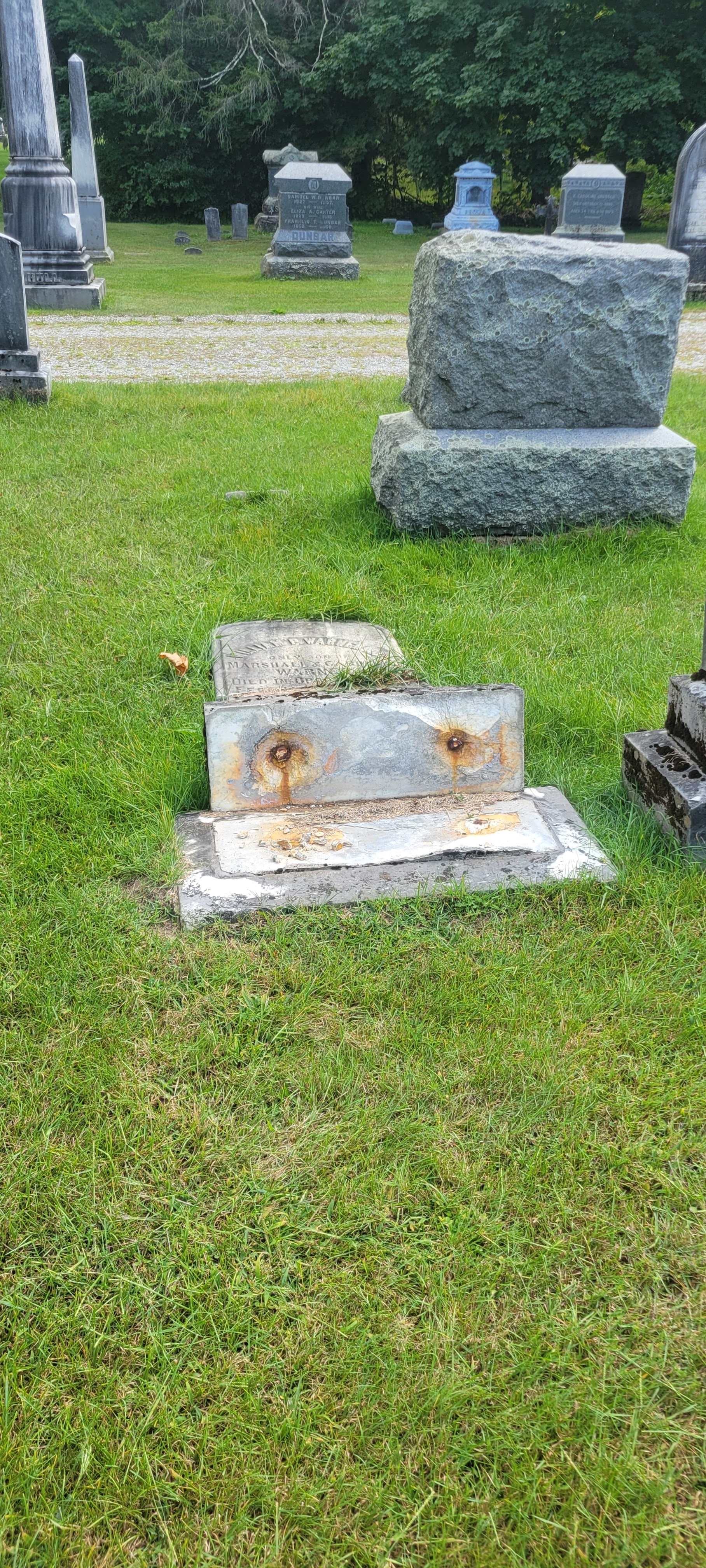
New York’s historic cemeteries range from the 17th through the early 20th century and cover every culture. Many offer visitors a rare opportunity to travel the state’s historic timeline for hundreds of years within their acreage. The variety of headstones is amazing to behold. This higher number of visitors is, unfortunately, often causing unrepairable damage to grave markers or headstones. Fragile historic artifacts that often appear more solid than they may be.
A toppled headstone. Photo credit: Ian Stewart, Preservation Inc.
Within these sacred spaces the sizes and types of stones or cement work used to mark graves can range from folk art to opulent cement work and newly created stones with laser cut designs. To preserve these artistic and historically significant pieces it is important that a few etiquette rules be observed. By doing so, we can ensure the history they represent remains for years to come.








 New York State Parks and Historic Sites Blog