Category Archives: Flora & Fauna

Rare or noteworthy wildlife spotted in New York State Parks

Early Birds Get More than the Worm

In the wild, February and March may seem like the worst time for a bird to raise a family, with challenges including frigid temps, sleet, wind, and snow. But this is no ordinary bird, this is a great bird—a Great Horned Owl (Bubo virginianus). These large, thick-bodied raptors- weighing in at 2.5 to 5 pounds with 4 ½ to 5’ wingspans –  are one of the most widespread owls in North America and have plenty of ‘don’t mess with me’ moxie. They have a very diverse diet, including small mammals, rabbits, geese, herons, amphibians and reptiles, skunks, porcupines – and even other raptorial birds. It is this adaptability and tenacious behavior that gives them a leg up on surviving tough conditions.

Great Horned Owls are among the earliest birds to breed each year, with males staking out territory from other males beginning in October. Most Great Horned Owls mate for life and every autumn they reestablish their bonds by loudly calling to each other. Like many birds, they have a range of vocalizations. Their classic hoot is unmistakable, a deep slightly muffled resonating “hoo-h’HOO–hoo-hoo” call with the female’s voice slightly higher in pitch than the male’s.

While establishing their territory they will seek out a suitable nest. They don’t build their own– instead, they use abandoned real estate like an old Red-tailed Hawk nest or a hollowed tree cavity, even a cliff ledge will do.
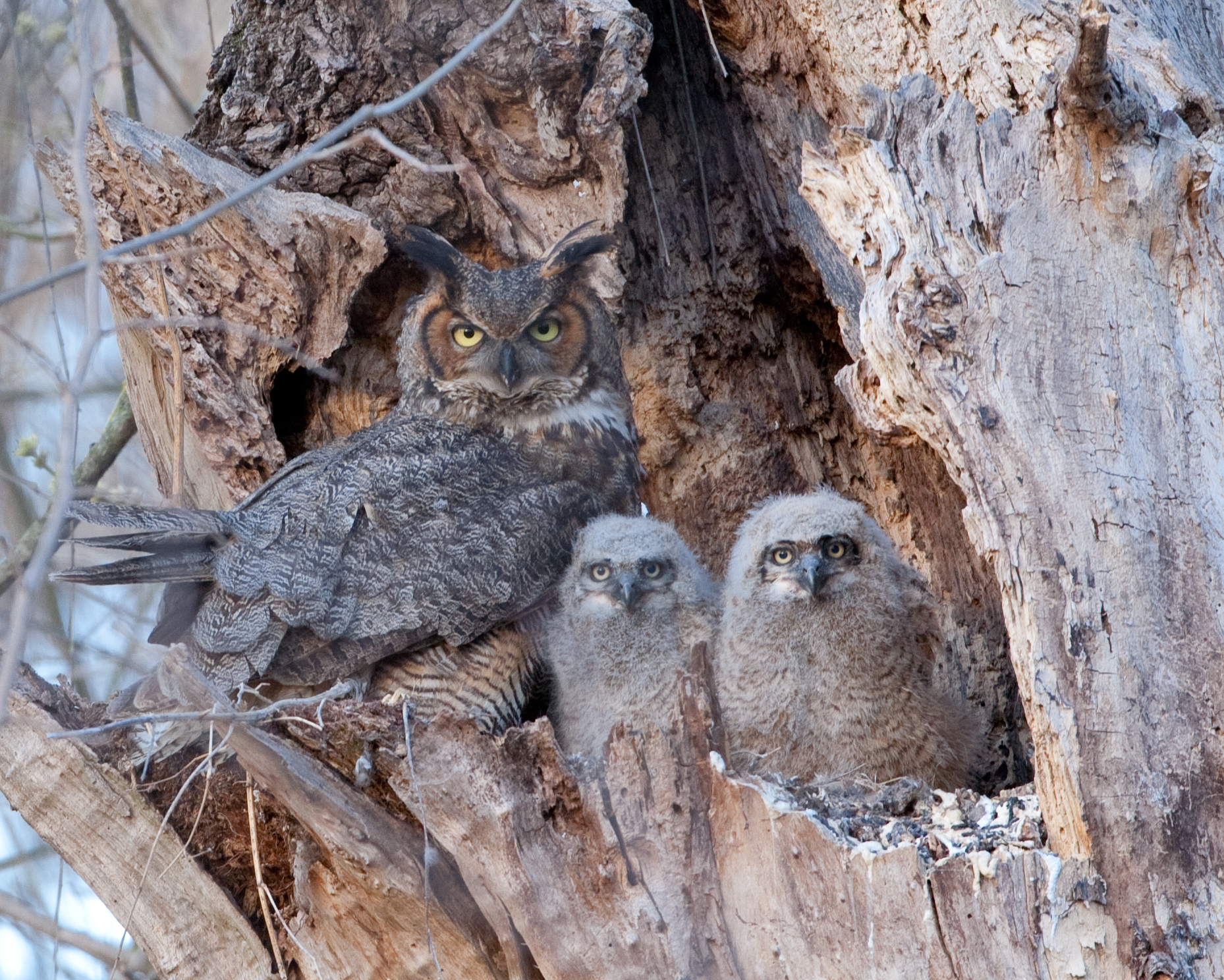
Great Horned Owl family
Great Horned Owl, at the nest with her Owlets

When January arrives the parents-to-be will be settled in and ready to start a family. The female will lay 1-4 eggs and incubate the eggs for 30-37 days through all kinds of weather.  Only the female can incubate the eggs as she has a featherless patch on her abdomen called a “brood patch,” an area that has many blood vessels and is very efficient at transferring her body heat to the eggs. While she is incubating and brooding the young chicks, the male will hunt for them, but if the food he provides is insufficient she will also hunt for the family. Great Horned Owls are large birds and it takes owlets longer to grow than say a robin and longer to develop and master complex skills.

Great Horned Owl Feather
Great-horned owl feathers have a velvety texture and combined with tiny serrations along each feather edges called flutes which muffle their wing beats allowing owls to silently swoop down on their prey unnoticed.

Nesting early is a risky move but there are definite advantages. By day 45, the young are fully feathered and capable of flight and by the time spring arrives, these youngsters are ready to practice their main craft– hunting.  Not only are temperatures milder but there is now an abundance of young inexperienced prey animals, such as rabbits, mice, squirrels and chipmunks who are also venturing out on their own. These predators can now hone their flying and hunting skills under ideal conditions all because their parents were early birds.
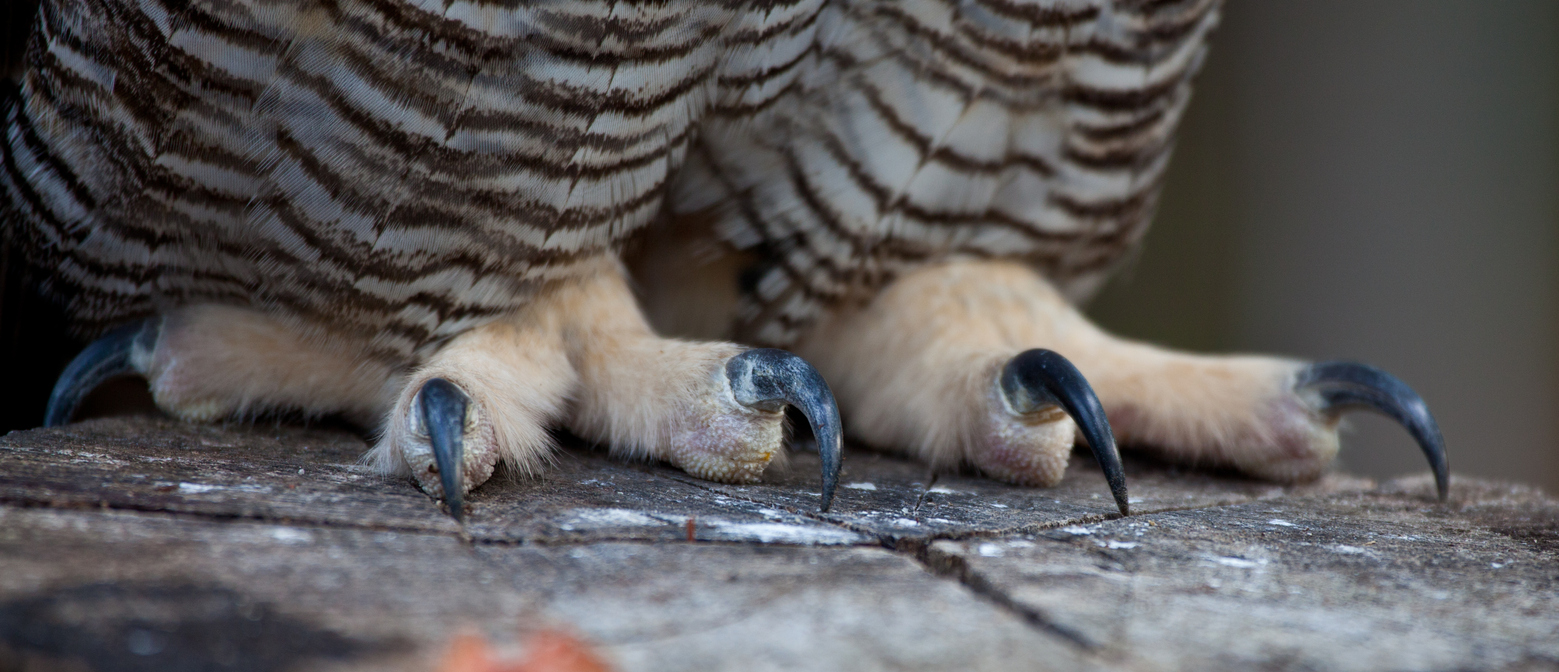
Owl Talons
When clenched, an adult Great Horned Owl’s talons lock down like a ratchet and require a force of 28 lbs. to pry them back open.
Tiger Owl Eye
Owls have huge eyes compared to their body size– larger eyes are able to take in more light which is picked up by their rod- and cone-shaped photoreceptors. Rods allow them to see well in dim light, but colors, not as well. Cones help distinguish colors but only when our surroundings are well lit. Humans have about 200,000 rods per square millimeter while owls have close to a million rods per square millimeter. This is then magnified by the owl’s tapetum lucidum or ‘eyeshine,’ a feature humans do not have. This layer of tissue located behind the retina reflects all available light to those photoreceptor rods and provides superior night vision.

For More Information

Cornell Lab of Ornithology https://www.allaboutbirds.org/guide/Great_Horned_Owl/id

Audubon Guide to North American Birds https://www.audubon.org/field-guide/bird/great-horned-owl
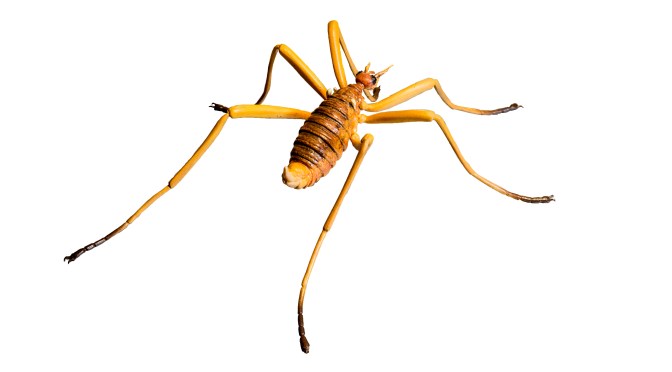
Flies that Know Snow

On a warm afternoon this winter, keep an eye out for snow flies walking on the snow.  Snow flies are typically a yellow brown to light brown fly with a body of about one quarter inch long, not including their long legs. Snow flies are wingless – scientists assume that they lost their wings because it takes too much energy to fly in winter. However, being wingless makes the snow flies more at risk of being eaten by predators. This may be why we see them in winter when there are fewer predators out. Snow flies are similar to woolly bear caterpillars and wood frogs, in that their bodies produce a natural antifreeze that prevents these small insects from freezing during winter.

onetimeuseonly
Adult snow fly, note the fly’s long legs, photo by Brandon Woo.

Little is known about the life history of snow flies. Scientists have found that females lay eggs in the winter. In the lab, eggs hatch in as little as eight days or as long as three weeks. But where the female lays her eggs, what the larvae eat, how long the larvae take to develop into adults, and where the larvae or adults live in winter remains a mystery.

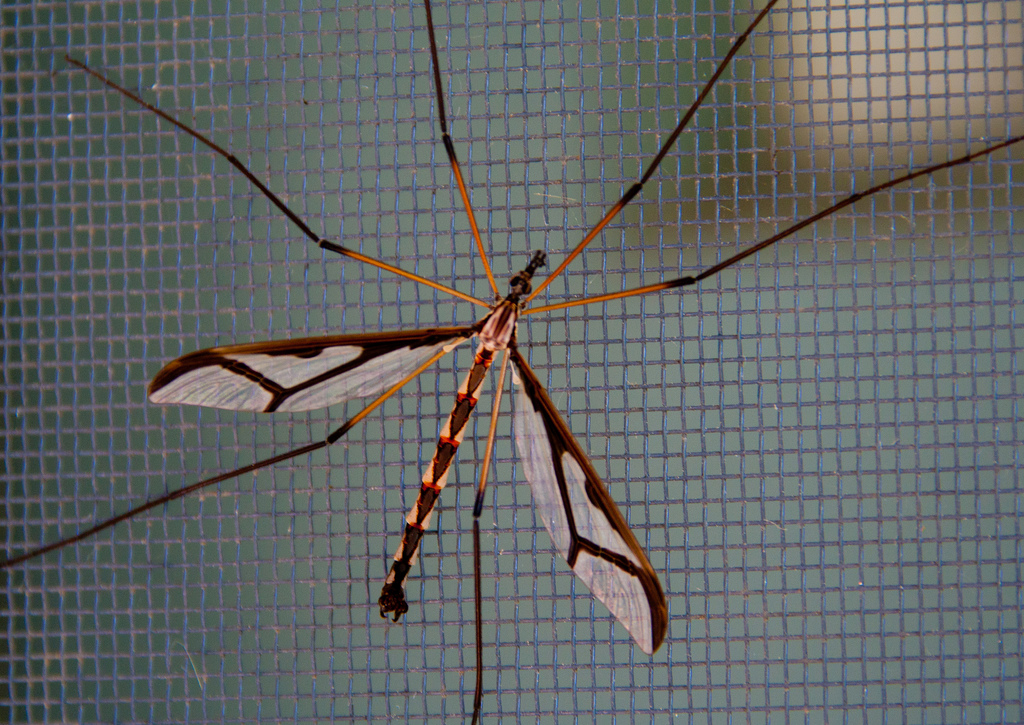
Giant Eastern Crane Fly on the screen
Giant eastern crane fly clings to a window screen, Bob Travis, accessed from Flickr.

Snow flies are related to crane flies, like the above giant eastern crane fly (Pedicia albivitta).  You may have seen a giant eastern crane fly clinging to window screens in the late summer.  At first glance, you might have thought it was a large mosquito. But if you look carefully, you will notice that the crane fly does not have a proboscis – or tube mouth – like a mosquito. Since they can’t bite you, it is safe to hold them in your hand to take a closer look.

chionea_tom murray_bugguide
Chionea scita, photo by Tom Murray, accessed from Bugguide

One common New York snow fly is Chionea scita that was first described in 1848. The translation of this fly’s scientific name is snow (chion in Greek) knows (scita in Latin).

If you see any snow flies this winter, please let us know!

References

BugGuide Chionea scita

 Byers, George W. The crane fly genus Chionea in North America, 1983. University of Kansas Science Bulletin.

Catalogue of the Craneflies of the World

Hansen, Amy. Bugs And Bugsicles : Insects In The Winter  Honesdale, Pa. : Boyds Mills Press, 2010.

Schrock, John Richard. Snow Flies, The Kansas School Naturalist, Volume 38, Number 2 – May 1992, updated 2005.

Wikipedia Chionea

Featured image: Chionea by MUSE, accessed from WikiCommons.

Know The Needles

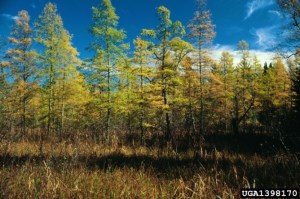
This time of year, much of New York’s landscape is dappled with bare-branched deciduous trees and dark, evergreen conifers. These cone-bearing conifer trees are adapted to survive harsh, cold weather, from the microscopic structure of the leaf to the overall shape of the entire tree. Despite the needle-like shape, conifer leaves serve much the same function as the flat, broad leaves of a sugar maple or oak tree. Most conifers keep their needles year-round. Do you know which New York native conifer drops its needles every fall? It is the tamarack (Larix laricina), a member of the larches, shown below.

ChangingTamaracks
Steven Katovich, USDA Forest Service, Bugwood.org

TamarackNeedles
Rob Routledge, Sault College, Bugwood.org

On the left, these tamaracks are changing color. Every autumn the needles turn bright yellow and will fall off the tree by winter, so they are not considered an “evergreen.” On the right, a closer view of tamarack needles, which grow from a woody spur in clusters of ten to twenty. The needles are approximately ¾” to 1 ¼” inches long.

When talking about evergreens, pines may first come to mind, but conifers also include firs, spruces, hemlocks, and others. But how do we tell which is which? Here are a few quick tips to help narrow down the tree group simply by looking at the needles.

Pines

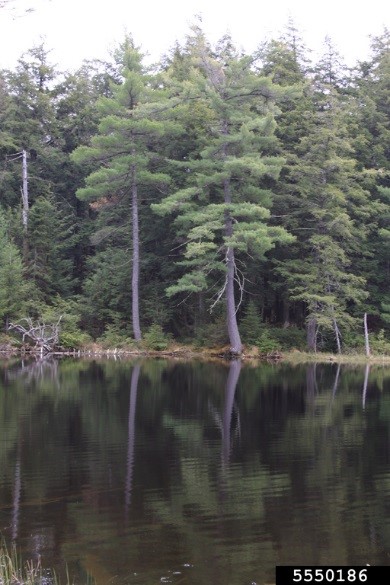
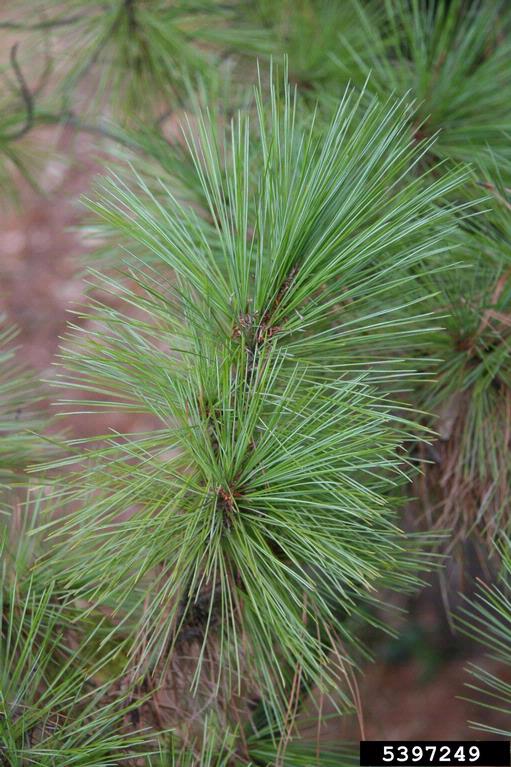
First, let’s look at pines. Pine trees have needles in bundles on the stem. The number per bundle depends on the species, but if you find bundles of five needles or less, you’ve likely discovered a pine. There are six native species of pine in New York, but two you may be most likely to encounter are white pine (Pinus strobus) and red pine (Pinus resinosa).

WhitePineTree
Steven Katovich, USDA Forest Service, Bugwood.org

WhitePineTreeRobert Vidéki, Doronicum Kft., Bugwood.org
Robert Vidéki, Doronicum Kft., Bugwood.org

WhitePineNeedles2
Bill Cook, Michigan State University, Bugwood.org

The eastern white pine (left) and its bundled needles (middle and right). This species of pine has five needles per bundle (and as a memory trick, there are five letters in the word “white”). The needles are soft and flexible, measuring about 2 to 4 inches long.

Spruces

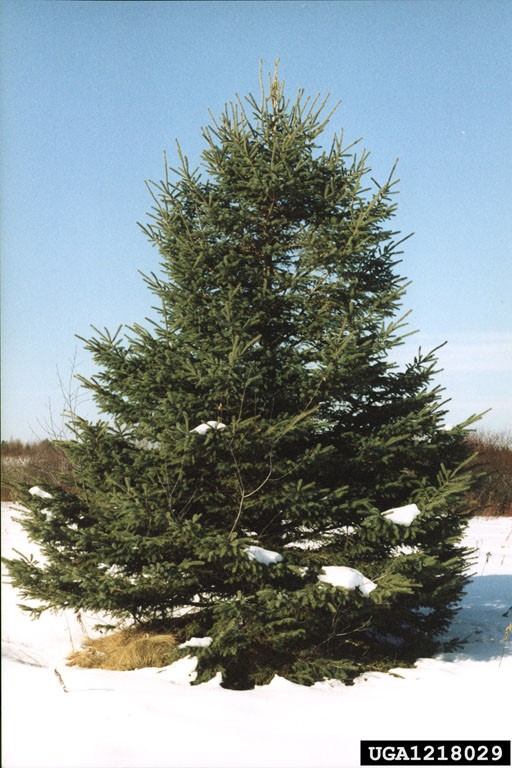
Spruce trees have needles that are individually attached to the branch with small woody pegs. A key characteristic for spruce needles is that they are square and can roll easily between your fingers. They are usually sharply pointed. Also, if any needles are shed the woody pegs make the branch feel rough, unlike the smooth branches of firs. There are three native spruces in New York: the white spruce (Picea glauca), the black spruce (Picea mariana), and the red spruce (Picea rubens).

WhiteSpruceTree
Bill Cook, Michigan State University, Bugwood.org

WhiteSpruceNeedles
Joseph OBrien, USDA Forest Service, Bugwood.org

The white spruce (left) and its needles (right), notice the woody pegs that attach the needle to the branch. Needles are stiff and measure about ½” to ¾” inches long. This species is sometimes called skunk spruce or cat spruce due to the strong odor from broken needles.

Firs

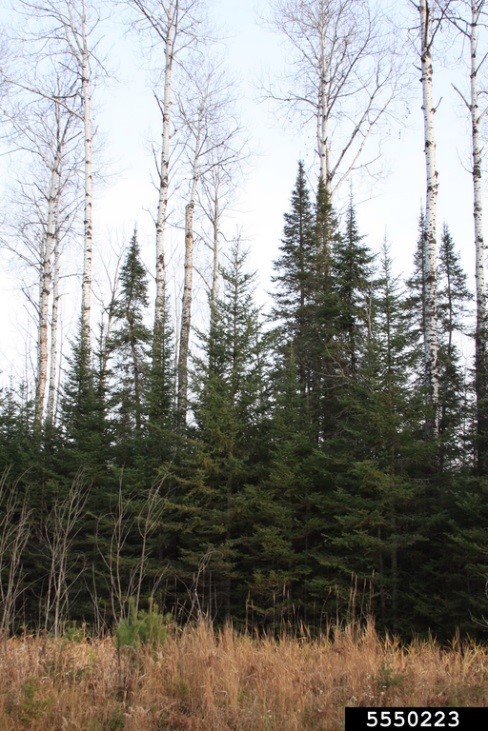
Fir needles are also individually attached, but unlike spruces, they are attached by what resembles a suction cup (look for a circular base). They are typically soft and flat with rounded needle tips. There are two whitish lines on the bottom of the needle. Another distinguishing characteristic of firs is that their cones stand upright on the branches, rather than droop down. The only native fir that can be found in New York is the balsam fir (Abies balsamea).

BalsamFirTree
Steven Katovich, USDA Forest Service, Bugwood.org

BalsamFirNeedles
Joseph OBrien, USDA Forest Service, Bugwood.org

A stand of balsam fir (left) and its needles (right). Balsam fir needles are dark green and measure around ¾” to 1 ½” in length. The tips of the needles can be blunt, rounded, or notched.

Hemlocks

Hemlocks have individually attached needles that are flat. Unlike firs, each hemlock needle has a small stem attached to a woody peg. In New York there is only one native hemlock species, the eastern hemlock (Tsuga canadensis). While you’re out testing your needle identification skills, keep an eye out for the invasive pest hemlock woolly adelgid, which creates white woolly masses at the base of hemlock needles. This insect causes tree health to decline and can lead to the death of the hemlock in as little as four years.

EasternHemlockTree
David Lee, Bugwood.org

EasternHemlockNeedles
Rob Routledge, Sault College, Bugwood.org

A young eastern hemlock stand (left) and its needles with stems (right). Needles are usually a shiny green. On the underside of each needle, you can see two characteristic white lines (shown in the picture). The needles are typically one inch or less in length.

So there you have it! Next time you’re out scratching your head, wondering if you’ve encountered a white spruce or a white pine, ask yourself these simple questions:

  • Are the needles in bundles or individually attached?
  • Does the needle roll easily between your fingers or is it flat?
  • Are the needles attached to a stem, woody peg, or a “suction cup” structure?

Just by taking a quick look (and maybe pluck) at the needles, it is often possible to categorize the conifer into pine, spruce, fir, or hemlock. If you come across a conifer that doesn’t fit into these categories, try looking at cedars or junipers too. And the best part of studying conifers is that you can look at needles all year long! Unless it’s a tamarack, of course.

If you’d like to learn more about some key conifers, check out this blog post to learn about identifying specific species you may encounter in State Parks!

Post by Kelsey Ruffino, State Parks

Resources:

Cover Photo – Eastern Hemlock: CC BY-SA 3.0, https://commons.wikimedia.org/w/index.php?curid=298754

How Galling!

Imagine that when you were very little, your mom drilled a small hole in a plant and placed you inside. The plant’s reaction to the hole was to quickly enlarge that section of the plant where the tiny you was nestled. This new plant growth gives you a round home that protects you from the weather and provides all the food you need to grow into an adult. This round home is called a gall.

Most galls are formed by insects, others by fungus or bacteria. Each gall is unique to the plant that it grows on. Galls come in a variety of colors from red to yellow, green and black. There are three types of galls:

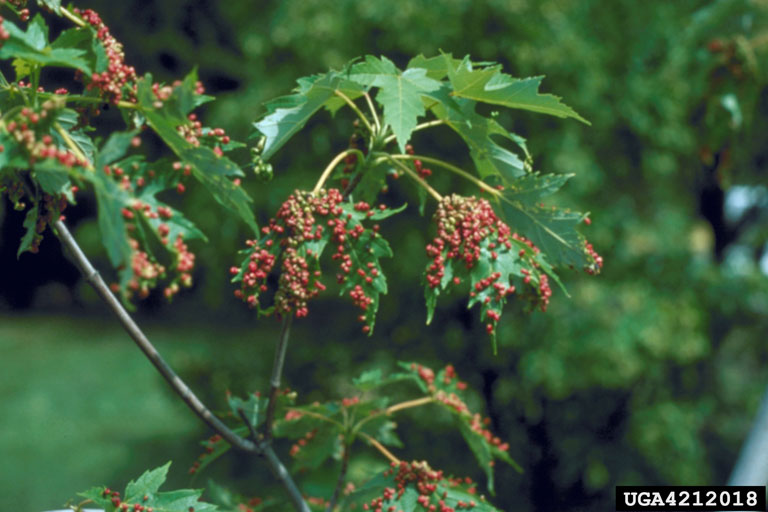
Leaf galls are the most common. They can be found on the lower or upper part of the leaf, and they may deform the leaf.

MapleBladderGallMite, Minnesota Department of Natural Resources , Minnesota Department of Natural Resources, Bugwood.org
Maple Bladder Gall, photo by Minnesota Department of Natural Resources , Minnesota Department of Natural Resources, accessed from Bugwood.org

Twig and stem galls look like an odd growth on the stems and twigs of plants. They can be small or large.

OakBulletGall_Dawn Dailey O'Brien, Cornell University, Bugwood.org
Oak bullet gall, photo by Dawn Dailey O’Brien, Cornell University, accessed from Bugwood.org.

Flower or bud galls disfigure a plant’s flowers or buds.

AshFlowerGall, A. Steven Munson, USDA Forest Service, Bugwood.org
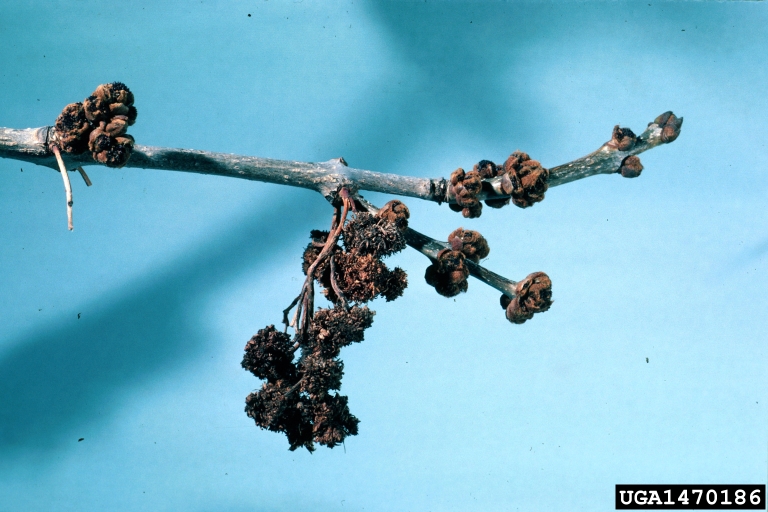
Ash flower gall, photo by A. Steven Munson, USDA Forest Service, accessed from Bugwood.org.

The Smithsonian notes that in North America alone, there are almost 1,500 different insect species that cause plant galls and most of them, over 800 species, make galls on oak trees.

Here is a sampling of some of the many galls you may see during your winter walks:

Oak apple gall

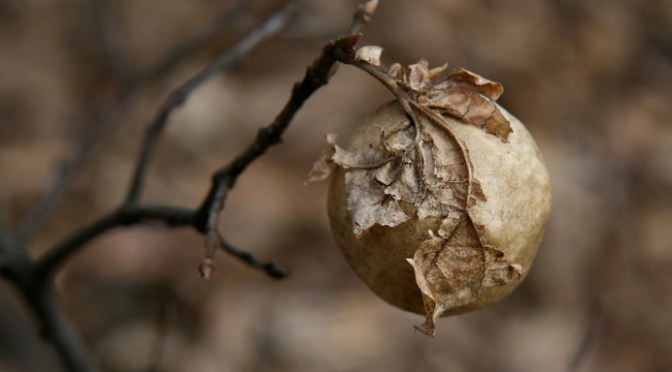
Walking under an oak tree, you may notice small, brown balls about the size of a ping pong ball hanging from the branches. These galls are the home of the oak apple gall wasp, Amphibolips confluenta. The galls are hard on the outside and soft on the inside. If you see a small hole in the gall, that hole was made by the adult wasp as it was emerging from the gall last summer.   Oak apple galls are commonly seen on scarlet and black oaks.

Goldenrod ball gall

Round galls on a goldenrod stem are an indication that a goldenrod gall fly (Eurosta solidaginis) is living inside the gall. Fly larvae live inside the gall all winter and emerge in the spring.  You can find these swollen stems in meadows and along paths.

Eastern spruce gall

Eastern spruce gall adelgids (Adelges abietis) cause galls on both Norway and white spruce.  Look for the small (½”-1” long) pineapple shaped galls near the tips of the branches.  One sign of eastern spruce gall adelgid is a scattering of brown spruce branch tips on the ground under a spruce tree. The tips break off during a heavy snow storm or wind storm.

Cedar-apple gall and rust

The fungus Gymnosporangium juniperi-virginiana infects both cedar trees and apple trees during its two-year life cycle. In the winter, look for the fungus on eastern red cedar (Juniperus virginiana; also known as eastern juniper) trees. Spores develop in the gall during the early spring and they are released in May and June after a warm rain. If the spores land on apple or pear trees, they will infect the leaves of the tree where they land.  Spores from cedar-apple gall on apple or pear leaves are released in June and July and may infect nearby cedars and other kinds of junipers and the cycle continues again.

Crown gall

One bacteria that forms galls is Rhizobium Rhizobium radiobacter. Grapes, walnuts, black cherry and other stone fruits are susceptible to Rhizobium radiobacter. The bacteria enters a plant when an insect or weather-related event injures the plant. For example, if the winter is severe, plants are more likely to get damaged from strong winds and crown gall bacteria will enter the plant. These galls can become enormous, over three feet in diameter when in the crown or body of trees, thus the name crown gall.

CrownGallWilliamJacobi, ColoradoStateUBugwood
Crown gall, photo by William Jacobi, Colorado State Univeristy, accessed from Bugwood.org

References and Additional Resources:

Brandeis University Biology Department, About Insect Galls.

Cornell University, Insect Diagnostic Laboratory, Galls on Plants.

Felt, Ephraim Porter and Millet Taylor Thompson, Key to American Insect Galls, New York State Museum Bulletin, The University of the State of New York, No. 200, August 1, 1917.

Jorgensen, Neil, A Sierra Club Naturalist Guide: Southern New England, Sierra Club Books, 1978.

Morton Arboretum, Plant Galls.

NYS Dept. of Conservation, Gall Making Insects Unsightly, Yet Ingenious,

Smithsonian BugInfo Insect and Mite Galls.

Stokes, Donald, Stokes Nature Guides: A Guide to Nature in Winter, Little, Brown and Company, 1976.

Thompson, Millet Taylor, Illustrated Catalogue of American Insect Galls Rhode Island Hospital Trust Company, 1907.

University of Minnesota Extension, Insect and Mite Galls.

Did You Know That Allegany State Park Played A Role In Wild Turkey Restoration?

The wild turkey is native to North America, but suffered severe declines due to wide-scale forest clearing and over hunting. By the mid-1800’s, this great bird was gone from New York state and much of the northeast. However, in the mid to late 1940’s, some wild turkeys were observed along the NY and PA border from Allegany State Park to the Genesee River Valley, a sign that the habitat might be recovering and able to support them again. So, in the early 1950’s, the New York State Conservation Department (forerunner to the NYS Dept. of Conservation) began a restoration effort in the early 1950s. They started with game farm turkeys, but after a few years, this effort failed because the game farm birds were not wild enough to avoid predation and lacked the capacity to survive.

fall.hens
Flock of hens in the forest in the 1950’s.

Meanwhile, a healthy breeding population of wild turkeys expanded from Pennsylvania into the Allegany State Park region of New York. Park managers then gave the Conservation Department permission to trap turkeys in the park, initiating the wild turkey trap and transfer program which began in 1958 and concluded successfully in 1974. This program allowed for more rapid expansion of the turkey population to suitable unoccupied habitats.

dec.file.2
Tom turkey displays his tail.

The turkeys trapped in Allegany State Park were moved to several areas in the Region and then throughout the state. In addition to the in-state trap and transfer, turkeys from the park were also sent to Connecticut, New Hampshire, New Jersey and Vermont. Other trapping efforts in the region and elsewhere in New York sent birds to Delaware, Minnesota, Rhode Island and the Canadian Province of Ontario. New York turkeys helped re-establish populations throughout the Northeast, Midwest and southeastern Canada.

New York State Conservation Department was one of the pioneers among state agencies to restore wild turkey populations in the United States. This program would not have been successful without the cooperation of Allegany State Park and to this day is recognized as one of the greatest wildlife management success stories of North America.

RickMiller OleanTimesHerald
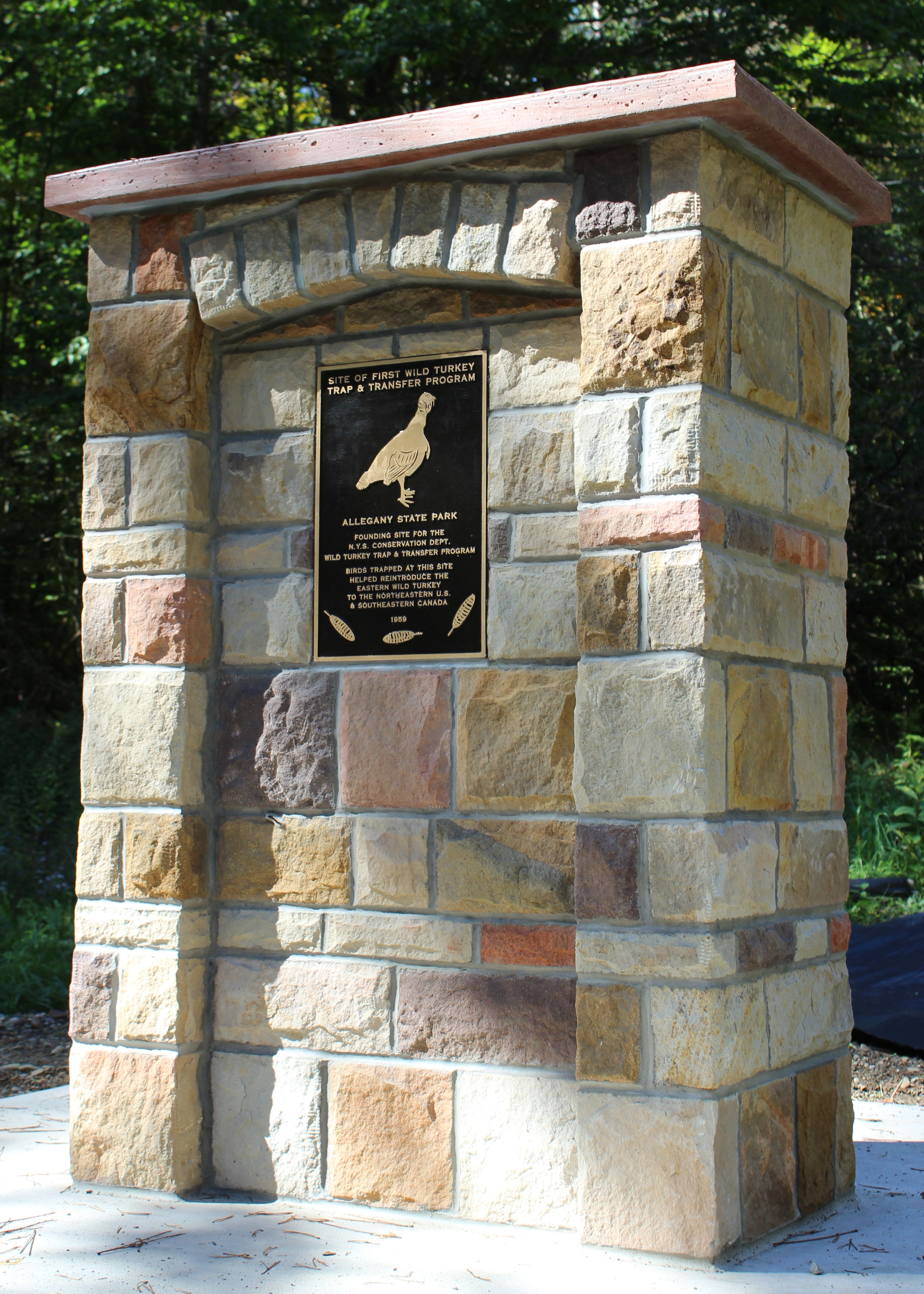
2017 Monument commemorating the first wild turkey trap and transfer program, photo courtesy of Rick Miller, Olean Times Herald

Conservationist 10-2017 p 28
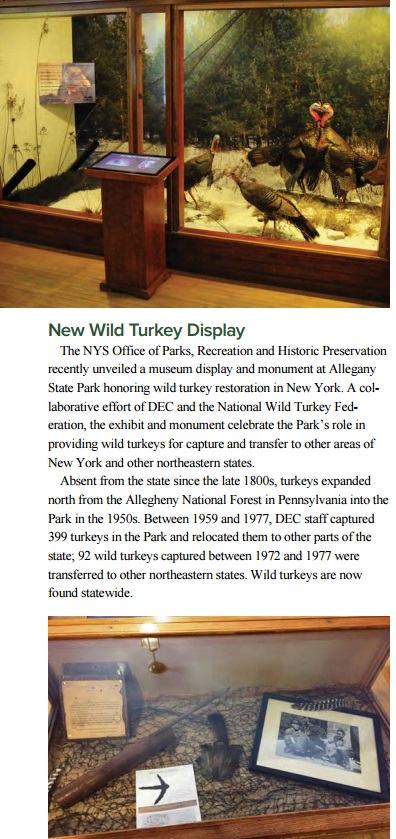
Wild Turkey Restoration exhibit in the Red House Natural History Museum, image from DEC Conservationist, October 2017, p 28.