Category Archives: Flora & Fauna

Rare or noteworthy wildlife spotted in New York State Parks

Camera Trapping

Camera trapping is one of the methods scientists use to keep track of wildlife in New York’s parks. To set a trap, researchers place a hidden camera in a location where an animal is likely to pass by, and sometimes they even leave bait to make the trap extra enticing. The bait in all these photographs is road-killed deer salvaged under permit for this purpose. At NYS Parks, we use infrared-sensing cameras. When an animal passes in front of the camera, the infrared-sensor is activated and the camera snaps a pic. Later, the researcher comes back to the camera to find out what he or she “captured” on film. In this way, researchers can observe and survey wildlife without frightening them or interfering with their natural behavior. It’s also one of the best ways to find out if certain rare, nocturnal, or particularly shy animals are living in our parks, such as bobcats, which are rarely sighted in the daytime.

This trap at Harriman State Park (Rockland and Orange Counties) was set up where golden eagles had been sighted in winter, 2013. We were thrilled to discover that we captured not only the golden eagle, but a coyote and bobcat as well! The observations of the golden eagle from this camera are being contributed to a database kept by the Appalachian Eagles Project, an effort to survey wintering golden eagles.

These next pictures were taken by the Taconic Outdoor Education Center at Fahnstock State Park for the purpose of better understanding the diversity of wildlife and their behavior. For example, we were surprised to capture an image of a great horned owl in our camera trap, as this species is not known to scavenge for meals. Other animals featured in these photos are turkey vultures, red tail hawk, crows, coyote, bobcat and bald eagle.

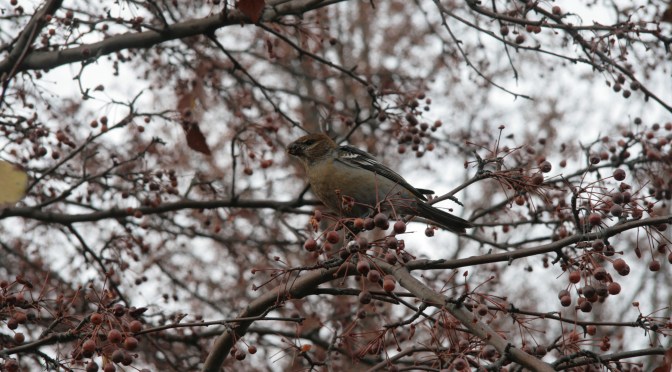
Wildlife Spotlight: Pine Grosbeak

The Pine Grosbeak is one of the largest members of the finch family, and a rare winter visitor to New York. This bird species generally breeds between Alaska and Newfoundland, and south in the western mountains to California and Arizona. They winter further south, in the Dakotas, New York, and also Eurasia. These birds use their short, curved beaks to eat seeds, buds, and berries from trees such as Mountain Ash, cedar, and Juniper. Look for Pine Grosbeaks in scattered forests where these kinds of trees are plentiful. Pine Grosbeak’s tame and slow-moving behavior has earned them an unusual name in Newfoundland, where they are called “mopes.”

Post by Paris Harper, photos by Lilly Schelling.

Ecological Change in Lake Minnewaska

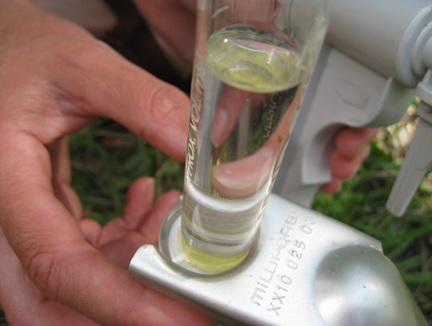
Small changes to lake ecosystems can mean big changes for plants and wildlife that make their homes there. Even though Lake Minnewaska (Minnewaska State Park Preserve, Ulster/Sullivan counties) looks the same from above the surface, life in the water has undergone major change in the past several decades. Lake Minnewaska is a unique “sky lake” ecosystem. Historically, Lake Minnewaska has been acidic acidic. No, it wouldn’t burn you to touch it, but it was too harsh for fish to live in. Studies show that Lake Minnewaska was oligotrophic as recently as the 1990s, meaning that nutrient levels were low and the phytoplankton that form algae were absent. The lake was home to other types of creatures, though, including a mat of sphagnum moss which grew up to 20 meters underwater and carpeted 60% of the lake, possible because of the high clarity of the water. The sphagnum moss sheltered two species of salamander which, because of the lack of predators, made use of the habitat and behaved in ways that no one had ever seen elsewhere (Bahret 1996).

Since the ‘90s, however, the lake has gradually become less acidic and phytoplankton more prolific, moving the lake towards mesotrophic status. The primary factor in the trophic shift is the introduction of the non-native bait fish species, the Golden Shiner, which was first observed in Lake Minnewaska in 2008. The Golden Shiner eats zooplankton, which are the primary consumers of phytoplankton, leading an increase in microscopic plant life in the lake. Because of these changes, sphagnum moss no longer grows in Lake Minnewaska, and as these trends continue, we can expect further reductions in water clarity, and more plant and fish species to take up residence in the lake. NYS Parks’ Environmental Management Bureau – Water Quality Unit continues to monitor Lake Minnewaska as an ongoing part of a statewide lake monitoring program.

Image

References

Bahret, R. 19996. Ecology of lake dwelling Eurycea bislineata in the Shawangunk Mountains, New York. Journal of Herpetology 30:399-401.

Townley, Lauren. Investigation of trophic changes in Lake Minnewaska, a pristine sky lake in Ulster County, New York. Poster, Northeast Association of Environmental Biologists Conference. Online, accessed 8/25/2014.

Happy Thanksgiving!

Be sure to thank a turkey today!

photo by NYS Parks
photo by NYS Parks

Hemlock Woolly Adelgid

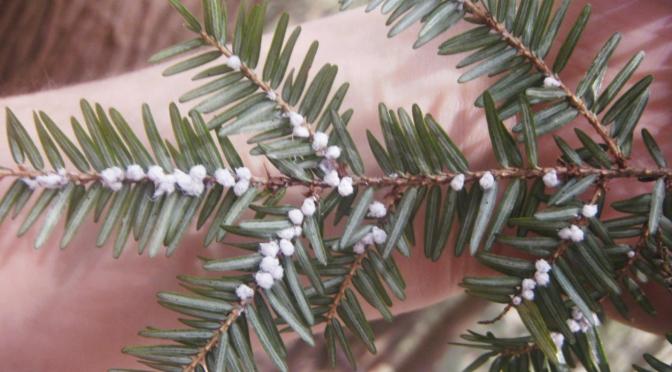
The Hemlock Woolly Adelgid (HWA) is one of few insects active during the winter months, and so now is the perfect time to be on the lookout for this tiny invader. Hemlock Woolly Adelgid (HWA) is an invasive insect native to Japan. We think it was introduced in the mid-1900s when Japanese ornamental plants became very popular in American gardens. This tiny insect is specific to evergreen hemlock trees (Tsuga spp.), attaching to new branchlets and feeding on the hemlocks starchy liquids. This continuous feeding weakens the trees and can kill it over the course of about six years. HWA has caused the death of millions of hemlocks along the Appalachians, and gray, ghostly forests are moving ever northward into New York.

HWA egg sacs are the most visible form of the insect, seen from October-May, a time when most insect predators are not active. Egg sacs are found on the underside of hemlock branches and look like small, white, fuzzy blobs, like the tip of a cotton swab.

HWA reproduces twice a year, allowing for exponential population growth in a short period of time. NYS Parks is taking an active role in managing new infestations of HWA. Chemical insecticides, applied very specifically to individual hemlocks, are the best method of control. In addition, NYS Parks has released predatory insects as biological controls in several state parks, with the hope they will one day keep HWA populations in check. Parks just hosted two HWA volunteer training events in Western NY to help us determine presence/absence areas.

Now is the perfect time to be on the lookout for HWA. For more information, or to report sightings in NYS Parks, contact  invasives@parks.ny.gov