Category Archives: Fun & Games

Flitting Crystals

“Snow”

by William Cullen Bryant

Here delicate snow-stars, out of the cloud,
Come floating down in airy play,
Like spangles dropped from the glistening crowd
That whiten by night the Milky Way.

Snow is that magical precipitation that turns our stark winter landscape into a winter wonderland; gives school children joy at the possibility of a day off – SNOW DAY; and gives commuters white knuckles as they navigate home on slippery roads.  Snow is what we expect to see each winter here in New York State.  But what is snow?  How is it formed?  Is it true that no two flakes are the same?

Snow will form in clouds between the temperatures of -39˚F and 32˚F.  Clouds are mostly filled with tiny water droplets, tiny meaning that thousands can fit in a period.  Microscopic dust and salt particles from the land and sea are also found in clouds.

As the dust and salt cool in a cloud, they attract the tiny water droplets which stick and freeze to the particles – beginingthe formation of a snow flake (or the scientific term snow crystal).  These tiny snowflakes grow by collecting more water molecules.  When they get too heavy to be in the cloud they start to fall to the ground.  As they fall, they bump into other snowflakes causing pieces (tiny crystals) of the snowflake to break off which become new snow flakes.  The humidity and temperature inside the clouds will determine which type of snowflake is formed.  If the air is moist and warm (25o-32o F) large flakes will form.  If it is cold and the cloud has little moisture, the snow that forms resembles tiny columns.  Figure 1 illustrates how different types of snowflakes form in different cloud conditions.
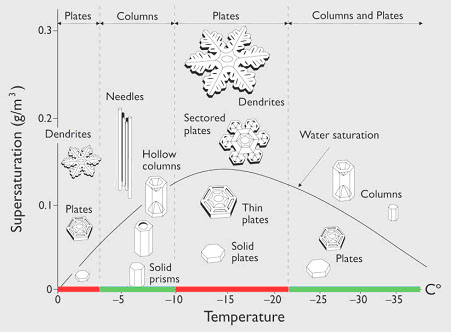
Figure 1. Snowflake shapes at different temperatures and humidity (“Supersaturation”). From: http://mrsgallscience.wikispaces.com/Snowflakes
Figure 1. Snowflake shapes at different temperatures and humidity (“Supersaturation”).
From: http://mrsgallscience.wikispaces.com/Snowflakes.

Why do snowflakes have a six-sided symmetry? Snowflakes are six-sided because of the way that the individual water molecules connect together – they form hexagonal lattices which give the snowflakes six-sided symmetry.

Eight common types of snowflakes are:

Hexagonal Plate Crystal:
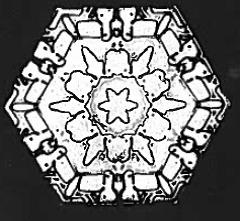
Hexagonal Bentley & Humphreys P. 45

Six-sided flat crystals with various amounts of surface patterns.  Largest of these can be just under ¼” across.  Hexagonal plate crystals are found in most snow falls.

Stellar Crystal or Dendrite:

Stellar Bentley 7 Humphreys P. 149

Stellar crystals are six-pointed star shaped snowflakes. These flakes can be up to 1/2″ across.  They can be found in low numbers in most snow falls.  Formed in the low atmosphere when the temperatures are not too cold and the humidity is high, sometimes the stellar crystal flakes join together to form large flakes that are 2” across.  The gentle drifting of the stellar crystal flakes gives a tranquil feeling to snowfalls.

Column Crystal:

Columns Bentley & Humphreys P. 210

Forming in cold clouds and low moisture, column crystal flakes are six sided and can be hollow inside.  During the winter, column crystals are commonly found in the high, wispy cirrus clouds.  They help to create a halo around the moon on winter nights. The halo is created by moonlight streaming through these ¼” crystals.  Rarely do these crystals fall to the ground.

Asymmetrical Crystal:

Asymmetrical Bentley & Humphreys P. 210

Asymmetrical Crystals are another common snowflake.  They appear to be many hexagonal plates stuck together and have been mistaken for stellar crystals.  They are about 3/8” across.

Bullet Crystal:
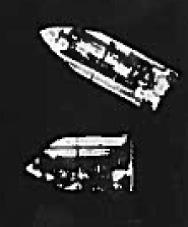
Bullet Bentley & Humphreys P. 210

Bullet crystals are column crystals that look like one end was sharpened with a pencil sharpener to form a hexagonal pyramid.  They can be seen either singly or in groups of three, attached by the points of the pyramid.

Tsuzumi Crystal:

Tsuzumi Bentley & Humphreys P. 210

Named for the Japanese drum of the same design, Tsuzumi crystals are column crystals with hexagonal plate crystals at each end.   They form when the column crystals bump into the hexagonal plate crystals as the snow falls.

Needles:
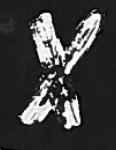
Needles Bentley & Humphreys P. 210

Needles are fine, six-sided columns with a point at each end; they range in length from ¼” to ¾” long.  This is one of the most common types of snow flake in a snow storm.  Sometimes the needle flakes freeze together during the descent forming conglomerate flakes.  These conglomerate flakes quickly break apart as soon as the flakes hit the ground.

Stellar Hexagonal Plate Crystals:

Stellar Hex Bentley & Humphreys P. 111

Stellar Hexagonal Plate Crystals are some of the most stunning snowflakes.  They form when either a stellar crystal goes through a hexagonal plate crystal cloud condition or a hexagonal plate crystal goes through a stellar crystal condition.  These are some of the most common snowflakes in a storm.

So is it true that no two snowflakes are alike?

During school vacation try one of these family activities – preserving snowflakes or making a snow catcher.

Post by Susan Carver, OPRHP.


Sources:

Bentley, W. A. and W. J. Humphreys, Snow crystals: 2453 illustrations, Dover Publications, New York, 1962.

Griffin, Julia, The science of snowflakes, and why no two are alike, PBS NewsHour, 22 December 2011, http://www.pbs.org/newshour/rundown/the-science-of-snowflakes/.

Martin, Jacqueline Briggs, Snowflake Bentley, Hougton Mifflin, Boston, 1998.

National Oceanic and Atmospheric Administration, How do snowflakes form?  The science behind snow.

Stokes, Donald, Stokes nature guides: a guide to nature in winter, Little Brown and Company, Boston, 1976.

National Snow and Ice Data Introduction to Snow.
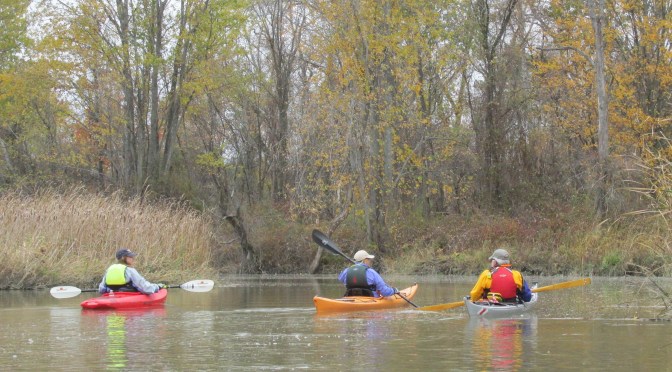


The 3 Season Paddler: Safety Tips for Extending Your Boating Season

The tang of a slightly warm breeze rattled the yellow leaves of the cottonwoods under a dome of grey clouds welcoming an intrepid group of fall paddlers chasing the last vestiges of summer at Schodack Island State Park on the Hudson River near Albany.

“We weren’t planning to go out on to the Hudson River for this trip, but were headed to the kayak launch at Schodack Creek on the eastern side of the island,” Ro Woodard recalled. “It has tidal waters like the Hudson and snakes through the phragmites reeds and cattails swamp under the mighty bridges of the CSX Railroad and NYS Thruway.  It was exciting to think, as I drove over the Thruway bridge and looked down to the creek, that I would be soon seeing the secrets of the marsh from a water’s eye view rather than a bird’s eye view.”

Warm fall and winter days might tease paddlers into heading for their favorite open water, but the warm air temperatures can deceptively mask the dangers of the cold water surrounding our boats as we paddle. NYS OPRHP would like to remind paddlers and sportsmen who venture out on the water between November 1 and May 1 that everyone in boats less than 21 feet in length  (this includes motor boats, too) MUST WEAR a US Coast Guard approved life jacket while underway.  OPRHP also recommends that everyone wear a life jacket if the water temperature is less than 70o F.

All boaters (and, yes, paddlers are boaters) should be aware of the possibility of a sudden unexpected swamping, capsize, or a fall overboard into the cold water. At the onset of a sudden cold water immersion there is an initial uncontrollable gasp reflex leading to hyperventilation and increased heart rate and blood pressure which can result in immediate drowning. Go to Cold Water Boot Camp to see what this reaction looks like.  A life jacket may save your life by keeping your head above water and your body floating you while you get your breathing in control.  Next you should attempt self-rescue by getting back in or on your boat.  You have about 10 -20 minutes depending on the temperature of the water before your muscles and nerves cool down and stop functioning;   even good swimmers can’t control their movements and ultimately experience swimming failure.   Again, the life jacket can make all the difference because it will float you.   This is a sobering message for those going out for what they hope to be a fine day on the water.  Remember to wear your life jacket, because it can make all the difference.

Late season paddlers should dress for the water temperature, not the air temperature with either a wet suit or dry suit under your life jacket.  Bring along safety equipment to help with rescue in case of a capsize: pump, rescue bag, sling, paddle float, whistle, visual distress signals, and a VHF radio or cell phone is a waterproof bag.  Also take a course to learn how to use the equipment and how to rescue a paddler who is in the water, empty the water from their boat and get them back inside before you head out for your cold season paddling trip. It is important to have essential skills and equipment, which we hope we never have to use, with you when you kayak and canoe.  The American Canoe Association has a variety of courses for all level of paddlers.

Always paddle with a group if possible and be sure to let someone know where you are going and when you are expected to return.  Take a boating safety course and refrain from the use of alcohol when paddling.  Boating safety courses can be found at http://nysparks.com/recreation/boating/boating-safety-class.aspx  and a free online paddle sport safety course at www.paddlecourse.com.

Click on an image above to enlarge it and read the caption.

The properly dressed and equipped group enjoyed a pleasant afternoon sweeping upstream on the incoming tide, sharing summer paddling stories and watching the sky hoping for a glimpse of one of the many eagles which inhabit the shores of the Park.  They passed under the bridges to the sound of a honking horn.  The honking must have come from a sharp-eye paddler who was crossing the bridge in his or her car and spotted us paddling. After encountering a tree across the narrowing creek, they turned around to head south just as the tide was turning and the current carried them back to the launch ramp. No eagles on this trip, but a flock of crows soared over head as we finished our day.

The fabulous fall padding season has wound down. The air temperatures are dropping and so is the water temperature.  Though lots of us summer paddlers put away our kayaks and canoes until spring, many hearty paddlers continue to enjoy the late fall paddling until ice forces them off the water. If that paddler is you, remember to wear your life jacket, let someone know when and where you are paddling, dress to stay warm, bring your safety equipment, don’t drink alcohol while out on the water, and paddle with a group if possible.   The rest of you, we’ll see you in the spring!

Post and photos by Ro Woodard, Marine Services Bureau, OPRHP.

Beyond the Gobble: Little Known Facts about Turkeys

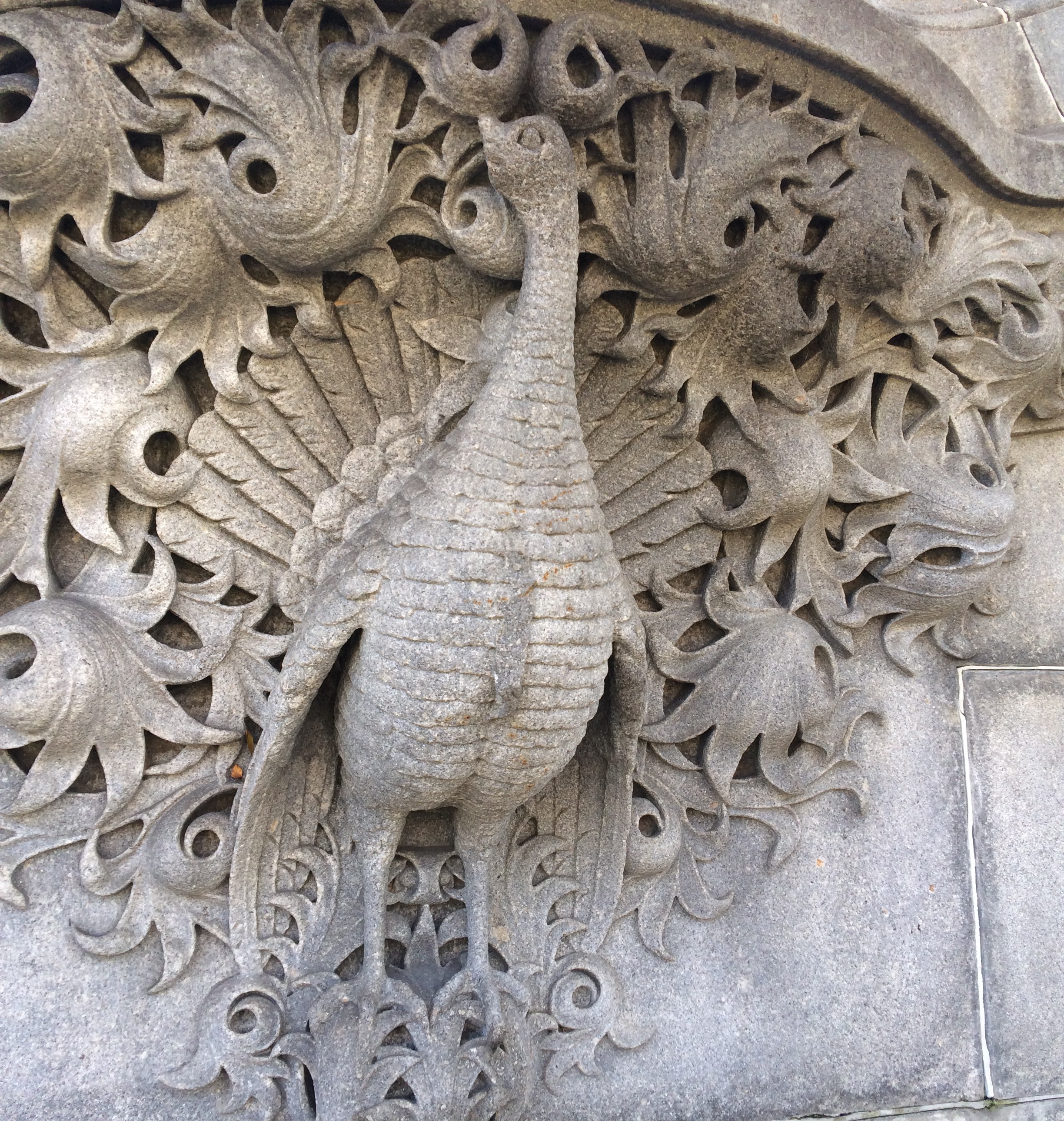
In 1782 Benjamin Franklin wrote “the wild turkey is a bird of courage that would not hesitate to attack a grenadier of the British guards, who should presume to invade his farmyard with a red coat on,” in an effort to promote the turkey over the bald eagle as the national emblem of the United States. Although the turkey was not selected to hold the prestigious position of national emblem, the bird is certainly an icon for the month of November and the celebration of the Thanksgiving holiday.

A turkey featured on the New York State Capital building. Photo by Lilly Schelling, OPRHP.
A turkey is featured on the New York State Capital building. Photo by Lilly Schelling, OPRHP.

There is much more to know about turkeys than what side dishes the bird pairs nicely with on the Thanksgiving table. To be the hostess with the mostess (turkey knowledge, that is) try sharing some of the following fun facts with your dinner guests this Thursday!

  • Turkeys can run at speeds of up to 25 miles per hour and can fly up to an impressive speed of 55 miles per hour.
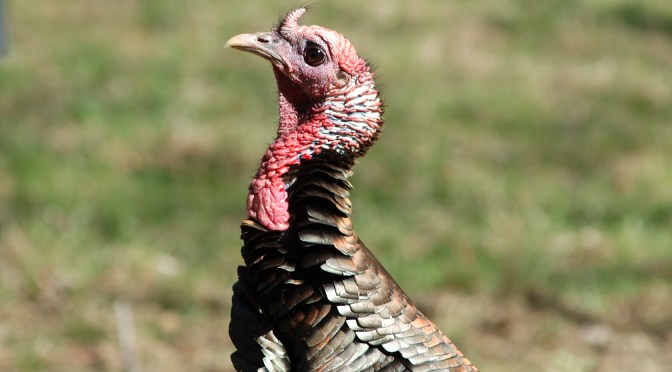
  • The area of bare skin on a turkey’s throat and head changes color depending on its level of stress or excitement. A male turkey’s head will turn blue when excited, or turn red when it is preparing to fight.
  • Male turkeys have beards and spurs. The older the turkey, the longer the beard. Females are called hens, chicks are known as poults, and young males are jakes. See the photo below for more information about turkey anatomy!
  • Because turkeys have a number of natural predators, including foxes, coyotes, and raccoons, they often sleep perched atop tree branches with their flock. In the morning, they call out a series of yelps before descending from the tree to ensure that the rest of their roosting group has made it safely through the night.
  • Turkeys have excellent daytime eyesight that is 3x better than a human’s! A turkey’s vision range covers 270 degrees, and they can also see in color. Turkeys have poor vision at night.
  • Wild turkeys were almost hunted to extinction by the early 1900’s, but recovery efforts have brought their numbers up to seven million across North America today. Allegany State Park in western New York was the source site for turkeys that were later reintroduced across the rest of the state in the 1950’s. It was presumed that these turkeys wandered across the state border from Pennsylvania.
Snood - wattle - caruncle - beard - spur diagram off of a parks turkey picture
Above: A male turkey (called a tom) at Minnewaska State Park Preserve. Photo by OPRHP, edited by Lilly Schelling.

Post by Megan Phillips, OPRHP. Photos by Lilly Schelling, OPRHP.

Sources:

http://birdnote.org/show/national-symbol-turkey-vs-eagle

http://www.smithsonianmag.com/science-nature/14-fun-facts-about-turkeys-665520/?no-ist

http://www.onekind.org/be_inspired/animals_a_z/turkey/

http://www.livescience.com/17057-turkey-facts-thanksgiving.html

http://birding.about.com/od/birdprofiles/a/turkeyfacts.htm

http://www.nytimes.com/1985/05/03/nyregion/wild-turkey-making-a-comeback.html

Symbols of New York State Scavenger Hunt

Ah, Labor Day Weekend, a perfect weekend to take a hike through your favorite state park.  If you do take a hike, try the Symbols of New York State Scavenger Hunt – let us know how you did.

Red-Spotted Admiral or White Admiral butterflies are one our newest state symbol, they were designated as the state butterfly in 2008.  These butterflies are polytypic – meaning that there are different coloration patterns for this butterfly depending on where it lives. The white admiral variation has blackish blue wings with wide white band.

Admiral
White Admiral. Plismo (Own work) [CC BY 3.0 (http://creativecommons.org/licenses/by/3.0)%5D, via Wikimedia Commons.
The red-spotted admiral lacks the wide white bands and sometimes has a row of red spots along the top of the wing. Overall the wings are a dark blue color with a light blue dusting on the hindwing.

If you are hiking in northern New York, you will only see the white admiral.  If you are hiking in any other part of the state, you will see either the red-spotted or white admiral.

Red Spotted Admiral
Red Spotted Admiral, note the red spots on the top wings. FrigidNinja (Own work) [CC BY-SA 3.0 (http://creativecommons.org/licenses/by-sa/3.0)%5D, via Wikimedia Commons.
Look for Eastern Bluebirds in Park grasslands and on utility wires. These birds are primarily cavity nesters, utilizing hollowed out holes in trees and man-made nest boxes to lay their eggs. Bright blue males are easy to spot while females are a bit more challenging with blueish grey plumage.  Both have rust-colored chests and white bellies.  Eastern bluebirds have been our state bird since 1970.

New York’s largest rodent, the Beaver, can be found in wooded streams, marshes, and along the edge of ponds and lakes.  When you are walking near these wetlands, tree cuttings and chewed trees or shrubs near the shore is a great indicator that beavers are live nearby. If you hear a slap on a pond or marsh, the beaver has spotted you and has slapped its tail on the water to warn other beavers that you are around.  If you can find a spot to hide and have time to wait, you might get a glimpse of these shy animals.  Beavers have been our state mammal since 1975.

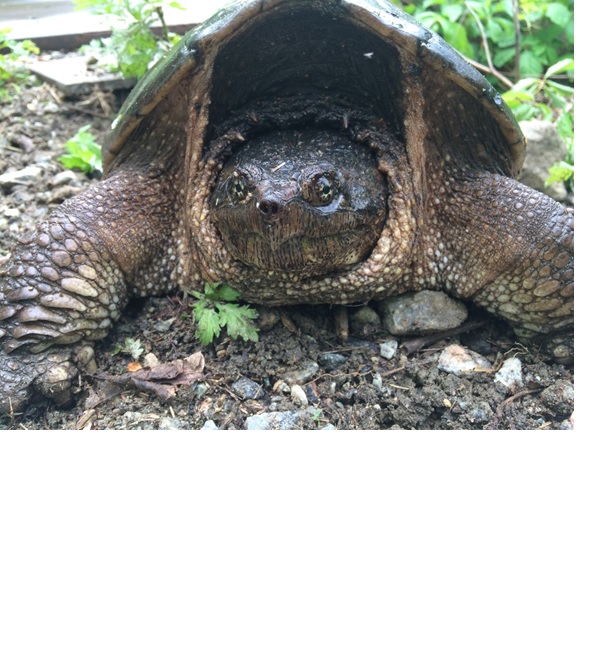
Snapping Turtles can be found in marshes, rivers, streams, lakes, and even in urban waterways.  Our largest turtle, their shells can be upwards of 20” long and they can weigh up to 35 lbs.  The upper part of the snapping turtle shell or carapace has three keels or ridges.  The turtle’s shell can vary in color from tan, brown, olive gray or black.  They have a long tail with saw-toothed ridges. Interestingly, snapping turtles have the smallest plastron (or bottom part of their shell) in proportion to their body of any turtle in New York State. Most of their defense strategy is their large size. Look for these turtles swimming slowly through the water with their head poking out of the surface or perched on rocks near the water’s edge. Remember to keep your distance from these turtles; their jaws have a powerful snap! Snapping turtles became our state reptile in 2006.

Female Snapper
Female Snapping Turtle. Lilly Schelling, NYSOPRHP.

The rare Nine-Spotted Ladybug has been our state insect since 1989.  Slightly bigger than a dime, these oval-shaped insects typically have nine-spots on their backs.  If you think you found one, please take a photo, record where you found it and send all the information to The Lost Ladybug Project.

9 Spotted Ladybug
Nine Spotted Ladybug, each wing usually has four spots, plus one spot that overlaps on both wings. http://musingsofabiologistanddoglover.blogspot.com/2011/08/lost-ladybugs.html?_sm_au_=iVVV163fqrZsRWDr.

The Sugar Maple was designated as our state tree in 1956. The bark of a young sugar maple is smooth and dark gray; as the tree ages the bark becomes furrowed in uneven long plates.   Sugar maples have easily recognized leaves that are between 3”-5” long and 3”-5” wide, usually with 5 shallow ‘u-shaped” lobes.   Perhaps you will see the leaves a few of these beautiful trees turning red or yellow during your walk.

And remember to stop and smell the Roses during your hike.  If you do, perhaps you will see some late flowers on some of our native roses such as this Common Wild Rose.  The flowers can be observed either individually or in small bunches.  Look for the common wild rose along roadsides, fields, and salt marshes.  Roses were designed our state flower in 1955; they are our oldest state symbol.

Rose
Common Wild Rose. magnolia1000 from Canada (Rosa virginiana) [CC BY 2.0 (http://creativecommons.org/licenses/by/2.0)%5D, via Wikimedia Commons.
When you are done, why not enjoy some New York state goodies: milk, the state beverage (designated 1981); apple muffin, the state muffin (designated 1987); apple, the state fruit (designated 1976); or yogurt, the state snack (designated 2014.).

Snack
Photo and snack prepared by Susan Carver, OPRHP.

Post by Susan Carver, OPRHP.

Learn more at:

http://www.dec.ny.gov/education/1887.html

http://www.dos.ny.gov/kids_room/508/symbols2.html

http://explorer.natureserve.org/

http://plants.usda.gov/java/


Explore NYS Parks’ Waterways

Now that the ice is finally gone and the water is warming up, those of us who love paddling are heading out to our favorite spots. Where better than to check out the ponds, lakes, and waterways than in New York State Parks? Whether just for exercise or to enjoy the sun and sky while paddling across the water, getting out in your kayak or canoe is a chance to relax and see a little of the world that can only be experienced from the water.

Grafotn PRK_2664
Kayakers at Grafton Lakes State Park. Photo courtesy of OPRHP.
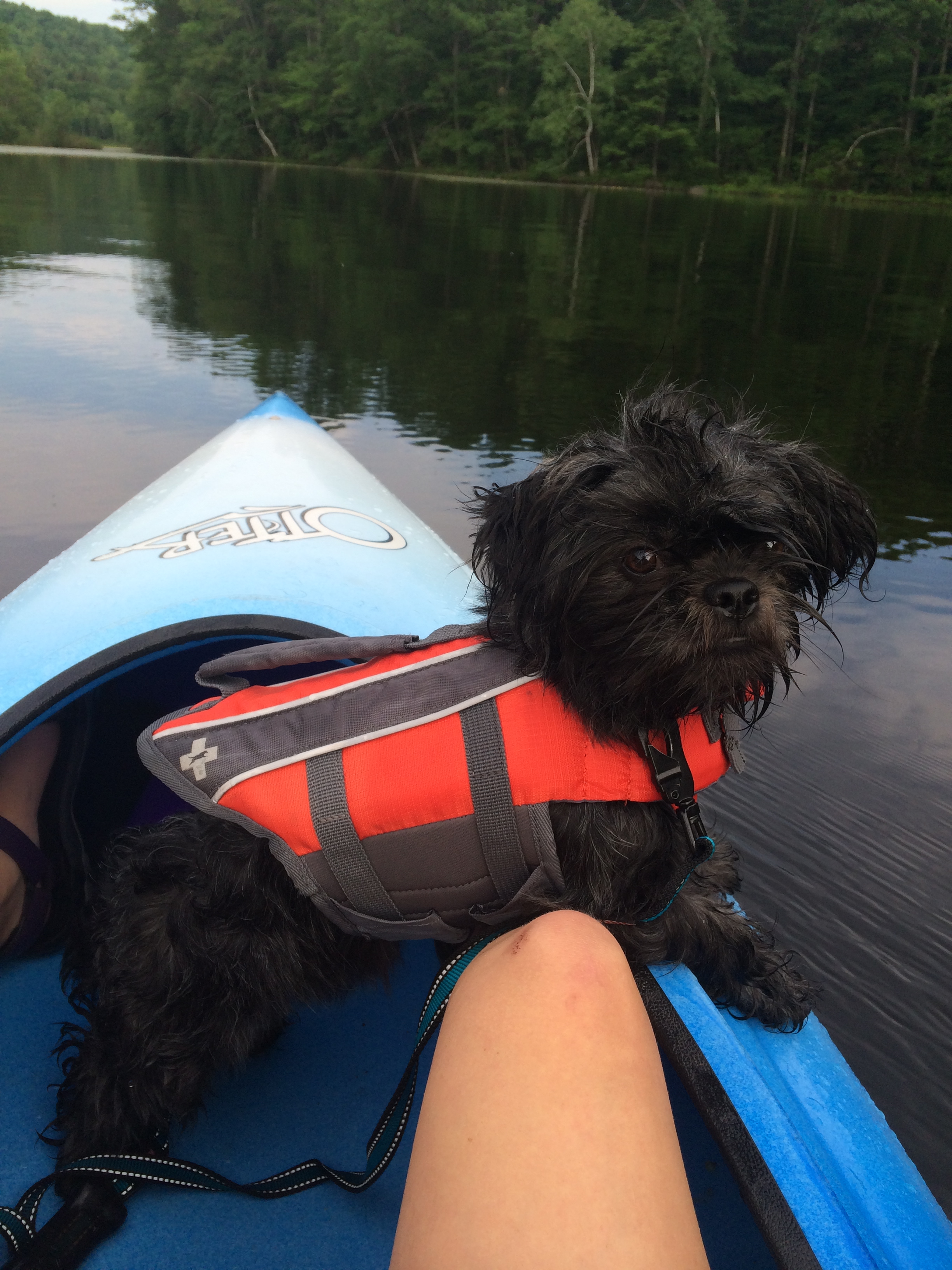
Dog in Kayak with life vest_Lilly Schelling
Life vests are also available for pets! Photo by Lilly Schelling, OPRHP.

The Marine Services Bureau of State Parks has just conducted training for Park staff who will be offering American Canoe Association kayaking lessons and tours in parks this summer.  Check out for their kayak program schedules.

Marine Services Bureau is also hosting two paddling events.  W.O.W. (Wear it On the Water) Paddle Fest will be held in two locationson Saturday, July 11 at Gilbert Lake State Park and Saturday, August 15 at Fair Haven Beach State Park.  This free event will feature free kayaking lessons, a Life Jacket Flash Mob, and Sport Fishing Clinics along with other family fun and friendly activities to help you enjoy the water.

Whether exploring for turtles, watching for osprey, fishing, or listening for the slap of a beaver’s tail, we want to remind you to be mindful of the safety of yourself and others who are paddling with you.  Take a free online paddle safety course at www.paddlecourse.com.  Don’t pack it, but wear your life jacket, be boat sober, and leave a float plan letting someone know where you are paddling and when you will return.

Marine Services Bureau encourages all paddlers to obtain an IF FOUND Sticker to identify your boat.  Write your name, cell phone and alternative phone number on the sticker and affix to your boat.  It’s a great way to return a lost boat or help law enforcement rescue a capsized kayaker.  Get your IF FOUND sticker by sending a legal sized self-addressed stamped envelope to NYS Parks, Marine Services Bureau, IF FOUND Sticker, Albany, NY 12238.

If Found
Photo by Ro Woodard, OPRHP.

So grab your life jacket and paddle and head out to the nearest lake or pond to enjoy the serenity and natural surprises that are just a paddle away.

Picture1


Post by Ro Woodard, Marine Services Bureau (OPRHP).