Definition of “subnivean”: the zone in or underneath the snowpack.
Entrance hole in the snow. Photo by Patty Wakefield, OPRHP.
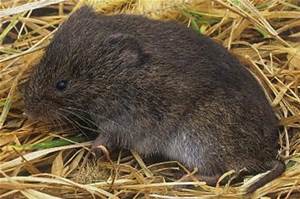
During the winter months when the temperatures fall into the single digits or below zero, and snow covers the landscape, survival in such harsh conditions is often challenging. Have you ever thought about the small mammals that reside in the fields along some of our country roads? One of those critters is the meadow vole (Microtus pennsylvanicus); which means small ears of Pennsylvania. The meadow vole is an integral part of the food chain for many prey species such as the red-tailed hawk (Buteo jamaicensis) and the red fox (Vulpes vulpes).
How do they survive? Meadow voles form runways or paths in dense grass in fields and/or wooded areas in the spring and summer months. You can see evidence of these tunnels by entrance holes.
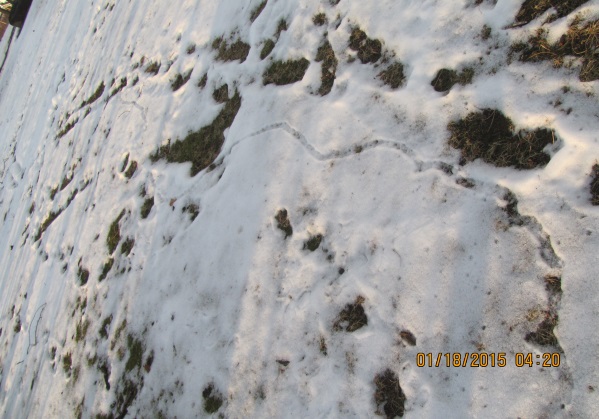
These runways allow the meadow voles to forage, reproduce and survive while protecting them from predation. Meadow voles also dig shallow burrows where nests are constructed. During the winter months, the tunnels are under the snow.
The snow actually works as an insulator to help protect them from the cold.
Evidence of snow tunnels (2 images). Photos by Patty Wakefield, OPRHP.
Meadow voles often eat the green basal (bottom) parts of grass, berries and the cambium (under bark) of small saplings and bushes.
Next time you take a walk in a State Park see if you can find traces of these remarkable little winter warriors. The beauty and wonders of nature is all around us. We need just take the time to observe and see what we can see.
Evergreen means these trees keep their “leaves” throughout the winter. Though we may call them pine needles, they are actually very skinny leaves that serve the same function as the leaves on a deciduous tree. Identifying evergreens during the winter months is almost the same as in spring and summer, with the added advantage of having mature pine cones. Growth pattern, bark, cones, needle shape and number are used to identify the different species. Let’s learn how you can identify red pine, white pine, and eastern hemlock.
Last time we learned that leaves attached at the stem from the node. This is the same for evergreen trees, except these trees can have multiple needles attached to the stem in a bundle or sheath. This helps identify species since they differ by the number of needles they have per bundle.
See the example below:
This red pine has two needles per bundle.
Now we are ready to learn some tree species!
We will start with white pine. First let’s look at the bark and growth pattern:
WHITE PINE
White pine usually grows straight and tall with horizontal, upturned branches. The tree has a uniformly full foliage appearance. The bark is a light gray in color with shallow ridges. White pines can be found in well drained soils and are native throughout the state.
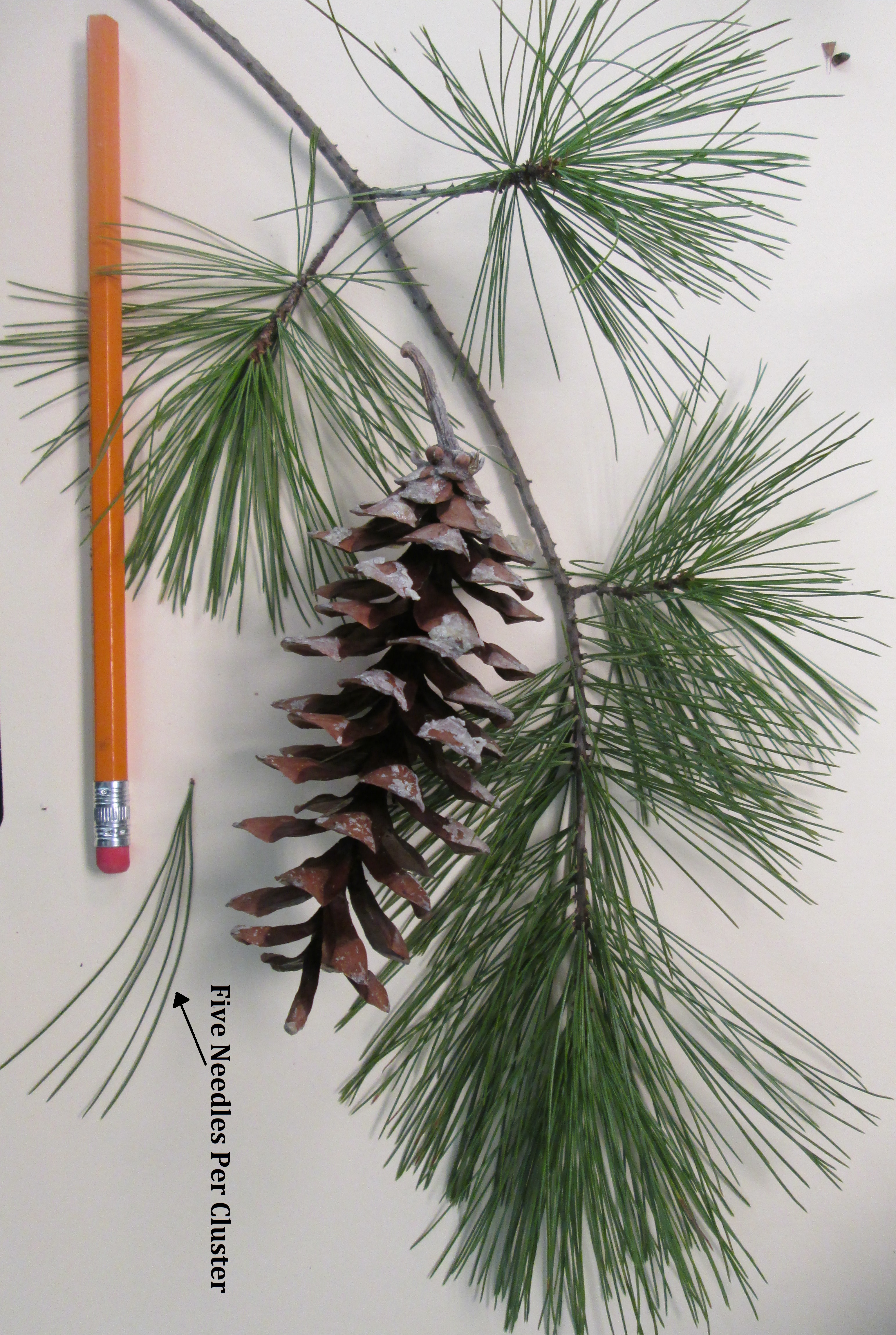
Now we will look at the characteristics of the twig and cone. There is a pencil in each picture for size reference:
White pine has 5 needles per bundle. The needles and stem are flexible and slender. The cone is long and narrow and about 3 to 8 inches in length. Needles are light green in color.
RED PINE
Red pine is a tall, straight growing tree with horizontal or dropping branches. The foliage looks clumpy, instead of uniformly full like white pine. The bark can have a reddish coloring and is flaky/ scaly. This tree grows in well drained areas; such as rocky or sandy habitat. Red pines are native to a small area of the state, but are often planted around reservoirs or in parks.
Red pine has two long needles per bundle. The needles and stem are thick, unlike white pine. The needles are dark green and stiff – they break in half easily. The cone is short and round; usually about 1.5 to 3 inches in length.
EASTERN HEMLOCK
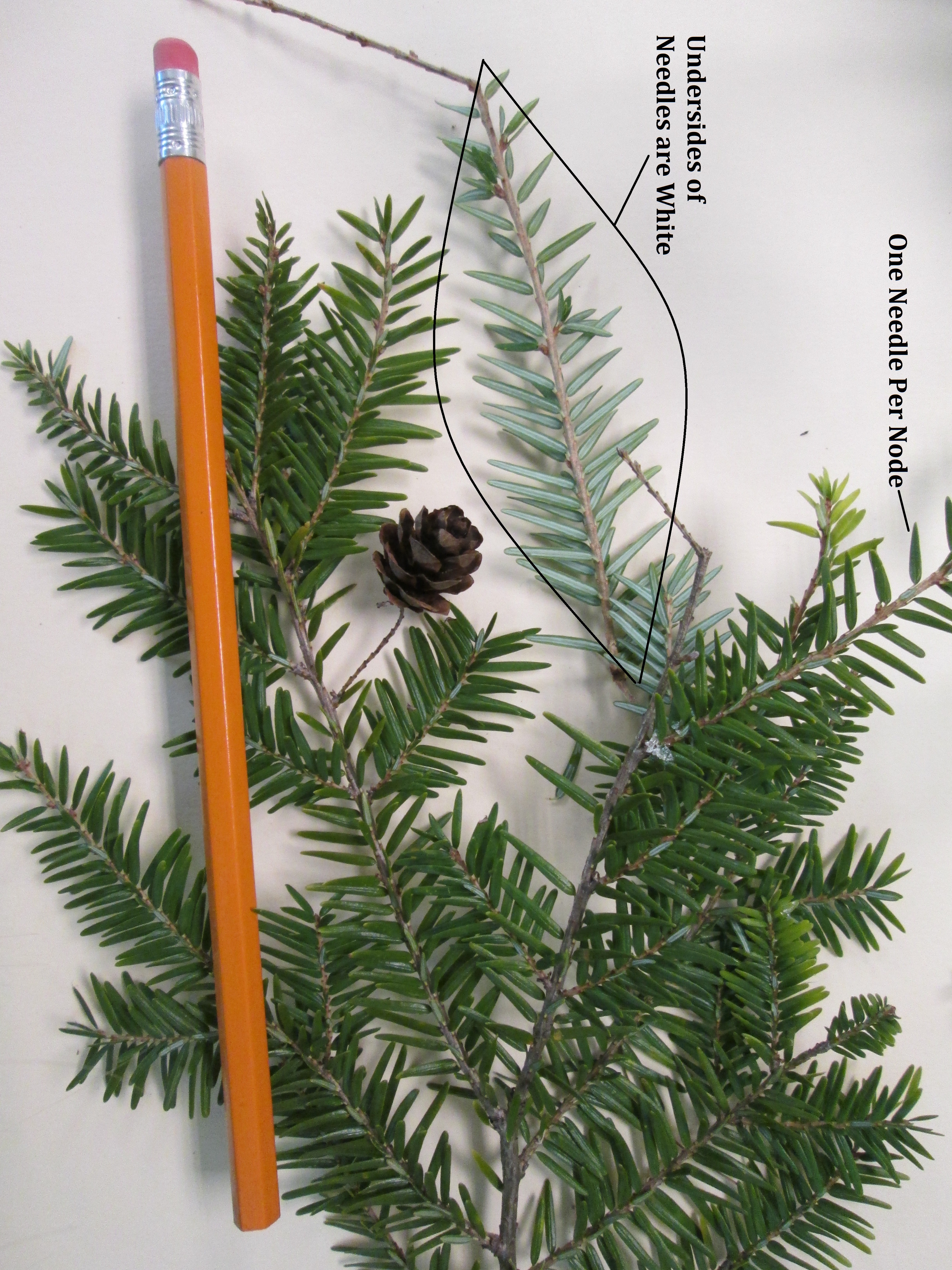
Eastern hemlock has a tall straight growth pattern. The branches grow horizontally. The foliage is more of a yellowish green in color compared to white pine. In this picture there are white pine trees in the left background for comparison. The bark is scaly when young, becoming ridged with age. The trunk is reddish-brown in color. These trees grow in shady-moist habitat, often along streams, on slopes or at higher elevations. Eastern Hemlocks are native to NY.
Hemlock does not have bundles of needles, just one short needle per node. The needles are yellow-green in color and are soft and flexible. The underside of the needle is whitish. The cone is small and round, under an inch in length. The twig is thin and flexible.
A highlight to any winter beach walk on a Long Island State Park beach is the sighting of a seal, either hauled out on sand bars during low tide or swimming off the beach at high tide.
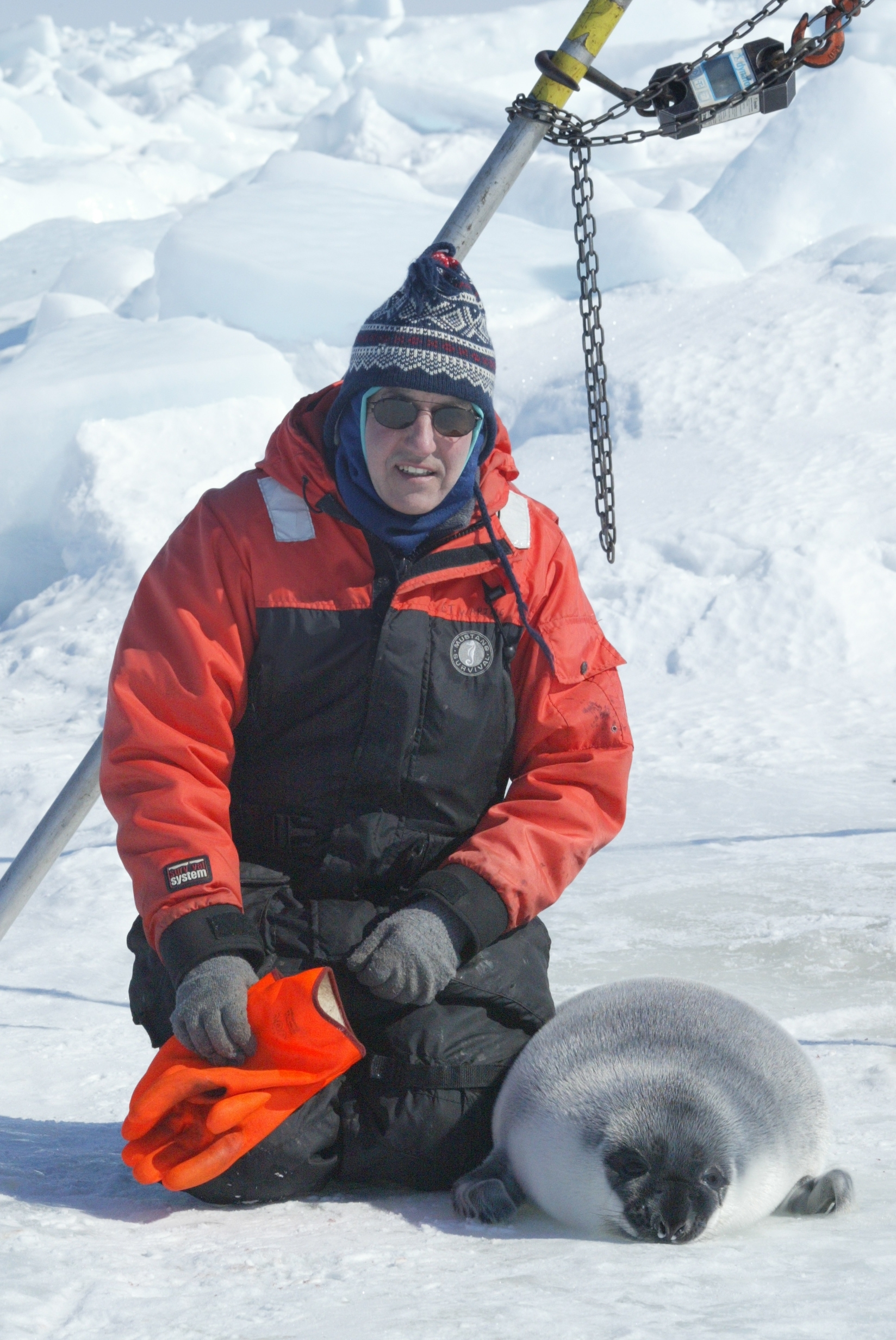
Harbor and grey seals, and more rarely hooded, ringed, and harp seals can be seen off of Long Island from late fall through early spring. These seals belong to the family Pinniped, meaning “feather-footed” or “wing-footed.” They are considered true seals – meaning they have no ear flaps, their front flippers are short, and their necks are short. Seals are excellent divers; they can hold their breath for 40 minutes, swim up to eight miles an hour, and dive up to 600 feet. They eat a variety of fish and invertebrates including crabs and squid. Thanks to a thick layer of fat and a dense coat seals keep warm in winter.
The best time to see large groups of seals is at low tide when they haul out of the water to rest and sleep on sand bars and rocks. When seals are hauled out at low tide they hold their head and tail up in a “banana-shaped” position. Be sure to watch the seals from a distance since seals can be easily scared.
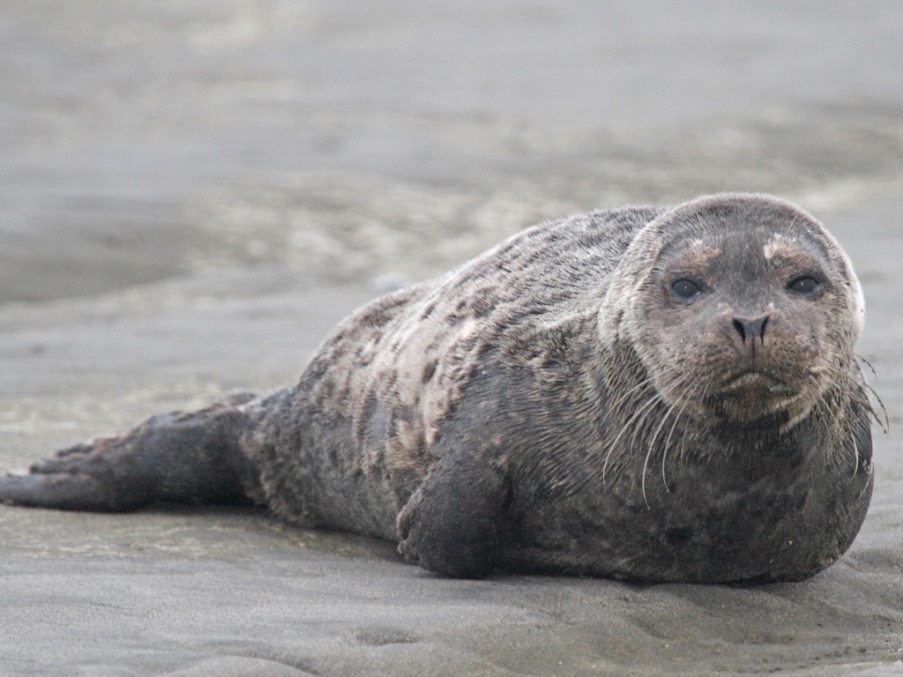
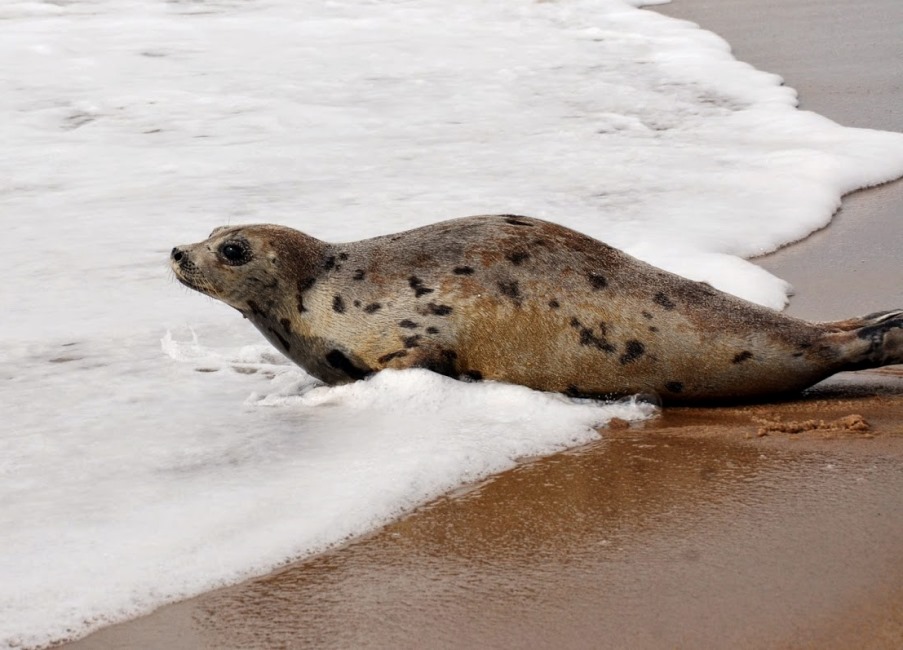
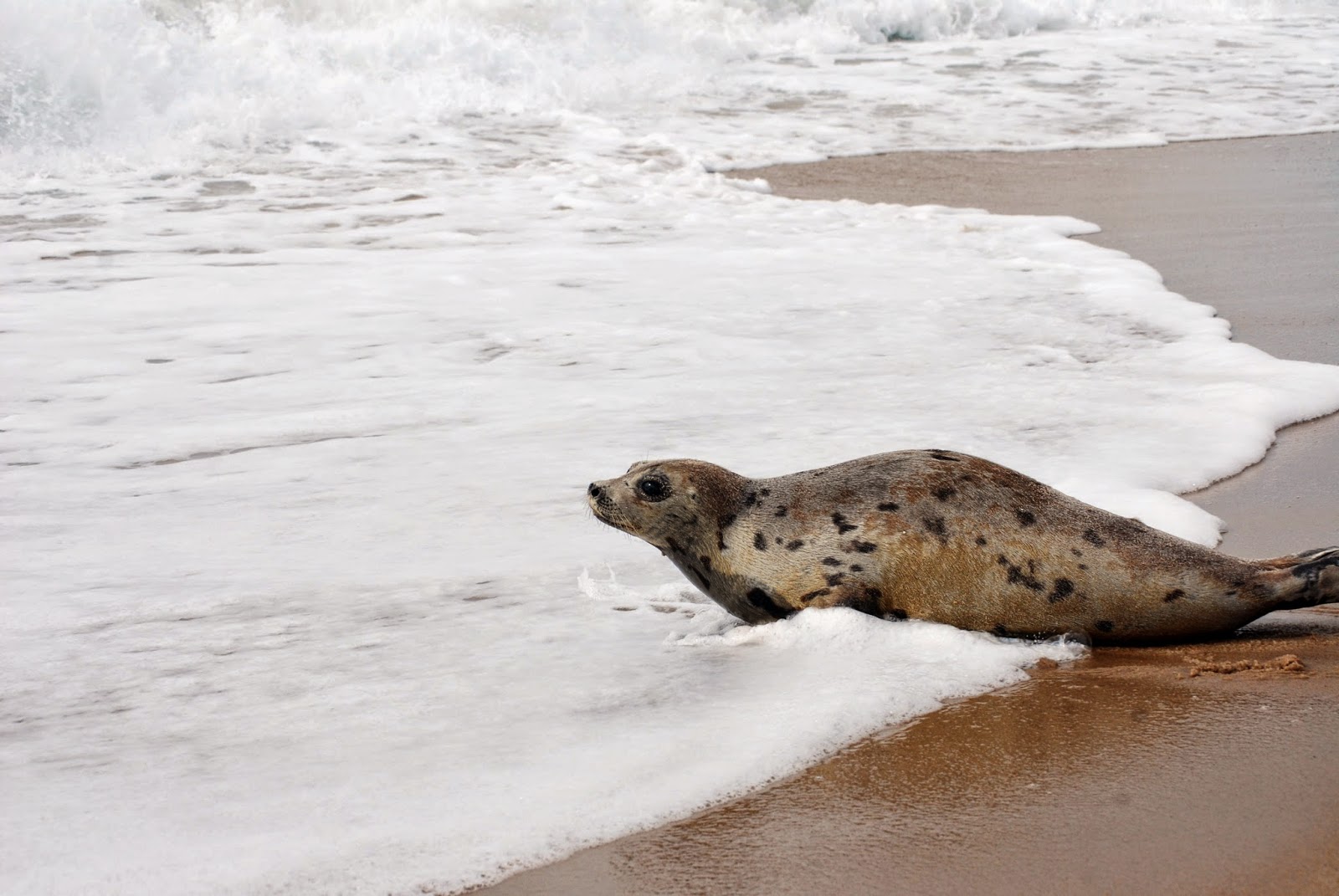
Harbor Seals are the most common seal that you will see. These 4-1/2’ – 6’ seals range in color from tan to brown to light gray with irregular black spots. They have a smallish head that looks like a Cocker Spaniel in profile. This profile gave them the nickname “sea dog.” Their nostrils are “V” shape when seen from the front. Harbor seals weigh 250 lb.
Gray Seals are a large seal with gray coloration. Interestingly, adult males are dark gray with small black markings and adult females are light gray or brown with dark patches. Males can be 8’ long and weigh 800 lb., females 7’ and weigh 400 lb. They have a distinctive “horsehead” profile and their nostrils form a “W” when seen from the front. Females have a slightly smaller head than males.
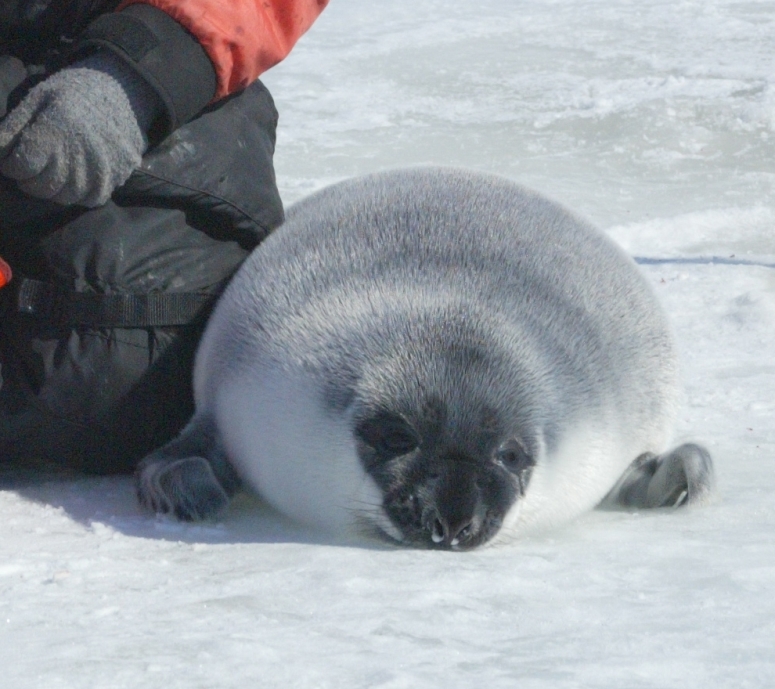
Hooded Seals are the largest seal that winters off of Long Island; males are 9’ long and females are 7’ long. Males weigh 900 lb., females 670 lb. The coat coloration of silver-grey with irregular black spots is the same in both adult males and females. First year pups have a slate colored coat. All female and juvenile male hooded seals have a larger head and broader muzzle than the harbor seal. Adult males have an unusual nasal apparatus that they will inflate when they are angered or threatened. Juvenile males do not have this nasal sac.
It is always a thrill to see harp seals and ringed seals because they are rare visitors to Long Island.
Harp Seal adults are white with a dark harp- or saddle-shaped pattern on its back and flanks. The more common juveniles have a light coat with dark blotches. Harp seals look similar to harbor seals in profile but they are slightly larger (both males and females are 6’ long and weigh 400 lb.) and they have a stockier body than the harbor seal.
Ringed Seals are the rarest and smallest seals found off of the New York coast in the winter; they measure between 4’-5-1/2’ long and weigh between 150-250 lb. Generally, the coats are a gray-black color with numerous dark spots surrounded by light areas that look like rings. Juvenile ring seals have a fine silvery coat. From a distance, ringed seals have a slightly smaller head than a harbor seal and their nose is more pointed than a harbor seal.
And please keep your dog at home. You wouldn’t want your dog scaring the seals.
References:
Katona, Steven, Rough, Valerie, and Richardson, David (1983). A field guide to the whales, porpoises, and seas on the Gulf of Maine and Eastern Canada : Cape Cod to Newfoundland. New York: Charles Scribner and Sons.
Whether you’re enjoying one of the numerous recreational opportunities of the season, or keeping warm by the cozy fire, one thing is on every New Yorker’s mind- snow! This frigid ice blanket provides more than a slick surface to ski, sled, and snowboard on; it can also create a hazard on our roadways and sidewalks. New York State, along with several other northeastern states, has historically used salt to melt any existing ice, prevent further ice from forming, and improve traction. While this method of salting has greatly improved the safety of our roadways, it has an acute impact on the environment- particularly on New York State’s reputable freshwater lakes, ponds, and streams.
Fresh snowfall at Allegany State Park. Photo taken by Kate Haggerty, NYSOPRHP EMB Water Quality Unit (12/1/2010).
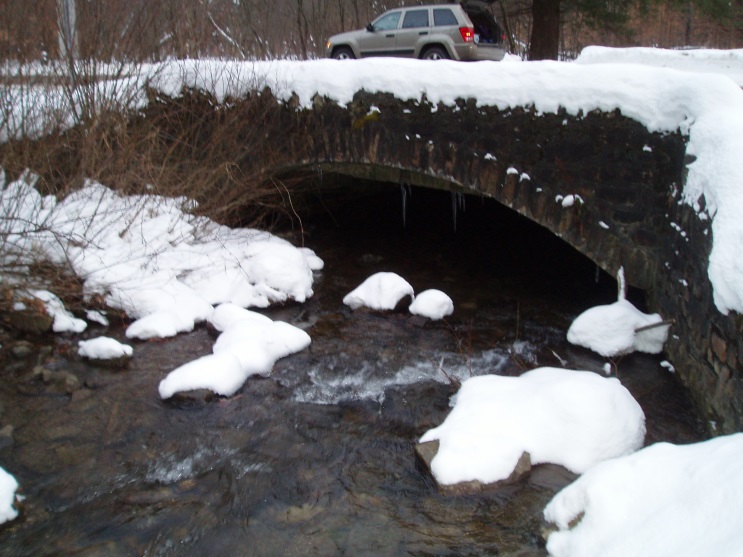
Cleared roadway over a stream crossing in Allegany State Park. Photo taken by Dan Munsell, NYSOPRHP EMB Water Quality Unit (1/08/2013).
During the washout period of the spring, when snow and ice melt due to increasing outdoor temperatures, residual salts (and other chemicals) wash off of roadways and into our freshwater waterways. In large amounts, these salts can be toxic to aquatic organisms by altering the chemical composition of our waters. Several of our favorite fish, amphibian, and plant species aren’t adapted to these saltier environments, which can lead to substantial changes in the aquatic food web.
Currently, innovative alternatives are being studied to reduce the amount of road salt needed in the winter. This includes the use of granular volcanic material, beet molasses, and fireplace ashes to minimize or even replace road salts. Innovative infrastructure designs, such as pervious (porous) concrete roadways have also been suggested to reduce the amount of water (and ice!) accumulated on street and sidewalk surfaces. These innovative alternatives could ultimately eliminate the need for road salt use during New York’s winters, while still providing safety for drivers and walkers alike!
In order to decrease the environmental impacts of using road salt, while also ensuring the safety of our patrons, NYS Parks adopted a policy to minimize the use of road salt in our parks. By focusing the use of road salt on high-risk park roadways, and using other materials to improve traction (such as sand and gravel), NYS Parks reduces the amount of salt needed, which has further protected our park enthusiasts and our beloved freshwater resources!
Post by Nate Kishbaugh, photos by Dan Munsell and Kate Haggerty.
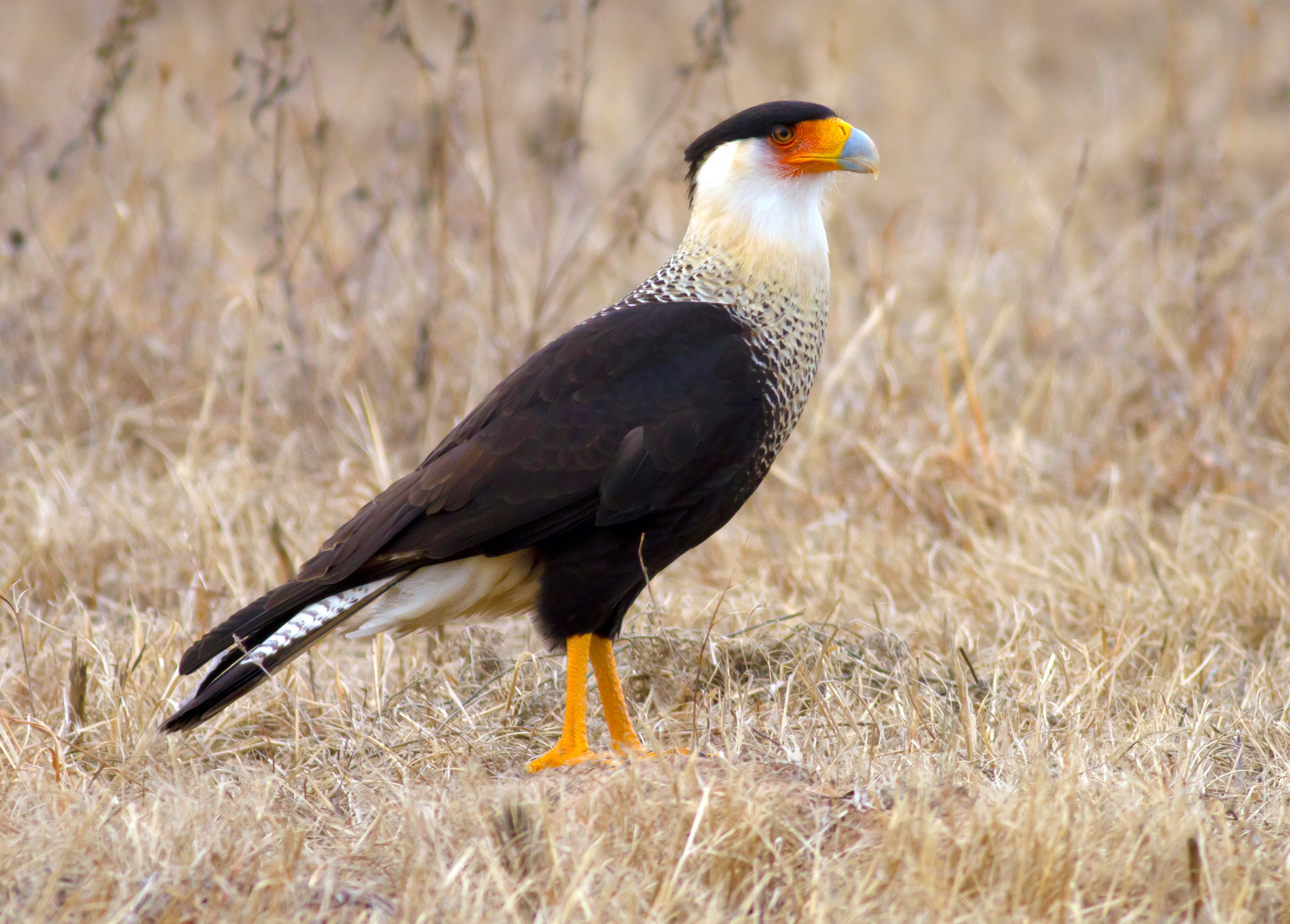
The following is a personal account of a Crested Caracara sighting by Ed McGowan, the Director of Science and the Trailside Museums and Zoo for the Palisades Interstate Park Commission:
Bear Mountain State Park, Doodletown – Jan 5, 2015 – Normally a time of year when New Yorkers head south, on this blustery winter day a Floridian made a rare visit to the skies over Bear Mountain State Park. Fellow League of Naturalists volunteers Gerhard Patsch, Dave Baker, Mike Adamovic, and I watched in amazement as a Crested Caracara soared overhead in the late morning sun. The bird circled several times, drifted north out of view but then returned overhead before heading east towards the Hudson. The field markings and overall gestalt of the bird were unmistakable. To our knowledge, this is the first record of a Caracara in New York State. We later learned that one of these southern raptors was photographed in Berks County, PA just a week earlier, so perhaps our sighting was the same bird blown north by the previous day’s violent winds. Wherever it came from, it was a sight to behold, a tropical apparition on a brisk winter’s day.












 New York State Parks and Historic Sites Blog

.JPG)