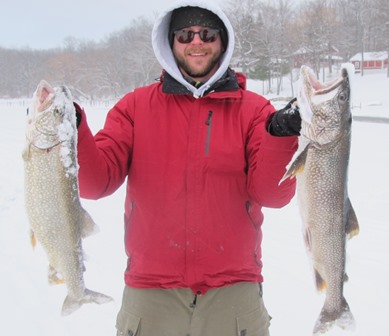
Ice Fishing in Central New York

Every winter, thousands of anglers take to New York’s frozen waters in quest of their ice fishing bounty.  Ice fishing can be a relatively easy and inexpensive way for the entire family to enjoy some mid-winter outdoor fun.  Terrific ice fishing opportunities can be found within or in close proximity to many state parks; with several free fishing clinics and derbies occurring each year that introduce new ice fishing anglers to the sport.  Chances are one of these hard water fishing opportunities is close to you!

Anna&IzzyHughes Jan 18 2015 Tully
Tom’s (the author’s) 6-year-old daughters Anna and Izzy Hughes caught their first fish through the ice from Tully Lake on January 18, 2015. They worked together to land two pickerel, which they later had for dinner that night.


2013 Glimmerglass Stephanie Smith pickerel
Former OPRHP Park & Recreation Aide Stephanie Smith landed this chain pickerel near Glimmerglass State Park in 2013 fishing with a tipup baited with a golden shiner.


Ice fishing does not require a lot of expensive gear to get started, especially compared to other winter sports like skiing, snowboarding and snowmobiling.  Unlike open water fishing, you don’t need a boat to get out on the water…just a nice pair of insulated winter boots.  Once out there, you can use all sorts of tools to get through the ice to access your fish, including axes, ice spuds, augers and power augurs.  Fishing techniques include actively fishing with small jigging rods or setting tipups (fish traps) rigged with live bait (e.g., shiners or suckers).  Many types of fish are active and feeding under the ice throughout the winter months, including bass, pike, walleye, trout and panfish.
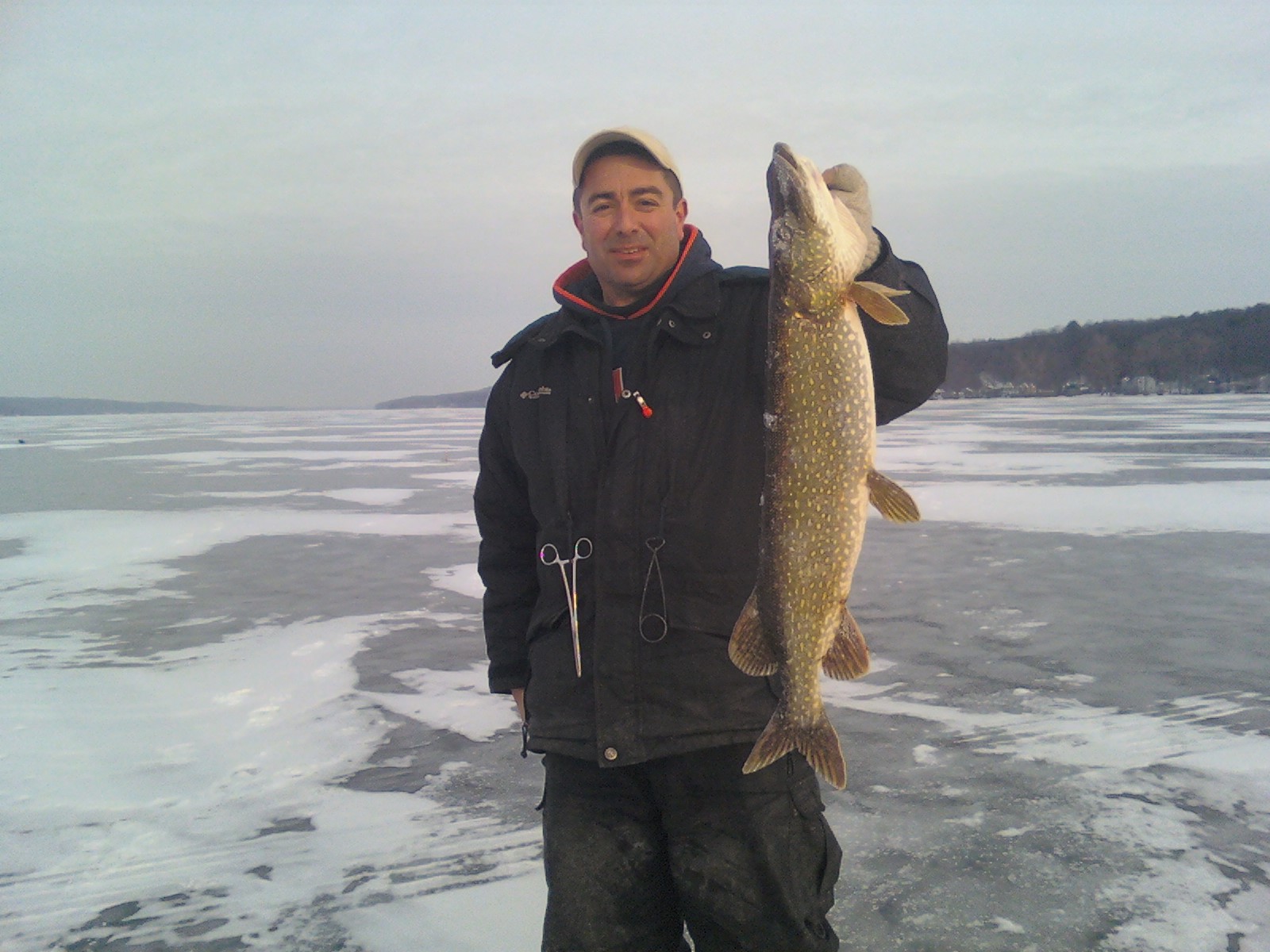
2014 Tom Hughes northern pike Owasco
OPRHP Natural Resource Steward Biologist Tom Hughes (author) shows off a northern pike caught from Owasco Lake. Believe it or not – every season, pike twice as large as this fish are hauled through the ice from Delta Lake near Delta Lake State Park, near Rome!


To learn all about the basics of ice fishing and what you will need to get started, visit the NYS DEC webpage for “Ice Fishing Basics.”

When you feel you are ready and dressed appropriately for New York’s winter weather, come out and join our OPRHP and NYS DEC staff and volunteers at an ice fishing clinic or derby near you!

Coming up in February, there are two ice fishing clinics scheduled for Central New York – February 22, 2017 at Otsego Lake, Glimmerglass State Park and February 26, 2017 at Lakeland Park (Cazenovia Lake), Cazenovia.  Both clinics are free fishing day events, with no fishing license required for participants.  For more information on the 8th annual ice fishing clinic at Glimmerglass, call 607-547-8662 or visit the State Parks calendar.  For more information about the ice fishing clinic at Lakeland Park, contact Judy Gianforte, Cazenovia Preservation Foundation, 315-877-1742.

Click below to watch a video of Anna & Izzy Hughes catching their pickerel. (Note: You must be using Internet Explorer in order for the video to stream properly).

Click below to see another angler Derek Conant from Otisco catching his first fish through ice on Otisco Lake.

Post by Tom Hughes, photos by Tom Hughes and Matt Fendya, videos by Tom Hughes.

Winter Tree Identification Part I: Deciduous Trees

In the summer you can recognize the different kinds of trees from the shape and size of their leaves. When trees drop their leaves in the winter months you can use different characteristics such as bud shape, leaf arrangement, bark, and overall growth pattern to identify tree species. As an example, let’s learn how you can identify Red Maple, Green Ash, and Black Walnut. First let’s learn some basic terms!

We will start with leaf or bud arrangement on the stem which will be either “alternate” or “opposite”. The buds are where next year’s leaves will emerge from and the nodes are where the leaf or bud attaches to the stem.

Alternate
Alternate leaf arrangement is when there is one leaf per node.
Opposite
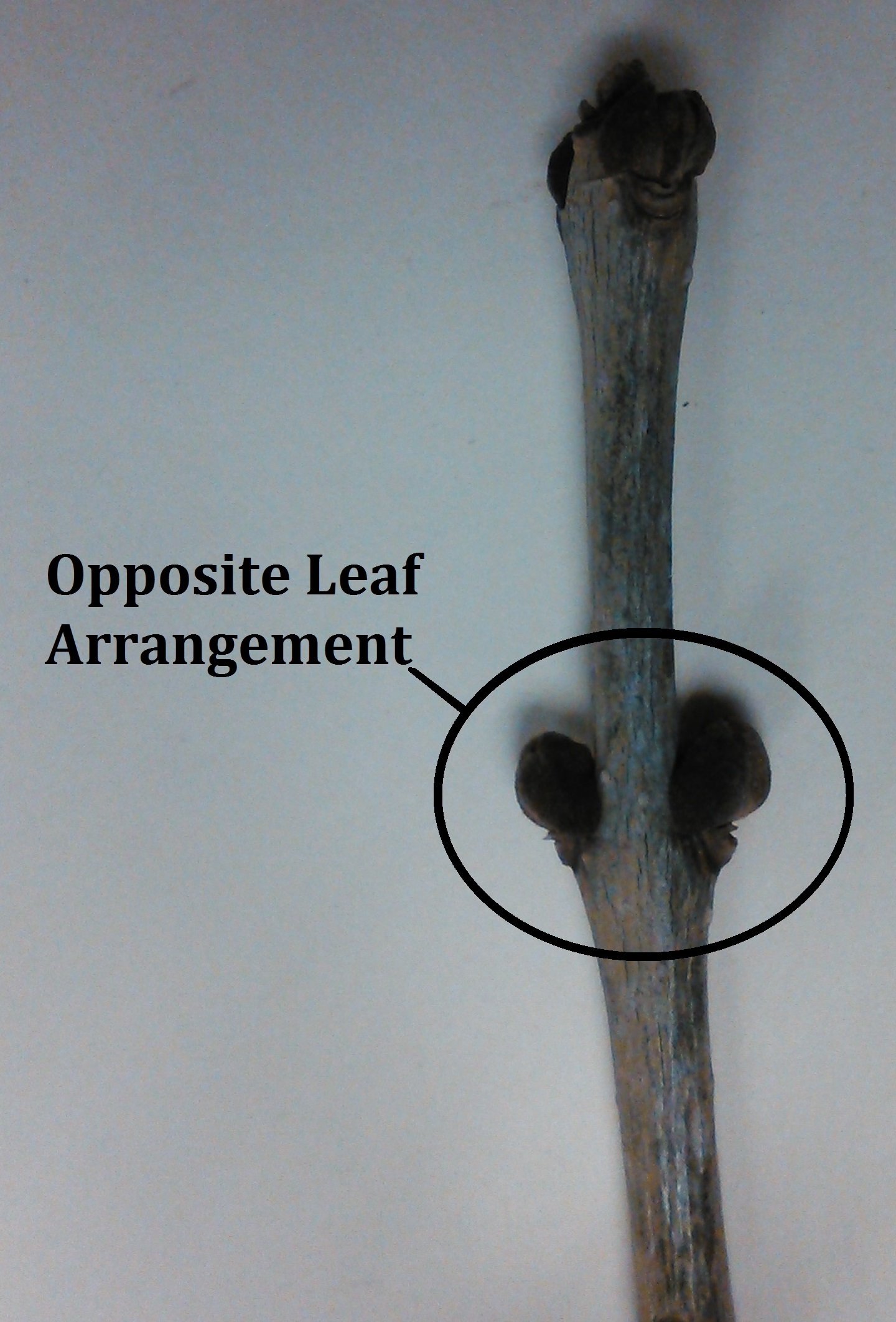
Opposite leaf arrangement is when there are leaves per node (across from one another).


Leaf Scar
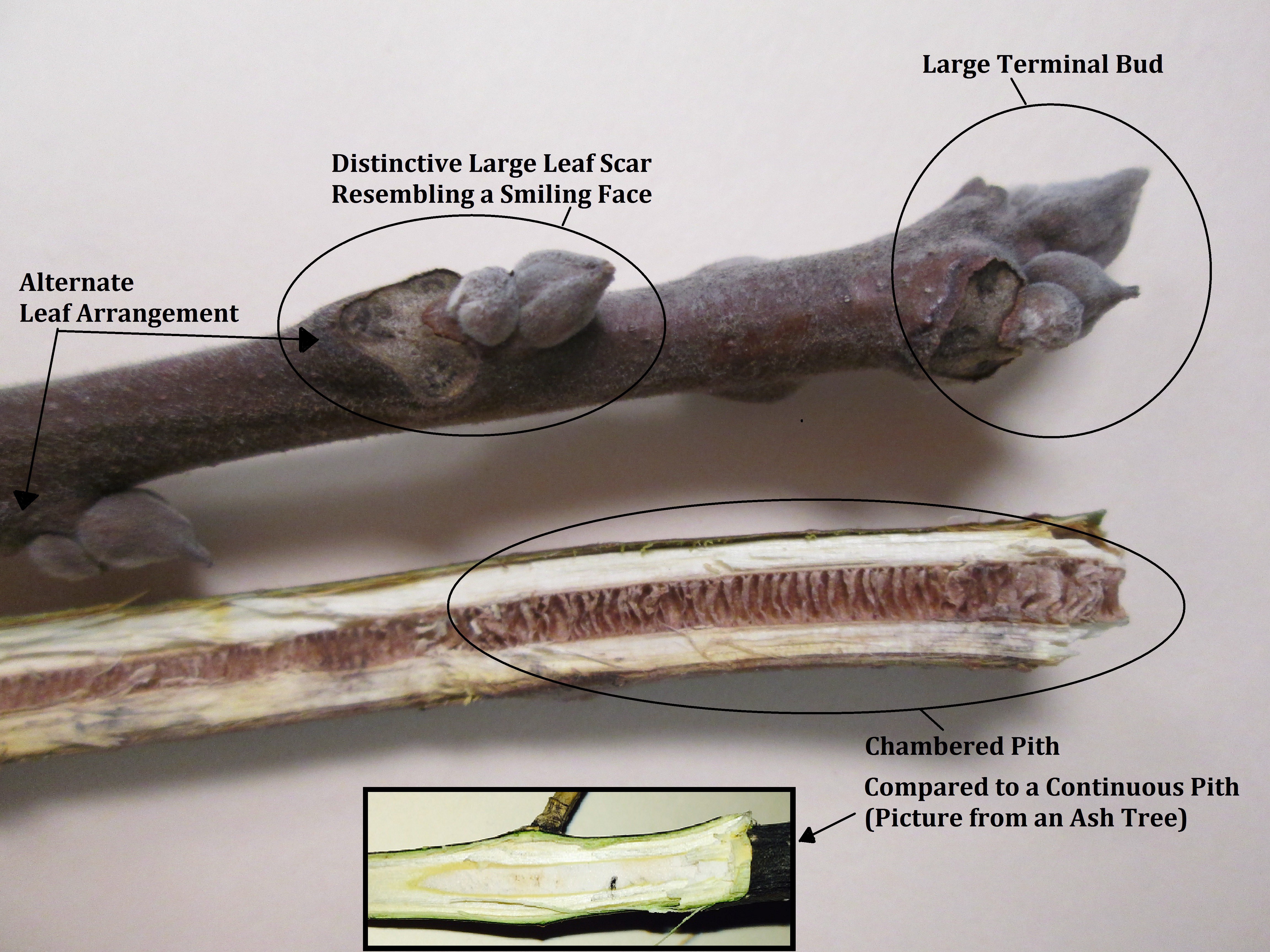
The leaf scar is another important characteristic to look at. This is where the leaf fell off the stem during autumn. Some trees, like the Black Walnut, have very distinctive leaf scars. Their leaf scar resembles a fuzzy smiley face!

Now we area ready to learn some tree species!

GREEN ASH

We will start with Green Ash. First let’s look at the bark and growth pattern:

Ash LS Final

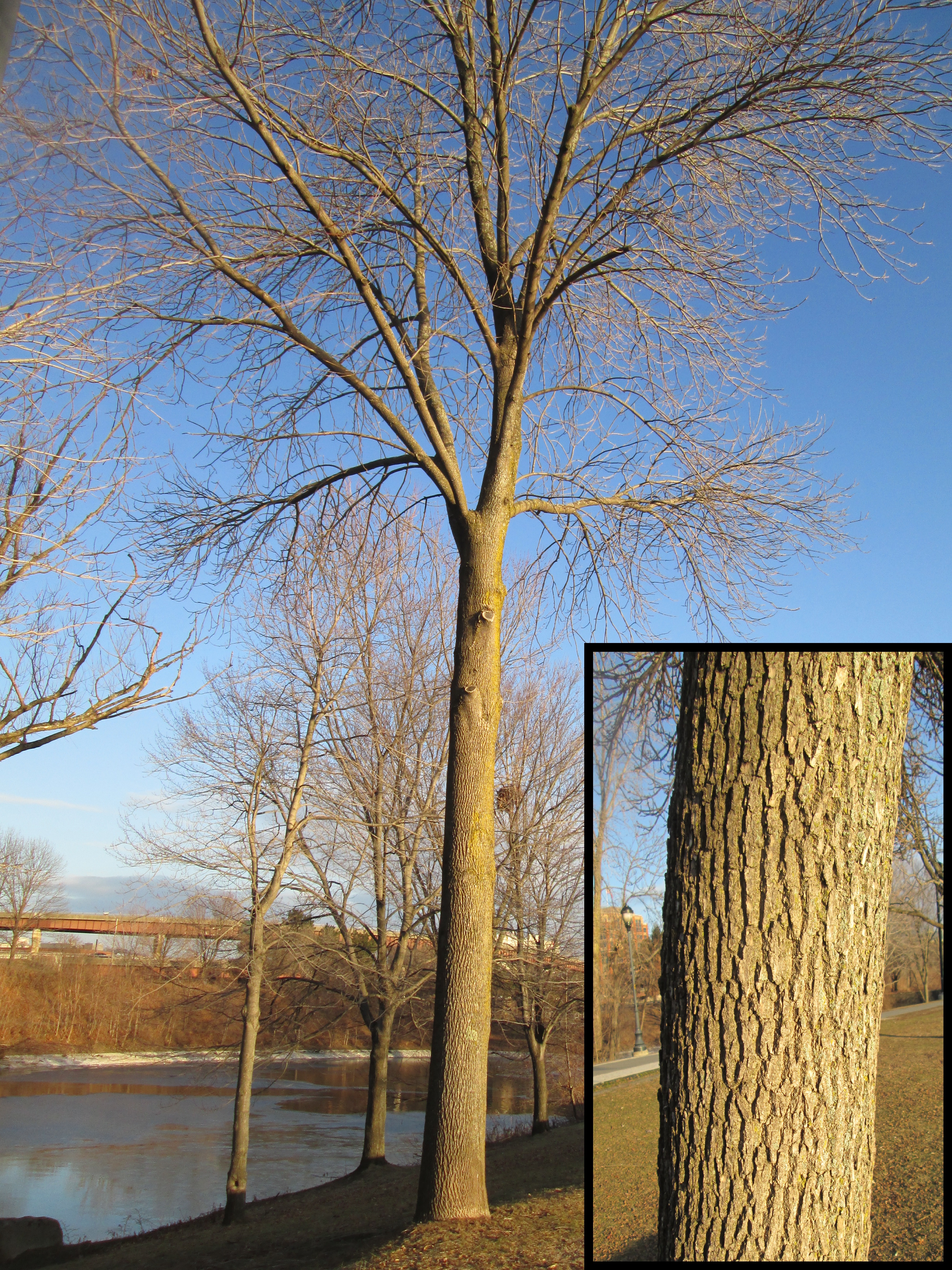
Green ash is typically very straight with a single trunk. The branches usually grow from the top of the tree, not from the sides. The bark is greyish in color with thin furrowed ridges forming an intersecting diamond pattern. Green ash is found growing in lowland areas.


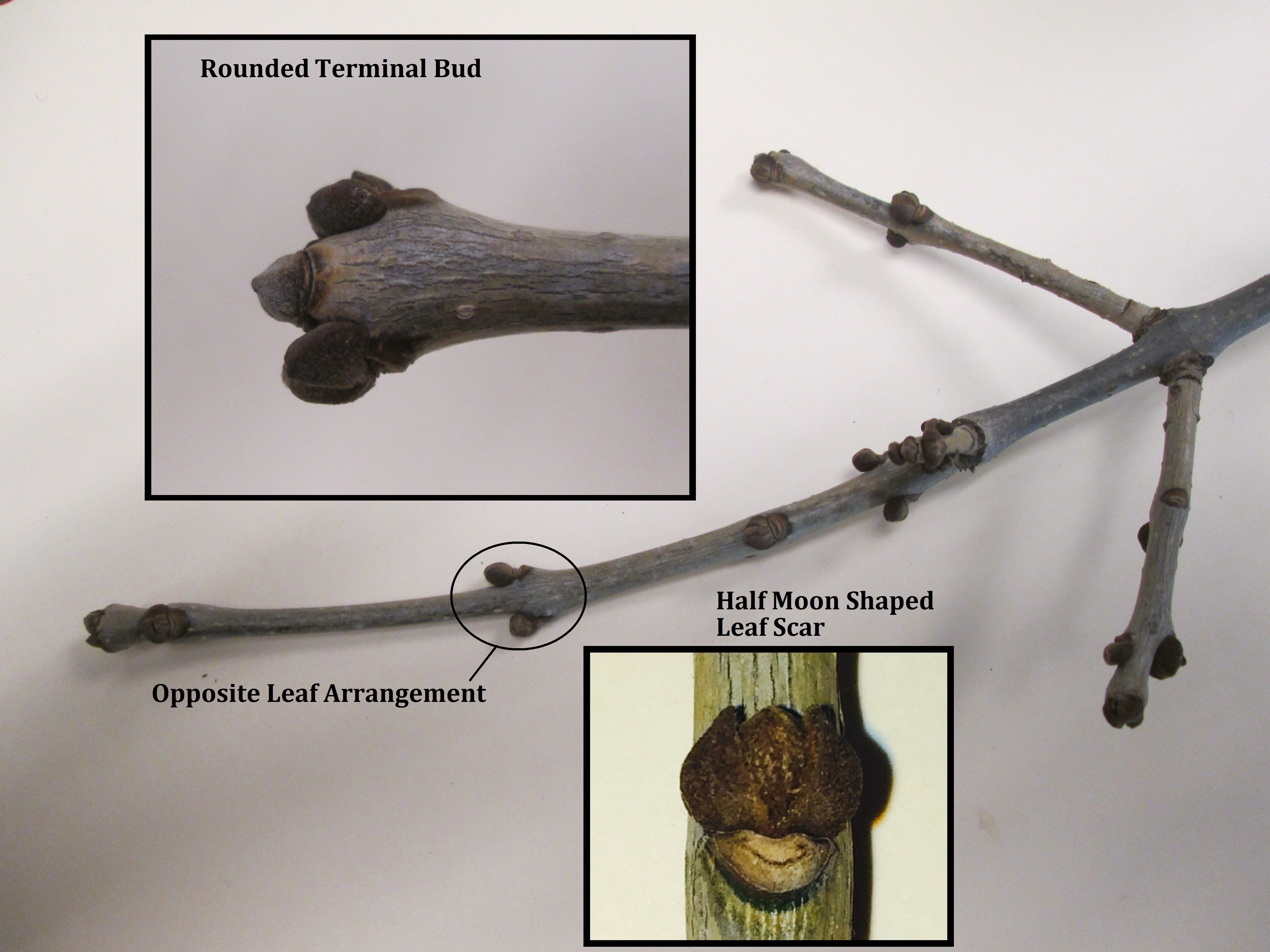
Now we will look at the characteristics of the twig:Ash LS Notice how the leaf buds are rounded and in an opposite arrangement at the leaf node. The leaf scar is shaped like a half moon or an upside-down “D”. The stem is grey in color and the buds are a dark greyish-brown. There is one bud at the apex, or tip of the stem. White ash is very similar, but the leaf scar has a v-shaped notch on the top and the twigs tend to be gray-green.

RED MAPLE

Red Maple Tree LS Final

Red maples vary in growth pattern. They may grow with a straight trunk or multi branched; like the tree in this picture. Bark is greyish-brown with a thin flaky appearance. Younger trees look smooth, the “plating” or flaky appearance, increases with age. Red maples often grow in swamps but are common in uplands too.


Red Maple KS final

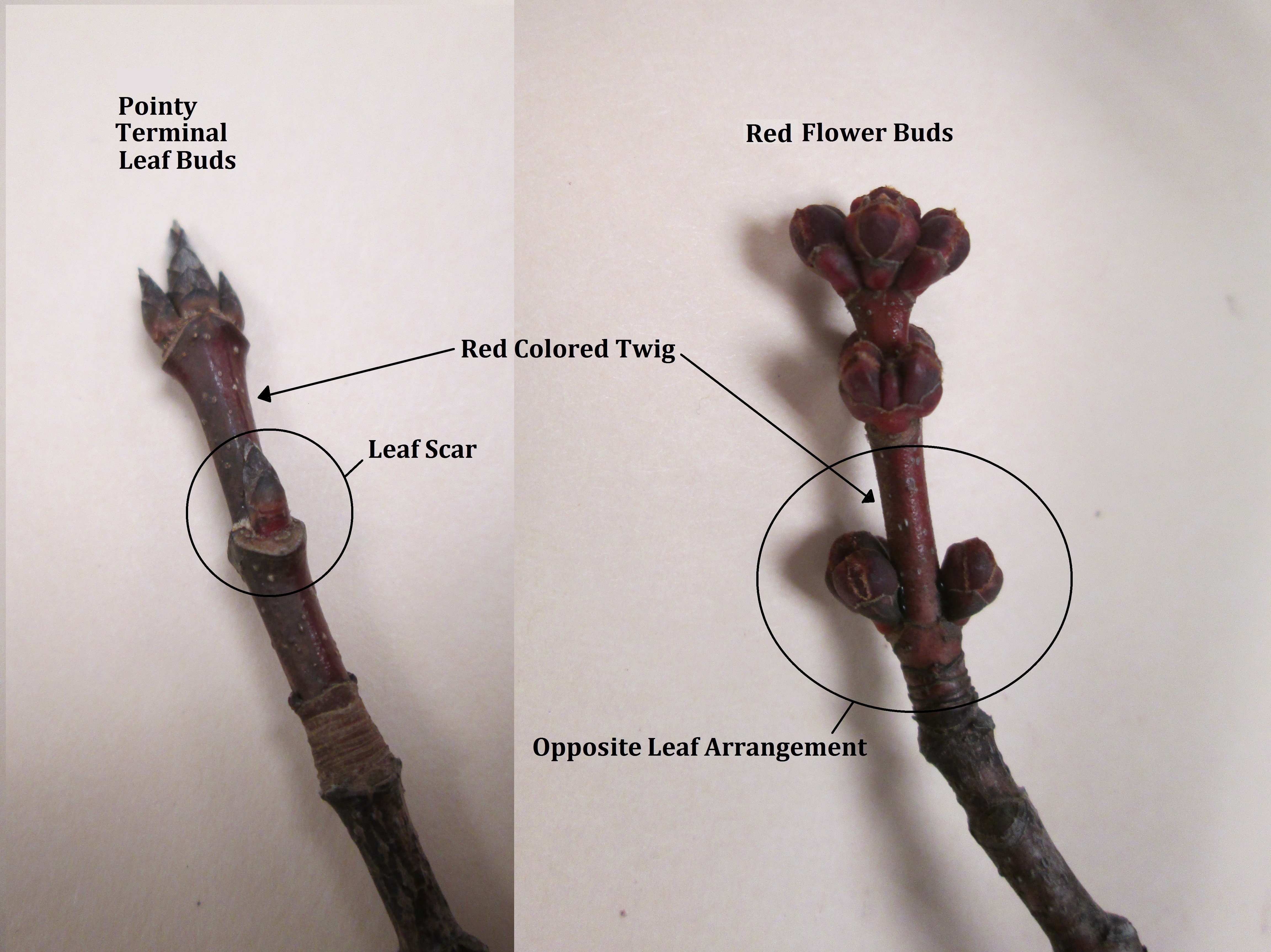
Red maples have opposite leaf arrangement. Flower buds usually form high up in the canopy and not on lower branches. Once the flowers have bloomed, leaves will replace them on the same node. The leaf and flower buds are reddish in color, as is the stem itself. The leaf buds are pointed and there is one terminal leaf bud.

BLACK WALNUT

Black Walnut Tree Final

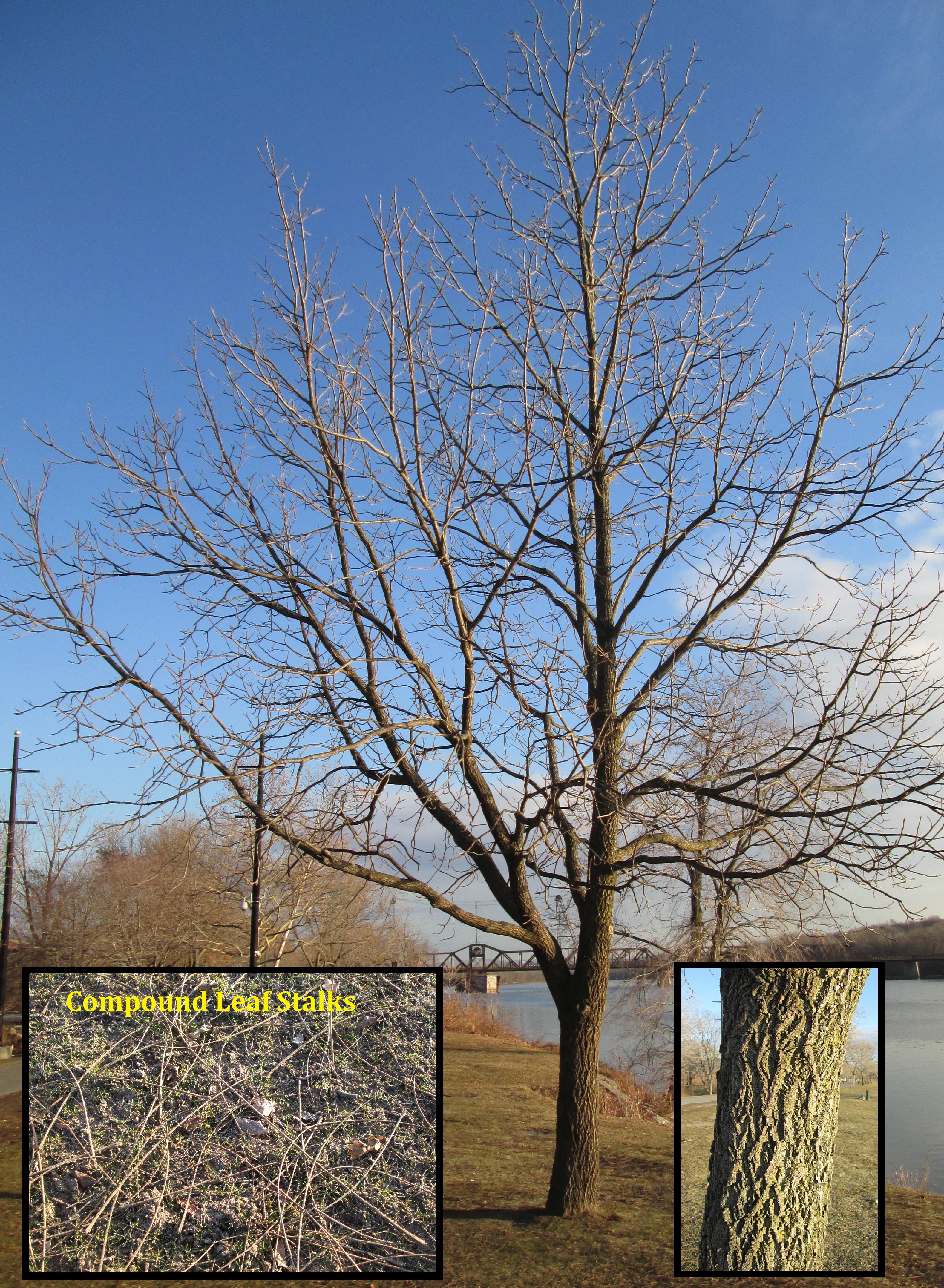
Black walnut trees have a wide branching growth pattern. The bark is dark brown, becoming darker with age. The bark has deeper furrowed ridges than ash, with looser intersecting ridges. Also evident is the dropped compound leaf stalks* underneath the tree. Black walnut trees are found growing in well drained, lowland areas.

*A compound leaf (such as on ash and walnut) has multiple leaflets on the leaf stalk. See below.
Compound leaf

Simple Leaf

Black walnuts have alternate leaf arrangement with a large terminal bud. The buds are fuzzy and light gray in color. The leaf scar is large compared to the bud. The pith (spongy tissue in the center of the stem) is distinctly chambered. This can be seen by carefully taking a sharp blade and cutting the stem in half, as shown in the image below.

Black Walnut LS

Learn more about identifying winter trees in the Winter Tree Identification Part II: Evergreen Trees and Winter Greens blogs.

Post and photos by Lilly Schelling.


Take a Friend Snowmobiling Day

Want to learn how you can explore New York’s more than 10,000 miles of snowmobile trails this winter? The New York State Snowmobile Association and Grafton Trail Blazers snowmobile club are teaming up with the New York State Office of Parks, Recreation, and Historic Preservation at the Grafton Lakes State Park 30th Annual Winter Festival Saturday, January 24th, for “Take a Friend Snowmobiling” day.  The event is a demonstration of the basics of snowmobile operation and ownership.

The New York State snowmobile trail system crisscrosses 45 counties through woods, fields, towns and our State Parks.  Snowmobiling is a fun, family-friendly way to enjoy winter scenery and wildlife, especially for those with physical conditions or disabilities preventing more strenuous activities like skiing and snowshoeing.  The “Take a Friend Snowmobiling” event is a great introduction to the sport for new riders or reintroduction for those who haven’t been on a snowmobile in years, and an opportunity for current snowmobilers to meet and share their interests.

Representatives from the New York State Parks Snowmobile Unit, the State Snowmobile Association, and the Grafton Trail Blazers snowmobile club will be on hand to answer all of your snowmobiling questions and provide short demonstration rides, conditions permitting.

The event will be held at the playground near the main parking lot from 11:00am to 3:00pm.  Necessary equipment will be provided, but participants are urged to dress appropriately for outdoor weather conditions.  Anyone age 16 and older is welcome to join (if conditions permit snowmobile operation, youth ages 16-17 must have a valid safety certificate to operate). Another “Take a Friend Snowmobiling” event will be held at Delta Lake State Park on February 8th, with more details to be announced.

_PRK9401 (2)
Jim MacFarland and Bennett Campbell from the OPRHP Snowmobiling Unit hit the trails near Old Forge.

Click here to view the full Winter Festival schedule of events.

Click here for more information on other Take a Friend Snowmobiling events. 

Click here to visit the NYS Parks website for more information about snowmobiling in New York, including a free Snowmobiler’s Guide.

NYSOPRHP recommends all snowmobilers attend a certified New York State snowmobiling safety course, and never drink & ride!

Post by Bennett Campbell, photo by John Rozell.

Deciphering Winter Animal Tracks

Have you ever come across animal tracks in fresh snow? Deciphering the mystery of what types of animals inhabit the places we visit can be a fascinating, and relatively simple task if you have some basic knowledge of animal gaits and patterns.

First, it is important to keep in mind that snow conditions can make a significant difference in the way that a track looks. For example, a print may appear quite clear in wet snow, whereas prints in drier, powder-like snow may be harder to analyze because they are not as clearly defined.

The next step is to think critically about the gait of the animal; the manner in which it walks or moves. There are four types of gaits that most animals employ throughout their daily (and in many cases, nightly) activities.

The first type of gait is the most common – the walk. Animal tracks left behind by a walk show alternating evenly spaced prints in parallel rows with a short stride and wide straddle. The second type of gait is the trot.  When an animal is trotting, each hind foot moves at the same time as the opposite front foot. As the animal’s speed increases, the prints are spaced farther and farther apart. Next, we have the gallop, which is the swiftest form of movement for a mammal. Because an animal must expend a significant amount of energy to gallop, it usually won’t employ this method of movement for very long unless it is being chased by a predator. The straddle of a gallop is much smaller than that of a trot or a walk. Lastly, jumping is the most energy consuming gait. During jumping, there is at least one stage where all four feet leave the ground entirely.  Examples of jumping animals include squirrels and rabbits.

animal tracks squirel
Above: Squirrel tracks feature four toes on the front feet and five on the back, with claws visible. When squirrels run, their back feet land in front of their front feet, so this track is evidence that this squirrel was running. This print was left in shallow wet snow, hence the distinct print outline.
Above: Snowshoe hare tracks have a clear Y-shaped pattern because the back feet always land in front of the front feet and are 2-4 times longer. This print was left in deep powder-like snow, making it more difficult to identify. Snowshoe hare have large feet proportionate to their body size so that they do not sink into the snow, hence their name.

In addition to determining the gait of the animal whose print you are examining, the shape of the track helps to identify what family or group of critter you are dealing with. For example, tracks from animals in the cat family are roundish and show four toes on both the back and front feet.  You won’t see any claw marks on cat prints because cats walk with their claws retracted. Members of the dog family (coyotes and foxes) leave prints with four toes showing on both the back and front feet. You can distinguish these prints from those of the cat family because the print is less rounded, and claw prints are typically visible. Deer tracks are prevalent throughout the state and are easy to identify. These prints are heart-shaped with a line down the middle. Moose tracks are similar in appearance; however they are considerably larger in size. Tracks from members of the rodent family as well as the weasel family can vary widely. Reference the key below for help with these types of tracks.

key-to-animal-tracks
Above: Key for identifying animal tracks. These are just some of the tracks you may encounter in New York State Parks and Historic Sites.
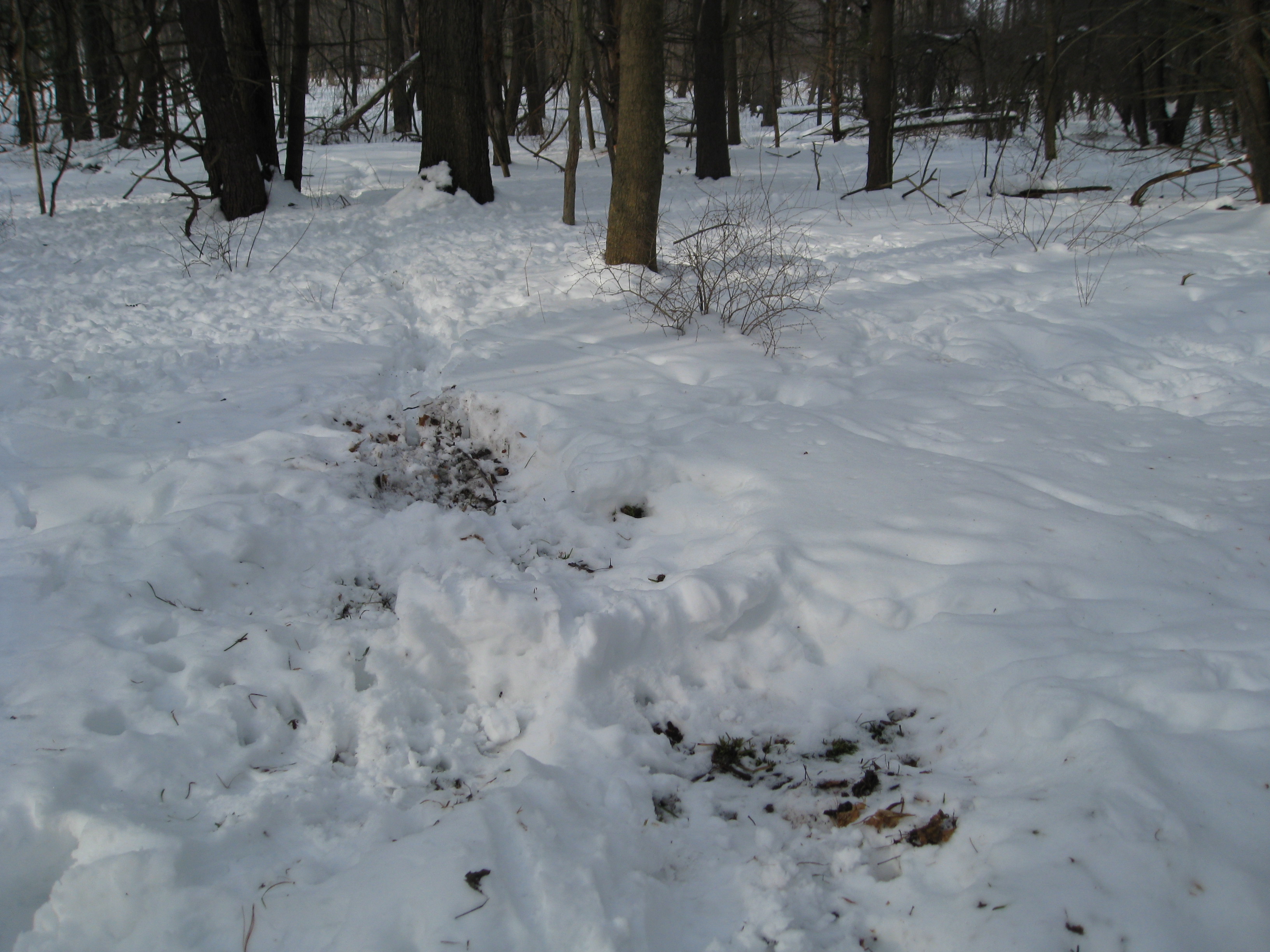
 Above: This is a deer trail through the woods. The area with exposed leaves is evidence of foraging activity, where the animal was likely in search of acorns, beech nuts or evergreen foliage to feed on.

Above: This is a deer trail through the woods. The area with exposed leaves is evidence of foraging activity, where the animal was likely in search of acorns, beech nuts or evergreen foliage to feed on.

Watch this video produced by our friends at the NYS Department of Environmental Conservation to learn more analyzing winter animal tracks and winter wildlife viewing: http://www.dec.ny.gov/dectv/dectv116.html

Information sourced from the New York State Conservationist (February 2001).

Post by Megan Phillips, photos by Lilly Schelling (OPRHP).

Ice is Nice!

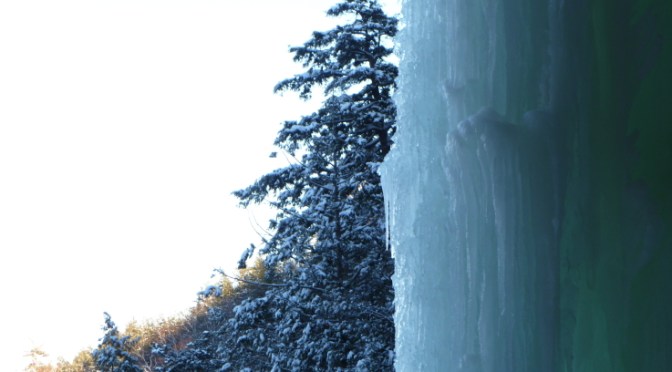
In winter, New York’s gorges and waterfalls turn into frozen ice sculptures that are no less beautiful than their summertime counterparts. These pictures of frozen waterfalls at Thacher State Park are iconic of New York’s natural beauty at any time of the year. Don’t let the cold and snow keep you cooped up inside all winter long. Thacher, and many of our other state parks in New York, offers wonderful opportunities for outdoor recreation, including hiking and snowshoeing.

The official blog for the New York State Office of Parks, Recreation & Historic Preservation