Mushroom Tech Cleans Up at Lake Erie State Park

For many people, mushrooms can be a healthy, tasty addition at mealtime. But along the Lake Erie shoreline south of Buffalo, the science of mushrooms is being used in an innovative way – as an environmentally-safe method to reduce harmful bacteria in a stream near the beach at Lake Erie State Park.

At the beginning of this decade, tests of the stream and water at the beach by the State Parks Water Quality Unit were showing consistently high levels of e. coli, a bacteria found in fecal matter which can severely sicken those who have been exposed.

The sand and cobble beach in Chautauqua County had been closed to swimming for several years due to a combination of high bacterial levels and fiscal constraints. Testing indicated that the problem likely was being caused by faulty septic systems or unsewered properties upstream, although additional contamination from animals could not be ruled out as another potential source.

While there are mechanical and chemical techniques  to filter such harmful bacteria from water, in 2014 Water Quality staff decided  to test an innovative mushroom-based system developed by Fungi Perfecti, a Washington-state based company with a long research history into fungus and mushrooms, a scientific field known as mycology.

Company founder and owner Paul Stamets is a nationally- and internationally-recognized expert and promotes innovative uses for mushrooms in bioremediation and medical therapies. He even entered the realm of popular culture when creators of the latest Star Trek franchise, which started in 2017 on CBS All Access, named the ship’s science officer after him as part of the use of a a mushroom-based propulsion system for the Starship Enterprise.

Meanwhile, back here in New York State and with funding support from the federal Great Lake Restoration Initiative, water quality staffers at State Parks installed a Stamets-designed mycofiltration system into this small creek at the Park.

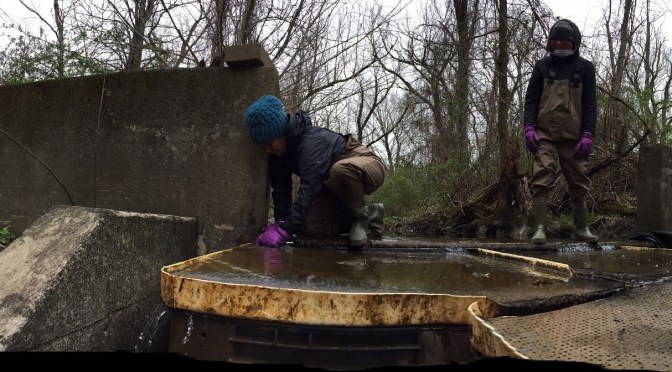
The filtration system uses large plastic containers called totes that contain a mixture of wood chips and mycelium (the tiny threadlike vegetative part of fungi that fruits as mushrooms) that allow water to pass through. This allows the mycelium mixture to absorb bacteria from contaminated water as it flows past.


A crane drops the mycofiltration tote into position within a concrete weir that channels the stream. (Photo Credit- State Parks)
Microscopic image of mycelium (Photo Credit- Fungi Perfecti)

So far, the test results seem promising. E. coli levels downstream of the filtration system have dropped and water quality at the beach has improved, although outside factors, including improvements in the surrounding watershed, may have contributed.

The mycelium in the totes were reinoculated – another way of saying reimplanted and reinvigorated – in 2016 and 2019. Data from this project is being shared with Fungi Perfecti to assist in their research and development of their system.

Said Renee Davis, director of research and development at Fungi Perfecti, “We are proud of the contributions that fungal mycelium has been able to make for Lake Erie State Park and the surrounding ecosystems. Though we still face challenges with scalability of this technology, the applications are promising. We are closely studying the aspects of fungal metabolism that drive these effects, particularly the secretion of specialized compounds from mycelium into the environment.”

She added, “New potential applications have also arisen for bioretention and stormwater. For us, this project is an example of the possibilities that emerge when we look at nature—particularly fungi—in a new, creative, and innovative way. We hope this is the first of many projects to come using mushroom mycelium for water quality.”
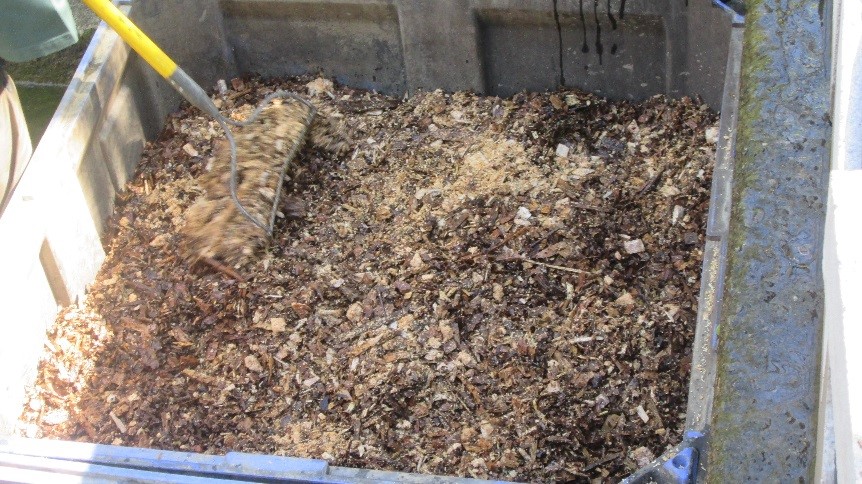
Mycelium and wood chips are mixed together in the totes. (Photo Credit- State Parks)
Totes rest within the concrete channel of the stream. (Photo Credit- State Parks)

Currently, this is the only State Park where this chemical-free, ecologically-safe method is being tested, although it could be introduced into the Finger Lakes region if a suitable location can be found.


Cover Shot: NYS Parks crews service the mycofiltration unit in Lake Erie State Park in 2016.

More Resources

See a technical display of the project here

Hear Fungi Perfecti Founder Paul Stamets give a TED lecture on the potential uses of mushrooms.

Fungi Perfecti founder and owner Paul Stamets. (Photo Credit- Fungi Perfecti)

Stamets’ awards include Invention Ambassador (2014-2015) for the American Association for the Advancement of Science (AAAS), the National Mycologist Award (2014) from the North American Mycological Association (NAMA), and the Gordon & Tina Wasson Award (2015) from the Mycological Society of America (MSA).

Currently, Stamets is testing extracts of rare mushroom strains at the NIH (National Institutes of Health/Virology) and with Washington State University/United States Department of Agriculture against a wide panel of viruses pathogenic to humans, animals and bees.

Read what local Capital Region entrepreneur Eben Bayer, owner of Ecovative Design, a mushroom-based packaging and development business based in Green Island, has to say about the scientific potential of mycelium.

Check out the Mushroom Blog at Cornell University.


Post by April Brun and Gabriella Cebada Mora, NYS Parks Water Quality Unit

First Day Hikes 2020

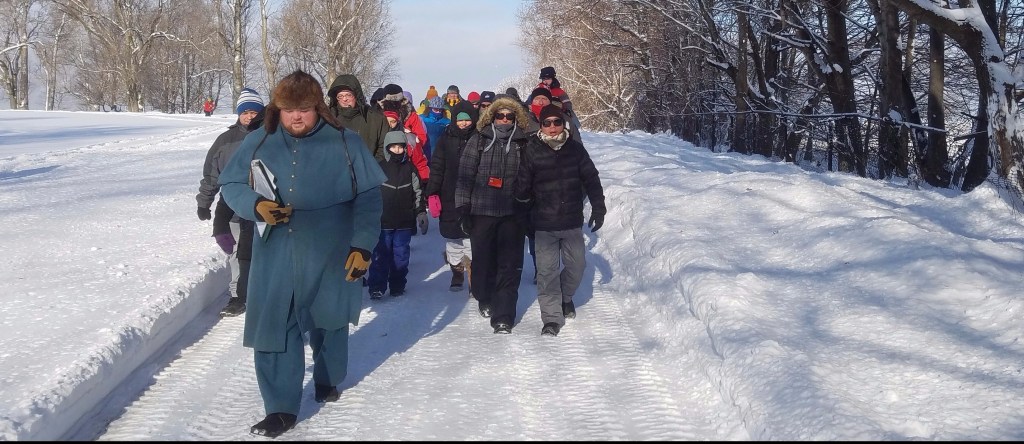
Many New Yorkers thrive in winter and are eager for falling temperatures and consistent snowfalls. To these hardy adventurers, a few extra layers of gear combined with the snowy terrain of parklands is a winning recipe for fitness, togetherness and outdoor fun.

Welcome the new decade, enjoy the winter landscapes, and unwind after a hectic holiday season by joining a First Day Hike on January 1, 2020.

First Day Hike

There are more than 75 such hikes planned at state parks, historic sites, wildlife areas, trails and public lands across the state as part of the 9th annual First Day Hikes program. This map can help find one near you…

Hikes are being offered at more than 50 state parks and historic sites (with some facilities offering multiple hikes for different age groups, skill levels and destinations within the park) and 21 state lands, wildlife areas, Forest Preserve trails and environmental education centers run by the state Department of Environmental Conservation.

Staff from State Parks and DEC, along with volunteers and partners at many sites, will lead these family-friendly walks and hikes, which range from one to five miles depending on the location and conditions. Remember to dress appropriately and keep this old Scandinavian saying in mind: “There is no such thing as bad weather, only bad clothing.”

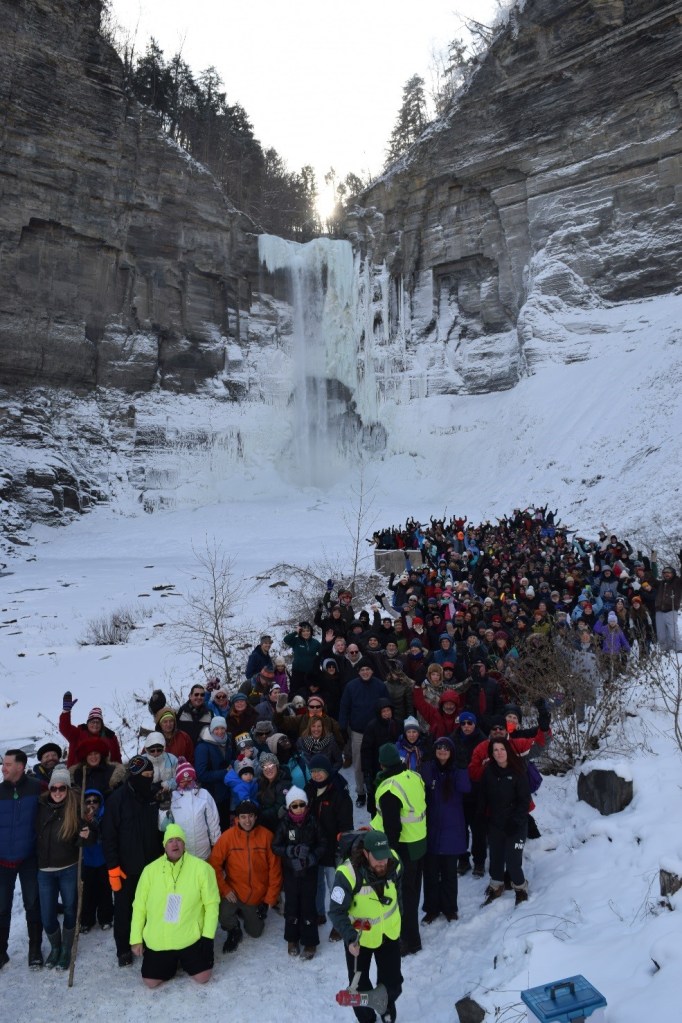
First Day hikers at Taughannock Falls State Park.

A sample of this year’s programs feature a seal walk, walking history tour, snowshoe waterfall hike, pet-friendly treks, gorge walks, fire towers, and more. If weather conditions permit, some First Day Hikes may include snowshoeing or cross-country skiing. Many host sites will be offering refreshments and giveaways.

Participants are encouraged to contact the park for information and pre-registration where noted.

Never too young to go out for a hike.

And know that you are part of something that is happening all across America. First Day Hikes, which started in Massachusetts in 1992, are now a national event taking place in all 50 states.

Last year nearly 55,000 people rang in the New Year, collectively hiking over 133,000 miles throughout the country on the guided hikes.  Numerous others hiked state park trails throughout the day.

If you’ve never been on a First Day Hike, 2020 is the year!


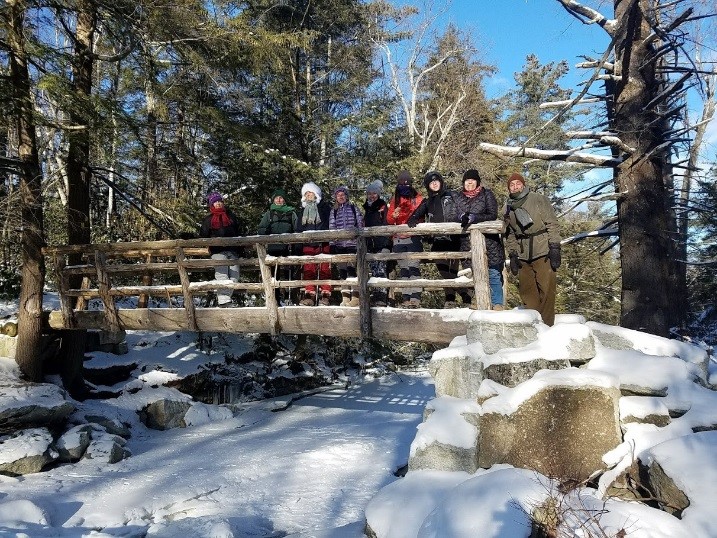
Cover photo: First Day hikers at a DEC fire tower. These hikers are wearing traction gear on their boots, which is important in steep or icy conditions.

Post by NYS Parks Staff

Gorge-ous Gulls of the Niagara in Winter

The Niagara River is well-known as an international destination for its tremendous waterfalls, which form spectacular ice formations during the winter. Perhaps a lesser known fact, however, is that the river is also a critical haven for migrating birds during this time of the year.

Gulls, in particular, are a common sight along the Niagara, with as many as 100,000 gulls stopping over the river during the winter and fall.

The river is attractive to gulls because it offers them food and shelter, and serves as a rest stop for long migrations from the arctic to the Atlantic coast. As well as providing plenty of small fish, the area also serves as protection from storms that can affect the Great Lakes during the wintertime.

Created in 1885, Niagara Falls State Park is the oldest state park in the United States, with hundreds of thousands of visitors annual drawn by the immense power and beauty of the thundering cataracts. Looking down from the edge of Niagara Gorge in autumn or winter, the air above the turbulent waters is at times white with wheeling and diving gulls.

In recognition of the river’s important habitat for feeding, nesting, wintering, and during migration, it has been designated as an Important Bird Area by the Audubon Society.

Just down the river, Fort Niagara State Park on Lake Ontario also is recognized as part of this area.


“The site is particularly noteworthy as a migratory stopover and wintering site for Bonaparte’s Gulls, with one-day counts ranging from 10,000-50,000 individuals (2-10% of the world population). One-day Ring-billed Gull counts vary from 10,000-20,000, and one-day Herring Gull counts vary from 10,000-50,000. The river also hosts a remarkable diversity and abundance of waterfowl.”

Audubon Society on Important Bird Area in Niagara River Corridor

These gull populations peak in the winter, so going bird-watching is a great way to get outdoors during the cold season and see yet another wonder that the falls, the river and this region have to offer.

If you choose to go birding along the river this season, here are some gulls you might end up seeing:

Bonaparte’s Gull

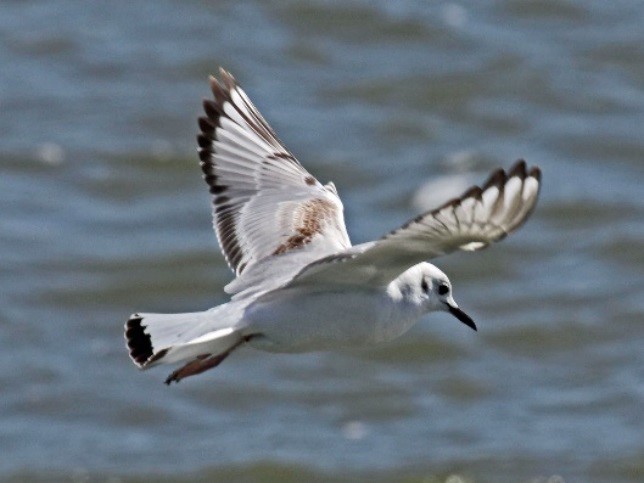
A nonbreeding Bonaparte’s Gull in flight. (Credit- Wikipedia Commons)
A breeding adult Bonaparte Gull, with its distinctive black head. (Credit- Wikipedia Commons)

Bonaparte’s Gull is a small gull with a white underbelly, grey back, and thin, black beak. The top outer parts of its wings have wedges of white edged in black. Breeding adults have black heads but nonbreeding and young gulls have a white head with a dark smudge behind its eye. These gulls like to winter near people and, in fact, are the only gulls that regularly nest in trees!

Ring-Billed Gull

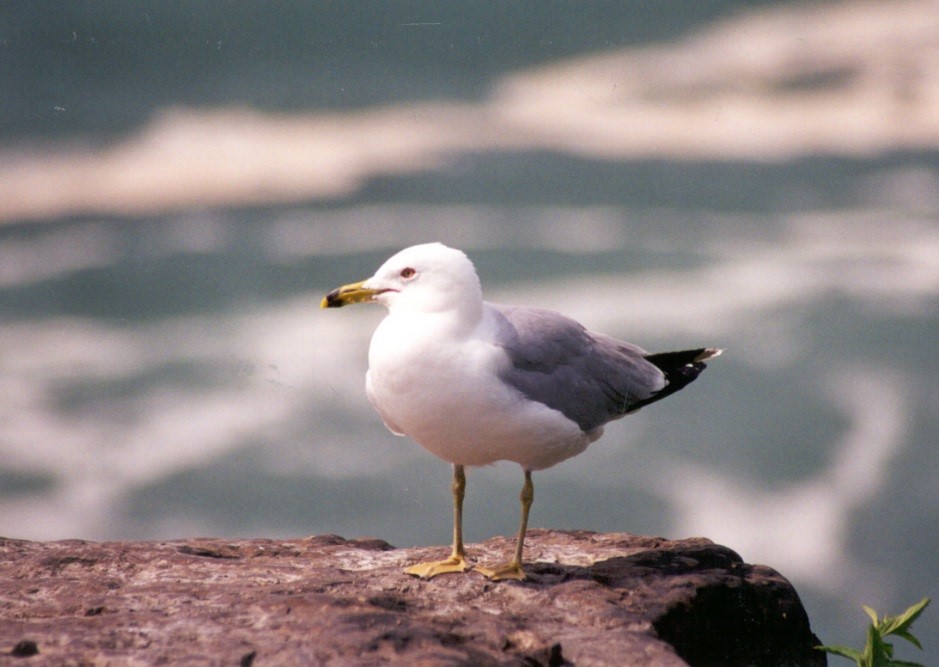
A Ring-Bill Gull stands on a rock. (Credit-State Parks)

Ring-Billed Gulls have yellow beaks with a black band, or ‘ring’, encircling it. The breeding adult has a gray back and black wingtips. In the winter, these birds develop tan streaking across the head. These yellow-legged birds may be found further inland.

Herring Gull

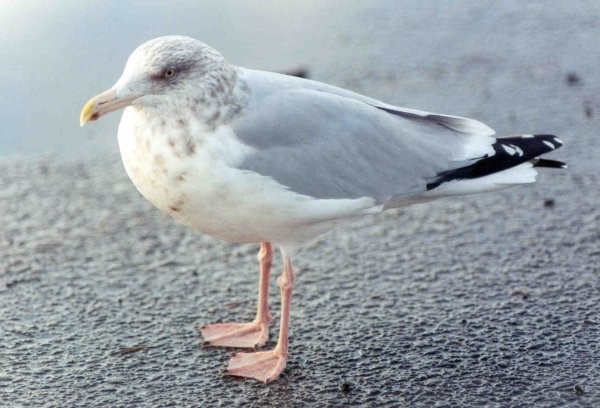
An adult Herring Gull. (Credit-State Parks)

Herring Gulls are on the larger side and are much like the quintessential seagull. They have yellow eyes, pale pink legs, and a red spot on the bottom of their yellow beaks. An adult has a grey mantle and black wingtips, much like the Ring-Billed Gull. These birds start of uniformly dark and then get paler and they grow older, their plumages varying over their first four years. Herring Gulls may be found year-round along the Niagara.

Great Black-Backed Gull

A Great Blacked-Back Gull in flght. (Credit- Wikipedia Commons)

The Great Black-Backed Gull is the world’s largest gull! It has black wings and mantle, a white underside as an adult, and red rings around its eyes. Like the Herring Hull, younger birds’ plumages change as they age; the younger Great Black-Backed Gulls can be differentiated because of higher contrast in their colors than the young Herring Gull. These gulls come to Niagara from the East Coast.

Iceland Gull

An iceland Gull in flight. (Credit-Audubon Society)

Iceland Gulls are slightly smaller than Herring Gulls. These gulls, when adults, have a pale gray mantle and wingtips that can vary in color, from white in the east to black in the west. The darker winged gulls used to be labeled ‘Thayer’s gulls’ and considered a different species, but the two were combined in 2017. These gulls come to Niagara from the Arctic.

Sabine’s Gull

A Sabine’s Gull in flight (Credit-Audubon Society)

This small gull has a spectacular wing pattern, long pointed wings, a notched tail, and a short black bill with a yellow tip . Generally a prized sighting for birders, because it nests on tundra of the high Arctic and migrates south at sea, often well offshore. Those from eastern Canada and Greenland mostly migrate eastward across North Atlantic and then south.

These are just six of the 19 different species of gulls have been spotted here. So, grab your binoculars and see for yourself!


Sources:

Cover Photo: New York State Department of Environmental Conservation

Audubon Society of New York: https://ny.audubon.org/

The Cornell Lab of Ornithology: https://www.allaboutbirds.org/

Important Bird Areas of Canada: https://www.ibacanada.com/

Ready At The Rope

It was going to take heavy ropes and safety gear to rescue a 75-year-old man who was hurt and bleeding after falling near the rocky summit of Dutchess County’s highest point — 2,316-foot Brace Mountain.

With temperatures above 90 degrees and humidity thick that July 4th weekend afternoon, crews at Taconic State Park faced a half-mile hike up the mountain to reach the victim, who could not walk after injuring his head and extremities in a fall on a steep trail.  Initial reports also indicated the man was on blood thinning medication, which could make his bleeding harder to stop.

Setting out from the trailhead, the crew included myself, members of the local Millerton Volunteer Fire Department, an emergency medical technician, two forest rangers from the state Department of Environmental Conservation, and members of the Northwest Connecticut Rope Rescue Team. With about 300 pounds of ropes and hardware for the crew to carry, the hike in took about 45 minutes.

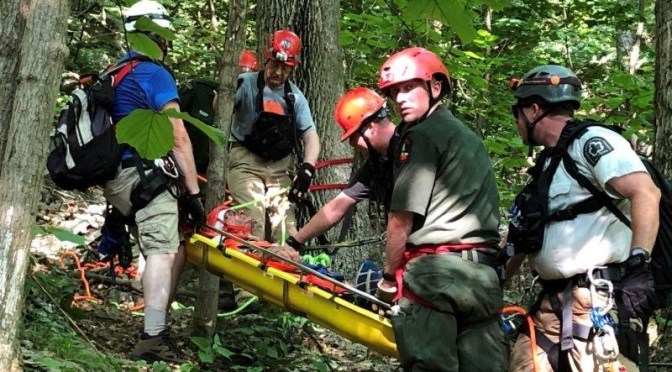
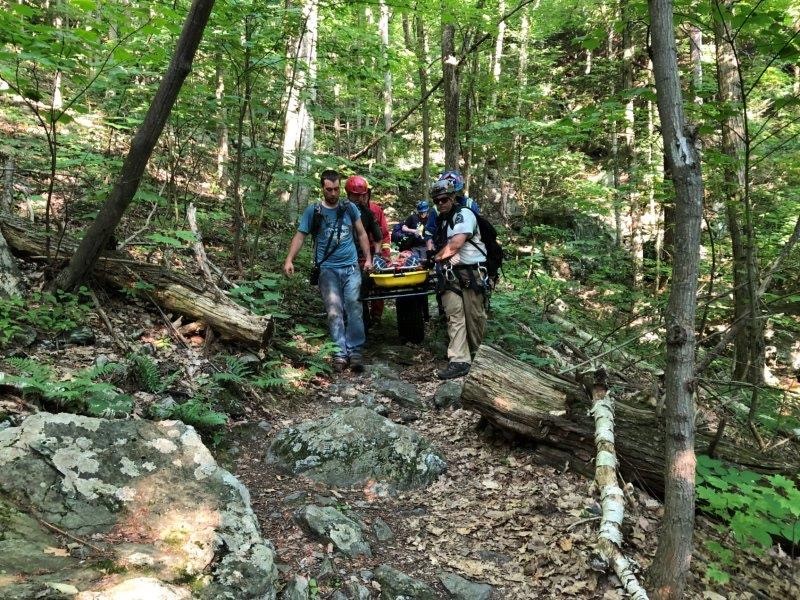
Some five grueling hours later, crews had carried and lowered the 125-pound victim hundreds of feet down the mountain, with the help of the stout ropes, a metal basket, and a piece of equipment called a stokes wheel. A stokes wheel is a single ATV tire that clips to the sides of a metal rescue basket, making transportation on rough terrain more comfortable for the patient and easier on rescuers. The victim was then airlifted to a local hospital with non-life threatening injuries.

Using a stokes wheel, the rescue crew carries an injured hiker down Brace Mountain.
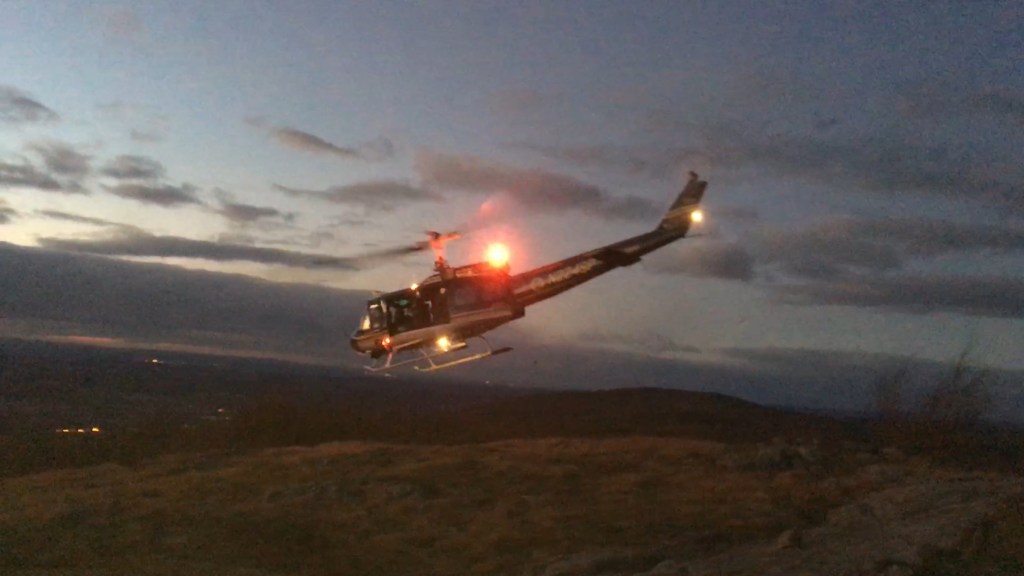
A helicopter heads to Brace Mountain to extricate an injured hiker.

This is not the first occurrence of this type of injury on this trail. Earlier that year, a hiker had fallen on the icy trail and injured his ribs, requiring rescue crews to carry him out on a stokes wheel. A few years earlier, another visitor fractured his leg while slipping on leaves and was airlifted off the summit of Brace Mountain after being carried by crews for more than a mile to a suitable landing zone.

As park attendance continues to rise, and social media convinces more potential hikers to head for the backcountry, we are seeing an increase in patron injuries and so-called ‘technical’ rescues in our State Parks. Such rescues are becoming more common at places like Taconic State Park and Hudson Highlands State Park in the Taconic Region, Minnewaska and Bear Mountain State Parks in Palisades Region, John Boyd Thatcher in Saratoga Region and Letchworth State Park in Genesee Region.

People fall while taking selfies, slip while wearing improper footwear, or enter hazardous and closed areas of our parks. Some patrons fail to dress for the weather, do not bring flashlights or maps, fail to bring enough water and are generally unprepared to hike some of the terrain our beautiful parks offer. The mighty cell phone has made many of our patrons more confident knowing help is only a call away. This false confidence has started to put a strain on park resources along with surrounding first responders who are constantly being called to parks for injuries, and search and rescues.

In order to work better together and streamline communications between rescue crews, here at Taconic State Park we have started annual rope rescue drills with local fire departments, forest rangers, rope rescue teams, park police and other first responders.

The drills include using Incident Action Plans and the Incident Command Structures we all learn in our classes as park managers. By drilling, we get to practice putting together planning documents and working with Incident Commanders who coordinate with park officials on such emergencies. We gain valuable facetime in a non-emergency atmosphere where we can dissect our pre-planning and offer each other suggestions and advice.

In late October, staff at Taconic State Park held a Joint Rope Rescue drill that brought together over a dozen responding agencies from two states and three counties. The drill was a mock exercise that practiced communication between different departments, navigation and various rope rescue skills and strategies.

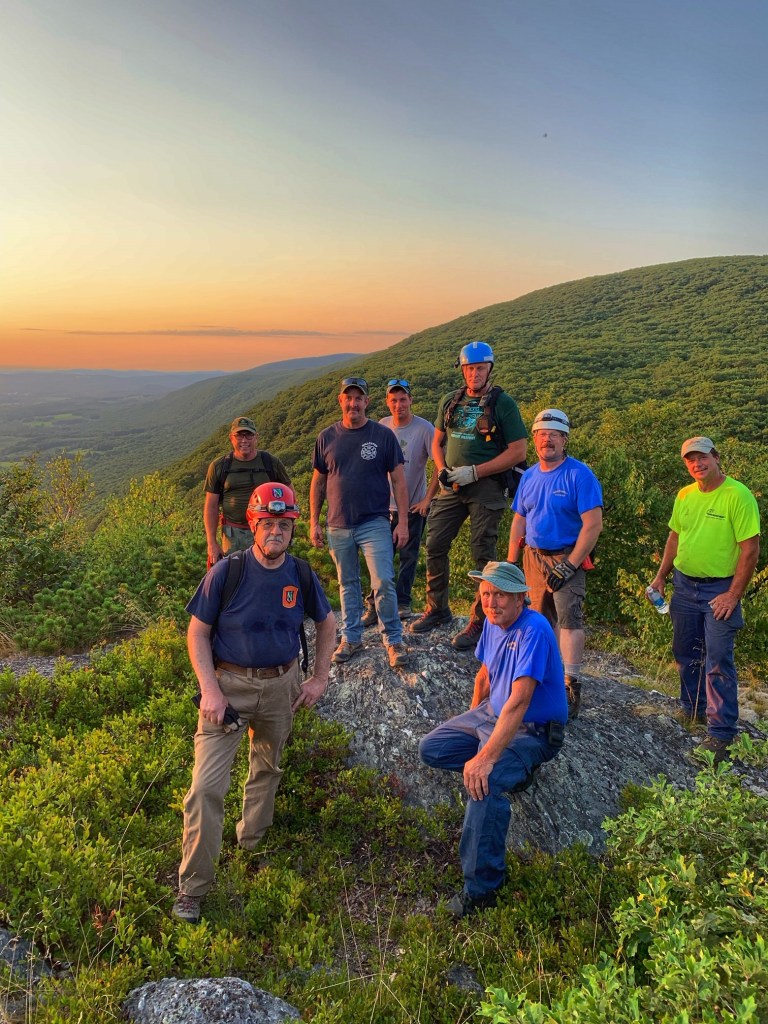
Members of the Brace Mountain Joint Rope Rescue Drill in October.
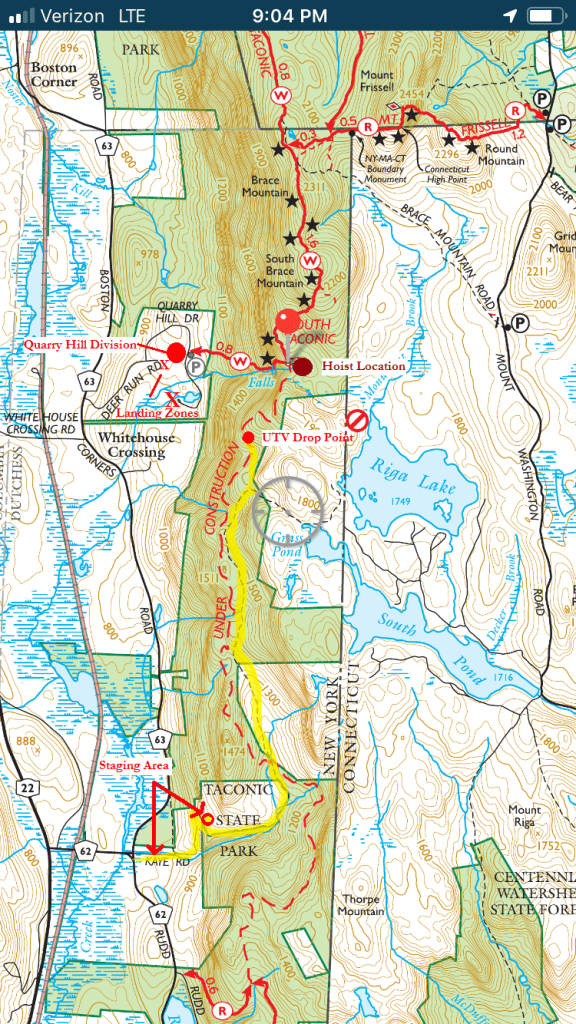
A map of the Brace Mountain region used during the safety drill.

We also review our rescues to learn not only what we did right but more importantly, where we can improve. One lesson from the July 4th incident is that we will now use staging areas for motorized UTV’s that shuttle rope gear to a pre-planned location near the summit of the mountain so that heavy equipment no longer needs to go uphill with rescuers on foot.

By using motorized vehicles to bring heavy gear above where a rescue has to happen, rope crews only have to carry this equipment downhill, which saves more of their energy for when they reach a victim. It takes a few more resources to do this but ultimately increases the efficiency of getting equipment to the injured hiker.

Also, we have established multiple hoist locations in the area, so if available, a helicopter can save us the time and effort of carrying and building lowering devices with ropes and hardware in the field. This will not always be available, but it is another tool that we can use to make rescues faster and safer.

All parks are required to have an All Hazards Emergency Action Plan. However, some emergencies in our parks require more planning than the normal fire drill or patron with heat exhaustion. Some potential emergencies require park managers to meet with local first responders on a regular basis to enhance the speed and efficiency of their response.

No matter what size the park or historic site, it is always essential to have an open line of communication with the local fire chief, rescue squad and Park Police so that the one day they are needed, they know your face and who you are. It just makes things easier – and ultimately safer – for the thousands of visitors who use the trails in the rugged regions of our State.


Post by Chris Rickard, Park Manager, Taconic State Park


Prepare To Help Avoid Accidents

  • For a safe hike, there are things to remember beyond carrying a mobile phone. Wear sturdy yet comfortable shoes or boots, and bring water and snacks for the trail. Wear clothing appropriate for the weather.
  • Be mindful during hikes on steep terrain or that go near cliff tops. Hiking poles can help stabilize yourself against a potential fall, and transfer stress of hiking from your knees and legs to your arms and back.
  • In the winter, when snow and ice can cover trails, carry and use traction gear on boots, such a webbed spikes or crampons.
  • Carry a small first-aid kit in case of emergency. Hike with a partner, so if something happens, help is present. Hiking alone is risky.
  • Use a trail map, which is available online at each park website at https://parks.ny.gov/ and at the main office at each park, in season. Check the park’s individual website to see if its maps can be downloaded to your iOS Apple or Android device, but a paper map is a good backup in the event of device failure.
  • For some facilities, data is available as a Google Earth KML file or a map is available to download to your iOS Apple and Android mobile devices in the free PDF-Maps app. Learn more
  • Once you have a map, you can tell how long a trail is and how long it ought to take to finish. As days grow shorter in fall and winter, having a flashlight or headlamp in your backpack is a good form of insurance, should you unexpectedly find yourself on the trail as dusk approaches.
  • If issues arise, be prepared to turn around. Don’t fall victim to “summit fever” – the desire to reach the top regardless of the risk.
  • And, as incidents of tick-borne diseases surge in the state, it is always important to check yourself for ticks after being outside during spring, summer and fall, even if it is only time spent in your own backyard. Thankfully, ticks are not normally active during the cold of winter.
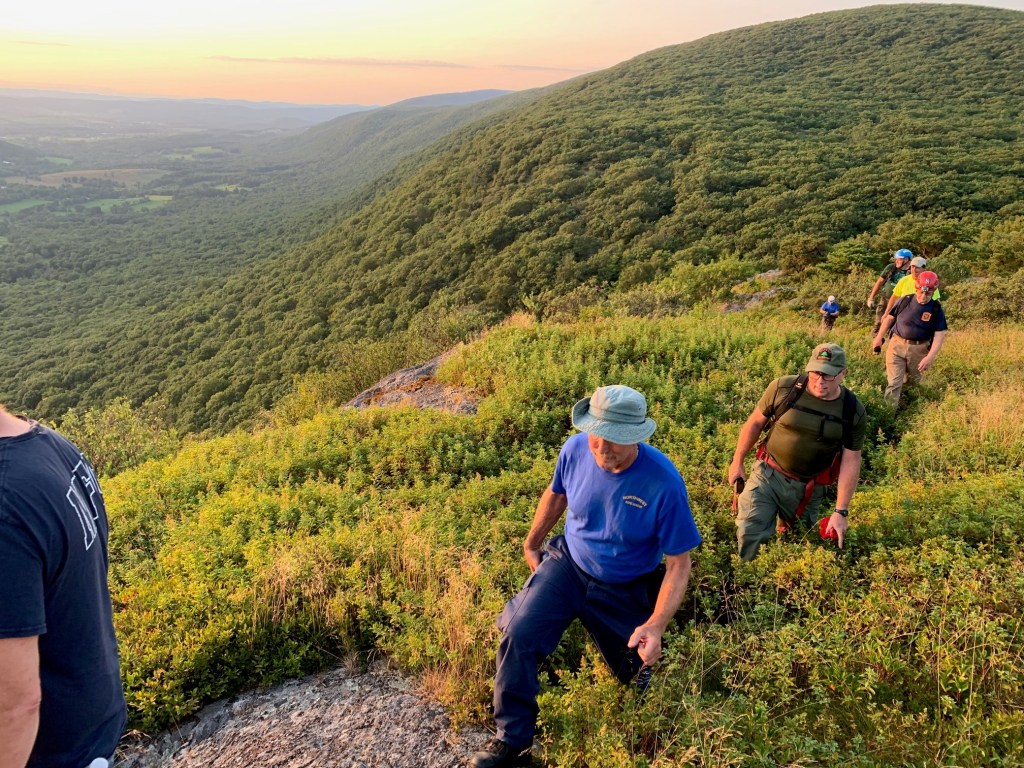
The Brace Mountain rope drill team nears the summit.

All pictures courtesy of NYS Parks

Mother of the American Youth Conservation Movement

Liz Titus Putnam looked at dozens of people in the dining hall at a Dutchess County summer camp — eating, talking and laughing — and she saw a room full of connections.

Although many people in the Sharpe Reservation hall that October morning were in their early 20s, their ties stretched back to 1953. That was when Putnam, a 20-year-old Long Island native and junior at nearby Vassar College, came up with an idea.

After reading a magazine article on the deplorable state of the national park system, Putnam used her senior thesis to propose a voluntary student service program to work at the parks. Her inspiration came from the Civilian Conservation Corps created two decades earlier by President Franklin Roosevelt to provide work for the unemployed during the Great Depression.

“I knew that I would be interested in doing that work. And I thought other young people would be interested, too,” Putnam said.

Through timely encouragement and helpful connections that seemed to show up just when needed, the new college graduate founded what became the not-for-profit Student Conservation Association (SCA), with its first crews of 53 men and women (Herself included) arriving in 1957 at Grand Teton and Olympic national parks to do trail work. The Peace Corps and Earth Day were still years away.

Six decades later, more than 90,000 young people from every part of the U.S. and many foreign countries have gone through the SCA, with most members later going on to jobs and careers in the field of conservation at a myriad of organizations.

Since the beginning, SCA members have performed about 40 million hours of public works service at parks and other public lands. In today’s dollars, that would be worth about $600 million.

Last month, their ranks grew by another 40 people who graduated from the Hudson Valley SCA 2019 program under Putnam’s appreciative and proud gaze. The ceremony was held at the Fresh Air Fund’s Sharpe Reservation in Fishkill.

“I have so much hope for the future, to see young people getting involved,” said Putnam, now an 86-year-old resident of Vermont where she lives on a farm. She retired from running the organization day-to-day as its president in 1969, but under the title of Founding President remains active and involved.

“You will have many adventures. You have one life, and it goes by very fast,” Putnam told the Hudson Valley SCA graduates. “It is what you do each day. You are part of a team, with the humans all around this earth. Each person counts.”

President Barack Obama presents Liz Titus Putnam with the Presidential Citizens Medal in 2010. The award is the nation’s second-highest civilian honor. (Credit: Student Conservation Association)

Putnam believes that connections helped her all along the way, starting with her faculty advisor at Vassar who encouraged her to pursue her idea. Then through a family connection, she met the daughter of the late Stephen Mather, first director of the National Park Service. She in turn introduced Putnam to his successor, former park director Horace Albright. He was intrigued enough by the idea to urge her to visit four national parks to gauge local interest in a volunteer corps, giving her a letter of introduction to ease the way. After that trip in 1955, the superintendents at Grand Teton and Olympic said yes to accepting her student volunteers.

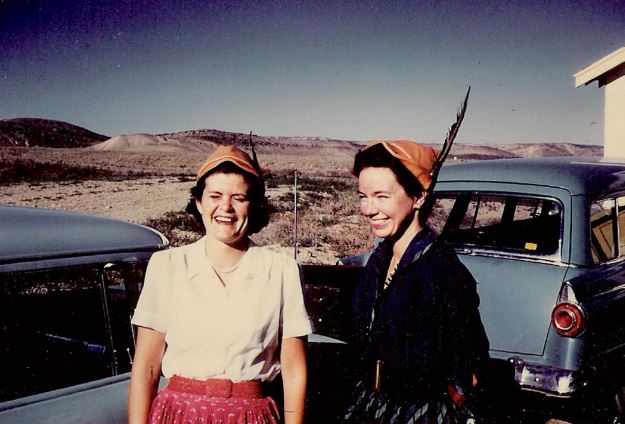
Liz Titus Putnam (left), near Grand Teton National Park during the first year of the Student Conservation Association in 1957. To the right is fellow Vassar College alumna Martha “Marty” Hayne, who co-founded the SCA and later was a member of its board of directors. (Credit: Student Conservation Association)
Liz Titus Putnam and Martha “Marty” Hayne share a laugh back in the day. (Credit: Student Conservation Association)

“I had no connections at the time, But the connections appeared when they were needed. That is the miracle,” Putnam told a visitor at the Hudson SCA graduation.

Speaking there, Putnam shared her tale of actually joining the group that she helped found. It was after fires had devastated Yellowstone National Park in 1988 and the SCA was lining up people to come help. She was 56 years old.

“I spoke to our staff, asking if anyone could join. And they said yes. And I asked if I could join, and they said yes,” Putnam said. “And I said, no special treatment, treated just like everyone else? And they said yes.”

After filling out an application, she got her SCA acceptance letter (she recalled saying ‘Yippee!” upon opening it), later arriving at Yellowstone under an assumed name to wield hand tools and help other members repair burned out bridges and cut downed trees. One day, a college student from Texas said he knew who she was, because she had spoken at his school about the SCA. “I asked him to keep it to himself, and we would be fine. And he did,” said Putnam.

Liz Titus Putnam plans a tree at Vassar College during a ceremony in her honor in 2018. (Credit: Vassar College)

“Liz is very inspiring,” said Dana Reinstein, a 23-year-old Queens resident who is finishing her second SCA stint. “I got to meet her when she was at Vassar last year, when she was helping plant a tree there.”

Now serving as an environmental educator in New York City schools, Reinstein said working at the SCA was about “a lot of new connections and experiences,” starting with lessons on how to use hand and power tools. “This is not something that I ever thought I would do. When I started, I did not even know how to use a hammer properly.”

A graduate of SUNY Fredonia with a degree in geology, Reinstein became part of an SCA team that provided more than 71,000 hours of service, valued at $1.7 million, working this year on trails, waterways, and recreational habitat.

Marking its 20th anniversary, the Hudson Valley SCA works with New York State Office of Parks, Recreation and Historic Preservation, New York State Department of Environmental Conservation, local Soil & Water Conservation Districts, Scenic Hudson, Audubon New York, and Vassar College. The Hudson Valley SCA Corps is an AmeriCorps program.

Some 900 young adults have gone through the Hudson Valley SCA since it started, logging some 1.7 million hours of service that would have cost $30 million if workers had to be hired.


Check out this slideshow of some of the members of the Hudson SCA 2019 session. (Credit: Hudson SCA)


‘Once an SCA member, always an SCA member’ seems to be a cardinal rule of the organization. When Putnam asked how many people attending the graduation had been in SCA, many hands went up.

One belonged to Melissa Miller, park manager for Grafton Lakes State Park, Cherry Plain State Park, and Bennington Battlefield State Historic Site.

Miller did two SCA terms in 2001 and 2002, working on landscape tours at Olana State Historic Site, and then as an environmental educator at Grafton, where she was hired subsequently as a State Parks employee.

“Before that, I had been working in a restaurant. Being in the SCA was such a wonderful experience,” Miller said. “It gave me my career.”

Sarah Davies, an alumna of the original Hudson Valley Corps in 1999, is now Chief Environmental Educator with State Parks after service with DEC. “SCA was the best decision of my professional life. It was the catalyst for my 20 years in government service,” she said.

Liz Titus Putnam, left, with Ann Harrison (center), bureau chief of environmental education at the state Department of Environmental Education, and Sarah Davies (right), chief environmental educator at NYS Parks. (Credit: Student Conservation Association)

Post by Brian Nearing, Deputy Public Information Officer for NYS Parks


Learn about applying to SCA here.

See Liz Titus Putnam interviewed on the 2009 Ken Burns film “The National Parks: America’s Best Idea”

Read the 1953 Harper’s Magazine article that inspired Liz Titus Putnam — then a 20-year-old college student — to create the Student Conservation Association. She described the article as “hitting me like a bolt.”

Read this in-depth interview with Liz Titus Putnam

Watch a short history of the SCA

The official blog for the New York State Office of Parks, Recreation & Historic Preservation