Hats Off to Lorenzo Driving Competition, a Summer Signature in Cazenovia

For lovers of horses and history, the annual Lorenzo Driving Competition is the jewel of Cazenovia’s summer traditions.

The click of hooves, the hum of carriage wheels, the shimmer of sunlight on canvas tents: It’s a singular weekend, a chance to be transported to a time when road trip meant four legs and a whip.


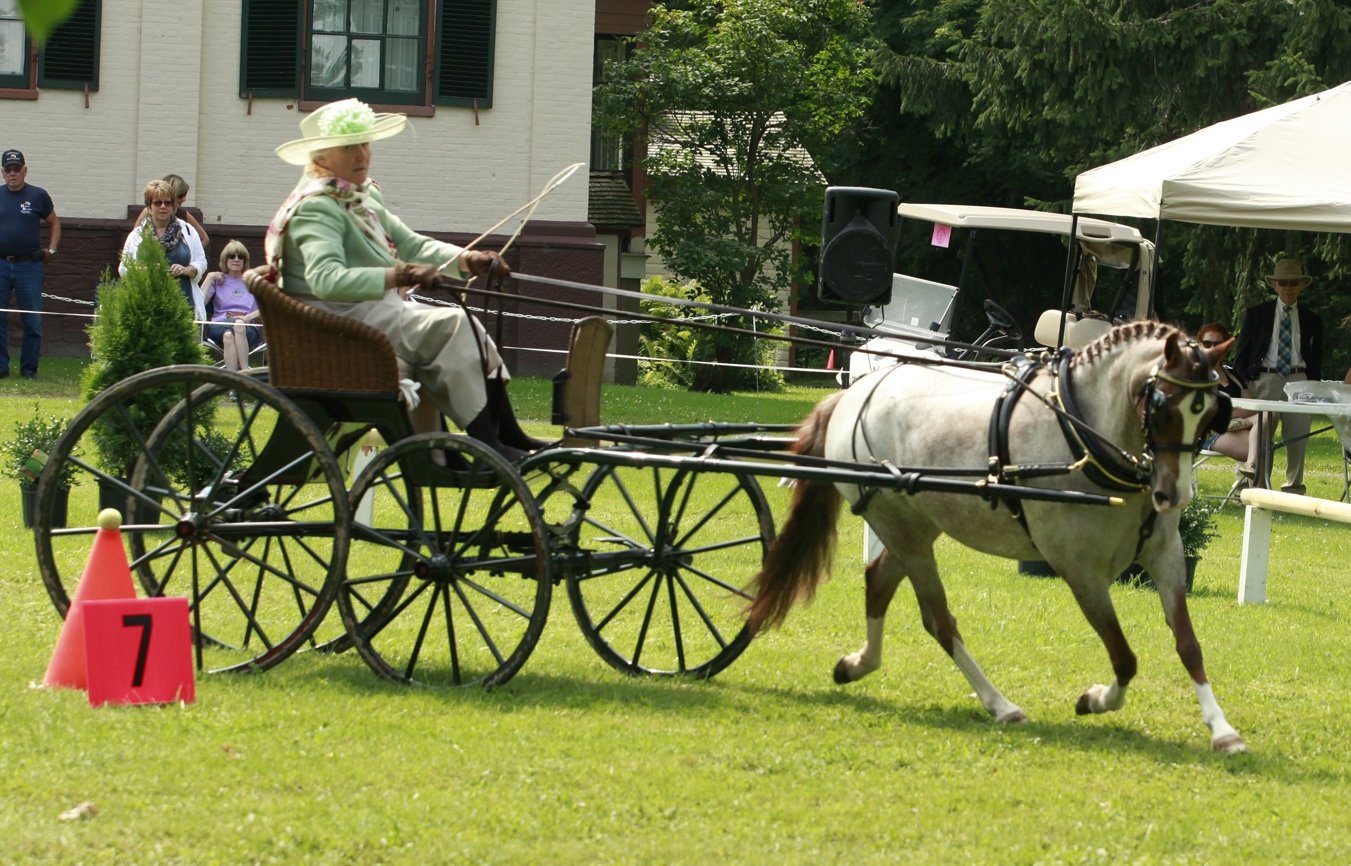
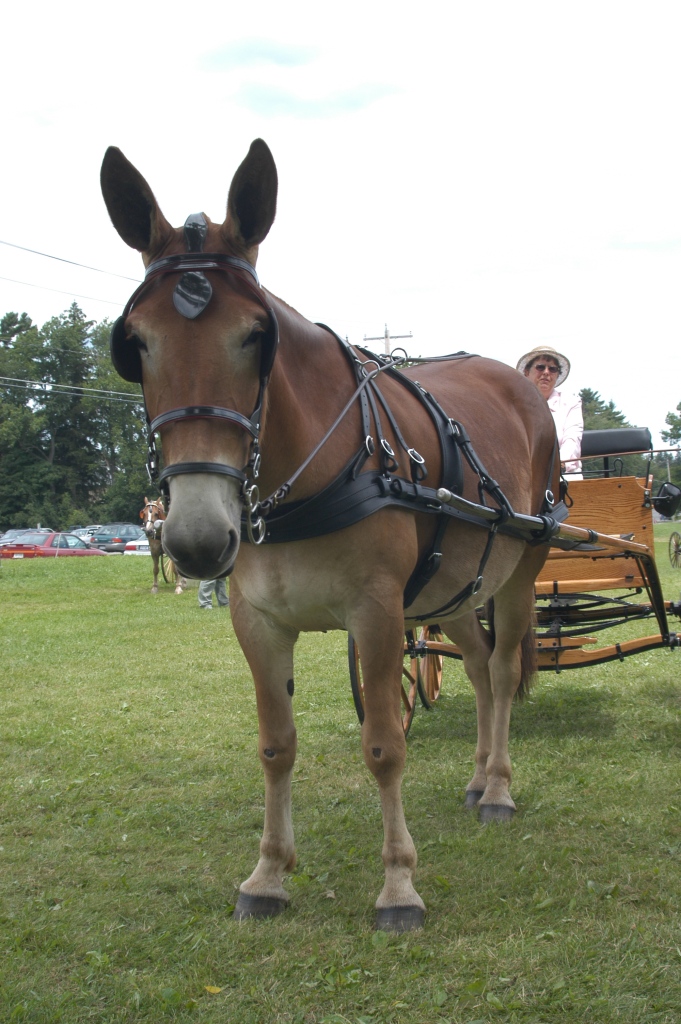
A driver puts her horse and carriage through the course. Photo courtesy of Janis Barth.

The competition, held July 19-21, is once again set on the central great lawn of the Lorenzo State Historic Site, once the home of John Lincklaen, a Holland Land Company agent who founded the town in 1793 and named it for his boss, Theophilus Cazenove.

Lincklaen’s neoclassical mansion is a signature surrounding, the gentle slope of the ring designed to recreate a traditional driving experience and show off the unique combination of skill, attire and showmanship that define the sport of pleasure driving.

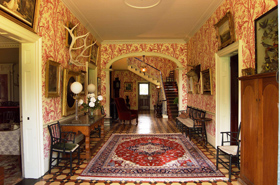
Interior hallway of the mansion.

For spectators, who are invited to bring chairs and blankets and find a comfortable vantage point, the restored historic buildings provide the perfect backdrop.

Plan for a full day, because the Lorenzo grounds and restored mansion beckon between classes. Wander the Dark Aisle Arboretum and the spectacular formal garden. Absolutely leave time to explore the carriage house and collection of antique vehicles that provide a link between the driving competition and Cazenovia’s rich equestrian history.  

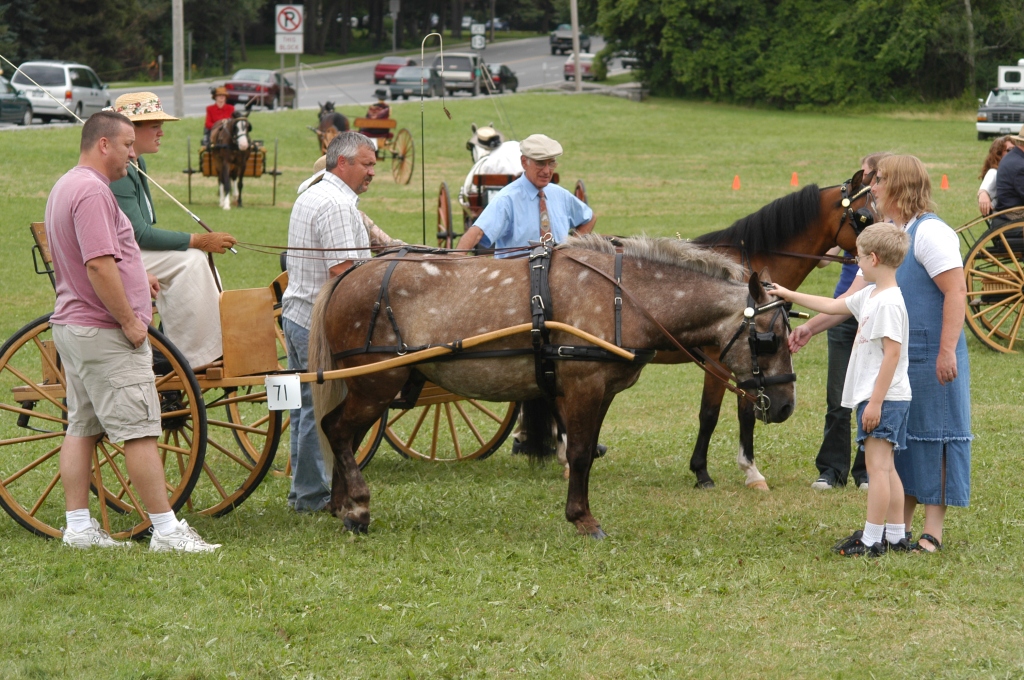
Visitors mingle with some of the horses and their drivers. Photo courtesy of Janis Barth.

The heart of the weekend, however, belongs to the polished pleasure-driving teams. Competition will take place in two rings: one featuring such crowd favorites as the Carriage Dog and Antique Vehicle classes, and one dedicated to a Christmas in July-themed obstacle class.

Yes, that is right! Carriage dogs… A carriage dog or coach dog refers to a type of dog rather than a specific breed. Originally, dogs of this type were bred and trained to trot alongside carriages to protect the occupants from banditry or other interference. They were usually owned and used by the wealthy or traders and merchants. Dalmations were once one of the most popular breed of carriage dog in England, starting in the 18th Century. The more carriage dogs that attended a carriage, the greater the indicator of the occupants’ wealth and prestige.

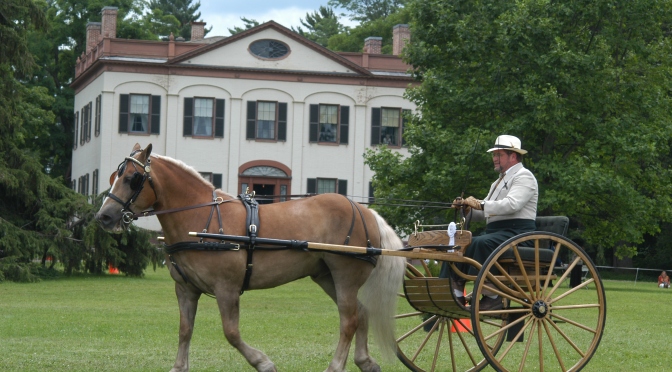
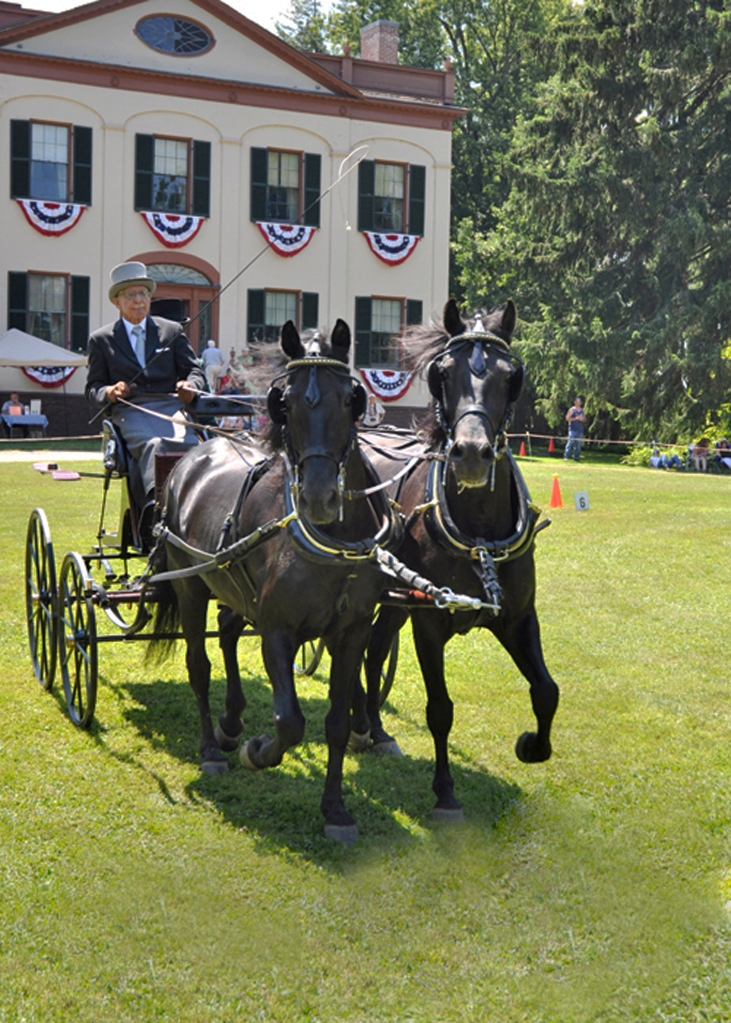
An elegantly-attired driver and his team in front of the neoclassical Lincklaen Mansion. Photo courtesy of Janis Barth.

Friday at Lorenzo starts with driven dressage classes, testing the skill of horse and driver as they perform prescribed patterns with circles, diagonals and changes of gait. Then it’s off through fields and woods to neighboring Empire Brewery. Pull up a chair and watch from the front lawn as teams weave between traffic cones topped with tennis balls – points lost for every ball knocked to the ground.

The day ends with something new: a Picnic Class, where competitors are judged on their ability to drive a horse and then set up a posh meal on tables around the main show ring. It’s an elegant nod to a bygone era and, as you might imagine, more fine china and silver and less plastic forks and paper plates. On Sunday morning look for Lorenzo’s signature 5-mile, Pleasure Drive-Pace through the lush countryside south of the mansion. During the lunch break, JK Percherons will dazzle in the main ring with their four-horse hitch.

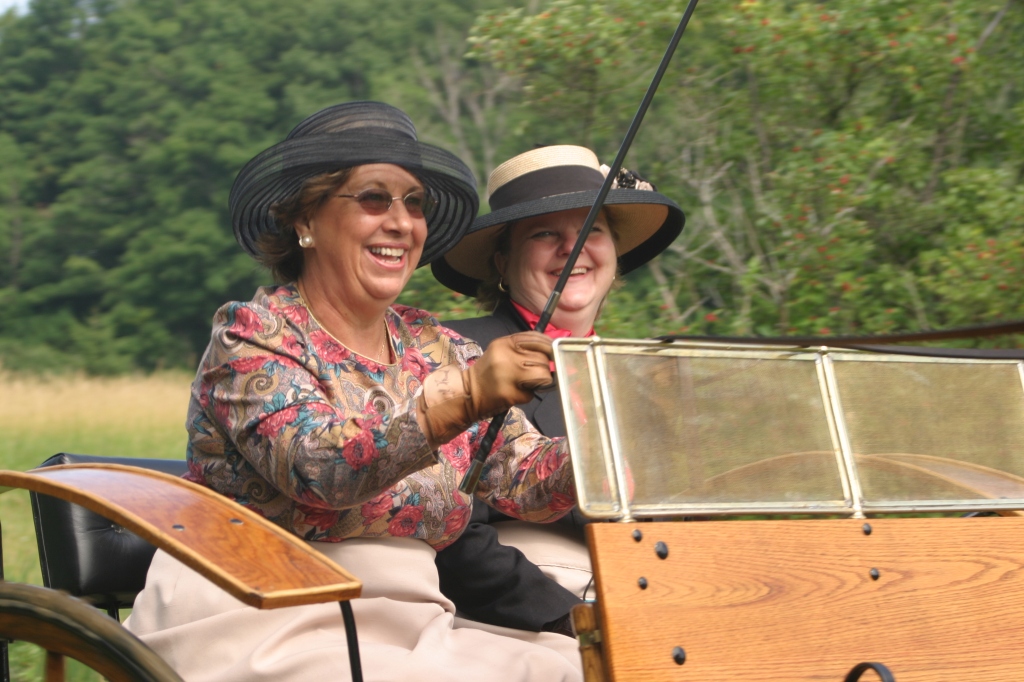
A driver and passenger show their joy on the course. Photo courtesy of Janis Barth.

Bring the littles and check out the Kids Korral, the many vendors along Market Lane and a silent auction featuring unique items – equestrian cocktail shaker, anyone?

As always, there is no charge for parking or to attend any day of the competition.

There’s something special about Lorenzo weekend– the mansion, the polished trophies, the gentle snort of horses and well-mannered woof of carriage dogs. This summer, plan to be part of the tradition.

For more information and updates go to lorenzodriving.org or follow the show on Facebook. Also, there are many other events at the Lorenzo site this season, and further information can be found here.


Hope to see you there! Photo courtesy of Janis Barth.

Post by Janis Barth, editor and publisher of New York Horse magazine and a member of the Lorenzo Driving Competition board.


Efforts to Control Invasive Species in Parks Gain a Four-Footed Team Member

One sniff at a time, an energetic Labrador retriever named Dia is changing the way we combat invasive species in New York State Parks.

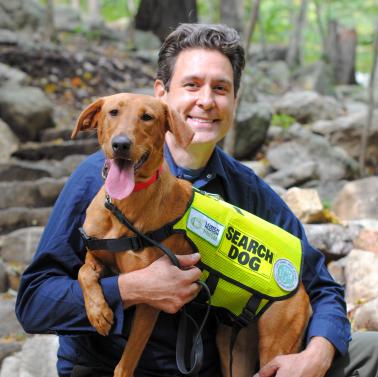
Along with her handler Joshua Beese, this invasives-fighting team from the nonprofit New York-New Jersey Trail Conference is on the hunt for Scotch broom, a threat to the native ecosystems in Bear Mountain and Harriman state parks in the Lower Hudson Valley.

Dia uses her powerful sense of smell to help find small and sparsely distributed invasive species that might be missed by human searchers. Since November 2018, her incredible nose has been specially trained to sniff out the invasive plant Scotch broom.

Joshua Beese with Dia. Photo by nynjtc.org

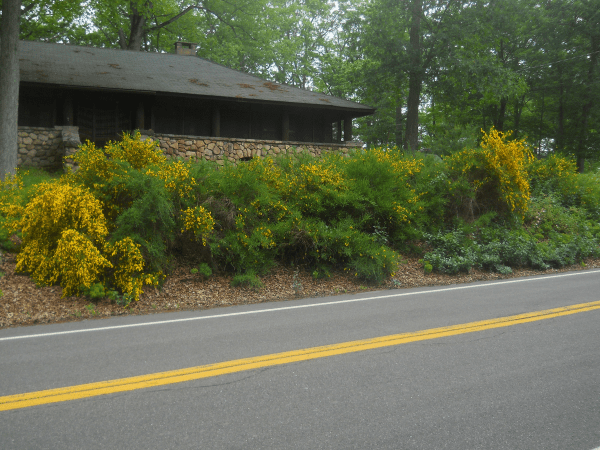
Scotch broom (Cytisus scoparius)is one of the most destructive invasives on the Pacific Coast, where it has had costly implications for agricultural industries. When it began showing up in New York’s parks, land managers became concerned. Scotch broom forms dense clusters that can displace native plant species and reduce biodiversity that is essential for a healthy ecosystem.

The Lower Hudson Partnership for Regional Invasive Species Management (LHPRISM), which works to minimize the harm caused by invasives, ranks Scotch broom as a tier 2 priority invasive species. That means it is present in such low numbers in the Lower Hudson Valley that with proper action it could be completely eradicated from the area before the population becomes established.

Scotch broom plant in flower on May 2015 at Harriman State Park. Photo by Shelby Timm, nynjtc.org.

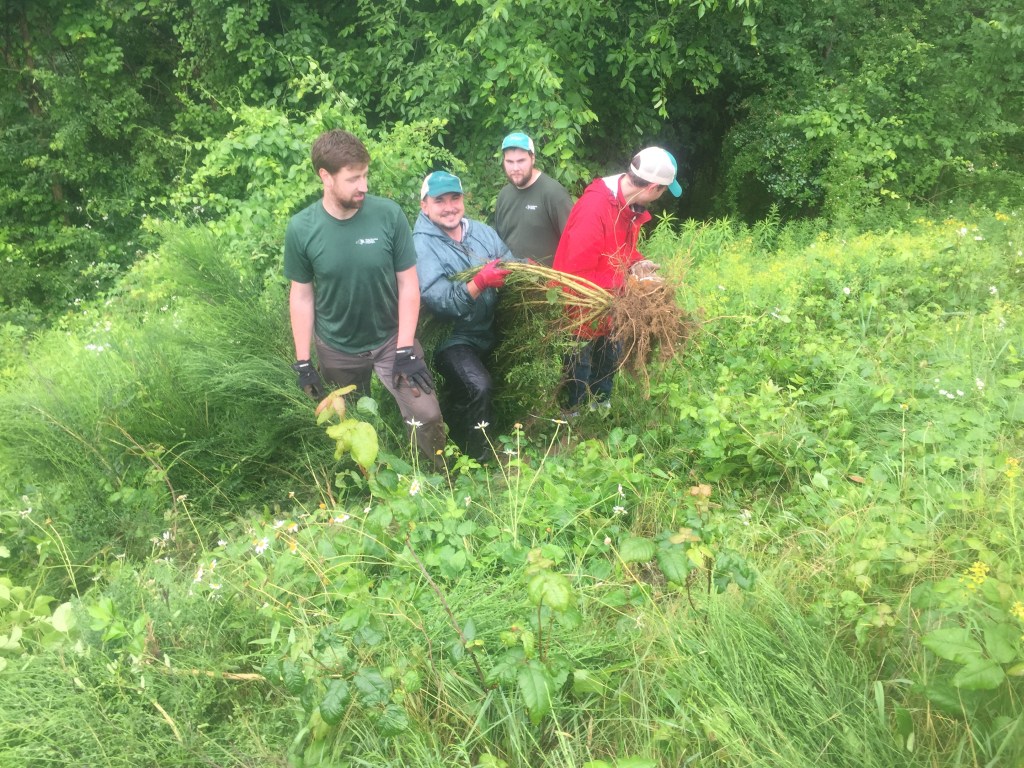
The New York State Parks Invasive Species Strike Team and the Trail Conference’s Invasives Strike Force (ISF) Crew of AmeriCorps members, volunteers, and interns have collaborated over the past several years in a bid to eradicate Scotch broom in the region. The ISF Crew has been finding and removing Scotch broom in state parks since 2014, when 37 separate populations were recorded at Bear Mountain and Harriman.

A Scotch broom infestation at Harriman State Park in 2014. Photo by Jennifer Breen, nynjtc.org
After the Scotch broom removal . Photo by Jennifer Breen, nynjtc.org

While a few locations no longer have any plants, other locations are harder to manage. It becomes challenging to find the few remaining individuals among all the other vegetation, which means this destructive plant could still propagate. That’s where Dia comes in!

“Dia first comes into the field with her nose up, smelling what’s in the air, working to detect the Scotch broom scent,” explains handler Beese. “She’s using what are called scent cones; she works her way into a cone and uses that cone to help her narrow down the source.”

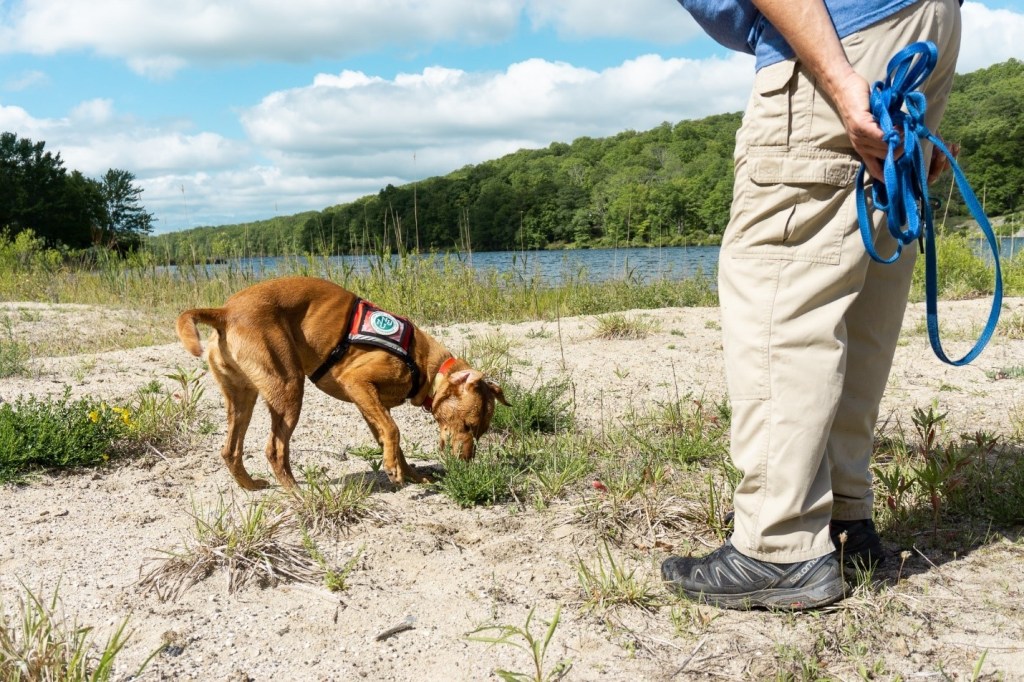
Once in a cone, she will search until she gets to the source and put her nose to the ground to sniff out smaller plants that may be tiny and low to the ground. She alerts Beese that she’s found the species by standing or sitting. “The most important thing is that she’s committed to an area where she’s detected the plant until I come and reward her,” Beese says. “Then we can mark it and remove it.”

Dia’s reward: Her ball on a rope with a game of tug and fetch. See Dia in action by following her on Instagram @diasavestheforest.

Dia on the hunt for invasives. Photo by Arden Blumenthal, nynjtc.org

Utilizing their exceptional sense of smell, dogs have been commonly used for search and rescue, as well as weapons and narcotics detection. These tracking and detection skills are now being used to protect our wild spaces. In 2010, the journal Invasive Plant Science and Management published a study that concluded trained dogs could smell and detect twice the number of invasive plants that humans could observe with their eyes.

Although other groups have used dogs for short projects to detect of invasive species, the Trail Conference’s Conservation Dog Program is the first permanent program of its kind in the Northeast.

This is Dia’s first season in the field; she has already been on more than 20 surveying trips. In several instances, the Trail Conference’s Invasives Strike Force Crew had been to a site and completely removed every plant they were able to find—and then Dia found a few more.

Trail Conference Conservation Corps members removing Scotch broom plants in 2016. The flags indicate where plants have been removed. Photo by Matt Simonelli, nynjtc.org

Dia came to the Trail Conference from a farm in Wisconsin that breeds dogs for hunting competitions. She was selected for the program by Beese, an experienced search and rescue dog handler, who is assisted by volunteer Arden Blumenthal. He has trained Dia with the mentorship of Aimee Hurt from Working Dogs for Conservation in Montana, an organization that has been working with dogs on conservation projects for more than 20 years.

In a metropolitan region highly prone to invasive infestations, early detection when populations are small is a key component of successful invasive species management. Not only does Dia make search-and-destroy efforts more thorough within infestations, she is also able to find stray plants outside the known boundaries where people had focused their searches. Dia helps make sure the area is really cleared to reduce the potential for reinfestation or further spread. With better search efficiency, it should be possible to declare New York State parks Scotch broom-free in the near future. 

Crew from New York State Parks Invasive Species Strike Team removing a Scotch broom plant. Phot by Linda Rohleder, nynjtc.org

Up next for Dia is slender false brome (Brachypodium sylvaticum), an invasive grass that can outcompete existing vegetation, including threatened and endangered species, and harm wildlife populations by altering food sources. Slender false brome has recently been found in Letchworth State Park, and this location will serve as a training ground for Dia.

***UPDATE: Dia and her team recently went to Letchworth State Park, where they did find the invasive slender false brome in areas where surveyors had missed it.

Conservation dogs can learn to detect up to three new species each year, meaning Dia’s incredible talents will continue to develop. “In three or four years,” Beese says, “we’ll be pushing forward the science on what can be done with invasive species detection using dogs.”

New York-New Jersey Trail Conference Conservation Dog team, from left, Arden Blumenthal, Dia, and Joshua Beese. Photo by Heather Darley, nynjtc.org

Post by Linda Rohleder, Director of Land Stewardship, New York – New Jersey Trail Conference and Coordinator, Lower Hudson Partnership for Regional Invasive Species Management (PRISM)

After Yorktown: The Path to Newburgh And VICTORY

Many visitors to The Hasbrouck House overlooking the Hudson River are surprised to learn that George Washington spent 16 and a half months headquartered and living in this fieldstone farmhouse in Newburgh, New York after the Siege of Yorktown (September 28-October 19, 1781).

To many the Siege of Yorktown, Virginia, was the end of the Revolutionary War. Although this decisive American/Franco victory did ultimately bring about the end of the war, it was not the end. In hindsight, the Siege of Yorktown created the path to Newburgh and victory! After all, the peace treaty was not signed until September 3, 1783—almost two years after the Yorktown victory. General Washington knew he and the military could not remain idle and expect to win.

1931 Postage Stamp
U.S. postage stamp commemorates 150th anniversary of Yorktown victory.

After Yorktown, the British regained the strategic upper hand on land and sea. Naval superiority had been compromised by the French with de Grasse’s victory in the Battle of the Capes in September 1781, but the British would reassert themselves with the defeat of de Grasse’s fleet in April 1782.

On land, three major American cities remained in the possession of the British after the siege. New York City had been taken in 1776 in a series of terrible losses. Savannah, Georgia had been captured in late 1778. Charleston, South Carolina, the gem of the South, had been lost on May 12, 1780.

In early 1782, the conflict awaited George Washington’s next move. His first inclination had been to liberate Charleston. After a conference with French Commander-in-Chief Rochambeau, Washington changed his mind. In a letter to Congress five days after Cornwallis’s surrender at Yorktown, Washington outlined his reasons to Congress and informed them of his next move:

“…having no means of water conveyance, the transportation by land, of the army, with all their baggage, artillery, ordnance, stores and other apparatus necessary for the siege of Charleston, would be impracticable and attended with such immense trouble, expense and delay, exclusive of the necessity of naval co-operation [with the French] to be sufficient to deter me from the undertaking, especially as the enemy, after regaining Naval superiority on this coast, could reinforce or withdraw the garrison at pleasure…Our Operations against the enemy in this state being concluded it becomes my duty to inform Congress…[that] I shall myself, with the troops of the States to the Northward of Pennsylvania, return to my former position on the North River.”

SANYO DIGITAL CAMERA
Reenactor portrays George Washington during event at Hasbrouck House.

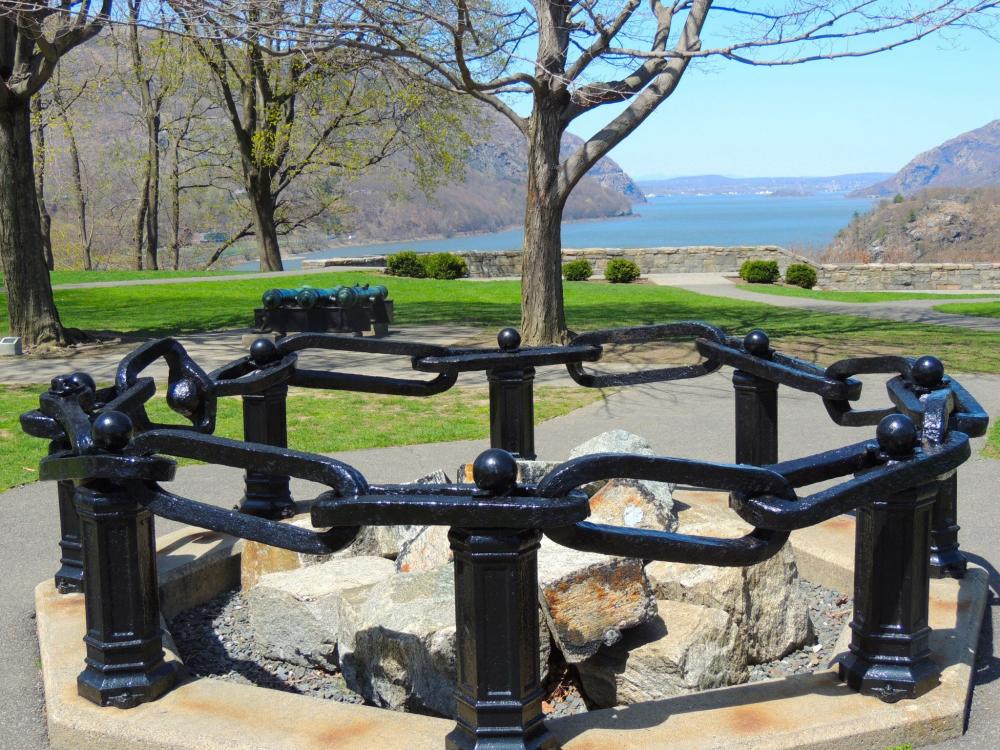
The to which Washington refers is the Hudson River, and his “former position” was the Newburgh area—the best place for Washington to go for both his army and the defense of our country. The New York City contingent of British troops was the largest in North America. Newburgh was in a sense out of reach of the British Navy because of the Great Chain at West Point, but the “North River” still held strategic importance as the British had tried earlier in the war to divide the states by conquering the North River.

Parts of the Great Chain

Loyalties and money played a role, too in Washington’s decision. The area around Newburgh was almost 100% patriotic. At earlier points in the war, Washington had headquartered where local loyalties were not so plain. In those areas, supplies were harder to come by and Congress could provide little to no financial support, so friendly country was a necessity. Around Newburgh, patriot supply lines and depots, communication lines, contractors, etc. had already been established earlier in the war.

Reenactors_with Cannon_PRK1039
Reenactors pose with Revolutionary War cannon.

Looking back on Yorktown, one can be forgiven for thinking the war was over, but that is only in hindsight. Had Washington thought that, we might be swearing allegiance to Queen Elizabeth today. After Yorktown, Washington worked hard to keep the army well positioned, battle ready, and under control. Newburgh gave him a relatively safe place from which to watch the British, strategically defend the country, and present a unified front at a time when internal turmoil threatened to undo all the hard work already done in defeating the British.

Come to Washington’s Headquarters in Newburgh to find out the rest of the story. For more information contact Washington’s Headquarters State Historic Site in Newburgh NY at 845-562-1195 or find us on Facebook.

_PRK_1175 copy
Schoolchildren learn about Washington at Hasbrouck House.

Post by Lynette Scherer, State Parks Recreation Aide at Washington’s Headquarters State Historic Site

Parks Water Quality Unit: Keeping Watch on our Beaches and Waterbodies

It’s finally June, which means the Water Quality Unit at New York State Parks is out in full swing for the 2019 summer season.  Each year, staff from the Water Quality Unit coordinate water quality monitoring programs for many of the waterbodies within Park boundaries.  A substantial portion of State Parks attendance is associated with recreational water use, so it is important to ensure the beaches are operated in a manner that is both safe for patrons and that protects this valuable resource for future use. The Beach program oversees weekly bacteriological sampling at 96 sampling stations within 60 parks, provides water quality training to Park staff, works on collaborative studies with other agencies, and ensures compliance with the Harmful Algal Bloom (HAB) protocol.  Keep reading for an overview of each of these responsibilities!

Beach Locations

New York State Park Beaches are located across the entire state – from end to end and top to bottom; on small inland lakes, the Finger Lakes, the Great Lakes, the Niagara and St. Lawrence Rivers, and on the Ocean.  This link will take you to the State Parks webpage where you can search for a beach near you or one you want to visit.

Moreau
Beachgoers relax at Moreau Lake State Park

Weekly Sampling

Each guarded beach is sampled a minimum of once a week for E. coli (freshwater) or Enterococci (marine) bacteriological indicators during the swim season.  The EPA defined regulatory limit for exceedances are greater than 235 E. coli colonies per 100 ml, and greater than 104 Enterococci colonies per 100 ml.  If a sample comes back over the regulatory limit, the beach is sampled again, until a satisfactory result is reported by the certified laboratory.  State Parks defines two categories of beaches: Category 1 (must resample and may remain open), and Category 2 (must resample and close immediately).  Click here to learn more about beach categories and closure criteria.  The data collected for the beach water quality program is carefully entered into large databases that are used for report generation, data evaluation, and reporting to regulatory agencies that in turn provide funding for beach sampling.

Beach Water Quality Training and Education

The Water Quality Unit provides regional trainings to park staff on how to properly collect a water sample, when to close or re-open a beach, and how to identify specific algae. The unit also conducts sanitary surveys to identify potential pollution sources and assists staff with site-specific questions and needs.  In addition, the unit develops and/or distributes educational materials on potential waterborne illnesses and other water-related topics.

Water Quality Collaborations

The Water Quality Unit routinely collaborates with other agencies and organizations such as the United States Geological Survey (USGS), the New York State Department of Health (NYSDOH), New York State Department of Environmental Conservation (NYSDEC) and colleges and universities on subjects such as E. coli predictive modeling and HAB occurrences.  State Parks collects and shares data with these agencies to help further current research.  Check out this link Cornell at Work in NYS Parks to see Professor Ruth Richardson from Cornell University at work in Buttermilk Falls State Park testing out a new technology!

SmartPhone
Staffer checks water quality data on smartphone.

Harmful Algal Blooms

Research on the occurrence of HABs is still in full bloom both in the United States and worldwide.  In past years, State Parks has seen HABs on our beloved lakes and beaches, sometimes for the first time ever noted.  While this can be a startling discovery on a beautiful morning, be secure in knowing that State Parks has in place a firm reporting and response protocol for blooms observed both at beaches and non-beaches.  State Parks follows guidance from the NYSDOH and NYSDEC in closing and re-opening beaches suffering from a HAB, and in posting signage and warning the public of an existing HAB on a State Park waterbody.

To learn what harmful algal blooms look like, click here for a link to last year’s blog on HABs and a summary of the concentrated effort being made in New York State to address HAB occurrences.

Post by Amy LaBarge, Ocean and Great Lakes Beach Water Quality Coordinator

Pausing to Ponder Pollinators

It is Pollinator Week, the week we celebrate pollinators small and tiny.  Our native pollinators, including bumble bees, mining bees, bee flies, longhorn beetles, and flower moths, play an important role in supporting the diversity of plant life in New York. Since 2016, State Parks staff has been working hard to help protect our native pollinators by cultivating native plant gardens and meadows.

This slideshow requires JavaScript.

Pollinator gardens are a great way to attract a variety of pollinators and provide a place for people to see and learn about plants and pollinators up close. Unlike natural areas, these areas often contain a familiar garden plants like daffodils, marigolds, petunias, snapdragons, Stella Dora lilies, garden iris, cosmos, and many other non-native plants that provide color and variety and attract pollinators. However, by adding in plants that are native to New York State, you boost the value to the insects. Native pollinators evolved with the native flora, so they do better on these plants.  Some examples of native flora that are good for gardens are violets, blue flag iris, wood lily, butterfly weed (not to be confused with the non-native butterfly bush see below), asters, goldenrods, native sunflowers, Joe-Pye weed, azalea, and many others. Using a variety plants helps to support both the insect “generalists” who use many kinds of flowers, as well as the “specialists” that go to only one or a few types of flowers. Pollinator gardens in State Parks offer a good way for you to learn about some plants that occur in the park or region too.

Pollinator meadows are larger areas from a quarter acre to many acres, typically where old fields containing a mix of native and pasture grasses are supplemented with native plant species that attract pollinators. This is the type of area that works well for planting milkweed, goldenrods, native grasses (like little bluestem, panic grass, big bluestem), and other species that don’t need a lot of care and that tend to spread. To maintain the meadow habitat, these sites are best managed by occasional mowing to keep woody plants from moving in. Targeted weeding is also needed to keep any non-native invasives from getting a foothold. But managing a meadow close to a woodland is a plus as a number of pollinators make their home their and visit the meadows for food.

GanondaganMeadow
The grassland at Ganondagan State Historic Site is a great place to find our native pollinators.

There are many lists of plants recommended for pollinator gardens or meadows but be wary as some contain plants that are not native to New York state. They also sometimes include non-native invasives which you really don’t want!

Fritilary aug 2017
Fritillary butterfly enjoys some milkweed at Caleb Smith State Park.

And beware that some common names can be confusing. For example, butterfly bush vs butterfly weed are not remotely related! Butterfly bush (Buddleia davidii) is a purple flowered shrub that is popular but not native and can be invasive. Best to avoid that one.  In contrast, butterfly weed, Asclepias tuberosa, is an orange flowered milkweed native to NY and a great choice for attracting pollinators to your garden or meadow. To determine if a plant species is native to NY go to NY Flora Atlas.

NY State Parks staff have created more areas that make it easy for you to learn about native flora and fauna. The following places offer excellent spots for you to see native pollinators and learn about the plants they depend on. Take time this week to ponder pollinators at one of State Parks’ pollinator gardens or meadows.

Some of the parks will also have special pollinator programs during both Pollinator Week and over the summer, where you can search for and identify native pollinators.

cassie-meadow Allegany
Pollinator program at Allegany State Park.

Learn more about our native pollinators and other insects:

Hohm, Heather, Pollinators of Native Plants: Attract, Observe and Identify Pollinators and Beneficial Insects with Native Plants, Pollination Press LLC; 2014.

NY Natural Heritage Program and the Empire State Native Pollinator Survey

Wilson, Joseph S, The Bees In Your Backyard, Princeton University Press, 2015.

Xerces Pollinator Conservation

More information on insects and flowers:

Websites

BugGuide

Butterflies and Moths of North America

Books

McKenny, Margaret and Roger Tory Peterson, A Peterson Field Guide to Wildflowers: Northeastern and North-central North America

Newcomb, Lawrence, Newcomb’s Wildflower Guide

Tallamy, Douglas and Rick Darke, Bringing Nature Home: How You Can Sustain Wildlife with Native Plants, Updated and Expanded

The official blog for the New York State Office of Parks, Recreation & Historic Preservation