Bear Mountain State Park and PS 218 Rafael Hernandez Dual Language Magnet School, Bronx

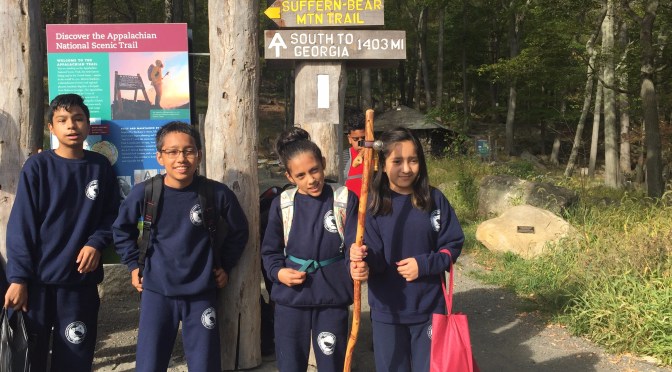
Since the fall of 2016, approximately 300 seventh graders from the P.S./I.S. 218 Rafael Hernandez Dual Language Magnet School in the Bronx have enjoyed an annual field trip to Bear Mountain State Park, thanks to the Connect Kids Field Trip Grant program run by  State Parks.  The hour-long journey from the school affords views of spectacular autumnal foliage and the Hudson River Valley to our urban students.

IMG_5575
Students pause at the top of Bear Mountain, enjoying the views of the Hudson River

Arriving at the site the students divide into two groups: one group hikes a portion of the Appalachian Trail, while the other visits the animal exhibitions at the Trailside Museum and engages in organized outdoor play outside the Bear Mountain Inn.  (Some of our students suffer from asthma and don’t choose the mountain hike.) They return to school thoroughly exercised, full of excitement from their experiences hiking or observing firsthand the animals at the Zoo. The trip coincides with an English Language Arts unit of study focused on memoir, or personal narrative. For many, the hike up the mountain has afforded the first opportunity to hike a woodland trail that our students have ever experienced, and they write about their experience and recall it throughout the year proudly.

Quote

Because we teachers applied late in the fall, we traveled to Bear Mountain in early December of 2016.  The smell of the pines was intoxicating, but a light snow had just fallen, making the trail slippery and a bit treacherous on the way up. We conceded that the mountain top was beyond our reach that day, and did our best to lead the students back down the trail as carefully as we could. We wished we had foreseen the footwear that the students needed to better negotiate the trail under slippery conditions – some were wearing sneakers with little tread.

IMG_3551
PS 218 students on the trail in early December

In our second year, we scheduled our trip in early October, and our mountain hikers encountered a blazing hot Indian summer day.  Though we reached the top of Bear Mountain, a few children had inexplicably brought loaded backpacks, which created all kinds of challenges for our teacher crew. Yellow jackets were abundant near the picnic areas below; one student was stung!  We realized later how much we needed to bring an abundant supply of water for the return trip home on the buses. Vomiting incidents drove home that there were risks related to the heat, but junk food and dehydration played a part as well.

This year, the buses were very late departing the school, which cut short our time and made it impossible to reach the top of the mountain.  NYC morning rush hour traffic can be unpredictable; next year we will be sure to request our buses earlier.  At the end of the day, a shortcut on a loosely pebbled trail led to multiple scraped knees.

Each year, we realize how we can plan better for the next!  So, for your Kids Connect Trip, be sure you …

  • Require comfortable and appropriate footwear, depending on time of year; jackets if appropriate
  • Limit backpack weights. Test as kids leave bus (allow only lunches and a drink)
  • Outlaw sweet drinks, and chips or sweets for the ride! Students should eat a good breakfast!
  • Bring first aid kits for bee stings, cuts, bug bites
  • Stock an abundant supply of water on your buses
  • Secure contacts of individual bus driver
  • Remember your bus permit and paperwork to verify your site visit with a signature from Parks administrative staff

Post and photos by Heather Baker Sullivan, PS 218 Rafael Hernandez Dual Language Magnet School teacher

Green Lakes State Park – Home to a National Natural Landmark and More!

New York’s State Parks are home to many unique natural features. Green Lakes State Park, near Syracuse, is the home of a National Natural Landmark. The Landmark found here is Round Lake, which is one of 28 such sites found in the state. A National Natural Landmark (NNL) is a natural area that has been designated by the Secretary of the Interior in recognition that the site contains significant examples of the nation’s biological and/or geological features. Round Lake is a rare meromictic lake surrounded by a forest that includes about 20 acres of diverse, old-growth forest. These two components led to Round Lake’s designation as a National Natural Landmark in 1973. The maple-basswood rich mesic forest and the meromictic lakes at Green Lakes State Park have also been recognized as being of statewide significance by the NY Natural Heritage Program (2018) in addition to Round Lake’s designation as a NNL.

NNLPlaqueWQ
The plaque at Round Lake dedicating it as a National Natural Landmark.

You may be asking yourself, what is a meromictic lake? A meromictic lake is a lake that does not have complete mixing of the surface and bottom waters. This is due to the lake being very deep without a large surface area: Round Lake is over 163 feet deep with a diameter of about 700 feet or 36 acres (see below).  The most common type of lake mixing is a dimictic lake which mixes twice a year, once in the summer and once in the fall. To learn more about lakes and their seasons (they have them too!), please see this blog.

MapDEC
This contour map was obtained by NYS DEC

Meromictic lakes remain chemically stratified throughout the year which makes it very hard for organisms to live there especially in the deepest layers of the lake. Chemical stratification refers to the layering of the water within the lake based on chemicals such as dissolved salts and oxygen. Because of this, there is no oxygen and there tends to be lots of dissolved salts in the lower layers as the salts increase the density, or weight, of the water which makes it sink to the bottom of the lake. These conditions make species diversity in a meromictic lake very low. The few fish that occur here are confined to live in the epilimnion, the top layer of water, because that is where there is enough oxygen for them. Snails, zooplankton and phytoplankton (microscopic aquatic critters and plants) are the more abundant species in these lakes.

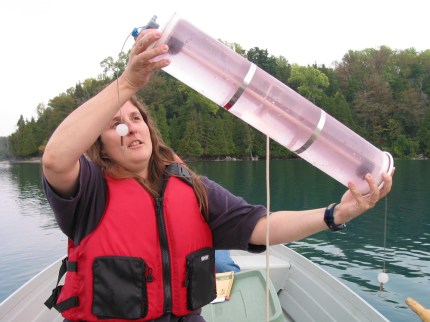
One exception to the lack of life in the depths of a meromictic lake is the presence of several interesting types of bacteria, for example those in the other lake on the park’s property, Green Lake. Green Lake has a characteristic purple sulfur bacterium that resides in the deep waters. If you pull a water sample from that layer of water, the sample that comes up is this purple-pink color and it smells like rotten eggs. This color and smell comes from the purple sulfur bacteria that resides in the water, which has been studied by many researchers such as those at SUNY College of Environmental Science and Forestry (see picture below). Although Green Lake is also a meromictic lake, it is not included in the Natural Landmark due to the higher use and less natural surroundings than Round Lake.

Sampling_KimSchulzESF
A water sample showing the purple sulfur bacteria at Green Lake. Photo by Kim Schulz, a professor at SUNY-ESF.

The other major component that makes Round Lake a National Natural Landmark is the old-growth forest that surrounds the lake. The Landmark is described as containing 20 acres of “virgin mesophytic forest”. The term “virgin forest” typically describes sites that have never been cut, which is not quite the case here, but the site is exceptional in having minimal cutting over the past few centuries and now supports trees that range from 100 to nearly 400 years old. Mesophytic is an ecological term that describes the vegetation characteristic of rich, moist, well-drained soils. NY Natural Heritage Program describes this forest as a maple-basswood rich mesic forest (2014) and maps roughly 130 acres in the park as old-growth forest – a good place to see some very old trees! There are some particularly old (and very tall) specimens of tuliptrees, bitternut hickory, sugar maple, hemlock and basswood within the Tuliptree Cathedral southwest of Round Lake. The largest tree measured there was 147 ft in 2011, one of the many tuliptrees to be found in this forest.

TuliptreeCathedral_DianeWheelock
Above is a picture of the Tuliptree Cathedral renamed as such following extensive surveys of the old-growth forests in 2001-2002. Photo by Diane Wheelock.

NY State Parks contain many more exceptional sites to see beyond Round Lake! To learn more about other National Natural Landmarks located within State Parks, please see these blogs on the Ellenville Fault Ice Caves and the Iona Marsh.

Post by April Brun, State Parks

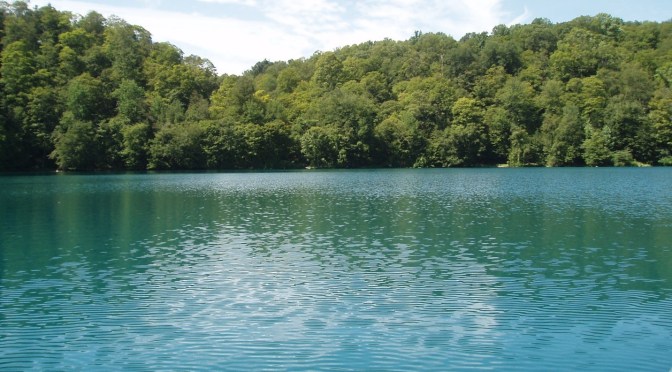
Featured Photo taken by Parks Water Quality Unit looking at the western shoreline of the lake.

Resources:

New York Natural Heritage Program. March 2014. Ecological Communities of New York State.

New York Natural Heritage Program. 2018. Significant Natural Community Occurrences. Biotics database. NY Natural Heritage Program Albany NY.

National Park Service. n.d. Round Lake National Natural Landmark.

I’d Like to Spy the World a Cloak

This spring, as you spend time hiking or recreating in one of your favorite state parks, keep an eye out for an insect with a name almost as evocative as its striking appearance – the mourning cloak!

Nymphalis antiopa, also known as the Camberwell beauty in Great Britain, is easily recognizable due to its wings, which feature an irregularly-shaped bright yellow border with a row of iridescent blue spots on the inner edge. Some other historical names for the species also reflect its appearance, including “grand surprise” and “white petticoat.”

The mourning cloak is unusual in that it overwinters as an adult, hiding in tree cavities and under loose bark. It starts flying again as soon as the days warm up, even where there’s still snow on the ground.

Not just native to the northeast, the mourning cloak is broadly distributed around the hemisphere – in fact, it’s the state insect of Montana! Their wingspan ranges from 2 ¼ to 4 inches and they have one of the longest lifespans for any butterfly at 10 to 12 months. Their favorite snacks include rotting fruit or tree sap, and they can often be found gathering on oak trees.

Hectonichus
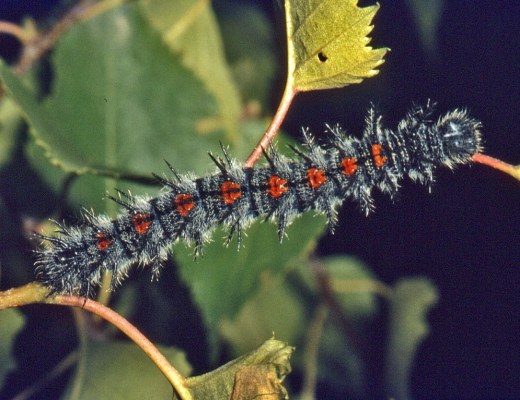
Nymphalis antiopa (mourning cloak) caterpillar, photo by Hectonichus, accessed from Wikimedia Commons

They’re also highly distinguishable in their immature form as the spiny elm caterpillars, with black spiny bodies run through with a streak of reddish to orange colored dots. After feeding on young leaves, the caterpillars will pupate and emerge in their adult form mid-summer. Some adults migrate in the fall, and have been spotted as far south as Guatemala.

Post by Ben Mattison , State Parks

Butterflies and Moths, mourning cloak

University of Florida,  Featured Creatures mourning cloak

Wikipedia, Nymphalis antiopa

Nest Hunt

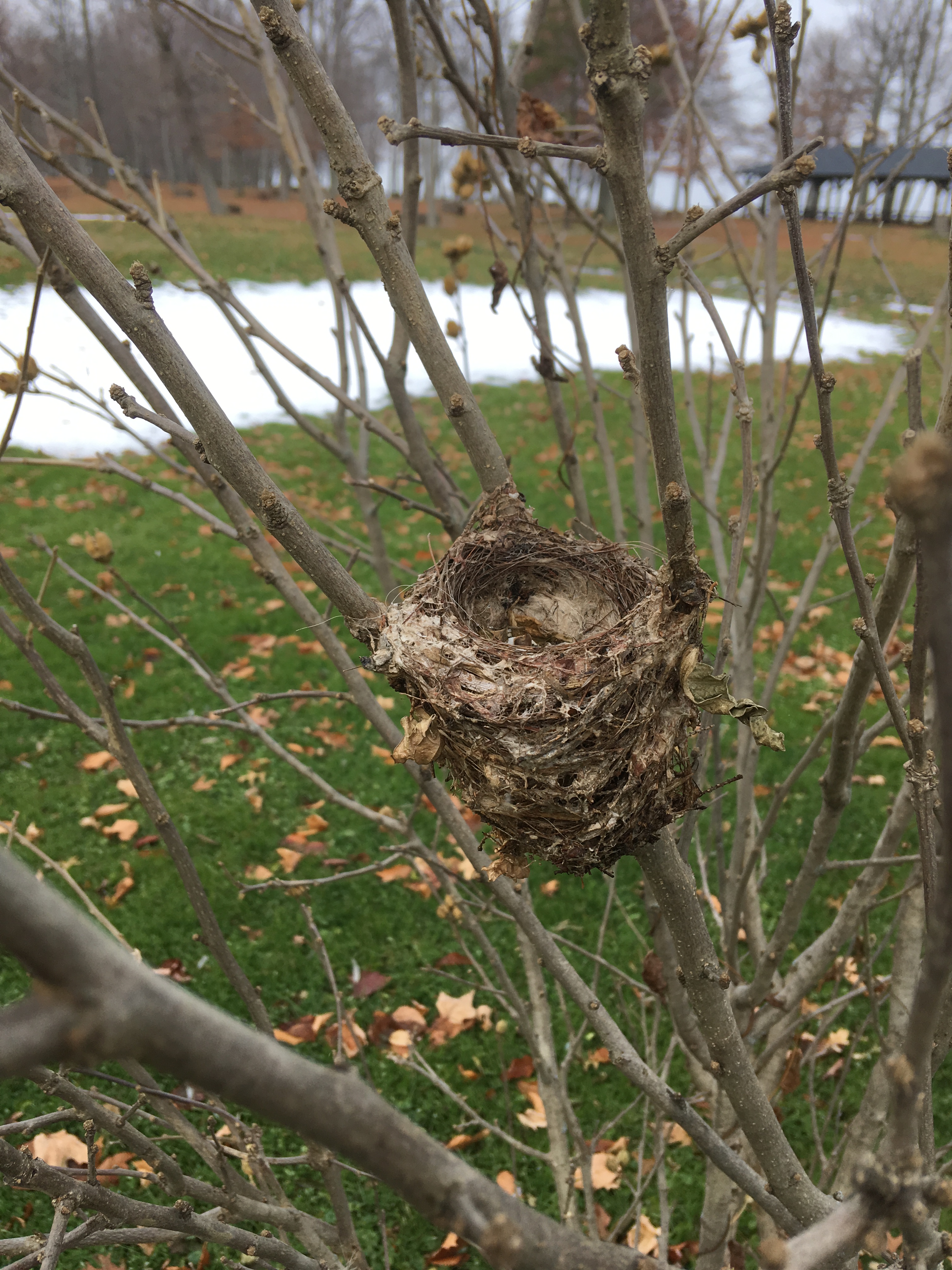
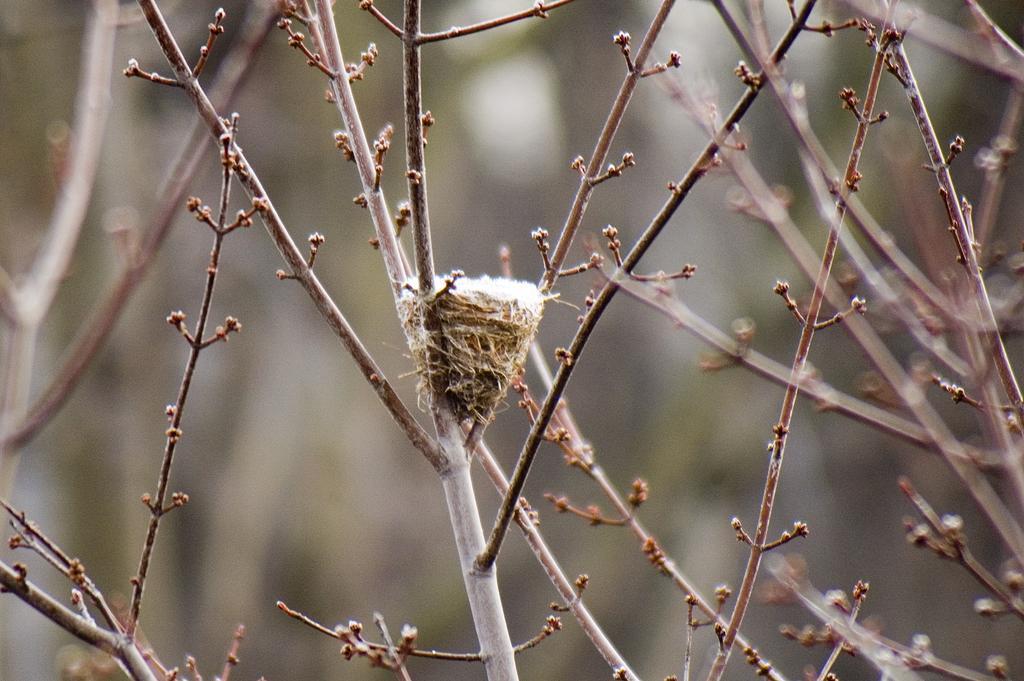
Late fall through early spring is a great time to look for abandoned bird nests in our parks.  These nests provided homes for young birds last year and are so well built that they have lasted through the harshest of winter weather

When you come upon a nest during your hike, there are a few things to consider when trying to identify which bird species built the nest.

Habitat

Different bird species live and nest in different habitats or places. Some birds nest along river banks, while others nest on the ground, on a cliff, in a shrub or dead tree, in a tangle of vines, in trees, or even floating on water.  In winter, the easiest nests to find are the ones in trees, shrubs, and vines.

Height

How far off the ground is the nest?  Birds such as robins will nest 10 -20 feet off the ground, while a cardinal will build a nest 1 -10 feet off the ground. As with habitat, nest height can help with nest identification.

Shape

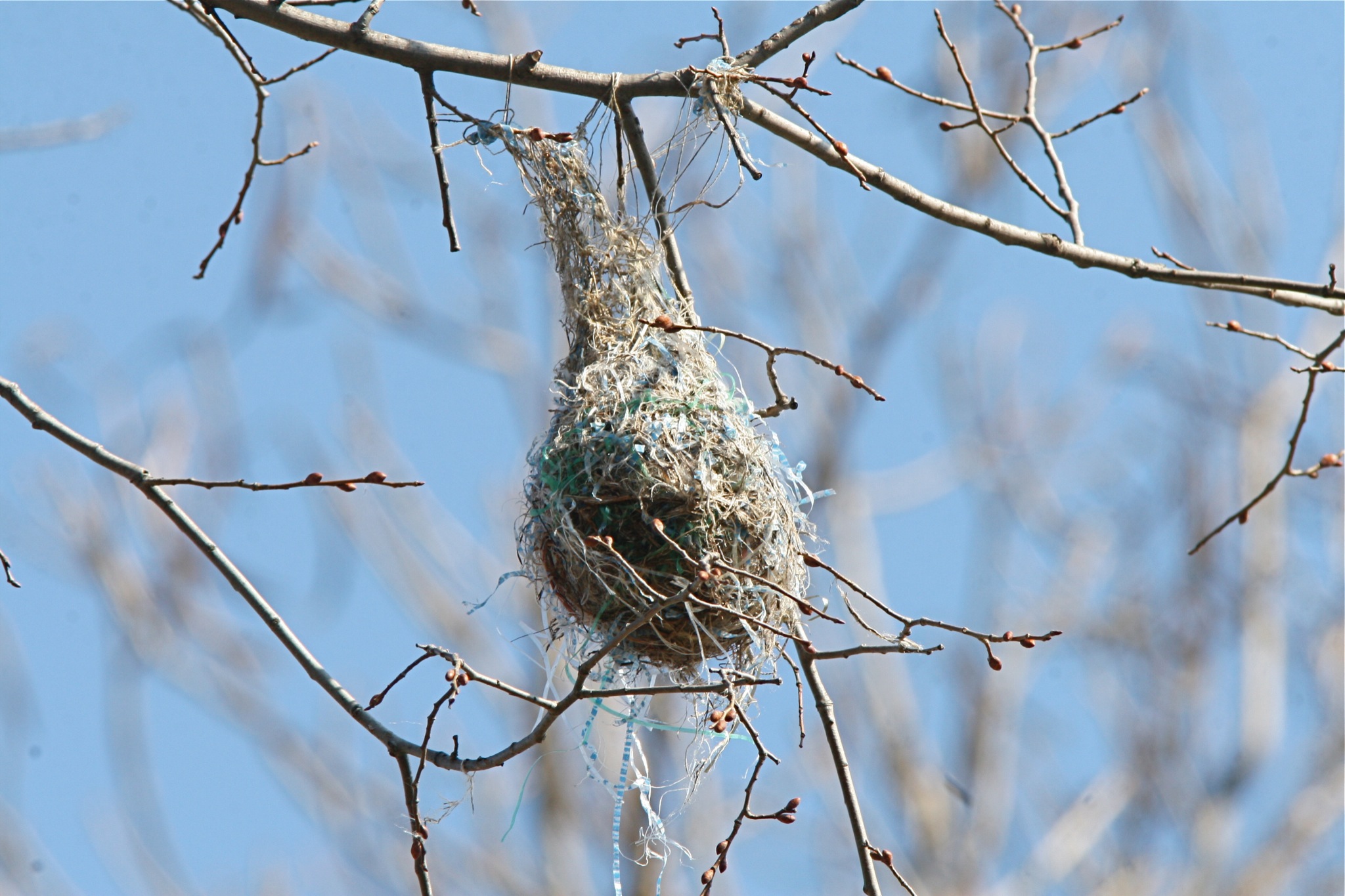
The overall shape of the nest is also a clue as to which species built the nest.  Goldfinches, like many bird species, build cup-shaped nests.  Mourning doves build saucer-like nests.  Marsh wrens build a ball-shaped nests and orioles build a pendant-shaped nest.

This slideshow requires JavaScript.

Nest Materials

The nests that we see in winter are made from sturdy materials such as plant matter (grass, bark, twigs, small roots, and tree branches), which may be held together by dried mud or spider webs.

Some common nests you may see on your walk:

dscn0333.jpg

One of the most common nests that you can see is an American robin nest. Robins usually build their nests in coniferous trees, like pine trees, that have a couple of horizontal branches near each other.  They will also build their nests in the eaves of buildings and gutters.  Robins use twigs and dead grass to build a cup-shaped platform nest.  Once the nest is formed, the inside of the nest is reinforced with soft mud then the inside of the nest is lined with dry fine grass.  These nests are between 10 and 20 feet off the ground and are quite durable thanks to the mud lining.

Bird_nest_JLundgren3
photo by Julie Lundgren

Blue jays build their cup-shaped nests on horizontal branches or forks in tree branches. They build their nests in conifer or deciduous trees like maple and oak trees 5 to 20 feet off the ground.  The nest is built from twigs, strips of bark, lichen, moss, and grass. Sometimes the blue jay nest builder will use mud to hold the nest together like a robin. The nest is lined with small roots.

ChippingSparrowHamlin

This chipping sparrow nest from Hamlin Beach State Park shows the cup-shaped nest made from dry grass and small roots.  Look for these nests in deciduous trees between 1 and 10 feet off the ground.

GoldfinchMaybe

An American goldfinch nest sits in a sapling along the edge of a field in Allegany State Park.  This cup shaped nest is made of tiny roots and plant fibers which are held together by spider webs.  Look for these nests between 1 and 30 feet off the ground.

Osprey _WellesleyIsland

Ospreys are commonly seen nesting on the light poles at Wellesley Island State Park. They use sticks to build their saucer-shaped nest which they line with grass, sod, bark, or other material. Each year they add more sticks to the nest; with nests growing to over 12 feet deep and 6 feet across as generations of osprey use the same nest.

Yellow Warbler EvangolaSP (MN)

Yellow warbler nests, like this nest from Evangola State Park, are found in small trees and bushes in woodlands near water. Their cup-shaped nests are usually about 10 feet off the ground, but can be as high as 60 feet. The nest is made from grass, nettles, and thin bark strips, which is surrounded by spider webs and plant fibers. If you can look in the nest, you may see the remains of the nest lining of cattail, cottonwood, and cattail seeds and deer hair.

BOriole_Henry T. McLin
photo by Henry T. McLin

Spotting one of these Baltimore oriole nests can be a treat. Baltimore orioles build their pendant-shaped nest in American elm, maple and basswood trees between 15 and 30 feet off the ground. The nest is made from fine plant fibers such as grass, strips of grapevine bark and as you can see here blue man-made fibers. Baltimore orioles tangle and knot the fibers together to form the nest.  The nest is built in three phases, the flexible outer portion is completed first, followed by springy fibers on the inside of the bowl. The springy fibers help the nest to maintain the pendant-shape. Finally, the inside of the nest is lined with downy fibers like dandelions.

Drey

One of the most common nests that you may see are not bird nests but squirrel nests. These leaf nests, or dreys, are made from twigs that are woven together into a ball shape in a tree crotch with an entry on the side of the nest..  They are lined with damp leaves and moss. Dreys have a variety of functions from being a winter retreat from winter’s cold to spring and summer homes for young squirrels.

MiceUsingNestbox

Mice are unexpected nest box visitors.  If you open up a nest box during your hike, you might encounter mice, like these deer mice, who use the nest box as a warm place to hide during winter’s cold days.

Make your next hike a nest hunt hike!  If you do find a nest, tag us on Instagram, #nystateparks.

Learn more about New York’s winter bird nests:

Boring, Mel. Birds, Nests, and Eggs, Milwaukee, Wis.: Gareth Stevens, 1998.

Cornell Lab of Ornithology, All About Birds

Dugmore, A. Radclyffe.; Bird homes. The nests, eggs and breeding habits of the land birds breeding in the eastern United States; with hints on the rearing and photographing of young birds, New York, Doubleday, Page & Co., 1902, c1900.

Harrison, Hal H. A Field Guide to Bird Nests in the United States East of the Mississippi River, Boston, Houghton Mifflin; Expanded, Subsequent edition, 1998.

Heinrich, Bernd, Which Bird Made That Nest? Northland Woods, 2009.

Massachusetts Audubon Society, Nests in Winter.

West Virginia Wildlife Magazine, What’s That Clump of Leaves?

Felines in the Northeast

BobcatTerry Spivey, USDA Forest Service, Bugwood.org
Image 1, Bobcat, Terry Spivey, USDA Forest Service, Bugwood.org

Many animals live in the Northeast, including wild felines like bobcats (Lynx rufus) (Image 1). Once heavily hunted for their prized and beautiful fur coats, the remarkable American bobcat (Lynx rufus) population has recently rebounded in the Northeast. This remarkable feline resides in young forest and shrub communities along wetlands and along the shrubby areas next to agricultural fields. Recently, bobcats have expanded their home range to mature forest communities of oak-beech-hemlock. In doing this transition to new habitats, the bobcat added young deer, squirrels, and chipmunks to their diet of beaver, muskrats, rabbits, and rodents but also young deer, squirrels, and chipmunks.  Like all felines, these hunters will be found “hiding” among shrubs, tree branches, on ledges, or even laying down as flat as possible on the ground. Their fur pattern and coloration, like all cats, acts like camouflage and helps the bobcats hide in the surrounding environment while stalking prey or taking a nap.

Identification

Several wild feline species, including bobcats, either make their home or once made their home in New York. The Canada lynx (Lynx canadensis) (Image 2, left) have made a presence and have been observed hunting or hiding among the far northern forests of New York. Eastern mountain lion or cougar (Image 2, right) have been absent from much of their eastern range, including New York State for nearly two hundred years. In the western states Mountain Lions have a secure presence while in the Everglades and Big Cypress Swamp of Florida their presence is much smaller.

Characteristics 

All cats have a distinct look – predatorial eyes located in front of their heads with upright ears. Like our domestic cats, New York felines have tails, some are just shorter than others.  Bobcats have either short stubs on their behinds or shortened tails. The bobcat also has a white behind that traces up to the underside of the tail and has a darkened tip.

The lynx always has a short, stubbed tail and a distinct black cap on the entire tail tip.

Ear tufts are present on both lynx and bobcat. Tufts of the bobcat are shorter than a lynx, or they may not be present at all. Lynx, on the other hand, will always have the distinct black tufts on top of the ears. Bobcats tend to have some black-brown-grey pattern or variation in colors compared to the more streamlined tannish-grey color and white chest of the lynx. Lynx also are notably wearing Elizabethan bowtie-like ruffs with black tips, which are lacking in the other two cats. Coloration of the hock, or the portion of the hind leg below what we commonly associate as the joint, are different in bobcats and lynx. Bobcats have black, dark brown, or dark grey. The hock of a lynx is not a dark color but rather an extended, continued coloration of their body. Lynx also have white on the insides of their legs.

Cats walk with an athletic stride and cautiously stalk their prey while hiding from plain sight.

TrackGuide_CatskillMountaineer
Image 4, Image above compares mountain lion, lynx, and bobcat pawprints. image courtesy of Catskill Mountaineer

Pawprints

If you were to place your hand on paint and press on a surface, a hand print would form showing your fingertips and palm. Just like our hand prints, all feline paw prints would also show their tips and a palm as shown in Image 4. The size and height of our fingers differ and so do the paw tips of cats (Image 4). In cat paw prints, we find four paw tips at different heights above the “M” shaped palm print. Cat lead finger is similar to our middle finger print, which would be at the highest height of the paw. The pinky would be the smallest print and at the lowest height, as would our pinkies. We would see the last other two cat paw tips varying in height and size as we would find the ring finger and the pointer finger vary our finger prints. Also, distinct with cats is the formation of a circle around the tips and palm that results from the fur on the paws. This shape is very distinct with the lynx as shown in Image 5 as a print inside this circle.

LynxTrack_JLS Photography
Image 5, Image above taken by JLS Photography – Alaska showing the distinct circular fur outline around the lynx’s pawprint.

Generally, the bobcat pawprints are round and roughly a couple inches in the size. Lynx’s pawprints are twice this size. Lynx have a smaller diameter in their tip and “M” shaped palm prints and have greater spacing between the positioning of their tips and their palm. The reason for the smaller diameter and greater spacing between the tips and palm is due to the denser fur on the paws. The mountain lion has the largest pawprint, totaling 3 inches in diameter or larger. If you happen to see the felines in motion, note the paws of the lynx as being large, plush slippers in comparison to the bobcat.

MaleCatScent_PicturesOfCats.org
Image 6

Territory Marking

Felines will mark their territory through scents. Just like our domestic feline friends, bobcats, lynx, and mountain lions will rub their faces, scratch their paws, and even spray to mark their territory. Glands that produce a scent are found on the face, between the toes of the paws, and by the tail (Image 6). On the head, they are found at the base of the ears (pinna glands), on the eyebrows (temporal glands), on the cheeks (cheek glands), at the base of the whiskers (perioral glands), and at the base of the chin (submand ibular).

Scent marking is why the wild felines in the forest and your domestic cat rub their face all over trees, rocks, and other objects. Scratching vertically on trees, or furniture, and kicking their hind legs are common ways cats mark their scent on objects through the interdigital glands between their toes. Also, notably rubbing their bum on objects leaves scents from their anal glands (Image 7). Hair can also be left on trees, stumps, rocks, and other objects as the feline rubs. Looking for their presence through hair on objects, scratch marks on trees, or two strips of unearthed vegetation leading to a pile of material (Image 7 & 8). You can also sniff for a musky urine smell on the undersides of decaying or falling trees, limbs, branches, or ledges.

Finding evidence or seeing one of New York’s native cats can be quite a treat.  If you do see a native cat, let us know!

References and learn more:

Morse, Sue, Bobcats (October 4, 2018)

NYS Dept. of Conservation Bobcat

NYS Dept. of Conservation  Canada Lynx

NYS Dept. of Conservation Eastern Cougar

US Fish and Wildlife Service, Canada Lynx

Post by Irene Holak, State Parks

The official blog for the New York State Office of Parks, Recreation & Historic Preservation