February vacation is a great time to get out and explore our state parks. Many parks are offering free programming to keep you and your family occupied this February break. Here is a sampler of just some of the many programs State Parks is offering this year. Our programs include active outdoor fun, wildlife ID, and parties!
Got a hankering to try ice fishing? Then head out to Glimmerglass State Park in central NY on February 21, Moreau Lake State Park, north of Saratoga Springs, on February 22, or John Boyd Thacher State Park, Thompson Lake just west of Albany, on February 24 for a free fishing clinic led by Department of Environmental Conservation staff. All the fishing gear will be provided during these workshops. Remember that proper clothing is critical for safe ice fishing outings. Dress warmly, paying extra attention to your head, feet and hands – dressing in layers is essential.
A success catch at Glimmerglass State Park, photos by State Parks
Setting the ‘tip-up’ line at Glimmerglass State Park, photo by State Parks.
Perhaps you are hoping to get to know our natives. Many parks are offering wildlife and plant identification walks, ranging from seal walks at Jones Beach State Park on Long Island to an owl prowl at Max V. Shaul State Park in the northern Catskills, as well as a winter tree identification workshop at Knox Farm State Park in western New York.
Geese gingerly step on frozen freshwater pond at Caumsett state Park.
You may be able to see harbor seals resting at low tide during a seal walk, photo by Maritime Aquarium of Norwalk.
If you are looking for a little adventure, check out the snowshoeing and cross-country skiing trails at Parks across the state or join in on a guided hike. The Lake Erie ice volcanos are particularly exciting, and you can visit them at Evangola State Park in western New York.
Snowshoe lesson, photo by State Parks.
Posing inside an ice volcano at Evangola State Park, photo by State Parks.
Many state parks across the state will be offering programs for preschoolers during February vacation.
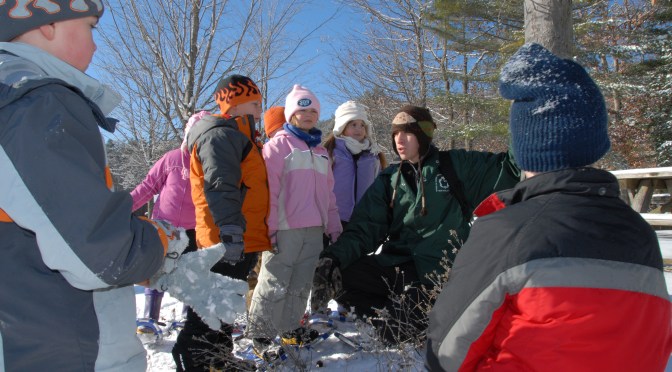
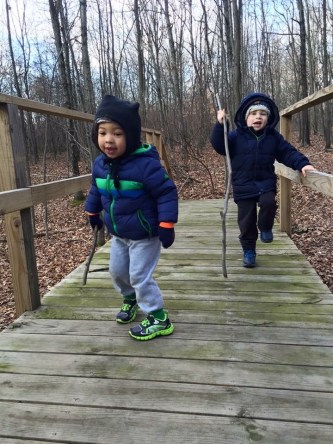
February is a great time to get the young explorers outdoors, photo by State Parks.
Maple sugaring starts in February! Clay Pit Ponds State Park Preserve on Staten Island Caumsett State Historic Park Preserve on Long Island, and Letchworth State Park south of Rochester will have maple programs this week. Visitors can learn how to identify and tap maple trees, and the sugaring process.
As the 2018 Winter Olympics kick off in PyeongChang, South Korea, figure skating, speed skating and hockey will be among the marquee events. Generations of young skaters will be inspired by the aerial feats, athletic prowess and teamwork showcased on the ice, while dreaming of standing on the medal podium proudly representing their country.
For amateur and recreational skaters who want to enjoy some quality ice time with family and friends a little closer to home, select New York State Parks offer a variety of locations and experiences throughout the winter months, including rinks and many frozen ponds. From Riverbank’s roof-top skyline in Manhattan to the oval at historic Bear Mountain to the quiet beauty among the pines in Saratoga, these scenic settings are the perfect backdrop to embrace the weather in the northeast and stay active in the outdoors.
Whether your specialty is a triple lutz, or you skew closer to a full-time klutz (or somewhere in between), ice skating is a fun way to exercise for people of all ages. The New England Baptist Hospital and M. Kathryn Steiner, M.D., the physician for the Skating Academy of Boston, recently noted the many fitness benefits of skating including strength, flexibility and balance.
For ice enthusiasts who prefer a net and some action, pond hockey is more popular than ever before. Both Chenango Valley and Saratoga Spa State Parks host annual multi-day tournaments that draw visitors from across the U.S. These, together with parks such as Schodack Island, Grafton Lake, and Glimmerglass, hold winter festivals and regular programs throughout January and February with some offering instruction to help grow new legions of skaters.
Along with inspiration for general winter recreation, the State Parks’ website (parks.ny.gov) offers a full list of State Parks with ice skating. Many sites offer skate rentals, lessons, special events, warming huts and refreshments. Call ahead for conditions and hours, and be sure to carve out some ice time for yourself this season!
It is without question that Niagara Falls State Park is one of the most beautiful places our state and country has to offer, drawing an average of nine million tourists every year. People come from all over the world to experience the power and wonder that is Niagara Falls. Designated as a national historic site and the nation’s very first state park, it comes as no surprise the amount of attention it receives.
However, something most people miss out on is the endless beauty of Niagara Falls in the winter. Watching the cascading water crash through the pure white snow and ice creates a unique and memorable experience only attainable during the winter. Visiting the Falls in the wintertime offers tourists stunning views and the beauty of freezing mist covering the landscape.
Overlooking the frozen Cave of the Winds Staircase, photo by Nicole Czarnecki.
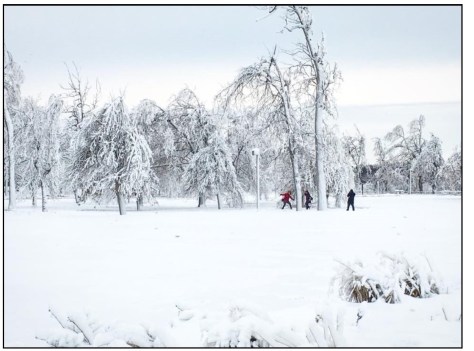
Impromptu snowball fight, photo by Nicole Czarnecki.Frozen tree just before the Falls, photo by Nicole Czarnecki.
The newly constructed Cave of the Winds pre-show attraction is now open year-round and offers audiences interactive and virtual exhibits as well as an escape from the chilly temperatures.
Although the Park has received some attention recently pertaining to the beautiful winter wonderland, some articles have mentioned the falls being “iced over” or “freezing over”. It is important to note that the only documented incident of the Falls being frozen completely came in March of 1848 when the Buffalo ExpressNewspaper stated the cause to be ice damming at the mouth of Lake Erie. The installation of an ice boom at the mouth of the Niagara River has made the likelihood of this event recurring very low if not impossible. Even during the infamous Polar Vortex of 2014 the Falls continued to flow.
Light show in January 2014 during the Polar Vortex, photo from Wikimedia Commons.
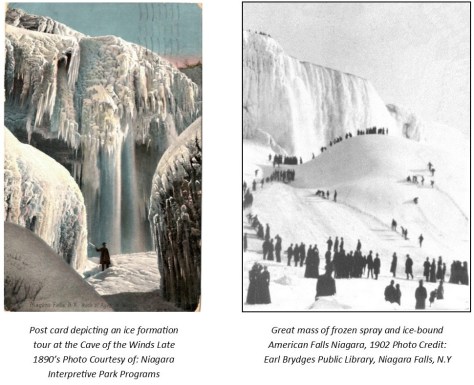
This does not mean that it has not come very close to freezing since then. During the early 1900’s tourists would often walk out onto “ice bridges” forming across the top of the Falls. This activity proved to be very dangerous and was forbidden after February 1914.
People standing on ice above the Falls 1909, photo from Niagara Falls Pubic Library.
All photos provided by State Parks Naturalist Nicole Czarnecki were taken during the Winter Wonder Photography hike. Look for other events at Niagara Falls and surrounding parks this winter on their Facebook page.
President Franklin Delano Roosevelt signing the New Deal legislation, photo from Wikipedia
When Franklin Delano Roosevelt (FDR) became president in 1933, the entire nation was in a state of turmoil never seen before or since. It was the height of the Great Depression: unemployment was at 25%, croplands were failing, and millions of families were going hungry. As governor of New York State, FDR had implemented the Temporary Emergency Relief Administration which put thousands of young men to work reforesting one million acres. Within his first one hundred days of his presidency FDR enacted the Civilian Conservation Corps, a national work program which gave men ages 17 to 28 unskilled labor jobs in infrastructure. The young men were paid $30 a month, $25 of which had to go home to their families. By the end of the program nine years later, over three million men from all fifty states had made significant improvements to the nation’s road system, planted three billion trees, and built thousands of facilities in state parks. The CCC had a major impact on New York’s state parks, with many of the structures remaining today.
The oldest surviving cabin built by the CCC at Fair Haven Beach State Park (and placard).
The CCC was active at Fair Haven Beach State Park from 1934 to 1942. The young men employed by the Corps built roads, cabins, service buildings, and created barriers against waterfront erosion from Lake Ontario. Park manager Jerry Egenhofer says: “The establishment of the CCC – with their readiness to lend assistance with personnel, built in financial aid, and their readily accessible materials – aided greatly in expediting and promoting the park’s development and growth.”
This slideshow requires JavaScript.
CCC activities at Green Lakes State Park.
A CCC company of Spanish-American War veterans built cabins, service buildings, roads, trails, the boathouse, the golf course, and the golf clubhouse at Green Lakes State Park. The men transferred tons of sand from Oneida Lake to create the beach in the park.
Civilian Conservation Corps members constructing the Lower Falls foot bridge in Letchworth State Park in 1935, with the current bridge shown in the inset picture.
Allegany State Park can also thank the CCC for many elements of the current park, including bridges, roads, camp sites, trails, and the ski area. The CCC also worked on wildlife conservation projects, including reforestation and stream bank retention.
At Bear Mountain State Park, both the Perkins Memorial Drive and Perkins Memorial Tower – named after the first president of the Palisades Interstate Park Commission – were built by the CCC between 1932 and 1934. On a clear day, four states and the Manhattan skyline can be seen from the summit.
Eleanor Roosevelt is introduced at a Camp TERA meeting, 1933, image from Wikipedia
Bear Mountain State Park also housed Camp TERA (Temporary Emergency Relief Assistance), the first of several camps for women established by then-First Lady Eleanor Roosevelt, nicknamed She-She-She camps. Jobless, single women under 40 from the New York City area spent the summer months in the woods learning new skills and recovering from health problems brought on my acute poverty and lack of food.
At Gilbert Lake State Park the CCC constructed cabins, trails, roads, dams, and erosion control structures between 1933 and 1941. The park is also home to the New York State Civilian Conservation Corps Museum, which displays photographs and artifacts from the days of the CCC.
New CCC recruit arrives at Newtown Battlefield
Company 1251-c (the “c” denoted a “colored” company), was assigned to the Newtown Battlefield in 1935.
Facing mounting controversy over racial integration, the CCC director Robert Fechner decided to segregate the camps in 1935. The “colored” CCC company at Newtown Battlefield hosted black educators and medical officers, and following complaints from the National Association for the Advancement of Colored People (NAACP) and other advocacy groups, the CCC appointed black officers to command the camp. The men built cabins, restrooms, ball fields, and the picnic pavilion.
A CCC worker posing at Robert H. Treman State Park, August 1935. Image from: Friends of Robert H. Treman State ParkCivilian Conservation Corps emblem, image fromhttp://whs-ushistory-1930s.wikispaces.com/CCC
The CCC contributed to many more projects at other state parks and historic sites not featured in this article. Without a doubt, the efforts of the CCC members created the foundation of New York’s incredible state park system, and their legacy deserves to be remembered and honored.
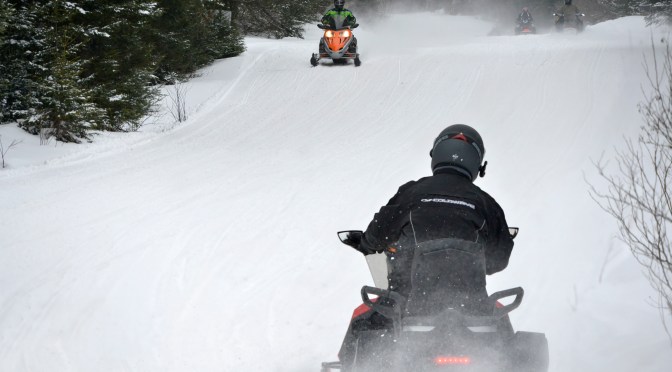
Snowmobile trails at Letchworth State Park offer more than 25 miles of trail passing through some of the most beautiful scenery in Wyoming and Livingston Counties. The corridor trail (C3) extends through most of the length of this 17-mile-long park. Entering the park in the North from the Genesee Valley Greenway, the corridor trail follows along the main park road.
Between the Perry and Castile entrances, the trail is the main park road. This stretch of the corridor gives riders spectacular views of park gorge overlooks not seen by many patrons during the winter months. On the corridor, south of the Castile entrance, riders can view the iconic Archery Field Overlook of the Genesee River Gorge. Continuing south, the corridor trail passes by the Humphrey Nature Center and Trailside Lodge where it then traverses the mature oak-hemlock forests of the park.
Riding at night requires a Genesee Region night time snowmobile riding permit. For more information regarding snowmobiling, winter accommodations, trail conditions, and permits online or call the Letchworth State Park Visitor Center at (585) 493-3600.
—
State Parks reminds all snowmobilers that their machines must be registered and insured to enjoy the trails in Letchworth State Park and the over 10,000 miles of additional trails throughout the state. The bulk of the registration fees is directed to the many volunteer-run snowmobile clubs across the state for trail development and maintenance. For information on joining a snowmobile club, visit New York State Snowmobile Association.
To help ensure a safe and enjoyable season, OPRHP offers the following tips:
– Young riders are required to attend a snowmobile safety course, but all riders can benefit from safety education. State Parks maintains a list of snowmobiling safety classes, check for course availability and age requirements.
– Use caution while traveling across frozen waterways. Check local ice conditions (ice should be at least 5” thick,) carry or wear a flotation device and self-rescue picks, limit travel at night, and “if you don’t know, don’t go.”
– Use the buddy system, leave a travel plan, and emergency contact information with someone at home.
– Wear proper clothing and remember that helmet use is required whenever operating a snowmobile. Using of a rigid chest and back protector is also recommended.
Grafton Lakes State Park is another great place to go snowmobiling. Grafton Trail Blazers will be offering free snowmobile rides during WinterFest, January 27, 2018.
Post by Bennett Campbell and Doug Kelly, State Parks









 New York State Parks and Historic Sites Blog
