Winter Greens

Winter is here! It is still a great time to get outside to enjoy nature. Here are some evergreen plants you can see in State Parks while hiking, snowshoeing or cross-country skiing this season. These plants are all native to NY state. Though popular for decorating, you should only pick them from your own lands or look for decorating greens at your local nursery or Christmas tree farm. Please don’t pick the plants in state parks or on other public lands so that others may enjoy seeing them in the wilds. A number of the plants below are designated as exploitably vulnerable (http://www.dec.ny.gov/animals/7135.html) to prevent their over harvesting.

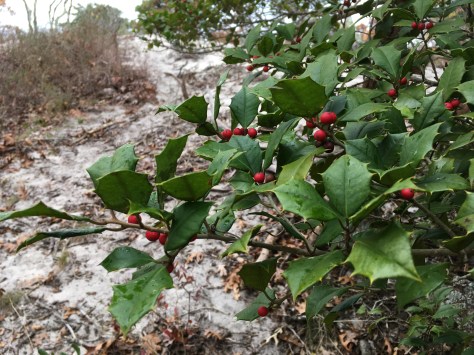
American holly (Ilex opaca) is most common in our Long Island parks and also planted in many landscapes. Its red berries provide good food for wintering birds and the sharp spines on the leaves protect the leaves from being eaten by deer or rabbits.

Ilex opaca
This photo of holly was taken in the dunes of Long Island – that is sand, not snow! Photo by J. Lundgren, NYNHP.

Several plants go by the common name of Wintergreen. This one is Gaultheria procumbens. Its thick waxy leaves stay green all winter and also contain wintergreen oil, like the smell of Canada mints or gum.

2-wintergreen-by-jubilee_fiest
Wintergreen.  Photo by Jubilee Fiest.

Clubmosses (lycopods) look like little small Christmas trees or candles on the forest floor. Some types grow along long runners that were popular for garlands. Today, this plant is on the protected list to prevent over harvesting.

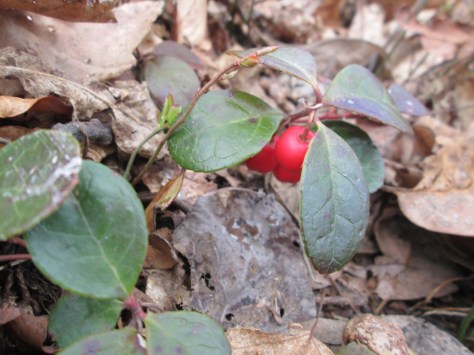
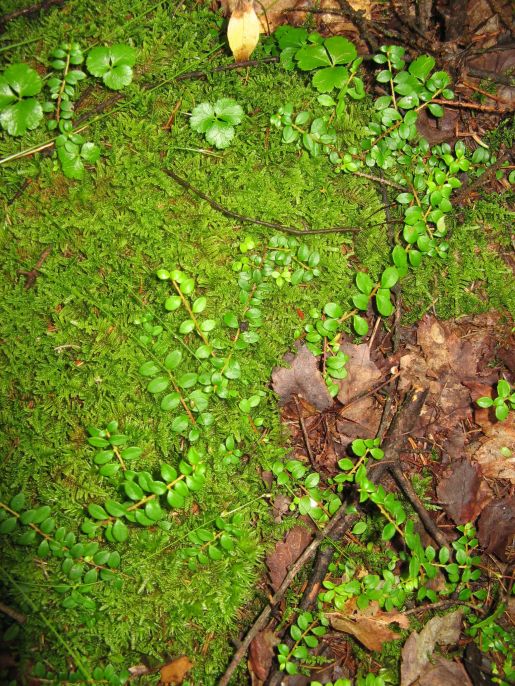
You may have read about this one in our November blog. The cranberry (Vaccinium macrocarpon) that is found in boggy places in parks. And the less common look-alike below is snowberry (Gaultheria hispidula) – oddly more closely related to the Wintergreen above than the cranberry plant. Look hard and you can see the white berry.

5-cranberry_gregedingernynhp
Cranberry. Photo by Greg Edinger, NYNHP
6-snowberry-julielundgrennynhp
Snowberry. Photo by J. Lundgren

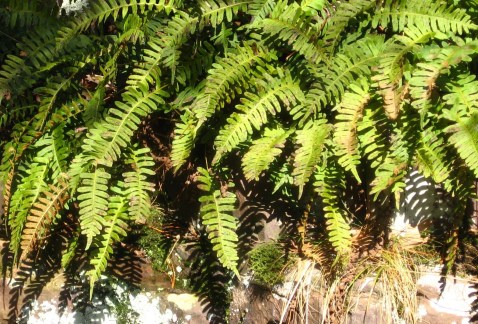
A few of our ferns are wintergreen too like the common polypody or rock-cap fern (Polypodium virginianum). As its name suggests, it grows on rocks, often in large patches.

7-polypodium-nynhp
Rock-cap fern.  Photo by NYNHP

Here one that is easy to learn – the Christmas fern (Polystichum acrostichoides). Each leaflet looks like a little boot or stocking!

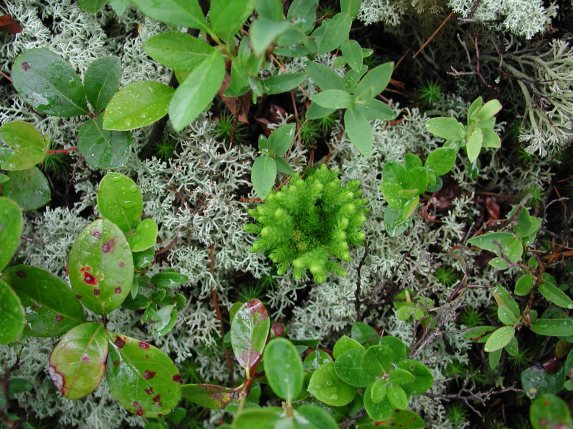
And what do Santa’s reindeer eat? Reindeer moss of course! This is actually not a moss, but a large group of gray-green lichens that are common in our forests and mountain tops and even more abundant in the tundra of Canada and northern countries where caribou and reindeer live. Shown here with wintergreen and clubmoss.

EPSON DSC picture
Reindeer moss. Photo by Steven Young, NYNYP

Do you know your evergreen trees? What has long soft needles in clusters of 5? Or sharp needles with a strong odor? Or flat needles that are soft to the touch? All of these trees provide important shelter and food for wildlife during the winter and add to the beauty of the winter landscape.

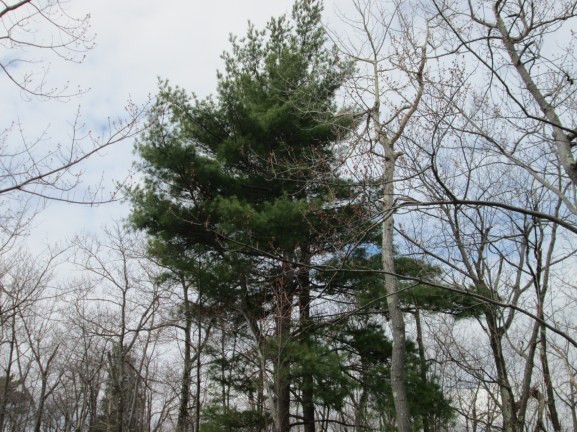
11white_pine_jubileefeist
This one is the white pine (Pinus strobus) with its long soft needles. Photo by Jubilee Feist
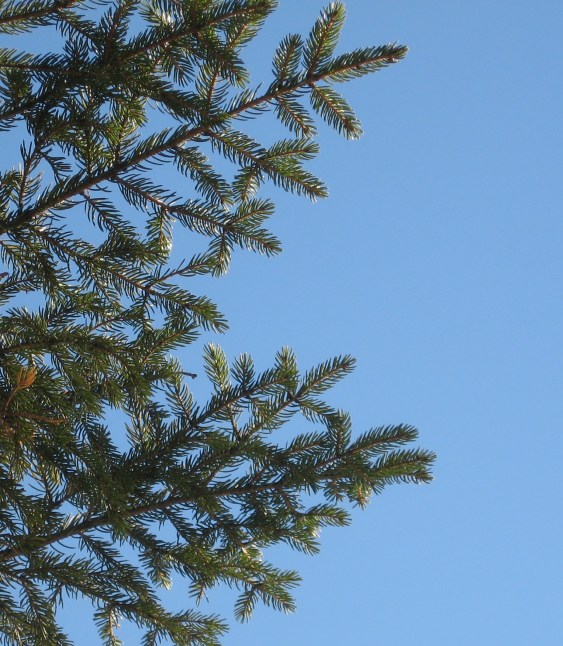
12-spruce-julielundgren-nynhp
Spruce (Picea sp.) has short, very sharp needles. Photo by J. Lundgren
13-hemlock-winter-julie-lundgrennynhp
Hemlock (Tsuga candensis) has short and soft flat needles, you can see the difference in this and the stiff spruce branches above. Balsam fir (Abies balsamea) and yew (Taxus) also have flat needles but both lack the white stripe on the underside of the hemlock leaf. Photo by J. Lundgren
14-hemlocks-in-snow-julielundgrennynhp
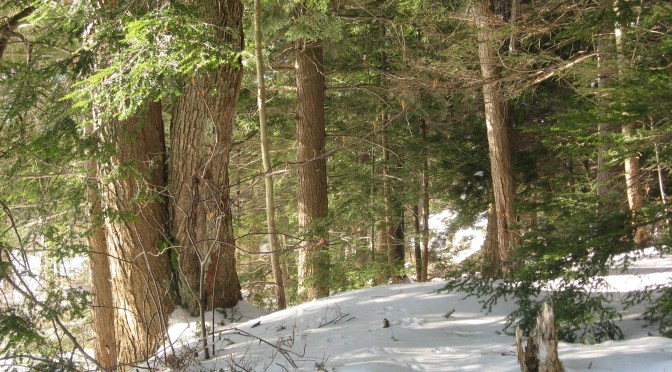
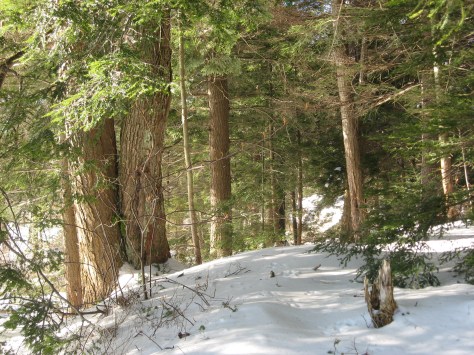
An inviting path through a grove of hemlocks. Photo by J. Lundgren

So get out and enjoy the greens of winter!

Post by Julie Lundgren, NY Natural Heritage Program

The Christmas Bird Count. And You Can Too!

In 1900, Frank Chapman, editor of Bird Lore (forerunner of Audubon magazine), whimsically urged people to go out and count birds on Christmas Day. The foray was intended as a civil alternative to the then-traditional “side hunt”, where teams vied to shoot the greatest number of furred and feathered creatures possible on Christmas Day. Anything that moved was fair game, the winning team commended in sportsmen’s magazines.

Happy holidays.

But Chapman’s folly caught on!

So here we are.

american-robin-david-johnson_must-be-credited
CBC counts in New York State often include American robins, photo by David Johnson

Driven if only by tradition, birding field parties will be scouring 1,500 National Audubon Society-sanctioned count “circles” from Canada to South America during the official 3-week Christmas Bird Count period (always 12/14 – 01/05). Participants tally the number of birds of each species they see or hear during each circle’s designated 24-hour timeframe. NY State has 69 official count circles, each managed by a “compiler” who sets the count date, musters field parties and  compiles all of the data collected by the birders in the circle.

Count circles are 15 miles in diameter, too big for a single field party to adequately census in one day, so compilers typically divide circles into smaller territories which a car-load of wide-eyed “bird dogs” can cover in a day’s time. On the appointed date, the eager field parties trudge through likely birding hot-spots within their assigned territory, often on public lands such as state parks and other conservation properties. They conduct windshield surveys en route, beginning at midnight to count owls, and ending hours later as the cold, hungry, and exhausted teams meet at a compilation pizza party.

dark_eyed-junco_davidjohnson_must-be-crediteddeju2
Sightings of Dark-eyed juncos are common during the CBC, photo by David Johnson

What do you find on a Christmas Bird Count?  In some locations, not much – like in Prudhoe Bay in 1994 only 1 species of bird, a Common Raven was spotted in the darkness of a winter’s mid-day. In contrast, 425 bird species were found in one circle in the Andes in 2007. In New York State, you can expect anywhere from 40 to 80 different species and numbering up to many thousands of birds, depending on the locale of your circle and recent weather patterns. That’s the beguiling thing about birding…you just never know.

If you are interested in joining a field party or submitting free-lance data, you can contact the nearest compiler. See if your location falls within a count circle by going to christmasbirdcount.org. Click on the “join the Christmas Bird Count” box on the right, then click the highlighted phrase “A map view of circles” on the next page.  Then type in your locale at the “find a location” box and scroll to find the nearest circle. A yellow bird icon represents the center of a count circle. Click on the icon to reveal compiler contact info.

great-blue-heron-david-johnson_must-be-credited
Great-blue herons can be seen near open water, photo by David Johnson

Openings may be scarce, as established teams tend to stick together year after year. Having the same teams patrol the same routes at pretty much the same time of day, year after year makes for reliable data. Joining a field party is very regimented field work, and, yes, it is work.

But good data like this helps us see changes in our environment and is the lifeblood of sound wildlife and natural resource management. Long-term studies like this are rare and with over 116 years of observations, CBC data has become a gold mine for professionals studying winter bird distribution and abundance and broader topics like climate change.

————-

A retired NYS DEC Environmental Educator, Craig D. Thompson has served as President of the Audubon Society of the Capital Region and Vice Chair the Audubon Council of New York State.

canada-geese-on-north-end-of-rudd-2
Canada geese at Rudd Pond, Taconic State Park, photo by State Parks


Nature Times Spotlight: Can you guess what the name of this winter guest is?

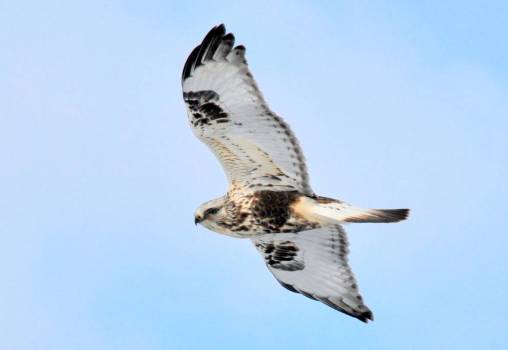
Good news, bird lovers! Not all birds are leaving New York for the winter. This beautiful bird, the Rough-legged hawk or roughy, spends its summers in the Arctic tundra, but when winter comes along he or she takes up residence in Southern Canada and the Northern United States, including New York State. So this winter you might see them circling high above or sitting at the highest point on a tree scanning an open grassy field for a bite to eat. These birds prefer to hunt on open grasslands, farmland, and large open wetlands. This type of habitat is similar to the grassy tundra of their summer homes. State Parks you may see a Rough-legged hawk are Jones Beach State Park, Golden Hill State Park, Chimney Bluffs State Park, Point au Roche State Park, and Clermont State Historic Site.  Other northern visitors that you may encounter while looking for roughys are Snow buntings and Short-eared owls – they also prefer the same type of open land to find food.

roughlegged_hawk_soaring_usfsw
Rougy in flight – notice the dark feathers in the middle of the wings and the white feathers on the chest. Photo by US Fish and Wildlife Service

Some characteristics to look for when identifying a Rough-legged hawk are the dark patches at the bend of the wing and a dark bellyband and a white bib around the throat (and no red tail like one of its cousins). There are light and dark color varieties of this species, so a bird book should always be on hand when searching for this and other bird of prey!

Roughys search for food from utility poles or while hovering over the ground.  They use their powerful eyesight to spot small mammals like mice and voles far below in grassy fields. Then they swoop down to catch the food in their talons.

Don’t be surprised if you look up and see one (or two) of these high flyers in the next few months.

tom-koerner-usfws
Rough-legged hawk in flight, photo by Tom Koerner, US Fish and Wildlife Service

Post by Greta Alvarado, State Parks

Working With Beavers to Minimize Negative Impacts

Beavers are native to New York State and play an important role in the natural landscape. They are ecosystem engineers – altering water levels by building strong dams using branches and mud; and creating wetland habitat where many plants and animals thrive. However in the wrong place, their dams can cause flooding and property damage. In 2016 a project was developed to minimize beaver impacts by building and installing Beaver Deceivers/ Flood Control Devices. Beaver deceivers stop the flooding caused by beavers, while continuing to allow beavers to live in State Park wetlands and other water bodies.

What is a beaver deceiver?

There are typically two kinds of beaver deceivers; a Trapezoidal-shaped Exclusion Fence (or Trapezoidal Fence for short) and a Pond Leveling Device. Let’s learn the purpose for each:

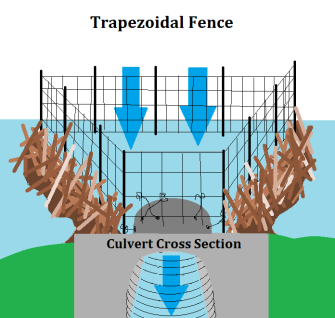
3-trapzoid-with-water_lilly-schelling
graphic by Lilly Schelling

The Trapezoidal Fence is intended for situations where the beavers’ dam is clogging a culvert and may cause damage to the culvert itself.  The fence is placed in front of the culvert, extending out at least 12 feet out from shore with a closed floor so the beaver can’t dig under it. Beavers usually then build their dams along the sides of the fence but not the back – allowing water to flow through the fence into the culvert.

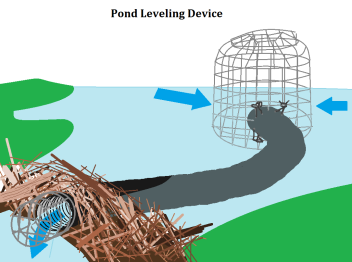
4-pipe-and-dome-with-cage_lilly-schelling
graphic by Lilly Schelling

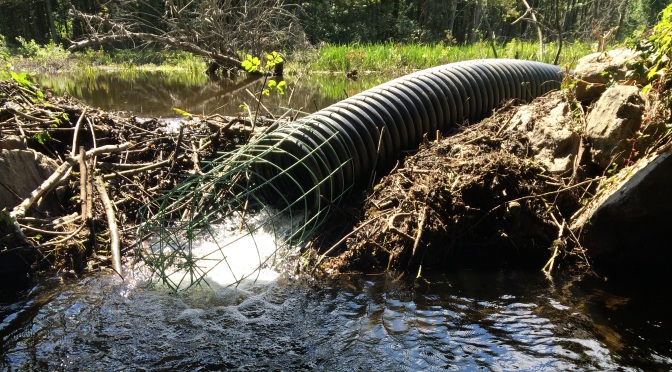
A Pond Leveling Device is made using an existing beaver dam. The dam is dug out (notched) to drop the water body to a desired water level and a corrugated pipe is placed through the dam and then covered back up with dam materials. Both ends are caged off to ensure water flow. The pond leveling device allows the beavers to continue building their dam around the pipe without raising water levels. Thus it prevents flooding of nearby roads and other use areas.

Installation

Materials for this project included 12″ corrugated pipe sections, 6 gauge epoxy coated fencing, copper hog rings to hold the fence together, and cinder blocks to sink structures and pipe.

Here’s a project where we dug out the beaver dam. It was fascinating to see how fast the water level  dropped. Beavers are extremely efficient! We also saw about 20 trout swim upstream over the dam to the beaver pond, taking advantage of the new access to the habitat. Naturally, the trout would persist below the dam until the dam fell apart after the beavers moved to a new home – which they do periodically. But in this case, we saw how our deceivers are also able to benefit other native animals.

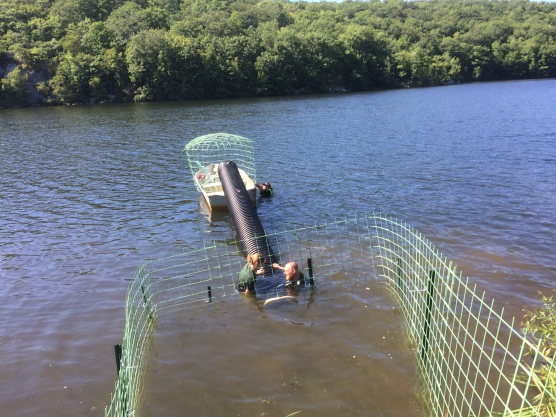
7-rr-16
Occasionally, with very persistent beavers, the two deceiver methods may need to be combined (i.e. a Trapezoidal Fence with a Pond Leveling Device attached). This picture is the installation of the combined devices at the culvert under Route 301 on Canopus Lake in Clarence Fahnestock State Park. A boat was needed to move the dome and pipe around in the deep water.  Photo by Lilly Schelling

Finished Product

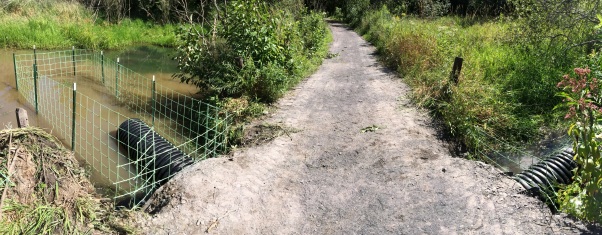
A pond leveling device installed at the bridge on the School Rd. Trail. The objective of this device was to decrease water levels so the trail would stop flooding. The line on the tree was the water level prior to installation.

10-lcs-crop
Trapezoidal Fence after installation on Beaver Pond Trail at Glimmer Glass State Park, photo by Lilly Schelling.

State Parks wildlife staff will monitor these beaver deceivers to ensure they continue to functioning properly and that they are still in place. Freezing and thawing during seasonal change may shift the placement of the device. Overall these devices have proven to be highly successful in solving beaver related flooding issues. It is great to solve human wildlife conflict in such a way that both human and wildlife can remain in the same area and neither is pushed out.

Post by Lilly Schelling, State Park Wildlife staff

Delicious, Nutritious and oh so… SWEET!

Can you guess which delicious fruit this is?

photo-by-keith-weller-public-domain-via-wikimedia-commons
American cranberry, Photo by Keith Weller [Public domain], via Wikimedia Commons

Thanksgiving is right around the corner, which means we’re about to start thinking about this little red berry. It will, we’re all betting, be the only certified super food on your plate come Thanksgiving dinner time (unless your family does kale or something). Native to North America and was first used as a food by Native Americans. It was also used as an effective dyeing agent, so don’t spill any on your shirt. We have two species , large and small (Vaccinium macrocarpon and Vaccinium oxycoccus) which are found naturally in peat bogs and other wetlands across the northern half of North America, including all of New York state. As the fruit became more popular, farms were developed to meet the demand. This delicious fruit was planted in areas that could be flooded for part of the season; the berries are harvested each fall. Today, Wisconsin and Massachusetts are the two largest producing states. Sailors used them as scurvy prevention in the 19th century as the berries are rich in vitamin C. Now we know that it can lower your risk for some common cancers (including mouth and lung cancers). Come Thanksgiving; make sure you load up on it. But don’t stress too much, they also stay fresh in the refrigerator longer than most other fruits (up to 2 months!) and you can also pop a bag in the freezer for use later.

Follow these links for more fun facts about this all-American fruit!

https://ag.umass.edu/cranberry/about/cranberry

http://plants.usda.gov/core/profile?symbol=VAMA

Posted by Greta Alvarado, State Parks

The official blog for the New York State Office of Parks, Recreation & Historic Preservation