Symbols of New York State Scavenger Hunt

Ah, Labor Day Weekend, a perfect weekend to take a hike through your favorite state park.  If you do take a hike, try the Symbols of New York State Scavenger Hunt – let us know how you did.

Red-Spotted Admiral or White Admiral butterflies are one our newest state symbol, they were designated as the state butterfly in 2008.  These butterflies are polytypic – meaning that there are different coloration patterns for this butterfly depending on where it lives. The white admiral variation has blackish blue wings with wide white band.

Admiral
White Admiral. Plismo (Own work) [CC BY 3.0 (http://creativecommons.org/licenses/by/3.0)%5D, via Wikimedia Commons.
The red-spotted admiral lacks the wide white bands and sometimes has a row of red spots along the top of the wing. Overall the wings are a dark blue color with a light blue dusting on the hindwing.

If you are hiking in northern New York, you will only see the white admiral.  If you are hiking in any other part of the state, you will see either the red-spotted or white admiral.

Red Spotted Admiral
Red Spotted Admiral, note the red spots on the top wings. FrigidNinja (Own work) [CC BY-SA 3.0 (http://creativecommons.org/licenses/by-sa/3.0)%5D, via Wikimedia Commons.
Look for Eastern Bluebirds in Park grasslands and on utility wires. These birds are primarily cavity nesters, utilizing hollowed out holes in trees and man-made nest boxes to lay their eggs. Bright blue males are easy to spot while females are a bit more challenging with blueish grey plumage.  Both have rust-colored chests and white bellies.  Eastern bluebirds have been our state bird since 1970.

New York’s largest rodent, the Beaver, can be found in wooded streams, marshes, and along the edge of ponds and lakes.  When you are walking near these wetlands, tree cuttings and chewed trees or shrubs near the shore is a great indicator that beavers are live nearby. If you hear a slap on a pond or marsh, the beaver has spotted you and has slapped its tail on the water to warn other beavers that you are around.  If you can find a spot to hide and have time to wait, you might get a glimpse of these shy animals.  Beavers have been our state mammal since 1975.

Snapping Turtles can be found in marshes, rivers, streams, lakes, and even in urban waterways.  Our largest turtle, their shells can be upwards of 20” long and they can weigh up to 35 lbs.  The upper part of the snapping turtle shell or carapace has three keels or ridges.  The turtle’s shell can vary in color from tan, brown, olive gray or black.  They have a long tail with saw-toothed ridges. Interestingly, snapping turtles have the smallest plastron (or bottom part of their shell) in proportion to their body of any turtle in New York State. Most of their defense strategy is their large size. Look for these turtles swimming slowly through the water with their head poking out of the surface or perched on rocks near the water’s edge. Remember to keep your distance from these turtles; their jaws have a powerful snap! Snapping turtles became our state reptile in 2006.
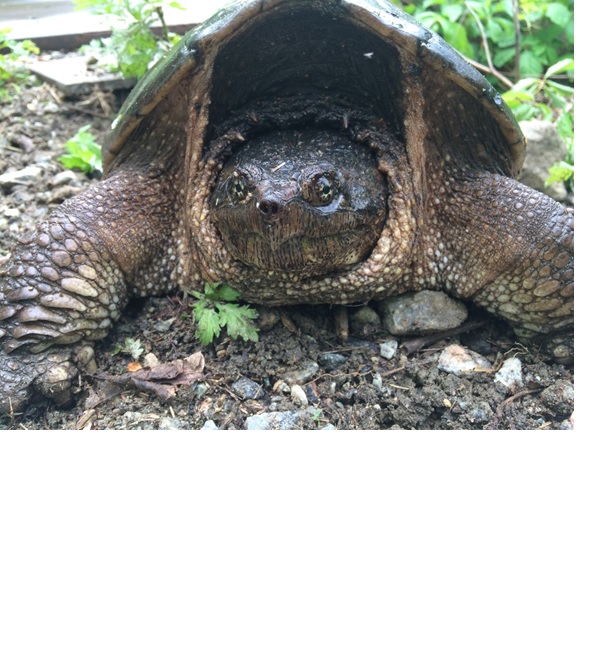
Female Snapper
Female Snapping Turtle. Lilly Schelling, NYSOPRHP.

The rare Nine-Spotted Ladybug has been our state insect since 1989.  Slightly bigger than a dime, these oval-shaped insects typically have nine-spots on their backs.  If you think you found one, please take a photo, record where you found it and send all the information to The Lost Ladybug Project.

9 Spotted Ladybug
Nine Spotted Ladybug, each wing usually has four spots, plus one spot that overlaps on both wings. http://musingsofabiologistanddoglover.blogspot.com/2011/08/lost-ladybugs.html?_sm_au_=iVVV163fqrZsRWDr.

The Sugar Maple was designated as our state tree in 1956. The bark of a young sugar maple is smooth and dark gray; as the tree ages the bark becomes furrowed in uneven long plates.   Sugar maples have easily recognized leaves that are between 3”-5” long and 3”-5” wide, usually with 5 shallow ‘u-shaped” lobes.   Perhaps you will see the leaves a few of these beautiful trees turning red or yellow during your walk.

And remember to stop and smell the Roses during your hike.  If you do, perhaps you will see some late flowers on some of our native roses such as this Common Wild Rose.  The flowers can be observed either individually or in small bunches.  Look for the common wild rose along roadsides, fields, and salt marshes.  Roses were designed our state flower in 1955; they are our oldest state symbol.

Rose
Common Wild Rose. magnolia1000 from Canada (Rosa virginiana) [CC BY 2.0 (http://creativecommons.org/licenses/by/2.0)%5D, via Wikimedia Commons.
When you are done, why not enjoy some New York state goodies: milk, the state beverage (designated 1981); apple muffin, the state muffin (designated 1987); apple, the state fruit (designated 1976); or yogurt, the state snack (designated 2014.).

Snack
Photo and snack prepared by Susan Carver, OPRHP.

Post by Susan Carver, OPRHP.

Learn more at:

http://www.dec.ny.gov/education/1887.html

http://www.dos.ny.gov/kids_room/508/symbols2.html

http://explorer.natureserve.org/
http://plants.usda.gov/java/


Sammi’s Story

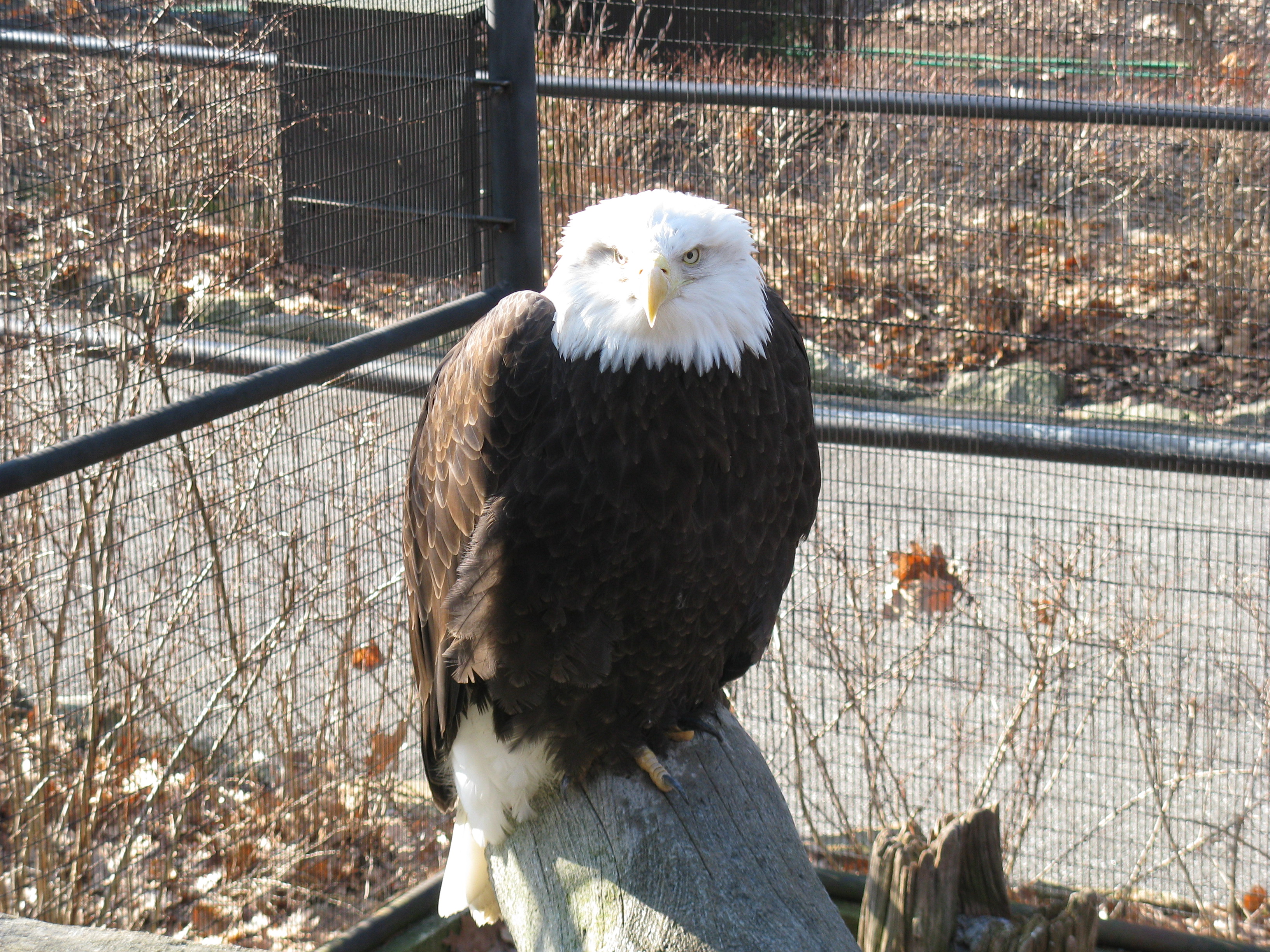
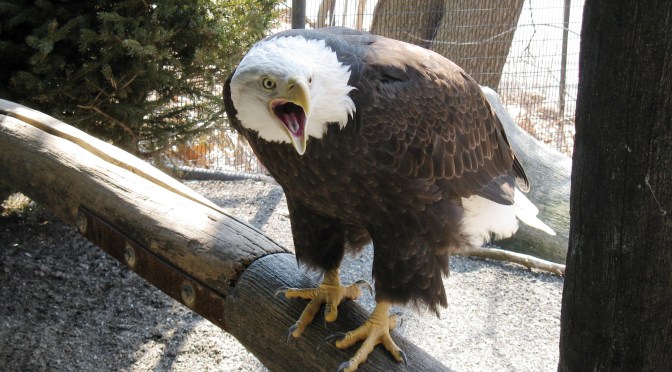
Up close observations of bald eagles are rare and usually reserved for biologists and dedicated naturalists, however if you have been to Trailside Museums and Zoo at Bear Mountain State Park over the last 30 years, then you have probably had an intimate encounter with Samantha, our impressive resident bald eagle. Affectionately known as Sammi, she has been greeting visitors since 1985.

Her story began in southeastern Alaska in the early spring of 1984. In the nest, her mother laid two eggs several days apart. Both parents took turns keeping the eggs warm and hunting for food. About thirty-five days later, Sammi and her sibling hatched from the eggs. Mom and Dad hunted continuously to feed their very hungry baby eaglets and themselves. The eaglets grew bigger and stronger and soon they would be getting ready to learn to fly, also known as fledging.

Meanwhile, Research Scientist and Endangered Species Unit Leader Peter Nye and a team of biologists from the New York State Department of Environmental Conservation’s (DEC) Endangered Species Unit had traveled to southeastern Alaska. As part of New York’s Bald Eagle Restoration Project, they collected nestling bald eagles from 1976 through 1989, restoring New York State’s declining eagle population, which had been decimated by hunting, habitat destruction and widespread use of the pesticide DDT. On July 17, 1984, Mr. Nye climbed up Sammi’s tree and collected her and her sibling. They were put into crates and transported, along with 30 other young eagles, back to New York State.

Sammi and about half of the eagles were transported to a site in the Adirondacks, while the others went to a site in Albany County. The young eagles were raised to independence through a process called hacking. Living in artificial nests, called hacking towers, they were fed by hidden human hands, until fully feathered, when they were released to learn to fly and hunt from the towers. Sammi was released on August 31, 1984. She fledged from the tower on September 2 and returned to it on September 7. She left the hacking area entirely on September 20. DEC personnel last had contact with her on November 2 on Sacandaga Reservoir, near Northville, NY. Winter was coming, so Sammi migrated south.

Unfortunately for Sammi, she would barely get to know the usual rewards for migrating south, warmer weather and open water for fishing. She was found injured on the ground on December 27 in Woodleaf, North Carolina by a private citizen. She was taken to Dr. Brown of the Carolina Raptor Rehabilitation Clinic, where it was discovered that she had been shot with a .22 caliber firearm, which broke one metacarpal in her right wing. Dr. Brown and his staff spent an extensive amount of time and effort trying to rehabilitate her, but to no avail. Even with surgically placed pins and replacement of dead bone, the damage was irreversible. She was returned to New York on April 17, 1985, where Dr. Edward Becker surgically removed the right wing at the wrist joint.

Samantha was transported to Trailside Museums and Zoo on May 10, 1985 on a permanent loan as an educational specimen. She is a very proud and feisty bird, keeping the zookeepers on their toes whenever they have to enter her enclosure. She keeps her feathers very well groomed and always seems to maintain an aura of majesty. It is difficult not to utter an ‘ooh’ or an ‘ah’ when coming upon her. She can be very vocal, delighting and sometimes startling passersby with her piercing call. While we know that Sammi would much rather have spent the last 30 years living her life in the wild, she remains an excellent ambassador of her magnificent species, providing daily lessons on power, grace and hope. The Bald Eagle Restoration Project was an astounding success. There are now more than 170 pairs of bald eagles nesting in New York State.

IMG_0260

Photos courtesy of Palisades Interstate Park Commission.

Sources:

Post by Chris O’Sullivan, Environmental Educator at Trailside Museum and Zoo at Bear Mountain State Park.

Four-Legged Grounds Crew

One hundred Southdown sheep once mowed the expansive lawn of William Rockefeller’s estate, Rockwood Hall, in North Tarrytown, NY.  A century later sheep and goats are grazing once again, but now the property is part of Rockefeller State Park Preserve (Preserve) in the renamed community of Sleepy Hollow.

sheep1
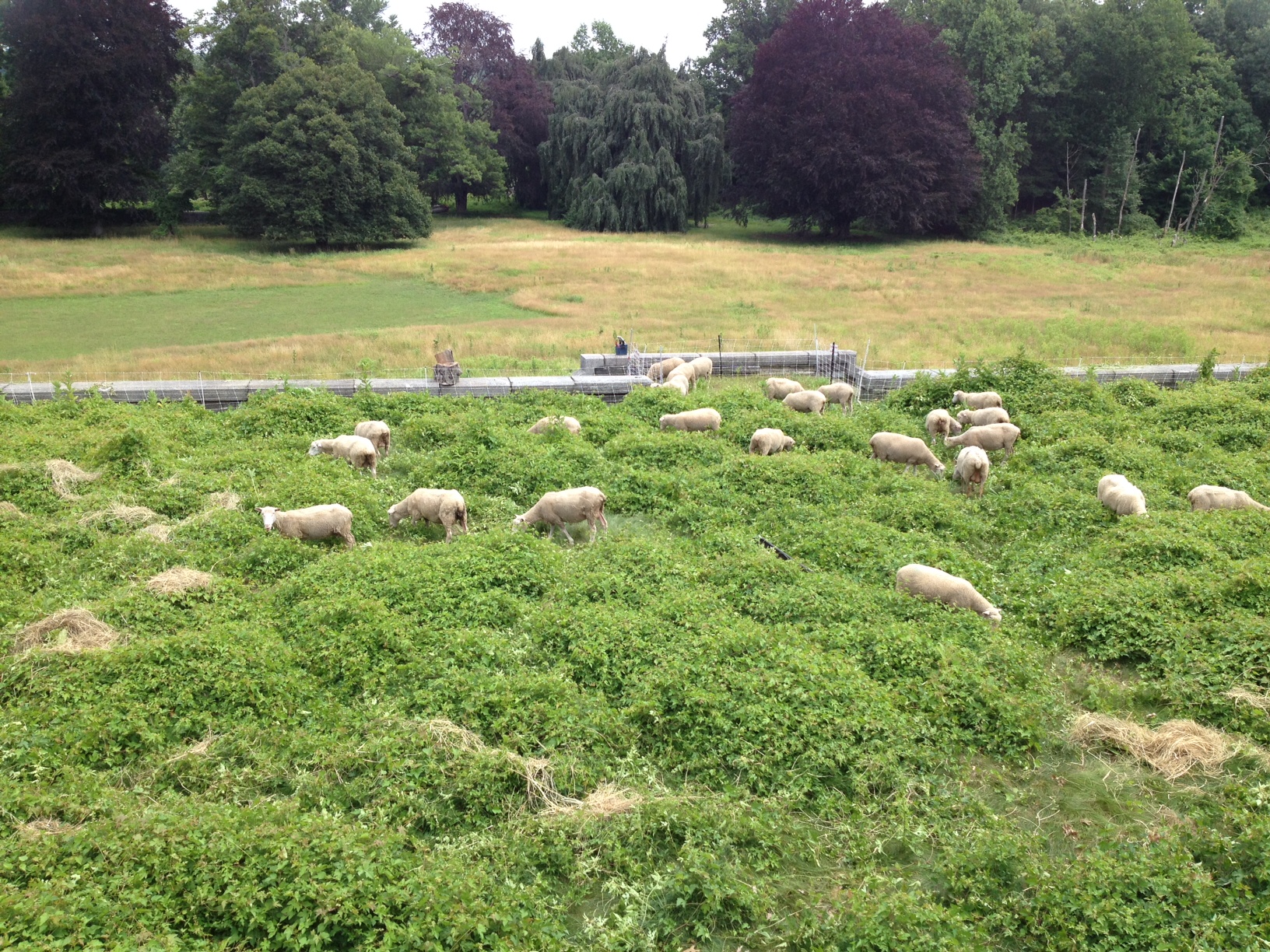
Sheep grazing at Rockefeller State Park Preserve.

Over recent years, the steep slopes and historic stone foundation overlooking the Hudson River became overrun by the highly invasive akebia vine (Akebia quinata), porcelainberry vine (Ampelopis brevipedunculata) and other invasive species.  To control the vines and manage the grassy hillsides, the Preserve has partnered with Stone Barns Center for Food & Agriculture, a neighboring non-profit working farm and education center, to rotate sheep and goats around the foundation.  Stone Barns gets more grass and forage for their sheep, while public lands get invasive species more under control in an ecofriendly way.

The project was begun in mid-summer of 2014 with 50 sheep augmented by 7 goats over four months.  This year Rockwood Hall will host 10 Boer goats, 30 Tunis sheep and 50 Finn Dorset sheep. They are rotated every 4-6 days through small paddocks enclosed with temporary electric netting and peripheral fencing.   Chris O’Blenness, a farmer employed by Stone Barns Center, is managing the flock and stays on-site at night in a travel trailer.

This is the first joint Rockefeller State Park Preserve-Stone Barns Center experiment aimed at improving landscape health and ecosystem function.  It is also a potential strategy for increasing access to land for beginning farmers.  Chris O’Blenness is representative of beginning farmers and ranchers who are searching for land to work. This type of symbiotic grazing arrangement on public lands is a potential model for other public lands that can offer beginning farmers affordable opportunities for land access—all while performing a vital public service and delighting Preserve visitors.

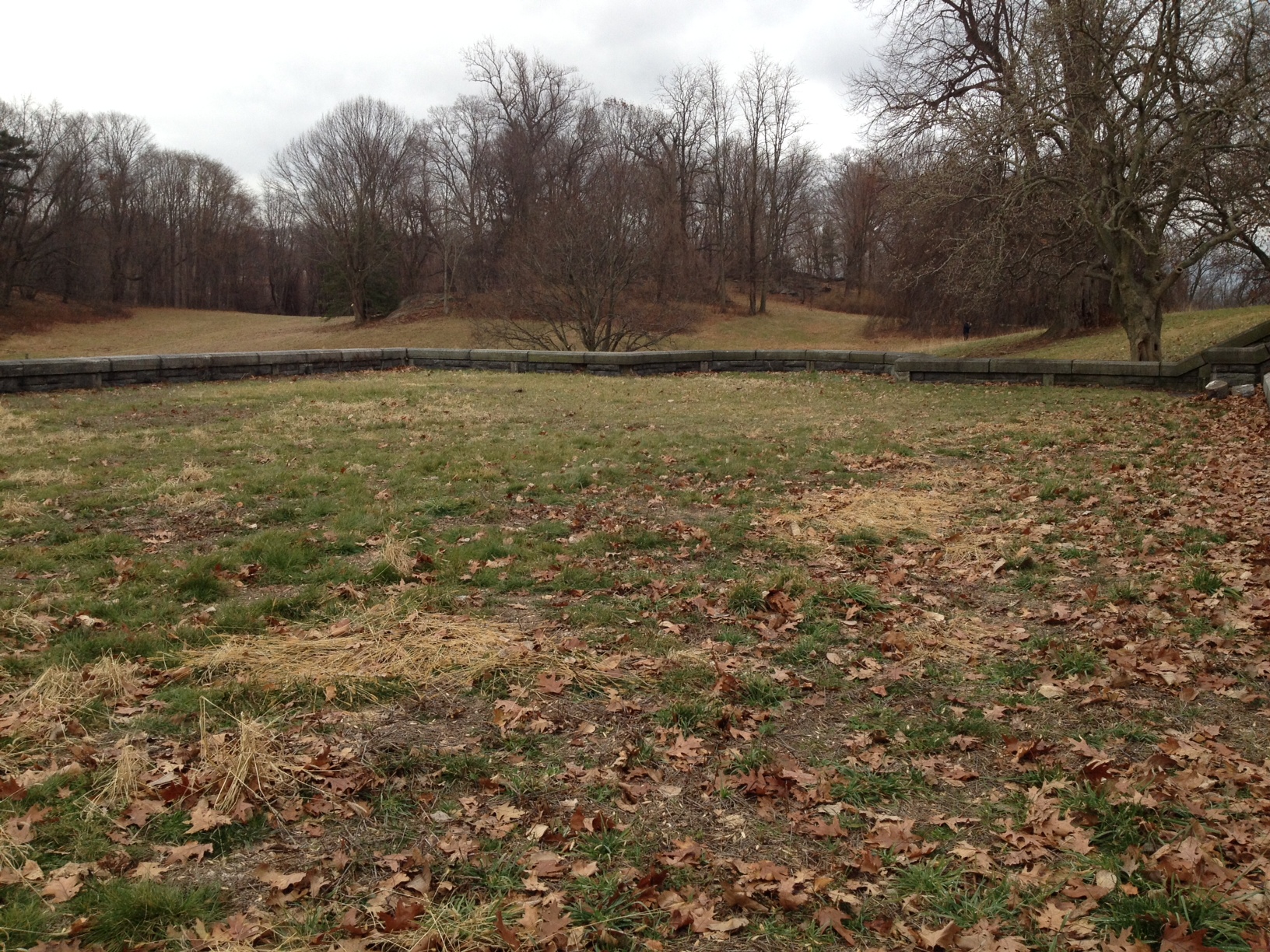
Envisioned as a multi-year initiative, this on-going land management is needed to make headway against the fast-growing spread of invasive species.   So far grazing is making a difference, but progress would be lost if grazing were stopped.  Although 90 grazing animals sounds like a lot, it’s not on a large landscape.  We have also added weedwacking and mowing to the rotation.  Since the grazing started, one terrace, once engulfed in a 3 foot tangle of thick porcelainberry vine, is now able to be mowed weekly and visitors are able to spread blankets on grass and picnic where no one dared before.

sheep2
Terrace with porcelainberry in the summer of 2014.

sheep3
The same terrace in December of 2014 after grazing and mowing.

As the Preserve and Stone Barns gain experience and increase numbers of animals, we’re hoping to fine-tune the grazing to achieve ecological and foraging goals.  Meanwhile, the baas of the sheep and goat greet visitors, many of whom now stop and look and think about invasive species and land management challenges.

Post and photos by Susan Antenen, Rockefeller State Park Preserve Manager.

Looking at the Big Picture: Implementing Ecosystem-Based Management in Parks

Ecosystem-Based Management, sometimes referred to as EBM, is a planning tool. It helps guide decisions on where to place development such as roads, buildings, trails, beaches etc., while also considering the long and short term impacts to the environment. It also looks at how development effects not just the surrounding environment, but also the upstream and downstream environment.  EBM helps remind us to take the big picture view when we do work in our State Parks.

New York State Parks’ Environmental Management Bureau has been implementing Ecosystem-Based Management (EBM) in our parks statewide since 2008.

EBM relies on citizen participation, partnerships, science-based approaches, and taking a long-term view   to provide an informed and adaptive approach to protecting our ecosystems while providing park patrons with experiences that connect them to the natural world.

There are 6 main components to EBM. These include:

  1. Place-based focus;
  2. Scientific foundations used for decision-making;
  3. Measurable management objectives to direct and evaluate performance;
  4. Adaptive management to respond to new knowledge;
  5. Recognition of interconnections within and among ecosystems; and,
  6. Involvement of stakeholders.

Taking this approach allows us to look at interacting systems, like watersheds, rather than individual components, such as a specific plant or animal or isolated water quality parameters.  NYS Parks has used this approach to help better understand, protect and manage our resources, such as swimming beaches, lake water quality, forest health, species richness, and aquatic connectivity.

In addition to helping us look at our natural environment in a more integrated way, EBM provides a means to communicate with multiple stakeholders including citizens, scientists, the private sector and government officials.

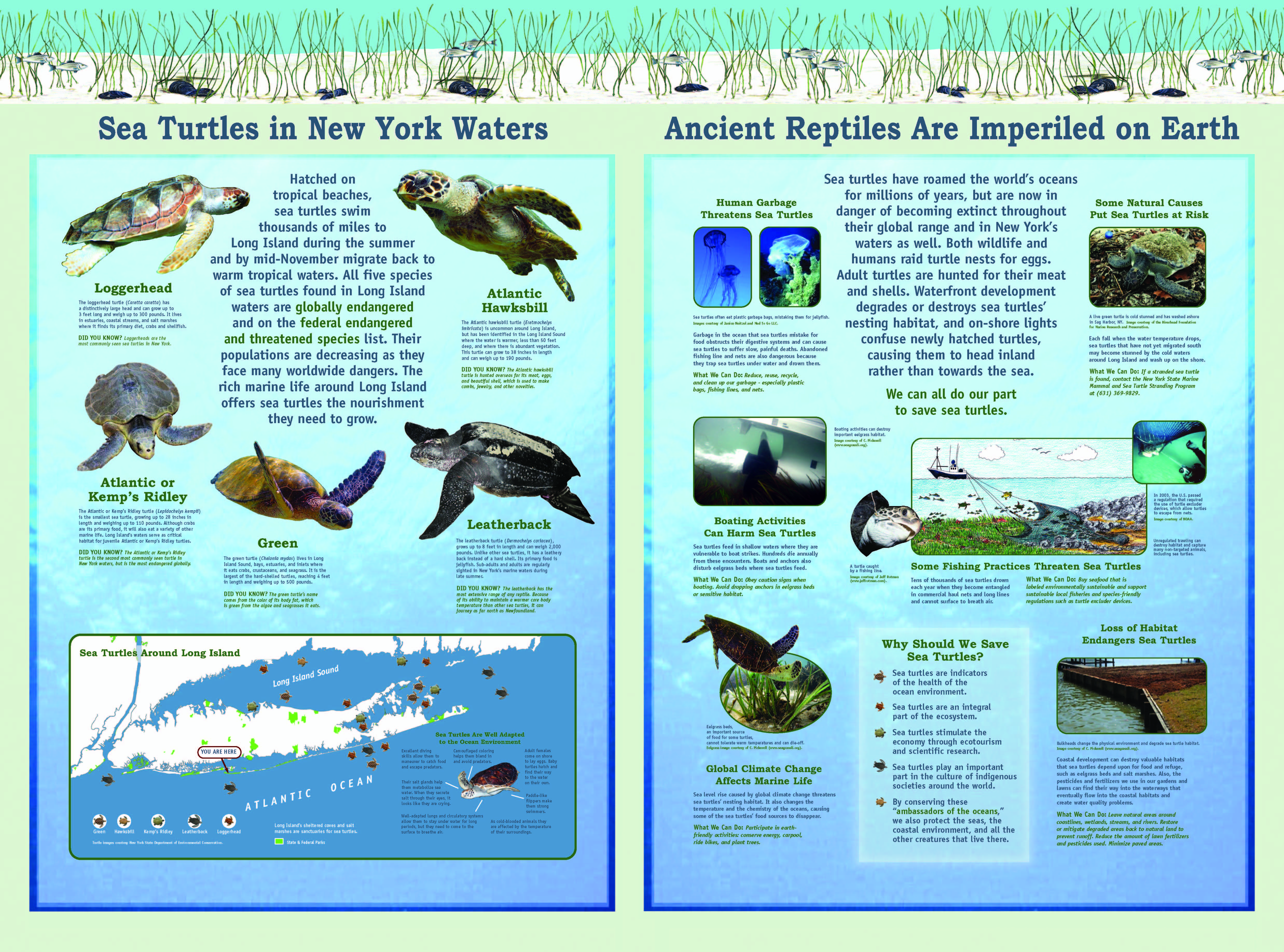
Ecosystem Based Management Education Panel_1

Ecosystem Based Management Panels at Sunken Meadow State Park on Long Island.
Ecosystem Based Management Panels at Sunken Meadow State Park on Long Island. Click to enlarge images.

NYS Parks will continue to integrate EBM into programs andactivities through training, watershed educational materials and ecosystem research, as well as projects which demonstrate that healthy ecosystems mean healthy communities.  Look for these EBM educational panels at Sunken Meadow State Park on Long Island (pictured above)! More educational panels and kiosks showing how our parks are part of the larger landscape are in the works for parks along the St. Lawrence River and Great Lakes.  Keep an eye out for them!

Post by Gabriella Cebada Mora, OPRHP.


Invasive Mussels & Snails of Lake Champlain

In my two months as a New York State Parks Boat Steward on Lake Champlain I have already collected two aquatic invasive species: the banded mystery snail and the zebra mussel. I encountered the banded mystery snail at two different boat launch sites by the shore of Lake Champlain near Point Au Roche State Park. The zebra mussels are often found attached to rocks, driftwood, and recreational equipment that has been in the water for some duration.

The banded mystery snail is native to the southern United States and its introduction to this region can be traced back to 1867 when an amateur biologist released 200 of the snails into the Hudson River. This event was followed by subsequent introductions from aquariums owners. The snails can grow to be 1.75 inches long and 1.5 inches wide, with anywhere from one to four red bands on the shell. This species also lives in very high densities. Scientists are still studying the ecological effects of banded mystery snail invasion on natural communities. However, the presence of the species has been shown to decrease the survival rates of large mouth bass eggs in ponds and in the lab, which may eventually lead to a decline in fish populations in Lake Champlain.

The zebra mussel is an aggressive species that has spread very quickly since its first introduction to North America from Russia in 1989. By the mid-1990’s the species had become established in Lake Champlain. It is a D-shaped mollusk that is less than 2 inches long and has a distinctive brown zebra pattern on the shell. It poses great threats to native environments because it lives in dense populations of up to 750,000 specimens per square meter. Zebra mussels will attach themselves to any hard surface including native mussels, plants, man-made objects (such as piers and boat motors), and will even adapt to live on soft sediment. They are able to attach to objects by spinning a mass of tiny fibers called byssal threads that allow them to cling to any surface. Their larvae (veligers) are microscopic and float near the surface of the water which makes them easily transportable by boats or any recreational watercraft. Zebra mussels are strong competitors. One way that they outcompete native species is by grazing on large volumes of phytoplankton, thereby reducing the food resources available for native mussel species. They also take up large amounts of space on the lake substrate that is needed for fish spawning. Additionally, they cause drastic economic damage each year by  clogging pipes and pumps at wastewater treatment facilities and damaging municipal drinking water systems, hydroelectric power plants and irrigation systems.

ariana inspection
Ariana London completing a boater/angler survey about aquatic invasive species at the Great Chazy River Boat Launch (north of Plattsburgh on Lake Champlain). Photo by Megan Phillips, OPRHP.

While it is possible that Lake Champlain may never be free of the zebra mussels and the banded mystery snail, we can still ensure that these species do not spread to ponds, lakes and streams that are not yet infested. I feel incredibly honored to be part of the effort to stop the spread of the aquatic invasive species by educating people on what they can do to help.

Remember to clean, drain and dry your watercraft after use. To reduce the risk of spreading invasive mussels and snails in their veliger stage, boaters may opt to wash their watercraft and flush the engine with hot water. Research indicates that zebra mussels in the veliger stage cannot withstand water warmer than 110 degrees Fahrenheit, and adults will experience mortality at temperatures greater than 140 degrees Fahrenheit. For a list of hot water, high pressure boat washing station in the North Country/Adirondack Park area, click here.

Post by Ariana London, OPRHP Thousand Island Region Boat Steward.

Sources:

http://www.nps.gov/isro/planyourvisit/upload/ZMBoaters.pdf

http://www.watershedmanagement.vt.gov/lakes/docs/ans/lp_zeeb-factsheet.pdf

http://www.adkwatershed.org/invasive-species/invasive-species-information/zebra-quagga-mussel

https://adkwatershed.wordpress.com/2014/04/17/banded-mystery-snail-vs-chinese-mystery-snail/

http://www.lcbp.org/wp-content/uploads/2012/08/LCB_Invasive_Species_Guide.pdf

http://nas.er.usgs.gov/queries/FactSheet.aspx?SpeciesID=1047

The official blog for the New York State Office of Parks, Recreation & Historic Preservation