

A highlight to any winter beach walk on a Long Island State Park beach is the sighting of a seal, either hauled out on sand bars during low tide or swimming off the beach at high tide.
Harbor and grey seals, and more rarely hooded, ringed, and harp seals can be seen off of Long Island from late fall through early spring. These seals belong to the family Pinniped, meaning “feather-footed” or “wing-footed.” They are considered true seals – meaning they have no ear flaps, their front flippers are short, and their necks are short. Seals are excellent divers; they can hold their breath for 40 minutes, swim up to eight miles an hour, and dive up to 600 feet. They eat a variety of fish and invertebrates including crabs and squid. Thanks to a thick layer of fat and a dense coat seals keep warm in winter.
The best time to see large groups of seals is at low tide when they haul out of the water to rest and sleep on sand bars and rocks. When seals are hauled out at low tide they hold their head and tail up in a “banana-shaped” position. Be sure to watch the seals from a distance since seals can be easily scared.
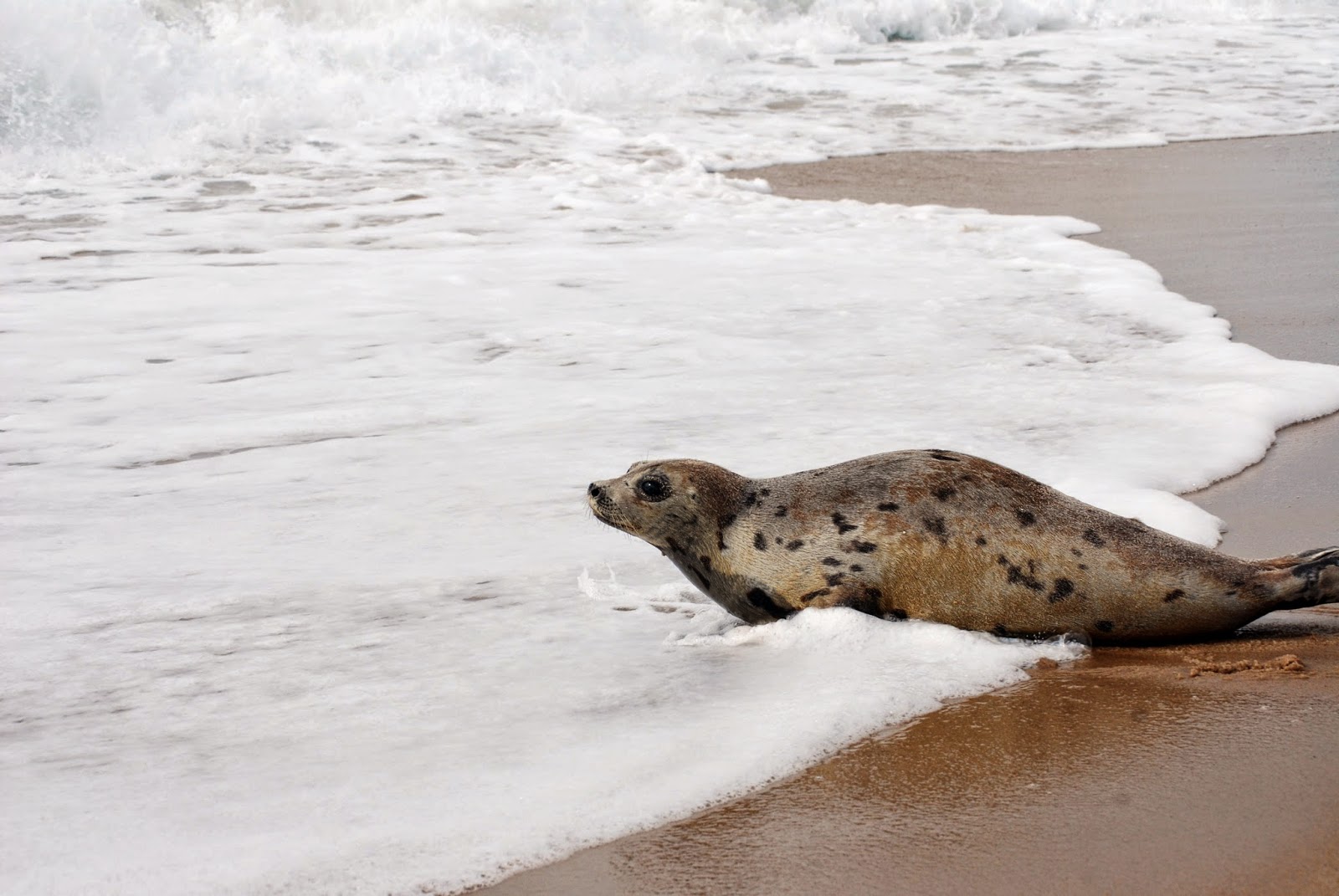
Harbor Seals are the most common seal that you will see. These 4-1/2’ – 6’ seals range in color from tan to brown to light gray with irregular black spots. They have a smallish head that looks like a Cocker Spaniel in profile. This profile gave them the nickname “sea dog.” Their nostrils are “V” shape when seen from the front. Harbor seals weigh 250 lb.
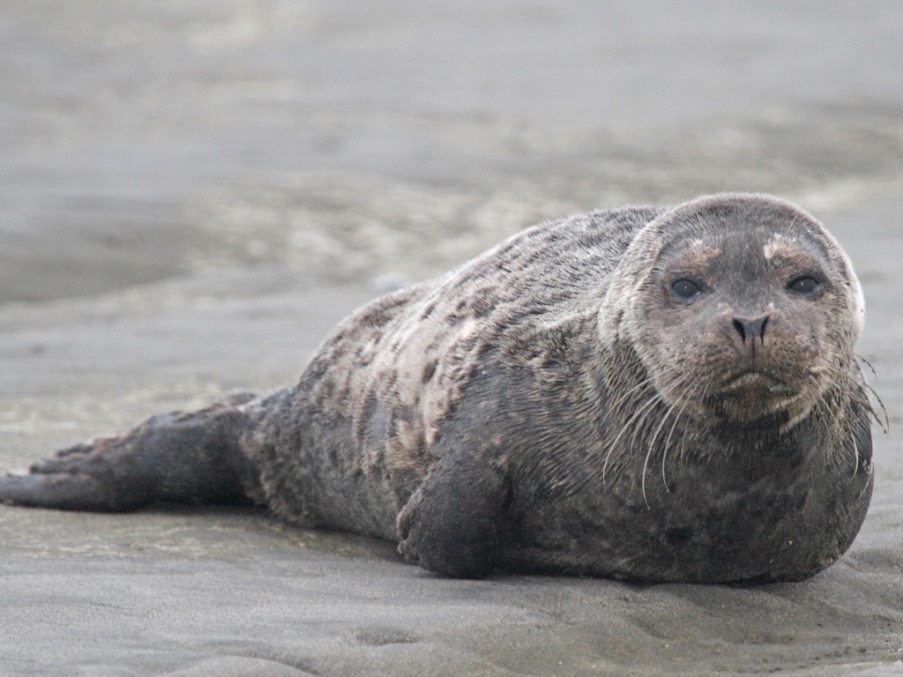
Gray Seals are a large seal with gray coloration. Interestingly, adult males are dark gray with small black markings and adult females are light gray or brown with dark patches. Males can be 8’ long and weigh 800 lb., females 7’ and weigh 400 lb. They have a distinctive “horsehead” profile and their nostrils form a “W” when seen from the front. Females have a slightly smaller head than males.

Hooded Seals are the largest seal that winters off of Long Island; males are 9’ long and females are 7’ long. Males weigh 900 lb., females 670 lb. The coat coloration of silver-grey with irregular black spots is the same in both adult males and females. First year pups have a slate colored coat. All female and juvenile male hooded seals have a larger head and broader muzzle than the harbor seal. Adult males have an unusual nasal apparatus that they will inflate when they are angered or threatened. Juvenile males do not have this nasal sac.
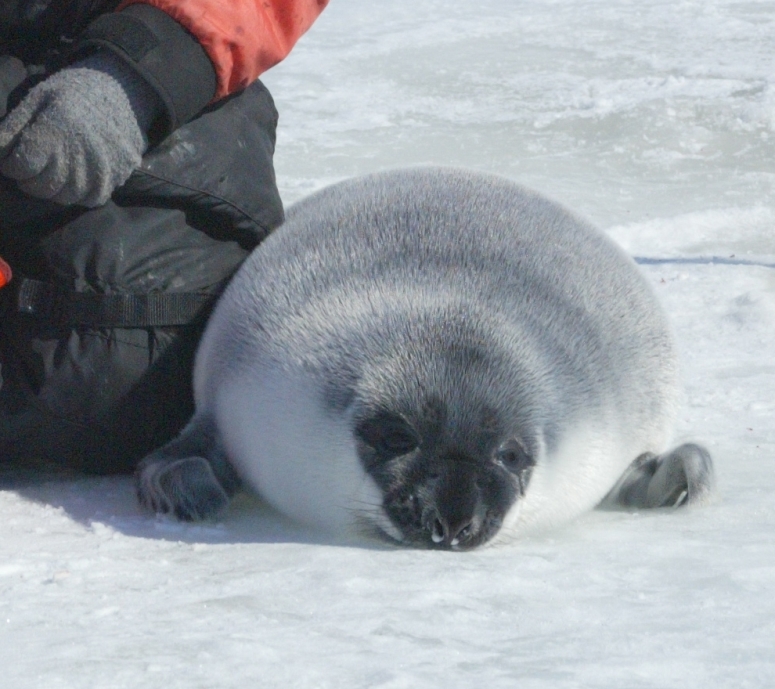
It is always a thrill to see harp seals and ringed seals because they are rare visitors to Long Island.
Harp Seal adults are white with a dark harp- or saddle-shaped pattern on its back and flanks. The more common juveniles have a light coat with dark blotches. Harp seals look similar to harbor seals in profile but they are slightly larger (both males and females are 6’ long and weigh 400 lb.) and they have a stockier body than the harbor seal.
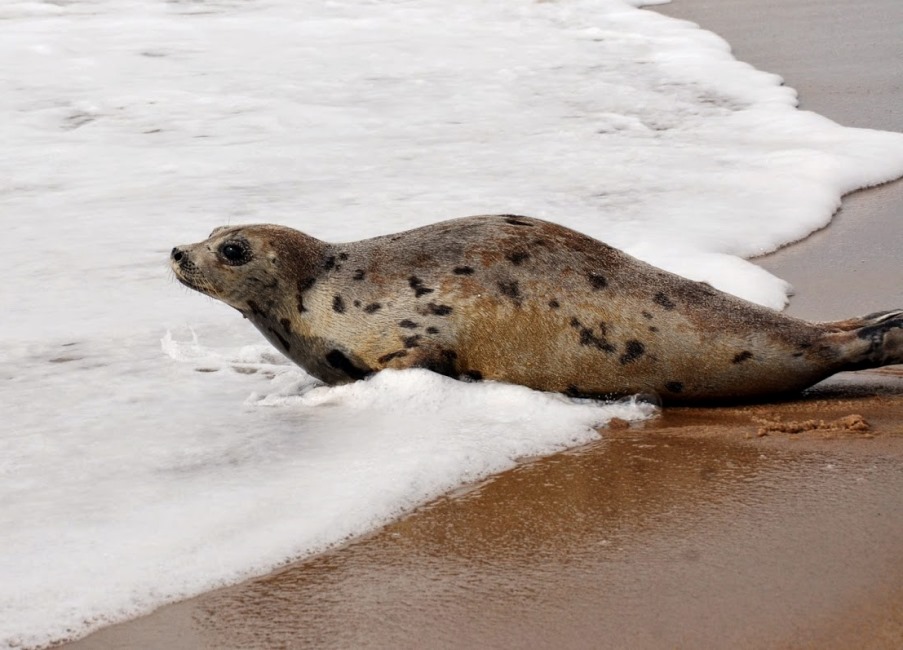
Ringed Seals are the rarest and smallest seals found off of the New York coast in the winter; they measure between 4’-5-1/2’ long and weigh between 150-250 lb. Generally, the coats are a gray-black color with numerous dark spots surrounded by light areas that look like rings. Juvenile ring seals have a fine silvery coat. From a distance, ringed seals have a slightly smaller head than a harbor seal and their nose is more pointed than a harbor seal.

Join us for a seal walk at either Jones Beach State Park or Montauk Point State Park. Be sure to bring your binoculars!
And please keep your dog at home. You wouldn’t want your dog scaring the seals.
References:
Katona, Steven, Rough, Valerie, and Richardson, David (1983). A field guide to the whales, porpoises, and seas on the Gulf of Maine and Eastern Canada : Cape Cod to Newfoundland. New York: Charles Scribner and Sons.
New York State Department of Conservation (n.d.) Harbor seals http://www.dec.ny.gov/animals/60840.html accessed 01/22/2014
Dig Deeper in to Seals:
Bonner, Nigel (1994). Seals and sea lions of the world. New York : Facts on File.
Kalman, Bobbie (2006) Seals and sea lions. New York : Sierra Club Books.
Marine Mammal Stranding Center: http://mmsc.org/education/marine-species
The North Atlantic Seal Research Consortium: http://coastalstudies.org/programs/seal-research/cape-cod-seals/
Post by Susan Carver.


 New York State Parks and Historic Sites Blog


.JPG)