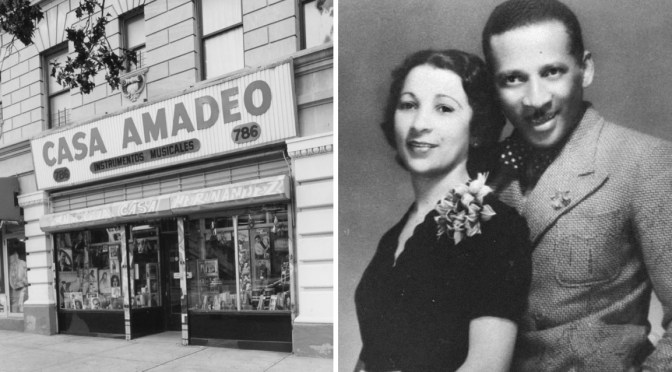
Added to the National Register of Historic Places in 2001, Casa Amadeo, antigua Casa Hernández is best known as the Bronx’s longest continually run music establishment and the oldest Latin music store in New York City. The store’s founder, Victoria Hernández, is one of the earliest female Puerto Rican entrepreneurs in the city. The National Register listing highlights her story and the lasting impact she had on the city’s Latin music scene.
Looming on a corner along Prospect Avenue in the Bronx, this 1905 Neo-Renaissance style apartment building is home to a cornerstone of New York City’s Latin music history.
The Manhanset, home to Casa Amadeo, antigua Casa Hernández, in operation since 1941. Casa Amadeo National Register nomination | Photographer: Martha Cooper (September 2000)
We’re showcasing some of the stand-out, unusual, and noteworthy New York State listings in the National Register of Historic Places in honor of the milestone 200th meeting of the New York State Board for Historic Preservation (on September 10, 2025). There are around 130,000 resources in New York listed in the National Register, either as individual sites or as parts of historic districts.
Our list recognizes decades of work by historic preservationists. They are listed here in no particular order, but rather by characteristic or region to give a flavor of the different types of listings on the register.
The Board – which was established in 1972 and expanded by the New York State Historic Preservation Act of 1980 – works with the New York State Historic Preservation Office to review nominations to the State and National Registers of Historic Places. You can learn more about the State Review Board online.
The Stonewall Inn, a State Historic Site in our system, is the most well-known place in LGBTQ American history. In June 1969, following a routine police raid, patrons at the Mafia-run Stonewall Inn, as well as young queer and trans people who lived or regularly congregated in Greenwich Village, spontaneously erupted in multiple nights of protest. The event was a turning point in the ongoing LGBTQ rights movement and sparked its growth in New York City, New York State, and across the nation. Organizations and groups formed around the country to promote LGBTQ rights, and thousands of people became active in the movement.



 New York State Parks and Historic Sites Blog