

Upon his death in 1921, the New York Times devoted an entire page to John Burroughs. The New York State Senate adjourned, and the Daily Times of Los Angeles reported that a resolution passed in Burroughs’ honor by the California State Assembly – it read in part, “whereas press dispatches today announce the death of John Burroughs, foremost naturalist of the United States, be it resolved that in his death the nation has sustained the loss of one who as scientist, citizen and man, occupied a deservedly high place in the regard of all people…”
When I was in my teens, I stumbled upon one of John Burroughs’ 27 books in a local library. His writing was simple yet elegant and wonderfully descriptive of the natural world. I was hooked.
Every walk in the woods is a religious rite, every bath in a stream is a saving ordination.
Who was this man of such great fame 100 years ago but who today is almost forgotten?
John Burroughs was first and foremost a farmer who developed an intimate, deep-rooted connection with the land. Born in 1837, Burroughs dropped out of school after the sixth grade. He spent 17 years working on his family’s farm and read every single book from his small local library. His father was a strict Baptist, but Burroughs resisted organized religion.

I never went to Sunday school and was not often seen inside the church. My Sunday’s were spent roaming in the woods or fields… following the streams and swimming in the pools.
He briefly attended the Cooperstown Seminary, but formal schooling was not for him.
I can learn more about a cat by it jumping on my lap than by dissecting it in a laboratory.
At age 20, Burroughs married Ursula North, and like most of his family and acquaintances, she did not support his intense interest in writing. Undaunted, Burroughs began to write seriously for the Saturday Press and the New York Leader. By age 23, he was regularly publishing essays in the Atlantic Monthly and would continue to do so for the rest of his career.
At age 26, he met Ralph Waldo Emerson who was a great influence on him as a writer. He then moved to Washington D.C. where he met another writing mentor, Walt Whitman, who ultimately became a close friend. By age 48, Burroughs was a full-time writer and farmer gleaning much of his inspiration for his essays from the natural world that surrounded him. This is what set him apart from other writers of his time(?).
John Burroughs is credited with inventing the nature essay, a truly American form of creative writing, and he did so in a way that spoke to the masses. His writings soon became standard in popular magazines, as well as in many schools across the nation where his descriptions of nature enthralled students and piqued their interest in the out-of-doors.
The student and lover of nature has this advantage over people who gad up and down the world, seeking some novelty or excitement; he has only to stay at home and see the procession pass. The great globe swings around to him like a revolving showcase.
By his late sixties, John Burroughs was a household name across the nation. He had befriended John Muir and traveled with him as the naturalist on the Harriman Alaska Expedition in 1899. Industrialists of the age, including Edison, Firestone and Ford, sought out John Burroughs as the guest naturalist on camping expeditions. President Roosevelt, a big fan of Burroughs’ essays, steamed up the Hudson River in his presidential yacht to visit the famous writer at his small writing cabin that Burroughs had named “Slabsides.”
The most precious things in life are near at hand, without money and without price. All that I have ever had or will have can be yours by reaching forth your hand and taking it.
It is impossible to know what influence Burroughs’ work and friendship had on all of these important figures in American history. What we do know is the extent to which they sought him out, and undoubtedly he helped form their impressions of the natural world and man’s relationship to it.
Our civilization is terribly expensive to all of its natural resources. One hundred years of modern life doubtless exhausts its stores more than a millennium of the life of antiquity.
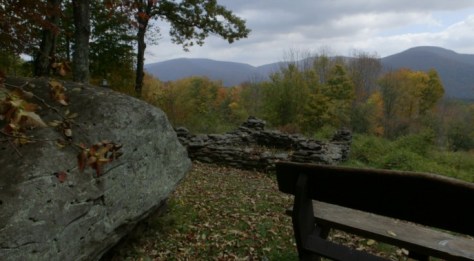
John Burroughs died at age 84 on a train heading for home from California. He was laid to rest in his home town of Roxbury, New York, adjacent to what he referred to as “boyhood rock”, the giant rock he played on as a child. The property and gravesite are proudly maintained by New York State Parks. His summer get-away home in his later years, “Woodchuck Lodge”, stands adjacent to his gravesite and is maintained by “Woodchuck Lodge Inc.” His writing cabin “Slabsides” in West Park, New York, is maintained by the John Burroughs Association.
John Burroughs’ nature writing remains relevant today for several reasons, but perhaps most importantly, because it focuses on nature close at hand, right outside our door. Wherever we are, there too is nature with all its mystery and wonder.
Young people (and old) are getting outside less, suffering from what Richard Louv described in his book “Last Child in the Woods” as nature deficit disorder. All of us at State Parks play a critical role in reversing this trend. We are providing more and more opportunities for young people to get outside to learn about nature and have fun while enjoying the great outdoors!
I suspect John Burroughs would approve.
I am not always in sympathy with nature study as pursued in schools… such study is too cold, too mechanical and likely to rub the bloom off of nature. It lacks soul and emotion, it misses the accessories of the open air and its exhilarations.
Post by Tom Alworth, State Parks
Featured image John Burroughs and grandchild courtesy of New York State Archives


![CCC By Unknown or not provided (U.S. National Archives and Records Administration) [Public domain], via Wikimedia Commons](https://nystateparks.blog/wp-content/uploads/2016/01/ccc-by-unknown-or-not-provided-u-s-national-archives-and-records-administration-public-domain-via-wikimedia-commons.jpg)


 New York State Parks and Historic Sites Blog