Tag Archives: Sustainability

Excelsior Conservation Corps: A Modern Vision of an Old Idea

CCC By Unknown or not provided (U.S. National Archives and Records Administration) [Public domain], via Wikimedia Commons
Civilian Conservation Corps By Unknown or not provided (U.S. National Archives and Records Administration) [Public domain], via Wikimedia Commons.

What started in 1931 as a simple idea to put unemployed New Yorkers to work on state-funded public works projects through the New York Temporary Emergency Relief Administration grew to become the largest peace time utilization of people and equipment in US history – the Civilian Conservation Corps, the CCC. Many New York State Parks including Thacher State Park, Fahnestock State Park, Lake Taghkanic State Park, Selkirk Shores State Park, Thacher State Park, Green Lakes State Park, Letchworth State Park, Hamlin Beach State Park, Chenango Valley State Park, Franklin D. Roosevelt State Park and more benefited from the work that was performed by over 200,000 CCC members from 1933-1942.  During these nine years, 61 camps of 200 CCC members built roads, trails, cabins, and stonewalls, planted trees, worked on early invasive species detection and removal and more.  The Allegany and lower Hudson Valley regions were considered the highest environmental priority and had CCC camps each year, while other encampments would last a season or two, moving on to another location when the job was done.

This slideshow requires JavaScript.

About 40 different CCC camps were spread across the state each year. The typical CCC member was between 18-25 years old, “unemployed, unmarried, healthy, not in school, from a needy family, and capable of doing work” (Thompson).  Most CCC members were white males; however New York also had CCC camps for Native Americans, African Americans, WWI veterans (separate camps for white and African American veterans), and separate camps for women (known as She-She-She Camps).

State Parks honors the memory of the CCC members with a CCC Statue at Letchworth State Park.
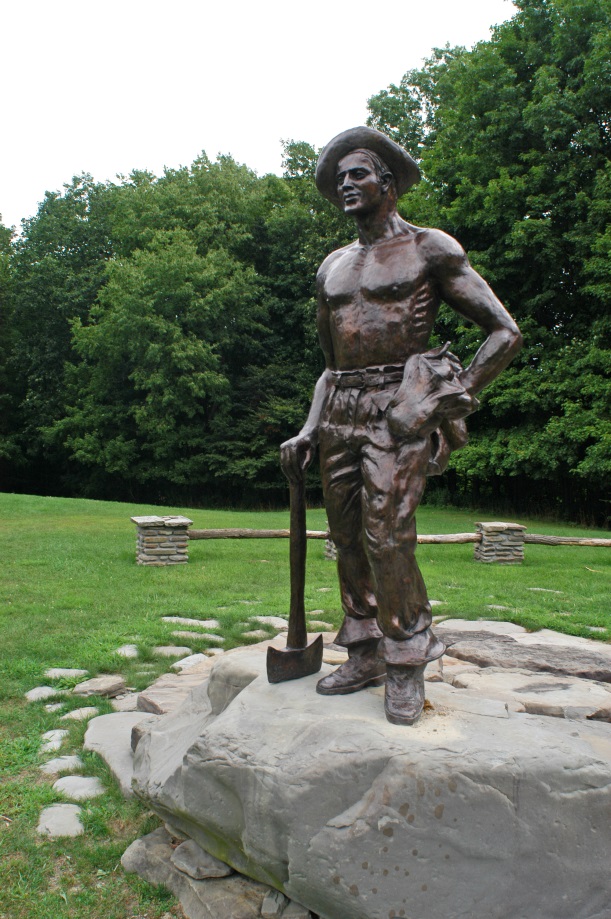
CCC Statue, Letchworth State Park, OPRHP photo
CCC Statue at Letchworth State Park. Photo by OPRHP.

This January, New York State is reviving the Temporary Emergency Relief Administration conservation corps with the inaugural New York State Excelsior Conservation Corps (ECC) and a 10-month residential program modeled after the CCC.  The program is open toNew York State students and residents aged 18-25, with an emphasis on veterans and expanding diversity. The 50 ECC members will be based at SUNY Morrisville where they will receive eight weeks of specialized trainings and certifications lead by the Student Conservation Association – Hudson Valley Corps .  Then, starting in March and running through early November, ECC members will work in State Parks, Department of Environmental Conservation and other state agency lands on projects across the state focused on:

  1. Open Space Management, maintaining and improving hundreds of miles on New York’s hiking trails
  2. Recreation and Access Mapping, monitoring and mapping over 10,000 acres of public land for safe recreational use
  3. Natural Resource Stewardship, invasive species removal and protection of native species and ecosystems
  4. Environmental Education and Outreach, educating New Yorkers on conservation and stewardship of public lands
  5. Infrastructure and Sustainability, helping to cut New York’s energy consumption and energy costs through the construction of renewable energy projects.

During the 10-months, ECC members will get a chance to work on their education plans and develop career skills.  At the end of their service they will be given a Segal AmeriCorps Education Award.

Building on their hands-on experiences and training, ECC members will be poised to become New York’s next generation of conservation leaders.  Learn more about the ECC in future blogs.

Post by Susan Carver, OPRHP. Slideshow photos courtesy of OPRHP.

References:

Hopkins, June; The New York State Temporary Emergency Relief Administration: October 1, 1931, The Social Welfare History Project, n.d.; http://www.socialwelfarehistory.com/eras/great-depression/temporary-emergency-relief-administration/

She-She-She Camps, George Washington University, n.d.; http://www.gwu.edu/~erpapers/teachinger/glossary/she-she-she-camps.cfm

Thompson, Craig; 75 Years Later: The Legacy of the Civilian Conservation Corp; Conservationist, New York State Department of 85 Environmental Conservation, February 2008; http://www.dec.ny.gov/pubs/42768.html.
Green Parking At FDR State Park

A project at Franklin Delano Roosevelt State Park aims to redesign the 6.2 acre parking lot in order to greater serve the goals of environmental sustainability and stewardship. The project will rehabilitate the lot’s surface, improve the efficiency of the parking layout and improve drainage and storm water runoff quality. The new parking lot will feature native trees and vegetation to visually soften the hard surface of the parking lot. Ultimately, the redesign will create a more welcoming and pleasant entrance experience to patrons visiting the popular pool and provide important benefits to the park’s wetland and lake by reducing the amount of nutrients (e.g. phosphorus) and typical parking lot pollutants that are currently flowing into these resources untreated.

This is a joint project between NYS OPRHP and the NY Department of Transportation (DOT). DOT has been tasked with reducing phosphorus loading from storm water runoff from public highways and other impervious surfaces within the Croton watershed. They identified the large pool parking lot at FDR as a project that would help them meet their phosphorus reduction goals. As this lot is in need of rehabilitation, DOT’s assistance with its upgrade will result in a net benefit for both agencies. DOT will provide design and construction management funding and assistance. OPRHP will fund the construction contract.

 The Environmental Impact of Parking Lots

Parking lots can be bad for the environment for many reasons. More pavement means less green space, thereby reducing the number of trees and plants that serve as natural “air cleaners” by absorbing carbon dioxide in the air and releasing oxygen. It also means less open soil that can collect rainwater, which helps to replenish natural aquifers. Impervious surfaces, like asphalt, don’t allow rain to percolate into the ground; instead they channel rainwater to a storm drain. Stormwater runoff can be highly polluted with oil, grease, coolant, and other fluids which leak out of cars and collect on pavement until rain washes it into our lakes and streams, negatively impacting our health as well as the habitat and living conditions of fish and other aquatic life.

Another negative effect of parking lots is that they raise local temperatures through a process known as the “heat island” effect. Asphalt and concrete absorb and retain heat from the sun’s rays more than the surrounding ground. This in turn raises surrounding temperatures a few degrees.

The Project at FDR State Park

FDR State Park is located along the Taconic State Parkway, approximately 40 miles north of New York City. The park offers day use recreational facilities including picnicking, trails, fishing and boating and areas for field games. One of the central features of the park is a large outdoor pool that can accommodate up to 3,500 bathers at a time. The park is popular with local residents for walking, hosts many events throughout the year and is also used for winter activities.

To accommodate all these visitors, FDR State Park also has a very large parking area. The lot is 6.2 acres in size and primarily services the pool complex during the summer. It is also used year-round for access to nearby trails, picnic areas, and events. Storm water drainage from the existing lot is directed to storm drains that flow to a nearby wetland and then into Mohansic Lake, a large lake within the park.

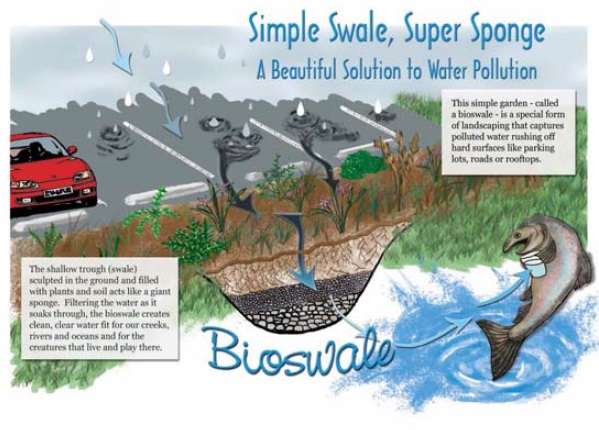
Bioswales are landscape elements designed to filter silt and pollution from surface runoff water.

The primary elements of the proposed design include:

  • Parking Lot – The existing asphalt surface will be removed and replaced. The removed asphalt will be milled and reused or recycled. In addition, approximately 15,000 square feet of asphalt will be removed from an adjacent service road entrance and replaced with grass.
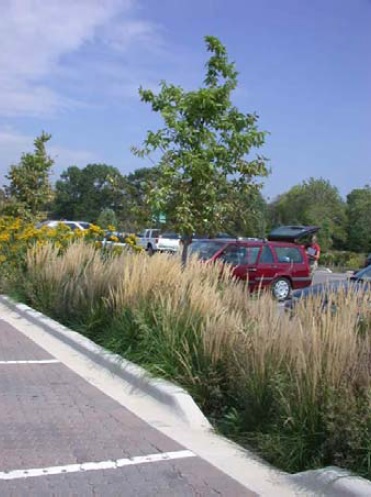
  •  Storm water treatment – The proposed plan includes the construction of new bioswales throughout the lot which will consist of a combination of soil, cobbles and native vegetation. Storm water drainage will flow into these areas before entering into the existing storm water drainage system. These bioswales will allow for biological filtration and treatment, breaking down many of the nutrients and pollutants found in typical storm water runoff. Native trees, shrubs, and ornamental grass species will be planted to reduce the lot’s heat island effect, improve aesthetics, and provide shade and wind breaks. Below is a photo of a typical bioswale that is similar to what will be installed.

green parking 1