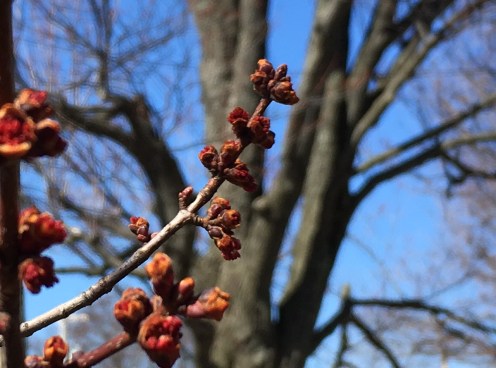
Spring is here and the tree buds are starting to pop. Red maple (Acer rubrum) is among the first to flower, revealing little tassles of red and orange. The leaves will emerge a bit later.
Silver maple (Acer saccharinum) is another early bloomer. Perhaps this tree was named after its silvery flowers.
Beech trees are late comers — the long skinny buds and last year’s leaves are still holding tight. They are easy to spot in the woods before everything greens up.
American beech (Fagus grandifolia) bud and leaves.
Remember all that snow and how heavy it was? If you find trees arching over a trail or at odd angles in the woods, that may be a sign that it survived a heavy load of snow like these hemlocks. Trees are amazingly resilient and strong.
Hemlock (Tsuga canadensis) branches bent down by the weight of the snow.
Before long the trees will be greening up and a new season of growth, with the sounds of birds, insects, and wildlife, will return. Take a walk through the woods. Look how small we are compared to the trees!
Immersed in the woods on a trail at Bennington Battlefield State Historic Site.
Do you feel inspired, in awe, empowered or claustrophobic under a canopy of trees? More than 80% of NY State Parks and Historic Sites are covered in forest, so you can find spots like this in a park near you.
Tree canopy at Clay Pit Ponds State Park Preserve, Staten Island.
Perhaps you prefer viewing the trees from a distance or sitting under a favorite tree. NYS Historic Sites are great places for this: Crown Point on Lake Champlain (below), Olana on the Hudson, Sackets Harbor on Lake Ontario, Lorenzo in Cazenovia, or Hyde Hall at Glimmerglass are a few spots to enjoy big trees.
Crown Point State Historic Site offers scenic vistas and some beautiful trees.
Take a little time this Arbor Day to appreciate our tall tree friends and spring into action with some walks in the woods or a stroll along a tree-lined path.
Post and photos by Julie Lundgren, State Parks Ecologist, NY Natural Heritage Program, NYNHP. NYNHP works in partnership with State Parks to survey and map rare species and natural communities in the parks to aid in stewardship of their natural resources.
Fall is an especially good time to find all kinds of nuts on the forest floor, in a picnic area in the park, or maybe even in your neighborhood or back yard. Let’s take a look and learn how to identify some of these wild nuts.
In technical botanical terms, all of these “nuts” are called the “fruit”. The fruit is defined as the seed and the package which holds the seed. So, for example, the acorn is the “fruit” of an oak tree, and inside is the nut which is a type of seed. If you use plant keys you will see those terms, but for general use, it is ok to call them all nuts!
Acorns are some of the most common types of nuts. Do you know what tree they come from? Acorns come from oak trees. Oaks are found far and wide across New York State and the United States so you should be able to find oak trees and acorns in a park near you. Acorns come in different shapes and sizes, depending on the type of oak they are from. They are a favorite food of squirrels, turkeys, deer, and other animals.
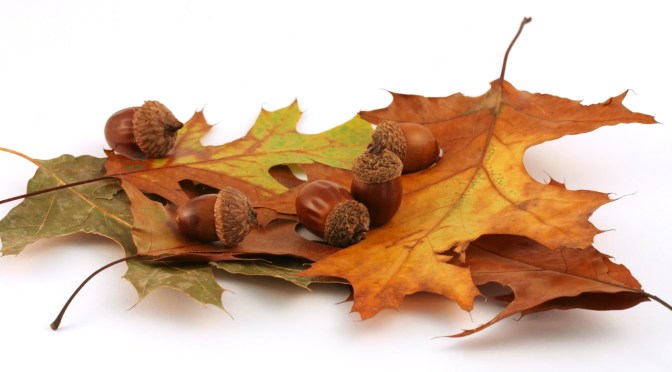
Red oak acorn, photo by Julie Lundgren, NYNHP
Red oak acorns are big (over 1 inch long) and roundish like a fat egg. They have very flat caps that cover only a small part of the acorn. The northern red oak (Quercus rubra) is the most common oak species in NY and its state parks.
Scarlet oak acorn, photo by Julie Lundgren, NYNHP
Scarlet oak (Quercus coccinea) acorns are less than 1 inch long and have shiny caps with tight scales. Scarlet oaks are common in Eastern NY, usually found on sandy or rocky soils. If you look closely at this picture, you can see a small round hole in the acorn: a sign that it was eaten by some type of insect.
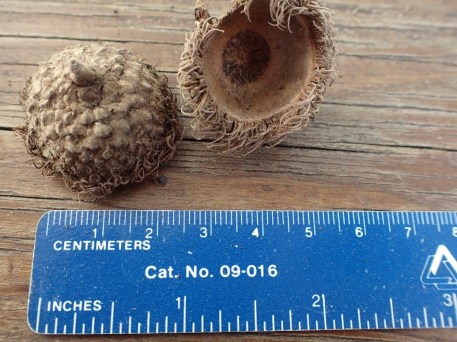
Bur oak acorn, photo by Julie Lundgren, NYNHP
The large size and heavy fringe of this acorn cap tell us that these are from bur oak (Quercus macrocarpa), one of our less common oak species in NY. Sometimes you will only the acorns caps, as the nuts have been carried away by squirrels.
Walnuts
What nut looks like a green tennis ball? That would be the black walnut (Juglans nigra), from the tree of the same name. They have a really strong smell and can stain your clothes, so handle with care. Over time they turn brown and dry out. Black walnuts can be eaten but it takes a lot of work to dry and husk them. They also make a beautiful natural dye.
Fresh black walnuts can get almost as big as a tennis ball. As they age and dry out, they get smaller like the one in the center. photo by Julie Lundgren, NYNHP
The butternut tree (Juglans cinerea) is a closely related to black walnut and has very similar nuts. They start out bright green like the black walnut, but are shaped more like footballs rather than the tennis balls shape of black walnuts.
Butternuts, photo by Julie Lundgren, NYNHP
By early fall, the butternuts nuts have dried up and lost their fuzzy husk and they look very much like the English walnuts you buy in the store. This butternut was found empty. Both black walnuts and butternuts are edible but it can be tough to find one that hasn’t already been snacked on by a squirrel!
Butternuts in mid-fall, photo by Julie Lundgren, NYNHP
Hickory
Hickories are another very important tree for wildlife including turkey, deer, chipmunk, squirrel, mice and others. Of the 20 hickory species found in North America, five species are native to New York State. A good key to identifying these is found here.
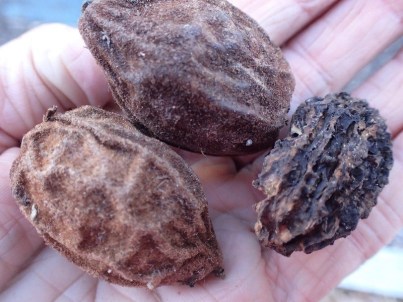
Hickory nuts can have thin or thick-walled husks like the two types shown here, photo by Julie Lundgren, NYNHP.Pig nut, photo by Julie Lundgren, NYNHP.
Pignut (Carya glabra), Mockernut (Carya tomentosa) and Bitternut (Carya cordiformis) hickory have thin husks like this. There are two types of nuts: ones that keep their husk on as they mature or ripen (“indehiscent”) and those with husks that split completely and fall off the nut by the end of fall (“dehiscent”). One has to look at the leaves and/or buds to properly identify these species. As its name suggests, Bitternut is one that is not palatable to either wildlife or people.
Shellback Hickory nut, photo by Julie Lundgren, NYNHP.
Wow – what nuts are these? These are the thick husks of the Shellbark hickory (Carya laciniosa), a tree that is rare in NY. The husks range from 1.5 inches to nearly 3 inches long, and the nuts inside would be pointed at both ends. That’s one tough nut to crack! These husks were empty, but you can see how the cavity tapers to a point at each end. The more common Shagbark hickory (Carya ovata) is very similar, but the nuts are rounded at the base and the husks do not exceed 2 inches long. Nuts from both of these trees are sweet and edible.
American Chestnut
American chestnut, photo by Julie Lundgren, NYNHP.
If you find one of these, consider yourself very lucky! This is the fruit and nut of the American chestnut tree (Castanea dentata). Although a blight killed off the large trees, some sprouts persisted and some trees do get large enough to produce nuts like this. These spikes are so sharp you can’t even pick them up with your bare hands, which keeps animals from eating the nut inside. Eventually the husks open up to release the nut in hopes that a new tree will grow.
Quiz Time – What Nuts are These?
Shell pile at the base of a tree, photo by Julie Lundgren, NYNHP.
It’s easy to overlook them, but look around the base of the trees and sometimes you will find piles of nuts – empty or maybe whole. All kinds of nuts are a very important food source for wildlife. The ones shown above (mixed in with the leaves) are mostly the empty shells or husks of hickory nuts that were eaten by animals.
Can you find the following nuts: black walnut, a half-eaten butternut, 2 kinds of hickory nuts, and caps from some acorns? Photo by Julie Lundgren, NYNHP.
Learn More
Want to learn more about nuts and tree fruits of all kinds? Below are some good books and websites to get you started.
“Fruit Key and Twig Key to Trees and Shrubs” by William Harlow, photo by Julie Lundgren.
GoBotany – an online tool for identifying plants in New England but includes most tree species found in NY state too.
What is it about trees that can make you stop and look?
Is it the sunlight on the trunks of yellow birch that catches your eye – the bark silvery-gold and curling? Or the smooth gray bark of beech – easy to look for scars from bear claws on this canvas. Or perhaps it is the rough platy bark of a shagbark hickory that intrigues you. No matter what catches you about a particular tree, your gaze inevitably follows the trunk up it’s base, and continues upward into the canopy where the branches are silhouetted against the sky. The beautiful spectacle prompts many questions: How old is it? What has it been through? Are there any animals up there?
An old-growth hemlock (Tsuga canadensis) in Allegany State Park
Yellow birch (Betula alleghaniensis) in Grafton Lakes State Park
Of course, trees with showy flowers – like magnolia, cherry, or crabapple – always grab our attention. But all our broadleaf trees also have flowers, so look a little closer for those that are not so conspicuous. Among the first to flower in the spring are the maples, a hint of color in the treetops. Look for red tassels on red maple (Acer rubrum) or silver maple (Acer saccharinum) or green on sugar maple (Acer saccharum). Norway maple (Acer platanoides) has larger yellow-green flowers. Take a closer look at these little bouquets; you can usually find clusters that have fallen to the ground.
Red maple (Acer rubrum) flowers. Photo by Donald Cameron 2017, GoBotany, used with permission.
A nice tree to look for in the spring is serviceberry, also known as shadbush (Amelanchiercanadensis and A. arborea). Its delicate white flowers show up long before the other trees leaf out, so you can spot these trees more easily in spring than in the summer. There are also several shrub species of Amelanchier in NY State, all with similar flowers.
Canadian serviceberry (Amelanchier canadensis) at Hither Hills State Park. Photo by NYNHP.
Serviceberry (Amelanchier arborea and A. canadensis) is common in woodlands in parks across the state, blooming in April to May before the other trees have leafed out..
And later in the season, in May-June, look for the straight-as-a-pole tulip poplar (Liriodendron tulipifera) whose flowers look like yellow-green tulips!
A towering tulip poplar (Liriodendron tulipifera) at Hamlin Beach State Park – a small park with spectacular trees.
Trees become a busy place in the spring too. Bees and other insects feed on the nectar and pollen of the flowers above. Woodpeckers search for insects under the bark and many animals hide out or make their home in tree cavities – bats, owls and other birds, raccoons, squirrels, and porcupines. Bears climb trees for safety and sometimes curl up in the base of big hollow trees. With all that activity, trees are a good place for wildlife watching, whether in your neighborhood or in a state park or historic site.
Binoculars are good for watching wildlife and also for getting a better look at the trees. This volunteer was making a list of birds at Minnewaska State Park Preserve on I Love My Park Day.
NY State Parks are home to countless beautiful trees. Look for many mature and outstanding trees around the mansions and other historic sites, at campgrounds and picnic areas, and in the forests that cover nearly 80% of State Park lands. Get out and enjoy the trees on Arbor Day – and every day – in your neighborhood and favorite parks.
The Pileated woodpecker is our largest woodpecker, photo by Lilly Schelling, State Parks
They makes these square or rectangular holes in trees., photo by Jubilee Feist.
Post by Julie Lundgren, NY Natural Heritage Program. Photos by NYNHP or other as noted; for use by permission only.
Evergreen means these trees keep their “leaves” throughout the winter. Though we may call them pine needles, they are actually very skinny leaves that serve the same function as the leaves on a deciduous tree. Identifying evergreens during the winter months is almost the same as in spring and summer, with the added advantage of having mature pine cones. Growth pattern, bark, cones, needle shape and number are used to identify the different species. Let’s learn how you can identify red pine, white pine, and eastern hemlock.
Last time we learned that leaves attached at the stem from the node. This is the same for evergreen trees, except these trees can have multiple needles attached to the stem in a bundle or sheath. This helps identify species since they differ by the number of needles they have per bundle.
See the example below:
This red pine has two needles per bundle.
Now we are ready to learn some tree species!
We will start with white pine. First let’s look at the bark and growth pattern:
WHITE PINE
White pine usually grows straight and tall with horizontal, upturned branches. The tree has a uniformly full foliage appearance. The bark is a light gray in color with shallow ridges. White pines can be found in well drained soils and are native throughout the state.
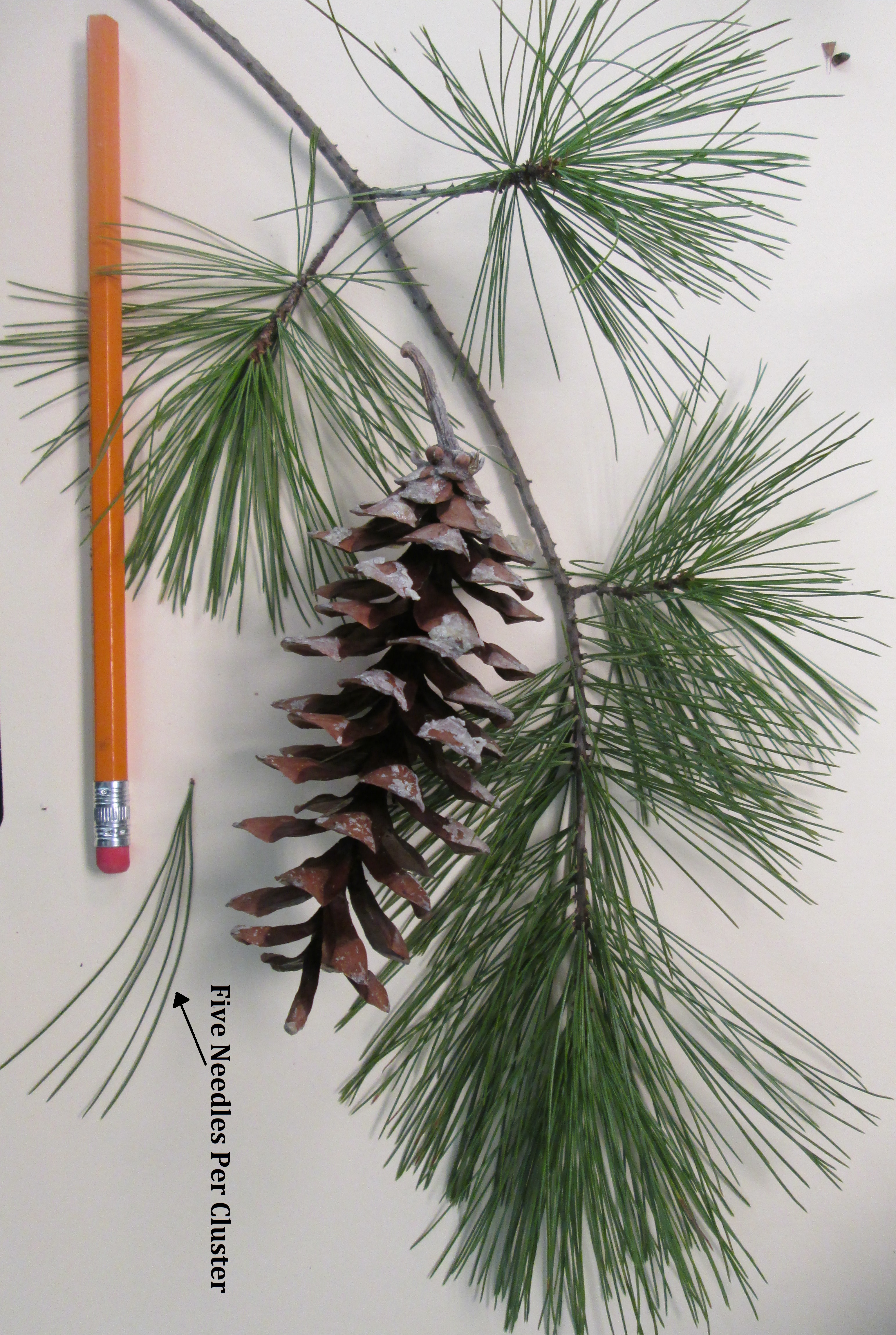
Now we will look at the characteristics of the twig and cone. There is a pencil in each picture for size reference:
White pine has 5 needles per bundle. The needles and stem are flexible and slender. The cone is long and narrow and about 3 to 8 inches in length. Needles are light green in color.
RED PINE
Red pine is a tall, straight growing tree with horizontal or dropping branches. The foliage looks clumpy, instead of uniformly full like white pine. The bark can have a reddish coloring and is flaky/ scaly. This tree grows in well drained areas; such as rocky or sandy habitat. Red pines are native to a small area of the state, but are often planted around reservoirs or in parks.
Red pine has two long needles per bundle. The needles and stem are thick, unlike white pine. The needles are dark green and stiff – they break in half easily. The cone is short and round; usually about 1.5 to 3 inches in length.
EASTERN HEMLOCK
Eastern hemlock has a tall straight growth pattern. The branches grow horizontally. The foliage is more of a yellowish green in color compared to white pine. In this picture there are white pine trees in the left background for comparison. The bark is scaly when young, becoming ridged with age. The trunk is reddish-brown in color. These trees grow in shady-moist habitat, often along streams, on slopes or at higher elevations. Eastern Hemlocks are native to NY.
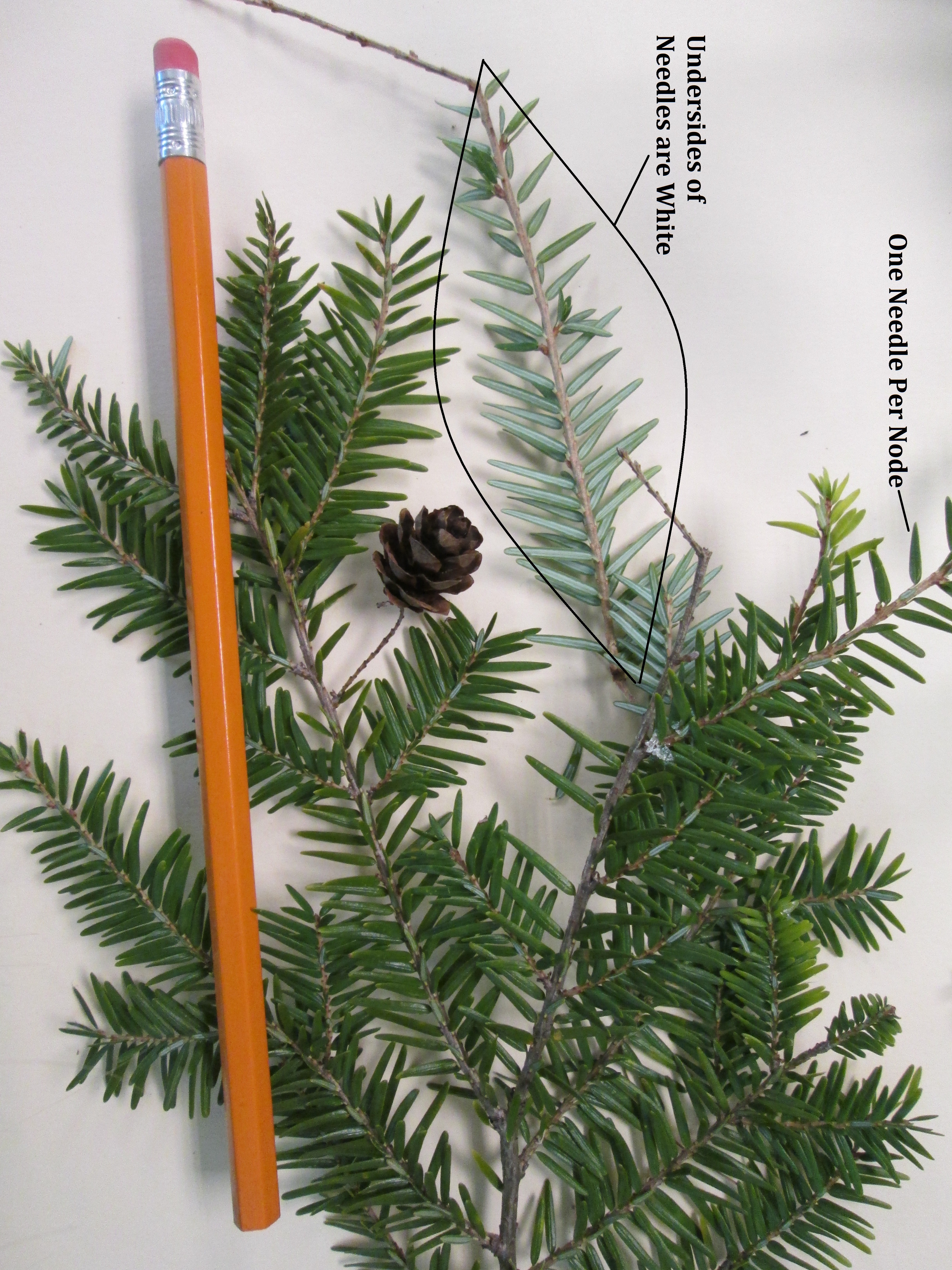
Hemlock does not have bundles of needles, just one short needle per node. The needles are yellow-green in color and are soft and flexible. The underside of the needle is whitish. The cone is small and round, under an inch in length. The twig is thin and flexible.
In the summer you can recognize the different kinds of trees from the shape and size of their leaves. When trees drop their leaves in the winter months you can use different characteristics such as bud shape, leaf arrangement, bark, and overall growth pattern to identify tree species. As an example, let’s learn how you can identify Red Maple, Green Ash, and Black Walnut. First let’s learn some basic terms!
We will start with leaf or bud arrangement on the stem which will be either “alternate” or “opposite”. The buds are where next year’s leaves will emerge from and the nodes are where the leaf or bud attaches to the stem.
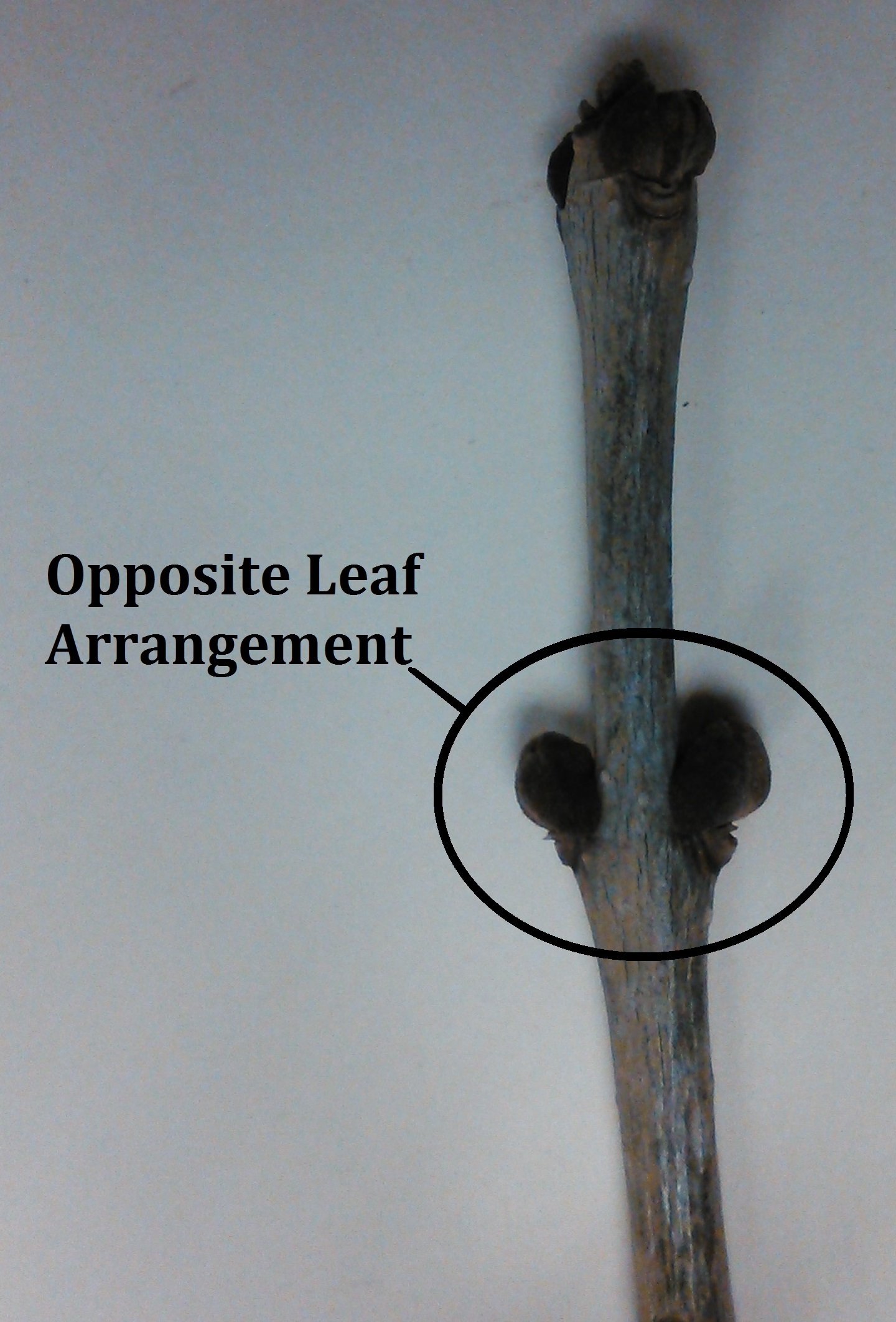
Alternate leaf arrangement is when there is one leaf per node.Opposite leaf arrangement is when there are leaves per node (across from one another).
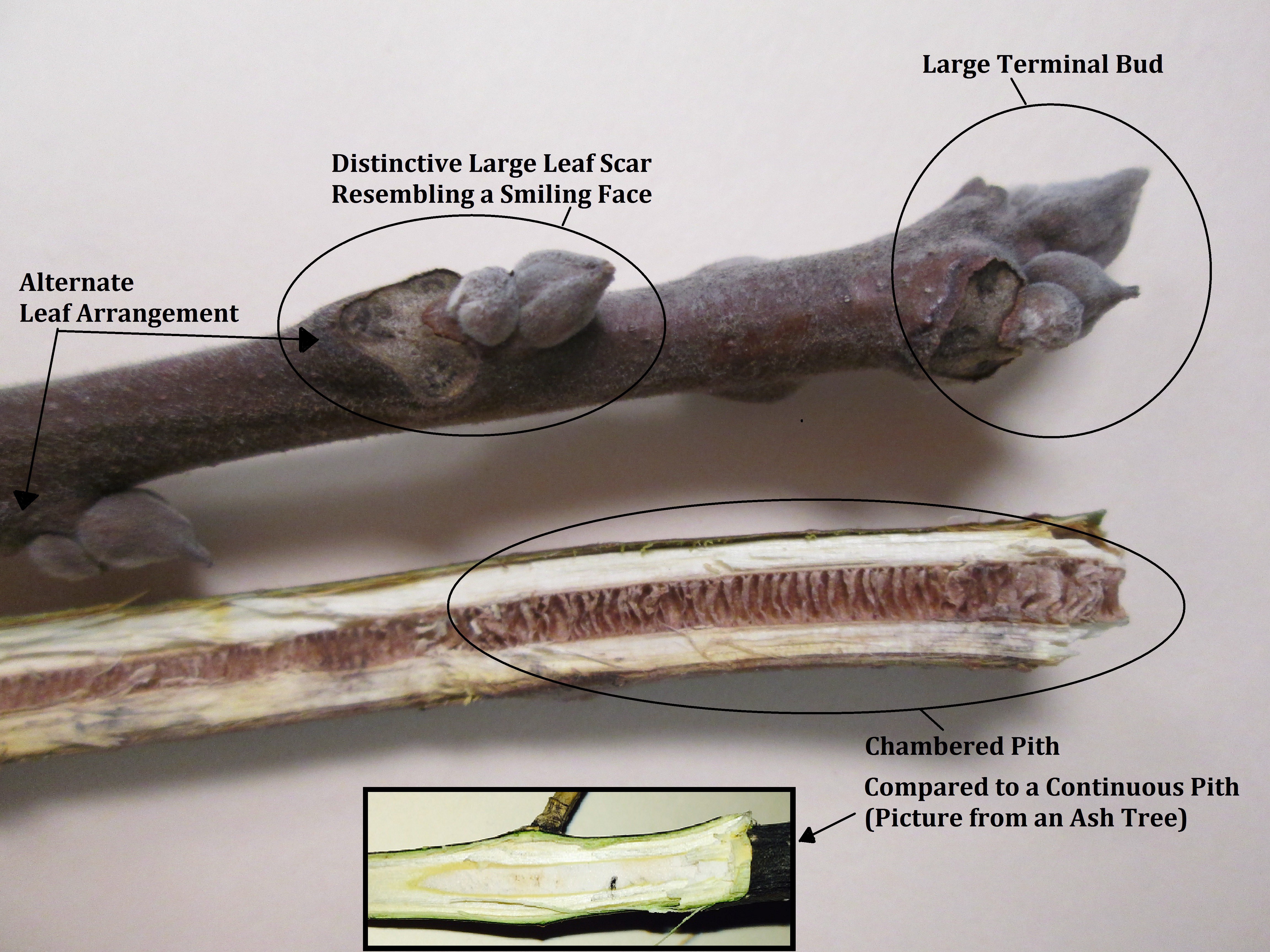
The leaf scar is another important characteristic to look at. This is where the leaf fell off the stem during autumn. Some trees, like the Black Walnut, have very distinctive leaf scars. Their leaf scar resembles a fuzzy smiley face!
Now we area ready to learn some tree species!
GREEN ASH
We will start with Green Ash. First let’s look at the bark and growth pattern:
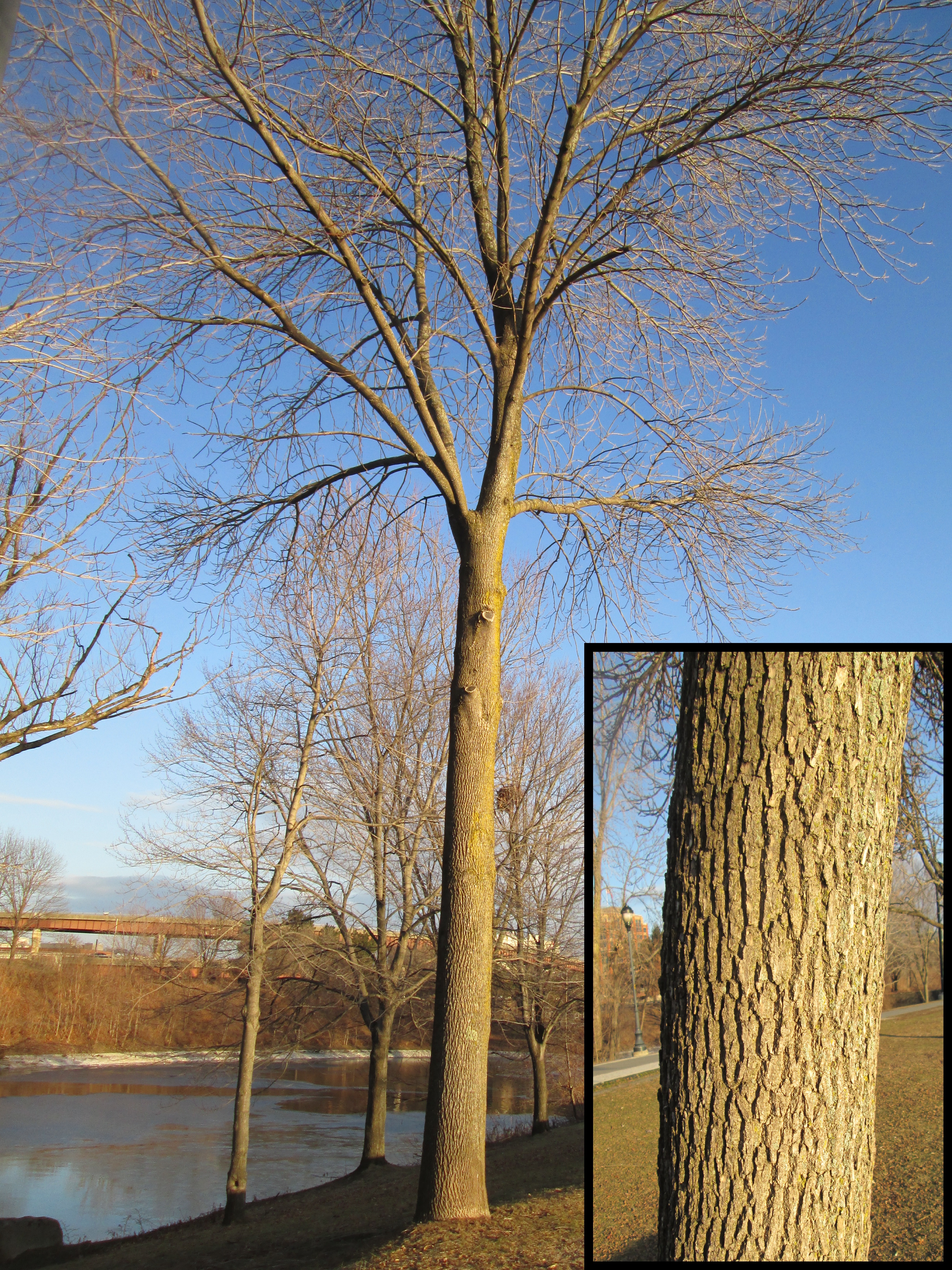
Green ash is typically very straight with a single trunk. The branches usually grow from the top of the tree, not from the sides. The bark is greyish in color with thin furrowed ridges forming an intersecting diamond pattern. Green ash is found growing in lowland areas.
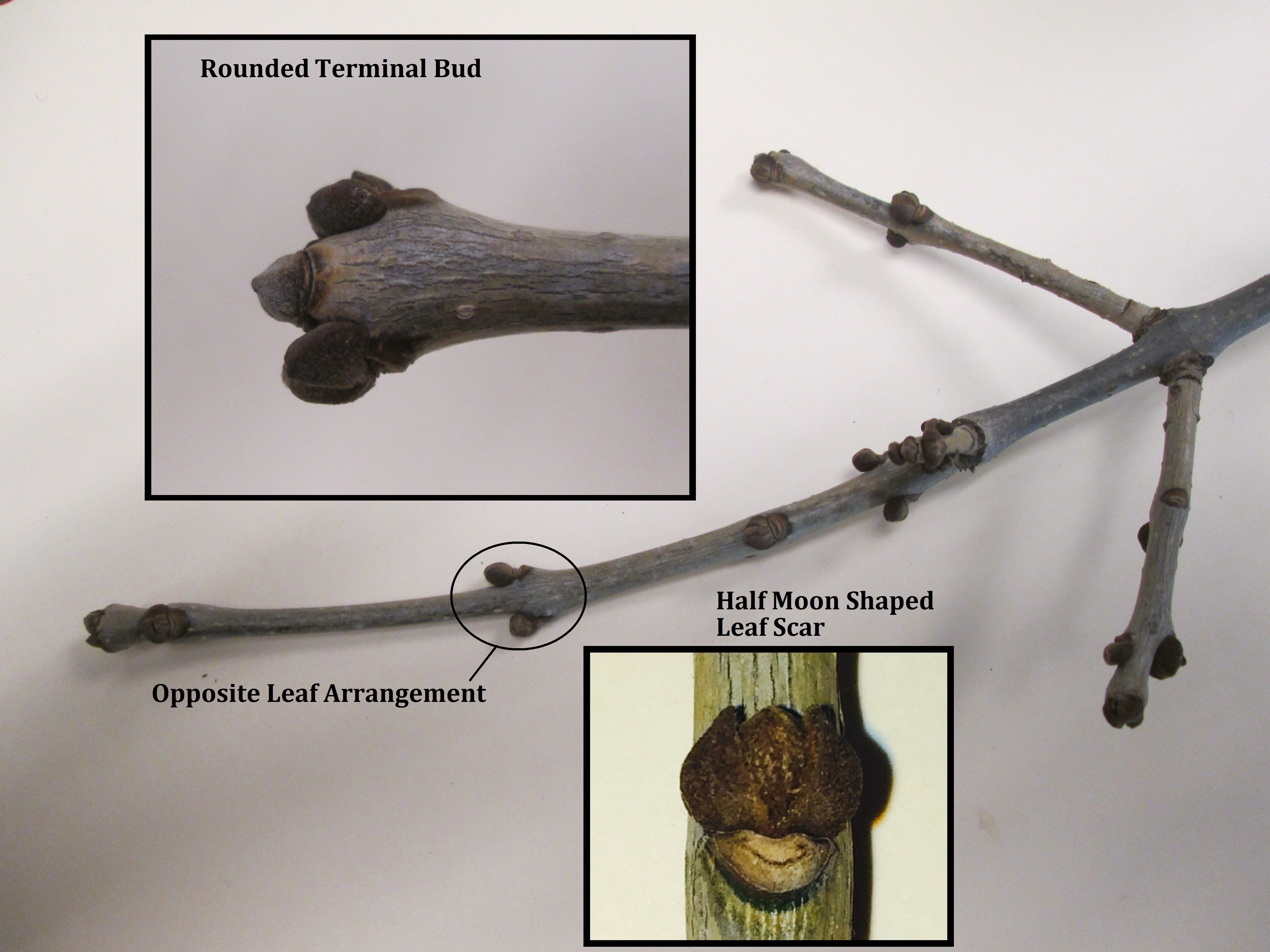
Now we will look at the characteristics of the twig: Notice how the leaf buds are rounded and in an opposite arrangement at the leaf node. The leaf scar is shaped like a half moon or an upside-down “D”. The stem is grey in color and the buds are a dark greyish-brown. There is one bud at the apex, or tip of the stem. White ash is very similar, but the leaf scar has a v-shaped notch on the top and the twigs tend to be gray-green.
RED MAPLE
Red maples vary in growth pattern. They may grow with a straight trunk or multi branched; like the tree in this picture. Bark is greyish-brown with a thin flaky appearance. Younger trees look smooth, the “plating” or flaky appearance, increases with age. Red maples often grow in swamps but are common in uplands too.
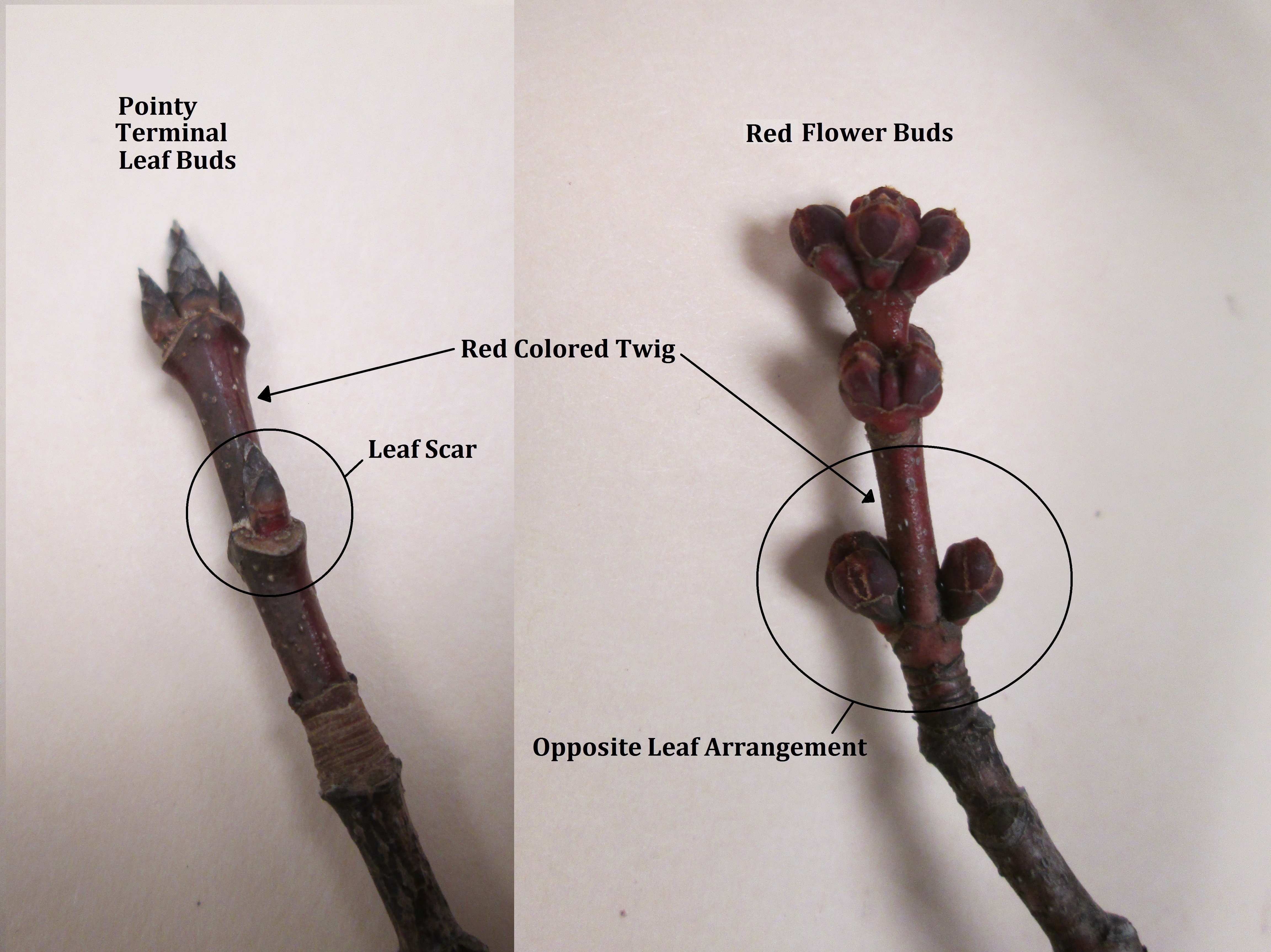
Red maples have opposite leaf arrangement. Flower buds usually form high up in the canopy and not on lower branches. Once the flowers have bloomed, leaves will replace them on the same node. The leaf and flower buds are reddish in color, as is the stem itself. The leaf buds are pointed and there is one terminal leaf bud.
BLACK WALNUT
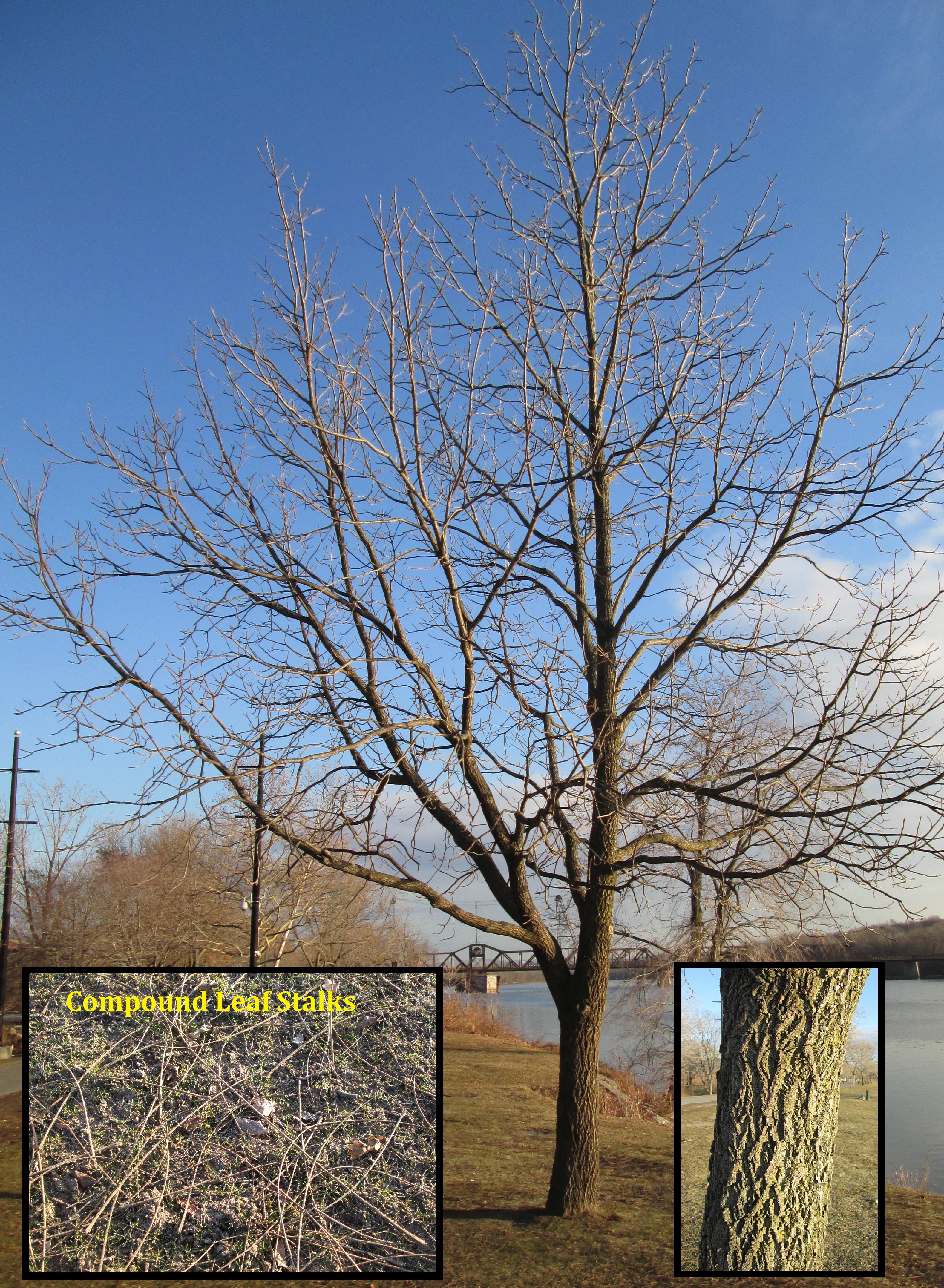
Black walnut trees have a wide branching growth pattern. The bark is dark brown, becoming darker with age. The bark has deeper furrowed ridges than ash, with looser intersecting ridges. Also evident is the dropped compound leaf stalks* underneath the tree. Black walnut trees are found growing in well drained, lowland areas.
*A compound leaf (such as on ash and walnut) has multiple leaflets on the leaf stalk. See below.
Black walnuts have alternate leaf arrangement with a large terminal bud. The buds are fuzzy and light gray in color. The leaf scar is large compared to the bud. The pith (spongy tissue in the center of the stem) is distinctly chambered. This can be seen by carefully taking a sharp blade and cutting the stem in half, as shown in the image below.











![By Dcrjsr (Own work) [CC BY 3.0 (http://creativecommons.org/licenses/by/3.0)], via Wikimedia Commons](https://i0.wp.com/nystateparks.blog/wp-content/uploads/2017/04/tulip-tree-flower_dcrjsr.jpg?w=266&h=266&crop=1&ssl=1 "Tulip Tree Flower_Dcrjsr")










 New York State Parks and Historic Sites Blog